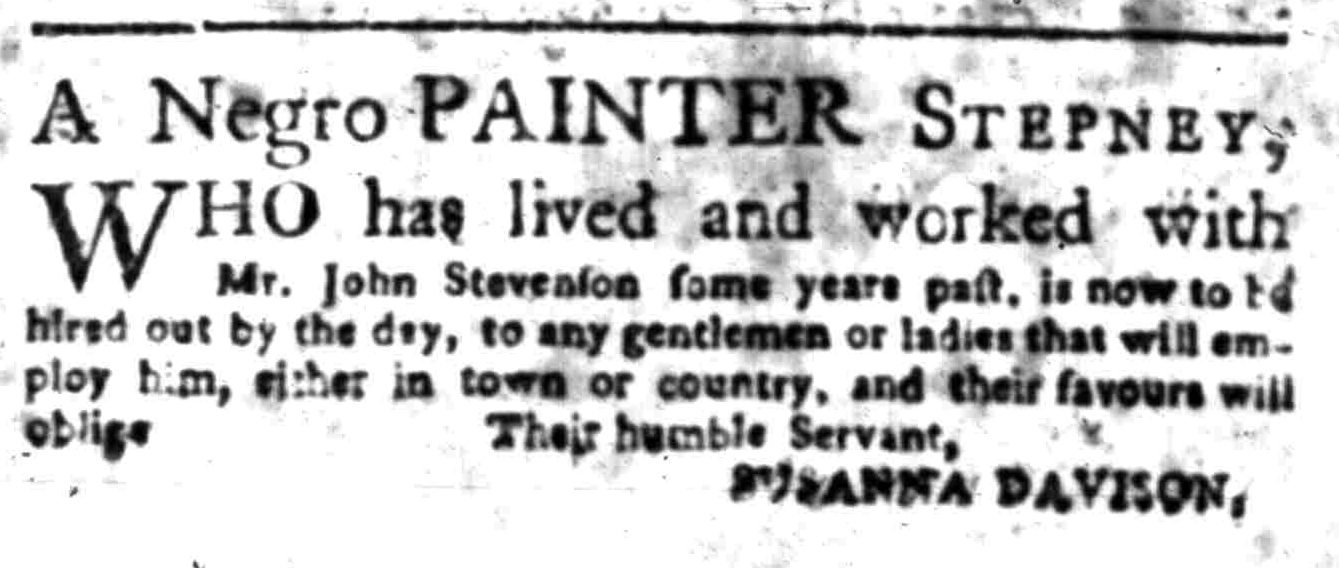
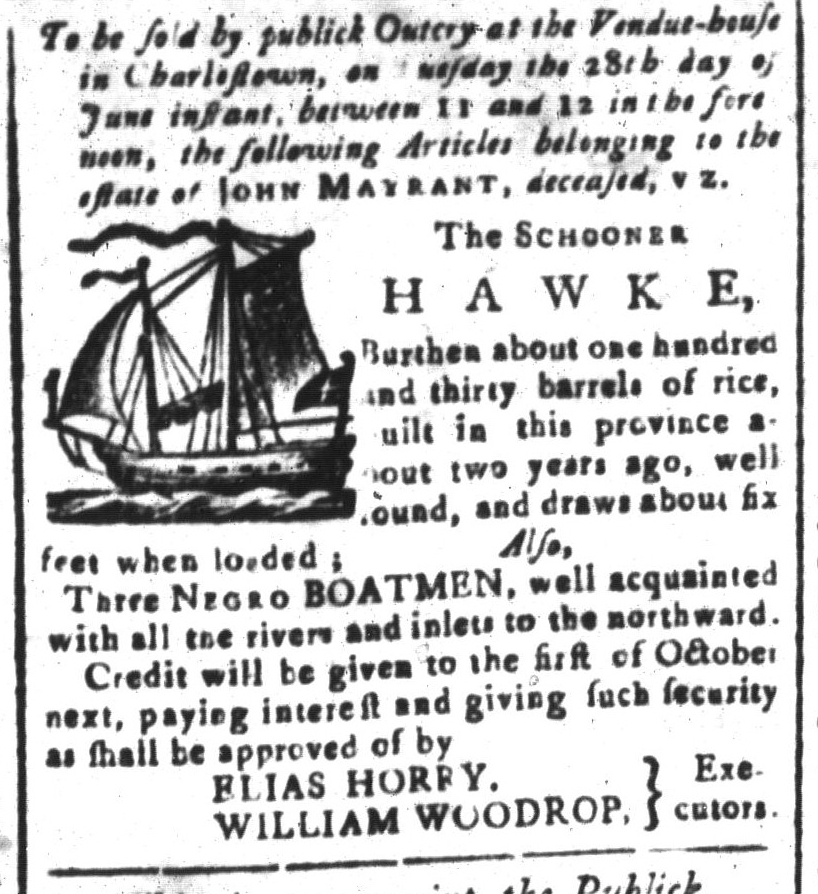
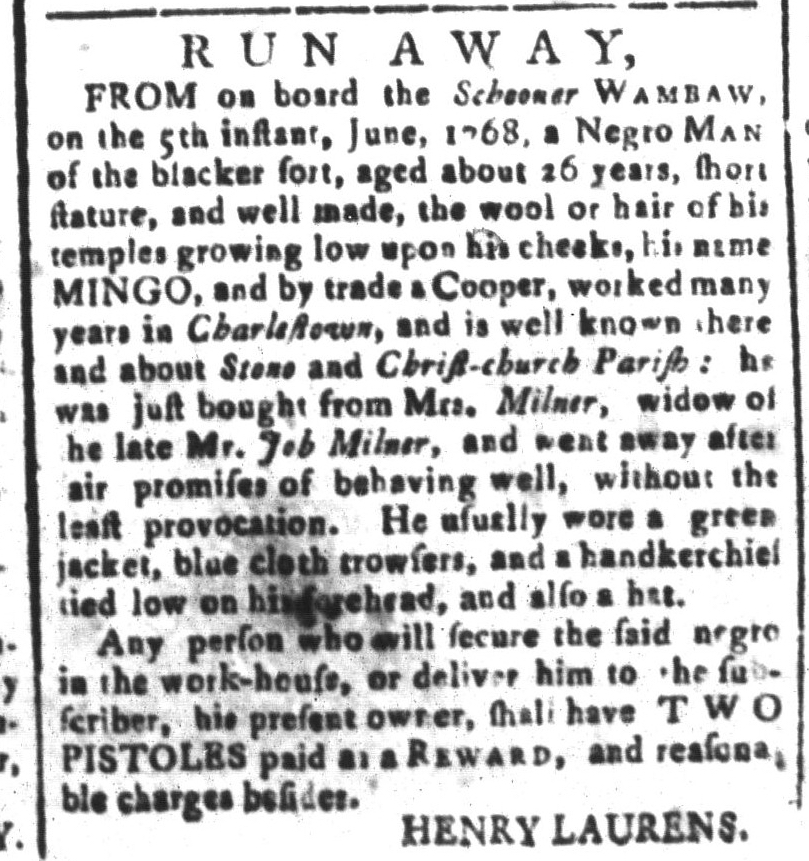
The Slavery Adverts 250 Project chronicles the role of newspaper advertising in perpetuating slavery in the era of the American Revolution. The project seeks to reveal the ubiquity of slavery in eighteenth-century life from New England to Georgia by republishing advertisements for slaves – for sale, wanted to purchase, runaways, captured fugitives – in daily digests on this site as well as in real time via the @SlaveAdverts250 Twitter feed, utilizing twenty-first-century media to stand in for the print media of the eighteenth century.
The project aims to provide modern audiences with a sense of just how often colonists encountered these advertisements in their daily lives. Enslaved men, women, and children appeared in print somewhere in the colonies almost every single day. Those advertisements served as a constant backdrop for social, cultural, economic, and political life in colonial and revolutionary America. Colonists who did not own slaves were still confronted with slavery as well as invited to maintain the system by purchasing slaves or assisting in the capture of runaways. The frequency of these newspaper advertisements suggests just how embedded slavery was in colonial and revolutionary American culture in everyday interactions beyond the printed page.
These advertisements also testify to the experiences of enslaved men, women, and children, though readers must consider that those experiences have been remediated through descriptions offered by slaveholders rather than the slaves themselves. Often unnamed in the advertisements, enslaved men, women, and children were not invisible or unimportant in early America.
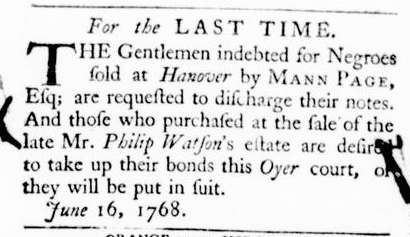
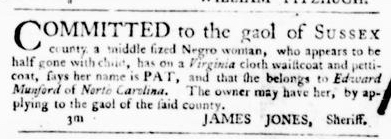
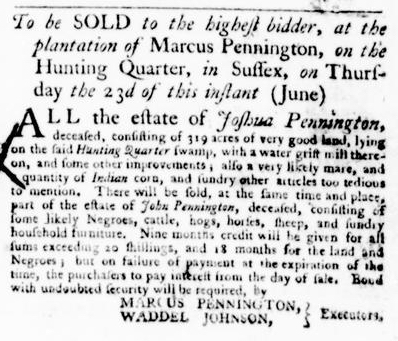
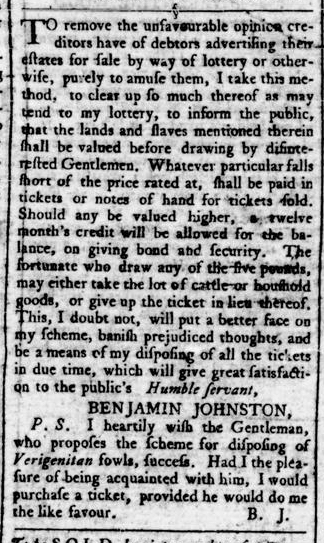
These advertisements appeared in colonial American newspapers 250 years ago today.
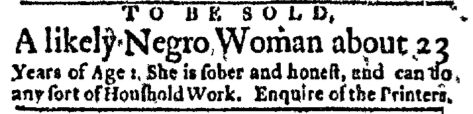
Boston Evening-Post (June 20, 1768).
**********
Supplement to the Boston Evening-Post (June 20, 1768).
**********
Boston Post-Boy (June 20, 1768).
**********
Boston Post-Boy (June 20, 1768).
**********
Boston Post-Boy (June 20, 1768).
**********
Boston-Gazette (June 20, 1768).
**********
New-York Gazette and Weekly Mercury (June 20, 1768).
**********
New-York Gazette and Weekly Mercury (June 20, 1768).
**********
New-York Gazette and Weekly Mercury (June 20, 1768).
**********
New-York Gazette and Weekly Mercury (June 20, 1768).
**********
New-York Gazette and Weekly Mercury (June 20, 1768).
**********
New-York Gazette and Weekly Mercury (June 20, 1768).
**********
Supplement to the New-York Gazette and Weekly Mercury (June 20, 1768).
**********
Supplement to the New-York Gazette and Weekly Mercury (June 20, 1768).
**********
Supplement to the New-York Gazette and Weekly Mercury (June 20, 1768).
**********
Supplement to the New-York Gazette and Weekly Mercury (June 20, 1768).
**********
New-York Gazette: Or, the Weekly Post-Boy (June 20, 1768).
What was advertised in a colonial American newspaper 250 years ago this week?
Boston Weekly News-Letter (June 16, 1768).
“A great Variety of Callicoes.”
Even though he advertised many of the same goods as other merchants and shopkeepers who placed notices in Boston’s newspapers in June 1768, Samuel Fletcher attempted to attract attention to his wares via the visual design of his advertisement in the Boston Weekly News-Letter. Eighteenth-century advertisers often listed an assortment of goods that comprised their inventory, informing potential customers of a vast array of choices to suit their tastes and budgets. Most merchants and shopkeepers who published such advertisements simply listed their merchandise in dense paragraphs. Others experimented, perhaps with the encouragement of printers and compositors who better understood the possibilities, with arranging their goods in columns, listing only one or two items per line, in order to make the entire advertisement easier for readers to peruse.
Usually list-style advertisements broken into columns featured only two columns, but Fletcher’s advertisement in the June 16, 1768, edition of the Boston Weekly News-Letter had three, distinguishing it from others that appeared in the same publication that week. (Fletcher’s advertisement was the only one divided into columns in the Boston Weekly News-Letter, but two others in Richard Draper’s Massachusetts Gazette used columns to organize “A great Variety of English and India Goods.” For the purposes of this examination of these advertisements, I have classified Draper’s Massachusetts Gazette and the Boston Weekly News-Letter as only one publication because they were printed on a single broadsheet folded in half to create four pages, two of which comprised Draper’s Massachusetts Gazette and the other two the Boston Weekly News-Letter. Whether the boundaries between the two were permeable when it came to inserting advertisements requires further investigation, but Draper printed both and the same compositors presumably set type for both.) Caleb Blanchard and Samuel Eliot inserted lengthy advertisements that extensively listed scores of items, each advertisement divided down the middle to create two columns. Other newspapers published in Boston in the late 1760s often included advertisements that used this format, making it familiar to readers in the city and its hinterlands. Very rarely, however, did advertisements feature three columns.
As a result, the visual aspects of Fletcher’s advertisement made it stand out from others, even if nothing else about the list of goods distinguished it from the notices placed by his competitors. Fletcher made a brief appeal to price, noting that he “Sells cheap for Cash,” but primarily relied on the graphic design of his advertisement to direct readers to his advertisement as part of his effort to convince potential customers to visit his shop “Near the Draw-Bridge, BOSTON.”
What was advertised in a colonial American newspaper 250 years ago today?
Providence Gazette (June 18, 1768).
“Lessening the unnecessary Importation of such Articles as may be fabricated among ourselves.”
Edward Spalding (sometimes Spauldin), a clockmaker, placed advertisements in the Providence Gazette fairly frequently in the late 1760s. In fact, he ran a notice for four weeks in August 1766 when the newspaper resumed publication after the repeal of the Stamp Act and the printer resolved other concerns related to the business. He had also inserted a notice in one of the few “extraordinary” issues that appeared while the Stamp Act was still in effect.
Although Spalding sometimes recycled material from one advertisement to the next, at other times he submitted completely new copy that addressed current political and commercial issues, attempting to leverage them to the benefit of his business. In June 1768, for instance, he linked the clocks and watches made and sold in his shop with efforts to achieve greater self-sufficiency throughout the colonies as a means of resisting the Townshend Act and other abuses by Parliament. To that end, he opened his advertisement by announcing two recent additions to his workshop. First, he had “just supplied himself with a compleat Sett of Tools.” He also “engaged a Master Workman” to contribute both skill and labor. As a result, Spalding advised potential customers that he was particularly prepared “to carry on his Business in a very extensive Manner.”
Artisans often invoked that standardized phrase when making appeals about their skill and the quality of the items produced in their workshop, but Spalding did not conclude his pitch to potential patrons there. Instead, he mobilized that common appeal by explaining to prospective customers that since he produced clocks and watches of such high quality – in part thanks to the new tools and “Master Workman” – that they did not need to purchase alternatives made in Britain only because they assumed imported clocks and watches were superior in construction. Spalding took on the expenses of new tools and a new workman in his shop “to contribute his Mite towards lessening the unnecessary Importation of such Articles as may be fabricated among ourselves.” That appeal certainly resonated with ongoing conversation about domestic production that appeared elsewhere in colonial newspapers in 1768.
Ultimately, Spalding placed the responsibility on consumers: “To this Undertaking he flatters himself the Public will afford all die Encouragement.” It did not matter if leaders advocated in favor of “local manufactures” and artisans heeded the call if colonists did not choose to purchase those products. Spalding wished to earn a living; the imperial crisis presented a new opportunity for convincing customers that they had not a choice but instead an obligation to support his business.
What was advertised in a colonial American newspaper 250 years ago today?
New-Hampshire Gazette (June 17, 1768).
“A new Shop … near Swing or Liberty Bridge.”
When Zechariah Beal, a cobbler, set up shop in a new location he placed an advertisement in the New-Hampshire Gazette to inform “his Customers and others, that he has Removed from Queen Street, to a new Shop, almost adjoining to that of Mr. John Noble’s Barber, near Swing or Liberty Bridge, not far from the Long-Wharfe in Portsmouth.” Beal advertised in an era before American cities and towns adopted standardized street numbers, though some of the largest American cities would do so in the final decade of the eighteenth century.
In the absence of street numbers, Beal and other colonists relied on a variety of landmarks to establish locations and give directions. Sometimes these instructions were short, simply referencing the name of the street. In other cases, they were quite lengthy (and even rather convoluted from the perspective of modern readers accustomed to precise street numbers designating the locations of homes and businesses), as was the case when Beal listed his new location in his advertisement.
Among the landmarks he invoked, Beal noted that his new shop was “near Swing or Liberty Bridge.” This description reveals that colonists in Portsmouth were in the midst of reconceptualizing the meaning they attributed to a local landmark. On January 6, 1766, the Sons of Liberty had paraded an effigy of George Grenville around Portsmouth in protest of the Stamp Act. They burned the effigy of the prime minister and, like several other cities and towns in the colonies, erected a liberty pole that flew a flag that read “LIBERTY, PROPERTY, and NO STAMPS,” according to an account that appeared in the January 20, 1766, edition of the Boston Evening-Post. That same account reported that the pole and flag were “now fixed near LIBERTY-BRIDGE.”
Some advertisers in Portsmouth quickly adopted the name, indicating that they and other colonists continued to commemorate the protest by associating new significance with the Swing Bridge that predated the protest. Yet this process was not universal among those who resided in the area. The bridge now had two names, “Swing or Liberty Bridge,” among the inhabitants of Portsmouth. An older way of describing the urban landscape did not disappear just because some colonists now preferred a new designation for one landmark. Even those who supported protests against the Stamp Act and, more recently in the summer of 1768, the Townshend Act likely discovered that they sometimes had to consciously correct themselves when it came to associating names with political significance with landmarks previously known as something else. In Portsmouth, that meant that one landmark simultaneously had two names, “Swing or Liberty Bridge,” as colonists collectively reconceptualized their descriptions of their environs.
The Slavery Adverts 250 Project chronicles the role of newspaper advertising in perpetuating slavery in the era of the American Revolution. The project seeks to reveal the ubiquity of slavery in eighteenth-century life from New England to Georgia by republishing advertisements for slaves – for sale, wanted to purchase, runaways, captured fugitives – in daily digests on this site as well as in real time via the @SlaveAdverts250 Twitter feed, utilizing twenty-first-century media to stand in for the print media of the eighteenth century.
The project aims to provide modern audiences with a sense of just how often colonists encountered these advertisements in their daily lives. Enslaved men, women, and children appeared in print somewhere in the colonies almost every single day. Those advertisements served as a constant backdrop for social, cultural, economic, and political life in colonial and revolutionary America. Colonists who did not own slaves were still confronted with slavery as well as invited to maintain the system by purchasing slaves or assisting in the capture of runaways. The frequency of these newspaper advertisements suggests just how embedded slavery was in colonial and revolutionary American culture in everyday interactions beyond the printed page.
These advertisements also testify to the experiences of enslaved men, women, and children, though readers must consider that those experiences have been remediated through descriptions offered by slaveholders rather than the slaves themselves. Often unnamed in the advertisements, enslaved men, women, and children were not invisible or unimportant in early America.
These advertisements appeared in colonial American newspapers 250 years ago today.
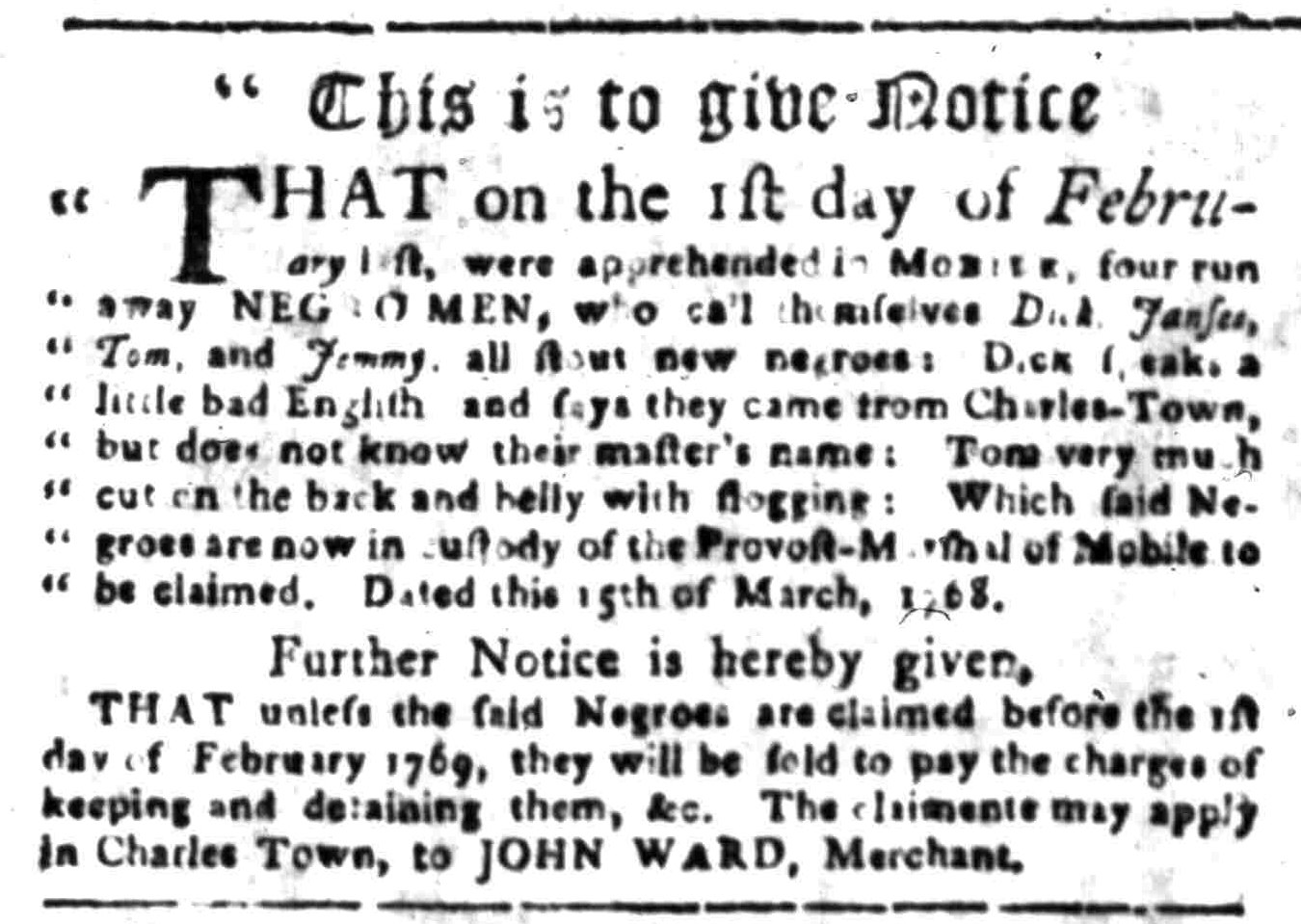
New-Hampshire Gazette (June 17, 1768).
**********
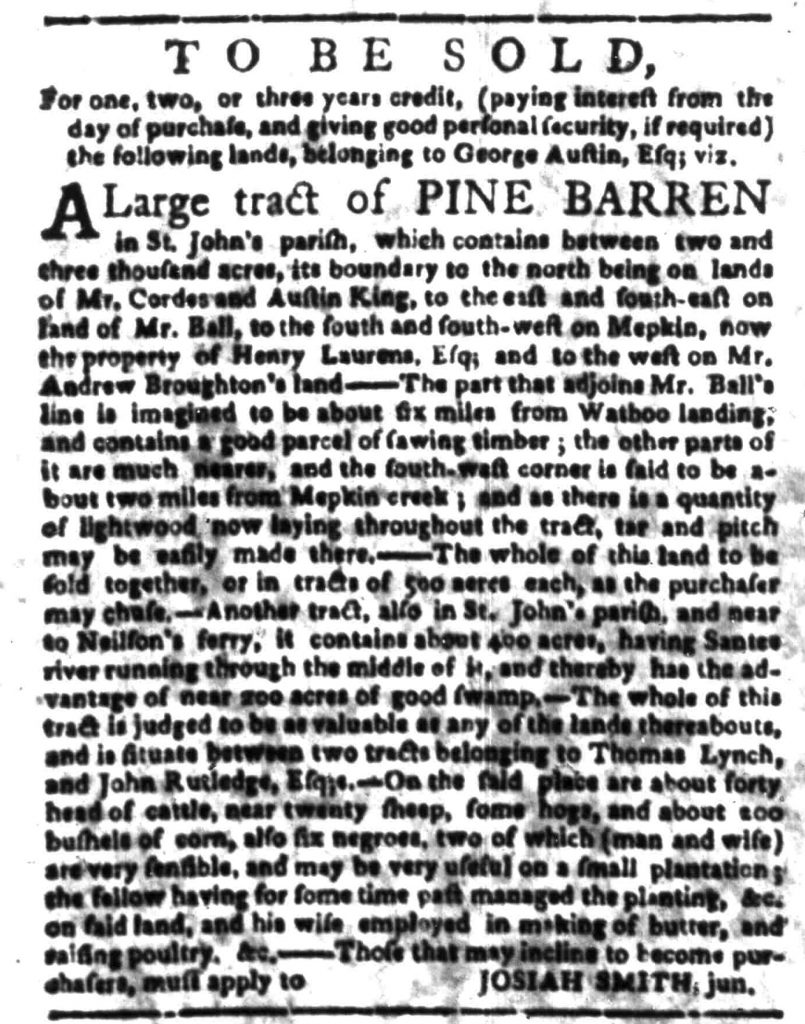
South-Carolina and American General Gazette (June 17, 1768).
**********
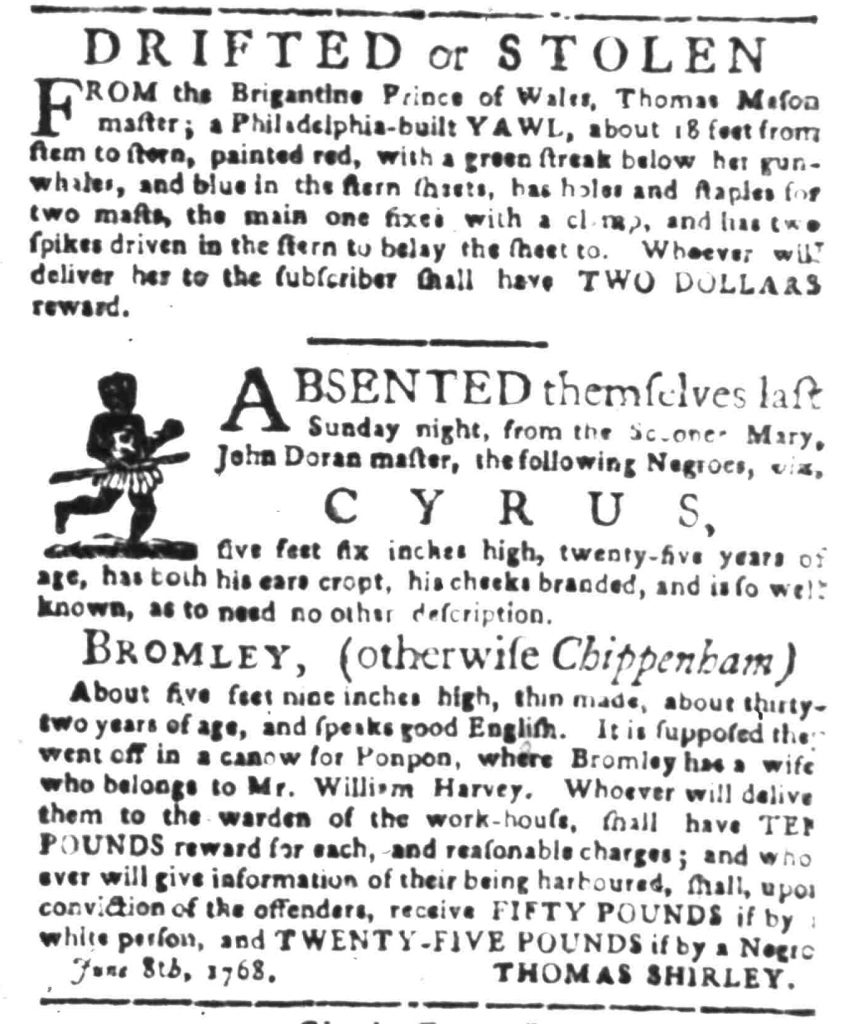
South-Carolina and American General Gazette (June 17, 1768).
**********
South-Carolina and American General Gazette (June 17, 1768).
**********
South-Carolina and American General Gazette (June 17, 1768).
**********
South-Carolina and American General Gazette (June 17, 1768).
**********
South-Carolina and American General Gazette (June 17, 1768).
What was advertised in a colonial American newspaper 250 years ago today?
“Large or small Entertainments provided, in the most genteel Manner.”
New-York Journal (June 16, 1768).
As summer arrived in New York in 1768, Josiah Davenport continued placing advertisements in newspapers published in that city to inform colonists planning to visit Philadelphia that he had recently opened a new inn and tavern “called the BUNCH of GRAPES.” This was not merely a way station for food and lodging but instead “a genteel HOUSE of ENTERTAINMENT, for travelers and others.”
Yet New Yorkers did not need to travel to Philadelphia to enjoy the sorts of amenities Davenport advertised. Starting with the June 16 edition of the New-York Gazette (number 1328), Samuel Francis (more commonly known today as Samuel Fraunces) announced that his summer resort at the edge of the city, “VAUX-HALL GARDEN,” was open for business. Naming his pleasure garden after Vauxhall Gardens of London, Fraunces opened “VAUX-HALL GARDEN” at Spring Hill, a villa located on the Hudson River, in 1767. The establishment competed with nearby Ranelagh Gardens, the site of several fireworks exhibitions in the spring of 1768. Fraunces countered the series of advertisements for the fireworks shows with his own notices, slated to appear in the New-York Gazette for at least four weeks (according to the issue numbers – “28 31” – that the compositor inserted at the end of the advertisement).
Visitors to his “House and Gardens” could experience “Large or small Entertainments … in the most genteel Manner” as they selected among “neat Wines, and other Liquors.” In addition to evening amusements, patrons could also enjoy “Breakfasting” complete with tea and coffee as well as “Cakes, Tarts, Jellies, [and] Sillibubs.” In addition, Fraunces offered catering services – “Dinners, Suppers, &c. dressed at Gentlemen’s own Houses” – for those who wished to entertain in their own homes.
In the second half of the eighteenth century an emerging leisure and hospitality industry served “such Ladies, Gentlemen, and others, who may be pleased to favour” establishments like Vauxhall Garden, Ranelagh Gardens, and the Bunch of Grapes “with their Company.” Colonists participated in a transatlantic consumer revolution that involved more than acquiring goods. Those with the time and resources also enjoyed a variety of services and entertainments presented for their amusement. For some early Americans, the culture of consumption extended to consuming experiences as well as the myriad of housewares and apparel advertised in eighteenth-century newspapers.
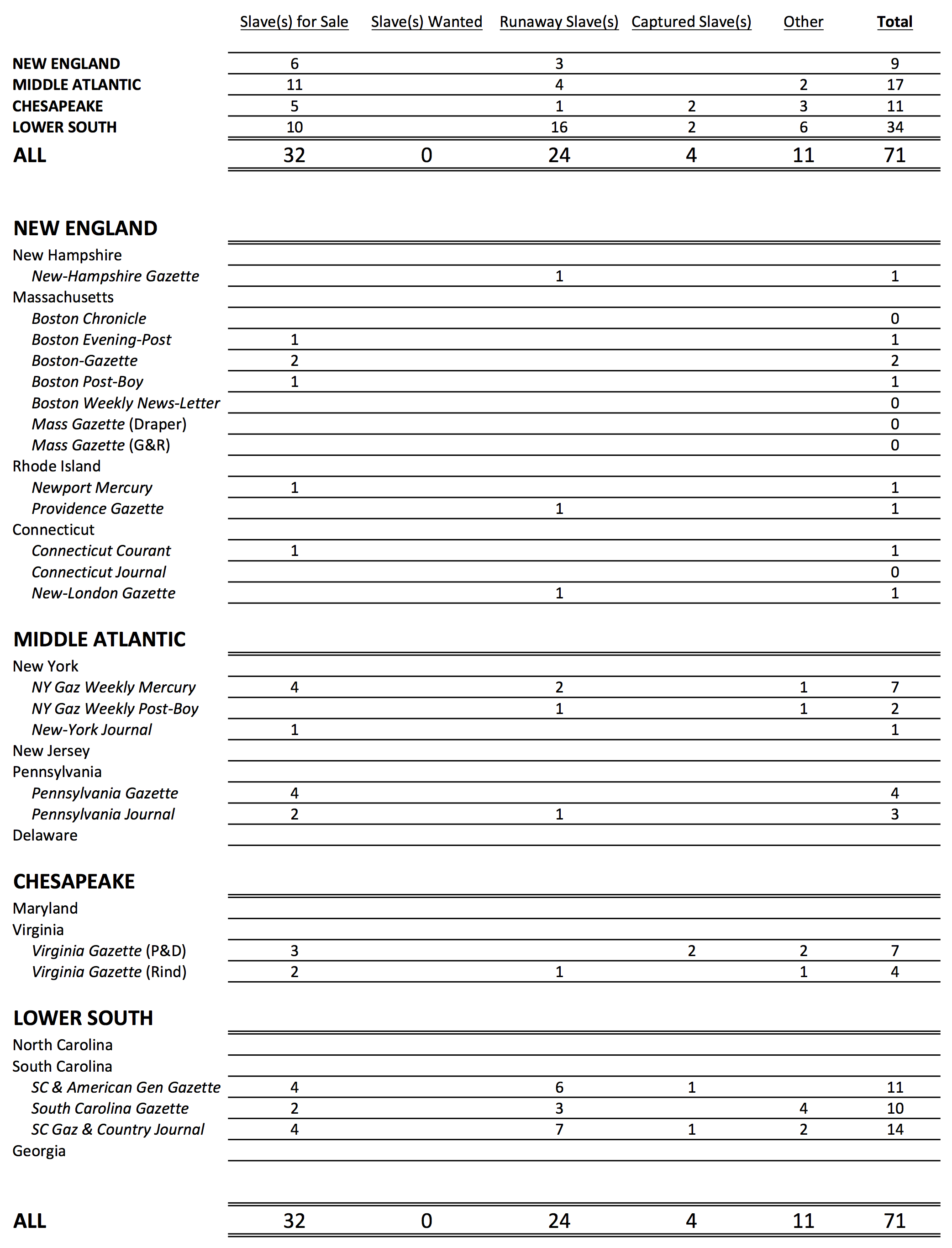
These tables indicate how many advertisements for slaves appeared in colonial American newspapers during the week of June 10-16, 1768.
Note: These tables are as comprehensive as currently digitized sources permit, but they may not be an exhaustive account. They includes all newspapers that have been digitized and made available via Accessible Archives, Colonial Williamsburg’s Digital Library, and Readex’s America’s Historical Newspapers. There are several reasons some newspapers may not have been consulted:
Issues that are no longer extant;
Issues that are extant but have not yet been digitized (including the Pennsylvania Journal); and
Newspapers published in a language other than English (including the Wochentliche Philadelphische Staatsbote).
**********
Slavery Advertisements Published June 10-16, 1768: By Date
**********
Slavery Advertisements Published June 10-16, 1768: By Region
The Slavery Adverts 250 Project chronicles the role of newspaper advertising in perpetuating slavery in the era of the American Revolution. The project seeks to reveal the ubiquity of slavery in eighteenth-century life from New England to Georgia by republishing advertisements for slaves – for sale, wanted to purchase, runaways, captured fugitives – in daily digests on this site as well as in real time via the @SlaveAdverts250 Twitter feed, utilizing twenty-first-century media to stand in for the print media of the eighteenth century.
The project aims to provide modern audiences with a sense of just how often colonists encountered these advertisements in their daily lives. Enslaved men, women, and children appeared in print somewhere in the colonies almost every single day. Those advertisements served as a constant backdrop for social, cultural, economic, and political life in colonial and revolutionary America. Colonists who did not own slaves were still confronted with slavery as well as invited to maintain the system by purchasing slaves or assisting in the capture of runaways. The frequency of these newspaper advertisements suggests just how embedded slavery was in colonial and revolutionary American culture in everyday interactions beyond the printed page.
These advertisements also testify to the experiences of enslaved men, women, and children, though readers must consider that those experiences have been remediated through descriptions offered by slaveholders rather than the slaves themselves. Often unnamed in the advertisements, enslaved men, women, and children were not invisible or unimportant in early America.
These advertisements appeared in colonial American newspapers 250 years ago today.
New-York Journal (June 16, 1768).
**********
Pennsylvania Gazette (June 16, 1768).
**********
Pennsylvania Gazette (June 16, 1768).
**********
Supplement to the Pennsylvania Gazette (June 16, 1768).
**********
Supplement to the Pennsylvania Gazette (June 16, 1768).
What was advertised in a colonial American newspaper 250 years ago this week?
Supplement to the South-Carolina Gazette and Country Journal (June 14, 1768).
“ALL Person who are anywise indebted to the Estate of JOHN DUTARQUE, deceased, are desired to make payment.”
The “missing” Georgia Gazette from June 15, 1768, presents an opportunity to discuss methodology. Each day the Adverts 250 Project republishes an advertisement originally published in an American newspaper exactly 250 years ago that day, along with a short essay that provides historical context and analysis of the contents of the advertisement. These advertisements are drawn from databases of eighteenth-century newspapers that have been digitized: the Virginia Gazette from Colonial Williamsburg’s Digital Library, newspapers published in Charleston from Accessible Archives’s South Carolina Newspapers, and an extensive array of newspapers from throughout the colonies from Readex’s America’s Historical Newspapers.
If no newspaper was published on a particular day (or if no newspaper published on a particular day has been digitized as part of one of those databases), the Adverts 250 Project instead features an advertisement printed sometime during the previous week. Although colonial printers clustered newspaper publications on Mondays and Thursdays in the late 1760s, at least one newspaper was published somewhere in the colonies on every day of the week except Sundays. This means that usually there is only one day of the week that the Adverts 250 Project needs to feature an advertisement not published exactly 250 years to the day.
The clustering of publications on Mondays and Thursdays means that some days offer many more choices for both newspapers and advertisements. During most weeks, the South-Carolina Gazette and Country Journal was the only [extant and digitized] newspaper printed on Tuesdays, the Georgia Gazette was the only newspaper printed on Wednesdays, and the Providence Gazette was the only newspaper printed on Saturdays. As a result, the Adverts 250 Project features an advertisement from each of these publications once a week. During the rest of the week the project draws from among more than a dozen other newspapers, attempting an informal rotation to feature as many as possible.
This methodology causes some newspapers to be featured much more often than others. Even though it carried relatively little advertising compared to some of its counterparts published in the largest port cities, the Georgia Gazette contributes an advertisement to the Adverts 250 Project once a week because it was only newspaper published in the colonies on Wednesdays in the late 1760s. (Dates that fell on Wednesdays in 1768 fall on Fridays in 2018.)
This calendar indicates which issues of the Georgia Gazette from 1768 have been digitized for Readex’s America’s Historical Newspapers database.
Today’s advertisement should have come from the Georgia Gazette, but the issue for June 15, 1768, is “missing.” Note the availability of other issues summarized in the calendar provided via Readex’s America’s Historical Newspapers. On closer investigation of some of those other issues it turns out that the June 15 edition is not missing after all. The June 8 edition is numbered 246. June 22 is numbered 247. June 29 is numbered 248, indicating that the June 22 edition is indeed numbered correctly and not the result of the printer or compositor neglecting to advance the number if there had been a June 15 edition (that would have been 247). For whatever reason, printer James Johnston did not issue the Georgia Gazette on June 15, 1768. Despite the noticeable gap in the calendar depicting publication in 1768, complete runs of the Georgia Gazette for that year have been preserved in archives and reproduced via America’s Historical Newspapers.
Rather than examine an advertisement published sometime during the previous week, the not-missing-after-all issue of the Georgia Gazette presents an opportunity to discuss the Advert 250 Project’s methodology in greater detail as well as describe the schedule of publication throughout the colonies in the late 1760s. This should give readers a better sense of why advertisements from some newspapers appear so frequently and advertisements from other newspapers are featured much less often.
What was advertised in a colonial American newspaper 250 years ago today?
South-Carolina Gazette and Country Journal (June 14, 1768).
“A Catalogue of which will be in our next.”
In advance of an auction of “A COLLECTION of LAW BOOKS” to be held on June 22, 1768, Charles Crouch placed an advertisement in the June 14 edition of the South-Carolina Gazette and Country Journal. He attempted to incite enthusiasm by informing potential bidders that the collection included several “valuable Articles; many of which, are now rarely to be found.” Anyone potentially interested would not want to miss this sale since auctions often yielded bargain prices, even for rare items that might otherwise cost significantly more when they exchanged hands through other sorts of transactions.
Crouch did not expect prospective buyers simply to trust his assertions about the value and rarity of the books up for auction in just over a week. Instead, he advised them that “A Catalogue … will be in our next” edition, a promise that Crouch could confidently make since he was the printer of the South-Carolina Gazette and Country Journal. Publishing a catalog, whether in a newspaper or as a separate pamphlet or broadside, provided a preview of the auction. It allowed interested parties to contemplate the merchandise in advance; as they anticipated the auction they likely imagined themselves bidding and acquiring some of the items, perhaps increasing the chances they would do so once they found themselves at the auction.
Yet Crouch did not yet direct readers to such visualizations: the list of rare and valuable books would not appear in the newspaper until the following week. He mentioned the catalog, however, as an invitation to potential bidders to peruse the next issue of the South-Carolina Gazette and Country Journal, perhaps assuming that their eagerness would make them more inclined to select items that they did indeed wish to buy at the auction. Alternately, he ran the risk that the catalog would merely disappoint some readers if its contents did not include books they considered interesting or particularly valuable or rare. Crouch gambled that mentioning the catalog in advance would make readers more disposed to examining it and attending the auction.