October 13

What was advertised in a colonial American newspaper 250 years ago today?

Oct 13 - 10:13:1768 Massachusetts Gazette Draper
Massachusetts Gazette [Draper] (October 13, 1768).
“All Persons shall be as well served by Letter as if present.”

In the late 1760s Joshua Blanchard operated a “Wine-Cellar near the Market” in Boston. He sold “Choice Sterling Madeira … and all other Sorts of Wine” in a variety of quantities, “by the Pipe, Quarter-Cask, or in Bottles by the Groce or Dozen” or any other measure “as may suit the Buyer.” In addition, he also sold “West India and New-England Rum.” Transporting, repackaging, and selling wine and spirits required special skills and attention compared to textiles, housewares, hardware, and many other imported goods frequently promoted in newspaper advertisements. To that end, Blanchard informed prospective customers of the care exhibited in distributing his wine in the marketplace.

Blanchard envisioned several sorts of customers. He addressed “Gentlemen of the Town, Masters of Vessels, and all Persons going abroad,” promising them that he offered the “best Kinds” of wine. He also assured prospective customers about the packaging, noting that they “may depend on having their Wine put up in the best Manner.” There was no need to worry about spilling or spoiling that resulted from the work undertaken at Blanchard’s wine cellar to transfer wine from its original casks to new bottles or barrels of various sizes. Blanchard’s emphasis on quality extended beyond the product itself; it included his efforts in distributing the wine.

In addition to serving customers in the busy port, Blanchard invited “Gentlemen in the Country, Inn-keepers, and all other Persons” to send orders to his wine cellar. Transactions did not need to take place face to face. Instead, customers “shall be as well served by Letter as if present.” In other words, Blanchard provided a form of mail order service. That made his attention to quality an even more important marketing appeal. He first needed to assure prospective customers that his wine and rum would survive transport without incident before presenting the option of delivering it in response to orders placed in letters. Blanchard underscored “Care & Fidelity” in the second half of his advertisement, in relation to his work as a broker, but that phrase also applied to treatment of the products that passed through his wine cellar as well.

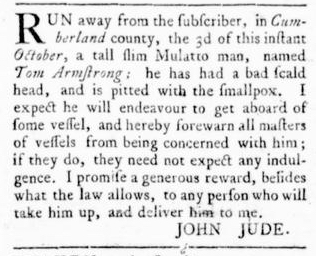
Slavery Advertisements Published October 13, 1768

GUEST CURATOR: Thomas Daley

The Slavery Adverts 250 Project chronicles the role of newspaper advertising in perpetuating slavery in the era of the American Revolution. The project seeks to reveal the ubiquity of slavery in eighteenth-century life from New England to Georgia by republishing advertisements for slaves – for sale, wanted to purchase, runaways, captured fugitives – in daily digests on this site as well as in real time via the @SlaveAdverts250 Twitter feed, utilizing twenty-first-century media to stand in for the print media of the eighteenth century.

The project aims to provide modern audiences with a sense of just how often colonists encountered these advertisements in their daily lives. Enslaved men, women, and children appeared in print somewhere in the colonies almost every single day. Those advertisements served as a constant backdrop for social, cultural, economic, and political life in colonial and revolutionary America. Colonists who did not own slaves were still confronted with slavery as well as invited to maintain the system by purchasing slaves or assisting in the capture of runaways. The frequency of these newspaper advertisements suggests just how embedded slavery was in colonial and revolutionary American culture in everyday interactions beyond the printed page.

These advertisements also testify to the experiences of enslaved men, women, and children, though readers must consider that those experiences have been remediated through descriptions offered by slaveholders rather than the slaves themselves. Often unnamed in the advertisements, enslaved men, women, and children were not invisible or unimportant in early America.

During the week of October 7-13, 2018, the Slavery Adverts 250 Project is guest curated by Thomas “Tommy” Daley (2019), a History major at Assumption College in Worcester, Massachusetts.

These advertisements appeared in colonial American newspapers 250 years ago today.

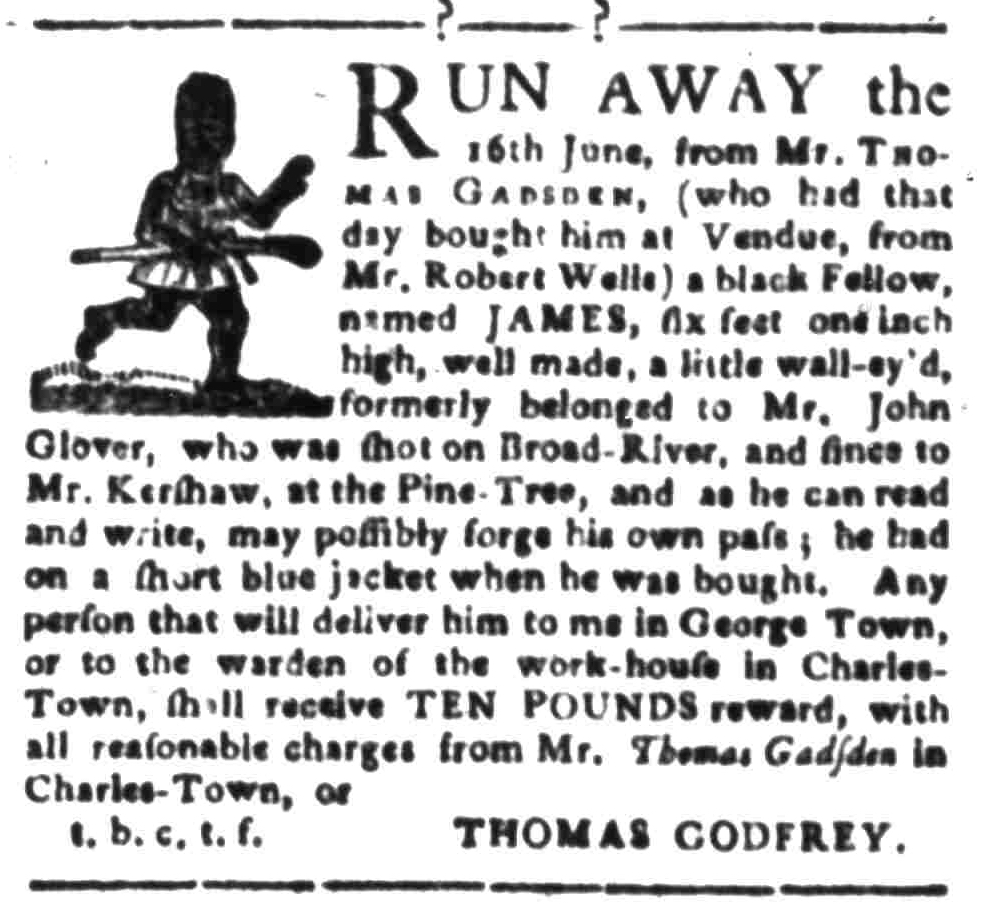
Oct 13 - Massachusetts Gazette Draper Slavery 1
Massachusetts Gazette [Draper] (October 13, 1768).

**********

Oct 13 - Massachusetts Gazette Draper Slavery 2
Massachusetts Gazette [Draper] (October 13, 1768).

**********

Oct 13 - Massachusetts Gazette Draper Slavery 3
Massachusetts Gazette [Draper] (October 13, 1768).

**********

Oct 13 - New-York Journal Slavery 1
New-York Journal (October 13, 1768).

**********

Oct 13 - New-York Journal Slavery 2
New-York Journal (October 13, 1768).

**********

Oct 13 - Pennsylvania Gazette Postscript Slavery 1
Postscript to the Pennsylvania Gazette (October 13, 1768).

**********

Oct 13 - Pennsylvania Gazette Postscript Slavery 2
Postscript to the Pennsylvania Gazette (October 13, 1768).

**********

Oct 13 - Pennsylvania Gazette Slavery 1
Pennsylvania Gazette (October 13, 1768).

**********

Oct 13 - Pennsylvania Gazette Supplement Slavery 1
Supplement to the Pennsylvania Gazette (October 13, 1768).

**********

Oct 13 - Pennsylvania Gazette Supplement Slavery 2
Supplement to the Pennsylvania Gazette (October 13, 1768).

**********

Oct 13 - Pennsylvania Gazette Supplement Slavery 3
Supplement to the Pennsylvania Gazette (October 13, 1768).

**********

Oct 13 - Virginia Gazette Purdie and Dixon Slavery 1
Virginia Gazette [Purdie & Dixon](October 13, 1768).

**********

Oct 13 - Virginia Gazette Purdie and Dixon Slavery 2
Virginia Gazette [Purdie & Dixon](October 13, 1768).

**********

Oct 13 - Virginia Gazette Purdie and Dixon Slavery 3
Virginia Gazette [Purdie & Dixon](October 13, 1768).

**********

Oct 13 - Virginia Gazette Purdie and Dixon Slavery 4
Virginia Gazette [Purdie & Dixon](October 13, 1768).

**********

Oct 13 - Virginia Gazette Purdie and Dixon Slavery 5
Virginia Gazette [Purdie & Dixon](October 13, 1768).

**********

Oct 13 - Virginia Gazette Purdie and Dixon Slavery 6
Virginia Gazette [Purdie & Dixon] (October 13, 1768).

**********

Oct 13 - Virginia Gazette Purdie and Dixon Slavery 7
Virginia Gazette [Purdie & Dixon] (October 13, 1768).

**********

Oct 13 - Virginia Gazette Purdie and Dixon Slavery 8
Virginia Gazette [Purdie & Dixon] (October 13, 1768).

**********

Oct 13 - Virginia Gazette Rind Slavery 1
Virginia Gazette [Rind] (October 13, 1768).

**********

Oct 13 - Virginia Gazette Rind Slavery 2
Virginia Gazette [Rind] (October 13, 1768).

**********

Oct 13 - Virginia Gazette Rind Slavery 3
Virginia Gazette [Rind] (October 13, 1768).

**********

Oct 13 - Virginia Gazette Rind Slavery 4
Virginia Gazette [Rind] (October 13, 1768).

**********

Oct 13 - Virginia Gazette Rind Slavery 5
Virginia Gazette [Rind (October 13, 1768).

**********

Oct 13 - Virginia Gazette Rind Slavery 6
Virginia Gazette [Rind] (October 13, 1768).

**********

Oct 13 - Virginia Gazette Rind Slavery 7
Virginia Gazette [Rind] (October 13, 1768).

**********

Oct 13 - Virginia Gazette Rind Slavery 8
Virginia Gazette [Rind] (October 13, 1768).

**********

Oct 13 - Virginia Gazette Rind Slavery 9
Virginia Gazette [Rind] (October 13, 1768).

**********

Oct 13 - Virginia Gazette Rind Slavery 10
Virginia Gazette [Rind] (October 13, 1768).

**********

Oct 13 - Virginia Gazette Rind Slavery 11
Virginia Gazette [Rind] (October 13, 1768).

**********

Oct 13 - Virginia Gazette Rind Slavery 12
Virginia Gazette [Rind] (October 13, 1768).

**********

Oct 13 - Virginia Gazette Rind Slavery 13
Virginia Gazette [Rind] (October 13, 1768).

**********

Oct 13 - Virginia Gazette Rind Slavery 14
Virginia Gazette [Rind] (October 13, 1768).

October 12

What was advertised in a colonial American newspaper 250 years ago today?

Oct 12 - 10:12:1768 Georgia Gazette
Georgia Gazette (October 12, 1768).

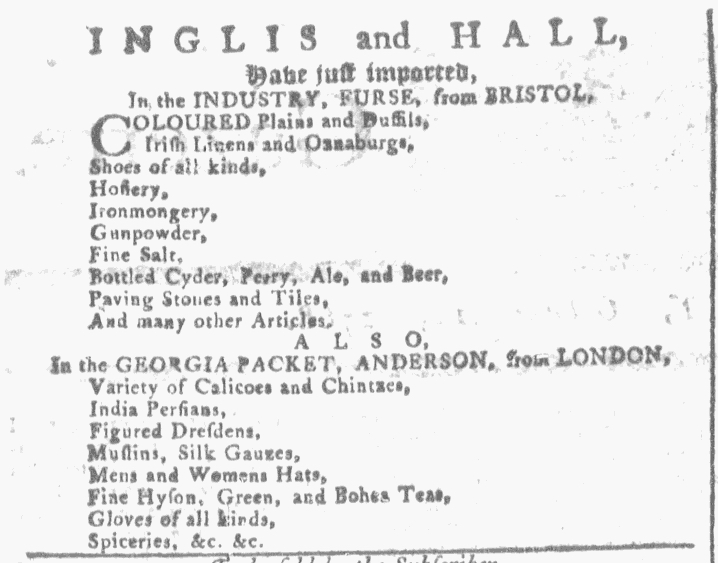
“INGLIS and HALL, Have just imported, In the INDUSTRY, FURSE, from BRISTOL.”

When Inglis and Hall placed an advertisement in the October 12, 1768, edition of the Georgia Gazette they adopted formulaic language that often appeared in other advertisements. The partners informed prospective customers that they “have just imported” a variety of goods from London and Bristol. Like many other colonial merchants and shopkeepers, Inglis and Hall reported which ship had transported their goods across the Atlantic: “the GEORGIA PACKET, ANDERSON, from LONDON” and “the INDUSTRY, FURSE, from BRISTOL.” This allowed readers to determine for themselves that Inglis and Hall did indeed stock new merchandise. Many may have been aware of which vessels recently arrived in port, but all could read the shipping news that appeared elsewhere in the newspaper.

Inglis and Hall’s advertisement appeared on the second page of the October 12 issue, opposite the list of ships ‘ENTERED INWARDS at the CUSTOM-HOUSE,” those “ENTERED OUTWARDS,” and others that had “CLEARED” the port. The shipping news indicated that the “Ship Georgia Packet, George Anderson” from London “ENTERED INWARDS” on October 10. The Industry was not listed, but it was still in port, having ‘ENTERED INWARDS” on September 30 according to the October 5 edition.

Given the time required to set the type and print both sides of the newspaper on a hand-operated press, Inglis and Hall must have submitted the copy for their advertisement to James Johnston at the printing office in Savannah immediately upon the arrival of Captain Anderson and the Georgia Packet. The shipping news bolstered their claim that they “have just imported” a variety of goods. In other instances, merchants and shopkeepers ran advertisements for weeks or months, never updating them. The appeal to having “just imported” merchandise became outdated, even if the list of goods available for sale remained accurate. Readers could assess that particular appeal: sometimes an inventory described as “just imported” had been lingering on the shelves for quite some time. Consumers interested in the newest goods, including the current fashions from London, had to be aware that advertisers deployed the phrase “just imported” with little attention to the passage of time over the run of their advertisements. Usually accurate when an advertisement first appeared, that description did not disappear until advertisers discontinued their advertisements.

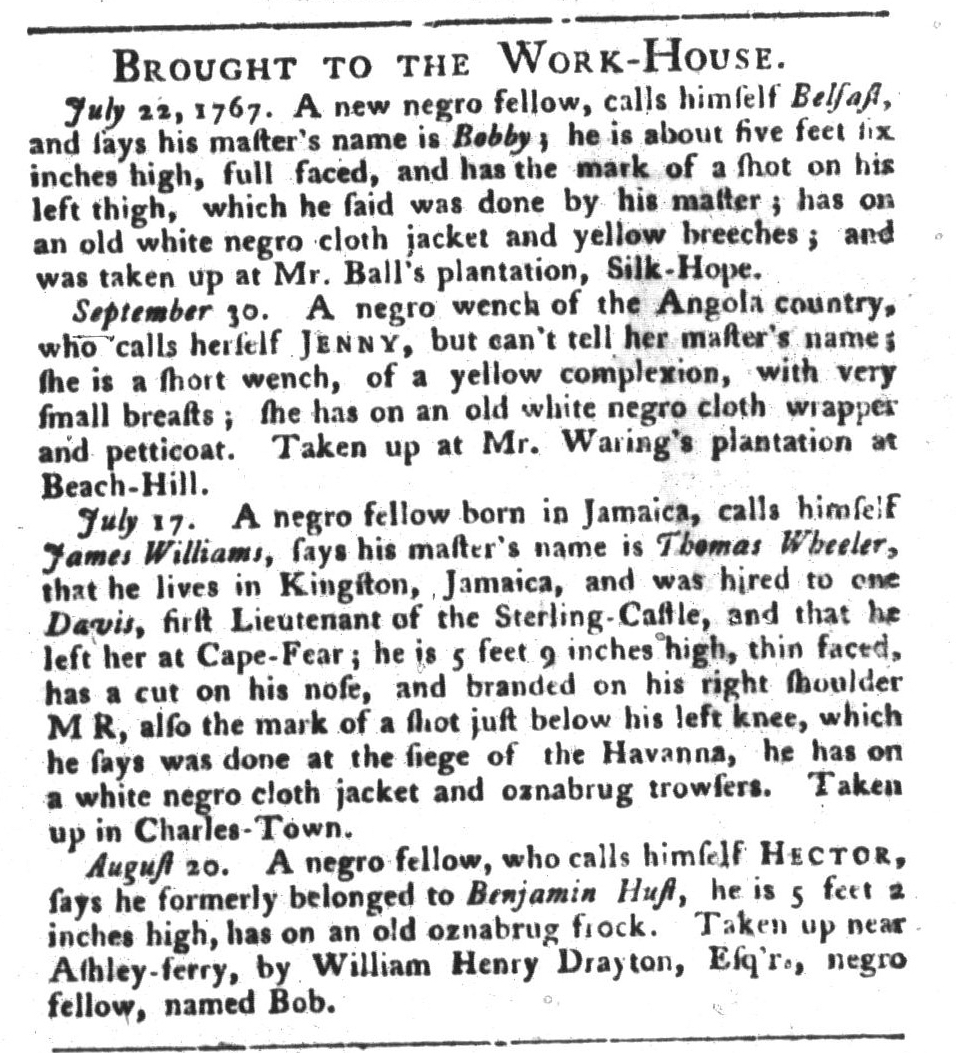
Slavery Advertisements Published October 12, 1768

GUEST CURATOR: Thomas Daley

The Slavery Adverts 250 Project chronicles the role of newspaper advertising in perpetuating slavery in the era of the American Revolution. The project seeks to reveal the ubiquity of slavery in eighteenth-century life from New England to Georgia by republishing advertisements for slaves – for sale, wanted to purchase, runaways, captured fugitives – in daily digests on this site as well as in real time via the @SlaveAdverts250 Twitter feed, utilizing twenty-first-century media to stand in for the print media of the eighteenth century.

The project aims to provide modern audiences with a sense of just how often colonists encountered these advertisements in their daily lives. Enslaved men, women, and children appeared in print somewhere in the colonies almost every single day. Those advertisements served as a constant backdrop for social, cultural, economic, and political life in colonial and revolutionary America. Colonists who did not own slaves were still confronted with slavery as well as invited to maintain the system by purchasing slaves or assisting in the capture of runaways. The frequency of these newspaper advertisements suggests just how embedded slavery was in colonial and revolutionary American culture in everyday interactions beyond the printed page.

These advertisements also testify to the experiences of enslaved men, women, and children, though readers must consider that those experiences have been remediated through descriptions offered by slaveholders rather than the slaves themselves. Often unnamed in the advertisements, enslaved men, women, and children were not invisible or unimportant in early America.

During the week of October 7-13, 2018, the Slavery Adverts 250 Project is guest curated by Thomas “Tommy” Daley (2019), a History major at Assumption College in Worcester, Massachusetts.

These advertisements appeared in colonial American newspapers 250 years ago today.

Oct 12 - Georgia Gazette Slavery 1
Georgia Gazette (October 12, 1768).

**********

Oct 12 - Georgia Gazette Slavery 2
Georgia Gazette (October 12, 1768).

**********

Oct 12 - Georgia Gazette Slavery 3
Georgia Gazette (October 12, 1768).

**********

Oct 12 - Georgia Gazette Slavery 4
Georgia Gazette (October 12, 1768).

**********

Oct 12 - Georgia Gazette Slavery 5
Georgia Gazette (October 12, 1768).

**********

Oct 12 - Georgia Gazette Slavery 6
Georgia Gazette (October 12, 1768).

**********

Oct 12 - Georgia Gazette Slavery 7
Georgia Gazette (October 12, 1768).

October 11

What was advertised in a colonial American newspaper 250 years ago today?

Oct 11 - 10:11:1768 South-Carolina Gazette and Country Journal
Supplement to the South-Carolina Gazette and Country Journal (October 11, 1768).

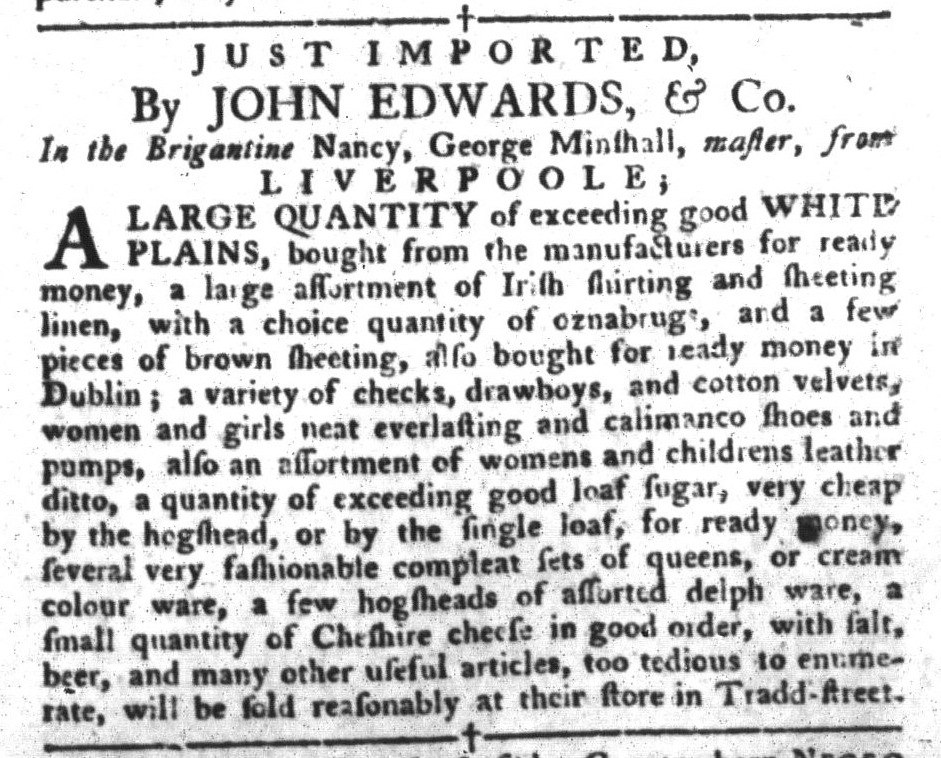
“Many other useful articles, too tedious to mention.”

John Edwards and Company advertised an array of goods in the supplement that accompanied the October 11, 1768, edition of the South-Carolina Gazette and Country Journal. They emphasized abundance and consumer choice in the language deployed to describe the textiles available at their store on Tradd Street: “A LARGE QUANTITY of exceeding good WHITE PLAINS,” “a large assortment of Irish shirting and sheeting linen,” “a choice quantity of oznaburgs,” “a variety of checks, drawboys, and cotton velvets.” They applied the same appeals to other merchandise as well, including “an assortment of womens and childrens leather [shoes]” and “several very fashionable compleat sets of queens, or cream colour ware.” After listing dozens of items in their inventory, Edwards and Company concluded by underscoring the intertwined themes of abundance and choice, stressing that they carried “many other useful articles, too tedious to enumerate.” Rather than “tedious” perhaps the partners considered it too expensive to purchase additional space to list even more merchandise. They had made their pitch and their final appeal suggested prospective customers would discover an even more extensive selection when visiting their shop.

Other merchants and shopkeepers joined Edwards and Company in making general statements about the vast array of goods they sold. Godfrey and Gadsden, for instance, listed even more items than Edwards and Company yet also stated that carried “many other articles.” Mary King, a milliner, named about two dozen items associated with her trade but also promised “a variety of other articles.” Mansell, Corbett, and Roberts concluded their list-style advertisement with “&c. &c.” Dawson and Walter did the same. Not to be outdone, Alexander Gillon published a list twice as long and with an additional “&c.” at the end: “&c. &c. &c.” Through invoking the eighteenth-century abbreviation for et cetera, these entrepreneurs challenged readers to imagine what else they sold. Choosing not “to enumerate” all of their goods allowed advertisers to incite curiosity among prospective customers. They named enough to get readers thinking about the possibilities without eliminating any options outright. Advertisers offered consumers extensive choices, but when it came to tallying all of those choices in the public prints they often opted for a version of “less is more.” They accounted for just enough to stimulate interest and then promised even more, inviting prospective customers to see for themselves when visiting their shops.

Slavery Advertisements Published October 11, 1768

GUEST CURATOR: Thomas Daley

The Slavery Adverts 250 Project chronicles the role of newspaper advertising in perpetuating slavery in the era of the American Revolution. The project seeks to reveal the ubiquity of slavery in eighteenth-century life from New England to Georgia by republishing advertisements for slaves – for sale, wanted to purchase, runaways, captured fugitives – in daily digests on this site as well as in real time via the @SlaveAdverts250 Twitter feed, utilizing twenty-first-century media to stand in for the print media of the eighteenth century.

The project aims to provide modern audiences with a sense of just how often colonists encountered these advertisements in their daily lives. Enslaved men, women, and children appeared in print somewhere in the colonies almost every single day. Those advertisements served as a constant backdrop for social, cultural, economic, and political life in colonial and revolutionary America. Colonists who did not own slaves were still confronted with slavery as well as invited to maintain the system by purchasing slaves or assisting in the capture of runaways. The frequency of these newspaper advertisements suggests just how embedded slavery was in colonial and revolutionary American culture in everyday interactions beyond the printed page.

These advertisements also testify to the experiences of enslaved men, women, and children, though readers must consider that those experiences have been remediated through descriptions offered by slaveholders rather than the slaves themselves. Often unnamed in the advertisements, enslaved men, women, and children were not invisible or unimportant in early America.

During the week of October 7-13, 2018, the Slavery Adverts 250 Project is guest curated by Thomas “Tommy” Daley (2019), a History major at Assumption College in Worcester, Massachusetts.

These advertisements appeared in colonial American newspapers 250 years ago today.

Oct 11 - South-Carolina Gazette and Country Journal Slavery 1
South-Carolina Gazette and Country Journal (October 11, 1768).

**********

Oct 11 - South-Carolina Gazette and Country Journal Slavery 2
South-Carolina Gazette and Country Journal (October 11, 1768).

**********

Oct 11 - South-Carolina Gazette and Country Journal Slavery 3
South-Carolina Gazette and Country Journal (October 11, 1768).

**********

Oct 11 - South-Carolina Gazette and Country Journal Supplement Slavery 1
Supplement to the South-Carolina Gazette and Country Journal (October 11, 1768).

**********

Oct 11 - South-Carolina Gazette and Country Journal Supplement Slavery 2
Supplement to the South-Carolina Gazette and Country Journal (October 11, 1768).

October 10

What was advertised in a colonial American newspaper 250 years ago today?

Oct 10 - 10:10:1768 Newport Mercury
Newport Mercury (October 10, 1768).

“To be sold … by Freelove Saunders.”

In October 1768, Freelove Saunders inserted an advertisement for imported textiles, adornments, and other goods in four consecutive issues of the Newport Mercury. Commencing on October 10, the advertisement last appeared on October 31. It moved from page to page, initially appearing on the third page, then in a privileged place as the first item in the first column on the first page, and ultimately on the final page for its last two insertions. The headline, “Freelove Saunders” in a larger font with generous white space surrounding it, makes the advertisement easy to spot when looking for it in particular … at least to the human eye.

Recent technological developments have revolutionized historical research. The Adverts 250 Project, for instance, is possible due to the digitization of eighteenth-century newspapers by Accessible Archives, Colonial Williamsburg, and Readex. Colonial Williamsburg photographed and digitized newspapers from its own collections, but Accessible Archives and Readex partnered with research libraries in their efforts to make historical sources more widely accessible (by creating a product, it should be acknowledged, to market and sell to scholars, educators, and their institutions). In addition to images of primary sources, many databases also feature other tools, including the ability to search texts for keywords.

Such searches, however, must be deployed carefully. Say that in examining the October 10, 1768, edition of the Newport Mercury I encounter the advertisement placed by Freelove Saunders 250 years ago and that I want to know more about its publication history. I have sufficient information to pursue a keyword search in Readex’s America’s Historical Newspapers database. Limiting the year to 1768 and the newspapers to the Newport Mercury, I choose “Freelove” as the only search term. The results return only the insertion in the October 24 issue. The search returns the same results when substituting “Saunders” for the keyword. Choosing the phrase “Freelove Saunders” instead yields zero instances of the advertisement. These results run counter to the historical record, something I already know because examining the advertisement in the digitized October 10 edition first prompted me to conduct the subsequent searches. Page-by-page examination of all issues of the Newport Mercury published in October and November 1768 reveals that Freelove Saunders did insert the same advertisement for four consecutive weeks before discontinuing it.

OCR (optical character recognition) oftentimes streamlines the research process. Using it can be much more efficient than skimming through either original or digitized copies of primary sources. Yet OCR is also fallible, though in different ways than the naked human eye. From long experience working on the Adverts 250 Project and using digitized sources for other research endeavors, I have learned that OCR often overlooks text that I already know exists because I have a hard copy sitting right next to the computer. Sometimes this is merely frustrating, but it can also skew the results of an inquiry. Scholars must use OCR keyword searches cautiously. Such searches often lead to sources of interest, but they do not definitively identify all relevant sources. When an OCR keyword search does not yield any results that does not necessarily mean that there was nothing to find. Scholars should supplement such searches with other methods. Relying on keyword searches alone would have resulted in evidence of Freelove Saunders’s participation in the colonial marketplace becoming less rather than more visible in the historical record.

Slavery Advertisements Published October 10, 1768

GUEST CURATOR: Thomas Daley

The Slavery Adverts 250 Project chronicles the role of newspaper advertising in perpetuating slavery in the era of the American Revolution. The project seeks to reveal the ubiquity of slavery in eighteenth-century life from New England to Georgia by republishing advertisements for slaves – for sale, wanted to purchase, runaways, captured fugitives – in daily digests on this site as well as in real time via the @SlaveAdverts250 Twitter feed, utilizing twenty-first-century media to stand in for the print media of the eighteenth century.

The project aims to provide modern audiences with a sense of just how often colonists encountered these advertisements in their daily lives. Enslaved men, women, and children appeared in print somewhere in the colonies almost every single day. Those advertisements served as a constant backdrop for social, cultural, economic, and political life in colonial and revolutionary America. Colonists who did not own slaves were still confronted with slavery as well as invited to maintain the system by purchasing slaves or assisting in the capture of runaways. The frequency of these newspaper advertisements suggests just how embedded slavery was in colonial and revolutionary American culture in everyday interactions beyond the printed page.

These advertisements also testify to the experiences of enslaved men, women, and children, though readers must consider that those experiences have been remediated through descriptions offered by slaveholders rather than the slaves themselves. Often unnamed in the advertisements, enslaved men, women, and children were not invisible or unimportant in early America.

During the week of October 7-13, 2018, the Slavery Adverts 250 Project is guest curated by Thomas “Tommy” Daley (2019), a History major at Assumption College in Worcester, Massachusetts.

These advertisements appeared in colonial American newspapers 250 years ago today.

Oct 10 - Boston Post-Boy Slavery 1
Boston Post-Boy (October 10, 1768).

**********

Oct 10 - Boston-Gazette Slavery 1
Boston-Gazette (October 10, 1768).

**********

Oct 10 - Boston-Gazette Slavery 2
Boston-Gazette (October 10, 1768).

**********

Oct 10 - Boston-Gazette Supplement Slavery 1
Supplement to the Boston-Gazette (October 10, 1768).

**********

Oct 10 - New-York Gazette Weekly Mercury Slavery 1
New-York Gazette and Weekly Mercury (October 10, 1768).

**********

Oct 10 - New-York Gazette Weekly Mercury Slavery 2
New-York Gazette and Weekly Mercury (October 10, 1768).

**********

Oct 10 - New-York Gazette Weekly Mercury Slavery 3
New-York Gazette and Weekly Mercury (October 10, 1768).

**********

Oct 10 - New-York Gazette Weekly Post-Boy Slavery 3
New-York Gazette: Or, the Weekly Post-Boy (October 10, 1768).

**********

Oct 10 - Newport Mercury Slavery 1
Newport Mercury (October 10, 1768).

**********

Oct 10 - Pennsylvania Chronicle Slavery 1
Postscript to the Pennsylvania Chronicle (October 10, 1768).

**********

Oct 10 - Pennsylvania Chronicle Slavery 2
Postscript to the Pennsylvania Chronicle (October 10, 1768).

**********

Oct 10 - South-Carolina Gazette Slavery 1
South-Carolina Gazette (October 10, 1768).

**********

Oct 10 - South-Carolina Gazette Slavery 2
South-Carolina Gazette (October 10, 1768).

**********

Oct 10 - South-Carolina Gazette Slavery 3
South-Carolina Gazette (October 10, 1768).

**********

Oct 10 - South-Carolina Gazette Slavery 4
South-Carolina Gazette (October 10, 1768).

**********

Oct 10 - South-Carolina Gazette Slavery 5
South-Carolina Gazette (October 10, 1768).

**********

Oct 10 - South-Carolina Gazette Slavery 6
South-Carolina Gazette (October 10, 1768).

October 9

What was advertised in a colonial American newspaper 250 years ago this week?

Oct 9 - 10:6:1768 Boston Weekly News-Letter
Boston Weekly News-Letter (October 6, 1768).

“Strong and Small Malt Beer and Spruce, by the Barrel.”

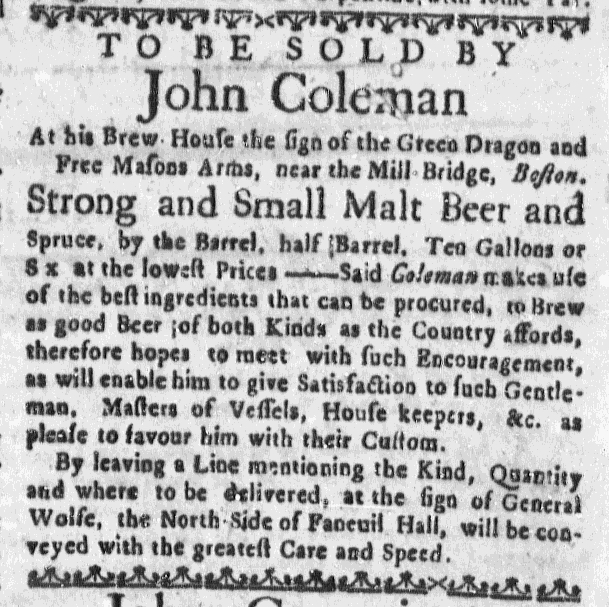
In the fall of 1768 John Coleman advertised the several varieties of beer he sold at “his Brew House [at] the sign of the Green Dragon and Free Masons Arms, near the Mill Bridge” in Boston. He advised “Gentlem[e]n, Masters of Vessels, House keepers” and others that he brewed spruce beer and two sorts of malt beer, strong and small. His spruce beer may or may not have contained alcohol. Many consumers, including “Masters of Vessels,” purchased it as a means of warding off scurvy. His small beer contained less alcohol than strong beer. A safer alternative to water, some customers likely served small beer to children, servants, and other members of their households. Coleman marketed his beers in several quantities – “by the Barrel, half Barrel, Ten Gallons or Six” – and allowed his customers to choose according to their needs.

The brewer made many of the most common appeals that appeared in advertisements throughout the eighteenth century. He made an appeal to price, stating that he sold his beer “at the lowest Prices.” He also made an appeal to quality, stating that he brewed “as good Beer of both Kinds as the Country affords.” His beer was equal to any other produced in the colonies. In another regard, however, Coleman deviated from the marketing strategies deployed in most other advertisements of the era. For the convenience of his customers, he provided delivery service. He concluded with these instructions: “By leaving a Line mentioning the Kind, Quantity and where to be delivered” customers will have their beer “conveyed with the greatest Care and Speed.” Coleman provided an alternate address for placing such orders, “the sign of General Wolfe, the North Side of Faneuil Hall” rather than at “his Brew House.” Presumably customers could have also submitted orders at the latter as well; the additional location compounded the conveniences offered to them.

Coleman had previously advertised in the Boston Weekly News-Letter.   Just two months earlier he announced that his former partner, Benjamin Leigh, was so busy with his new enterprise running an “Intelligence Office” that Coleman now operated the brewery on his own. He called on prior customers to settle accounts and briefly mentioned the price of a barrel of beer. In this subsequent advertisement, however, he incorporated several new appeals intended to market his beer more effectively. Having assumed sole responsibility for the business, he may have determined that attracting customers demanded greater innovation.

October 8

What was advertised in a colonial American newspaper 250 years ago today?

Oct 8 - 10:8:1768 Providence Gazette
Providence Gazette (October 8, 1768).

“[48—6W.]”

Thurber and Cahoon placed a new advertisement in the October 8, 1768, edition of the Providence Gazette.   The partners promoted a “new and general Assortment of English and India GOODS, Imported in the last Ships from London and Bristol.” They listed some of that merchandise in a two short paragraphs, one for textiles and trimmings and the other for hardware. They also informed prospective customers about the location of their store at “the Sign of the BUNCH of GRAPES,” across the street from their houses in “the North End of Providence.”

Yet not all of the contents of their advertisement provided information intended for readers and consumers. The final line included a notation in brackets – “[48—6W.]” – intended to aid the compositor when laying out the pages of subsequent issues. The printers also likely referred to that notation in the course of their own bookkeeping. The “48” revealed that the advertisement first appeared in issue number 248. The “6W” presumably indicated that it was supposed to run for six weeks before being discontinued.

Several other advertisements concluded with issue numbers that corresponded with when they first appeared in the Providence Gazette. John White’s advertisement for candles and soap, for instance, listed “(46)” on the final line. Similarly, prolific advertisers Joseph Russell and William Russell inserted a notice about their “neat and fresh Assortment of GOODS” that also stated its initial issue number, “(47).” None of those advertisements, however, included any indication of their intended duration, but “6W” did apparently mean six weeks. Thurber and Cahoon’s advertisement ran in the next five issues, appearing for the last time in the November 12 edition. It moved from column to column and page to page, but the notation apparently served its purpose in reminding the compositor when to remove the advertisement.

The Providence Gazette was not the only newspaper that inserted such notations into advertisements in the colonial era. Throughout the colonies compositors and printers used this device to facilitate operating their publications. Readers may have taken note and decoded the notations on their own, but they were not the primary audience for those portions of the advertisements.