October 7

What was advertised in a colonial American newspaper 250 years ago today?

Oct 7 - 10:7:1768 New-Hampshire Gazette
New-Hampshire Gazette (October 7, 1768).

“She now has full Liberty to contract any Debts on my Account.”

In the summer and fall of 1768, the Wiggin family of Stratham, New Hampshire, engaged in a domestic dispute that played itself out in the public prints. Readers of the New-Hampshire Gazette had their first glimpse of the Wiggins’ trouble when Tuften placed an advertisement in the August 19 edition. He informed the public that his wife, Sarah, “refuses to live with me as an obedient Wife” and instructed others from “giving her Credit on my Account.” In a nota bene, Tuften addressed a short note directly to his wife: “If she returns, she will be kindly received upon reasonable terms.”

Apparently Sarah had no desire to reconcile with her husband at that time. The next issue included a brief notice from the printers, Daniel Fowle and Robert Fowle, that her “APPEAL to the Public representing her Husband’s Advertising her in this Paper, came too late, but will be in our next.” The Fowles reinforced the discord, reporting that this appeal would demonstrate “how greatly [Sarah] has been injured and imposed upon by [Tuften].” In so doing, they signaled to readers that the pages of the next issue would contain gossip that they would not want to miss. A public argument between husband and wife certainly could not hurt circulation of their newspaper. The September 2 edition included Sarah’s advertisement, extending three-quarters of a column. The aggrieved wife delivered a detailed account of the many abuses she had suffered at the hands of her husband.

For three consecutive weeks readers of the New-Hampshire Gazette glimpsed a new scene of the Wiggins’ marital difficulties. Most eighteenth-century runaway wife advertisements did not garner responses in print, but occasionally a wife or one of her friends or relatives did attempt to present the story from her perspective. Even more rarely, a subsequent advertisement advised the public that a couple had resolved their altercation. Tuften Wiggin placed such an advertisement in the October 7, 1768, edition of the New-Hampshire Gazette. He advised “THE PUBLICK” that “the Breach between us is now made up; and I do hereby REVOKE that Advertisement in every Part.” Sarah now had “full Liberty to contract any Debts on my Account … if she should be so inclined.” The new notice did not mention how the Wiggins had arrived at their accord, only that they had made peace. Now that Sarah was back in Tuften’s good graces, the Fowles benefited from another windfall from the couple’s dispute: one more advertisement that generated revenues for the newspaper. The printers made money each time the Wiggins decided that they would continue to publish their saga in the public prints.

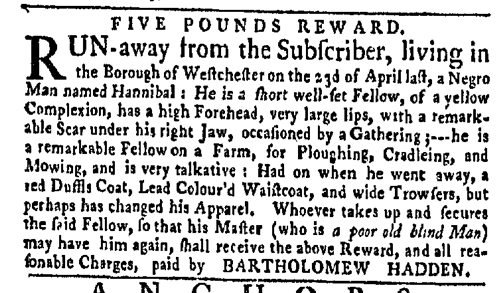
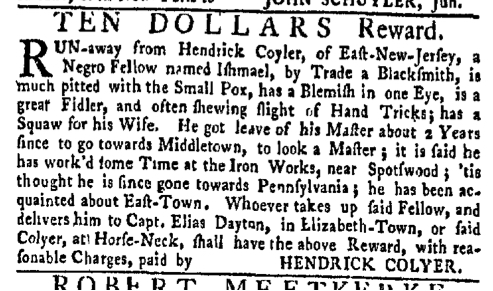
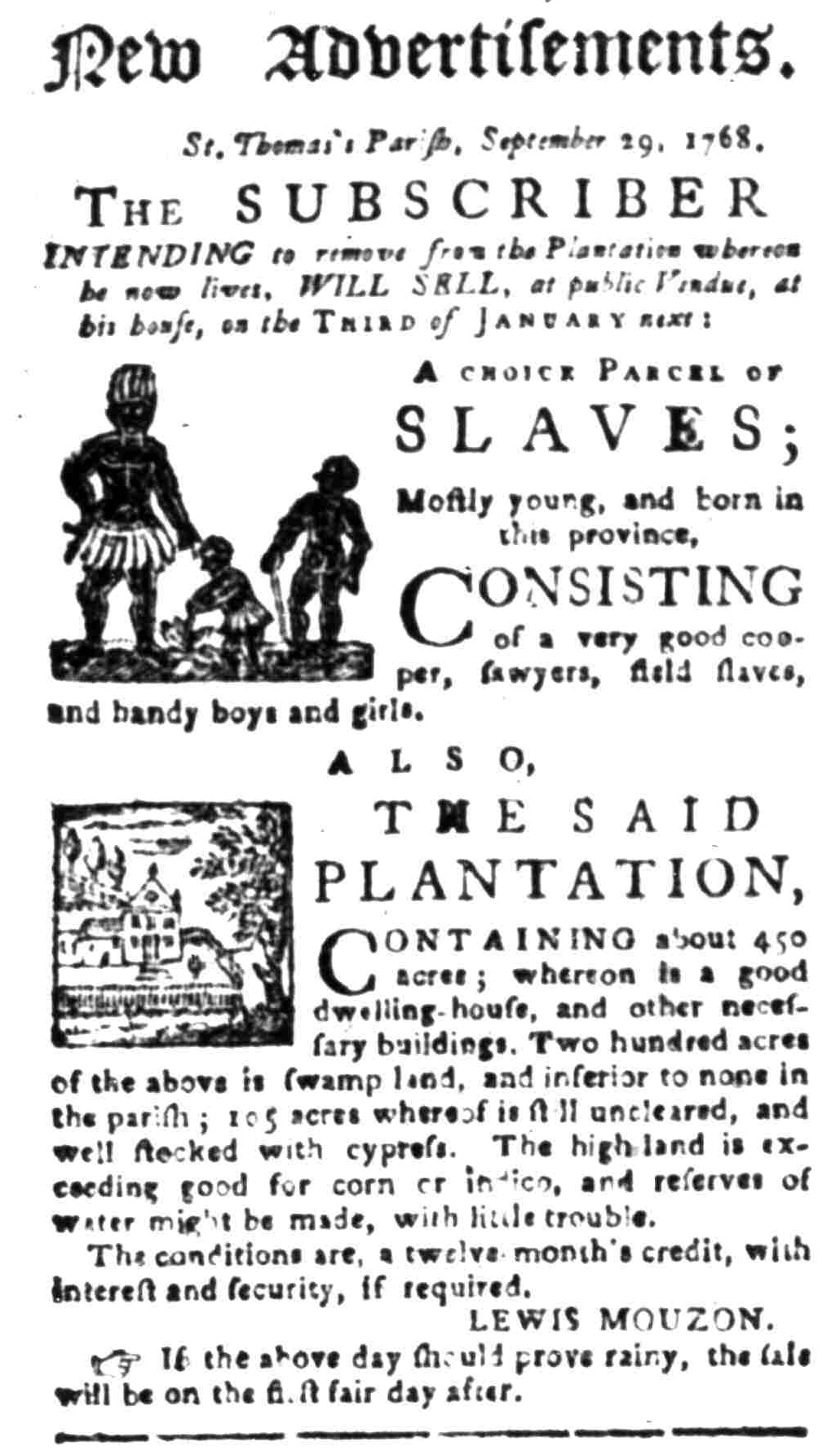
Slavery Advertisements Published October 7, 1768

GUEST CURATOR: Thomas Daley

The Slavery Adverts 250 Project chronicles the role of newspaper advertising in perpetuating slavery in the era of the American Revolution. The project seeks to reveal the ubiquity of slavery in eighteenth-century life from New England to Georgia by republishing advertisements for slaves – for sale, wanted to purchase, runaways, captured fugitives – in daily digests on this site as well as in real time via the @SlaveAdverts250 Twitter feed, utilizing twenty-first-century media to stand in for the print media of the eighteenth century.

The project aims to provide modern audiences with a sense of just how often colonists encountered these advertisements in their daily lives. Enslaved men, women, and children appeared in print somewhere in the colonies almost every single day. Those advertisements served as a constant backdrop for social, cultural, economic, and political life in colonial and revolutionary America. Colonists who did not own slaves were still confronted with slavery as well as invited to maintain the system by purchasing slaves or assisting in the capture of runaways. The frequency of these newspaper advertisements suggests just how embedded slavery was in colonial and revolutionary American culture in everyday interactions beyond the printed page.

These advertisements also testify to the experiences of enslaved men, women, and children, though readers must consider that those experiences have been remediated through descriptions offered by slaveholders rather than the slaves themselves. Often unnamed in the advertisements, enslaved men, women, and children were not invisible or unimportant in early America.

During the week of October 7-13, 2018, the Slavery Adverts 250 Project is guest curated by Thomas “Tommy” Daley (2019), a History major at Assumption College in Worcester, Massachusetts.

These advertisements appeared in colonial American newspapers 250 years ago today.

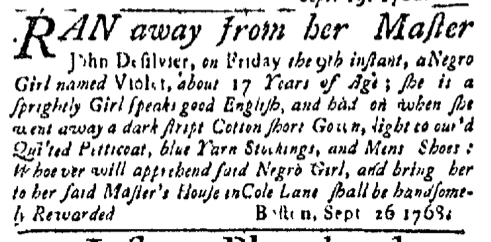
Oct 7 - New-London Gazette Slavery 1
New-London Gazette (October 7, 1768).

**********

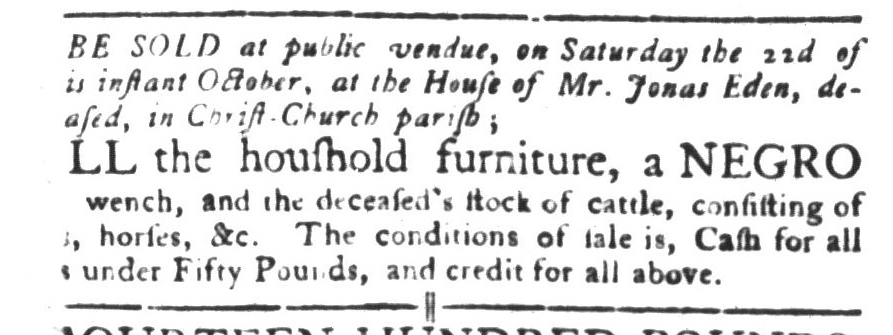
Oct 7 - South-Carolina and American General Gazette Slavery 1
South- Carolina and American General Gazette (October 7, 1768).

**********

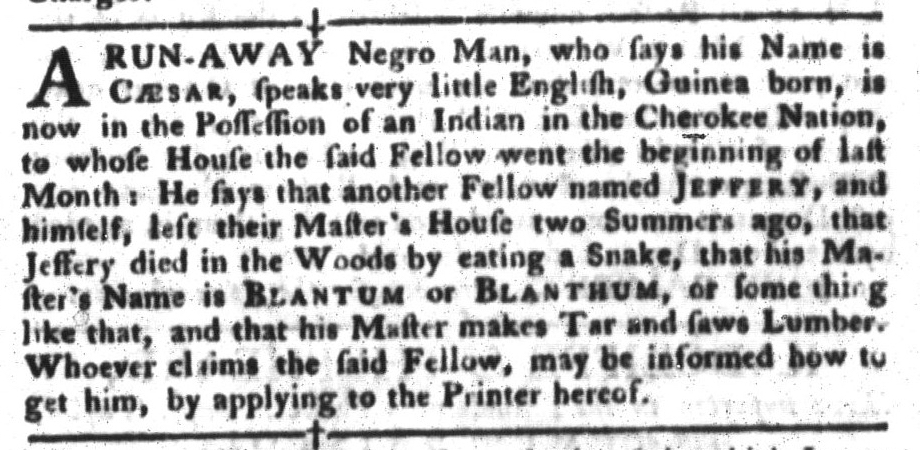
Oct 7 - South-Carolina and American General Gazette Slavery 2
South- Carolina and American General Gazette (October 7, 1768).

**********

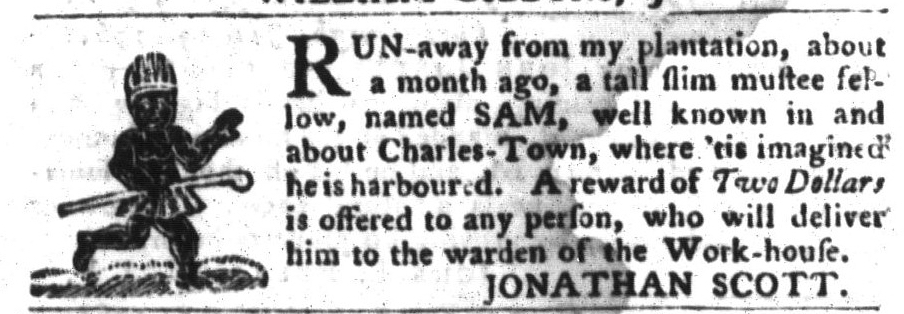
Oct 7 - South-Carolina and American General Gazette Slavery 3
South- Carolina and American General Gazette (October 7, 1768).

**********

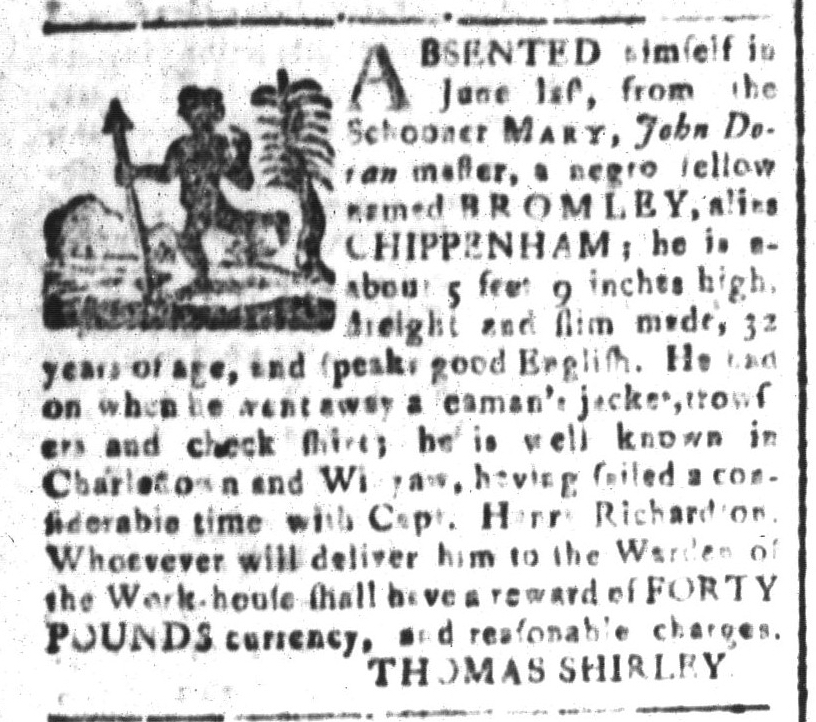
Oct 7 - South-Carolina and American General Gazette Slavery 4
South- Carolina and American General Gazette (October 7, 1768).

**********

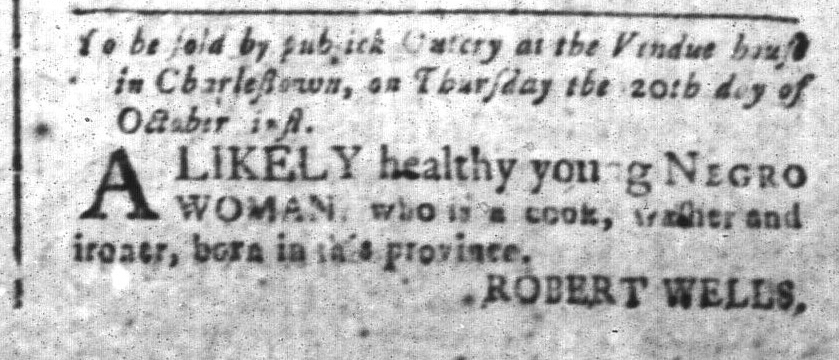
Oct 7 - South-Carolina and American General Gazette Slavery 5
South- Carolina and American General Gazette (October 7, 1768).

**********

Oct 7 - South-Carolina and American General Gazette Slavery 6
South- Carolina and American General Gazette (October 7, 1768).

October 6

What was advertised in a colonial American newspaper 250 years ago today?

Oct 6 - 10:6:1768 Pennsylvania Gazette
Pennsylvania Gazette (October 6, 1768).

“Encouraging all our own Manufactures.”

Shopping became an increasingly political act during the years of the imperial crisis that culminated with the American Revolution. As a means of resisting Parliament’s attempts to overstep its authority, colonists joined nonimportation agreements in the 1760s, first in response to the Stamp Act and later in response to the Townshend Act. They hoped to apply economic pressure to achieve political goals, drafting English merchants harmed by the boycotts to advocate on their behalf. At the same time, colonists also envisioned that “domestic manufactures” would reduce their dependence on goods imported from Britain. In the late 1760s advertisers increasingly addressed this public discourse as they devised “Buy American” campaigns in their advertisements.

Much of Benjamin Jackson and John Gibbons’s advertisement for their “Mustard and Chocolate Store” in Philadelphia expressed such concerns. The partners acknowledged that “there now seems a noble and magnanimous Disposition diffused, and daily diffusing itself more and more, amongst the British Colonies in America, of encouraging all our own Manufactures.” Jackson and Gibbons joined in that call. Because they were “desirous to contribute thereto all in their Power as Individuals,” they proclaimed that they sold their “flour of Mustard … at very low Profits by Wholesale Quantities.” They considered it their civic obligation to make their product as affordable as possible, even if that meant less profit for their own business. In turn, they hoped that this would “induce the true patriotic Merchants, Masters of Vessels, &c. trading to and from New-York, Boston, West Indies, Halifax, &c. to favour them with their Orders.” Jackson and Gibbons did their part, but the scheme depended on others, especially those who supplied “Flour of Mustard” to other colonies, participating as well. If they did, Jackson and Gibbons imagined their plan “would be a Means of annually vending some, perhaps several Hundred, Bushels of Mustard-seed, that might be raised here with little Trouble, and be as a net Gain to the Province.” That would shift the balance of trade that previously favored England. Even a “trifling article” like mustard could have a significant impact on commerce and, in turn, politics if enough suppliers and consumers opted for a product produced in the colonies.

Furthermore, Jackson and Gibbons directly addressed the provisions of the Townshend Act later in the advertisement. “For the Sake of those that are not inclined to encourage the Duty on Glass,” the partners had acquired “a Quantity of neat Earthen Jars” to package their wares. This had the advantage of “helping out own Earthen Ware” industry while depriving Parliament of revenues from the taxes placed on imported glassware. This also yielded additional savings for consumers since the earthenware jars cost “One Shilling per Dozen cheaper than Glass.” The partners still offered “neat Glass Bottles, as usual,” as an option, but they encouraged consumers to make decisions that reduced the demand for those containers.

Jackson and Gibbons made many of their customary appeals to price and quality in their lengthy advertisement, but they also devoted significant space to convincing potential customers – consumers, wholesalers, and retailers – about the political ramifications of their commercial decisions. They offered a means for “true patriotic” colonists to follow through on the rhetoric so often expressed in conversation and in the news and editorial items that appeared elsewhere in the newspaper.

Slavery Advertisements Published October 6, 1768

GUEST CURATOR: Damian Bryan

The Slavery Adverts 250 Project chronicles the role of newspaper advertising in perpetuating slavery in the era of the American Revolution. The project seeks to reveal the ubiquity of slavery in eighteenth-century life from New England to Georgia by republishing advertisements for slaves – for sale, wanted to purchase, runaways, captured fugitives – in daily digests on this site as well as in real time via the @SlaveAdverts250 Twitter feed, utilizing twenty-first-century media to stand in for the print media of the eighteenth century.

The project aims to provide modern audiences with a sense of just how often colonists encountered these advertisements in their daily lives. Enslaved men, women, and children appeared in print somewhere in the colonies almost every single day. Those advertisements served as a constant backdrop for social, cultural, economic, and political life in colonial and revolutionary America. Colonists who did not own slaves were still confronted with slavery as well as invited to maintain the system by purchasing slaves or assisting in the capture of runaways. The frequency of these newspaper advertisements suggests just how embedded slavery was in colonial and revolutionary American culture in everyday interactions beyond the printed page.

These advertisements also testify to the experiences of enslaved men, women, and children, though readers must consider that those experiences have been remediated through descriptions offered by slaveholders rather than the slaves themselves. Often unnamed in the advertisements, enslaved men, women, and children were not invisible or unimportant in early America.

During the week of September 30 through October 6, 2018, the Slavery Adverts 250 Project is guest curated by Damian Bryan (2019), a History major at Assumption College in Worcester, Massachusetts.

These advertisements appeared in colonial American newspapers 250 years ago today.

Oct 6 - Boston Weekly News-Letter Slavery 1
Boston Weekly News-Letter (October 6, 1768).

**********

Oct 6 - Boston Weekly News-Letter Slavery 2
Boston Weekly News-Letter (October 6, 1768).

**********

Oct 6 - Massachusetts Gazette Draper Slavery 1
Massachusetts Gazette [Draper] (October 6, 1768).

**********

Oct 6 - Pennsylvania Gazette Supplement Slavery 1
Supplement to the Pennsylvania Gazette (October 6, 1768).

**********

Oct 6 - Pennsylvania Gazette Supplement Slavery 2
Supplement to the Pennsylvania Gazette (October 6, 1768).

**********

Oct 6 - Virginia Gazette Purdie and Dixon Slavery 1
Virginia Gazette [Purdie and Dixon] (October 6, 1768).

**********

Oct 6 - Virginia Gazette Purdie and Dixon Slavery 2
Virginia Gazette [Purdie and Dixon] (October 6, 1768).

**********

Oct 6 - Virginia Gazette Purdie and Dixon Slavery 3
Virginia Gazette [Purdie and Dixon] (October 6, 1768).

**********

Oct 6 - Virginia Gazette Purdie and Dixon Slavery 4
Virginia Gazette [Purdie and Dixon] (October 6, 1768).

**********

Oct 6 - Virginia Gazette Purdie and Dixon Slavery 5
Virginia Gazette [Purdie and Dixon] (October 6, 1768).

**********

Oct 6 - Virginia Gazette Purdie and Dixon Slavery 6
Virginia Gazette [Purdie and Dixon] (October 6, 1768).

**********

Oct 6 - Virginia Gazette Purdie and Dixon Slavery 7
Virginia Gazette [Purdie and Dixon] (October 6, 1768).

**********

Oct 6 - Virginia Gazette Purdie and Dixon Slavery 8
Virginia Gazette [Purdie and Dixon] (October 6, 1768).

**********

Oct 6 - Virginia Gazette Purdie and Dixon Slavery 9
Virginia Gazette [Purdie and Dixon] (October 6, 1768).

**********

Oct 6 - Virginia Gazette Purdie and Dixon Slavery 10
Virginia Gazette [Purdie and Dixon] (October 6, 1768).

**********

Oct 6 - Virginia Gazette Rind Slavery 1
Virginia Gazette [Rind] (October 6, 1768).

**********

Oct 6 - Virginia Gazette Rind Slavery 2
Virginia Gazette [Rind] (October 6, 1768).

**********

Oct 6 - Virginia Gazette Rind Slavery 3
Virginia Gazette [Rind] (October 6, 1768).

**********

Oct 6 - Virginia Gazette Rind Slavery 4
Virginia Gazette [Rind] (October 6, 1768).

**********

Oct 6 - Virginia Gazette Rind Slavery 5
Virginia Gazette [Rind] (October 6, 1768).

**********

Oct 6 - Virginia Gazette Rind Slavery 6
Virginia Gazette [Rind] (October 6, 1768).

**********

Oct 6 - Virginia Gazette Rind Slavery 7
Virginia Gazette [Rind] (October 6, 1768).

**********

Oct 6 - Virginia Gazette Rind Slavery 8
Virginia Gazette [Rind] (October 6, 1768).

**********

Oct 6 - Virginia Gazette Rind Slavery 9
Virginia Gazette [Rind] (October 6, 1768).

**********

Oct 6 - Virginia Gazette Rind Slavery 10
Virginia Gazette [Rind] (October 6, 1768).

**********

Oct 6 - Virginia Gazette Rind Slavery 11
Virginia Gazette [Rind] (October 6, 1768).

**********

Oct 6 - Virginia Gazette Rind Slavery 12
Virginia Gazette [Rind] (October 6, 1768).

**********

Oct 6 - Virginia Gazette Rind Slavery 13
Virginia Gazette [Rind] (October 6, 1768).

**********

Oct 6 - Virginia Gazette Rind Slavery 14
Virginia Gazette [Rind] (October 6, 1768).

**********

Oct 6 - Virginia Gazette Rind Slavery 15
Virginia Gazette [Rind] (October 6, 1768).

October 5

What was advertised in a colonial American newspaper 250 years ago today?

Oct 5 - 10:5:1768 Georgia Gazette
Georgia Gazette (October 5, 1768).

“Mrs. Cosgreve would undertake to teach young Ladies to sew and read.”

Although several schoolmasters and –mistresses offered their services in Savannah in the late 1760s, James Cosgreve published one of the most extensive advertisements in the Georgia Gazette. The length was due in part to the schoolmaster’s description of his curriculum. Like his counterparts, he taught the basics of reading, writing, and arithmetic. However, he also delivered lessons in several other subjects not as widely taught by other schoolmasters in Georgia at the time. For instance, Cosgreve indicated that he provided instruction in “Mathematicks, such as the first six books of Euclid, with their application in the theory and practice of Trigonometry, Navigation, Surveying, Gnomicks, Astronomy, Geography, Algebra, and the Use of the Globes.” He also offered two tracks of language instruction to match the abilities and resources of his students. Advanced students learned Latin and Greek, but those who “cannot spend so much time at school as to acquire” those languages “to any degree of perfection” could instead study “the English and French tongues grammatically.” Cosgreve was well qualified to teach all of these subjects, “having acquired a competent skill and communicative faculty … by the laborious study and experience of a long course of years, in the most noted Seminaries, Academies, and Schools in Ireland, England, and America.”
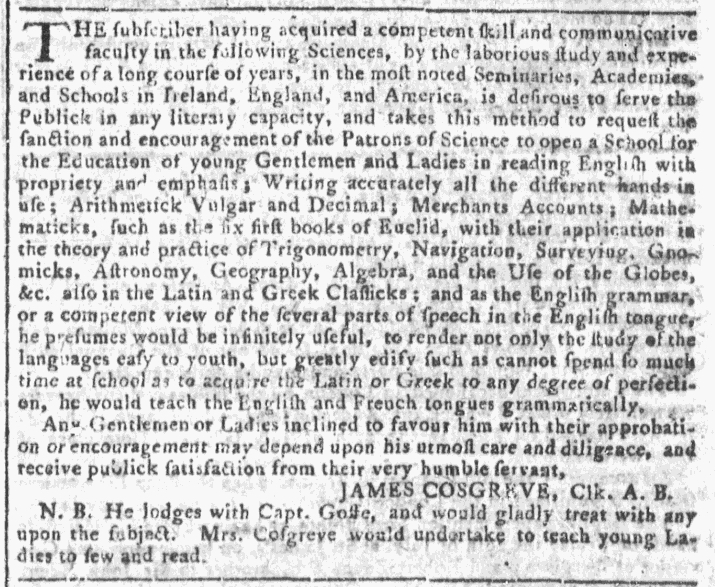
In a short nota bene Cosgreve first noted where he resided and then added that “Mrs. Cosgreve would undertake to teach young Ladies to sew and read.” Mrs. Cosgreve was not nearly as accomplished as her husband, yet she also contributed to their household economy by offering her services as a teacher. She too participated in the marketplace, yet the representation of her activities that appeared in the public prints was dramatically overshadowed by her husband’s lengthy narration of his credentials and subjects he taught. Such was often the case for wives of schoolmasters and others who provided goods and services. If their contributions to family businesses and household finances were acknowledged at all, they tended to be mentioned only briefly in the conclusions to advertisements, almost as an afterthought. Admittedly, James Cosgreve did require a greater amount of space to detail the many and varied subjects he proposed teaching to “young Gentlemen and Ladies,” but that did not mean that Mrs. Cosgreve’s parallel instruction in sewing and reading had to be consigned to a nota bene. The husband could have instead chosen to depict his wife as an assistant or junior partner while still maintaining his status as the head of a well-ordered household. Such an approach was not unknown in eighteenth-century advertisements placed by schoolmasters whose wives made contributions to the enterprise. In this case, however, Cosgreve may have believed that placing any more emphasis on his wife would have distracted from the image of himself, the atmosphere of genteel learning at his school, and the extensive curriculum that he sought to market to prospective students and their parents.

Slavery Advertisements Published October 5, 1768

GUEST CURATOR: Damian Bryan

The Slavery Adverts 250 Project chronicles the role of newspaper advertising in perpetuating slavery in the era of the American Revolution. The project seeks to reveal the ubiquity of slavery in eighteenth-century life from New England to Georgia by republishing advertisements for slaves – for sale, wanted to purchase, runaways, captured fugitives – in daily digests on this site as well as in real time via the @SlaveAdverts250 Twitter feed, utilizing twenty-first-century media to stand in for the print media of the eighteenth century.

The project aims to provide modern audiences with a sense of just how often colonists encountered these advertisements in their daily lives. Enslaved men, women, and children appeared in print somewhere in the colonies almost every single day. Those advertisements served as a constant backdrop for social, cultural, economic, and political life in colonial and revolutionary America. Colonists who did not own slaves were still confronted with slavery as well as invited to maintain the system by purchasing slaves or assisting in the capture of runaways. The frequency of these newspaper advertisements suggests just how embedded slavery was in colonial and revolutionary American culture in everyday interactions beyond the printed page.

These advertisements also testify to the experiences of enslaved men, women, and children, though readers must consider that those experiences have been remediated through descriptions offered by slaveholders rather than the slaves themselves. Often unnamed in the advertisements, enslaved men, women, and children were not invisible or unimportant in early America.

During the week of September 30 through October 6, 2018, the Slavery Adverts 250 Project is guest curated by Damian Bryan (2019), a History major at Assumption College in Worcester, Massachusetts.

These advertisements appeared in colonial American newspapers 250 years ago today.

Oct 5 - Georgia Gazette Slavery 1
Georgia Gazette (October 5, 1768).

**********

Oct 5 - Georgia Gazette Slavery 2
Georgia Gazette (October 5, 1768).

**********

Oct 5 - Georgia Gazette Slavery 3
Georgia Gazette (October 5, 1768).

**********

Oct 5 - Georgia Gazette Slavery 4
Georgia Gazette (October 5, 1768).

**********

Oct 5 - Georgia Gazette Slavery 5
Georgia Gazette (October 5, 1768).

**********

Oct 5 - Georgia Gazette Slavery 6
Georgia Gazette (October 5, 1768).

**********

Oct 5 - Georgia Gazette Slavery 7
Georgia Gazette (October 5, 1768).

October 4

What was advertised in a colonial American newspaper 250 years ago today?

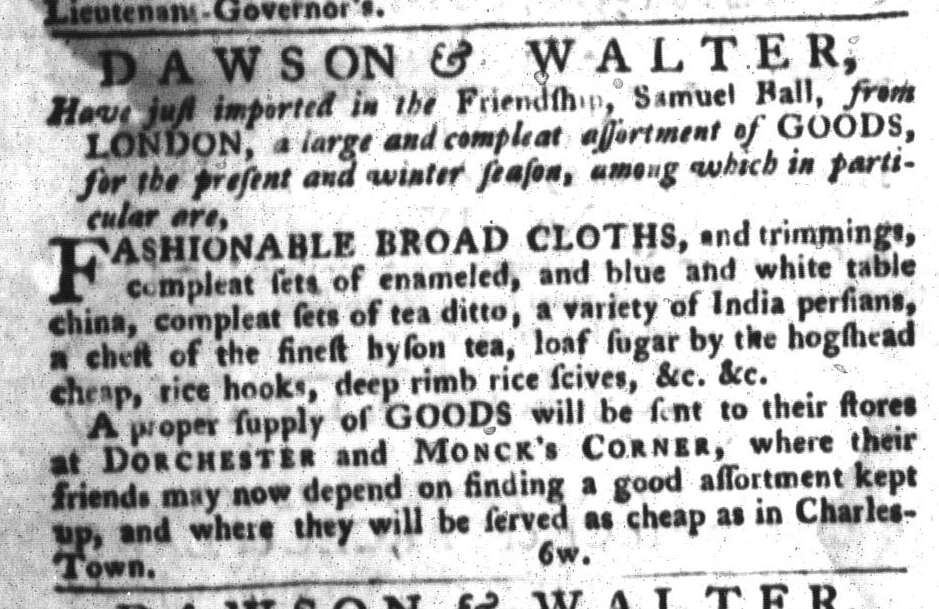
Oct 4 - 10:4:1768 South-Carolina Gazette and Country Journal
South-Carolina Gazette and Country Journal (October 4, 1768).

“A proper supply of GOODS will be sent to their stores at DORCHESTER and MONCK’S CORNER.”

For six weeks in the fall of 1768 the partnership of Dawson and Walter placed an advertisement in the South-Carolina Gazette and Country Journal to promote the “large and compleat assortment of GOODS, for the present and winter season” that they had imported from London. In addition to seasonal goods, their inventory included items that testified to the refinement of provincial consumers, especially when it came to apparel and housewares. From among the assortment of goods on hand, Dawson and Walter specifically enumerated “FASHIONABLE BROAD CLOTHS, and trimmings, compleat sets of enameled, and blue and white table china, [and] complete sets of tea ditto.”

Like many other colonial merchants and shopkeepers, Dawson and Walter did not address residents of Charleston exclusively. They also wished to cultivate customers among colonists who lived in the hinterlands surrounding the colony’s major port city. Some of their counterparts advertised that they accepted orders delivered by post or messenger and faithfully filled them, but Dawson and Walter instead opened additional shops in smaller towns to serve colonists outside of Charleston. They informed readers that “A proper supply of GOODS will be sent to their stores at DORCHESTER and MONCK’S CORNER, where their friends may now depend on finding a good assortment kept up.” Furthermore, the partners pledged that customers in the countryside would be “served as cheap as in Charles-Town.” In other words, convenience did not come at the expense of limited selections or higher prices. Those who shopped in Dorchester and Monck’s Corner could depend on choosing from among the same merchandise presented to customers in the bustling port. Despite their distance from Charleston – and their even greater distance from London, the cosmopolitan center of the empire – customers in the hinterlands could demonstrate their refinement by purchasing the same goods as consumers in the cities. Demand alone does not explain the extensive reach of the consumer revolution during the eighteenth century. Instead, entrepreneurs like Dawson and Walter who established shops beyond major cities and towns facilitated the distribution of consumer goods throughout the American colonies.

Slavery Advertisements Published October 4, 1768

GUEST CURATOR: Damian Bryan

The Slavery Adverts 250 Project chronicles the role of newspaper advertising in perpetuating slavery in the era of the American Revolution. The project seeks to reveal the ubiquity of slavery in eighteenth-century life from New England to Georgia by republishing advertisements for slaves – for sale, wanted to purchase, runaways, captured fugitives – in daily digests on this site as well as in real time via the @SlaveAdverts250 Twitter feed, utilizing twenty-first-century media to stand in for the print media of the eighteenth century.

The project aims to provide modern audiences with a sense of just how often colonists encountered these advertisements in their daily lives. Enslaved men, women, and children appeared in print somewhere in the colonies almost every single day. Those advertisements served as a constant backdrop for social, cultural, economic, and political life in colonial and revolutionary America. Colonists who did not own slaves were still confronted with slavery as well as invited to maintain the system by purchasing slaves or assisting in the capture of runaways. The frequency of these newspaper advertisements suggests just how embedded slavery was in colonial and revolutionary American culture in everyday interactions beyond the printed page.

These advertisements also testify to the experiences of enslaved men, women, and children, though readers must consider that those experiences have been remediated through descriptions offered by slaveholders rather than the slaves themselves. Often unnamed in the advertisements, enslaved men, women, and children were not invisible or unimportant in early America.

During the week of September 30 through October 6, 2018, the Slavery Adverts 250 Project is guest curated by Damian Bryan (2019), a History major at Assumption College in Worcester, Massachusetts.

These advertisements appeared in colonial American newspapers 250 years ago today.

Oct 4 - Essex Gazette Slavery 1
Essex Gazette (October 4, 1768).

**********

Oct 4 - South-Carolina Gazette and Country Journal Slavery 1
South-Carolina Gazette and Country Journal (October 4, 1768).

**********

Oct 4 - South-Carolina Gazette and Country Journal Slavery 2
South-Carolina Gazette and Country Journal (October 4, 1768).

**********

Oct 4 - South-Carolina Gazette and Country Journal Slavery 3
South-Carolina Gazette and Country Journal (October 4, 1768).

**********

Oct 4 - South-Carolina Gazette and Country Journal Slavery 4
South-Carolina Gazette and Country Journal (October 4, 1768).

**********

Oct 4 - South-Carolina Gazette and Country Journal Slavery 5
South-Carolina Gazette and Country Journal (October 4, 1768).

**********

Oct 4 - South-Carolina Gazette and Country Journal Supplement Slavery 1
Supplement to the South-Carolina Gazette and Country Journal (October 4, 1768).

**********

Oct 4 - South-Carolina Gazette and Country Journal Supplement Slavery 2
Supplement to the South-Carolina Gazette and Country Journal (October 4, 1768).

October 3

What was advertised in a colonial American newspaper 250 years ago today?

Oct 3 - 10:3:1768 New-York Gazette Weekly Mercury
New-York Gazette and Weekly Mercury (October 3, 1768).

“JUST imported by ADAM GILCHRIST.”

Hugh Gaine, the printer of the New-York Gazette and Weekly Mercury, took in so many advertisements that he could not fit all of them in the standard four-page issue for October 3, 1768. In addition to two pages of advertising in the regular issue, Gaine distributed a two-page supplement comprised solely of advertisements. That still did not provide sufficient space for all of the paid notices submitted to the printing shop at the Sign of the Bible and Crown in Hanover Square. Either Gaine or the compositor who set the type for the October 3 edition made space for inserting four additional advertisements on the second and third pages by printing them in the margins.

The first and fourth pages appeared as usual: three columns on each page as well as the masthead and prices current running across the top of the first page. The second and third pages, however, each had a slender fourth column created by rotating the text of short advertisements and setting them perpendicular to the rest of the content. These advertisements appeared in the left margin of the second page and the right margin of the third page, positioned away from the fold that separated the two pages.

This strategy required selecting short advertisements to divide into columns. For instance, the second page featured two short advertisements: nine lines from Adam Gilchrist promoting textiles he had recently imported and five lines announcing an employment opportunity for “A Person qualified to teach three or four Children, in a Gentleman’s Family.” These notices had the same width as other advertisements and news content throughout the rest of the New-York Gazette and Weekly Mercury yet they were broken into several columns to fit them in the margins. If necessary, the several columns of each could be combined into one and printed elsewhere in subsequent issues without having to set the type from scratch.

The unconventional placement of these advertisements may have given them more visibility than if they had appeared in the long columns amidst other paid notices. Their position on the page may have incited curiosity among readers, yielding a benefit for the advertisers even as Gaine and the compositor sought to solve the problem of having too much content for the current issue of the New-York Gazette and Weekly Mercury. Many printers throughout the colonies resorted to this trick on occasion, yet not so frequently that the unusual placement of these advertisements would have passed without notice.

Slavery Advertisements Published October 3, 1768

GUEST CURATOR: Damian Bryan

The Slavery Adverts 250 Project chronicles the role of newspaper advertising in perpetuating slavery in the era of the American Revolution. The project seeks to reveal the ubiquity of slavery in eighteenth-century life from New England to Georgia by republishing advertisements for slaves – for sale, wanted to purchase, runaways, captured fugitives – in daily digests on this site as well as in real time via the @SlaveAdverts250 Twitter feed, utilizing twenty-first-century media to stand in for the print media of the eighteenth century.

The project aims to provide modern audiences with a sense of just how often colonists encountered these advertisements in their daily lives. Enslaved men, women, and children appeared in print somewhere in the colonies almost every single day. Those advertisements served as a constant backdrop for social, cultural, economic, and political life in colonial and revolutionary America. Colonists who did not own slaves were still confronted with slavery as well as invited to maintain the system by purchasing slaves or assisting in the capture of runaways. The frequency of these newspaper advertisements suggests just how embedded slavery was in colonial and revolutionary American culture in everyday interactions beyond the printed page.

These advertisements also testify to the experiences of enslaved men, women, and children, though readers must consider that those experiences have been remediated through descriptions offered by slaveholders rather than the slaves themselves. Often unnamed in the advertisements, enslaved men, women, and children were not invisible or unimportant in early America.

During the week of September 30 through October 6, 2018, the Slavery Adverts 250 Project is guest curated by Damian Bryan (2019), a History major at Assumption College in Worcester, Massachusetts.

These advertisements appeared in colonial American newspapers 250 years ago today.

Oct 3 - Boston-Gazette Slavery 1
Boston-Gazette (October 3, 1768).

**********

Oct 3 - Boston-Gazette Slavery 2
Boston-Gazette (October 3, 1768).

**********

Oct 3 - Boston-Gazette Slavery 3
Boston-Gazette (October 3, 1768).

**********

Oct 3 - Massachusetts Gazette Green and Russell Slavery 1
Massachusetts Gazette [Green and Russell] (October 3, 1768).

**********

Oct 3 - New-York Gazette Weekly Mercury Slavery 1
New-York Gazette and Weekly Mercury (October 3, 1768).

**********

Oct 3 - New-York Gazette Weekly Mercury Supplement Slavery 1
Supplement to the New-York Gazette and Weekly Mercury (October 3, 1768).

**********

Oct 3 - New-York Gazette Weekly Mercury Supplement Slavery 2
Supplement to the New-York Gazette and Weekly Mercury (October 3, 1768).

**********

Oct 3 - South-Carolina Gazette Slavery 1
South-Carolina Gazette (October 3, 1768).

**********

Oct 3 - South-Carolina Gazette Slavery 2
South-Carolina Gazette (October 3, 1768).

**********

Oct 3 - South-Carolina Gazette Slavery 3
South-Carolina Gazette (October 3, 1768).

**********

Oct 3 - South-Carolina Gazette Slavery 4
South-Carolina Gazette (October 3, 1768).

**********

Oct 3 - South-Carolina Gazette Slavery 5
South-Carolina Gazette (October 3, 1768).

**********

Oct 3 - South-Carolina Gazette Slavery 6
South-Carolina Gazette (October 3, 1768).