October 19

Who was the subject of an advertisement in a colonial American newspaper 250 years ago today?
Oct 19 - 10:19:1768 Georgia Gazette
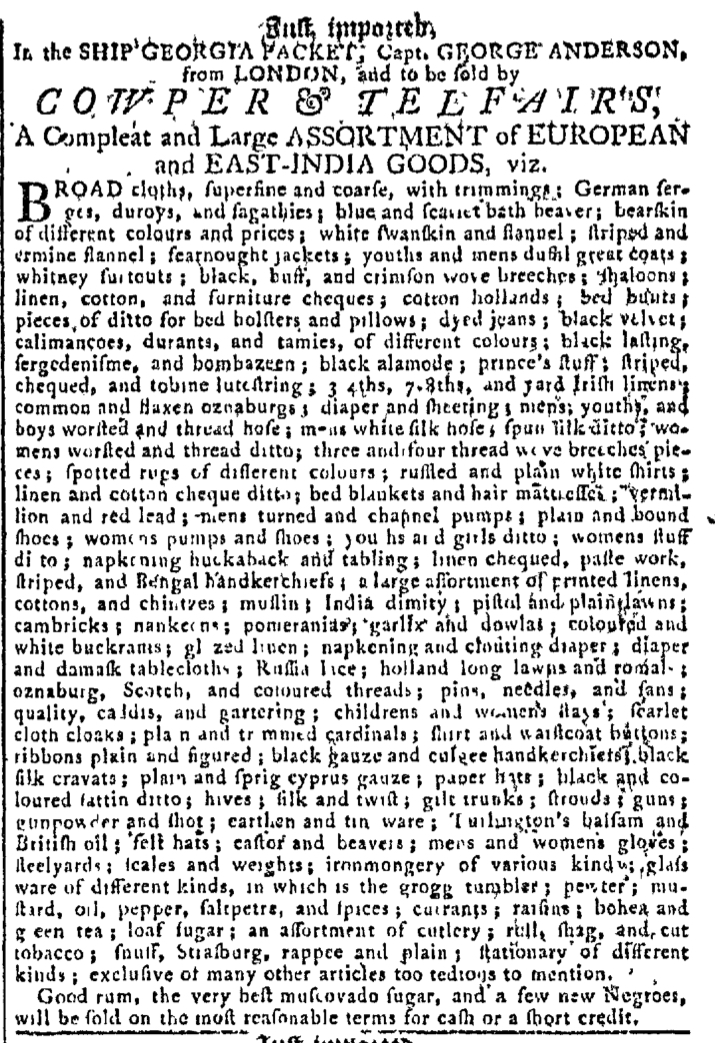
Georgia Gazette (October 19, 1768).

“A few new Negroes, will be sold on the most reasonable terms.”

The partnership of Cowper and Telfairs repeatedly inserted a list-style advertisement in the Georgia Gazette in the fall of 1768. Extending nearly half a column, the advertisement enumerated dozens of items included among the “Compleat and Large ASSORTMENT of EUROPEAN and EAST-INDIA GOODS” that Cowper and Telfairs had imported from London. Their inventory included everything from “black, buff, and crimson wove breeches” to “a large assortment of printed linens, cottons, and chintzes” to “gunpowder and shot” to “ironmongery of various kinds.” To further underscore the vast array of choices they made available to consumers, the partners indicated that all the merchandise listed in their advertisement was “exclusive of many other articles too tedious to mention.”

Running this sort of advertisement was a familiar strategy for Cowper and Telfairs. Although they did not maintain a constant presence in the Georgia Gazette, they periodically placed similar notices. For instance, they inserted a notice of a comparable length the previous fall as well as a shorter one two years earlier. This advertisement, however, included one commodity that distinguished it from some of those earlier advertisements. Cowper and Telfairs trafficked in slaves, reducing “a few new Negroes” to goods to be sold alongside “glass ware of different kinds” and “womens pumps and shoes.”

The advertisement concluded with a short paragraph that consisted of only two lines. It listed three items presumably shipped from the Caribbean rather than via “the SHIP GEORGIA PACKET … from LONDON.” In addition to textiles, housewares, and hardware, Cowper and Telfairs advised that “Good rum, the very best muscovado sugar, and a few new Negroes, will be sold on the most reasonable terms for cash or a short credit.” The trade in enslaved men, women, and children was so enmeshed in the networks of exchange that crisscrossed the Atlantic in the eighteenth century that neither the advertisers who placed hits notice nor the prospective customers who read it would have considered it peculiar to mention human commodities almost as an afterthought after the fans, buttons, and so many other baubles that comprised the rest of the advertisement.

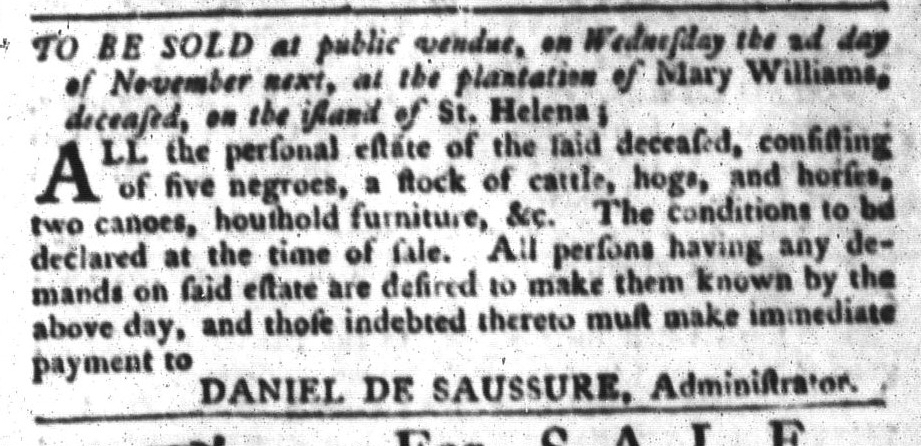
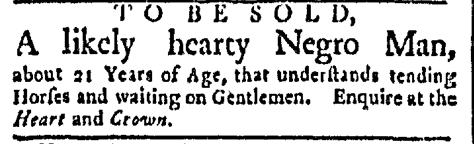
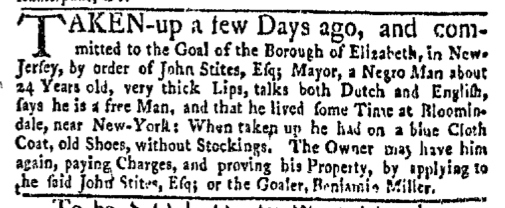
Advertisements for slaves were ubiquitous in colonial newspapers, especially the Georgia Gazette. Notices concerning enslaved people for sale, runaways, and captured fugitives generated revenues that contributed to the continued operation of eighteenth-century newspapers. Those notices also harnessed the power of print to buttress a system of exploitation, inviting all readers, whether they owned slaves or not, to participate in buying and selling enslaved people as well as encouraging them to participate in the surveillance of black people to capture any who attempted to escape. Many of these advertisements were easy to recognize at a glance because they exclusively focused on slaves for sale or fugitives, but today’s advertisement from Cowper and Telfairs demonstrates that even some advertisements that did not focus primarily on enslaved people undergirded the system of bondage in early America. The casual mention of “a few new Negroes” at the end of an extensive list of merchandise suggested the impossibility of separating slavery from commerce in Georgia on the eve of the American Revolution.

Slavery Advertisements Published October 19, 1768

GUEST CURATOR: Marny Fappiano

The Slavery Adverts 250 Project chronicles the role of newspaper advertising in perpetuating slavery in the era of the American Revolution. The project seeks to reveal the ubiquity of slavery in eighteenth-century life from New England to Georgia by republishing advertisements for slaves – for sale, wanted to purchase, runaways, captured fugitives – in daily digests on this site as well as in real time via the @SlaveAdverts250 Twitter feed, utilizing twenty-first-century media to stand in for the print media of the eighteenth century.

The project aims to provide modern audiences with a sense of just how often colonists encountered these advertisements in their daily lives. Enslaved men, women, and children appeared in print somewhere in the colonies almost every single day. Those advertisements served as a constant backdrop for social, cultural, economic, and political life in colonial and revolutionary America. Colonists who did not own slaves were still confronted with slavery as well as invited to maintain the system by purchasing slaves or assisting in the capture of runaways. The frequency of these newspaper advertisements suggests just how embedded slavery was in colonial and revolutionary American culture in everyday interactions beyond the printed page.

These advertisements also testify to the experiences of enslaved men, women, and children, though readers must consider that those experiences have been remediated through descriptions offered by slaveholders rather than the slaves themselves. Often unnamed in the advertisements, enslaved men, women, and children were not invisible or unimportant in early America.

During the week of October 14-20, 2018, the Slavery Adverts 250 Project is guest curated by Marny Fappiano (2019), a History major at Assumption College in Worcester, Massachusetts.

These advertisements appeared in colonial American newspapers 250 years ago today.

Oct 19 - Georgia Gazette Slavery 1
Georgia Gazette (October 19, 1768).

**********

Oct 19 - Georgia Gazette Slavery 2
Georgia Gazette (October 19, 1768).

**********

Oct 19 - Georgia Gazette Slavery 3
Georgia Gazette (October 19, 1768).

**********

Oct 19 - Georgia Gazette Slavery 4
Georgia Gazette (October 19, 1768).

**********

Oct 19 - Georgia Gazette Slavery 5
Georgia Gazette (October 19, 1768).

**********

Oct 19 - Georgia Gazette Slavery 6
Georgia Gazette (October 19, 1768).

**********

Oct 19 - Georgia Gazette Slavery 7
Georgia Gazette (October 19, 1768).

**********

Oct 19 - Georgia Gazette Slavery 8
Georgia Gazette (October 19, 1768).

October 18

What was advertised in a colonial American newspaper 250 years ago today?

Oct 18 - 10:18:1768 South-Carolina Gazette and Country Journal
South-Carolina Gazette and Country Journal (October 18, 1768).

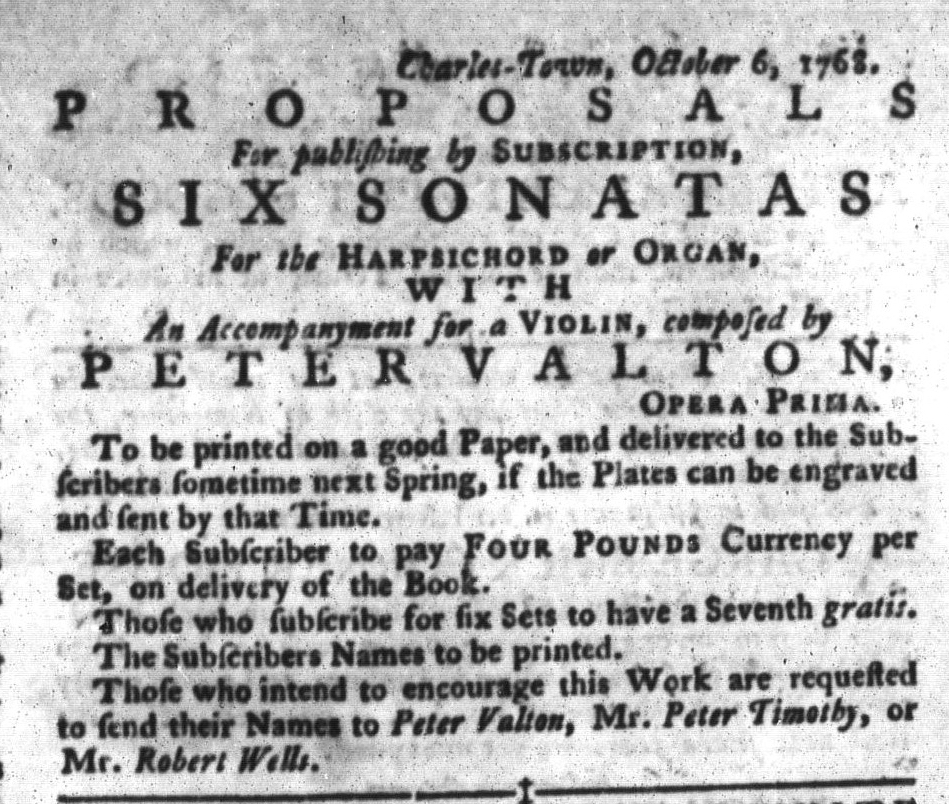
“Those who intend to encourage this Work are requested to send their Names to Peter Valton, Mr. Peter Timothy, or Mr. Robert Wells.”

When it came to publishing newspapers, Peter Timothy, Robert Wells, and Charles Crouch were competitors. All three operated printing shops in Charleston, where Timothy published the South-Carolina Gazette, Wells published the South-Carolina and American General Gazette, and Crouch published the South-Carolina Gazette and Country Journal. This did not, however, preclude their cooperation when it came to other ventures.

In the fall of 1768, Peter Valton circulated a subscription notice that announced his intention to publish “SIX SONATAS For the HARPSICHORD or ORGAN, WITH An Accompanyment for a VIOLIN.” Valton intended for the subscription notice to incite demand. For instance, he highlighted the quality of the paper, promised to print the names of subscribers in recognition of their support for this genteel endeavor, and offered to provide a seventh copy free to anyone who pledged to purchase six. Valton also used the subscription notice to gauge interest in the project. He needed to know if he could attract enough subscribers to make it a viable venture and, if so, how many copies to print without ending up with an unprofitable surplus. To that end, he instructed, “Those who intend to encourage this Work are requested to send their Names to Peter Valton, Mr. Peter Timothy, or Mr. Robert Wells.” When Valton inserted the advertisement in the October 18 edition of the South-Carolina Gazette and Country Journal, its appearance brought together all three of Charleston’s newspaper publishers.

All three stood to profit from the venture, either directly or indirectly. According to Odai Johnson, Wells was the intended printer.[1] Robust sales of the prospective publication would certainly benefit him. Yet all three printers generated revenues by publishing Valton’s subscription notice in their newspapers. Timothy further lent support for the project by collecting the names of subscribers. Promoting a culture of consumption contributed to their livelihoods, even if they were not the producers or purveyors of the printed materials advertised in their newspapers.

**********

[1] Odai Johnson, London in a Box: Englishness and Theatre in Revolutionary America (Iowa City: University of Iowa Press, 2017), 167.

Slavery Advertisements Published October 18, 1768

GUEST CURATOR: Marny Fappiano

The Slavery Adverts 250 Project chronicles the role of newspaper advertising in perpetuating slavery in the era of the American Revolution. The project seeks to reveal the ubiquity of slavery in eighteenth-century life from New England to Georgia by republishing advertisements for slaves – for sale, wanted to purchase, runaways, captured fugitives – in daily digests on this site as well as in real time via the @SlaveAdverts250 Twitter feed, utilizing twenty-first-century media to stand in for the print media of the eighteenth century.

The project aims to provide modern audiences with a sense of just how often colonists encountered these advertisements in their daily lives. Enslaved men, women, and children appeared in print somewhere in the colonies almost every single day. Those advertisements served as a constant backdrop for social, cultural, economic, and political life in colonial and revolutionary America. Colonists who did not own slaves were still confronted with slavery as well as invited to maintain the system by purchasing slaves or assisting in the capture of runaways. The frequency of these newspaper advertisements suggests just how embedded slavery was in colonial and revolutionary American culture in everyday interactions beyond the printed page.

These advertisements also testify to the experiences of enslaved men, women, and children, though readers must consider that those experiences have been remediated through descriptions offered by slaveholders rather than the slaves themselves. Often unnamed in the advertisements, enslaved men, women, and children were not invisible or unimportant in early America.

During the week of October 14-20, 2018, the Slavery Adverts 250 Project is guest curated by Marny Fappiano (2019), a History major at Assumption College in Worcester, Massachusetts.

These advertisements appeared in colonial American newspapers 250 years ago today.

Oct 18 - South-Carolina Gazette and Country Journal Slavery 1
South-Carolina Gazette and Country Journal (October 18, 1768).

**********

Oct 18 - South-Carolina Gazette and Country Journal Slavery 2
South-Carolina Gazette and Country Journal (October 18, 1768).

**********

Oct 18 - South-Carolina Gazette and Country Journal Slavery 3
South-Carolina Gazette and Country Journal (October 18, 1768).

**********

Oct 18 - South-Carolina Gazette and Country Journal Slavery 4
South-Carolina Gazette and Country Journal (October 18, 1768).

**********

Oct 18 - South-Carolina Gazette and Country Journal Slavery 5
South-Carolina Gazette and Country Journal (October 18, 1768).

**********

Oct 18 - South-Carolina Gazette and Country Journal Slavery 6
South-Carolina Gazette and Country Journal (October 18, 1768).

**********

Oct 18 - South-Carolina Gazette and Country Journal Slavery 7
South-Carolina Gazette and Country Journal (October 18, 1768).

**********

Oct 18 - South-Carolina Gazette and Country Journal Slavery 8
South-Carolina Gazette and Country Journal (October 18, 1768).

**********

Oct 18 - South-Carolina Gazette and Country Journal Slavery 9
South-Carolina Gazette and Country Journal (October 18, 1768).

October 17

What was advertised in a colonial American newspaper 250 years ago today?

Oct 17 - 10:17:1768 New-York Gazette Weekly Mercury
New-York Gazette and Weekly Mercury (October 17, 1768)

“I also expect by the first vessels from London and Bristol, a number of other articles suitable for the season.”

In the fall of 1768 Eleazer Miller, Jr., placed an advertisement in the New-York Gazette and Weekly Mercury to promote the “neat assortment of Goods fit for the Season” that he had “just imported.” Miller’s inventory included a variety of textiles, garments, and adornments, including an “assortment of silk handkerchiefs, mens black cravats, [and] womens Barcelona handkerchiefs.” Like many other merchants and shopkeepers, he indicated the English ports where shipments of those goods had originated. Some had arrived “from London, per Capts. Gilchrist, Farquhar, Mund, & Miller” and others via the “last vessels from Bristol.” Doing so helped to confirm that Miller carried new merchandise. He assumed that readers would be familiar with the vessels that had recently arrived in port. Those who were not could compare Miller’s list to the shipping news, a list of ships, captains, and ports of origin provided by the customs house.

Yet Miller did not solely market goods “just imported” from English cities. He also encouraged prospective customers to anticipate other merchandise that would arrive soon. After listing dozens of items already in stock, Miller noted, “I also expect by the first vessels from London and Bristol, a number of other articles suitable for the season, which will also be sold cheap.” Perhaps Miller hoped that prospective customers would make their way to his store in Hanover Square regularly to see what kinds of new items had arrived since their last visit. Announcing that he expected additional shipments let consumers know that he did not allow the inventory on his shelves to stagnate, nor did he expect shoppers to accept whatever goods happened to remain. Instead, he refreshed his wares to better serve his customers … at least for the moment.

In addition to such concerns, Miller also faced a deadline of sorts. On August 27, “nearly all the Merchants and Traders in Town” had subscribed to a nonimportation agreement in response to the taxes levied by the Townshend Act. Their resolution appeared in the September 8, 1768, edition of the New-York Journal. The first resolution stated that they “will not send for from Great-Britain, either upon our own Account or on Commission, any other Goods than what we have already ordered.” By underscoring that he expected the imminent arrival of new merchandise via vessels from London and Bristol, Miller could claim that these were goods that he had “already ordered” and that they did not violate the nonimportation agreement. Furthermore, the second resolution stated that the city’s merchants and traders “will not import any kind of Merchandise from Great-Britain, either on our own Account or on Commission … that shall be shipped from Great-Britain after the First Day of November.” Again, by emphasizing that any new merchandise in his shop would arrive on “the first vessels from London and Bristol” Miller suggested that he abided by the parameters of the nonimportation agreement.

Merchants and shopkeepers in New York subscribed to their nonimportation agreement only after stockpiling goods to sell to local consumers. By skating right up to the deadlines for ceasing orders and deliveries, Miller did not explicitly mention the nonimportation agreements but he did send a message to prospective customers with a wink and a nod. Even as colonists extolled the virtues of resistance through their endorsements of nonimportation they could continue many of their usual habits of consumption. The new merchandise at Miller’s store provided the means for doing so.

Slavery Advertisements Published October 17, 1768

GUEST CURATOR: Marny Fappiano

The Slavery Adverts 250 Project chronicles the role of newspaper advertising in perpetuating slavery in the era of the American Revolution. The project seeks to reveal the ubiquity of slavery in eighteenth-century life from New England to Georgia by republishing advertisements for slaves – for sale, wanted to purchase, runaways, captured fugitives – in daily digests on this site as well as in real time via the @SlaveAdverts250 Twitter feed, utilizing twenty-first-century media to stand in for the print media of the eighteenth century.
The project aims to provide modern audiences with a sense of just how often colonists encountered these advertisements in their daily lives. Enslaved men, women, and children appeared in print somewhere in the colonies almost every single day. Those advertisements served as a constant backdrop for social, cultural, economic, and political life in colonial and revolutionary America. Colonists who did not own slaves were still confronted with slavery as well as invited to maintain the system by purchasing slaves or assisting in the capture of runaways. The frequency of these newspaper advertisements suggests just how embedded slavery was in colonial and revolutionary American culture in everyday interactions beyond the printed page.

These advertisements also testify to the experiences of enslaved men, women, and children, though readers must consider that those experiences have been remediated through descriptions offered by slaveholders rather than the slaves themselves. Often unnamed in the advertisements, enslaved men, women, and children were not invisible or unimportant in early America.

During the week of October 14-20, 2018, the Slavery Adverts 250 Project is guest curated by Marny Fappiano (2019), a History major at Assumption College in Worcester, Massachusetts.

These advertisements appeared in colonial American newspapers 250 years ago today.

Oct 17 - Boston Evening-Post Slavery 1
Boston Evening-Post (October 17, 1768).

**********

Oct 17 - Boston Post-Boy Slavery 1
Boston Post-Boy (October 17, 1768).

**********

Oct 17 - Boston-Gazette Slavery 1
Boston-Gazette (October 17, 1768).

**********

Oct 17 - Boston-Gazette Slavery 2
Boston-Gazette (October 17, 1768).

**********

Oct 17 - Boston-Gazette Slavery 3
Boston-Gazette (October 17, 1768).

**********

Oct 17 - Boston-Gazette Slavery 4
Boston-Gazette (October 17, 1768).

**********

Oct 17 - New-York Gazette Weekly Mercury Slavery 1
New-York Gazette and Weekly Mercury (October 17, 1768).

**********

Oct 17 - New-York Gazette Weekly Mercury Slavery 2
New-York Gazette and Weekly Mercury (October 17, 1768).

**********

Oct 17 - New-York Gazette Weekly Mercury Slavery 3
New-York Gazette and Weekly Mercury (October 17, 1768).

**********

Oct 17 - New-York Gazette Weekly Post-Boy Slavery 1
New-York Gazette: Or, the Weekly Post-Boy (October 17, 1768).

**********

Oct 17 - Newport Mercury Slavery 1
Newport Mercury (October 17, 1768).

**********

Oct 17 - Newport Mercury Slavery 2
Newport Mercury (October 17, 1768).

**********

Oct 17 - South-Carolina Gazette Slavery 1
South-Carolina Gazette (October 17, 1768).

**********

Oct 17 - South-Carolina Gazette Slavery 2
South-Carolina Gazette (October 17, 1768).

**********

Oct 17 - South-Carolina Gazette Slavery 3
South-Carolina Gazette (October 17, 1768).

October 16

What was advertised in a colonial American newspaper 250 years ago today?

Oct 16 - 10:16:1768 South-Carolina Gazette
South-Carolina Gazette (October 17, 1768, but misdated October 16, 1768).

“A FRESH ASSORTMENT of GOODS, proper for the present and approaching season.”

At a glance, Paul Townsend’s advertisement for a “FRESH ASSORTMENT of GOODS, proper for the present and approaching season” would seem to have been published on October 16, 1768. After all, it appeared on the front page of the October 16, 1768, edition of the South-Carolina Gazette. Most modern readers would not think twice about that date when examining a single issue of the South-Carolina Gazette, but anyone perusing several consecutive issues would notice a discrepancy.

Like other newspapers of the colonial era, the South-Carolina Gazette was published only once a week, with the exception of occasional supplements and extraordinaries. According to the dates embedded in the masthead of the issues from October 1768, Peter Timothy distributed new editions on October 3, 10, 16, 24, and 31. The issue from October 16 deviates from the seven-day interval that usually fell between issues, suggesting something out of the ordinary with that issue.

It was possible that Timothy could have released an issue a day early. Others printers did so on rare occasions. However, the South-Carolina Gazette was regularly published on Mondays. Colonial printers did not circulate new issues on Sundays. Indeed, Sunday was the only day of the week that did not see the publication of at least one newspaper somewhere in colonial America. Most printers published their newspapers on Mondays and Thursdays, but a few also published on Tuesdays, Wednesdays, Fridays, and Saturdays. It would have been extremely exceptional for Timothy to publish the South-Carolina Gazette on a Sunday. Nothing in the issue under consideration merited doing so.

Indeed, the masthead reads “MONDAY, OCTOBER 16, 1768.” A summary of local news from “CHARLES-TOWN” on the third page, however, bears that date “October 17.” All of this evidence makes it clear that the compositor made a mistake when updating the issue number and date of what should have been the October 17 edition of the South-Carolina Gazette.

This minor discrepancy may not seem to matter much in telling the story of the American experience during the period of the imperial crisis that ultimately became the American Revolution. It does, however, provide a stark example for demonstrating to students the importance of noticing the details and identifying patterns among the sources they examine. If the date on the issue had been accurate, if it had been published on October 16, the contents would have demanded even greater scrutiny to determine what the printer considered so momentous to deem publication on a Sunday imperative. The details led to a false alarm in this instance, but in other cases noticing such deviations from the printing practices of the era can lead readers to coverage of significant events. For instance, the New-Hampshire Gazette, usually published on Fridays, appeared a day early on Thursday, May 22, 1766. Colonial newspapers rarely incorporated headlines. This one, however, announced “Total Repeal of the STAMP-ACT.” The printers rushed to press a day early to spread the breaking news about such a significant story.

October 15

What was advertised in a colonial American newspaper 250 years ago today?

Oct 15 - 10:15:1768 Providence Gazette
Providence Gazette (October 15, 1768).

“Leather and Breeches may also be had at said Nash’s Store, the Sign of the Buck and Glove.”

When Joseph Nash advertised a “large Parcel of Deers Leather” and “Buckskin Breeches” in the Providence Gazette in the fall of 1768, he informed readers that they could purchase these items at two locations in Providence. Prospective customers could deal directly with Nash “At the North End of the Town of Providence.” Alternately, they could also visit “Nash’s Store, the Sign of the Buck and Glove, just below the Mill-Bridge, in Providence.” Nash reported that Levi Hall and N. Metcalf, “Leather-Dressers,” had set up shop at that location. It appears that Hall and Metcalf may have been tenants rather than employees of Nash, but their relationship extended to assisting each other with their business endeavors. Nash’s advertisement concluded with a note that Hall and Metcalf wished to procure sheepskins, “for which they will give Cash or Leather.”

Whatever their relationship, Nash was the focal point of the advertisement, in terms of both the typography and the appeals made to prospective customers. “Joseph Nash” served as the headline for the advertisement, appearing on a line of its own and in much larger font than the rest of the copy in the advertisement. In that regard “Joseph Nash” matched the treatment given to the names of other advertisers in their notices, including “Joseph Olney,” “John White,” and “Charles Stevens.” The compositor also applied this design to advertisements placed by partners, giving each partner his own line: “JOSEPH / AND / Wm. RUSSELL” and “THURBER / AND / CAHOON.” With the exception of the masthead, the only other text of similar size in that issue came from the headline of an advertisement in which the printers promoted the “New-England / TOWN and COUNTRY / Almanack.” Both “New-England” and “Almanack” appeared in the same significantly larger font as “Joseph Nash.” Even though “LEVI HALL, and N. METCALF” appeared in capitals in the middle of the advertisement, “Joseph Nash” was the name readers would notice at a glance. It dominated the advertisement and the rest of the page on which it appeared.

Nash’s appeals to customers also overshadowed any independent work undertaken by Hall and Metcalf. Before he even mentioned that they occupied his store at the Sign of the Buck and Glove, Nash addressed the quality and range of choices among his “large Parcel of Deers Leather,” stating that the pieces were “dressed in the neatest Manner, and well so sorted, from the thickest Buckskin to the finest Doe; so that any Gentleman may have his Choice.” Furthermore, his “ready made Buckskin Breeches” were also “done in the neatest Manner, by a Workman from London.” Unlike Hall and Metcalf, Nash certainly supervised the work done by an employee at his location at the north end of Providence. The remainder of the advertisement mentioned that prospective customers could purchase the same items from Hall and Metcalf, but did not promote the quality, prices, or choices of their inventory, which also included “Sheep and Lambskins … and Sheeps Wool.”

Nash’s advertisement certainly promoted his own products. It also granted increased visibility to Hall and Metcalf even though the focus remained primarily on their collaboration with Nash. That likely served Nash’s purposes, especially if he wished to retain as much of his share of the local market as possible while also making Hall and Metcalf’s business a viable enough enterprise that they could continue as tenants or otherwise operating his second location at the Sign of the Buck and Glove.

October 14

What was advertised in a colonial American newspaper 250 years ago today?

Oct 14 - 10:14:1768 New-Hampshire Gazette
New-Hampshire Gazette (October 14, 1768).

“A suit of Broad Cloth, full trim’d.”

By the time he “opened a Taylors Shop” in Portsmouth late in the summer of 1768, Richard Lowden was already familiar to many colonists in New Hampshire. More than a year earlier he had advertised that “the Co-Partnership between him and Robert Patterson … was Dissolved,” but Lowden “still continues to carry on the Taylors Business.” At the time, he had his own shop “near the Town-School in Queen-street.” He apparently changed locations in 1768, through he remained on Queen Street, his shop “almost adjoining to that of Messi’rs Williams and Stanwood, Barbers.” Although in a news shop, he continued to pledge that his clients “may depend on being faithfully and punctually served.”

The format of Lowden’s advertisement made it stand out from others published in the same issue of the New-Hampshire Gazette, particularly a table that listed the prices for several of the garments he made. Prospective customers could expect to pay one pound for “A suit of Broad Cloth, full trim’d,” but only eighteen shillings for “A plain suit of Cloaths” and nine shillings for “A Coat only.” These prices set the baseline for children’s apparel. Lowden charged “in the same proportion” for those items.

Relatively few advertisers who offered consumer goods and services published prices in the 1760s, though general appeals to low prices were among he most common marketing strategies throughout the eighteenth century. Sometimes merchants, shopkeepers, and artisans highlighted special prices for particular items, but rarely did they specify how much they charged for everything listed in their advertisements. Taking this approach may have given Lowden an advantage over other tailors in Portsmouth. Publishing his prices served as a guarantee of sorts, a maximum price that prospective clients could expect to pay. This also presented opportunities for Lowden to bestow bargains on some customers, both those who loyally visited his shop and others who negotiated for better deals. Lowden could underscore to both constituencies that they received a deal, though he could also hold the line with the latter by stating that the published price were the final prices.

Advertisers throughout the colonies realized that making appeals to price made their goods and services more attractive to consumers. Lowden further experimented with that concept, inserting the prices for his garments in order to engage potential clients. He transformed vague assertions about price into specific amounts that he charged for the garments made in his shop.

Slavery Advertisements Published October 14, 1768

GUEST CURATOR: Marny Fappiano

The Slavery Adverts 250 Project chronicles the role of newspaper advertising in perpetuating slavery in the era of the American Revolution. The project seeks to reveal the ubiquity of slavery in eighteenth-century life from New England to Georgia by republishing advertisements for slaves – for sale, wanted to purchase, runaways, captured fugitives – in daily digests on this site as well as in real time via the @SlaveAdverts250 Twitter feed, utilizing twenty-first-century media to stand in for the print media of the eighteenth century.

The project aims to provide modern audiences with a sense of just how often colonists encountered these advertisements in their daily lives. Enslaved men, women, and children appeared in print somewhere in the colonies almost every single day. Those advertisements served as a constant backdrop for social, cultural, economic, and political life in colonial and revolutionary America. Colonists who did not own slaves were still confronted with slavery as well as invited to maintain the system by purchasing slaves or assisting in the capture of runaways. The frequency of these newspaper advertisements suggests just how embedded slavery was in colonial and revolutionary American culture in everyday interactions beyond the printed page.

These advertisements also testify to the experiences of enslaved men, women, and children, though readers must consider that those experiences have been remediated through descriptions offered by slaveholders rather than the slaves themselves. Often unnamed in the advertisements, enslaved men, women, and children were not invisible or unimportant in early America.

During the week of October 14-20, 2018, the Slavery Adverts 250 Project is guest curated by Marny Fappiano (2019), a History major at Assumption College in Worcester, Massachusetts.

These advertisements appeared in colonial American newspapers 250 years ago today.

Oct 14 - New-London Gazette Slavery 1
New-London Gazette (October 14, 1768).

**********

Oct 14 - South-Carolina and American General Gazette Slavery 1
South-Carolina and American General Gazette (October 14, 1768).

**********

Oct 14 - South-Carolina and American General Gazette Slavery 2
South-Carolina and American General Gazette (October 14, 1768).

**********

Oct 14 - South-Carolina and American General Gazette Slavery 3
South-Carolina and American General Gazette (October 14, 1768).

**********

Oct 14 - South-Carolina and American General Gazette Slavery 4
South-Carolina and American General Gazette (October 14, 1768).

**********

Oct 14 - South-Carolina and American General Gazette Slavery 5
South-Carolina and American General Gazette (October 14, 1768).

**********

Oct 14 - South-Carolina and American General Gazette Slavery 6
South-Carolina and American General Gazette (October 14, 1768).