November 13

What was advertised in a colonial American newspaper 250 years ago this week?

Nov 13 - 11:10:1768 Pennsylvania Gazette Supplement
Supplement to the Pennsylvania Gazette (November 10, 1768).

“Orders from the West-Indies, or any part of America, &c. shall be faithfully complied with.”

When Richard Mason placed an advertisement for his “FIRE-ENGINES of the newest construction” in the Pennsylvania Gazette in the fall of 1768, he anticipated reaching an audience far beyond the residents of Philadelphia. The Pennsylvania Gazette, formerly published by Benjamin Franklin but then published by David Hall (Franklin’s partner who assumed control of the printing office upon his retirement from printing) and William Sellers, was one of the most successful and widely circulated newspapers in the colonies. It regularly included a supplement devoted entirely to advertising, sometimes two pages printing on both sides of a half sheet but often four pages that required an entire broadsheet and doubled the amount of content of a standard issue. The proportion of paid notices to other items made it clear that the Pennsylvania Gazette was a delivery mechanism for advertising that happened to carry some news.

And deliver advertising it did! After describing in detail the fire engines that he made and sold, Mason advised that “Orders from the West-Indies, or any part of America, &c. shall be faithfully complied with.” In addition, he “will also undertake to keep all the fire engines of this city in repair.” With a single advertisement, Mason strove to position himself in multiple markets, near and far. It comes as no surprise that he offered goods and services to residents of Philadelphia. His call for orders from the West Indies and mainland North America, however, suggests that he had a reasonable expectation that the Pennsylvania Gazette would find its way into the hands of readers and prospective customers in faraway places. Even if they did not maintain their own subscription, they might read the Pennsylvania Gazette at coffeehouses that made newspapers from Europe and the colonies available to their clients, or they might come into possession of a copy that passed from hand to hand via the networks of exchange that crisscrossed the Atlantic world. Mason may not have anticipated that the bulk of his business would derive “from the West-Indies, or any part of America,” but he recognized the possibility. Another advertisement on the same page offered “Freight or Passage” aboard the Clarendon bound for “KINGSTON, in JAMAICA.” In addition to goods and people, it likely carried news, including copies of the Pennsylvania Gazette and other newspapers, to other port cities.
November 12

What was advertised in a colonial American newspaper 250 years ago today?

Nov 12 - 11:12:1768 Providence Gazette
Providence Gazette (November 12, 1768).

“To plead and defend the glorious Cause of Liberty … the Publisher trusts has been one grand Design of the PROVIDENCE GAZETTE.”

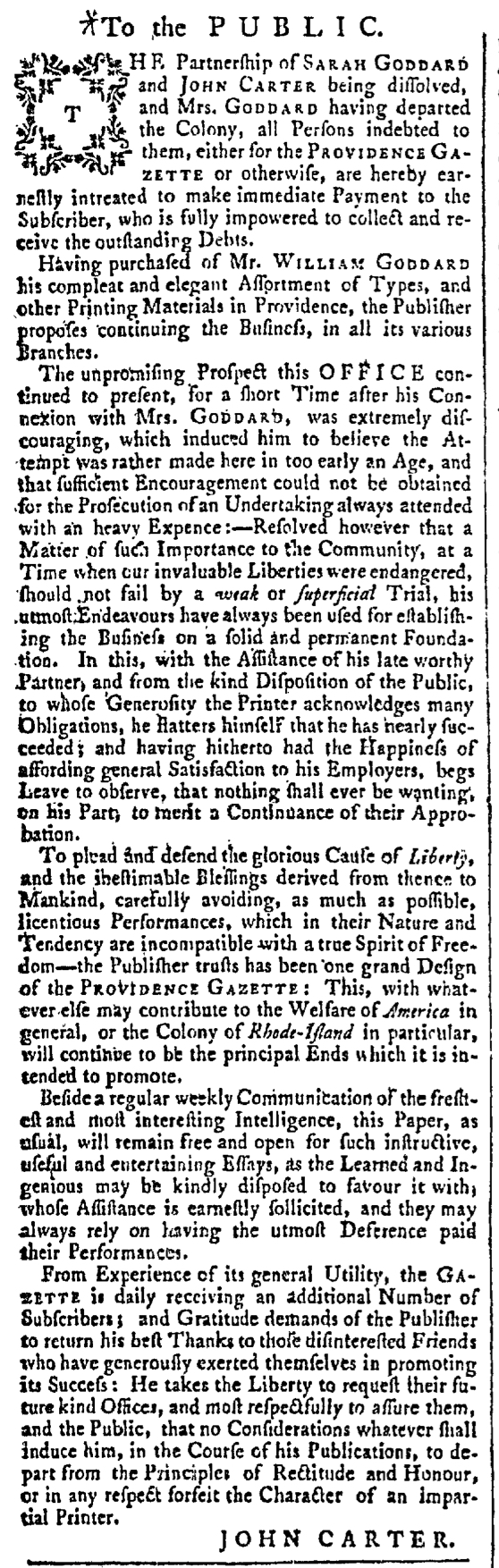
When John Carter assumed control of the Providence Gazette as the sole publisher on November 12, 1768, the colophon dropped Sarah Goddard’s name and slightly revised the description of services available at the printing office. “Subscriptions, Advertisements, Articles and Letters of Intelligence, &c. are received for this Paper.” Carter added articles, indicated his willingness to accept news items from readers and others beyond the network of printers and correspondents that previously supplied content for the newspaper. In addition, he expanded on the previous description of the printing work done at the office. Where Goddard and Carter had proclaimed that they did job printing “with Care and Expedition,” Carter now stated that he did that work “in a neat and correct manner, with Fidelity and Expedition.” This may not have been commentary on work previously produced at the printing office at “the Sign of Shakespear’s Head” but rather assurances that Carter took his new responsibilities seriously now that the partnership with Goddard had been dissolved and he alone ran the printing office.

In addition to updating the colophon, Carter placed a notice “To the PUBLIC” on the first page of his inaugural issue. He offered a brief history of the Providence Gazette following its revival after the repeal of the Stamp Act, an expensive undertaking given that the newspaper had difficulty attracting sufficient subscribers. He thanked those friends, subscribers, and employers who had supported the Providence Gazette and the printing office over the years, but also pledged “that nothing shall ever be wanting, on his Part, to merit a Continuance of their Approbation.”

Carter also took the opportunity to assert the primary purpose of the newspaper, the principle that justified its continuation even when expenses overwhelmed revenues. “To plead and defend the glorious Cause of Liberty,” Carter trumpeted, “and the inestimable Blessings derived from thence to Mankind … the Publisher trusts has been one grand Design of the PROVIDENCE GAZETTE: This, with whatever else may contribute to the Welfare of America, in general, or the Colony of Rhode-Island in particular, will continue to be the principal Ends which it is intended to promote.” Carter further indicated that the newspaper daily increased its number of subscribers, suggesting that readers in Providence and beyond endorsed its purpose and recognized the necessity of a newspaper that kept them apprised of current events and attempts to inhibit the liberty of the colonists. Although it took the form of an editorial, Carter’s address to the public was also an advertisement intended to boost his business. He leveraged politics and patriotism in his effort to increase readership of the Providence Gazette, arguing that the press played a vital role in maintaining liberty.

November 11

What was advertised in a colonial American newspaper 250 years ago today?

Nov 11 - 11:11:1768 Connecticut Journal
Connecticut Journal (November 11, 1768).

“SAMUEL BROOME, and Co. Have the following Goods to Sell.”

Samuel Broome and Company’s advertisement for an assortment of goods they sold “on the most reasonable Terms, at their Store in NEW-YORK” probably became quite familiar to readers of the Connecticut Journal and New-Haven Post-Boy in 1768. The advertisement appeared regularly during the last five months of the year, though on a rather unique publication schedule.

After first appearing in the August 5 edition, Broome and Company’s advertisement ran again on August 19, September 2, 16, and 30, October 14, November 11 and 25, and December 9 and 23. It did not appear on August 12 and 26, September 9 and 23, October 7 and 21, November 18, and December 2, 16, and 30. (Any extant copies of the October 28 and November 4 editions have not been digitized so they have not been consulted in compiling this calendar. Presumably the advertisement ran on October 28 but not on November 4.) In other words, Broome and Company’s advertisement alternated issues from August through December before being discontinued.

Most eighteenth-century newspaper advertisements ran in consecutive issues for a set period. Why did Broome and Company adopt a schedule that deviated from standard practices? Several factors may have played a role. The partners may have considered the expense of advertising weekly prohibitive. They may have also wished to prolong their advertising campaign while maintaining a particular budget. Staggering their advertisements allowed them to do so. The publishers of the Connecticut Journal may have also played a role in Broome and Company’s decision. Compared to other advertisements in that newspaper, their notice was extensive. It usually filled and entire column (though sometimes the compositor managed to squeeze a short advertisement above or below). Unlike most other newspapers published in 1768, the Connecticut Journal featured only two columns per page. That meant that Broome and Company’s advertisement that filled an entire column actually comprised one-eighth of any standard four-page issue. Without sufficient news and additional advertising to regularly justify a supplement, he publishers may have determined that Broome and Company’s advertisement so dominated the pages of the Connecticut Journal that it could not appear every week.

Whatever factors contributed to the unique publication schedule, Broome and Company inserted their advertisement in the Connecticut Journal a total of eleven times. By the end of December, readers almost certainly recognized it at a glance. They published the same advertisement in the New-York Journal, but it did not achieve the same visibility in a publication that featured far more advertisements, many of them of a length that rivaled Broome and Company’s notice.

Slavery Advertisements Published November 11, 1768

GUEST CURATOR: Kaylen McClarey

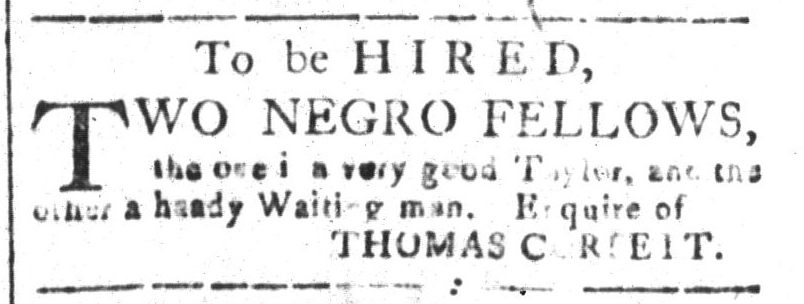
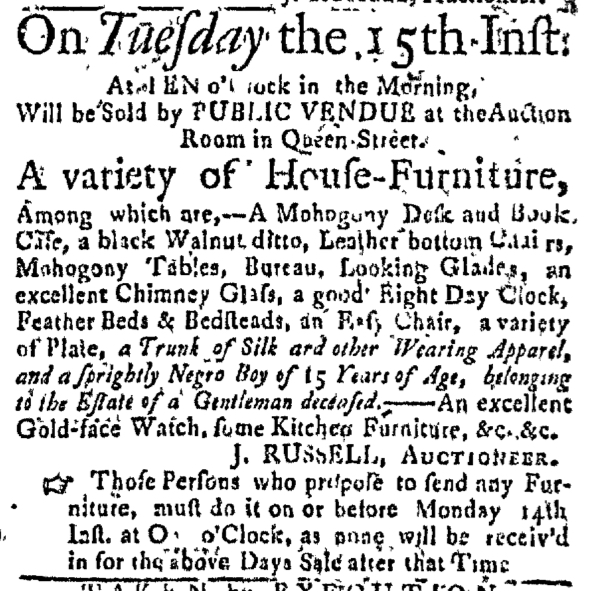
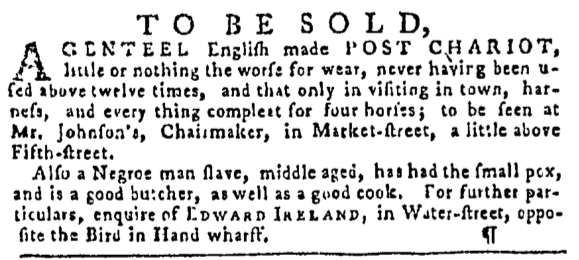
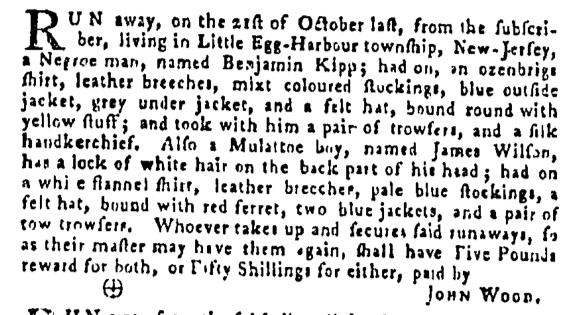
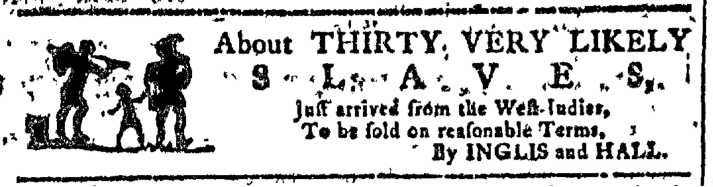
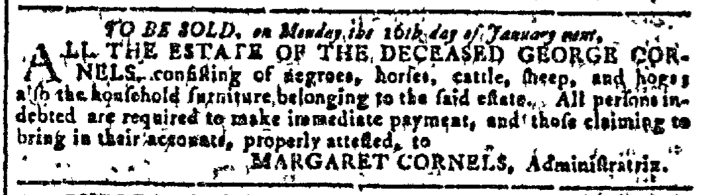
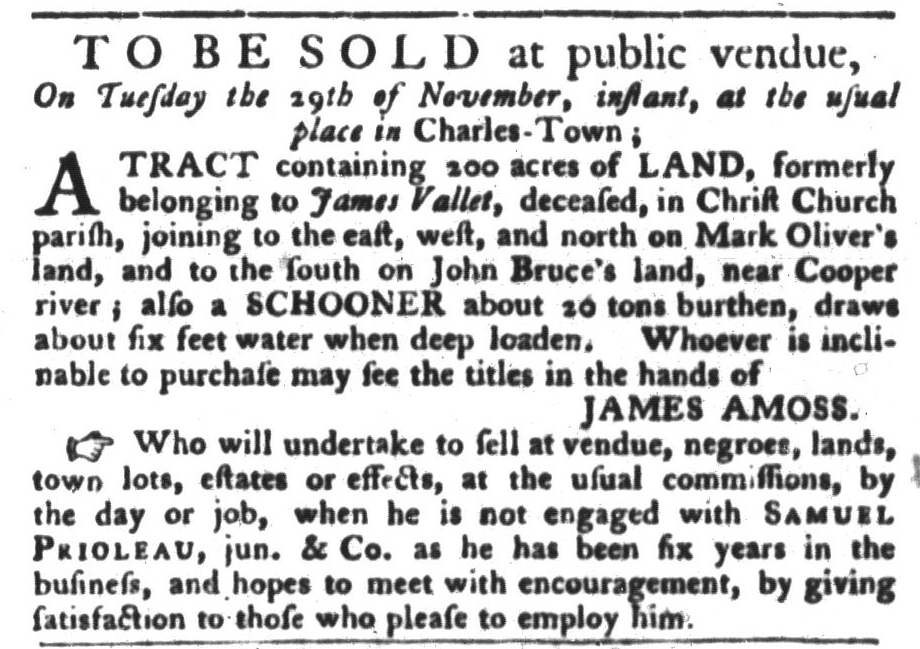
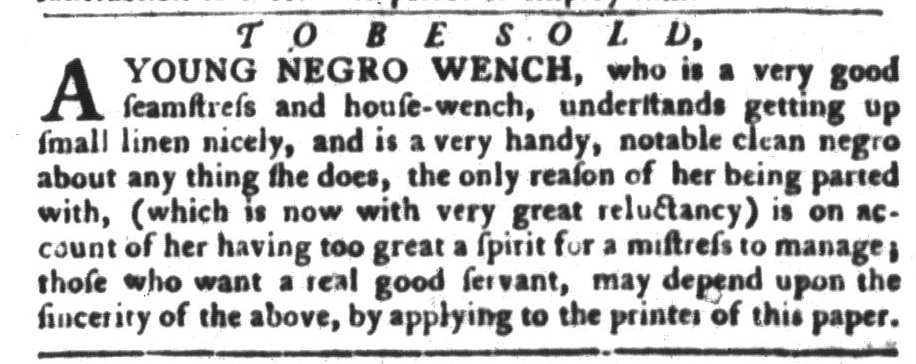
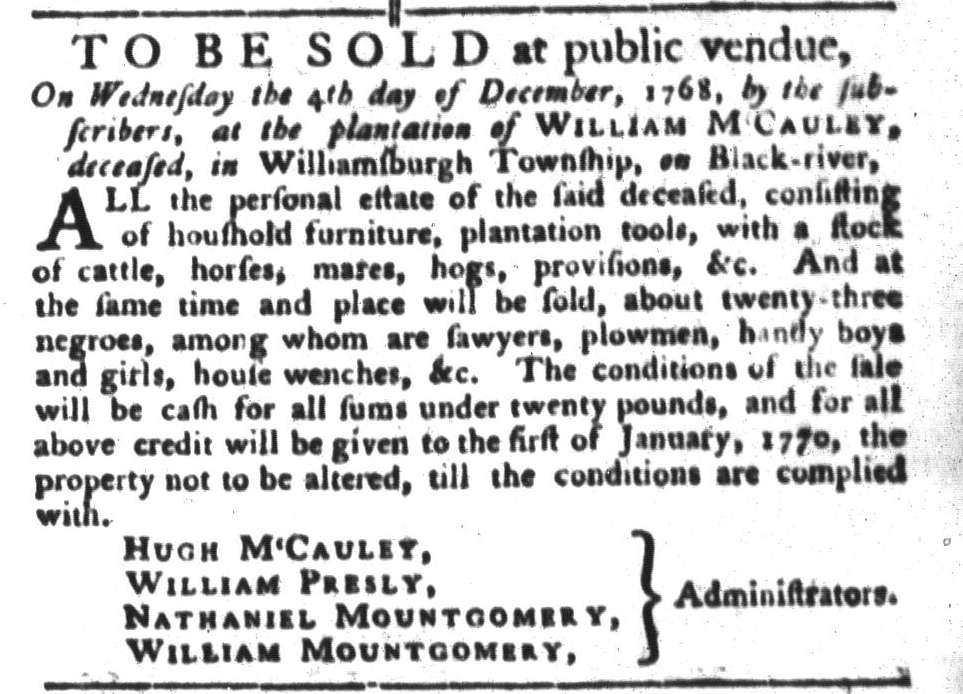
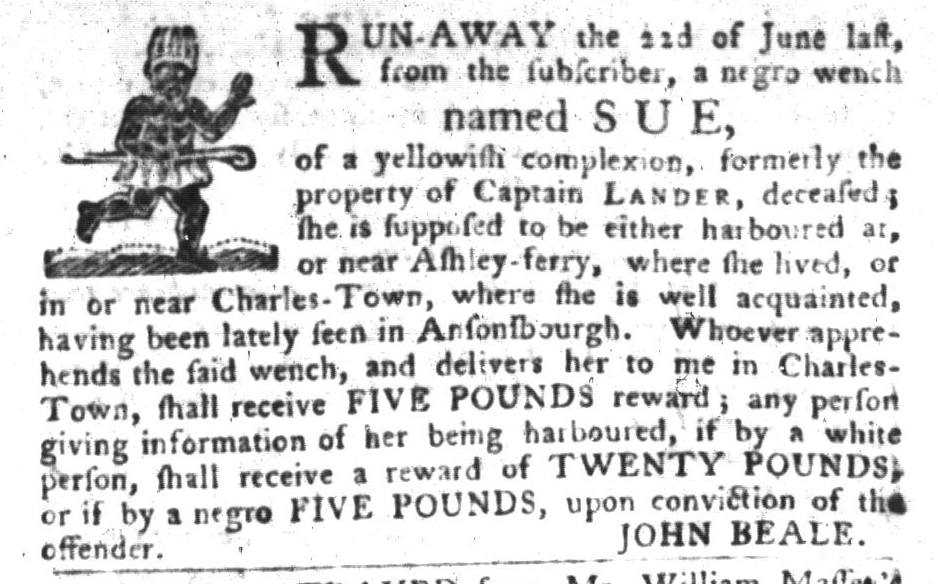
The Slavery Adverts 250 Project chronicles the role of newspaper advertising in perpetuating slavery in the era of the American Revolution. The project seeks to reveal the ubiquity of slavery in eighteenth-century life from New England to Georgia by republishing advertisements for slaves – for sale, wanted to purchase, runaways, captured fugitives – in daily digests on this site as well as in real time via the @SlaveAdverts250 Twitter feed, utilizing twenty-first-century media to stand in for the print media of the eighteenth century.

The project aims to provide modern audiences with a sense of just how often colonists encountered these advertisements in their daily lives. Enslaved men, women, and children appeared in print somewhere in the colonies almost every single day. Those advertisements served as a constant backdrop for social, cultural, economic, and political life in colonial and revolutionary America. Colonists who did not own slaves were still confronted with slavery as well as invited to maintain the system by purchasing slaves or assisting in the capture of runaways. The frequency of these newspaper advertisements suggests just how embedded slavery was in colonial and revolutionary American culture in everyday interactions beyond the printed page.

These advertisements also testify to the experiences of enslaved men, women, and children, though readers must consider that those experiences have been remediated through descriptions offered by slaveholders rather than the slaves themselves. Often unnamed in the advertisements, enslaved men, women, and children were not invisible or unimportant in early America.

During the week of November 11-17, 2018, the Slavery Adverts 250 Project is guest curated by Kaylen McClarey (2019), a History major at Assumption College in Worcester, Massachusetts.

These advertisements appeared in colonial American newspapers 250 years ago today.

Nov 11 - New-Hampshire Gazette Slavery 1
New-Hampshire Gazette (November 11, 1768).

**********

Nov 11 - New-London Gazette Slavery 1
New-London Gazette (November 11, 1768).

**********

Nov 11 - South-Carolina and American General Gazette Slavery 1
South-Carolina and American General Gazette (November 11, 1768).

**********

Nov 11 - South-Carolina and American General Gazette Slavery 2
South-Carolina and American General Gazette (November 11, 1768).

**********

Nov 11 - South-Carolina and American General Gazette Slavery 3
South-Carolina and American General Gazette (November 11, 1768).

**********

Nov 11 - South-Carolina and American General Gazette Slavery 4
South-Carolina and American General Gazette (November 11, 1768).

**********

Nov 11 - South-Carolina and American General Gazette Slavery 5
South-Carolina and American General Gazette (November 11, 1768).

**********

Nov 11 - South-Carolina and American General Gazette Slavery 6
South-Carolina and American General Gazette (November 11, 1768).

**********

Nov 11 - South-Carolina and American General Gazette Slavery 7
South-Carolina and American General Gazette (November 11, 1768).

**********

Nov 11 - South-Carolina and American General Gazette Slavery 8
South-Carolina and American General Gazette (November 11, 1768).


November 10

What was advertised in a colonial American newspaper 250 years ago today?

Nov 10 - 11:10:1768 New-York Journal Supplement
Supplement to the New-York Journal (November 10, 1768).

“A Large and neat Assortment of Windsor Chairs.”

A woodcut depicting a Windsor chair dominated Jonathan Hampton’s advertisement in the Supplement to the New-York Journal published on November 10, 1768. In that regard, his advertisement deviated significantly from the vast majority of paid notices placed in newspapers throughout the colonies. Most advertisements consisted entirely of text unaccompanied by images, in part because woodcuts required an additional investment. Printers did provide some woodcuts that advertisers could insert in their notices, but they were limited to a narrow selection. The selection was usually limited to depictions of ships, houses, horses, slaves, and runaways (servants and slaves). They were used interchangeably. For instance, a real estate advertisement could incorporate any woodcut depicting a house; the details of the woodcut did not necessarily correspond to the description of the house offered in the copy.

When advertisers desired to include images that represented their shop signs or, as was the case with Hampton, their merchandise, they could not draw from stock images provided by printers. Instead, they incurred the additional expense of commissioning woodcuts that then belonged exclusively to them. Not only did those images not accompany any other advertisements in a particular publication, advertisers could collect them and submit them from the printing office and submit them for inclusion in advertisements they placed in competing newspapers.

Even though it appears to have been damaged as the result of repeated impressions on a hand-operated press, the woodcut depicting a Windsor chair in Hampton’s advertisement would have drawn attention. Except for the masthead, no images appeared in the standard issue of the New-York Journal distributed on November 10, 1768. The supplement included only two images, Hampston’s Windsor chair and the elaborate frame that enclosed Gerardus Duyckinck’s list of goods he sold “At the Sign of the Looking Glass & Druggist Pot.” That frame incorporated both a looking glass and a druggist pot.

Some advertisements deployed typography or ornamental printing to distinguish them from others, yet they still consisted entirely of text and type. Including a woodcut helped some advertisers to even further differentiate their notices as a means of drawing attention to the goods and services they offered to prospective customers.

Slavery Advertisements Published November 10, 1768

GUEST CURATOR: Patrick Keane

The Slavery Adverts 250 Project chronicles the role of newspaper advertising in perpetuating slavery in the era of the American Revolution. The project seeks to reveal the ubiquity of slavery in eighteenth-century life from New England to Georgia by republishing advertisements for slaves – for sale, wanted to purchase, runaways, captured fugitives – in daily digests on this site as well as in real time via the @SlaveAdverts250 Twitter feed, utilizing twenty-first-century media to stand in for the print media of the eighteenth century.

The project aims to provide modern audiences with a sense of just how often colonists encountered these advertisements in their daily lives. Enslaved men, women, and children appeared in print somewhere in the colonies almost every single day. Those advertisements served as a constant backdrop for social, cultural, economic, and political life in colonial and revolutionary America. Colonists who did not own slaves were still confronted with slavery as well as invited to maintain the system by purchasing slaves or assisting in the capture of runaways. The frequency of these newspaper advertisements suggests just how embedded slavery was in colonial and revolutionary American culture in everyday interactions beyond the printed page.

These advertisements also testify to the experiences of enslaved men, women, and children, though readers must consider that those experiences have been remediated through descriptions offered by slaveholders rather than the slaves themselves. Often unnamed in the advertisements, enslaved men, women, and children were not invisible or unimportant in early America.

During the week of November 4-10, 2018, the Slavery Adverts 250 Project is guest curated by Patrick Keane (2019), a History major at Assumption College in Worcester, Massachusetts.

These advertisements appeared in colonial American newspapers 250 years ago today.

Nov 10 - Boston Weekly News-Letter Slavery 1
Boston Weekly News-Letter (November 10, 1768).

**********

Nov 10 - New-York Journal Supplement Slavery 1
Supplement to the New-York Journal (November 10, 1768).

**********

Nov 10 - Pennsylvania Gazette Slavery 1
Pennsylvania Gazette (November 10, 1768).

**********

Nov 10 - Pennsylvania Gazette Slavery 2
Pennsylvania Gazette (November 10, 1768).

**********

Nov 10 - Pennsylvania Gazette Supplement Slavery 1
Supplement to the Pennsylvania Gazette (November 10, 1768).

**********

Nov 10 - Virginia Gazette Purdie and Dixon Slavery 1
Virginia Gazette [Purdie & Dixon] (November 10, 1768).

**********

Nov 10 - Virginia Gazette Purdie and Dixon Slavery 2
Virginia Gazette [Purdie & Dixon] (November 10, 1768).

**********

Nov 10 - Virginia Gazette Purdie and Dixon Slavery 3
Virginia Gazette [Purdie & Dixon] (November 10, 1768).

**********

Nov 10 - Virginia Gazette Purdie and Dixon Slavery 4
Virginia Gazette [Purdie & Dixon] (November 10, 1768).

**********

Nov 10 - Virginia Gazette Purdie and Dixon Slavery 5
Virginia Gazette [Purdie & Dixon] (November 10, 1768).

**********

Nov 10 - Virginia Gazette Purdie and Dixon Slavery 6
Virginia Gazette [Purdie & Dixon] (November 10, 1768).

**********

Nov 10 - Virginia Gazette Purdie and Dixon Slavery 7
Virginia Gazette [Purdie & Dixon] (November 10, 1768).

**********

Nov 10 - Virginia Gazette Purdie and Dixon Slavery 8
Virginia Gazette [Purdie & Dixon] (November 10, 1768).

**********

Nov 10 - Virginia Gazette Purdie and Dixon Slavery 9
Virginia Gazette [Purdie & Dixon] (November 10, 1768).

**********

Nov 10 - Virginia Gazette Purdie and Dixon Slavery 10
Virginia Gazette [Purdie & Dixon] (November 10, 1768).

**********

Nov 10 - Virginia Gazette Purdie and Dixon Slavery 11
Virginia Gazette [Purdie & Dixon] (November 10, 1768).

November 9

What was advertised in a colonial American newspaper 250 years ago today?

Nov 9 - 11:9:1768 Georgia Gazette
Georgia Gazette (November 9, 1768).

“He has moved into town, in order to carry on his business as formerly.”

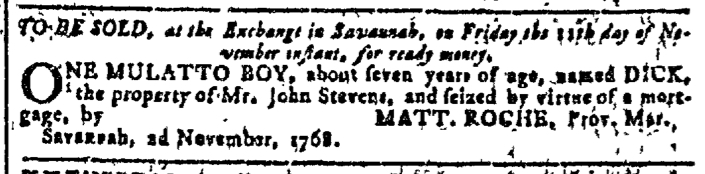
When he placed an advertisement in the November 9, 1768, edition of the Georgia Gazette, Thomas Morgan relied on readers already possessing some familiarity with the services he offered. In its entirety, his advertisement announced, “THE subscriber gives his friends and former customers notice, that he has moved into town, in order to carry on his business as formerly, and hopes to give them satisfaction when favoured with their commands. He lives at present in the house where Mr. Garratt Allan did live. THOMAS MORGAN.” He did not even mention the type of business he operated but instead expected residents of Savannah to know his occupation. Such was the nature of life in a relatively small town in the middle of the eighteenth century.

Further investigation yields two advertisements most likely published by the same Thomas Morgan, advertisements that provided more specific information about how he earned his livelihood. Two years earlier, Morgan and Jonathan Remington stated that they had formed a partnership and proposed “carrying on the TAYLOR BUSINESS.” In an advertisement in the September 24, 1766, edition of the Georgia Gazette, they requested “the continuance of the favours of their former friends and customers, and all others who may be pleased to favour them with their commands. In another advertisement, this one placed in the July 12, 1769, edition, “MORGAN and ROCHE, Taylors,” informed the public that “they have entered into copartnership to carry on the TAYLOR BUSINESS in all its branches.”

In both of these additional advertisements, Morgan and his partner advanced more robust appeals to potential customers. In 1769 Morgan and Roche pledged that “all gentlemen may depend on being served with diligence and quick dispatch.” In 1766 Morgan and Remington proclaimed that their clients “may depend on having their work made in the genteelest and most fashionable manner, with the utmost dispatch and good attendance.” While it is impossible to know who wrote the copy for each advertisement, Morgan’s partners may have had the better instincts when it came to promoting their business in the public prints. This may have been one factor that contributed to Morgan once again entering a partnership just eight months after moving into Savannah to operate a business on his own.

When considered collectively, these advertisements tell a more complete story of Morgan’s business endeavors. Digitization of eighteenth-century newspapers has made telling that story much more viable. Formerly, identifying these advertisements would have required traveling to an archive that possessed the original issues of the Georgia Gazette or a research library that had the newspaper on microfilm, followed by hours of paging through each issue and skimming for Morgan’s name. Thanks to digitization, however, a keyword search efficiently identified advertisements placed Morgan. In Readex’s America’s Historical Newspapers database, I limited a search to the Georgia Gazette, set the dates for 1760 through 1775, and selected “Thomas Morgan” as the keyword. This yielded twenty-two results, many of them advertisements for runaway slaves. The others, however, elaborated on Morgan’s business activities as a tailor. An inquiry that formerly would have taken hours in an archive or research library took only minutes with a keyword search of digitized primary sources.

Slavery Advertisements Published November 9, 1768

GUEST CURATOR: Patrick Keane

The Slavery Adverts 250 Project chronicles the role of newspaper advertising in perpetuating slavery in the era of the American Revolution. The project seeks to reveal the ubiquity of slavery in eighteenth-century life from New England to Georgia by republishing advertisements for slaves – for sale, wanted to purchase, runaways, captured fugitives – in daily digests on this site as well as in real time via the @SlaveAdverts250 Twitter feed, utilizing twenty-first-century media to stand in for the print media of the eighteenth century.

The project aims to provide modern audiences with a sense of just how often colonists encountered these advertisements in their daily lives. Enslaved men, women, and children appeared in print somewhere in the colonies almost every single day. Those advertisements served as a constant backdrop for social, cultural, economic, and political life in colonial and revolutionary America. Colonists who did not own slaves were still confronted with slavery as well as invited to maintain the system by purchasing slaves or assisting in the capture of runaways. The frequency of these newspaper advertisements suggests just how embedded slavery was in colonial and revolutionary American culture in everyday interactions beyond the printed page.

These advertisements also testify to the experiences of enslaved men, women, and children, though readers must consider that those experiences have been remediated through descriptions offered by slaveholders rather than the slaves themselves. Often unnamed in the advertisements, enslaved men, women, and children were not invisible or unimportant in early America.

During the week of November 4-10, 2018, the Slavery Adverts 250 Project is guest curated by Patrick Keane (2019), a History major at Assumption College in Worcester, Massachusetts.

These advertisements appeared in colonial American newspapers 250 years ago today.

Nov 9 - Georgia Gazette Slavery 1
Georgia Gazette (November 9, 1768).

**********

Nov 9 - Georgia Gazette Slavery 2
Georgia Gazette (November 9, 1768).

**********

Nov 9 - Georgia Gazette Slavery 3
Georgia Gazette (November 9, 1768).

**********

Nov 9 - Georgia Gazette Slavery 4
Georgia Gazette (November 9, 1768).

**********

Nov 9 - Georgia Gazette Slavery 5
Georgia Gazette (November 9, 1768).

**********

Nov 9 - Georgia Gazette Slavery 6
Georgia Gazette (November 9, 1768).

**********

Nov 9 - Georgia Gazette Slavery 7
Georgia Gazette (November 9, 1768).

**********

Nov 9 - Georgia Gazette Slavery 8
Georgia Gazette (November 9, 1768).

**********

Nov 9 - Georgia Gazette Slavery 9
Georgia Gazette (November 9, 1768).

**********

Nov 9 - Georgia Gazette Slavery 10
Georgia Gazette (November 9, 1768).

November 8

What was advertised in a colonial American newspaper 250 years ago today?

Nov 8 - 11:8:1768 South-Carolina Gazette and Country Journal
South-Carolina Gazette and Country Journal (November 8, 1768).

“M. NELSON, PASTRY-COOK, from LONDON.”

The advertisements that appeared in eighteenth-century newspapers testify to the presence of women in the marketplace as purveyors of goods and services, not merely as consumers. They ran their own businesses. They advanced their commercial activities in the public prints, carving out greater visibility for themselves in their communities. Yet women who advertised adopted a variety of approaches when it came to establishing that visibility.
Consider three advertisements that appeared in the November 8, 1768, edition of the South-Carolina Gazette and Country Journal and its supplement devoted entirely to advertisements. Mary King, a milliner, achieved the greatest visibility. Her notice used her name as a headline: “MARY KING.” A secondary headline, “A COMPLEAT ASSORTMENT of / MILLINARY GOODS,” described the merchandise that she then listed in greater detail. King achieved greater visibility as a female entrepreneur than either of the other two women who placed advertisements in the same issue.

Sabina Taylor was the least visible. Her advertisement filled only six lines, making it one of the shortest in the entire issue. Unlike many of the other advertisements of similar length, hers did not include a headline that pronounced her name in larger font and capital letters. Instead, the schoolmistress figuratively signed her name on the final line. Although “SABINA TAYLOR” appeared in capitals, her name still was not in a larger font. The lack of white space in her own notice as well as the headline for the advertisement that appeared immediately below, “TO BE SOLD CHEAP,” crowded out Taylor’s signature, making it even more difficult to spot her on the page.

Nelson charted a middle course. Her advertisement occupied only lightly less space than King’s notice. She also had a headline – “M. NELSON” – and secondary headline – “PASTRY-COOK, from LONDON” – with sufficient white space to draw attention to her advertisement. Yet she did not list her full name, making it impossible for many readers to recognize at a glance that her advertisement promoted an enterprise operated by a woman. Many residents of Charleston would have already known of Nelson and her business. For those who did not, it would not have been apparent that a woman placed the advertisement until they read the body in which Nelson expressed “her sincere thanks to those gentlemen and ladies who has honoured her with their custom.” Nelson asserted visibility for her business while simultaneously downplaying her own visibility as a female entrepreneur.

Women who provided consumer goods and services were present among the advertisers in the South-Carolina Gazette and Country Journal, but their decisions about the copy for their advertisements resulted in various levels of visibility. While Mary King boldly claimed a place alongside male entrepreneurs, Sabina Taylor and M. Nelson obscured their participation in the marketplace even as they promoted the goods and services they offered to consumers.

Slavery Advertisements Published November 8, 1768

GUEST CURATOR: Patrick Keane

The Slavery Adverts 250 Project chronicles the role of newspaper advertising in perpetuating slavery in the era of the American Revolution. The project seeks to reveal the ubiquity of slavery in eighteenth-century life from New England to Georgia by republishing advertisements for slaves – for sale, wanted to purchase, runaways, captured fugitives – in daily digests on this site as well as in real time via the @SlaveAdverts250 Twitter feed, utilizing twenty-first-century media to stand in for the print media of the eighteenth century.

The project aims to provide modern audiences with a sense of just how often colonists encountered these advertisements in their daily lives. Enslaved men, women, and children appeared in print somewhere in the colonies almost every single day. Those advertisements served as a constant backdrop for social, cultural, economic, and political life in colonial and revolutionary America. Colonists who did not own slaves were still confronted with slavery as well as invited to maintain the system by purchasing slaves or assisting in the capture of runaways. The frequency of these newspaper advertisements suggests just how embedded slavery was in colonial and revolutionary American culture in everyday interactions beyond the printed page.

These advertisements also testify to the experiences of enslaved men, women, and children, though readers must consider that those experiences have been remediated through descriptions offered by slaveholders rather than the slaves themselves. Often unnamed in the advertisements, enslaved men, women, and children were not invisible or unimportant in early America.

During the week of November 4-10, 2018, the Slavery Adverts 250 Project is guest curated by Patrick Keane (2019), a History major at Assumption College in Worcester, Massachusetts.

These advertisements appeared in colonial American newspapers 250 years ago today.

Nov 8 - South-Carolina Gazette and Country Journal Slavery 1
South-Carolina Gazette and Country Journal (November 8, 1768).

**********

Nov 8 - South-Carolina Gazette and Country Journal Slavery 2
South-Carolina Gazette and Country Journal (November 8, 1768).

**********

Nov 8 - South-Carolina Gazette and Country Journal Slavery 3
South-Carolina Gazette and Country Journal (November 8, 1768).

**********

Nov 8 - South-Carolina Gazette and Country Journal Slavery 4
South-Carolina Gazette and Country Journal (November 8, 1768).

**********

Nov 8 - South-Carolina Gazette and Country Journal Slavery 5
South-Carolina Gazette and Country Journal (November 8, 1768).

**********

Nov 8 - South-Carolina Gazette and Country Journal Slavery 6
South-Carolina Gazette and Country Journal (November 8, 1768).

**********

Nov 8 - South-Carolina Gazette and Country Journal Slavery 7
South-Carolina Gazette and Country Journal (November 8, 1768).

**********

Nov 8 - South-Carolina Gazette and Country Journal Slavery 8
South-Carolina Gazette and Country Journal (November 8, 1768).

**********

Nov 8 - South-Carolina Gazette and Country Journal Slavery 9
South-Carolina Gazette and Country Journal (November 8, 1768).

**********

Nov 8 - South-Carolina Gazette and Country Journal Slavery 10
South-Carolina Gazette and Country Journal (November 8, 1768).

**********

Nov 8 - South-Carolina Gazette and Country Journal Slavery 11
Supplement to the South-Carolina Gazette and Country Journal (November 8, 1768).

**********

Nov 8 - South-Carolina Gazette and Country Journal Slavery 12
Supplement to the South-Carolina Gazette and Country Journal (November 8, 1768).

**********

Nov 8 - South-Carolina Gazette and Country Journal Slavery 13
Supplement to the South-Carolina Gazette and Country Journal (November 8, 1768).

**********

Nov 8 - South-Carolina Gazette and Country Journal Slavery 14
Supplement to the South-Carolina Gazette and Country Journal (November 8, 1768).