Luke DiCicco is a sophomore with a double major in History and Political Science at Assumption College. His main historical interests include the World Wars and the history of Europe, but he is always eager to learn about anything related to history. He is a member of the Honors Program as well as a resident assistant in Hanrahan Hall. He is involved in the Resident Hall Association and Peer Ministry. He just returned from a SEND trip (or alternative spring break) to Washington, DC.
The Slavery Adverts 250 Project chronicles the role of newspaper advertising in perpetuating slavery in the era of the American Revolution. The project seeks to reveal the ubiquity of slavery in eighteenth-century life from New England to Georgia by republishing advertisements for slaves – for sale, wanted to purchase, runaways, captured fugitives – in daily digests on this site as well as in real time via the @SlaveAdverts250 Twitter feed, utilizing twenty-first-century media to stand in for the print media of the eighteenth century.
The project aims to provide modern audiences with a sense of just how often colonists encountered these advertisements in their daily lives. Enslaved men, women, and children appeared in print somewhere in the colonies almost every single day. Those advertisements served as a constant backdrop for social, cultural, economic, and political life in colonial and revolutionary America. Colonists who did not own slaves were still confronted with slavery as well as invited to maintain the system by purchasing slaves or assisting in the capture of runaways. The frequency of these newspaper advertisements suggests just how embedded slavery was in colonial and revolutionary American culture in everyday interactions beyond the printed page.
These advertisements also testify to the experiences of enslaved men, women, and children, though readers must consider that those experiences have been remediated through descriptions offered by slaveholders rather than the slaves themselves. Often unnamed in the advertisements, enslaved men, women, and children were not invisible or unimportant in early America.
Luke DiCicco is serving as guest curator for the week of March 10-16, 2019. He compiled these advertisements that appeared in colonial American newspapers 250 years ago today.
In the twenty-first century, many people, including myself, skim over advertisements that appear in newspapers or magazines and oftentimes find them annoying. Before partaking in this project, I had little experience with interpreting advertisements nor had I given much thought to advertisements in the eighteenth century. However, as I dove into this project, I quickly began to recognize the importance of these advertisements as manifestations of culture in the eighteenth century.
In that period, print culture was an important aspect of society that I was able to see firsthand in the Adverts 250 Project. Newspapers were one of the colonists’ primary basis for communication with each other. In looking at them in the twenty-first century, they serve as a methodology in learning about everyday life in the American colonies in 1769 and the era of the American Revolution more generally. Analyzing advertisements from the newspapers printed in the colonies in 1769 improved my interpretation skills but also gave me a primary source glimpse into colonial life.
The Adverts 250 Project allowed me to “do” history. I had to not only read and understand the variety of advertisements that were printed, but I also had to do background research from credible sources to be able to get an inside look at the significance of the advertisements at this time. I took data from digital databases, primary sources, and secondary sources to be able to research and analyze each advertisement and then make it available to a variety of public audiences. Research to gain a full understanding of the topic was crucial, but I also had to keep in mind that this is a public history project. Picking advertisements that would be interesting to the general public was important. Because many others view this project daily, correct information and insightful analysis was crucial. An example of how this project allowed me to do history was the advertisement for a paint store I analyzed on March 4. In today’s society, anyone can buy a $30 can of paint and color their house white, red, blue, or tan without much thought. However, back in the eighteenth century, paint was expensive and certain colors were only available to the wealthy. It is important to look at these advertisements with an eye focused on the culture of the eighteenth century and how it differs from the twenty-first century and be able to relay that to the public.
Carl Robert Keyes and Olivia Burke examining eighteenth-century newspapers at the American Antiquarian Society. (Courtesy Assumption College Office of Communications)
I was able to go to the American Antiquarian Society to access their databases and see original editions of some of these newspapers with my own eyes. Students at Assumption College are blessed to be so close to the Antiquarian Society, where I was able to access the largest collection of early American newspapers in the world. Thanks to this research library, I was able to contribute to the Adverts 250 Project by using their collections to get a more complete view of American culture in the eighteenth century.
One of my favorite parts about this project was really digging deep into certain subjects. I used outside sources to be able to fully analyze and understand the cultural importance that a short advertisement can provide. For example, the advertisement I analyzed on March 7 was about flour of mustard. An archeological study of mustard bottles found at a Loyalist homestead in Canada showed the shift from imported British goods to goods grown and sold in the colonies and, eventually, the new nation. The advertisement proudly states “The best New-England Flour of Mustard.” Through this advertisement, we see the important shift from reliance of British goods to the colonies attempting to become more self-sustaining. However, this was also one of the most difficult aspects of the project. There are so many avenues that I could research in each ad that sometimes it was difficult to choose what part I wanted to analyze.
This brings us to another important aspect of the Adverts 250 Project that I loved. Advertisements were a window into an emerging pride and nationalism in colonial America. As the colonists become more connected with each other through print culture, including newspaper advertisements, thoughts about revolution began to swirl. As I mentioned earlier with the mustard advertisement, colonists were trying to become self-sufficient and did not want to rely on Britain for everything. This is exhibited in advertisements in the eighteenth century newspapers that I was able to explore in the Adverts 250 Project.
The Adverts 250 Project got me thinking: in 250 years will historians look back to our society now and analyze the advertisements in our newspapers and other media? What will they tell future researchers about the early twenty-first century? Overall, this project enriched my understanding of the products and services that people in the colonial and Revolutionary periods relied upon. We can see their needs on a day-to-day basis. I was able to participate in writing history by asking the question: “why does this matter?” With each advertisement I interpreted, I was able to go deeper and discover different aspects of colonial society. I am fortunate to be able to participate in the Adverts 250 Project this semester and I hope to be able to work with Professor Keyes again in the future.
What was advertised in a colonial American newspaper 250 years ago today?
Boston Weekly News-Letter (March 9, 1769).
“LEMMONS new Fruit.”
Many kinds of fruit were considered a rare luxury in the eighteenth century, primarily only available for the wealthy. This was a direct result of where fruit grew and how people got it. Colonists had two options when it came to acquiring fruit: locally grown or imported, both of which were only available in season.
Colonists enjoyed fruit they introduced to North America, like apples and peaches, as well as indigenous plants that they had added to their diet, like strawberries, cherries, and grapes. Even with this variety, colonists had to settle for what could be grown in their specific climate or a particular time of year. John Crosby advertised another kind of fruit: lemons. As Mark Ziarko explains, “Naturally, tropical species like citrus fruits and pineapples became the zenith of the colonial fruit hierarchy. If someone really wanted to demonstrate their wealth, these imported fruits were the way to go.”
Because fruit was expensive to acquire, it became a form of showing status. Fresh fruit could be displayed on a fruit dish as decoration and as a status symbol. People who could afford fruit wanted to show it off to others. Fresh fruit was not always a practical purchase because it could be expensive and did not have a long shelf life. For colonial Americans, eating fresh fruit was more than just a tasty and healthy snack; it was a way to show wealth and class.
**********
ADDITIONAL COMMENTARY: Carl Robert Keyes
John Crosby set up shop “at the Sign of the Basket of Lemmons, South-End” in Boston. In an era before standardized street numbers, colonists relied on various landmarks, including shop signs, to give directions and indicate locations. Many merchants, shopkeepers, artisans, tavernkeepers, and others purveyors of consumer goods and services erected signs to mark where they conducted business. Some tied the images they selected directly to their occupation, as John Crosby, “Lemmon-Trader,” did with his “Sign of the Basket of Lemmons,” but others chose distinctive images that did not necessarily testify to the merchandise they offered for sale.
Some advertisers did not incur the expense of having their own sign painted or carved. Instead, they treated signs posted by neighbors as landmarks to help guide prospective customers to their own shops. On the same day that Crosby inserted his advertisement in the Boston Weekly News-Letter, Elias Dupee announced upcoming auctions at his “New AUCTION-ROOM” in the Boston Chronicle. Lest potential bidders confuse his establishment with any of the several other auction houses in the bustling port city, he offered extensive directions that included a shop sign: “Between the Swing and Draw-bridge, near the Golden-key, over Mr John Dupee Mathematical Instrument-maker’s shop.” Similarly, Hammatt and Brown sold imported groceries and housewares “near the Sign of the Cornfield, in Union-street.” According to his advertisement in the same issue of Boston Evening-Post as Hammatt and Brown’s notice, John Hunt hawked “a good Assortment of Ironmongery, Braizery, Cutlery and Pewter” at a shop located “next Door Northward of the Heart and Crown, in Cornhill.” The Heart and Crown happened to be the emblem that marked the printing shop operated by T. and J. Fleet, the publishers of the Boston Evening-Post. The image also appeared in the masthead of the newspaper, augmenting its familiarity to colonists in Boston.
Crosby’s advertisement does more than reveal what kinds of goods were offered for sale in Boston as spring approached in 1769. It also testifies to the sights colonists glimpsed as they traversed the streets of the city. Shop signs, like the “Basket of Lemmons,” decorated buildings while also aiding both residents and visitors as they made their way through the busy port. Some advertisers adopted the images depicted via their shop signs as brands that represented their businesses, but those signs first served other purposes in the visual landscape of Boston and other cities.
The Slavery Adverts 250 Project chronicles the role of newspaper advertising in perpetuating slavery in the era of the American Revolution. The project seeks to reveal the ubiquity of slavery in eighteenth-century life from New England to Georgia by republishing advertisements for slaves – for sale, wanted to purchase, runaways, captured fugitives – in daily digests on this site as well as in real time via the @SlaveAdverts250 Twitter feed, utilizing twenty-first-century media to stand in for the print media of the eighteenth century.
The project aims to provide modern audiences with a sense of just how often colonists encountered these advertisements in their daily lives. Enslaved men, women, and children appeared in print somewhere in the colonies almost every single day. Those advertisements served as a constant backdrop for social, cultural, economic, and political life in colonial and revolutionary America. Colonists who did not own slaves were still confronted with slavery as well as invited to maintain the system by purchasing slaves or assisting in the capture of runaways. The frequency of these newspaper advertisements suggests just how embedded slavery was in colonial and revolutionary American culture in everyday interactions beyond the printed page.
These advertisements also testify to the experiences of enslaved men, women, and children, though readers must consider that those experiences have been remediated through descriptions offered by slaveholders rather than the slaves themselves. Often unnamed in the advertisements, enslaved men, women, and children were not invisible or unimportant in early America.
Olivia Burke is serving as guest curator for the week of March 3-9, 2019. She compiled these advertisements that appeared in colonial American newspapers 250 years ago today.
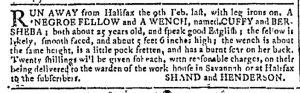
Who was the subject of an advertisement in a colonial American newspaper 250 years ago today?
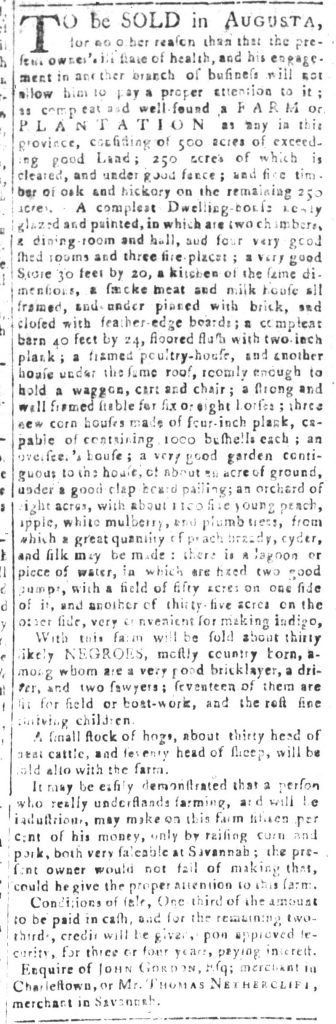
Georgia Gazette (March 8, 1769).
“RUN AWAY … CUFFY and BERSHEBA.”
Slavery advertisements were common in eighteenth-century newspapers, especially in the Georgia Gazette and other newspapers in southern colonies,. In the advertisement, Shand and Henderson offered a monetary reward for two of their slaves who ran away: Cuffy and Bersheba. They offered twenty shillings for each of them. This was one of six advertisements concerning slavery in this issue. In the Georgia Gazette, advertisements for slaves were just as common as advertisements for tea, household goods, and property for sale.
In a chapter on “Runaway Advertisements in Colonial Newspapers,” Victoria Bissell Brown and Timothy J. Shannon discuss how colonists saw slaves as material goods, not as human beings. “One of the great advantages to reading these advertisements in their original context is to comprehend how casually colonial Americans bought and sold human laborers.”[1] Based on the look inside colonial society that newspapers give us, we are able to see how colonists in the eighteenth century did not think twice about seeing an advertisement for a runaway slave next to one for a stray horse. As revolution drew closer to becoming a reality, slavery began to decline in the north but it remained strong in the south, where advertisements like this one were very common.
**********
ADDITIONAL COMMENTARY: Carl Robert Keyes
Olivia notes that in addition to Shand and Henderson’s notice about Cuffy and Bersheba making their escape, five other advertisements concerning enslaved men, women, and children appeared in the March 8, 1769, edition of the Georgia Gazette. Two of them reported on runaways that had been captured. Two offered enslaved people for sale, wile the final one offered an enslaved woman “To be hired out” as a domestic servant. When it came to such advertisements in the Georgia Gazette, this was actually relatively few compared to most issues. That newspaper often featured a dozen or more advertisements related to enslavement. They constituted an important source of revenue for James Johnston, the printer.
Olivia challenges us to consider how unremarkable white colonists found these advertisements that appeared week after week throughout the colonial period. This certainly reveals something significant about the attitudes of most colonists, but these advertisements also tell important stories about the experiences of enslaved people. Consider not only Cuffy and Bersheba but also their counterparts in the advertisements reporting Africans and African Americans who had been “TAKEN UP” or “”Brought to the Work-house.” Cuffy and Bersheba were both approximately twenty-five years old. Both spoke “good English,” indicating that they were either born in the colonies or had been transported there quite some time ago. When they made their escape, Cuffy had “leg irons on” (and Bersheba may have as well, though the wording of the advertisement does not make it clear). Shand and Henderson made every effort to keep them around, but Cuffy and Bersehba were determined to free themselves. Sampson, Molly, and an unnamed infant were discovered “on the Indian Country Path,” making their escape from a “master [who] lives near the salt water.” Sampson “speaks such bad English as scarcely to be understood,” suggesting that he may not have been enslaved his entire life. Michael, a “TALL STOUT ABLE NEGROE FELLOW” who had been confined to the workhouse in Savannah definitely had not been born into slavery in Georgia. He spoke little English. The advertisement reported that he was “of the Coromantee country” and had “his country marks thus ||| on each side of his face,” referring to ritual scarification.
Each of these advertisements provides a miniature and incomplete biography of enslaved people who attempted to seize their own liberty in the era of the American Revolution. White colonists placed them for one reason, recovering their human property, but these advertisements ultimately served an unintended purpose. They testified to the agency and resistance of enslaved men and women. Although not in their own words, these advertisements tell the stories of people who had few opportunities to create documents that recorded their own experiences.
**********
[1] Victoria Bissell Brown and Timothy J. Shannon, Going to the Source: The Bedford Reader in American History (Boston: Bedford/St. Martin’s, 2004), 48.
The Slavery Adverts 250 Project chronicles the role of newspaper advertising in perpetuating slavery in the era of the American Revolution. The project seeks to reveal the ubiquity of slavery in eighteenth-century life from New England to Georgia by republishing advertisements for slaves – for sale, wanted to purchase, runaways, captured fugitives – in daily digests on this site as well as in real time via the @SlaveAdverts250 Twitter feed, utilizing twenty-first-century media to stand in for the print media of the eighteenth century.
The project aims to provide modern audiences with a sense of just how often colonists encountered these advertisements in their daily lives. Enslaved men, women, and children appeared in print somewhere in the colonies almost every single day. Those advertisements served as a constant backdrop for social, cultural, economic, and political life in colonial and revolutionary America. Colonists who did not own slaves were still confronted with slavery as well as invited to maintain the system by purchasing slaves or assisting in the capture of runaways. The frequency of these newspaper advertisements suggests just how embedded slavery was in colonial and revolutionary American culture in everyday interactions beyond the printed page.
These advertisements also testify to the experiences of enslaved men, women, and children, though readers must consider that those experiences have been remediated through descriptions offered by slaveholders rather than the slaves themselves. Often unnamed in the advertisements, enslaved men, women, and children were not invisible or unimportant in early America.
Olivia Burke is serving as guest curator for the week of March 3-9, 2019. She compiled these advertisements that appeared in colonial American newspapers 250 years ago today.
What was advertised in a colonial American newspaper 250 years ago today?
Essex Gazette (March 7, 1769).
“The best New-England Flour of Mustard.”
In “A Taste for Mustard: An Archaeological Examination of a Condiment and Its Bottles from a Loyalist Homestead in Upper Canada,” Denise C. McGuire provides an overview of mustard production and consumption and examines an excavation of the Butler Homestead site in Niagara-on-the-Lake, Ontario. “Flour of Mustard” was very popular in Britain. It played an important role in eighteenth-century cooking, but was also considered to have medicinal value. It also reveals changes in transatlantic trade. Initially imported in the American colonies, it was subsequently grown there. As we can see in this advertisement, flour of mustard was sold in the colonies; it even specifically states that it was “New-England Flour of Mustard,” proudly showing that the mustard was grown and produced in the colonies.
That production continued after the American Revolution, intended for local consumption as well as export. When a cache of glass bottles was discovered, the square shape led McGuire to believe that they were mustard bottles. The discoveries at the Butler Homestead show that Loyalists got their flour of mustard from American producers after the Revolution. “[E]ven two generations after the first wave of Loyalist settlement, the ability to acquire simple commodities was not always easily accessible in more remote locations.”[1] Such evidence shows that the Butler family retained commercial ties to upstate New York even after the Revolutionary War.
**********
ADDITIONAL COMMENTARY: Carl Robert Keyes
When she consulted me about including this advertisement among those she would examine during her week as guest curator, Olivia expressed some concern about Chloe Amour previously examined flour of mustard in another advertisement recently featured on the Adverts 250 Project. She did not wish to duplicate the work of one of her peers. I encouraged her to continue with Thomas Walley’s advertisement, especially after she revealed that she had already consulted McGuire’s article. We certainly had more to learn about this particular commodity. As we move chronologically from the imperial crisis to the early republic, our Revolutionary America class has so far focused on the politics and economics of producing, trading, and consuming goods in the 1760s through the early 1780s. By incorporating mustard bottles uncovered during an archaeological excavation of a Loyalist site in Canada, Olivia has given our class a preview of the period we will be examining later in the semester.
For my part, I’m interested in the many similarities between Walley’s advertisement in the Essex Gazette and William Chace’s advertisement in the Providence Gazette. Both named their products “New-England Flour of Mustard,” emphasizing that it had been produced locally. Walley underscored that his mustard “has been greatly admired, both for its Strength and Flavor, by all that have used it.” Similarly, Chace proclaimed that his mustard “is allowed by the best Judges to be superior both for Strength and Flavour to any imported.” In this instance, Chace more explicitly attached a political meaning to acquiring his mustard, comparing it imports that many colonists had vowed to eschew as acts of economic resistance against the Townshend Acts. Walley made a nod toward such appeals when he offered to make “An Allowance … to those that buy to sell again, in order to encourage this Manufacture.” Such discounts may have helped to move his product out the door and, eventually, into the hands of greater numbers of consumers, but they also invoked images of “domestic manufacture” so often touted in news and editorials, especially in those moments that the imperial crisis intensified. Even Samuel Hall, the printer of the Essex Gazette, stocked a “small Parcel of the above Mustard” to make it available to residents of Salem who might not otherwise have an opportunity to acquire it from Walley at his store in Boston. In advancing similar appeals to prospective customers, Walley and Chace demonstrated that they participated in a larger conversation about the meaning of mustard. In the late 1760s, mustard did more than merely flavor food. It was enmeshed in the politics of the period.
**********
[1] Denise C. McGuire, “A Taste for Mustard: An Archaeological Examination of a Condiment and Its Bottles from a Loyalist Homestead in Upper Canada,” International Journal of Historical Archaeology 20, no. 4 (December 2016): 680.
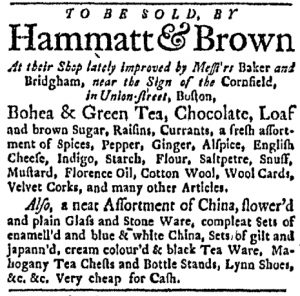
What was advertised in a colonial American newspaper 250 years ago today?
Boston Evening-Post (March 6, 1769).
“A neat Assortment of China, flower’d and plain Glass and Stone Ware.”
Advertisements like this were very common in newspapers in the latter half of the eighteenth century. Hammatt and Brown had for sale an impressive list of goods, including tea, chocolate, cotton wool and a “neat Assortment” of china, glass, and stoneware. This advertisement displayed the expanding consumer culture in the colonies. No longer were people producing things for self-sufficiency. As T.H. Breen explains, “[A] pioneer world of homespun cloth and wooden dishes … was swept away by a flood of store-bought sundries.”[1] Colonists became interested in things and what those material goods did for their image. This change also led to an emergence of a commonalities and a community mindset among colonists of different areas. For example, in “Baubles of Britain”; The American and Consumer Revolutions of the Eighteenth Century,” Breen describes a “shared language of consumption.”[2] People in the colonies had this newfound connection with each other. A colonist from Massachusetts would see the type of fabric a visitor from a southern colony wore and immediately know the material and social class that went with it. This created a common connection among people and subsequently grew a feeling of nationalism through the colonies as the imperial crisis with Britain drew to its boiling point.
**********
ADDITIONAL COMMENTARY: Carl Robert Keyes
As Olivia indicates, advertisements of this sort were indeed commonly inserted in eighteenth-century newspapers, especially in those published in the largest port cities. Although they ran in every newspaper printed in the colonies, they appeared in greater numbers and with greater frequency in publications from Boston, Charleston, New York, and Philadelphia. In each of those cities, advertisers contended not only with competitors who placed advertisements in the same newspapers they did but also with rival merchants and shopkeepers who advertised in other newspapers as well as those who did not advertise at all. The advertisements in the Boston Evening-Post, for instance, reveal only a small portion of the commercial landscape that made consumer goods available in colonial Massachusetts.
When they decided to advertise the assortment of goods they sold at their shop in Union Street, Hammatt and Brown chose from among several newspapers published in Boston. The Boston Chronicle, the Boston Evening-Post, the Boston-Gazette, the Boston Post-Boy, and Green and Russell’s Massachusetts Gazette were all published on Mondays. A second issue of the Boston Chronicle came out on Thursdays, along with the Boston Weekly News-Letter and Draper’s Massachusetts Gazette. Each included an array of advertisements that hawked the same kinds of wares that Hammatt and Brown listed in their notice. Some merchants and shopkeepers opted to advertise in more than one publication, but others, like Hammatt and Brown, confined themselves to a single newspaper. Among them, advertisers created sufficient copy to barrage colonial readers and potential customers with lists of goods and encouragement to acquire them. Advertising often accounted for as much as half or more of each newspaper. Advertisers submitted so many notices to T. and J. Fleet’s printing office that the issue of the Boston Evening-Post that carried Hammatt and Brown’s advertisement was accompanied by a two-page supplement comprised entirely of advertisement, including Thomas Knight’s advertisement that listed almost all of the same merchandise. Elsewhere in the colonies, other newspapers carried advertisements that peddled similar inventory, contributing to a shared experience, as both readers and consumers, among colonists from New Hampshire to Georgia.
**********
[1] Breen, “‘Baubles of Britain’: The American and Consumer Revolutions of the Eighteenth Century,” Past and Present 119, (May 1988): 78
The Slavery Adverts 250 Project chronicles the role of newspaper advertising in perpetuating slavery in the era of the American Revolution. The project seeks to reveal the ubiquity of slavery in eighteenth-century life from New England to Georgia by republishing advertisements for slaves – for sale, wanted to purchase, runaways, captured fugitives – in daily digests on this site as well as in real time via the @SlaveAdverts250 Twitter feed, utilizing twenty-first-century media to stand in for the print media of the eighteenth century.
The project aims to provide modern audiences with a sense of just how often colonists encountered these advertisements in their daily lives. Enslaved men, women, and children appeared in print somewhere in the colonies almost every single day. Those advertisements served as a constant backdrop for social, cultural, economic, and political life in colonial and revolutionary America. Colonists who did not own slaves were still confronted with slavery as well as invited to maintain the system by purchasing slaves or assisting in the capture of runaways. The frequency of these newspaper advertisements suggests just how embedded slavery was in colonial and revolutionary American culture in everyday interactions beyond the printed page.
These advertisements also testify to the experiences of enslaved men, women, and children, though readers must consider that those experiences have been remediated through descriptions offered by slaveholders rather than the slaves themselves. Often unnamed in the advertisements, enslaved men, women, and children were not invisible or unimportant in early America.
Olivia Burke is serving as guest curator for the week of March 3-9, 2019. She compiled these advertisements that appeared in colonial American newspapers 250 years ago today.
Supplement to the Boston Evening-Post (March 6, 1769).
**********
Supplement to the Boston Evening-Post (March 6, 1769).
**********
Connecticut Courant (March 6, 1769).
**********
Massachusetts Gazette [Green and Russell] (March 6, 1769).
**********
New-York Gazette and Weekly Mercury (March 6, 1769).
**********
New-York Gazette and Weekly Mercury (March 6, 1769).
**********
New-York Gazette and Weekly Mercury (March 6, 1769).
**********
New-York Gazette and Weekly Mercury (March 6, 1769).
**********
Supplement to the New-York Gazette and Weekly Mercury (March 6, 1769).
**********
Supplement to the New-York Gazette and Weekly Mercury (March 6, 1769).
**********
New-York Gazette: Or, the Weekly Post-Boy (March 6, 1769).
**********
New-York Gazette: Or, the Weekly Post-Boy (March 6, 1769).
**********
South-Carolina and American General Gazette (March 6, 1769).
**********
South-Carolina and American General Gazette (March 6, 1769).
**********
South-Carolina and American General Gazette (March 6, 1769).
**********
South-Carolina and American General Gazette (March 6, 1769).
**********
South-Carolina and American General Gazette (March 6, 1769).
**********
South-Carolina and American General Gazette (March 6, 1769).
**********
South-Carolina and American General Gazette (March 6, 1769).
**********
South-Carolina and American General Gazette (March 6, 1769).
**********
South-Carolina and American General Gazette (March 6, 1769).
**********
South-Carolina and American General Gazette (March 6, 1769).
**********
South-Carolina and American General Gazette (March 6, 1769).
**********
South-Carolina and American General Gazette (March 6, 1769).
**********
South-Carolina and American General Gazette (March 6, 1769).
**********
South-Carolina and American General Gazette (March 6, 1769).
**********
South-Carolina and American General Gazette (March 6, 1769).