June 13

What was advertised in a colonial American newspaper 250 years ago today?

Jun 13 - 6:13:1769 Essex Gazette
Essex Gazette (June 13, 1769).

“Bengalls, Chints, striped Ginghams, and red & white striped Holland.”

Samuel Cottman advertised “a Variety of English Goods” in the June 13, 1769, edition of the Essex Gazette. To whet prospective customers’ appetite, he listed some of the items available at his shop, though his litany of goods was nowhere near as extensive as what appeared in George Deblois’s advertisement on the same page. That advertisement extended half a column, while Cottman’s filled a single square of text (the standard unit for purchasing advertising space in eighteenth-century newspapers). Still, Cottman named about a dozen kinds of textiles that customers would find among his merchandise. In the process, he engaged readers in a conversation about consumer culture that relied on specialized knowledge of the goods presented for their consideration.

Cottman offered several fabrics that customers could use to make “Men’s Waistcoats,” including “Bengalls,” “Chints,” “Ginghams,” and “Holland.” He also supplied “Gauze” for aprons and “Persians” for other uses. While some of these patterns remain familiar in the twenty-first century, most are not as widely recognized as they were in the eighteenth century … and they were certainly recognized by average readers and consumers. Cottman, Deblois, and others who advertised in the Essex Gazette and other newspapers throughout the colonies knew that their fellow customers spoke the language of consumer culture, especially when it came to textiles. They knew that prospective customers could distinguish among the several fabrics listed in Cottman’s advertisement as well as nearly a dozen others that Deblois included in his lengthier notice. Even if they could not afford certain fabrics or declined to purchase them because the patterns did not suit their tastes, readers knew the differences among the options presented to them and could easily envision them.

By modern standards, Cottman’s advertisement seems dull. It looks like a dense block of text that would have incited little interest in the goods he attempted to sell. Yet it must be considered according to how readers in the eighteenth-century would have read it. Few advertisements included any sort of visual images. Those that did usually did not feature depictions of the particular merchandise offered for sale; instead, crude woodcuts replicated shop signs or showed generic representations of commonly purchased items. No newspaper advertisement provided color images of fabrics or other goods. Instead, advertisers relied on the imaginations of readers. They deployed the expansive language of consumer culture as a means of invoking images that printing technologies of the time allowed them to deliver only through text. Eighteenth-century readers, well versed in the language of consumption, would have derived far more from Cottman’s advertisement than just the words on the page. It would have evoked vivid images of the many sorts of fabrics in his inventory.

Slavery Advertisements Published June 13, 1769

The Slavery Adverts 250 Project chronicles the role of newspaper advertising in perpetuating slavery in the era of the American Revolution. The project seeks to reveal the ubiquity of slavery in eighteenth-century life from New England to Georgia by republishing advertisements for slaves – for sale, wanted to purchase, runaways, captured fugitives – in daily digests on this site as well as in real time via the @SlaveAdverts250 Twitter feed, utilizing twenty-first-century media to stand in for the print media of the eighteenth century.

The project aims to provide modern audiences with a sense of just how often colonists encountered these advertisements in their daily lives. Enslaved men, women, and children appeared in print somewhere in the colonies almost every single day. Those advertisements served as a constant backdrop for social, cultural, economic, and political life in colonial and revolutionary America. Colonists who did not own slaves were still confronted with slavery as well as invited to maintain the system by purchasing slaves or assisting in the capture of runaways. The frequency of these newspaper advertisements suggests just how embedded slavery was in colonial and revolutionary American culture in everyday interactions beyond the printed page.

These advertisements also testify to the experiences of enslaved men, women, and children, though readers must consider that those experiences have been remediated through descriptions offered by slaveholders rather than the slaves themselves. Often unnamed in the advertisements, enslaved men, women, and children were not invisible or unimportant in early America.

These advertisements appeared in colonial American newspapers 250 years ago today.

Jun 13 - Essex Gazette Slavery 1
Essex Gazette (June 13, 1769).

June 12

What was advertised in a colonial American newspaper 250 years ago today?

Jun 12 - 6:12:1769 Boston-Gazette
Boston-Gazette (June 12, 1769).

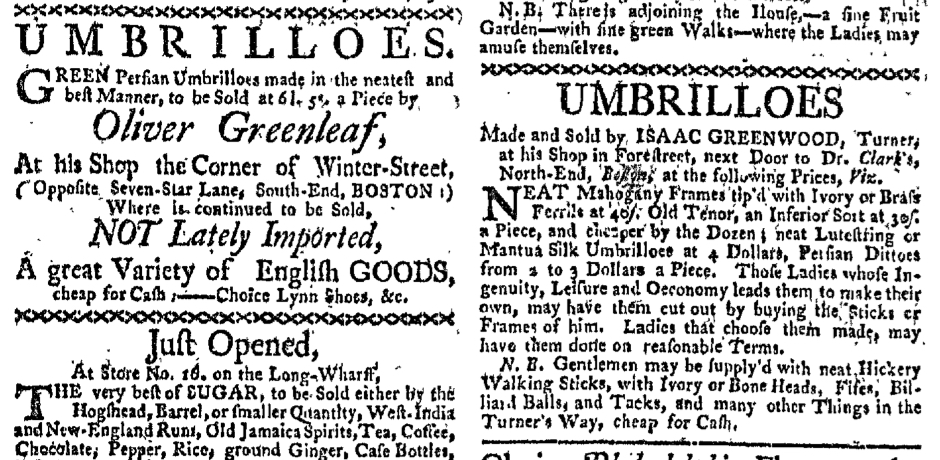
“UMBRILLOES.”

Oliver Greenleaf and Isaac Greenwood placed competing advertisements for “UMBRILLOES” in the June 12, 1769, edition of the Boston-Gazette. They relied on different marketing strategies, but both presented umbrellas as accessories perfectly appropriate for colonists, especially women, to acquire and use. Kate Haulman explains that umbrellas were a source of debate in the era of the American Revolution. They had only recently appeared in England and its colonies in North America. “Though large and clumsy by modern standards,” Haulman explains, “the umbrellas of the late eighteenth century were brightly colored items of fashion made of oiled silk, stylistic spoils of empire hailing from India.” Yet some colonists were uncertain that they should adopt this fashion. Beyond the space devoted to advertising, debates about umbrellas appeared elsewhere in colonial newspaper, “the forum best suited to prescribe or proscribe certain styles and behaviors for a wide audience of readers.” Some colonists considered umbrellas “ridiculous and frivolous, serving no purpose that a good hat could not supply.” Others allowed for their use, but only by women. In the eighteenth-century, many considered the umbrella a feminine accessory.[1]

Other colonists, however, defended umbrellas. Greenleaf and Greenwood addressed them, though they likely hoped to win new converts with their advertisements as well. Greenleaf did not acknowledge the debate over umbrellas. Instead, he positioned his umbrellas and the “great Variety of English GOODS” available at his shop within another debate about consumer culture. He proclaimed that his umbrellas and other goods were “NOT Lately Imported.” Usually merchants and shopkeepers emphasized that they carried the latest fashions that only recently arrived via ships from English ports, but in 1769 the vast majority in Boston participated in a nonimportation pact in protest of the duties on certain goods imposed by the Townshend Acts. A committee of merchants and traders monitored adherence and published reports in the city’s newspapers. Greenleaf’s livelihood and his reputation both depended on assuring the public that he did not peddle goods that violated the nonimportation agreement, hence his assertion that his merchandise was “NOT Lately Imported.”

Prospective customers interested in making purchases from Greenwood, on the other hand, did not need to worry about when he had acquired his umbrellas because he made them at his shop in the North End of Boston. Along with the nonimportation agreement, merchants, shopkeepers, and other colonists emphasized the importance of local production, what they termed domestic manufactures, coupled with virtuous consumption of goods produced in the colonies. This required the commitment of both suppliers and consumers. As a producer, Greenwood fulfilled the first part; he depended on consumers to do their part by choosing his umbrellas over those imported by Greenleaf, regardless of when they might have been transported across the Atlantic. He did imply that women might be more interested in umbrellas than men when he addressed “Ladies whose Ingenuity, Leisure and Oeconomy leads them to make their own.” They could save some money and demonstrate their own industry by purchasing the materials – fabrics and “Sticks or Frames” – from Greenwood and then putting together the umbrellas on their own. Although Greenleaf more explicitly commented on the nonimportation agreement then in effect, Greenwood more effectively placed his umbrellas within the discourse of local production.

Umbrellas were the subject of several debates and controversies in the decade before the American Revolution. Some colonists questioned their use at all, depicting them as unnecessary luxuries and frivolous feminine accessories. Others advocated for umbrellas, but only those that did not violate the terms of the nonimportation agreements. Those produced in local workshops possessed even greater cachet. In that regard, umbrellas became imbued with political as well as cultural meaning.

**********

[1] Kate Haulman, “Fashion and the Culture Wars of Revolutionary Philadelphia,” William and Mary Quarterly, 3rd ser., 62, no. 4 (October 2005): 632.

Slavery Advertisements Published June 12, 1769

The Slavery Adverts 250 Project chronicles the role of newspaper advertising in perpetuating slavery in the era of the American Revolution. The project seeks to reveal the ubiquity of slavery in eighteenth-century life from New England to Georgia by republishing advertisements for slaves – for sale, wanted to purchase, runaways, captured fugitives – in daily digests on this site as well as in real time via the @SlaveAdverts250 Twitter feed, utilizing twenty-first-century media to stand in for the print media of the eighteenth century.

The project aims to provide modern audiences with a sense of just how often colonists encountered these advertisements in their daily lives. Enslaved men, women, and children appeared in print somewhere in the colonies almost every single day. Those advertisements served as a constant backdrop for social, cultural, economic, and political life in colonial and revolutionary America. Colonists who did not own slaves were still confronted with slavery as well as invited to maintain the system by purchasing slaves or assisting in the capture of runaways. The frequency of these newspaper advertisements suggests just how embedded slavery was in colonial and revolutionary American culture in everyday interactions beyond the printed page.

These advertisements also testify to the experiences of enslaved men, women, and children, though readers must consider that those experiences have been remediated through descriptions offered by slaveholders rather than the slaves themselves. Often unnamed in the advertisements, enslaved men, women, and children were not invisible or unimportant in early America.

These advertisements appeared in colonial American newspapers 250 years ago today.

Jun 12 - Boston Evening-Post Slavery 1
Boston Evening-Post (June 12, 1769).

**********

Jun 12 - Boston Evening-Post Slavery 2
Boston Evening-Post (June 12, 1769).

**********

Jun 12 - Boston Post-Boy Slavery 2
Massachusetts Gazette [Green and Russell] (June 12, 1769).

**********

Jun 12 - Boston-Gazette Slavery 1
Boston-Gazette (June 12, 1769).

**********

Jun 12 - Massachusetts Gazette Green and Russell Slavery 1
Massachusetts Gazette [Green and Russell] (June 12, 1769).

**********

Jun 12 - New-York Gazette Weekly Mercury Slavery 1
New-York Gazette and Weekly Mercury (June 12, 1769).

**********

Jun 12 - New-York Gazette Weekly Mercury Slavery 2
New-York Gazette and Weekly Mercury (June 12, 1769).

**********

Jun 12 - New-York Gazette Weekly Mercury Slavery 3
New-York Gazette and Weekly Mercury (June 12, 1769).

**********

Jun 12 - New-York Gazette Weekly Mercury Slavery 4
New-York Gazette and Weekly Mercury (June 12, 1769).

**********

Jun 12 - New-York Gazette Weekly Mercury Supplement Slavery 1
Supplement to the New-York Gazette and Weekly Mercury (June 12, 1769).

**********

Jun 12 - New-York Gazette Weekly Mercury Supplement Slavery 2
Supplement to the New-York Gazette and Weekly Mercury (June 12, 1769).

**********

Jun 12 - New-York Gazette Weekly Mercury Supplement Slavery 3
Supplement to the New-York Gazette and Weekly Mercury (June 12, 1769).

**********

Jun 12 - Pennsylvania Chronicle Slavery 1
Pennsylvania Chronicle (June 12, 1769).

**********

Jun 12 - South-Carolina and American General Gazette Slavery 1
South-Carolina and American General Gazette (June 12, 1769).

**********

Jun 12 - South-Carolina and American General Gazette Slavery 2
South-Carolina and American General Gazette (June 12, 1769).

**********

Jun 12 - South-Carolina and American General Gazette Slavery 3
South-Carolina and American General Gazette (June 12, 1769).

**********

Jun 12 - South-Carolina and American General Gazette Slavery 4
South-Carolina and American General Gazette (June 12, 1769).

**********

Jun 12 - South-Carolina and American General Gazette Slavery 5
South-Carolina and American General Gazette (June 12, 1769).

**********

Jun 12 - South-Carolina and American General Gazette Slavery 6
South-Carolina and American General Gazette (June 12, 1769).

**********

Jun 12 - South-Carolina and American General Gazette Slavery 7
South-Carolina and American General Gazette (June 12, 1769).

**********

Jun 12 - South-Carolina and American General Gazette Slavery 8
South-Carolina and American General Gazette (June 12, 1769).

**********

Jun 12 - South-Carolina and American General Gazette Slavery 9
South-Carolina and American General Gazette (June 12, 1769).

June 11

What was advertised in a colonial American newspaper 250 years ago this week?

Jun 11 - 6:8:1769 New-York Chronicle
New-York Chronicle (June 8, 1769).

“Numbers of Disorders have been cured by them.”

When John Priestly and Charles Besronett advertised the “convenient Bath and House” they constructed at Chalybeat Springs in Bristol, Pennsylvania, in the spring of 1769, they emphasized the medicinal qualities of the waters rather than promoting their establishment as a destination for tourists. Even though they claimed it was “needless to publish the Uses of these Waters,” Priestly and Besronett went into great detail about the benefits of partaking in a trip to Chalybeat Springs. The name itself came from the word “chalybeate” associated with mineral springs and medicines that contained salts of iron.

They proclaimed that “Numbers of Disorders … that had eluded the most powerful Medicines” had been cured as a result of visiting. Yet they did not ask prospective clients merely to take their word for it. To ward off suspicions of quackery, they reported that members of the Philosophical Society in Philadelphia (known today as the American Philosophical Society, one of the oldest learned societies in the nation) had conducted experiments and published the results the previous year. That “Analysis of these Waters” revealed that they contained “a Portion of Iron dissolved and suspended by a vitriolick Acid in Water, perhaps as pure as any hitherto discovered in any Part of the World.” Even if prospective clients did not understand all of the scientific terminology, the advertisers expected terms like “pure” to resonate. Priestly and Besronett directed prospective clients to consult with their own physicians who were more qualified to examine the analysis published by the Philosophical Society. Still, they presented opportunities for readers to reach their own preliminary conclusions. They anticipated that prospective clients would recognize, or at least be impressed by, allusions to “the celebrated GERMAN SPAW.”

In addition, Priestly and Besronett signaled that analysis of the beneficial results of taking the waters continued. “In Order more fully to ascertain the Virtue of these Waters,” they announced, “an exact Register is intended to be kept.” That register would included the names of clients, the maladies they sought to alleviate, and the effects of visiting Chalybeat Springs. Rather than entrust compilation of this register solely to patrons, Priestly and Besronett requested that they bring “a short Account of their Case, drawn up by the Doctor attending them.” Descriptions by physicians, especially when they invoked the specialized language of the profession, would imbue the register with greater authority, exactly the sort of legitimacy that Priestly and Besronett already demonstrated they valued when they trumpeted the analysis undertaken by the Philosophical Society.

Some advertisements from the period testify to a nascent hospitality and travel industry in early America, but Priestly and Besronett eschewed marketing strategies often adopted by advertisers who provided lodging, transportation, and entertainment. Instead, they focused almost exclusively on the efficacious effects of visiting Chalybeat Springs as a remedy for medical disorders.  In that regard, their advertisement adopted an approach similar to the one in advertisements for “Jackson‘s Mineral Well” in the Boston Evening-Post a couple of years earlier. They could have also promoted a trip to the springs as an enjoyable leisure activity, but they instead privileged their attention to scientific inquiry as the primary means of persuading prospective clients to experience Chalybeat Springs for themselves.

June 10

What was advertised in a colonial American newspaper 250 years ago today?

Jun 10 - 6:10:1769 Providence Gazette
Providence Gazette (June 10, 1769).

“TO BE SOLD, (At a Distance from the Town of Providence only).”

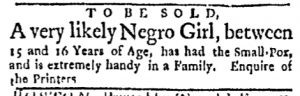
Among the advertisements in the June 10, 1769, edition of the Providence Gazette, an unnamed colonist offered to sell an enslaved youth. The advertisement did not provide many details except that the “young NEGROE WOMAN” was approximately fifteen years old and had been “born in the Country” rather than surviving the middle passage from Africa. The advertiser claimed that the enslaved youth was “capable of any Work suited to her Age,” but did not specify any particular skills that she possessed. Interested parties were instructed to “Enquire of the Printer” for more information.

None of that deviated from typical advertisements that offered enslaved men, women, and children for sale in the 1760s. The advertisement, however, did include one unusual element. It specified an exception concerning the terms of sale, stating that the seller intended to deal with buyers “At a Distance from the Town of Providence only.” The advertisement did not elaborate on the reason. This suggested a deliberate effort to separate the young woman from someone else. It hints at a story that most likely will never be recovered.

“Enquire of the Printer” advertisements truncated the information provided to readers, but they also truncated the miniature biographies of enslaved men, women, and children contained in those advertisements. Filtered through the perspective of a slaveholder, the advertisement obscures what may have been one of the most significant relationships in the young woman’s life at the time. Perhaps the advertiser considered it necessary to sell her “At a Distance” in order to effectively separate her from family members who exercised too much influence over her. Perhaps friends encouraged her to engage in acts of resistance and the seller hoped that sending her away would correct such insubordination. Perhaps she had embarked on a new romance that made her difficult to manage. Perhaps she frequently participated in altercations with the advertiser or a member of the advertiser’s family. Perhaps she had been sexually harassed, abused, or assaulted by a member of the household and selling her “At a Distance” was a strategy intended to make it easier for members of the household to overcome the rifts in their relationships with each other that had resulted. What might this young woman have recorded had she written her own narrative rather than having her experiences voiced, mostly in the formulaic language of advertisements of the period, by an unnamed slaveholder? The advertisement insinuates so much more while denying the young woman her own voice and concealing her story from readers past and present.

Slavery Advertisements Published June 10, 1769

The Slavery Adverts 250 Project chronicles the role of newspaper advertising in perpetuating slavery in the era of the American Revolution. The project seeks to reveal the ubiquity of slavery in eighteenth-century life from New England to Georgia by republishing advertisements for slaves – for sale, wanted to purchase, runaways, captured fugitives – in daily digests on this site as well as in real time via the @SlaveAdverts250 Twitter feed, utilizing twenty-first-century media to stand in for the print media of the eighteenth century.

The project aims to provide modern audiences with a sense of just how often colonists encountered these advertisements in their daily lives. Enslaved men, women, and children appeared in print somewhere in the colonies almost every single day. Those advertisements served as a constant backdrop for social, cultural, economic, and political life in colonial and revolutionary America. Colonists who did not own slaves were still confronted with slavery as well as invited to maintain the system by purchasing slaves or assisting in the capture of runaways. The frequency of these newspaper advertisements suggests just how embedded slavery was in colonial and revolutionary American culture in everyday interactions beyond the printed page.

These advertisements also testify to the experiences of enslaved men, women, and children, though readers must consider that those experiences have been remediated through descriptions offered by slaveholders rather than the slaves themselves. Often unnamed in the advertisements, enslaved men, women, and children were not invisible or unimportant in early America.

These advertisements appeared in colonial American newspapers 250 years ago today.

Jun 10 - Providence Gazette Slavery 1
Providence Gazette (June 10, 1769).

June 9

What was advertised in a colonial American newspaper 250 years ago today?

Jun 9 - 6:9:1769 New-Hampshire Gazette
New-Hampshire Gazette (June 9, 1769).

“A very large and compleat Assortment of BOOKS.”

Daniel Fowle and Robert Fowle, the printers of the New-Hampshire Gazette, experienced a disruption in their paper supply for two months in the late spring and early summer of 1769. As a result, they temporarily published the newspaper on slightly larger broadsheets, expanding the number of columns to four rather than three while reducing the length of most issues to two pages instead of four. This meant that overall they published eight columns of content in each issue (compared to the usual twelve) during the time they resorted to larger sheets. On June 9, however, the Fowles distributed a four-page edition that consisted of sixteen columns, one-third more content than a standard issue printed on slightly smaller broadsheets.

William Appleton’s advertisement for “a very large and compleat Assortment of BOOKS” accounted for three of those columns. In the headline, Appleton identified several genres to entice prospective customers: “Law, Physic, History, Anatomy, Novelty, Surgery, Navigation, Divinity, Husbandry, and Mathematicks.” He then listed more than two hundred titles available at his store in Portsmouth. As many booksellers did in their notices, he concluded with a short list of stationery and writing supplies. Had it appeared on a broadside rather than in a newspaper, this advertisement would have been considered a book catalog in its own right. Indeed, many newspaper advertisements placed by booksellers in eighteenth-century America amounted to book catalogs that were not published separately but instead integrated into other media.

The amount of space that Appleton’s advertisement occupied in the New-Hampshire Gazette was impressive. Had it been included in an issue printed on a broadsheet of the usual size, it would have filled an entire page on its own. Although rare, full-page advertisements were not unknown in eighteenth-century newspapers. John Mein, bookseller and printer of the Boston Chronicle, regularly inserted full-page advertisements (and some that even overflowed onto a second page) in his newspaper in the late 1760s. Other booksellers who were not printers as well as merchants and shopkeepers also published full-page advertisements, though not nearly as often as Mein since they did not have immediate access to the press or need to generate content for publication.

While not technically a full-page advertisement, Appleton’s catalog of books in the June 9, 1769, edition of the New-Hampshire Gazette would have been if it had been published during almost any other month that year. Still, it dominated the page and demonstrated that advertisers recognized the value in purchasing significant amount of space in newspapers as part of their efforts to attract customers.

June 8

What was advertised in a colonial American newspaper 250 years ago today?

Jun 8 - 6:8:1769 Boston Weekly News-Letter
Boston Weekly News-Letter (June 8, 1769).

“He will take second-hand Chaises in Pay for new.”

Adino Paddock offered several methods for consumers to acquire carriages of very sorts when he advertised in the Boston Weekly News-Letter in June 1769. In an advertisement that ran along the outer margin of the second page of the June 8 edition, the coachmaker proclaimed that he “has to sell a second-hand Post-Chaise, a very light Phaeton, and a Variety of Chaises, some of them genteel, and very little wore.” To facilitate purchases, he suggested that he “will take second-hand Chaises in part pay for new.” He also noted that he carried “Wilton Carpeting for Chaises.” In a rather brief advertisement, this eighteenth-century coachmaker invoked several marketing strategies that became common practices for the automobile industry in the twentieth and twenty-first centuries.

First, Paddock offered several models to meet the diverse needs, tastes, and budgets of prospective customers: a post-chaise, a phaeton, and a “variety” of chaises. He also realized that some buyers might not have the means to afford a new carriage but would be willing to purchase a used one, provided that it was in good condition. The “second-hand Post-Chaise” was the eighteenth-century equivalent of a used car. Yet “second-hand” did not have to mean inferior. Paddock stressed that his used carriages “were very little wore,” their quality and durability hardly reduced by having been driven by previous owners. In addition, they some of them were quite fashionable or “genteel.” To aid buyers who aimed to purchase new carriages, Paddock encouraged trade-ins, not unlike the modern automobile industry. In response to his offer to “take second-hand Chaises in part Pay for new,” prospective customers could expect to negotiate for the value of their used carriages that would be applied to the purchase price of new ones. Finally, Paddock acknowledged the benefits of a comfortable and luxurious interior, stressing that he installed “Wilton Carpeting for Chaises.” A carriage was not merely a means of transportation but also a status symbol that incorporated various accessories that contributed to both appearances and comfort.

More than a century before anyone even conceived of producing and selling automobiles, coachmaker Adino Paddock deployed marketing strategies for selling carriages that eventually became staples of the modern automobile industry. An array of models, used carriages, trade-ins, and accessories all played a role in selling vehicles for personal transportation in the eighteenth century, just as they would continue to do when invention and technology made more advanced products available to consumers in subsequent centuries.

Slavery Advertisements Published June 8, 1769

The Slavery Adverts 250 Project chronicles the role of newspaper advertising in perpetuating slavery in the era of the American Revolution. The project seeks to reveal the ubiquity of slavery in eighteenth-century life from New England to Georgia by republishing advertisements for slaves – for sale, wanted to purchase, runaways, captured fugitives – in daily digests on this site as well as in real time via the @SlaveAdverts250 Twitter feed, utilizing twenty-first-century media to stand in for the print media of the eighteenth century.

The project aims to provide modern audiences with a sense of just how often colonists encountered these advertisements in their daily lives. Enslaved men, women, and children appeared in print somewhere in the colonies almost every single day. Those advertisements served as a constant backdrop for social, cultural, economic, and political life in colonial and revolutionary America. Colonists who did not own slaves were still confronted with slavery as well as invited to maintain the system by purchasing slaves or assisting in the capture of runaways. The frequency of these newspaper advertisements suggests just how embedded slavery was in colonial and revolutionary American culture in everyday interactions beyond the printed page.

These advertisements also testify to the experiences of enslaved men, women, and children, though readers must consider that those experiences have been remediated through descriptions offered by slaveholders rather than the slaves themselves. Often unnamed in the advertisements, enslaved men, women, and children were not invisible or unimportant in early America.

These advertisements appeared in colonial American newspapers 250 years ago today.

Jun 8 - New-York Chronicle Slavery 1
New-York Chronicle (June 8, 1769).

**********

Jun 8 - New-York Chronicle Slavery 2
New-York Chronicle (June 8, 1769).

**********

Jun 8 - New-York Journal Supplement Slavery 1
Supplement to the New-York Journal (June 8, 1769).

**********

Jun 8 - New-York Journal Supplement Slavery 2
Supplement to the New-York Journal (June 8, 1769).

**********

Jun 8 - Pennsylvania Gazette Slavery 1
Pennsylvania Gazette (June 8, 1769).

**********

Jun 8 - Pennsylvania Gazette Supplement Slavery 1
Supplement to the Pennsylvania Gazette (June 8, 1769).

**********

Jun 8 - Pennsylvania Gazette Supplement Slavery 2
Supplement to the Pennsylvania Gazette (June 8, 1769).

**********

Jun 8 - Pennsylvania Journal Slavery 1
Pennsylvania Journal (June 8, 1769).

**********

Jun 8 - Pennsylvania Journal Slavery 2
Pennsylvania Journal (June 8, 1769).

**********

Jun 8 - Pennsylvania Journal Slavery 3
Pennsylvania Journal (June 8, 1769).

**********

Jun 8 - Pennsylvania Journal Slavery 4
Pennsylvania Journal (June 8, 1769).

**********

Jun 8 - South-Carolina Gazette Slavery 1
South-Carolina Gazette (June 8, 1769).

**********

Jun 8 - South-Carolina Gazette Slavery 2
South-Carolina Gazette (June 8, 1769).

**********

Jun 8 - South-Carolina Gazette Slavery 3
South-Carolina Gazette (June 8, 1769).

**********

Jun 8 - Virginia Gazette Purdie and Dixon Slavery 1
Virginia Gazette [Purdie and Dixon] (June 8, 1769).

**********

Jun 8 - Virginia Gazette Purdie and Dixon Slavery 3
Virginia Gazette [Purdie and Dixon] (June 8, 1769).

**********

Jun 8 - Virginia Gazette Purdie and Dixon Slavery 4
Virginia Gazette [Purdie and Dixon] (June 8, 1769).

**********

Jun 8 - Virginia Gazette Purdie and Dixon Slavery 5
Virginia Gazette [Purdie and Dixon] (June 8, 1769).

**********

Jun 8 - Virginia Gazette Purdie and Dixon Slavery 6
Virginia Gazette [Purdie and Dixon] (June 8, 1769).

**********

Jun 8 - Virginia Gazette Purdie and Dixon Slavery 7
Virginia Gazette [Purdie and Dixon] (June 8, 1769).

**********

Jun 8 - Virginia Gazette Purdie and Dixon Slavery 8
Virginia Gazette [Purdie and Dixon] (June 8, 1769).