June 7

What was advertised in a colonial American newspaper 250 years ago today?

Jun 7 - 6:7:1769 Georgia Gazette
Georgia Gazette (June 7, 1769).

SOLOMON SOLOMONS … A fmall Affortment of JEWELERY.”

Earlier this week NPR commentator Cokie Roberts caused quite a hullabaloo when she suggested that historians had significantly inflated the frequency of advertisements for abortion providers that appeared in nineteenth-century newspapers. Roberts stated, “There are many articles by abortion rights proponents who claim the procedure was so common that newspapers advertised providers. Look, I did a search of nineteenth-century newspapers and couldn’t find them.”[1] Historians quickly responded via Twitter, with Dr. Lauren MacIvor Thompson, a specialist in the history of medicine, public health, and the law, in the forefront with a tweet thread that corrected the record.

In addition to addressing content, historians representing various other fields within the discipline addressed the flaws in Roberts’s methodology. Roberts, a pundit rather than a trained historian, apparently did not realize that the absence of results generated by keyword searches does not mean that the historical evidence was not there. Like many of my colleagues, I pointed out two relevant issues. Both are so fundamental that I discuss them with undergraduate students in introductory and upper-level history courses on the first day that we begin working with databases of historical newspapers.

First, keyword searches have many shortcomings, especially because OCR (optical character recognition) is so imperfect. I explain to my students that computers are often, for lack of a better word, stupid. They do not always recognize or make sense of visual images (photographs or digital scans of historical sources) as effectively as people do. Computer software lacks the necessary creativity and flexibility. This is especially true when working with eighteenth-century printed sources that use the long “s” that looks like an “f” to twenty-first-century eyes. What human readers recognize as “Assortment,” for instance, looks like “Affortment” via OCR. (See Solomon Solomons’s advertisement from the June 7, 1769, edition of the Georgia Gazette.) Yet the long “s” is not the only pitfall for OCR. If the original printed words were not clear or subsequent remediation (photographs, microfilm, digital scans) was poorly done, then OCR has no chance of decoding the words on the page.

Second, when doing historical research it is necessary to think like the people from the period, especially to use the words they would have used rather than impose modern terminology. Context matters. Roberts, lacking an historian’s understanding of the period she investigated, apparently did not choose her keywords carefully or appropriately. When I train my undergraduate students to serve as guest curators for the Slavery Adverts 250 Project, I underscore that they must look for words beyond just “slave” (and that they have to examine every advertisement because keyword searches will exclude MANY advertisements that belong in the project). In addition to “slave,” they must also keep their eyes open for “negro,” “mulatto,” and “wench,” some of the words most often used to describe enslaved men, women, and children even when the word “slave” did not appear in an advertisement.

To demonstrate the shortcomings of keyword searches, I like to provide a practical example of an advertisement that I know exists yet a keyword search will not produce. Consider an advertisement from the June 7, 1769, edition of the Georgia Gazette. I previously downloaded the entire issue via Readex’s America’s Historical Newspapers database. I know that it contains an advertisement for jewelry placed by Solomon Solomons. Say that I want to know the extent of Solomons’s advertising campaign in 1769. Doing a keyword search with his last name would be a good place to start. To make the search as efficient as possible, I set several parameters. I limit the date under consideration to 1769. I restrict the newspapers to be searched to the Georgia Gazette. Then I enter “Solomons” as the keyword. This yields only two results: Solomons’s advertisement when it appeared in the May 24 and May 31 editions, but not the June 7 edition. This certainly tells me more about the frequency that Solomons advertised, but it did not yield an advertisement that I already knew existed! The digitized image of the advertisement is fairly clear (especially compared to many others), yet it appears that just enough ink bled through from the other side of the page to trick the OCR into overlooking this advertisement when doing a keyword search for “Solomons.”

This particular instance is not as “fraught,” to invoke Roberts’s term, as advertisements placed by abortion providers in the nineteenth century, but it is a practical example of how technology cannot substitute for historical expertise and appropriate methodologies for conducting research with primary sources. As many other historians have done in recent days, I encourage reporters and pundits to call on trained historians rather than make misleading assertions based on incomplete understandings of the past and shoddy research methods.

**********

[1] This quotation comes from Thompson’s tweet thread. NPR has updated the original audio and transcript to excise Robert’s incorrect and misleading assertions.

Slavery Advertisements Published June 7, 1769

The Slavery Adverts 250 Project chronicles the role of newspaper advertising in perpetuating slavery in the era of the American Revolution. The project seeks to reveal the ubiquity of slavery in eighteenth-century life from New England to Georgia by republishing advertisements for slaves – for sale, wanted to purchase, runaways, captured fugitives – in daily digests on this site as well as in real time via the @SlaveAdverts250 Twitter feed, utilizing twenty-first-century media to stand in for the print media of the eighteenth century.

The project aims to provide modern audiences with a sense of just how often colonists encountered these advertisements in their daily lives. Enslaved men, women, and children appeared in print somewhere in the colonies almost every single day. Those advertisements served as a constant backdrop for social, cultural, economic, and political life in colonial and revolutionary America. Colonists who did not own slaves were still confronted with slavery as well as invited to maintain the system by purchasing slaves or assisting in the capture of runaways. The frequency of these newspaper advertisements suggests just how embedded slavery was in colonial and revolutionary American culture in everyday interactions beyond the printed page.

These advertisements also testify to the experiences of enslaved men, women, and children, though readers must consider that those experiences have been remediated through descriptions offered by slaveholders rather than the slaves themselves. Often unnamed in the advertisements, enslaved men, women, and children were not invisible or unimportant in early America.

These advertisements appeared in colonial American newspapers 250 years ago today.

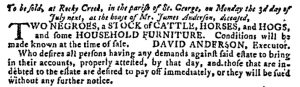
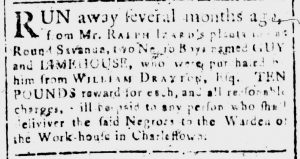
Jun 7 - Georgia Gazette Slavery 1
Georgia Gazette (June 7, 1769).

**********

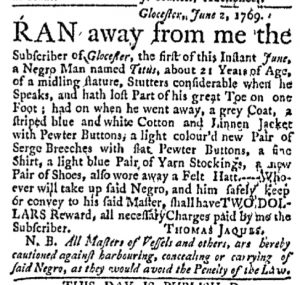
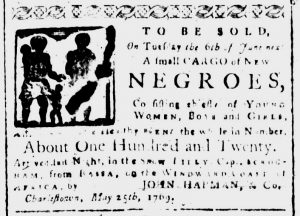
Jun 7 - Georgia Gazette Slavery 2
Georgia Gazette (June 7, 1769).

**********

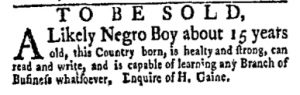
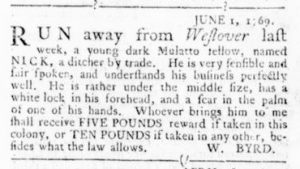
Jun 7 - Georgia Gazette Slavery 3
Georgia Gazette (June 7, 1769).

**********

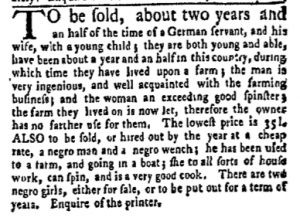
Jun 7 - Georgia Gazette Slavery 4
Georgia Gazette (June 7, 1769).

**********

Jun 7 - Georgia Gazette Slavery 5
Georgia Gazette (June 7, 1769).

**********

Jun 7 - Georgia Gazette Slavery 6
Georgia Gazette (June 7, 1769).

**********

Jun 7 - Georgia Gazette Slavery 7
Georgia Gazette (June 7, 1769).

**********

Jun 7 - Georgia Gazette Slavery 8
Georgia Gazette (June 7, 1769).

**********

Jun 7 - Georgia Gazette Slavery 9
Georgia Gazette (June 7, 1769).

**********

Jun 7 - Georgia Gazette Slavery 10
Georgia Gazette (June 7, 1769).

**********

Jun 7 - Georgia Gazette Slavery 11
Georgia Gazette (June 7, 1769).

**********

Jun 7 - Georgia Gazette Slavery 12
Georgia Gazette (June 7, 1769).

**********

Jun 7 - Georgia Gazette Slavery 13
Georgia Gazette (June 7, 1769).

**********

Jun 7 - Georgia Gazette Slavery 14
Georgia Gazette (June 7, 1769).

June 6

What was advertised in a colonial American newspaper 250 years ago today?

Jun 6 - 6:6:1769 Essex Gazette
Essex Gazette (June 6, 1769).

Goldsmith and Jeweller, AT the Sign of the Gold Cup.”

Like many other eighteenth-century advertisers, John Andrew noted the proximity of a landmark to his shop when directing prospective customers to his location. In an advertisement that ran in the Essex Gazette on June 6, 1769, Andrew informed readers that they could find his shop “near the Long-Wharf-Lane” in Salem. Yet he did not rely solely on landmarks and street names to identify his business. Andrew also declared that customers could seek him out at “the Sign of the Gold Cup.” A goldsmith and jeweler, Andrew selected a device that resonated with his occupation to mark his location.

Andrew’s advertisement testifies to an element of the visual landscape that residents and visitors alike encountered in Salem and other towns on the eve of the American Revolution. Merchants, shopkeepers, artisans, tavernkeepers, and others posted signs to identify where they did business. Often these signs featured images that became associated with both entrepreneurs and locations. In Andrew’s case, the “Sign of the Gold Cup” was appropriate for an artisan who “makes all Sorts of Goldsmith’s and Jewellery Ware,” yet others who followed different occupations most likely also made reference to that sign when giving directions. Advertisements from newspapers published in several cities reveal that even when they did not invest in signs themselves, colonists made use of signs posted by others to give directions. In addition to marking the locations of particular businesses, shop signs served as landmarks for navigating the vicinity. Just as Andrew stated that his shop was near Long Wharf Lane, advertisers sometimes invoked nearby signs erected by others as features that would aid prospective customers in finding their shops. Given the frequency that this occurred in newspaper advertisements, colonists likely adopted such strategies in conversation just as regularly. Useful not only for commerce, shop signs aided everyday navigation of the lanes, streets, and alleys in colonial cities and towns.
June 5

What was advertised in a colonial American newspaper 250 years ago today?

Jun 5 - 6:5:1769 New-York Chronicle
New-York Chronicle (June 5, 1769).

“Advertisements … are inserted for Five Shillings.”

Advertising represented an important revenue stream for eighteenth-century printers, prompting many to regularly solicit advertisements in the colophons of their newspapers. In 1769, for example, the colophon for the New-York Gazette: Or, the Weekly Post-Boy stated that James Parker printed it “at the NEW PRINTING-OFFICE … where Subscriptions, and Advertisements, &c. for this Paper are taken in.” Similarly, William Goddard used the colophon of the Pennsylvania Chronicle to proclaim that “Subscriptions, (at TEN SHILLINGS per Annum) Advertisements, Articles and Letters of Intelligence are gratefully received for this Paper” at his printing office. While printers regularly encouraged colonists to submit advertisements, they much less frequently indicated how much it cost to advertise in their publications.

Those that did list their advertising rates most often did so in the colophon, again utilizing it for conducting business on behalf of the newspaper rather than merely listing the particulars about who published it. A systematic examination of the colophons of eighteenth-century newspapers would produce a much better accounting of eighteenth-century advertising rates than has yet been compiled by historians of early American print culture. Such a project would include the New-York Chronicle.

When Alexander Robertson and James Robertson launched this newspaper in May 1769, they included their advertising rates in the colophon: “Advertisements of no more Length than Breadth are inserted for Five Shillings, four Weeks, and One Shilling for each Week after, and larger Advertisements in the same Proportion.” Their pricing schedule reflected common practices among printers who listed the fees for inserting notices in newspapers. Advertisers commonly purchased a “square” of advertising as the basic unit, paying an initial fee that covered both setting the type and running the advertisement for several weeks, usually three or four. Most printers also indicated additional costs for continuing an advertisement after its initial run, as well as proportional pricing for those that exceeded the standard square. In this case, the five shillings that the Robertsons charged to insert an advertisement for four weeks consisted of one shilling for setting the type and one shilling for each week it appeared in the New-York Chronicle. Each additional week cost one shilling. In this case, the colophon revealed valuable information about the business of printing in early America.

Slavery Advertisements Published June 5, 1769

The Slavery Adverts 250 Project chronicles the role of newspaper advertising in perpetuating slavery in the era of the American Revolution. The project seeks to reveal the ubiquity of slavery in eighteenth-century life from New England to Georgia by republishing advertisements for slaves – for sale, wanted to purchase, runaways, captured fugitives – in daily digests on this site as well as in real time via the @SlaveAdverts250 Twitter feed, utilizing twenty-first-century media to stand in for the print media of the eighteenth century.

The project aims to provide modern audiences with a sense of just how often colonists encountered these advertisements in their daily lives. Enslaved men, women, and children appeared in print somewhere in the colonies almost every single day. Those advertisements served as a constant backdrop for social, cultural, economic, and political life in colonial and revolutionary America. Colonists who did not own slaves were still confronted with slavery as well as invited to maintain the system by purchasing slaves or assisting in the capture of runaways. The frequency of these newspaper advertisements suggests just how embedded slavery was in colonial and revolutionary American culture in everyday interactions beyond the printed page.

These advertisements also testify to the experiences of enslaved men, women, and children, though readers must consider that those experiences have been remediated through descriptions offered by slaveholders rather than the slaves themselves. Often unnamed in the advertisements, enslaved men, women, and children were not invisible or unimportant in early America.

These advertisements appeared in colonial American newspapers 250 years ago today.

Jun 5 - Boston Evening-Post Supplement Slavery 1
Supplement to the Boston Evening-Post (June 5, 1769).

**********

Jun 5 - Boston-Gazette Slavery 1
Boston-Gazette (June 5, 1769).

**********

Jun 5 - Massachusetts Gazette Green and Russell Slavery 1
Massachusetts Gazette [Green and Russell] (June 5, 1769).

**********

Jun 5 - New-York Chronicle Slavery 1
New-York Chronicle (June 5, 1769).

**********

Jun 5 - New-York Gazette Weekly Mercury Slavery 1
New-York Gazette and Weekly Mercury (June 5, 1769).

**********

Jun 5 - New-York Gazette Weekly Mercury Slavery 2
New-York Gazette and Weekly Mercury (June 5, 1769).

**********

Jun 5 - New-York Gazette Weekly Mercury Slavery 3
New-York Gazette and Weekly Mercury (June 5, 1769).

**********

Jun 5 - New-York Gazette Weekly Mercury Slavery 4
New-York Gazette and Weekly Mercury (June 5, 1769).

**********

Jun 5 - New-York Gazette Weekly Mercury Supplement Slavery 1
Supplement to the New-York Gazette and Weekly Mercury (June 5, 1769).

**********

Jun 5 - New-York Gazette Weekly Mercury Supplement Slavery 2
Supplement to the New-York Gazette and Weekly Mercury (June 5, 1769).

**********

Jun 5 - New-York Gazette Weekly Mercury Supplement Slavery 3
Supplement to the New-York Gazette and Weekly Mercury (June 5, 1769).

**********

Jun 5 - Newport Mercury Slavery 1
Newport Mercury (June 5, 1769).

**********

Jun 5 - Pennsylvania Chronicle Slavery 1
Pennsylvania Chronicle (June 5, 1769).

**********

Jun 5 - South-Carolina and American General Gazette Slavery 1
South-Carolina and American General Gazette (June 5, 1769).

**********

Jun 5 - South-Carolina and American General Gazette Slavery 2
South-Carolina and American General Gazette (June 5, 1769).

**********

Jun 5 - South-Carolina and American General Gazette Slavery 3
South-Carolina and American General Gazette (June 5, 1769).

**********

Jun 5 - South-Carolina and American General Gazette Slavery 4
South-Carolina and American General Gazette (June 5, 1769).

**********

Jun 5 - South-Carolina and American General Gazette Slavery 5
South-Carolina and American General Gazette (June 5, 1769).

**********

Jun 5 - South-Carolina and American General Gazette Slavery 6
South-Carolina and American General Gazette (June 5, 1769).

**********

Jun 5 - South-Carolina and American General Gazette Slavery 7
South-Carolina and American General Gazette (June 5, 1769).

**********

Jun 5 - South-Carolina and American General Gazette Slavery 8
South-Carolina and American General Gazette (June 5, 1769).

**********

Jun 5 - South-Carolina and American General Gazette Slavery 9
South-Carolina and American General Gazette (June 5, 1769).

June 4

What was advertised in a colonial American newspaper 250 years ago this week?

Jun 4 - 6:1:1769 South-Carolina Gazette
South-Carolina Gazette (June 1, 1769).

“BREW-HOUSE.”

John Calvert and Company placed a brief advertisement in the June 1, 1769, edition of the South-Carolina Gazette to advise readers that they sold “ALE, TABLE and SHIP BEER.” The partners also offered a convenient service for their customers: delivery to “any part of the town,” provided that the buyer purchased at least five gallons.

Decorative typography, however, rather than the copy accounted for the most notable part of Calvert and Company’s advertisement. Like some other advertisers, they included a headline to draw attention: “BREW-HOUSE.” Unlike other advertisers, they arranged for a decorative border to enclose the headline, distinguishing the advertisement from almost every other in the South-Carolina Gazette. One other notice did feature a similar layout, an advertisement for the “Sloop MONTAGU” to be sold at public auction. Its headline announced “SALE by the Provost-Marshal,” also enclosed in decorative type.

The South-Carolina Gazette frequently featured such advertisements for goods, property, or enslaved men, women, and children seized by the provost marshal and to be sold to settle debts or resolve other legal disputes. Such notices benefited from the unique format, the headline in the decorative border, but other advertisements for goods and services placed by merchants, shopkeepers, artisans, and others did not incorporate such distinctive typography. Although the compositor could have made the decision independently, this suggests that Calvert and Company negotiated for that particular element of their advertisement, realizing that the headline and border would make it more visible among the advertisements that filled the final pages of the South-Carolina Gazette. Alternately, the partners could have commissioned a woodcut to spruce up their advertisement, but that likely would have incurred greater expense compared to utilizing decorative type the printer already had in hand.

In general, advertisers generated copy for newspaper notices in eighteenth-century America, but printers and compositors made decisions about graphic design. Calvert and Company’s notice suggests that advertisers sometimes observed distinctive design elements that they wished to incorporate into their own advertisements. Some likely suspected that distinctive visual elements made advertisements more effective and yielded a greater return on their investment, prompting them to borrow styles that they regularly encountered when they perused the newspapers.

June 3

What was advertised in a colonial American newspaper 250 years ago today?

Jun 3 - 6:3:1769 Providence Gazette
Providence Gazette (June 3, 1769).

“He will engage to sell as cheap … as any Person in Providence.”

When he advertised “ European and East-India GOODS” in the Providence Gazette in early June 1769, Thomas Greene resorted to two of the most popular marketing strategies of the eighteenth century: an appeal to consumer choice and an appeal to price.

He did not elaborate much on the choices he made available to prospective customers, but he did promise a “General and compleat Assortment” to anyone who visited his shop “near the Great Bridge.” Other advertisers sometimes provided extensive lists of their inventory, but many settled for “General and compleat Assortment” or some variation as a means of signaling choice to consumers. Elsewhere in the same issue Jonathan Russell promoted a “compleat Assortment,” Clark and Nightingale described a “new and compleat Assortment,” and Thurber and Cahoon hawked a “large and general Assortment” of imported goods. Greene’s choice of “General and compleat Assortment” did not much distinguish his advertisement from others, but it did demonstrate his awareness that customers expected some sort of assurances about choice or else they were unlikely to patronize his shop.

Greene put more effort into distinguishing his low prices from those of his competitors. Each deployed some form of standardized language to make the point to readers. For Russell, it was “the very cheapest Rate,” while Clark and Nightingale opted for “the lowest rate” and Thurber and Cahoon edged them out with “the very lowest Rates.” In contrast to these general statements, Greene made a firmer commitment to win over prospective customers. He pledged “to sell as cheap … as any Person in Providence,” assuring readers that they would not find better deals anywhere else. In effect, Greene offered the eighteenth-century version of a price match guarantee. Prospective customers could do some comparison shopping around town, but in the end Greene vowed that he would match any deals when readers chose to make their purchases from him. In so doing, he stood to increase his share of the market while luring customers away from his competitors.

Greene’s appeal to choice may have been generic, but his appeal to price was not. It was an innovative and crafty way of setting his advertisement apart from others that ran simultaneously in the Providence Gazette.

June 2

What was advertised in a colonial American newspaper 250 years ago today?

Jun 2 - 6:2:1769 New-Hampshire Gazette
New-Hampshire Gazette (June 2, 1769)

“SIMNET, Chief WATCHMAKER in AMERICA.”

It was another volley in an ongoing feud that was taking place in the advertisements published in the New-Hampshire Gazette in the spring of 1769. John Simnet proclaimed himself the “Chief WATCHMAKER in AMERICA,” the sort of hyperbole intended to promote his own skills and attract prospective customers, but also designed to taunt his rival, Nathaniel Sheaff Griffith.

Simnet was a relative newcomer in Portsmouth, having arrived earlier in the year. Griffith quickly determined that he did not appreciate Simnet intruding on his turf and competing for local customers. To protect his share of the market, he published advertisements that disparaged the upstart. In response, Simnet, who had been trained in London and pursued his occupation there for more than two decades, mocked Griffith for not having acquired the same skills. Griffith accused Simnet of being an itinerant who stole watches from his clients. Simnet claimed that Griffith further damaged watches put in his care, ultimately making it necessary for their owners to take the course of action they should have chosen from the start and deliver their watches to Simnet for more competent attention. Throughout all of this, neither watchmaker named his rival, but readers could hardly mistake the target of each allegation in the New-Hampshire Gazette, especially since the printers often positioned their advertisements side-by-side or one after the other.

In this salvo, Simnet offered a guarantee to prospective clients, pledging the “Owner [was] insur’d from future expence, (Accidents excepted).” In other words, Simnet confidently stood by his work, but he would also make additional repairs if he did not manage to completely resolve defects after an initial consultation. Simultaneously, he made a dig at Griffith, denigrating his rival once again without naming him. The unspoken contrast between Simnet as “Chief WATCHMAKER in AMERICA” and Griffith as a backwater dolt infused the advertisement for any reader who had followed the escalating feud over the past several months. As with several previous advertisements, this short notice may have looked rather bland at first glance, but when considered in the context of the advertising campaigns waged by both watchmakers it conveyed much more meaning, despite its brevity.

June 1

What was advertised in a colonial American newspaper 250 years ago today?

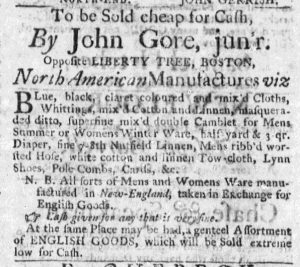
Jun 1 - 6:1:1769 Boston Weekly News-Letter
Boston Weekly News-Letter (June 1, 1769).

North American Manufactures.”

In the late 1760s, shopkeeper John Gore, Jr., became familiar to readers of several of Boston’s newspapers thanks to the steady series of advertisements he ran to promote the goods he sold at “Opposite LIBERTY TREE, BOSTON.” Gore adopted the famous symbol to mark the location of his shop at the time of the Stamp Act crisis, as did several other advertisers. Gore, however, consistently incorporated the Liberty Tree into his advertisements long after Parliament repealed the Stamp Act in response to various resistance efforts mobilized by the colonists. He could have given other sorts of directions, as was the custom for other advertisers. Caleb Blanchard, for instance, noted that his shop was located “In Union-Street.” Joshua Blanchard stated that his “Wine Cellar” was in “Dock-square, Near the Market.” Oliver Greenleaf directed prospective customers to his shop at “the Corner of Winter-Street (Opposite Seven-Star Lane).” Gore could have incorporated street names or other landmarks into his advertisement, but “Opposite LIBERTY TREE” apparently provided sufficient information while also associating his business with political principles that resonated with many consumers.

Often Gore invoked the Liberty Tree and allowed it to stand alone when it came to political discourse in his advertisements, but in early June 1769 he began pairing the popular icon with “North American Manufactures.” In so doing, he indicated to prospective customers that he heeded the calls to encourage greater self-sufficiency within the colonies through the production of more goods locally as a means of addressing a trade imbalance with Britain. Such plans had the additional benefit of avoiding the duties placed on certain imported goods by the Townshend Acts. In his advertisement he also noted that he had on hand “a genteel Assortment of ENGLISH GOODS.” For as long as Boston’s merchants and others had been promoting “domestic manufactures” as well as enforcing a nonimportation agreement, Gore had continued to advertise English goods (apparently imported before the agreement went into effect) in notices that boldly proclaimed his proximity to the Liberty Tree. Only in the late spring of 1760 did he seek to exchange “Mens and Womens Ware manufactured in New-England” for imported English goods. That offer usually appeared as a nota bene at the conclusion of his advertisements. His notice in the June 1, 1769, edition of the Boston Weekly News-Letter was his first that made “North American Manufactures” the focal point for attracting prospective customers. Although he consistently included the Liberty Tree into his advertisements, his understanding of how to most effectively incorporate politics into his marketing efforts slowly evolved. He more explicitly linked his wares to political discourse over time, especially in the wake of news articles that reported on whether merchants and shopkeepers adhered to the nonimportation agreements. The changing emphasis in his advertisements accompanied other advertisers becoming increasingly explicit in their own invocations of the politics associated with purchasing the goods they provided. Advertisers learned from each other as they experimented with mobilizing politics as a means of making sales as the nonimportation agreement continued to have an impact on their inventories.

Slavery Advertisements Published June 1, 1769

The Slavery Adverts 250 Project chronicles the role of newspaper advertising in perpetuating slavery in the era of the American Revolution. The project seeks to reveal the ubiquity of slavery in eighteenth-century life from New England to Georgia by republishing advertisements for slaves – for sale, wanted to purchase, runaways, captured fugitives – in daily digests on this site as well as in real time via the @SlaveAdverts250 Twitter feed, utilizing twenty-first-century media to stand in for the print media of the eighteenth century.

The project aims to provide modern audiences with a sense of just how often colonists encountered these advertisements in their daily lives. Enslaved men, women, and children appeared in print somewhere in the colonies almost every single day. Those advertisements served as a constant backdrop for social, cultural, economic, and political life in colonial and revolutionary America. Colonists who did not own slaves were still confronted with slavery as well as invited to maintain the system by purchasing slaves or assisting in the capture of runaways. The frequency of these newspaper advertisements suggests just how embedded slavery was in colonial and revolutionary American culture in everyday interactions beyond the printed page.

These advertisements also testify to the experiences of enslaved men, women, and children, though readers must consider that those experiences have been remediated through descriptions offered by slaveholders rather than the slaves themselves. Often unnamed in the advertisements, enslaved men, women, and children were not invisible or unimportant in early America.

These advertisements appeared in colonial American newspapers 250 years ago today.

Jun 1 - New-York Journal Supplement Slavery 1
Supplement to the New-York Journal (June 1, 1769).

**********

Jun 1 - Pennsylvania Gazette Slavery 1
Pennsylvania Gazette (June 1, 1769).

**********

Jun 1 - Pennsylvania Gazette Slavery 2
Pennsylvania Gazette (June 1, 1769).

**********

Jun 1 - Pennsylvania Gazette Supplement Slavery 1
Supplement to the Pennsylvania Gazette (June 1, 1769).

**********

Jun 1 - South-Carolina Gazette Slavery 1
South-Carolina Gazette (June 1, 1769).

**********

Jun 1 - South-Carolina Gazette Slavery 2
South-Carolina Gazette (June 1, 1769).

**********

Jun 1 - Virginia Gazette Purdie and Dixon 7
Virginia Gazette [Purdie & Dixon] (June 1, 1769).

**********

Jun 1 - Virginia Gazette Purdie and Dixon Slavery 1
Virginia Gazette [Purdie & Dixon] (June 1, 1769).

**********

Jun 1 - Virginia Gazette Purdie and Dixon Slavery 2
Virginia Gazette [Purdie & Dixon] (June 1, 1769).

**********

Jun 1 - Virginia Gazette Purdie and Dixon Slavery 3
Virginia Gazette [Purdie & Dixon] (June 1, 1769).

**********

Jun 1 - Virginia Gazette Purdie and Dixon Slavery 4
Virginia Gazette [Purdie & Dixon] (June 1, 1769).

**********

Jun 1 - Virginia Gazette Purdie and Dixon Slavery 5
Virginia Gazette [Purdie & Dixon] (June 1, 1769).

**********

Jun 1 - Virginia Gazette Purdie and Dixon Slavery 6
Virginia Gazette [Purdie & Dixon] (June 1, 1769).

**********

Jun 1 - Virginia Gazette Purdie and Dixon Slavery 8
Virginia Gazette [Purdie & Dixon] (June 1, 1769).

**********

Jun 1 - Virginia Gazette Rind Slavery 1
Virginia Gazette [Rind] (June 1, 1769).

**********

Jun 1 - Virginia Gazette Rind Slavery 2
Virginia Gazette [Rind] (June 1, 1769).

**********

Jun 1 - Virginia Gazette Rind Slavery 3
Virginia Gazette [Rind] (June 1, 1769).
Jun 1 - Virginia Gazette Rind Slavery 4
Virginia Gazette [Rind] (June 1, 1769).

**********

Jun 1 - Virginia Gazette Rind Slavery 5
Virginia Gazette [Rind] (June 1, 1769).

**********

Jun 1 - Virginia Gazette Rind Supplement Supplement Slavery 1
Supplement to the Virginia Gazette [Rind] (June 1, 1769).

**********

Jun 1 - Virginia Gazette Rind Supplement Supplement Slavery 2
Supplement to the Virginia Gazette [Rind] (June 1, 1769).

**********

Jun 1 - Virginia Gazette Rind Supplement Supplement Slavery 3
Supplement to the Virginia Gazette [Rind] (June 1, 1769).

**********

Jun 1 - Virginia Gazette Rind Supplement Supplement Slavery 4
Supplement to the Virginia Gazette [Rind] (June 1, 1769).