August 18

What was advertised in a colonial American newspaper 250 years ago today?

Aug 18 - 8:18:1769 New-Hampshire Gazette
New-Hampshire Gazette (August 18, 1769).

“I will properly Repair, and Rectify, and Refit a WATCH, better by half, in half the Time, and for half his Price.”

The rivalry between watchmakers John Simnet (who regularly referred to himself merely as “SIMNET”) and Nathaniel Sheaff Griffith continued in August 1769. Their advertisements conveniently appeared next to each at the top of the second and third columns on the third page of the August 18, 1769, edition of the New-Hampshire Gazette. Perhaps a canny compositor sought to create a dramatic scene and increase their entertainment value via their placement on the page.

Griffith placed the more subdued advertisement. In the past, he had directly targeted Simnet, though he had never mentioned the newcomer to the colony by name. Griffith had previously impugned Simnet’s skills by calling him an itinerant and implying that his mobility facilitated theft of the watches he accepted from clients. His advertisement on August 18, however, deployed formulaic language that any watchmaker anywhere in the colonies would have used in the 1760s. Griffith advised prospective customers that he “WILL speedily and properly, repair and rectify any CLOCKS or WATCHES out of Order, in the best and cheapest Manner.” Furthermore, he pledged that “Any CLOCK or WATCH sent to said GRIFFTH, will be speedily re-fitted and expeditiously returned.” In the course of only a few lines, he made appeals to his skill, the quality of his work, price, and convenience. He did not make any overt jabs at Simnet. Perhaps Griffith decided that doing so was unseemly or had not served his purposes or enhanced his reputation in the wake of past attempts.

Simnet, on the other hand, launched another barrage of insults against Griffith in the process of promoting his own work. In particular, he mocked the appeals that Griffith made in his advertisement. “Now here’s a promising Youth,” Simnett taunted, “tells us, he is best, and cheap, & speedy.” In early advertisements Simnet underscored his quarter century of experience in London and Dublin; he leveraged the longevity of his career to suggest that Griffith was an inexperience youth. Calling him “promising” was backhanded, at best. Simnet warned that prospective clients should not even waste their time with Griffith, suggesting that he was one of those “pretenders” who “get well paid, for what they don’t or can’t do.” In contrast, Simnet trumpeted, “I will properly Repair, and Rectify, and Refit a WATCH, better by half, in half the Time, and for half his Price.” He possessed the skills and experience to do so, having served as “Finisher to all the best original Workmen in the old Country.” Griffith had toned down his advertisements, but Simnet still felt enmity toward his rival, voicing it clearly and creatively in yet another advertisement.

Griffith and Simnet made choices about the content of their advertisements, frequently inserting new and updated notices in the New-Hampshire Gazette over the period of several months in 1769. Most advertisers did not directly engage their competitors, but these two watchmakers experimented with pursuing a feud in the public prints as a strategy for garnering attention. That is not to suggest that they coordinated their efforts to create a spectacle; that seems to have happened organically as each made decisions about the copy for their next advertisement. Simnet, newly arrived in New Hampshire, apparently believed that the squabble served him well, but Griffith tired of making his competitor so prominent in his own advertisements. Still, he felt the pressure from Simnet. Griffith rarely advertised before the English watchmaker appeared on the scene, but regularly promoted his services once Simnet launched his barrage of advertising.
Slavery Advertisements Published August 18, 1769

The Slavery Adverts 250 Project chronicles the role of newspaper advertising in perpetuating slavery in the era of the American Revolution. The project seeks to reveal the ubiquity of slavery in eighteenth-century life from New England to Georgia by republishing advertisements for slaves – for sale, wanted to purchase, runaways, captured fugitives – in daily digests on this site as well as in real time via the @SlaveAdverts250 Twitter feed, utilizing twenty-first-century media to stand in for the print media of the eighteenth century.

The project aims to provide modern audiences with a sense of just how often colonists encountered these advertisements in their daily lives. Enslaved men, women, and children appeared in print somewhere in the colonies almost every single day. Those advertisements served as a constant backdrop for social, cultural, economic, and political life in colonial and revolutionary America. Colonists who did not own slaves were still confronted with slavery as well as invited to maintain the system by purchasing slaves or assisting in the capture of runaways. The frequency of these newspaper advertisements suggests just how embedded slavery was in colonial and revolutionary American culture in everyday interactions beyond the printed page.

These advertisements also testify to the experiences of enslaved men, women, and children, though readers must consider that those experiences have been remediated through descriptions offered by slaveholders rather than the slaves themselves. Often unnamed in the advertisements, enslaved men, women, and children were not invisible or unimportant in early America.

These advertisements appeared in colonial American newspapers 250 years ago today.

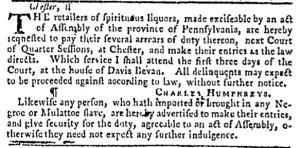
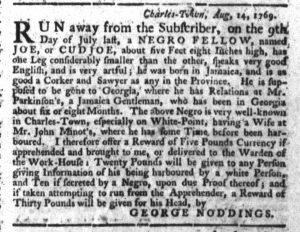
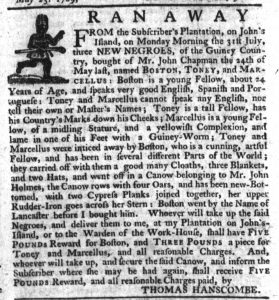
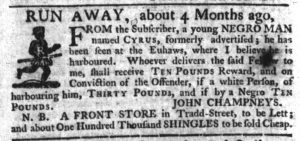
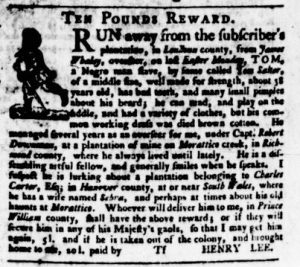
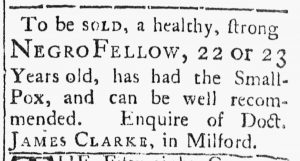
Aug 18 - Connecticut Journal Slavery 1
Connecticut Journal (August 18, 1769).

August 17

Who was the subject of an advertisement in a colonial American newspaper 250 years ago today?

Aug 17 - 8:17:1769 Massachusetts Gazette Draper
Massachusetts Gazette [Draper] (August 17, 1769).
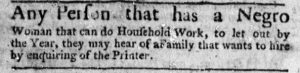
“A Negro Woman that can do Household Work, to let out by the Year.”

In the era of the American Revolution, enslavement of Africans and African Americans was not confined to the southern colonies. As newspaper advertisements and other sources from the period demonstrate, enslaved men, women, and children lived and labored throughout the colonies that eventually became the United States, from New England to Georgia. Consider this advertisement seeking “a Negro Woman that can do Household Work” that ran in the August 17, 1769, edition of Richard Draper’s Massachusetts Gazette. It testifies to the presence of enslaved people in Boston and its environs. It also reveals that the market for enslaved labor was more complex than buying and selling. The advertiser sought a domestic servant “let out by the Year.” In other words, the family did not wish to purchase and permanently acquire an enslaved woman; instead, they wished to rent her services for a year, a practice known as hiring out. Not only were enslaved people deemed commodities by colonists, their labor was also a commodity to be traded in the marketplace.

The conscribed freedom of “a Negro Woman [who] can do Household Work ” stood in stark contrast to the other contents of the newspaper, at least to anyone who cared to take notice. The front page carried news about the ongoing nonimportation agreement, an act of economic resistance to Parliament imposing taxes on paper, glass, lead, tea, and paint in the Townshend Acts. Henry Bass’s advertisement for “American Grindstones … esteemed vastly superior to those from Great-Britain” ran once again. A news article noted that the Sons of Liberty had celebrated their anniversary, gathering first at the “Liberty-Tree” to drink fourteen toasts and then adjourning to “Mr. Robinson’s at the Sign of Liberty-Tree in Dorchester.” By 1769, the Liberty Tree had become a familiar symbol in Boston. The bulk of the news concerned participation in the nonimportation agreement that “some Persons who had heretofore refused to join in the Agreement for Non-Importation appeared and signed the same.” Another indicated that the “Committee of Inspection” would soon make a report about those violated the agreement. Yet another outlined the political stakes of the boycott, noting that those who selfishly did not abide by it exhibited “a total Disregard to the Liberty and Welfare of their County.”

The concept of liberty appeared repeatedly in Draper’s Massachusetts Gazette in August 1769, in juxtaposition with an advertisement seeking “a Negro Woman that can do Household Work.” Colonists encountered symbols of liberty as they traversed the streets of Boston, just as they encountered enslaved men, women, and children denied their own liberty. Yet so few acknowledged the contradiction in 1769. Enslaved people, however, were all too aware of it. Any “Negro Woman [who] can do Household Work” likely had her own ideas about the meaning of liberty, informed by her own experiences, her treatment in the marketplace, and the discourse swirling around her in the era of the imperial crisis that led to the American Revolution.

Slavery Advertisements Published August 17, 1769

The Slavery Adverts 250 Project chronicles the role of newspaper advertising in perpetuating slavery in the era of the American Revolution. The project seeks to reveal the ubiquity of slavery in eighteenth-century life from New England to Georgia by republishing advertisements for slaves – for sale, wanted to purchase, runaways, captured fugitives – in daily digests on this site as well as in real time via the @SlaveAdverts250 Twitter feed, utilizing twenty-first-century media to stand in for the print media of the eighteenth century.

The project aims to provide modern audiences with a sense of just how often colonists encountered these advertisements in their daily lives. Enslaved men, women, and children appeared in print somewhere in the colonies almost every single day. Those advertisements served as a constant backdrop for social, cultural, economic, and political life in colonial and revolutionary America. Colonists who did not own slaves were still confronted with slavery as well as invited to maintain the system by purchasing slaves or assisting in the capture of runaways. The frequency of these newspaper advertisements suggests just how embedded slavery was in colonial and revolutionary American culture in everyday interactions beyond the printed page.

These advertisements also testify to the experiences of enslaved men, women, and children, though readers must consider that those experiences have been remediated through descriptions offered by slaveholders rather than the slaves themselves. Often unnamed in the advertisements, enslaved men, women, and children were not invisible or unimportant in early America.

These advertisements appeared in colonial American newspapers 250 years ago today.

Aug 17 - Boston Weekly News-Letter Slavery 1
Boston Weekly News-Letter (August 17, 1769).

**********

Aug 17 - Massachusetts Gazette Draper Slavery 1
Massachusetts Gazette [Draper] (August 17, 1769).

**********

Aug 17 - New-York Chronicle Slavery 1
New-York Chronicle (August 17, 1769).

**********

Aug 17 - Pennsylvania Gazette Slavery 1
Pennsylvania Gazette (August 17, 1769).

**********

Aug 17 - Pennsylvania Gazette Slavery 2
Pennsylvania Gazette (August 17, 1769).

**********

Aug 17 - South-Carolina Gazette Slavery 1
South-Carolina Gazette (August 17, 1769).

**********

Aug 17 - South-Carolina Gazette Slavery 2
South-Carolina Gazette (August 17, 1769).

**********

Aug 17 - South-Carolina Gazette Slavery 3
South-Carolina Gazette (August 17, 1769).

**********

Aug 17 - South-Carolina Gazette Slavery 4
South-Carolina Gazette (August 17, 1769).

**********

Aug 17 - Virginia Gazette Purdie and Dixon Slavery 1
Virginia Gazette [Purdie & Dixon] (August 17, 1769).

**********

Aug 17 - Virginia Gazette Purdie and Dixon Slavery 2
Virginia Gazette [Purdie & Dixon] (August 17, 1769).

**********

Aug 17 - Virginia Gazette Purdie and Dixon Slavery 3
Virginia Gazette [Purdie & Dixon] (August 17, 1769).

**********

Aug 17 - Virginia Gazette Purdie and Dixon Slavery 4
Virginia Gazette [Purdie & Dixon] (August 17, 1769).

**********

Aug 17 - Virginia Gazette Purdie and Dixon Slavery 5
Virginia Gazette [Purdie & Dixon] (August 17, 1769).

**********

Aug 17 - Virginia Gazette Purdie and Dixon Slavery 6
Virginia Gazette [Purdie & Dixon] (August 17, 1769).

**********

Aug 17 - Virginia Gazette Purdie and Dixon Slavery 7
Virginia Gazette [Purdie & Dixon] (August 17, 1769).

**********

Aug 17 - Virginia Gazette Purdie and Dixon Slavery 8
Virginia Gazette [Purdie & Dixon] (August 17, 1769).

**********

Aug 17 - Virginia Gazette Rind Slavery 1
Virginia Gazette [Rind] (August 17, 1769).

**********

Aug 17 - Virginia Gazette Rind Slavery 2
Virginia Gazette [Rind] (August 17, 1769).

**********

Aug 17 - Virginia Gazette Rind Slavery 3
Virginia Gazette [Rind] (August 17, 1769).

**********

Aug 17 - Virginia Gazette Rind Slavery 4
Virginia Gazette [Rind] (August 17, 1769).

**********

Aug 17 - Virginia Gazette Rind Slavery 5
Virginia Gazette [Rind] (August 17, 1769).

August 16

What was advertised in a colonial American newspaper 250 years ago today?

Aug 16 - 8:16:1769 Georgia Gazette
Georgia Gazette (August 16, 1769).

“Would be glad to be employed in keeping of books.”

Elizabeth Bedon’s advertisement proposing to open a boarding school in Savannah “for the education of young ladies” ran for the third and final time in the August 16, 1769, edition of the Georgia Gazette. Immediately below it appeared an employment advertisement inserted by George Bedon: “The subscriber being regularly bred to the mercantile business, would be glad to be employed in keeping of books, drawing out accounts, &c. Those who are pleased to employ him may depend upon the greatest correctness and dispatch.” That advertisement also made its third and final appearance on August 16, each time running in combination with Elizabeth’s advertisement.

George’s notice did not indicate where prospective employers could contact him. Given that Savannah was a small port, he may have considered listing such information unnecessary. After all, other advertisers did not always list their locations. In the same issue, Thomas Hamilton offered a “SMALL NEAT TENEMENT” for rent and Inglis and Hall hawked “superfine Philadelphia Flour.” Neither notice included a location, the advertisers expecting that they were familiar enough figures that interested parties would know where to find them.

That Elizabeth and George simultaneously placed advertisements seeking employment, however, suggests that they may have been new to Savannah and intended for the advertisements to serve as a form of introduction to their new neighbors. In that case, George likely meant for his advertisement to piggyback on Elizabeth’s, which concluded by advising “those who intend to intrust their children under her care to favour her with a line, directed to be left at Capt. Langford’s.” She apparently considered the captain a prominent enough figure in the community not to require additional information about his place of residence. George likely anticipated that subscribers and others engaged in sufficiently close reading of the advertisements that prospective employers would be able to deduce his location.

Even when they ran for multiple weeks, the order of advertisements in colonial newspapers shifted from issue to issue. Compositors moved them according to length in order to make all of the contents fit on the page. At only four lines, George’s advertisement would have been relatively easy to insert anywhere that a column fell just shy of being complete. That it consistently remained with Elizabeth’s advertisement suggests both that they purchased the two as a package and that the compositor exercised special care in making sure that they were not separated during the duration of their run in the Georgia Gazette.

Slavery Advertisements Published August 16, 1769

The Slavery Adverts 250 Project chronicles the role of newspaper advertising in perpetuating slavery in the era of the American Revolution. The project seeks to reveal the ubiquity of slavery in eighteenth-century life from New England to Georgia by republishing advertisements for slaves – for sale, wanted to purchase, runaways, captured fugitives – in daily digests on this site as well as in real time via the @SlaveAdverts250 Twitter feed, utilizing twenty-first-century media to stand in for the print media of the eighteenth century.

The project aims to provide modern audiences with a sense of just how often colonists encountered these advertisements in their daily lives. Enslaved men, women, and children appeared in print somewhere in the colonies almost every single day. Those advertisements served as a constant backdrop for social, cultural, economic, and political life in colonial and revolutionary America. Colonists who did not own slaves were still confronted with slavery as well as invited to maintain the system by purchasing slaves or assisting in the capture of runaways. The frequency of these newspaper advertisements suggests just how embedded slavery was in colonial and revolutionary American culture in everyday interactions beyond the printed page.

These advertisements also testify to the experiences of enslaved men, women, and children, though readers must consider that those experiences have been remediated through descriptions offered by slaveholders rather than the slaves themselves. Often unnamed in the advertisements, enslaved men, women, and children were not invisible or unimportant in early America.

These advertisements appeared in colonial American newspapers 250 years ago today.

Aug 16 - Georgia Gazette Slavery 1
Georgia Gazette (August 16, 1769).

**********

Aug 16 - Georgia Gazette Slavery 2
Georgia Gazette (August 16, 1769).

**********

Aug 16 - Georgia Gazette Slavery 3
Georgia Gazette (August 16, 1769).

**********

Aug 16 - Georgia Gazette Slavery 4
Georgia Gazette (August 16, 1769).

**********

Aug 16 - Georgia Gazette Slavery 5
Georgia Gazette (August 16, 1769).

**********

Aug 16 - Georgia Gazette Slavery 6
Georgia Gazette (August 16, 1769).

**********

Aug 16 - Georgia Gazette Slavery 7
Georgia Gazette (August 16, 1769).

August 15

What was advertised in a colonial American newspaper 250 years ago today?

Aug 15 - 8:15:1769 Essex Gazette
Essex Gazette (August 15, 1769).

“Printed by Samuel Hall, at his Printing-Office.”

Sometime during the week between publishing the August 8, 1769, edition of the Essex Gazette and the August 15 edition, Samuel Hall altered the colophon. The new colophon simply stated: “SALEM: Printed by Samuel Hall, at his Printing-Office a few Doors above the Town-House.” Except for the period instead of a semicolon after “Town-House,” this read the same as the first line of the former colophon. However, Hall eliminated the second line: “where Subscriptions for this GAZETTE, at Six Shillings and Eight Pence per Annum, are taken in;–3s. 4d. to be paid at Entrance.” Hall had been using the colophon as advertising space to promote subscriptions for the newspaper, hoping to attract new customers who read copies that passed from hand to hand. Not every colonial printer deployed the colophon as a final advertisement, but the practice was not uncommon either. Several used the space to solicit subscriptions or advertisements or to peddle handbills, stationery, printed blanks, or printing services.

This was not the first time that Hall altered the colophon for the Essex Gazette. Although he had been publishing the newspaper for only a little over a year (the August 15 edition was issue number 55), he had revised the colophon on several occasions, adding and removing a second line that served as advertising. In the first issue published in 1769, for instance, the second line informed readers of the price of subscriptions and announced that Hall sought advertisements. It read: “where SUBSCRIPTIONS, (at Six Shillings and Eight Pence per Annum) ADVERTISEMENTS, &c. are received for this Paper.” A couple of months later, Hall eliminated that second line and slightly altered the first, listing his name as “S. HALL” rather than “Samuel Hall.” That version eventually gave way to the one that appeared until August 8, the one in which Hall used the second line to encourage readers to become subscribers and specified that those who di so were expected to pay half of the subscription fee “at Entrance.”

Hall’s colophon for the Essex Gazette varied from issue to issue much more often than the colophons that appeared in other American newspapers in the 1760s. The publisher moved back and forth between using the colophon as space for advertising aspects of his own publication – subscriptions and advertisements – and a pared down notation limited to publisher and location. Why? What prompted Hall to make these changes? Does the elimination of the second line indicate that it had not achieved the purposes Hall intended? It took up so little space that Hall did not have to sacrifice other content when including it. Why did he choose to refrain from using the colophon to encourage subscriptions and advertising?

August 14

What was advertised in a colonial American newspaper 250 years ago today?

Aug 14 - 8:14:1769 Newport Mercury
Newport Mercury (August 14, 1769).

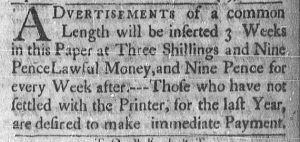
““ADvertisements of a common Length will be inserted 3 Weeks in this Paper at Three Shillings and Nine Pence Lawful Money.”

How much did advertising in colonial newspapers cost? Printers rarely published advertising rates in their newspapers. A few did include this information in the colophon that appeared at the bottom of the final page of each issue, but most did not make their rates so readily available. On occasion, some printers published their plan of publication, including advertising rates, in the first edition as part of launching a newspaper, but did not incorporate that information into subsequent issues. That made Solomon Southwick’s advertisement in the August 14, 1769, edition of the Newport Mercury all the more notable. It did not receive a place of prominence on the first page or in the colophon. Instead, it appeared among other advertisements on the final page, sandwiched between Elizabeth Mumford’s advertisement that John Remmington continued making shoes at her shop following the death of her husband and John Fryer’s notice about a house for rent. The first column of the first page consisted almost entirely of advertising; Southwick could have increased the visibility for his own advertisement about advertising rates (as well as a call for advertisers who had not yet made payment to settle accounts) by inserting it as the first item readers would encounter.

Despite his decision not to exercise his privilege as printer of the Newport Mercury, Southwick did provide important information for prospective advertisers (and for historians of print culture in early America). He informed readers that “ADvertisements of a common Length will be inserted 3 Weeks in this Paper at Three Shillings and Nine Pence Lawful Money, and Nine Pence for every Week after.” His pricing scheme corresponded to those published by other printers. He charged a flat rate for setting the type and inserting an advertisement for three weeks. Some printers ran advertisements for four weeks, but most chose three weeks as the standard for an initial run. At three shillings and nine pence, this cost advertisers nine pence for each insertion and eighteen pence for setting type. This system allowed Southwick to generate revenues based on both labor involved in preparing an advertisement for publication and the space it occupied in the newspaper. His own advertisement, which did not appear the following week, would have cost the printing office twenty-seven pence – eighteen pence for setting the type and nine pence for the space in the August 14 edition – but Southwick likely considered it a good investment if it brought in new advertisers or convinced delinquent customers to make payments on their outstanding accounts.

Although eighteenth-century printers frequently advertised books, stationery, printed blanks, and other goods they sold, they rarely advertised advertising as a service they provided. Many may not have considered it necessary since the pages of their newspapers practically overflowed with advertisements. Those that did reveal advertising rates in the public prints demonstrated a high level of consistency in their business practices, charging an initial fee for setting type and running an advertisement for a specified number of weeks and then another fee for each additional week. According to his own advertisement, Southwick adopted just such a plan.

Slavery Advertisements Published August 14, 1769

The Slavery Adverts 250 Project chronicles the role of newspaper advertising in perpetuating slavery in the era of the American Revolution. The project seeks to reveal the ubiquity of slavery in eighteenth-century life from New England to Georgia by republishing advertisements for slaves – for sale, wanted to purchase, runaways, captured fugitives – in daily digests on this site as well as in real time via the @SlaveAdverts250 Twitter feed, utilizing twenty-first-century media to stand in for the print media of the eighteenth century.

The project aims to provide modern audiences with a sense of just how often colonists encountered these advertisements in their daily lives. Enslaved men, women, and children appeared in print somewhere in the colonies almost every single day. Those advertisements served as a constant backdrop for social, cultural, economic, and political life in colonial and revolutionary America. Colonists who did not own slaves were still confronted with slavery as well as invited to maintain the system by purchasing slaves or assisting in the capture of runaways. The frequency of these newspaper advertisements suggests just how embedded slavery was in colonial and revolutionary American culture in everyday interactions beyond the printed page.

These advertisements also testify to the experiences of enslaved men, women, and children, though readers must consider that those experiences have been remediated through descriptions offered by slaveholders rather than the slaves themselves. Often unnamed in the advertisements, enslaved men, women, and children were not invisible or unimportant in early America.

These advertisements appeared in colonial American newspapers 250 years ago today.

Aug 14 - Boston Evening-Post Slavery 1
Boston Evening-Post (August 14, 1769).

**********

Aug 14 - Boston Post-Boy Slavery 1
Boston Post-Boy (August 14, 1769).

**********

Aug 14 - Boston-Gazette Slavery 1
Boston-Gazette (August 14, 1769).

**********

Aug 14 - New-York Gazette or Weekly Post-Boy Slavery 1
New-York Gazette or Weekly Post-Boy (August 14, 1769).

**********

Aug 14 - New-York Gazette or Weekly Post-Boy Slavery 2
New-York Gazette or Weekly Post-Boy (August 14, 1769).

**********

Aug 14 - New-York Gazette Weekly Mercury Slavery 1
New-York Gazette and Weekly Mercury (August 14, 1769).

**********

Aug 14 - New-York Gazette Weekly Mercury Slavery 2
New-York Gazette and Weekly Mercury (August 14, 1769).

**********

Aug 14 - New-York Gazette Weekly Mercury Slavery 3
New-York Gazette and Weekly Mercury (August 14, 1769).

**********

Aug 14 - New-York Gazette Weekly Mercury Slavery 4
New-York Gazette and Weekly Mercury (August 14, 1769).

**********

Aug 14 - New-York Gazette Weekly Mercury Slavery 5
New-York Gazette and Weekly Mercury (August 14, 1769).

**********

Aug 14 - Newport Mercury Slavery 1
Newport Mercury (August 14, 1769).

**********

Aug 14 - Newport Mercury Slavery 2
Newport Mercury (August 14, 1769).

**********

Aug 14 - Pennsylvania Chronicle Slavery 1
Pennsylvania Chronicle (August 14, 1769).

**********

Aug 14 - South-Carolina and American General Gazette Slavery 1
South-Carolina and American General Gazette (August 14, 1769).

**********

Aug 14 - South-Carolina and American General Gazette Slavery 2
South-Carolina and American General Gazette (August 14, 1769).

**********

Aug 14 - South-Carolina and American General Gazette Slavery 3
South-Carolina and American General Gazette (August 14, 1769).

**********

Aug 14 - South-Carolina and American General Gazette Slavery 4
South-Carolina and American General Gazette (August 14, 1769).

**********

Aug 14 - South-Carolina and American General Gazette Slavery 5
South-Carolina and American General Gazette (August 14, 1769).

**********

Aug 14 - South-Carolina and American General Gazette Slavery 6
South-Carolina and American General Gazette (August 14, 1769).

August 13

What was advertised in a colonial American newspaper 250 years ago this week?

Aug 13 - 8:10:1769 Pennsylvania Gazette
Pennsylvania Gazette (August 10, 1769).

“At present it seems peculiarly the interest of America to encourage her own manufactories.”

In August 1769, Richard Wistar took to the pages of the Pennsylvania Gazette to advertise the products he manufactured at his “GLASS-WORKS” in Philadelphia. His inventory included “BOXES of WINDOW GLASS, consisting of the common sizes” as well as “most sorts of bottles,” containers for mustard and snuff, and other specialty glassware. Wistar also offered to cut glass windows of “uncommon sizes.”

To encourage prospective customers to purchase his wares, Wistar emphasized that “the abovementioned glass is of American manufactory” and then launched into a political lesson that matched the discourse circulating throughout the colonies in newspapers and in conversations in taverns, coffeehouses, and town squares. Glass produced in the colonies was “consequently clear of the duties the Americans so justly complain of,” duties imposed on certain imported goods by Parliament in the Townshend Acts. Wistar continued his lecture: “at present, it seems peculiarly the interest of America to encourage her own manufactories, more especially those upon which duties have been imposed, for the sole purpose of raising a revenue.” Those goods included paper, tea, lead, paints, and, most significantly for Wistar, glass.

In response, colonists revived a strategy they had previously pursued to resist the Stamp Act: merchants and shopkeepers vowed not to import goods from Britain. In order for their economic resistance to have greater political impact, they did not limit their boycott to only those goods indirectly taxed by the Townshend Acts. Instead, they enumerated a broad array of goods that they would not import or sell until the duties had been repealed. Simultaneously, they issued calls for the encouragement of “domestic manufactures” and argued that consumers could demonstrate their own politics in the marketplace by making a point of purchasing goods produced in the colonies. Neither producers nor consumers alone would have as much of an impact as both exercising their civic virtue through “encourage[ing] her own manufactories,” as Wistar reminded readers of the Pennsylvania Gazette.

Colonists certainly imbibed political arguments in news articles and editorials in newspapers, but they also encountered them in advertisements. In the service of selling goods and services, savvy entrepreneurs mobilized politics during the period of the imperial crisis that led to the American Revolution. They directed consumers away from some products in favor of purchasing others, challenging them to consider the ramifications of their activities in the marketplace.