August 12

What was advertised in a colonial American newspaper 250 years ago today?

Aug 12 - 8:12:1769 Providence Gazette
Providence Gazette (August 12, 1769).

“(Tbc.).”

The August 12, 1769, edition of the Providence Gazette included several short advertisements that extended only five lines. In its entirety, one read: “To be SOLD by THOMAS G. STELLE, In Newport, Philadelphia superfine and common FLOUR, SHIP BREAD, BAR IRON, &c. (Tbc.).” Eighteenth-century readers would have recognized “&c.” as the abbreviation for et cetera. They would have ignored “(Tbc.),” understanding that it was a notation intended for the compositor rather than for readers.

Other advertisements in the same issue also included notations for use by the compositor and others in the printing office, though they each used numbers instead of letters. Jonathan Mosher’s advertisement for a lost pocketbook and a notice from the Overseers of the Poor concerning a five-year-old girl “to be bound out until she is 18,” both included “(88)” at the end or near the end. Another advertisement that offered a “pleasant Farm” for sale concluded with “(75).”

What did these notations mean? Like many other colonial printers, John Carter, the printer of the Providence Gazette, charged a flat rate for setting the type for an advertisement and inserting it in three consecutive issues. Advertisers could pay additional fees to run their notices for longer periods. The notations in the advertisements helped compositors determine when it was time to remove them, but the examples from the Providence Gazette suggest that compositors did not rely on the notations alone. They must have also worked with a list of advertisements provided by the printer or someone else responsible for keeping records in the printing office.

Some advertisements did not include any notations. Presumably they appeared on a list drawn up by the printer to correspond with whatever arrangements had been made with the advertiser. Thomas Lindsey, for instance, may have made arrangements to check in with the printing office on a weekly basis to indicate if he wished for his advertisement concerning the bad behavior of his wife to run once again. He noted that Sarah had “eloped from my Bed and Board” and cautioned that he would not “pay any Debts of her contracting.” Lindsey hay have determined to continue the advertisement until such time that he and his wife reconciled or, if she did not return, long enough to get out the word that he would not pay her debts.

For those advertisements that included numbers as notations, the numbers corresponded to their first issue. Mosher’s advertisement for the lost pocketbook, for instance, first appeared in issue 288. If Mosher paid the standard fee, his advertisements would have appeared in issues 288, 289, and 290 before the compositor removed it. It continued, however, into issues 291 and 292. The compositor did not automatically remove it, suggesting that instructions on a separate list countermanded the instructions implicit in the notation. If Mosher had not yet recovered his pocketbook, he likely instructed the printer to continue the advertisement for additional weeks. Similarly, the notice from the Overseers of the Poor should have been discontinued after three issues, but continued because the girl had not yet been bound out.

The advertisement for the farm initially ran in three consecutive issues: 275, 276, and 277. It then appeared sporadically in issues 279, 284, 289, and 292. The “(75)” notation should have prompted the compositor to remove the advertisement when setting the type for issue 278. Its multiple reappearances suggest that the printer added the advertisement to a list of notices to appear in the current issue on several occasions.

What of “(Tbc.)” at the end of Stelle’s advertisement for flour, bread, and iron? It most likely stood for “to be continued,” indicating that it should appear indefinitely until Stelle instructed otherwise. By invoking this abbreviation rather than associating the advertisement with an issue number, the printer and compositor streamlined the production process. The compositor could continue to insert the advertisement unless the list of advertisements for a particular issue stated that the advertiser had chosen to discontinue it. By issue 292, Stelle’s advertisement ran in seventeen issues, absent only in 280. An abundance of advertising may have squeezed it out of that issue, the compositor may have overlooked it, or Stelle may have chosen to discontinue it for a week. Whatever the case, it soon returned and ran for another twelve consecutive weeks, the “(Tbc.)” aiding the compositor in determining if the advertisement should continue from one issue to the next.

August 11

What was advertised in a colonial American newspaper 250 years ago today?

Aug 11 - 8:11:1769 New-Hampshire Gazette
New-Hampshire Gazette (August 11, 1769).

Most of these Papers will, probably, be irrecoverably lost in a few Years, unless they be preserved by Printing.”

During the summer of 1769, Daniel Fowle and Robert Fowle, printers of the New-Hampshire Gazette, cooperated with other printers to incite demand for “a Volume of curious Papers, to serve as an Appendix to Lieutenant-Governor HUTCHINSON’S History of Massachusetts-Bay,” a work frequently advertised in newspapers in Boston and other parts of New England. To that end, the Fowles inserted a subscription notice in the New-Hampshire Gazette. Printers had dual purposes in circulating such “PROPOSALS” as newspaper advertisements and, sometimes, separate subscription papers. They aimed to stimulate demand, but they also conducted market research by assessing demand. They did not move forward with projects if consumers did not express sufficient demand. Such was the case with this “Volume of curious Papers.” The subscription notice starkly stated that the “Work will begin as soon as a sufficient Number of Subscribers appear to defrey the Expence.” Those who wished to reserve a copy needed to submit their names to T. and J. Fleet in Boston, Bulkeley Emerson in Newburyport, or the Fowles in Portsmouth.

In their efforts to encourage colonists to subscribe to the work, the printers vowed that “No more Books will be printed than what are subscribed for.” This created a sense of urgency for prospective subscribers, warning that if they did not make a commitment soon that eventually it would be too late to acquire a copy so they better not waver. The printers also presented a challenge that made colonists responsible for preserving the history and heritage of New England. The subscription notice concluded with a short paragraph that outlined their duty: “As most of these Papers will, probably, be irrecoverably lost in a few Years, unless they be preserved by Printing, it is hoped that a sufficient Number of Subscribers will soon appear, from a regard to the Public, as well as for the sake of their particular Entertainment.” The printers did not envision carefully storing the original documents as a means of safeguarding them for future generations. Instead, the best form of preservation occurred through multiplication. Taking the volume to press would guarantee that the contents of those “curious Papers” would survive long beyond the originals becoming “irrecoverably lost” through deterioration or mishap over the years. Colonists had a civic duty, “a regard to the Public,” to play a role in preventing that loss, according to the printers. Rather than thinking about purchasing and reading the “Volume of curious Papers” as a form of “particular Entertainment” only for themselves, the subscription notice challenged colonists to think of it as a service to their community. Consumption need not be frivolous; it could also serve a purpose in the interests of the greater good.

August 10

What was advertised in a colonial American newspaper 250 years ago today?

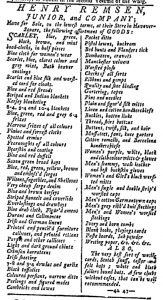
Aug 10 - 8:10:1769 New-York Journal
New-York Journal (August 10, 1769).

The following assortment of GOODS.”

With the exception of the “POETS CORNER” in the upper left and the colophon running across the bottom, advertisements of various lengths comprised the final page of the August 10, 1769, edition of the New-York Journal. Most consisted of dense blocks of text with headlines in a larger font, but two likely attracted attention because their format differed from the others. Jonathan Hampton’s advertisement included a familiar woodcut that depicted a Windsor chair. By that time, Hampton had included the image in his advertising so often that the woodcut had been damaged through such frequent use. The Windsor chair was missing an arm. Still, Hampton continued to garner a return on the investment he made in commissioning the woodcut, apparently believing that a visual image, even a slightly damaged one, enhanced the visibility of his advertisement.

Henry Remsen, Junior, and Company’s advertisement, on the other hand, consisted entirely of text, but its layout distinguished it from other advertisements, including those by competitors who also listed scores of goods available at their shops. Remsen and Company enumerated a variety of textiles and accessories, from “Blue and red strouds” and “Striped flannels and coverlids” to “Ribbons and gimps” and “Ivory and horn combs.” They divided their advertisement into two columns with a line down the center separating them. Only one or two items appeared on each line. Remsen and Company’s advertisement included far more white space than others that presented litanies of goods, making it easier to read and locate or notice merchandise of interest. The advertisement that ran immediately below it, for instance, also provided an extensive list of inventory at a shop in New York, but it followed the most common layout for advertisements of that sort. The goods appeared one after another in a dense paragraph. This format saved space (and thus reduced the cost of advertising) and may have been easier for the compositor to set the type, but it did not make the same impression on the page as the dual columns in Remsen and Company’s advertisement. Although compositors usually made decisions about typography and layout, Remsen and Company likely submitted specific instructions, possibly even a manuscript example, for the format they desired. While not every advertiser considered the power of graphic design in the eighteenth century, some, like Jonathan Hampton and Remsen and Company, did take how and advertisement looked in addition to what it said into account.

Slavery Advertisements Published August 10, 1769

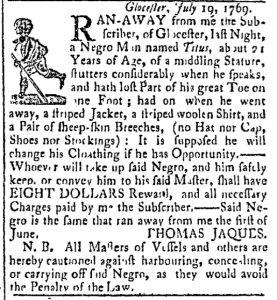
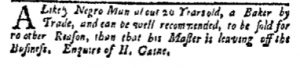
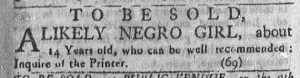
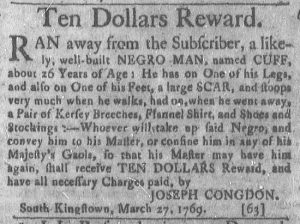
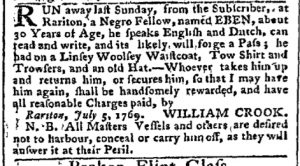
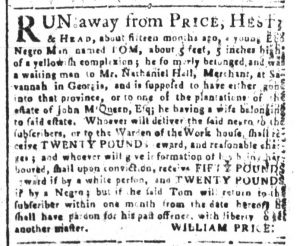
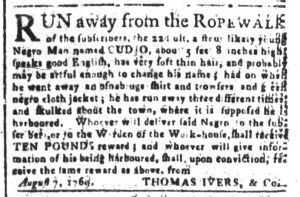
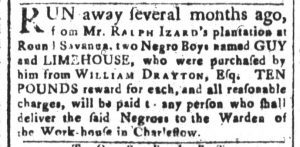
The Slavery Adverts 250 Project chronicles the role of newspaper advertising in perpetuating slavery in the era of the American Revolution. The project seeks to reveal the ubiquity of slavery in eighteenth-century life from New England to Georgia by republishing advertisements for slaves – for sale, wanted to purchase, runaways, captured fugitives – in daily digests on this site as well as in real time via the @SlaveAdverts250 Twitter feed, utilizing twenty-first-century media to stand in for the print media of the eighteenth century.

The project aims to provide modern audiences with a sense of just how often colonists encountered these advertisements in their daily lives. Enslaved men, women, and children appeared in print somewhere in the colonies almost every single day. Those advertisements served as a constant backdrop for social, cultural, economic, and political life in colonial and revolutionary America. Colonists who did not own slaves were still confronted with slavery as well as invited to maintain the system by purchasing slaves or assisting in the capture of runaways. The frequency of these newspaper advertisements suggests just how embedded slavery was in colonial and revolutionary American culture in everyday interactions beyond the printed page.

These advertisements also testify to the experiences of enslaved men, women, and children, though readers must consider that those experiences have been remediated through descriptions offered by slaveholders rather than the slaves themselves. Often unnamed in the advertisements, enslaved men, women, and children were not invisible or unimportant in early America.

These advertisements appeared in colonial American newspapers 250 years ago today.

Aug 10 - New-York Chronicle Slavery 1
New-York Chronicle (August 10, 1769).

**********

Aug 10 - New-York Journal Slavery 1
New-York Journal (August 10, 1769).

**********

Aug 10 - New-York Journal Supplement Slavery 1
Supplement to the New-York Journal (August 10, 1769).

**********

Aug 10 - Pennsylvania Gazette Slavery 1
Pennsylvania Gazette (August 10, 1769).

**********

Aug 10 - Pennsylvania Gazette Slavery 2
Pennsylvania Gazette (August 10, 1769).

**********

Aug 10 - Pennsylvania Gazette Slavery 3
Pennsylvania Gazette (August 10, 1769).

**********

Aug 10 - South-Carolina Gazette Slavery 1
South-Carolina Gazette (August 10, 1769).

**********

Aug 10 - South-Carolina Gazette Slavery 2
South-Carolina Gazette (August 10, 1769).

**********

Aug 10 - South-Carolina Gazette Slavery 3
South-Carolina Gazette (August 10, 1769).

**********

Aug 10 - South-Carolina Gazette Slavery 4
South-Carolina Gazette (August 10, 1769).

**********

Aug 10 - South-Carolina Gazette Slavery 5
South-Carolina Gazette (August 10, 1769).

**********

Aug 10 - South-Carolina Gazette Slavery 6
South-Carolina Gazette (August 10, 1769).

**********

Aug 10 - Virginia Gazette Purdie and Dixon Slavery 1
Virginia Gazette [Purdie and Dixon] (August 10, 1769).

**********

Aug 10 - Virginia Gazette Purdie and Dixon Slavery 2
Virginia Gazette [Purdie and Dixon] (August 10, 1769).

**********

Aug 10 - Virginia Gazette Purdie and Dixon Slavery 3
Virginia Gazette [Purdie and Dixon] (August 10, 1769).

**********

Aug 10 - Virginia Gazette Purdie and Dixon Slavery 4
Virginia Gazette [Purdie and Dixon] (August 10, 1769).

**********

Aug 10 - Virginia Gazette Purdie and Dixon Slavery 5
Virginia Gazette [Purdie and Dixon] (August 10, 1769).

**********

Aug 10 - Virginia Gazette Purdie and Dixon Slavery 6
Virginia Gazette [Purdie and Dixon] (August 10, 1769).

**********

Aug 10 - Virginia Gazette Purdie and Dixon Slavery 7
Virginia Gazette [Purdie and Dixon] (August 10, 1769).

**********

Aug 10 - Virginia Gazette Purdie and Dixon Slavery 8
Virginia Gazette [Purdie and Dixon] (August 10, 1769).

**********

Aug 10 - Virginia Gazette Rind Slavery 1
Virginia Gazette [Rind] (August 10, 1769).

**********

Aug 10 - Virginia Gazette Rind Slavery 2
Virginia Gazette [Rind] (August 10, 1769).

**********

Aug 10 - Virginia Gazette Rind Slavery 3
Virginia Gazette [Rind] (August 10, 1769).

August 9

What was advertised in a colonial American newspaper 250 years ago today?

Aug 9 - 8:9:1769 Georgia Gazette
Georgia Gazette (August 9, 1769).

“A BOARDING SCHOOL in Savannah, for the education of young ladies.”

In the summer of 1769 Elizabeth Bedon proposed opening a boarding school “for the education of young ladies” in Savannah, but only if she “meets with the proper encouragement” from other colonists. She inserted an advertisement in the Georgia Gazette that provided an overview of the curriculum (“Reading, Writing, Arithmetick, and all kinds of Needle Work”) and the tuition for day scholars, day boarders, night boarders, and students who wished to attend only the lessons on needlework.

Bedon used her advertisement to undertake rudimentary market research, much like printers used subscription notices to determine whether publishing a particular book would be a sound investment of their time and resources. She identified the enterprise she wished to pursue, but made opening the school contingent on receiving encouragement from the parents and guardians of prospective pupils. Bedon stated that “it does not suit her to open school until she can engage such a number of scholars as will render it worth her while.” To that end, she invited “those who intend to intrust their children under her care” to send a message. Once she had a sufficient number of students she would open her school, just as printers took books to press once they achieved a sufficient roster of subscribers. On the other hand, if she could not enroll enough students to make her school a viable venture she was not obligated to instruct any who had indicated interest, just as printers did not publish books for an inadequate number of subscribers.

Printers most often used advertising – both newspaper notices and separate subscription papers – to conduct market research and estimate demand for particular products in eighteenth-century America, but members of other occupational groups sometimes adopted similar methods to better determine their prospects for success before launching a new endeavor. Elizabeth Bedon, for instance, used the public prints to present a proposal for a boarding school for young ladies to colonists in Georgia. She anticipated using the results derived from this minor investment to determine her next step.

Slavery Advertisements Published August 9, 1769

The Slavery Adverts 250 Project chronicles the role of newspaper advertising in perpetuating slavery in the era of the American Revolution. The project seeks to reveal the ubiquity of slavery in eighteenth-century life from New England to Georgia by republishing advertisements for slaves – for sale, wanted to purchase, runaways, captured fugitives – in daily digests on this site as well as in real time via the @SlaveAdverts250 Twitter feed, utilizing twenty-first-century media to stand in for the print media of the eighteenth century.

The project aims to provide modern audiences with a sense of just how often colonists encountered these advertisements in their daily lives. Enslaved men, women, and children appeared in print somewhere in the colonies almost every single day. Those advertisements served as a constant backdrop for social, cultural, economic, and political life in colonial and revolutionary America. Colonists who did not own slaves were still confronted with slavery as well as invited to maintain the system by purchasing slaves or assisting in the capture of runaways. The frequency of these newspaper advertisements suggests just how embedded slavery was in colonial and revolutionary American culture in everyday interactions beyond the printed page.

These advertisements also testify to the experiences of enslaved men, women, and children, though readers must consider that those experiences have been remediated through descriptions offered by slaveholders rather than the slaves themselves. Often unnamed in the advertisements, enslaved men, women, and children were not invisible or unimportant in early America.

These advertisements appeared in colonial American newspapers 250 years ago today.

Aug 9 - Georgia Gazette Slavery 1
Georgia Gazette (August 9, 1769).

**********

Aug 9 - Georgia Gazette Slavery 2
Georgia Gazette (August 9, 1769).

**********

Aug 9 - Georgia Gazette Slavery 3
Georgia Gazette (August 9, 1769).

**********

Aug 9 - Georgia Gazette Slavery 4
Georgia Gazette (August 9, 1769).

**********

Aug 9 - Georgia Gazette Slavery 5
Georgia Gazette (August 9, 1769).

**********

Aug 9 - Georgia Gazette Slavery 6
Georgia Gazette (August 9, 1769).

**********

Aug 9 - Georgia Gazette Slavery 7
Georgia Gazette (August 9, 1769).

**********

Aug 9 - Georgia Gazette Slavery 8
Georgia Gazette (August 9, 1769).

August 8

What was advertised in a colonial American newspaper 250 years ago today?

Aug 8 - 8:8:1769 Essex Gazette
Essex Gazette (August 8, 1769).

“ALL Persons indebted to the Estate of ARTHUR HAMITLON … are requested … to make Payment.”

Colonists had many opportunities to shape the contents of eighteenth-century newspapers. Printers called on the public to submit “Articles and Letters of Intelligence,” many of them even reiterating this invitation weekly by embedding it in the colophon inserted in every issue (as was the case for William Goddard and the Pennsylvania Chronicle as well as John Carter and the Providence Gazette). Colonists also sent editorials and responses to items they saw published in the newspaper.

Colonists had other opportunities to shape the news beyond submitting editorials and “Letters of Intelligence” for printers to select or discard. Placing advertisements allowed them to distribute important information about local events which printers otherwise would not have incorporated into their newspapers. Consider the advertisements in the August 8, 1769, edition of the Essex Gazette. Several legal notices advised readers of events taking place in Salem and elsewhere in Massachusetts. For many readers, these notices had as much impact on their daily lives as coverage of “the honourable House of Representatives of this Province” gathering to drink toasts on the occasion of “the happy Anniversary of the Birth of our most gracious Sovereign” or the list of resolutions drawn up by “merchants, planters and other inhabitants of South-Carolina” who signed their own nonimportation agreement in late July.

One legal notice advised, “ALL Persons indebted to the Estate of ARTHUR HAMILTON, late of Salem, Merchant, deceased, are requested, without Delay, to make Payment of the Sums, respectively due, to Archibald Wilson, … Administrator of said Estate.” Those who did not settle accounts with Wilson could expect to suffer the consequences. The administrator stated that they would be “sued immediately” if they did not comply. Coverage of colonial legislators drinking toasts to “The KING, QUEEN, and ROYAL FAMILY” and “The Restoration of Harmony between Great Britain and the Colonies” gave readers a sense of the current political landscape in their colony. News of residents of Charleston adopting their own nonimportation agreement similar to those already in place in Boston and New York contributed made readers better informed about the intersection of commerce and politics throughout the colonies. Yet Archibald Wilson threatening to sue anyone indebted to the estate of Arthur Hamilton would have had the most immediate and consequential impact on some households that received the Essex Gazette.

Colonists could not dismiss the portion of newspapers devoted to advertising as ancillary; instead, they had to read both the items selected by the printer and advertisements submitted by fellow colonists in order to become aware of all “the freshest Advices, both foreign and domestic” promised in the masthead of the Essex Gazette and so many other eighteenth-century newspapers.

Slavery Advertisements Published August 8, 1769

The Slavery Adverts 250 Project chronicles the role of newspaper advertising in perpetuating slavery in the era of the American Revolution. The project seeks to reveal the ubiquity of slavery in eighteenth-century life from New England to Georgia by republishing advertisements for slaves – for sale, wanted to purchase, runaways, captured fugitives – in daily digests on this site as well as in real time via the @SlaveAdverts250 Twitter feed, utilizing twenty-first-century media to stand in for the print media of the eighteenth century.

The project aims to provide modern audiences with a sense of just how often colonists encountered these advertisements in their daily lives. Enslaved men, women, and children appeared in print somewhere in the colonies almost every single day. Those advertisements served as a constant backdrop for social, cultural, economic, and political life in colonial and revolutionary America. Colonists who did not own slaves were still confronted with slavery as well as invited to maintain the system by purchasing slaves or assisting in the capture of runaways. The frequency of these newspaper advertisements suggests just how embedded slavery was in colonial and revolutionary American culture in everyday interactions beyond the printed page.

These advertisements also testify to the experiences of enslaved men, women, and children, though readers must consider that those experiences have been remediated through descriptions offered by slaveholders rather than the slaves themselves. Often unnamed in the advertisements, enslaved men, women, and children were not invisible or unimportant in early America.

These advertisements appeared in colonial American newspapers 250 years ago today.

Aug 8 - Essex Gazette Slavery 1
Essex Gazette (August 8, 1769).

August 7

What was advertised in a colonial American newspaper 250 years ago today?

Aug 7 - 8:7:1769 Pennsylvania Chronicle
Pennsylvania Chronicle (August 7, 1769).

“JOHN MASON, Upholsterer, PRAYS for LIBERTY to inform his friends and customers that he has removed his PROPERTY, to a new built house.”

As the imperial crisis intensified in the late 1760s, newspaper advertisements for consumer goods and services increasingly incorporated political messages intended to sway prospective customers. Many such advertisements underscored the benefits of encouraging “domestic manufactures” to achieve greater self-sufficiency and the virtues of purchasing those locally produced goods. Those advertisements often connected their “Buy American” appeals to faithful adherence to nonimportation agreements adopted to resist Parliament’s attempts to enact new taxes, first via the Stamp Act and later through imposing duties on certain imported goods via the Townshend Acts.

Such advertisements became a genre that deployed similar language and took similar forms. In his attempt to sell mattresses and market his services as an upholsterer, John Mason took an even bolder approach. Like other purveyors of goods and services, he turned to the public prints to inform prospective customers when he moved locations. The language he used, however, had distinct political overtones that certainly resonated with debates taking place in newspapers as well as in taverns, coffeehouses, and the public square. Mason trumpeted that he “PRAYS for LIBERTY to inform his friends and customer that he removed his PROPERTY, to a new built house … where he carries on the Upholstery Business.” The word “PRAYS” appeared in capitals because it was the first word in the body of the advertisement. “LIBERTY” and “PROPERTY,” however, apparently appeared in capitals because Mason specified that they needed appropriate emphasis. The upholsterer invoked two of the most important concepts animating resistance to Parliament.

Readers could hardly have missed the point when they considered “LIBERTY” and “PROPERTY” in combination with the nota bene that Mason appended to his advertisement. “No WONDER that Liberty is the Common Cry,” Mason lectured, “for if it was not the inanimate creation would cry out against us, for the very flowers, they, when deprived of their Liberty, Choose Death Rather, than be Confined in the softest bosom.—Methinks a Moment’s Reflections would Convince those that would Deprive us of our Liberty and property that they are Doing WRONG – for if our Fathers have No Right to Deprive us of our Liberty and property after Twenty-one Years, Certainly out Mother* can have No Right after we have enjoyed it near an Hundred Years. *Mother Country.” In this sermon on liberty, Mason looked to the history of the colonies for guidance and precedents. Parliament could not suddenly impose regulations the colonies after more than a century of allowing them to govern themselves through their own colonial assemblies. Furthermore, the stark choice between liberty and death so was evident that it could be witnessed even in the natural world, as Mason attested in his example of flowers that dies when held too closely, even in the most loving embrace.

At a time when many purveyors of consumer goods and services crafted advertisements that either implicitly or softly invoked politics to influence prospective customers, Mason made a full-throated declaration of his political sentiments. Inserting this editorial into his advertisement allowed him to demonstrate his politics to customers. In addition to adding his voice to the discourse unfolding in the public prints, Mason also intended to encourage customers to support his business because they agreed with his politics and admired his bold stance.

Slavery Advertisements Published August 7, 1769

The Slavery Adverts 250 Project chronicles the role of newspaper advertising in perpetuating slavery in the era of the American Revolution. The project seeks to reveal the ubiquity of slavery in eighteenth-century life from New England to Georgia by republishing advertisements for slaves – for sale, wanted to purchase, runaways, captured fugitives – in daily digests on this site as well as in real time via the @SlaveAdverts250 Twitter feed, utilizing twenty-first-century media to stand in for the print media of the eighteenth century.

The project aims to provide modern audiences with a sense of just how often colonists encountered these advertisements in their daily lives. Enslaved men, women, and children appeared in print somewhere in the colonies almost every single day. Those advertisements served as a constant backdrop for social, cultural, economic, and political life in colonial and revolutionary America. Colonists who did not own slaves were still confronted with slavery as well as invited to maintain the system by purchasing slaves or assisting in the capture of runaways. The frequency of these newspaper advertisements suggests just how embedded slavery was in colonial and revolutionary American culture in everyday interactions beyond the printed page.

These advertisements also testify to the experiences of enslaved men, women, and children, though readers must consider that those experiences have been remediated through descriptions offered by slaveholders rather than the slaves themselves. Often unnamed in the advertisements, enslaved men, women, and children were not invisible or unimportant in early America.

These advertisements appeared in colonial American newspapers 250 years ago today.

Aug 7 - Boston Evening-Post Slavery 1
Boston Evening-Post (August 7, 1769).

**********

Aug 7 - Boston Evening-Post Slavery 2
Boston Evening-Post (August 7, 1769).

**********

Aug 7 - Boston-Gazette Slavery 1
Boston-Gazette (August 7, 1769).

**********

Aug 7 - Boston-Gazette Slavery 2
Boston-Gazette (August 7, 1769).

**********

Aug 7 - Boston-Gazette Slavery 3
Boston-Gazette (August 7, 1769).

**********

Aug 7 - Massachusetts Gazette Green and Russell Slavery 1
Massachusetts Gazette [Green and Russell] (August 7, 1769).

**********

Aug 7 - New-York Gazette and Weekly Mercury Slavery 1
New-York Gazette and Weekly Mercury (August 7, 1769).

**********

Aug 7 - New-York Gazette and Weekly Mercury Slavery 2
New-York Gazette and Weekly Mercury (August 7, 1769).

**********

Aug 7 - New-York Gazette and Weekly Mercury Slavery 3
New-York Gazette and Weekly Mercury (August 7, 1769).

**********

Aug 7 - New-York Gazette and Weekly Mercury Slavery 4
New-York Gazette and Weekly Mercury (August 7, 1769).

**********

Aug 7 - New-York Gazette and Weekly Mercury Slavery 5
New-York Gazette and Weekly Mercury (August 7, 1769).

**********

Aug 7 - New-York Gazette and Weekly Mercury Slavery 6
New-York Gazette and Weekly Mercury (August 7, 1769).

**********

Aug 7 - New-York Gazette or Weekly Post-Boy Slavery 1
New-York Gazette or Weekly Post-Boy (August 7, 1769).

**********

Aug 7 - Newport Mercury Slavery 1
Newport Mercury (August 7, 1769).

**********

Aug 7 - Newport Mercury Slavery 2
Newport Mercury (August 7, 1769).

**********

Aug 7 - Newport Mercury Slavery 3
Newport Mercury (August 7, 1769).

**********

Aug 7 - Pennsylvania Chronicle Slavery 1
Pennsylvania Chronicle (August 7, 1769).

**********

Aug 7 - Pennsylvania Chronicle Slavery 2
Pennsylvania Chronicle (August 7, 1769).

**********

Aug 7 - Pennsylvania Chronicle Slavery 3
Pennsylvania Chronicle (August 7, 1769).

**********

Aug 7 - Pennsylvania Chronicle Slavery 4
Pennsylvania Chronicle (August 7, 1769).

**********

Aug 7 - South-Carolina and American General Gazette Slavery 1
South-Carolina and American General Gazette (August 7, 1769).

**********

Aug 7 - South-Carolina and American General Gazette Slavery 2
South-Carolina and American General Gazette (August 7, 1769).

**********

Aug 7 - South-Carolina and American General Gazette Slavery 3
South-Carolina and American General Gazette (August 7, 1769).

**********

Aug 7 - South-Carolina and American General Gazette Slavery 4
South-Carolina and American General Gazette (August 7, 1769).

**********

Aug 7 - South-Carolina and American General Gazette Slavery 5
South-Carolina and American General Gazette (August 7, 1769).

**********

Aug 7 - South-Carolina and American General Gazette Slavery 6
South-Carolina and American General Gazette (August 7, 1769).

**********

Aug 7 - South-Carolina and American General Gazette Slavery 7
South-Carolina and American General Gazette (August 7, 1769).

**********

Aug 7 - South-Carolina and American General Gazette Slavery 8
South-Carolina and American General Gazette (August 7, 1769).

**********

Aug 7 - South-Carolina and American General Gazette Slavery 9
South-Carolina and American General Gazette (August 7, 1769).