August 6

What was advertised in a colonial American newspaper 250 years ago this week?

Aug 6 - 8:3:1769 South-Carolina Gazette
South-Carolina Gazette (August 3, 1769).

“Two negro boys brought up to the jeweler’s trade.”

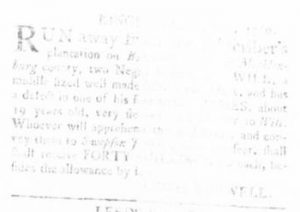
When John Paul Grimke, a jeweler, decided to “retire from business” he announced a going-out-of-business sale in the South-Carolina Gazette. He aimed to liquidate his entire “STOCK IN TRADE” via auction at his shop on Broad Street in Charleston beginning in early November of 1769 and continuing into December. Grimke provided a list of his inventory as a means of enticing prospective bidders to view his wares in advance and attend the auctions. His merchandise included “many valuable jewels of most kinds,” “silver handle table and desert knives and forks,” silver hilted swords and hangers with belts,” and “silver and Pinchbeck watches with chains.”

Grimke’s “STOCK IN TRADE” that he intended to auction also included “two negro boys brought up to the jeweler’s trade.” Each had acquired several skills. They could “make gold rings and buttons, engrave them very neatly, and do many other kinds of work.” Realizing that these claims required time and observation to verify, Grimke offered a trial period of one month before making the sale of these enslaved jewelers final.

Advertisements that presented enslaved people for sale testified to the many and varied skills they possessed. Enslaved men, women, and children did not merely perform agricultural labor on farms and plantations. They also worked in homes and workshops in both urban and rural environments. Many were highly skilled artisans who enriched those who held them in bondage not only through their involuntary labor but also through their skill and expertise. Advertisements in the South-Carolina Gazette regularly offered enslaved blacksmiths, carpenters, and coopers for sale. John Matthews advertised “two or three Negro Shoemakers” who had “done all my business for nine Years past,” indicating that they had played an indispensible part in the success of his business. Grimke’s enslaved assistants may never have labored in the fields, having instead been “brought up to the jeweler’s trade.” Along with other sources, newspaper advertisements catalog the variety of occupations pursued by enslaved people in eighteenth-century America, expanding our understanding of the contributions enslaved people made to colonial commerce and society. Enslaved artisans, these advertisements demonstrate, played a vital role in the development of the colonial marketplace.
August 5

What was advertised in a colonial American newspaper 250 years ago today?

Aug 5 - 8:5:1769 Providence Gazette
Providence Gazette (August 5, 1769).

“Enquire of the Printer.”

Like other printing offices throughout the colonies, John Carter’s printing office at the “Sign of Shakespear’s Head” in Providence was a hub for circulating information. Carter printed the Providence Gazette, distributing information to residents of the city, the colony, and beyond. To that end, he participated in exchange networks with other printers, sending and receiving newspapers and reprinting liberally from one publication to another. The August 5, 1769, edition of the Providence Gazette, for instance, included items “From the BOSTON EVENING-POST” and “From the Massachusetts Gazette” as well as other items almost certainly reprinted from other newspapers.

Yet Carter did not rely solely on other newspapers to provide the content he needed to fill the pages of the Providence Gazette. The colophon at the bottom of the final page of every issue advised readers that “Articles and Letters of Intelligence, &c. are received for this Paper” at the printing office. One item in the August 5 edition was an “Extract of a letter from Kennet, in Chester county,” Pennsylvania. Several such extracts came from London: “Extract of a letter from London,” “Extract of another letter from London,” and “Extract of another letter, by the last vessel, from a merchant in London to a merchant in Boston.” Carter depended on merchants, captains, and others to provide news to print in the Providence Gazette.
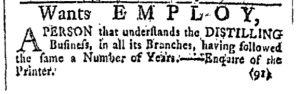
Yet not all of the information that found its way to the printing office circulated in print. Consider an employment advertisement placed by “A PERSON that understands the DISTILLING Business, in all its Branches.” Like so many other eighteenth-century advertisements, it withheld information in favor of instructing interested parties to “Enquire of the Printer.” The advertiser who paid to have this notice inserted in the Providence Gazette purchased more than the time and labor required to set the type and the space that it occupied on the page. This transaction also included an ongoing obligation on behalf of the printer to respond to inquiries, both written messages and visitors to the printing office. Carter acted as a gatekeeper for information, choosing which items to publish in the newspaper and doling out additional information to supplement what appeared in print. His printing office must have been a busy place considering the number of people, letters, and newspapers that passed through it.
August 4

What was advertised in a colonial American newspaper 250 years ago today?

Aug 4 - 8:4:1769 New-London Gazette
New-London Gazette (August 4, 1769).

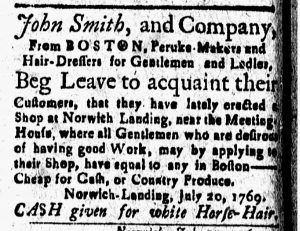
“Good Work … equal to any in Boston.”

The consumer revolution of the eighteenth century extended far beyond major metropolitan centers like London and into the provinces, both the English provinces and the colonies on the other side of the Atlantic. For colonists, participating in consumer culture became part of their identity and a marker of their membership in the vast British Empire. For many, acquiring goods also testified to their status. This sometimes prompted both anxiety and competition among consumers … and advertisers cultivated both for their own purposes. Some deployed an eighteenth-century version of “keeping up with the Joneses” to stimulate demand in their goods and services.

Consider the advertisement John Smith and Company placed in the August 4, 1769, edition of the New-London Gazette. Smith and Company introduced themselves as “Peruke-Makers and Hair-Dressers for Gentlemen and Ladies,” but before they specified their occupation they first proclaimed that they were “From BOSTON.” This inverted the usual order of information that commonly appeared in eighteenth-century advertisements. Most advertisers listed their occupation first and their place of origin or site of significant employment second, but Smith and Company made certain that their affiliation with Boston, the largest and most cosmopolitan city in New England, foregrounded everything else in their advertisement.

Smith and Company had recently opened a new shop at Norwich Landing, a much smaller town than the busy port of Boston. Despite the relatively bucolic setting, Smith and Company’s prospective clients could depend on “having good Work … equal to any in Boston.” This “good Work” presumably applied not only to the quality of the goods and services available from Smith and Company but also to the assistance they provided clients in demonstrating taste through adopting the latest styles, an important aspect of making wigs and dressing hair. Smith and Company encouraged readers of the New-London Gazette to consider current fashions and the services provided by wigmakers and hairdressers in Boston even though they lived at a distance from that busy port, much the same way that their counterparts in Boston, Charleston, New York, and Philadelphia urged their prospective customers to look to London or Paris and promised to deliver the current styles from those places. No matter where consumers resided, according to advertisements in colonial newspapers, purveyors of goods and services could help them achieve the fashions currently en vogue in places they considered one rung up the cosmopolitan ladder.

August 3

What was advertised in a colonial American newspaper 250 years ago today?

Aug 3 - 8:3:1769 New-York Journal
Supplement to the New-York Journal (August 3, 1769).

“79–.”

Like many other eighteenth-century printers, John Holt, the printer of the New-York Journal, inserted numbers at the end of advertisements. These numbers were not intended for readers but instead for those who worked in the printing office. They indicated how long an advertisement should run. For instance, an advertisement announcing that the brigantine Rebekah would sail for Jamaica appeared in the supplement that accompanied the August 3, 1769, edition of the New-York Journal. The compositor inserted the numbers 85 and 88 on the final line, 85 indicating that the advertisement first ran in issue 1385 on July 20 and 88 indicating that it would make its final appearance in issue 1388 on August 10. After that, the compositor would remove it. Similarly, Jonathan Hampton’s advertisement featuring a woodcut that depicted a Windsor chair also included 85 and 88 on the final line, though an earlier iteration included the numbers 63 and 72 instead. Hampton had inserted the advertisement for ten weeks earlier in the year, apparently determined it had been worth the investment, and then inserted it again for a shorter run.

Other advertisements, however, included a single number and a dash. Samuel Francis (better known today as Samuel Fraunces) ran an advertisement that concluded with “79–“ instead of two numbers. Similarly, Jarvis Roebuck had “62–“ on the final line of his advertisement. In each case, the number indicated the issue that the advertisement first appeared: issue 1362 on February 2 for Jarvis and issue 1379 on June 8 (the same date at that opened the advertisement) for Francis. What did the dash mean? How did the compositor interpret it when deciding which items belonged in an issue and which should be removed?

The publication history of these two advertisements reveals that the dash did not indicate that an advertisement should run continuously. Francis’s advertisement ran for five consecutive issues (June 8, 15, 22, and 22 and July 6) before appearing sporadically in six more issues (July 20, August 3 and 24, September 7, and October 12 and 26). Roebuck’s advertisement ran sporadically from the start, appearing on February 2 and 9, March 2 and 30, April 13 and 27, May 25, June 1, 8, and 29, July 27, August 3, 24, and 31, September 14, and October 12. Seemingly no particular plan corresponds to the publication schedule for the sixteen insertions of Roebuck’s notice over the course of nine months.

Perhaps the dash indicated that the compositor had carte blanche to insert the advertisement when necessary to complete a page. These two advertisements were the final items in the August 3 supplement, though they did not always appear at the end of an issue or supplement. Moderate in length, they may have been convenient filler when the compositor estimated that an issue or supplement ran short of other content. Paired numbers, like “85 88,” streamlined bookkeeping and production of the New-York Journal, but this arrangement for continued yet sporadic insertions required careful attention to bookkeeping. The printer or another employee in the printing office would have had to peruse each issue to see which advertisements with dashes appeared and then update the ledger accordingly.

What role did advertisers play in this process? Could they instruct the printing office to insert an advertisement on a week-by-week basis? If compositors made decisions about including advertisements, did advertisers pay for every insertion? Did advertisers receive any sort of discount for this arrangement? Did advertisements every run after advertisers no longer wished for them to appear? It seems unlikely that Francis would have been enthused about an advertisement promoting the summer entertainments at Vauxhall Gardens to appear in the New-York Journal in late October.

Some of the numbers compositors inserted at the end of advertisements clearly indicated their purpose in the operation of a printing office and the production of colonial newspapers. Other notations, however, only hinted at their purpose and now raise tantalizing questions about how printers, compositors, advertisers, and others used them. The dash at the end of some advertisements certainly served some purpose; otherwise compositors would not have taken the time to include such notation. A more systematic survey of advertisements combined with careful examination of printers’ ledgers may reveal some of the practices that printers found efficient and effective in running their shops in the eighteenth century.

Slavery Advertisements Published August 3, 1769

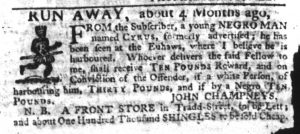
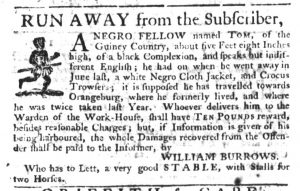
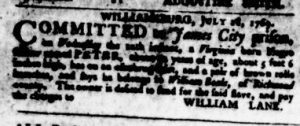
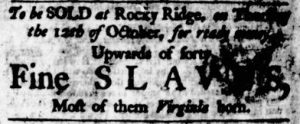
The Slavery Adverts 250 Project chronicles the role of newspaper advertising in perpetuating slavery in the era of the American Revolution. The project seeks to reveal the ubiquity of slavery in eighteenth-century life from New England to Georgia by republishing advertisements for slaves – for sale, wanted to purchase, runaways, captured fugitives – in daily digests on this site as well as in real time via the @SlaveAdverts250 Twitter feed, utilizing twenty-first-century media to stand in for the print media of the eighteenth century.

The project aims to provide modern audiences with a sense of just how often colonists encountered these advertisements in their daily lives. Enslaved men, women, and children appeared in print somewhere in the colonies almost every single day. Those advertisements served as a constant backdrop for social, cultural, economic, and political life in colonial and revolutionary America. Colonists who did not own slaves were still confronted with slavery as well as invited to maintain the system by purchasing slaves or assisting in the capture of runaways. The frequency of these newspaper advertisements suggests just how embedded slavery was in colonial and revolutionary American culture in everyday interactions beyond the printed page.

These advertisements also testify to the experiences of enslaved men, women, and children, though readers must consider that those experiences have been remediated through descriptions offered by slaveholders rather than the slaves themselves. Often unnamed in the advertisements, enslaved men, women, and children were not invisible or unimportant in early America.

These advertisements appeared in colonial American newspapers 250 years ago today.

Aug 3 - New-York Journal Slavery 1
New-York Journal (August 3, 1769).

**********

Aug 3 - New-York Journal Slavery 2
New-York Journal (August 3, 1769).

**********

Aug 3 - New-York Journal Supplement Slavery 1
Supplement to the New-York Journal (August 3, 1769).

**********

Aug 3 - New-York Journal Supplement Slavery 2
Supplement to the New-York Journal (August 3, 1769).

**********

Aug 3 - Pennsylvania Gazette Slavery 1
Pennsylvania Gazette (August 3, 1769).

**********

Aug 3 - Pennsylvania Gazette Slavery 2
Pennsylvania Gazette (August 3, 1769).

**********

Aug 3 - South-Carolina Gazette Slavery 1
South-Carolina Gazette (August 3, 1769).

**********

Aug 3 - South-Carolina Gazette Slavery 2
South-Carolina Gazette (August 3, 1769).

**********

Aug 3 - South-Carolina Gazette Slavery 3
South-Carolina Gazette (August 3, 1769).

**********

Aug 3 - South-Carolina Gazette Slavery 4
South-Carolina Gazette (August 3, 1769).

**********

Aug 3 - South-Carolina Gazette Slavery 5
South-Carolina Gazette (August 3, 1769).

**********

Aug 3 - South-Carolina Gazette Slavery 6
South-Carolina Gazette (August 3, 1769).

**********

Aug 3 - South-Carolina Gazette Slavery 7
South-Carolina Gazette (August 3, 1769).

**********

Aug 3 - Virginia Gazette Purdie and Dixon Slavery 1
Virginia Gazette [Purdie and Dixon] (August 3, 1769).

**********

Aug 3 - Virginia Gazette Purdie and Dixon Slavery 2
Virginia Gazette [Purdie and Dixon] (August 3, 1769).

**********

Aug 3 - Virginia Gazette Purdie and Dixon Slavery 3
Virginia Gazette [Purdie and Dixon] (August 3, 1769).

**********

Aug 3 - Virginia Gazette Purdie and Dixon Slavery 4
Virginia Gazette [Purdie and Dixon] (August 3, 1769).

**********

Aug 3 - Virginia Gazette Purdie and Dixon Slavery 5
Virginia Gazette [Purdie and Dixon] (August 3, 1769).

**********

Aug 3 - Virginia Gazette Purdie and Dixon Slavery 6
Virginia Gazette [Purdie and Dixon] (August 3, 1769).

**********

Aug 3 - Virginia Gazette Purdie and Dixon Slavery 6
Virginia Gazette [Purdie and Dixon] (August 3, 1769).

**********

Aug 3 - Virginia Gazette Purdie and Dixon Slavery 7
Virginia Gazette [Purdie and Dixon] (August 3, 1769).

**********

Aug 3 - Virginia Gazette Purdie and Dixon Slavery 8
Virginia Gazette [Purdie and Dixon] (August 3, 1769).

**********

Aug 3 - Virginia Gazette Purdie and Dixon Slavery 9
Virginia Gazette [Purdie and Dixon] (August 3, 1769).

**********

Aug 3 - Virginia Gazette Rind Slavery 1
Virginia Gazette [Rind] (August 3, 1769).

**********

Aug 3 - Virginia Gazette Rind Slavery 2
Virginia Gazette [Rind] (August 3, 1769).

**********

Aug 3 - Virginia Gazette Rind Slavery 3
Virginia Gazette [Rind] (August 3, 1769).

**********

Aug 3 - Virginia Gazette Rind Slavery 4
Virginia Gazette [Rind] (August 3, 1769).

**********

Aug 3 - Virginia Gazette Rind Slavery 5
Virginia Gazette [Rind] (August 3, 1769).

**********

Aug 3 - Virginia Gazette Rind Slavery 6
Virginia Gazette [Rind] (August 3, 1769).

**********

Aug 3 - Virginia Gazette Rind Slavery 7
Virginia Gazette [Rind] (August 3, 1769).

**********

Aug 3 - Virginia Gazette Rind Slavery 8
Virginia Gazette [Rind] (August 3, 1769).

August 2

What was advertised in a colonial American newspaper 250 years ago today?

Aug 2 - 8:2:1769 Georgia Gazette
Georgia Gazette (August 2, 1769).

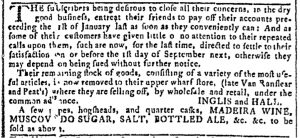
“THE subscribers being desirous to close all their concerns, in the dry good business.”

Inglis and Hall were among the most prolific advertisers in the Georgia Gazette in the late 1760s. They frequently inserted lengthy advertisements listing goods imported from Britain, the Caribbean, and other faraway places. They also participated in the transatlantic slave trade, advertising enslaved men, women, and children.

In the summer of 1769, the partners placed an advertisement announcing that they intended to “close all their concerns, in the dry good business.” Like other merchants and shopkeepers, Inglis and Hall extended credit to their customers. In preparation for going out of business, they asked their “friends” to pay any debts incurred prior to January 1. Those who made purchases since then presumably had more time to settle accounts. Despite their amicable description of their customers as “friends,” Inglis and Hall expressed exasperation that some of them “have given little or no attention to their repeated calls” to submit payment.   This was the last warning, the partners proclaimed, because those who did not “settle to their satisfaction” in one month’s time “may depend on being sued without further notice.” After first dispensing with that important piece of business, Inglis and Hall promoted their remaining merchandise, advising prospective customers that they still had “a variety of the most useful articles” in stock.

For several years Inglis and Hall provided residents of Savannah and the rest of the colony with vast assortments of goods, encouraging them to participate in the consumer revolution that was taking place throughout the British Atlantic world and beyond. During that time they were also important customers for James Johnston, the printer of the Georgia Gazette. For eighteenth-century newspaper printers, selling advertisements was often more lucrative than selling subscriptions. Most advertisements that ran in the Georgia Gazette were fairly short, extending three to fifteen lines. At fourteen lines, Inglis and Hall’s advertisement announcing the end of their dry goods business was short compared to many others that they placed in the Georgia Gazette, advertisements that filled half a column or more. Although Johnston did brisk business when it came to advertisements, he must have been disappointed to lose such an important customer and all of the revenue Inglis and Hall contributed to the operations of the Georgia Gazette.

Slavery Advertisements Published August 2, 1769

The Slavery Adverts 250 Project chronicles the role of newspaper advertising in perpetuating slavery in the era of the American Revolution. The project seeks to reveal the ubiquity of slavery in eighteenth-century life from New England to Georgia by republishing advertisements for slaves – for sale, wanted to purchase, runaways, captured fugitives – in daily digests on this site as well as in real time via the @SlaveAdverts250 Twitter feed, utilizing twenty-first-century media to stand in for the print media of the eighteenth century.

The project aims to provide modern audiences with a sense of just how often colonists encountered these advertisements in their daily lives. Enslaved men, women, and children appeared in print somewhere in the colonies almost every single day. Those advertisements served as a constant backdrop for social, cultural, economic, and political life in colonial and revolutionary America. Colonists who did not own slaves were still confronted with slavery as well as invited to maintain the system by purchasing slaves or assisting in the capture of runaways. The frequency of these newspaper advertisements suggests just how embedded slavery was in colonial and revolutionary American culture in everyday interactions beyond the printed page.

These advertisements also testify to the experiences of enslaved men, women, and children, though readers must consider that those experiences have been remediated through descriptions offered by slaveholders rather than the slaves themselves. Often unnamed in the advertisements, enslaved men, women, and children were not invisible or unimportant in early America.

These advertisements appeared in colonial American newspapers 250 years ago today.

Aug 2 - Georgia Gazette Slavery 1
Georgia Gazette (August 2, 1769).

**********

Aug 2 - Georgia Gazette Slavery 2
Georgia Gazette (August 2, 1769).

**********

Aug 2 - Georgia Gazette Slavery 3
Georgia Gazette (August 2, 1769).

**********

Aug 2 - Georgia Gazette Slavery 4
Georgia Gazette (August 2, 1769).

**********

Aug 2 - Georgia Gazette Slavery 5
Georgia Gazette (August 2, 1769).

August 1

What was advertised in a colonial American newspaper 250 years ago today?

Aug 1 - 8:1:1769 Essex Gazette
Essex Gazette (August 1, 1769).

“Said Negro is the same that ran away from me the first of June.”

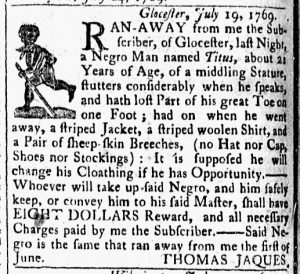
As white colonists fretted about their figurative enslavement by Parliament in the late 1760s and early 1770s, a “Negro Man named Titus” chafed under literal enslavement on Cape Ann in Massachusetts. In an advertisement from Gloucester in the Essex Gazette, Thomas Jaques announced that Titus made his escape sometime during the night of July 18, 1769. Titus cleverly timed his departure. Like most other colonial newspapers, the Essex Gazette published only one issue each week, distributing it on Tuesdays. Titus made his escape on a Tuesday night, perhaps realizing that Jaques would not be able to place a notice in the public prints for an entire week. With such a delay in mobilizing the power of the press to enlist other colonists in the surveillance necessary to capture him, Titus gained a bit of a head start. Jaques suspected that the young man was clever in other ways as well, cautioning that he would “change his Cloathing if he has Opportunity.” He was also resilient. Jaques indicated that Titus had attempted to escape in June as well.

Despite his best efforts in 1769, however, Titus did not manage to get clear of those who enslaved him. In an exhibition for the Cape Ann Museum, Molly O’Hagan Hardy identified two other advertisements concerning Titus that ran in the Essex Gazette, one in 1772 and the other in 1773. By that time, John Lee enslaved him in nearby Manchester, but Titus had no more intention of remaining under the authority of Lee than he did Jaques. Both advertisements reported that he “RAN away,” but did not acknowledge his repeated attempts to escape as acts of self-determination. These subsequent advertisements do not reveal how long he managed to make good on his escape in 1769, only that he somehow returned to bondage within the next few of years. Yet they also make clear that he was not dissuaded from his efforts to liberate himself. The final advertisement testified to his continued ingenuity, stating that Titus “has with him a false pass or Bill of Sale.” The enslaved man had either forged the document himself or found an accomplice to aid him in his escape. Lee warned “All Masters of Vessels and others” against harboring or transporting Titus “on Penalty of the Law,” but perhaps the forged document or sympathy for his plight or a combination of the two convinced someone to help him. Given that he made at least four attempts to escape, Titus was not the type to give up on freeing himself. The absence of further advertisements documenting additional attempts to escape suggests that Titus may have finally succeeded.

Slavery Advertisements Published August 1, 1769

The Slavery Adverts 250 Project chronicles the role of newspaper advertising in perpetuating slavery in the era of the American Revolution. The project seeks to reveal the ubiquity of slavery in eighteenth-century life from New England to Georgia by republishing advertisements for slaves – for sale, wanted to purchase, runaways, captured fugitives – in daily digests on this site as well as in real time via the @SlaveAdverts250 Twitter feed, utilizing twenty-first-century media to stand in for the print media of the eighteenth century.

The project aims to provide modern audiences with a sense of just how often colonists encountered these advertisements in their daily lives. Enslaved men, women, and children appeared in print somewhere in the colonies almost every single day. Those advertisements served as a constant backdrop for social, cultural, economic, and political life in colonial and revolutionary America. Colonists who did not own slaves were still confronted with slavery as well as invited to maintain the system by purchasing slaves or assisting in the capture of runaways. The frequency of these newspaper advertisements suggests just how embedded slavery was in colonial and revolutionary American culture in everyday interactions beyond the printed page.

These advertisements also testify to the experiences of enslaved men, women, and children, though readers must consider that those experiences have been remediated through descriptions offered by slaveholders rather than the slaves themselves. Often unnamed in the advertisements, enslaved men, women, and children were not invisible or unimportant in early America.

These advertisements appeared in colonial American newspapers 250 years ago today.

Aug 1 - Essex Gazette Slavery 1
Essex Gazette (August 1, 1769).