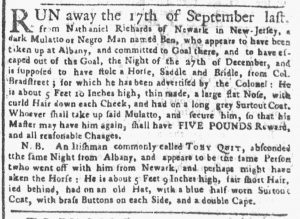
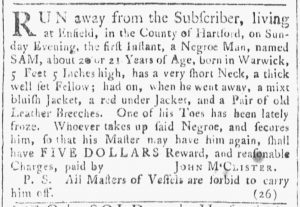
Slavery Advertisements Published April 19, 1770

The Slavery Adverts 250 Project chronicles the role of newspaper advertising in perpetuating slavery in the era of the American Revolution. The project seeks to reveal the ubiquity of slavery in eighteenth-century life from New England to Georgia by republishing advertisements for slaves – for sale, wanted to purchase, runaways, captured fugitives – in daily digests on this site as well as in real time via the @SlaveAdverts250 Twitter feed, utilizing twenty-first-century media to stand in for the print media of the eighteenth century.

The project aims to provide modern audiences with a sense of just how often colonists encountered these advertisements in their daily lives. Enslaved men, women, and children appeared in print somewhere in the colonies almost every single day. Those advertisements served as a constant backdrop for social, cultural, economic, and political life in colonial and revolutionary America. Colonists who did not own slaves were still confronted with slavery as well as invited to maintain the system by purchasing slaves or assisting in the capture of runaways. The frequency of these newspaper advertisements suggests just how embedded slavery was in colonial and revolutionary American culture in everyday interactions beyond the printed page.

These advertisements also testify to the experiences of enslaved men, women, and children, though readers must consider that those experiences have been remediated through descriptions offered by slaveholders rather than the slaves themselves. Often unnamed in the advertisements, enslaved men, women, and children were not invisible or unimportant in early America.

These advertisements appeared in colonial American newspapers 250 years ago today.

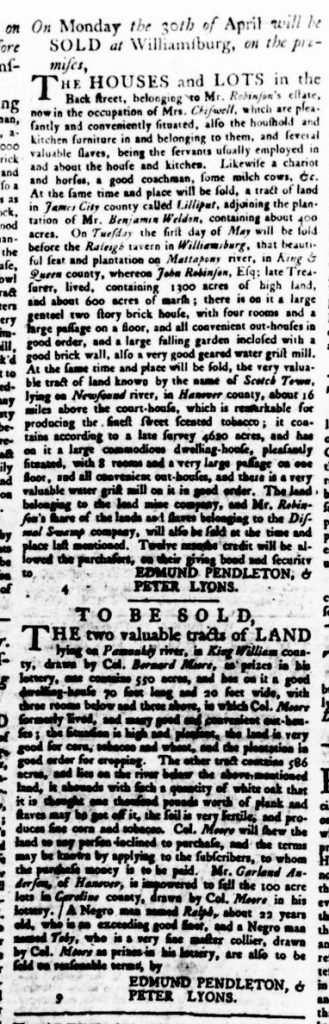
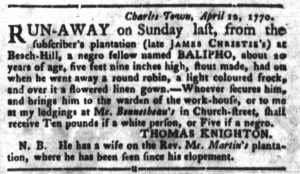
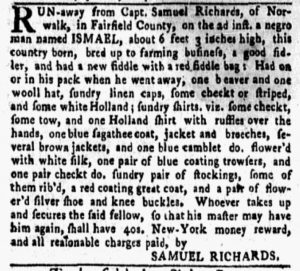
Apr 19 1770 - Maryland Gazette Slavery 1
Maryland Gazette (April 19, 1770).

**********
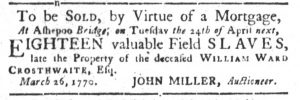
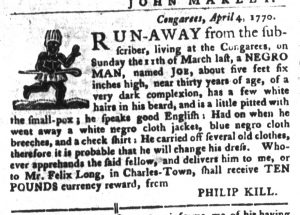
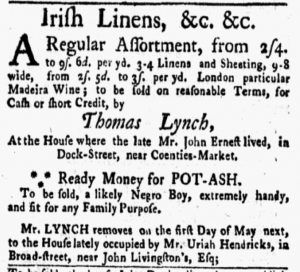
Apr 19 1770 - Maryland Gazette Slavery 2
Maryland Gazette (April 19, 1770).

**********

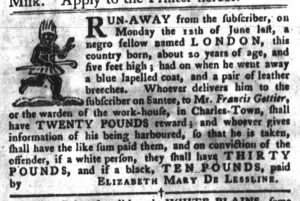
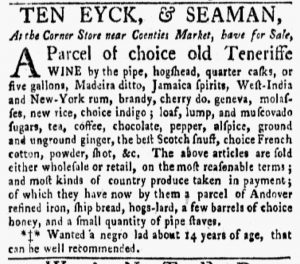
Apr 19 1770 - Maryland Gazette Slavery 3
Maryland Gazette (April 19, 1770).

**********

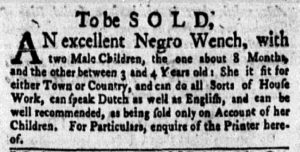
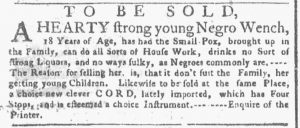
Apr 19 1770 - Maryland Gazette Slavery 4
Maryland Gazette (April 19, 1770).

**********
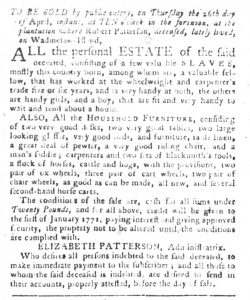
Apr 19 1770 - Maryland Gazette Slavery 5
Maryland Gazette (April 19, 1770).

**********
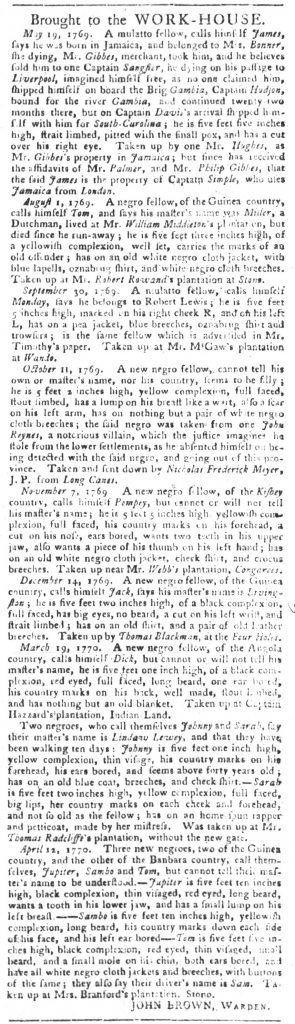
Apr 19 1770 - New-York Journal Slavery 1
New-York Journal (April 19, 1770).

**********
Apr 19 1770 - New-York Journal Slavery 2
New-York Journal (April 19, 1770).

**********
Apr 19 1770 - Pennsylvania Gazette Slavery 1
Pennsylvania Gazette (April 19, 1770).

**********
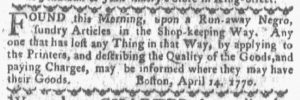
Apr 19 1770 - Pennsylvania Journal Slavery 1
Pennsylvania Journal (April 19, 1770).

**********

Apr 19 1770 - Pennsylvania Journal Slavery 2
Pennsylvania Journal (April 19, 1770).

**********
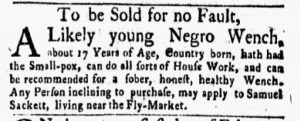
Apr 19 1770 - Pennsylvania Journal Slavery 3
Pennsylvania Journal (April 19, 1770).

**********

Apr 19 1770 - Pennsylvania Journal Slavery 4
Pennsylvania Journal (April 19, 1770).

**********
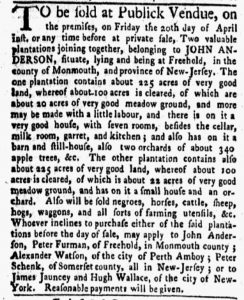
Apr 19 1770 - Pennsylvania Journal Slavery 5
Pennsylvania Journal (April 19, 1770).

**********

Apr 19 1770 - South-Carolina Gazette Slavery 1
South-Carolina Gazette (April 19, 1770).

**********

Apr 19 1770 - South-Carolina Gazette Slavery 2
South-Carolina Gazette (April 19, 1770).

**********

Apr 19 1770 - South-Carolina Gazette Slavery 3
South-Carolina Gazette (April 19, 1770).

**********

Apr 19 1770 - South-Carolina Gazette Slavery 4
South-Carolina Gazette (April 19, 1770).

**********

Apr 19 1770 - South-Carolina Gazette Slavery 5
South-Carolina Gazette (April 19, 1770).

**********

Apr 19 1770 - South-Carolina Gazette Slavery 6
South-Carolina Gazette (April 19, 1770).

**********

Apr 19 1770 - South-Carolina Gazette Slavery 7
South-Carolina Gazette (April 19, 1770).

**********

Apr 19 1770 - South-Carolina Gazette Slavery 8
South-Carolina Gazette (April 19, 1770).

**********

Apr 19 1770 - South-Carolina Gazette Slavery 9
South-Carolina Gazette (April 19, 1770).

**********

Apr 19 1770 - South-Carolina Gazette Slavery 10
South-Carolina Gazette (April 19, 1770).

**********

Apr 19 1770 - South-Carolina Gazette Slavery 11
South-Carolina Gazette (April 19, 1770).

**********

Apr 19 1770 - South-Carolina Gazette Slavery 12
South-Carolina Gazette (April 19, 1770).

**********

Apr 19 1770 - South-Carolina Gazette Slavery 13
South-Carolina Gazette (April 19, 1770).

**********

Apr 19 1770 - South-Carolina Gazette Slavery 14
South-Carolina Gazette (April 19, 1770).

**********

Apr 19 1770 - South-Carolina Gazette Slavery 15
South-Carolina Gazette (April 19, 1770).

**********

Apr 19 1770 - Virginia Gazette Purdie & Dixon Slavery 1
Virginia Gazette [Purdie and Dixon] (April 19, 1770).

**********

Apr 19 1770 - Virginia Gazette Purdie & Dixon Slavery 2
Virginia Gazette [Purdie and Dixon] (April 19, 1770).

**********

Apr 19 1770 - Virginia Gazette Purdie & Dixon Slavery 3
Virginia Gazette [Purdie and Dixon] (April 19, 1770).

**********

Apr 19 1770 - Virginia Gazette Purdie & Dixon Slavery 4
Virginia Gazette [Purdie and Dixon] (April 19, 1770).

**********

Apr 19 1770 - Virginia Gazette Purdie & Dixon Slavery 5
Virginia Gazette [Purdie and Dixon] (April 19, 1770).

**********

Apr 19 1770 - Virginia Gazette Purdie & Dixon Slavery 6
Virginia Gazette [Purdie and Dixon] (April 19, 1770).

**********

Apr 19 1770 - Virginia Gazette Purdie & Dixon Slavery 7
Virginia Gazette [Purdie and Dixon] (April 19, 1770).

**********

Apr 19 1770 - Virginia Gazette Purdie & Dixon Slavery 8
Virginia Gazette [Purdie and Dixon] (April 19, 1770).

**********

Apr 19 1770 - Virginia Gazette Purdie & Dixon Slavery 9
Virginia Gazette [Purdie and Dixon] (April 19, 1770).

**********

Apr 19 1770 - Virginia Gazette Rind Slavery 1
Virginia Gazette [Rind] (April 19, 1770).

**********

Apr 19 1770 - Virginia Gazette Rind Slavery 2
Virginia Gazette [Rind] (April 19, 1770).

**********

Apr 19 1770 - Virginia Gazette Rind Slavery 3
Virginia Gazette [Rind] (April 19, 1770).

**********

Apr 19 1770 - Virginia Gazette Rind Slavery 4
Virginia Gazette [Rind] (April 19, 1770).

**********

Apr 19 1770 - Virginia Gazette Rind Slavery 5
Virginia Gazette [Rind] (April 19, 1770).

**********

Apr 19 1770 - Virginia Gazette Rind Slavery 6
Virginia Gazette [Rind] (April 19, 1770).

**********

Apr 19 1770 - Virginia Gazette Rind Slavery 7
Virginia Gazette [Rind] (April 19, 1770).

**********

Apr 19 1770 - Virginia Gazette Rind Slavery 8
Virginia Gazette [Rind] (April 19, 1770).

**********

Apr 19 1770 - Virginia Gazette Rind Slavery 9
Virginia Gazette [Rind] (April 19, 1770).

April 18

What was advertised in a colonial American newspaper 250 years ago today?

Apr 18 - 4:18:1770 Georgia Gazette
Georgia Gazette (April 18, 1770).

“LOST … A GREEN SILK UMBRELLA.”

An advertisement offering a reward for the return of a lost “GREEN SILK UMBRELLA” appeared in the April 18, 1770, edition of the Georgia Gazette.  It ran at the bottom of the first column of the second page.  Unfortunately, a portion of the advertisement is missing from the digital image available via Readex’s America’s Historical Newspapers database.

Apr 18 - Clarence Calendar
Calendar from Clarence: Denotes Issues of Georgia Gazette in the Collections of the American Antiquarian Society

Yet consulting another digital resource, Clarence:  Newspaper Holdings of the American Antiquarian Society, makes clear that Readex faithfully captured an image of the April 18 edition in its extant status in the archive.  According to the American Antiquarian Society, “Clarence is named in honor of Clarence S. Brigham (1877-1963), a man pivotal in the building of the AAS newspaper collection.  Brigham began his service to AAS in 1980 as its librarian and retired in 1959 as its director.”  Brigham is well known among scholars of early American print culture for his monumental History and Bibliography of American Newspapers, 1690-1820 (1947).

Apr 18 - Readex Calendar
Calendar from America’s Historical Newspapers: Denotes Issues of Georgia Gazette in that Database

The Clarence database appropriately provides detailed information about the newspapers in the collections at AAS.  It does not, however, provide digital images.  The AAS and Readex partnered to create America’s Historical Newspapers. Although Readex also worked with other research libraries to produce its database, the calendars in Clarence and America’s Historical Newspapers indicate that the digital images in the latter come from original sources at the AAS.  Although Brigham’s bibliography reports that the Georgia Gazette continued publication until 1776, the AAS has issues only through May 23, 1770.  Compare the calendar from Clarence to the calendar from America’s Historical Newspapers.  They match, indicating that the images of the Georgia Gazette in Readex’s database did indeed come from the originals in the collections at the AAS.  For further confirmation, note the status of the issues at the AAS.  Those denoted with a blue box are “whole” according to the legend, while those denoted with a red box are “damaged.”  All of the digital images missing the bottom of the page in America’s Historical Newspapers correspond to damaged newspapers at the AAS.

Close examination of the digital images on their own suggest that they are accurate renderings of the originals in the archive, but working back and forth between the two digital resources confirms that is the case and tells a more complete story of the sources available to historians and other scholars.

Slavery Advertisements Published April 18, 1770

The Slavery Adverts 250 Project chronicles the role of newspaper advertising in perpetuating slavery in the era of the American Revolution. The project seeks to reveal the ubiquity of slavery in eighteenth-century life from New England to Georgia by republishing advertisements for slaves – for sale, wanted to purchase, runaways, captured fugitives – in daily digests on this site as well as in real time via the @SlaveAdverts250 Twitter feed, utilizing twenty-first-century media to stand in for the print media of the eighteenth century.

The project aims to provide modern audiences with a sense of just how often colonists encountered these advertisements in their daily lives. Enslaved men, women, and children appeared in print somewhere in the colonies almost every single day. Those advertisements served as a constant backdrop for social, cultural, economic, and political life in colonial and revolutionary America. Colonists who did not own slaves were still confronted with slavery as well as invited to maintain the system by purchasing slaves or assisting in the capture of runaways. The frequency of these newspaper advertisements suggests just how embedded slavery was in colonial and revolutionary American culture in everyday interactions beyond the printed page.

These advertisements also testify to the experiences of enslaved men, women, and children, though readers must consider that those experiences have been remediated through descriptions offered by slaveholders rather than the slaves themselves. Often unnamed in the advertisements, enslaved men, women, and children were not invisible or unimportant in early America.

These advertisements appeared in colonial American newspapers 250 years ago today.

Apr 18 1770 - Georgia Gazette Slavery 1
Georgia Gazette (April 18, 1770).

**********

Apr 18 1770 - Georgia Gazette Slavery 2
Georgia Gazette (April 18, 1770).

**********

Apr 18 1770 - Georgia Gazette Slavery 3
Georgia Gazette (April 18, 1770).

**********

Apr 18 1770 - Georgia Gazette Slavery 4
Georgia Gazette (April 18, 1770).

**********

Apr 18 1770 - Georgia Gazette Slavery 5
Georgia Gazette (April 18, 1770).

**********

Apr 18 1770 - Georgia Gazette Slavery 6
Georgia Gazette (April 18, 1770).

April 17

What was advertised in a colonial American newspaper 250 years ago today?

Apr 17 - 4:17:1770 South-Carolina Gazette and Country Journal Supplement
Supplement to the South-Carolina Gazette and Country Journal (April 17, 1770).

“NEW Bourdeaux RAPPEE.”

In an effort to launch a new product Henry Margue inserted an advertisement in the supplement that accompanied the April 17, 1770, edition of the South-Carolina Gazette and Country Journal.  Margue announced that he sold rappee, a coarse snuff made from dark strong-smelling tobacco leaves, “made by the French Protestants, at New Bourdeaux.”  Since this product was as yet unfamiliar to most consumers, Margue offered assurances of its quality, asserting that the snuff “is allowed, by Connisseurs, to be very good.”  In a nota bene, he suggested that rappee from New Bordeaux could become very popular, “a considerable Manufacture,” if the French Protestants encountered “any Encouragement” in their endeavor.  Margue challenged consumers to find out for themselves if they agreed with the “Connisseurs” and be among the first to demonstrate their good taste.

Even if “NEW Bourdeaux RAPPEE” met with immediate success, it did not last long.  The new settlement, established in 1764, ceased to exist during the American Revolution.  On behalf of the Huguenot Society of South Carolina, Cheves Leland offers a brief history of New Bordeaux as well as six other towns settled by French Protestants who migrated to the colony.  New Bordeaux was the destination of the “last large group of French Protestants to arrive and settle in South Carolina.  Led by the Rev. Jean Louis Gibert and the Rev. Jacques Boutiton, some 371 French, Swiss and German immigrants sailed into Charlestown harbor” on April 12, 1764.  Leland indicates that their efforts to cultivate grapes for wine and silkworms for silk “did well until financial considerations, political intrigues in England and France and the coming American Revolution ended them,” but does not mention the Huguenots cultivating tobacco or producing snuff.  However, Owen Stanwood contends that residents of New Bordeaux “seemed more interested in tobacco” than wine, citing Margue’s advertisement in the April 5, 1770 edition of the South-Carolina Gazette.[1]  On behalf of the French Protestants, Margue promoted snuff from New Bordeaux in more than one newspaper.

Margue and the Huguenots introduced new products to consumers in South Carolina at a time when the “governor had dedicated himself to diversifying the colonial economy, something that he saw as especially important in an era of rising tensions between colonists and Parliament.”[2]  The governor placed far more emphasis on viniculture, but Margue’s advertisement for snuff suggests that some Huguenot settlers had other ideas when it came to which enterprise they wished to develop.

**********

[1] Owen Stanwood, “From the Desert to the Refuge:  The Saga of New Bordeaux,” French Historical Studies 40, no. 1 (February 2017):  26.

[2] Stanwood, “From the Desert to the Refuge,” 26.

Slavery Advertisements Published April 17, 1770

The Slavery Adverts 250 Project chronicles the role of newspaper advertising in perpetuating slavery in the era of the American Revolution. The project seeks to reveal the ubiquity of slavery in eighteenth-century life from New England to Georgia by republishing advertisements for slaves – for sale, wanted to purchase, runaways, captured fugitives – in daily digests on this site as well as in real time via the @SlaveAdverts250 Twitter feed, utilizing twenty-first-century media to stand in for the print media of the eighteenth century.

The project aims to provide modern audiences with a sense of just how often colonists encountered these advertisements in their daily lives. Enslaved men, women, and children appeared in print somewhere in the colonies almost every single day. Those advertisements served as a constant backdrop for social, cultural, economic, and political life in colonial and revolutionary America. Colonists who did not own slaves were still confronted with slavery as well as invited to maintain the system by purchasing slaves or assisting in the capture of runaways. The frequency of these newspaper advertisements suggests just how embedded slavery was in colonial and revolutionary American culture in everyday interactions beyond the printed page.

These advertisements also testify to the experiences of enslaved men, women, and children, though readers must consider that those experiences have been remediated through descriptions offered by slaveholders rather than the slaves themselves. Often unnamed in the advertisements, enslaved men, women, and children were not invisible or unimportant in early America.

These advertisements appeared in colonial American newspapers 250 years ago today.

Apr 17 1770 - Essex Gazette Slavery 1
Essex Gazette (April 17, 1770).

**********

Apr 17 1770 - South-Carolina Gazette and Country Journal Slavery 1
South-Carolina Gazette and Country Journal (April 17, 1770).

**********

Apr 17 1770 - South-Carolina Gazette and Country Journal Slavery 2
South-Carolina Gazette and Country Journal (April 17, 1770).

**********

Apr 17 1770 - South-Carolina Gazette and Country Journal Slavery 3
South-Carolina Gazette and Country Journal (April 17, 1770).

**********

Apr 17 1770 - South-Carolina Gazette and Country Journal Slavery 4
South-Carolina Gazette and Country Journal (April 17, 1770).

**********

Apr 17 1770 - South-Carolina Gazette and Country Journal Slavery 5
South-Carolina Gazette and Country Journal (April 17, 1770).

**********

Apr 17 1770 - South-Carolina Gazette and Country Journal Slavery 6
South-Carolina Gazette and Country Journal (April 17, 1770).

**********

Apr 17 1770 - South-Carolina Gazette and Country Journal Slavery 7
South-Carolina Gazette and Country Journal (April 17, 1770).

**********

Apr 17 1770 - South-Carolina Gazette and Country Journal Slavery 8
South-Carolina Gazette and Country Journal (April 17, 1770).

**********

Apr 17 1770 - South-Carolina Gazette and Country Journal Supplement Slavery 1
Supplement to the South-Carolina Gazette and Country Journal (April 17, 1770).

**********

Apr 17 1770 - South-Carolina Gazette and Country Journal Supplement Slavery 2
Supplement to the South-Carolina Gazette and Country Journal (April 17, 1770).

**********

Apr 17 1770 - South-Carolina Gazette and Country Journal Supplement Slavery 3
Supplement to the South-Carolina Gazette and Country Journal (April 17, 1770).

**********

Apr 17 1770 - South-Carolina Gazette and Country Journal Supplement Slavery 4
Supplement to the South-Carolina Gazette and Country Journal (April 17, 1770).

**********

Apr 17 1770 - South-Carolina Gazette and Country Journal Supplement Slavery 5
Supplement to the South-Carolina Gazette and Country Journal (April 17, 1770).

**********

Apr 17 1770 - South-Carolina Gazette and Country Journal Supplement Slavery 6
Supplement to the South-Carolina Gazette and Country Journal (April 17, 1770).

**********

Apr 17 1770 - South-Carolina Gazette and Country Journal Supplement Slavery 7
Supplement to the South-Carolina Gazette and Country Journal (April 17, 1770).

**********

Apr 17 1770 - South-Carolina Gazette and Country Journal Supplement Slavery 8
Supplement to the South-Carolina Gazette and Country Journal (April 17, 1770).

**********

Apr 17 1770 - South-Carolina Gazette and Country Journal Supplement Slavery 9
Supplement to the South-Carolina Gazette and Country Journal (April 17, 1770).

**********

Apr 17 1770 - South-Carolina Gazette and Country Journal Supplement Slavery 10
Supplement to the South-Carolina Gazette and Country Journal (April 17, 1770).

**********

Apr 17 1770 - South-Carolina Gazette and Country Journal Supplement Slavery 11
Supplement to the South-Carolina Gazette and Country Journal (April 17, 1770).

**********

Apr 17 1770 - South-Carolina Gazette and Country Journal Supplement Slavery 12
Supplement to the South-Carolina Gazette and Country Journal (April 17, 1770).

April 16

What was advertised in a colonial American newspaper 250 years ago today?

Apr 16 - 4:16:1770 Boston-Gazette
Boston-Gazette (April 16, 1770).

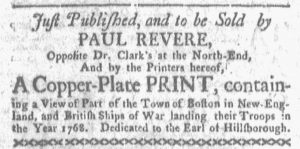
“A Copper-Plate PRINT, containing a View of Part of the Town of Boston in New-England, and British Ships of War landing their Troops in the Year 1768.”

The simultaneous commemoration and commodification of the American Revolution began long before shots were fired at Lexington and Concord in April 1775.  Just three weeks after the Boston Massacre occurred, Paul Revere advertised an engraved print depicting the event in two of Boston’s newspapers.  It did not take long for Revere to issue another print inspired by the imperial crisis.  On April 16, 1770, he inserted an advertisement in the Boston-Gazette to promote “A Copper-Plate PRINT, containing a View of Part of the Town of Boston in New-England, and British Ships of War landing their Troops in the Year 1768.”

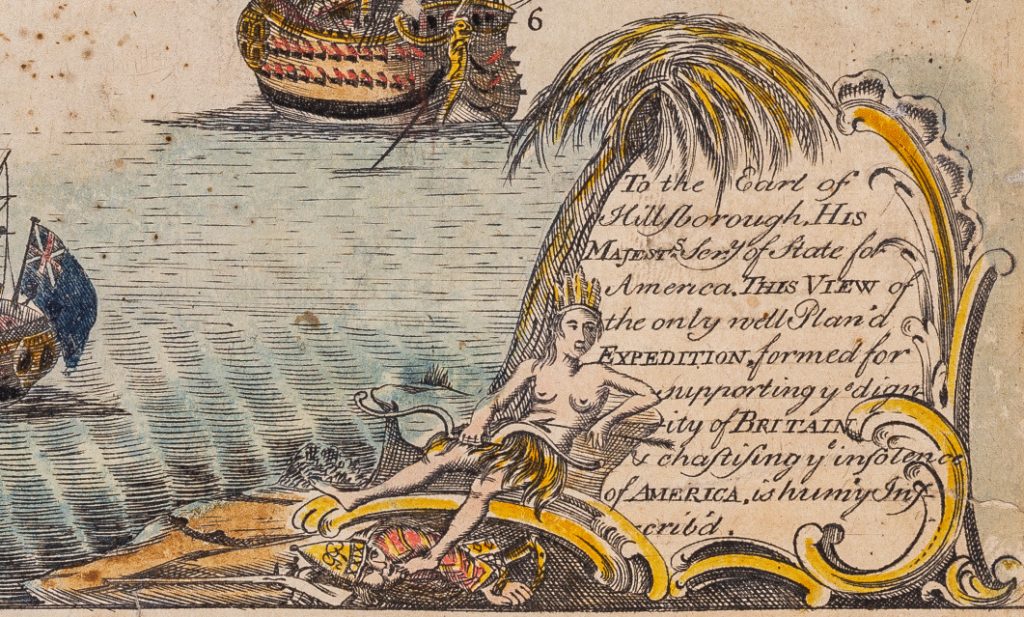
Catharina Slautterback asserts that the “citizens of Boston could not fail to make a connection between the two prints,” especially since the “relationship between the two events was underscored by the cartouche in the lower right-hand corner of A View of the Part of the Town of Boston.”  Revere stated in the advertisement that the print was “Dedicated to the Earl of Hillsborough,” a sarcastic honor that received further elaboration in the cartouche.  In addition to identifying Hillsborough as “HIS MAJEST[Y]’S Se[creta]ry of State for America,” the cartouche featured a Native American woman, bow and arrow firmly in hand, with her foot on the throat of a British soldier who had dropped his musket.  The soldier’s helmet bore the number “XXIX” for the 29th Regiment that had fired on the crowd during the Boston Massacre.  While the image of ships loaded with British soldiers arriving in Boston may have suggested imperial power, the personification of the American colonies readily dispatching one of those soldiers encouraged resistance and the possibility of overcoming abuse perpetrated by both soldiers and Parliament.  Revere’s image depicted the threat and called for action.

Apr 16 - Cartouche from Revere Engraving
Detail from A View of the Part of the Town of Boston (Paul Revere, 1770). Courtesy American Antiquarian Society.

Slautterback states that the success of the The Bloody Massacre Perpetrated in King-Street demonstrated that “the public was hungry for anti-British propaganda.”  Revere was just as eager to provide it.  Indeed, he previously created another version of the engraved print, a woodcut offering A Prospective View of the Town of BOSTON, the Capital of New-England; and of the Landing of – Troops in the Year 1768, in Consequence of Letters from Gov. Bernard, the Commissioners, &c. to the British Ministry.  That woodcut accompanied Edes and Gill’s North-American Almanack and Massachusetts Register for the Year 1770, a publication that overflowed with propaganda favoring the patriot cause.  Revere’s image of the threat represented by the arrival of those troops in Boston was the first item in the lengthy list of contents that appeared in newspaper advertisements for the almanac and register.  Created before the Boston Massacre, it did not include the cartouche or the dedication, but the implication of the danger inherent in quartering British troops in the city was clear.   Revere further elaborated on the theme from A Prospective View when he created A View of the Part of the Town in Boston.  Compared to a woodcut, the copperplate engraving allowed for greater elaboration of details, including the addition of a Native American woman disarming a soldier from the 29th Regiment.

Revere promoted and sold the new print, as did Edes and Gill, publishers of the Boston-Gazette.  They marketed a pivotal event in the imperial crisis years before the military conflict between the colonies and Britain commenced.  Through their efforts, they attempted to leverage consumer culture and advertising to bolster support for the American cause among the broader public.

Slavery Advertisements Published April 16, 1770

The Slavery Adverts 250 Project chronicles the role of newspaper advertising in perpetuating slavery in the era of the American Revolution. The project seeks to reveal the ubiquity of slavery in eighteenth-century life from New England to Georgia by republishing advertisements for slaves – for sale, wanted to purchase, runaways, captured fugitives – in daily digests on this site as well as in real time via the @SlaveAdverts250 Twitter feed, utilizing twenty-first-century media to stand in for the print media of the eighteenth century.

The project aims to provide modern audiences with a sense of just how often colonists encountered these advertisements in their daily lives. Enslaved men, women, and children appeared in print somewhere in the colonies almost every single day. Those advertisements served as a constant backdrop for social, cultural, economic, and political life in colonial and revolutionary America. Colonists who did not own slaves were still confronted with slavery as well as invited to maintain the system by purchasing slaves or assisting in the capture of runaways. The frequency of these newspaper advertisements suggests just how embedded slavery was in colonial and revolutionary American culture in everyday interactions beyond the printed page.

These advertisements also testify to the experiences of enslaved men, women, and children, though readers must consider that those experiences have been remediated through descriptions offered by slaveholders rather than the slaves themselves. Often unnamed in the advertisements, enslaved men, women, and children were not invisible or unimportant in early America.

These advertisements appeared in colonial American newspapers 250 years ago today.

Apr 16 1770 - Boston-Gazette Slavery 1
Boston-Gazette (April 16, 1770).

**********

Apr 16 1770 - Massachusetts Gazette and Boston Post-Boy Slavery 1
Massachusetts Gazette and Boston Post-Boy (April 16, 1770).

**********

Apr 16 1770 - New-York Gazette and Weekly Mercury Slavery 1
New-York Gazette and Weekly Mercury (April 16, 1770).

**********

Apr 16 1770 - New-York Gazette and Weekly Mercury Slavery 2
New-York Gazette and Weekly Mercury (April 16, 1770).

**********

Apr 16 1770 - New-York Gazette and Weekly Mercury Slavery 3
New-York Gazette and Weekly Mercury (April 16, 1770).

**********

Apr 16 1770 - New-York Gazette and Weekly Mercury Slavery 4
New-York Gazette and Weekly Mercury (April 16, 1770).

**********

Apr 16 1770 - New-York Gazette and Weekly Mercury Slavery 5
New-York Gazette and Weekly Mercury (April 16, 1770).

**********

Apr 16 1770 - New-York Gazette and Weekly Mercury Slavery 6
New-York Gazette and Weekly Mercury (April 16, 1770).

**********

Apr 16 1770 - New-York Gazette and Weekly Mercury Supplement Slavery 1
Supplement to the New-York Gazette and Weekly Mercury (April 16, 1770).

**********

Apr 16 1770 - New-York Gazette and Weekly Mercury Supplement Slavery 2
Supplement to the New-York Gazette and Weekly Mercury (April 16, 1770).

**********

Apr 16 1770 - New-York Gazette or Weekly Post-Boy Slavery 1
New-York Gazette or Weekly Post-Boy (April 16, 1770).

**********

Apr 16 1770 - New-York Gazette or Weekly Post-Boy Slavery 2
New-York Gazette or Weekly Post-Boy (April 16, 1770).

**********

Apr 16 1770 - New-York Gazette or Weekly Post-Boy Slavery 3
New-York Gazette or Weekly Post-Boy (April 16, 1770).

April 15

What was advertised in a colonial American newspaper 250 years ago this week?

Apr 15 - 4:12:1770 New-York Journal
New-York Journal (April 15, 1770).

“Chisels … superior in Quality to those imported from Great Britain.”

Abeel and Byvanck sold ironmongery and cutlery in New York in the early 1770s.  They listed an array of merchandise in their newspaper notices, but they did not merely inform prospective customers of the goods they offered for sale.  In an advertisement in the April 12, 1770, edition of the New-York Journal, Abeel and Byvanck noted the various ways that their business bolstered the nonimportation agreement adopted to protest duties imposed on imported paper, glass, lead, paint, and tea in the Townshend Acts.

For instance, their inventory included chisels “superior in Quality to those imported from Great Britain, and at a less Price.”  The partners did not explicitly state that the chisels were produced in the colonies, but the implication was clear.  In presenting the chisels for consideration, Abeel and Byvanck made appeals commonly advanced by others who marketed “domestic manufactures” as alternative to imported goods.  They assured consumers that they did not have to sacrifice quality for political principles.  While some artisans and shopkeepers declared their merchandise produced in the colonies equal to any imported, Abeel and Byvanck made an even bolder statement when they asserted their chisels were “superior.”  Yet customers did not have to pay a premium for that quality.  Instead, they could acquire chisels produced in the colonies for lower prices than imported ones.  Everything about these chisels seemed to work to the advantage of both consumers and the American cause.

Those chisels may have come from “the Manufactory in this Province.”  Abeel and Byvanck noted that they would soon stock “a large Parcel of Sithes [Scythes]” currently under production there.  Like the chisels, those scythes were “superior in Quality to those imported.”  The partners did not comment on the price, but they had previously framed their entire advertisement in terms that favorably compared the prices they charged in April 1770 to what they charged prior to the nonimportation agreement going into effect.  They declared that they set prices “Upon as reasonable Terms, as they sold before the Agreement for not importing Goods from Great Britain.”  In other words, Abeel and Byvanck did not engage in price gouging after merchants and shopkeepers ceased replenishing their inventories with imported goods.

Nonimportation agreements ratified in New York and other colonies were the subject of press coverage in the 1760s and 1770s, but that coverage was not confined to news items and editorials.  Instead, advertisements for consumer goods and services also endorsed and promoted nonimportation agreements, encouraging colonists to understand the connections between consumption and politics.

April 14

What was advertised in a colonial American newspaper 250 years ago today?

Apr 14 - 4:14:1770 Providence Gazette
Providence Gazette (April 14, 1770).

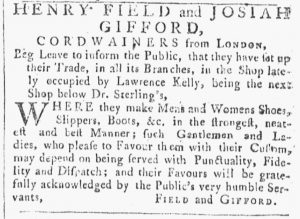
“CORDWAINERS from LONDON.”

When cordwainers Henry Field and Josiah Gifford set up shop in Providence they placed an advertisement in the April 14, 1770, edition of the Providence Gazette to inform the community that they made and sold “Mens and Womens Shoes, Slippers, [and] Boots.”  They advanced some of the most common marketing appeals of the era, pledging that their customers benefited from both the quality of their craftsmanship and the customer service they provided.  Field and Gifford asserted that they made footwear “in the strongest, neatest and best Manner.”  They followed their trade “in all its Branches,” suggesting that no request or order was beyond their capability.  They also pledged that patrons “may depend on being served with Punctuality, Fidelity and Dispatch.”  Field and Gifford exercised deference to “such Gentlemen and Ladies, who please to favour them with their Custom.”

Yet before they made any of these appeals Field and Gifford first introduced themselves as “CORDWAINERS from LONDON.”  In so doing, they adopted a strategy commonly invoked by artisans who advertised in eighteenth-century newspapers.  Those who migrated across the Atlantic, especially artisans who had trained or worked in London, often indicated their place of origin, but not merely by way of introduction.  They expected that their connections to the cosmopolitan center of the empire carried a certain cachet that gave them a competitive advantage among colonial consumers … or at least leveled the playing field.  After all, other artisans benefited from long familiarity within their community.  They built relationships with consumers and cultivated reputations over time.  As newcomers, Field and Gifford did not have those advantages.  Instead, they made their recent arrival in the colonies work to their benefit.  Just as colonial consumers tended to look to London and the rest of England when it came to goods, often expressing preferences for imported wares, Field and Gifford encouraged them to express preferences and recognize the value of artisans who also came from the other side of the Atlantic

Slavery Advertisements Published April 14, 1770

The Slavery Adverts 250 Project chronicles the role of newspaper advertising in perpetuating slavery in the era of the American Revolution. The project seeks to reveal the ubiquity of slavery in eighteenth-century life from New England to Georgia by republishing advertisements for slaves – for sale, wanted to purchase, runaways, captured fugitives – in daily digests on this site as well as in real time via the @SlaveAdverts250 Twitter feed, utilizing twenty-first-century media to stand in for the print media of the eighteenth century.

The project aims to provide modern audiences with a sense of just how often colonists encountered these advertisements in their daily lives. Enslaved men, women, and children appeared in print somewhere in the colonies almost every single day. Those advertisements served as a constant backdrop for social, cultural, economic, and political life in colonial and revolutionary America. Colonists who did not own slaves were still confronted with slavery as well as invited to maintain the system by purchasing slaves or assisting in the capture of runaways. The frequency of these newspaper advertisements suggests just how embedded slavery was in colonial and revolutionary American culture in everyday interactions beyond the printed page.

These advertisements also testify to the experiences of enslaved men, women, and children, though readers must consider that those experiences have been remediated through descriptions offered by slaveholders rather than the slaves themselves. Often unnamed in the advertisements, enslaved men, women, and children were not invisible or unimportant in early America.

These advertisements appeared in colonial American newspapers 250 years ago today.

Apr 14 1770 - Providence Gazette Slavery 1
Providence Gazette (April 14, 1770).