April 13

What was advertised in a colonial American newspaper 250 years ago today?

Apr 13 - 4:13:1770 New-Hampshire Gazette
New-Hampshire Gazette (April 13, 1770).

“At his Shop next to the Printing Office.”

Throughout the eighteenth century, most residences and businesses did not have standardized street addresses.  City directories as well as trade cards and billheads and other advertising ephemera reveal that some of the largest cities did adopt street numbers in the late 1780s and 1790s, but that practice did not arrive in other cities and towns until the nineteenth century.

Newspaper advertisements featured a variety of means of identifying locations of businesses in eighteenth-century America.  Some simply listed the street, as was the case in the advertisement for garden seeds that John Adams placed in the April 13, 1770, edition of the New-Hampshire Gazette.  Adams indicated that he sold his wares “In Queen Street, Portsmouth.”  The port town was small enough that Adams may not have needed to list an address of any sort for residents.  However, since the New-Hampshire Gazette was the only newspaper published in the colony and circulated far beyond Portsmouth, Adams may have included his street to aid prospective customers from the countryside who traveled to town or sent orders.

In the same issue, Gillam Butler advertised an assortment of textiles that he sold “At his Shop next to the Printing Office, in the Street that leads from the Parade to the Market and Ferry.”  He deployed two strategies for identifying his location.  Given that he did not frequently place advertisements, Butler may have thought it necessary to give as much information as possible to aid consumers who wished to visit his shop.  He named a landmark and described his location in relation to that landmark: “next to the Printing Office.”  He also provided more extensive information about the street.  In some cases, advertisers named intersecting streets to help readers get their bearings.  In this instance, Butler invoked other aspects of the street by describing other landmarks that it connected: “the Street that leads from the Parade to the Market and Ferry.”  He made it possible for prospective customers to imagine a map of his neighborhood to navigate to his shop.

To some extent, we have reverted to eighteenth-century means of thinking about where businesses are located as GPS systems become more advanced.  The algorithms that produce directions still rely on standardized street addresses, but users do not need to supply them or even be aware of them.  It is now possible to simply enter the name of a business and let the GPS take care of street numbers, landmarks, intersections, and a variety of other data.

Slavery Advertisements Published April 13, 1770

The Slavery Adverts 250 Project chronicles the role of newspaper advertising in perpetuating slavery in the era of the American Revolution. The project seeks to reveal the ubiquity of slavery in eighteenth-century life from New England to Georgia by republishing advertisements for slaves – for sale, wanted to purchase, runaways, captured fugitives – in daily digests on this site as well as in real time via the @SlaveAdverts250 Twitter feed, utilizing twenty-first-century media to stand in for the print media of the eighteenth century.

The project aims to provide modern audiences with a sense of just how often colonists encountered these advertisements in their daily lives. Enslaved men, women, and children appeared in print somewhere in the colonies almost every single day. Those advertisements served as a constant backdrop for social, cultural, economic, and political life in colonial and revolutionary America. Colonists who did not own slaves were still confronted with slavery as well as invited to maintain the system by purchasing slaves or assisting in the capture of runaways. The frequency of these newspaper advertisements suggests just how embedded slavery was in colonial and revolutionary American culture in everyday interactions beyond the printed page.
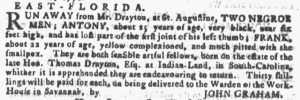
These advertisements also testify to the experiences of enslaved men, women, and children, though readers must consider that those experiences have been remediated through descriptions offered by slaveholders rather than the slaves themselves. Often unnamed in the advertisements, enslaved men, women, and children were not invisible or unimportant in early America.

These advertisements appeared in colonial American newspapers 250 years ago today.

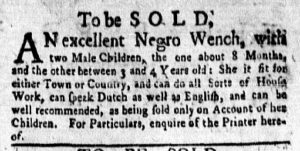
Apr 13 1770 - New-Hampshire Gazette Slavery 1
New-Hampshire Gazette (April 13, 1770).

**********

Apr 13 1770 - New-Hampshire Gazette Slavery 2
New-Hampshire Gazette (April 13, 1770).

**********

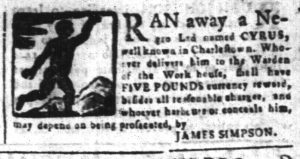
Apr 13 1770 - South-Carolina and American General Gazette Slavery 1
South-Carolina and American Gazette (April 13, 1770).

**********

Apr 13 1770 - South-Carolina and American General Gazette Slavery 2
South-Carolina and American Gazette (April 13, 1770).

**********

Apr 13 1770 - South-Carolina and American General Gazette Slavery 3
South-Carolina and American Gazette (April 13, 1770).

**********

Apr 13 1770 - South-Carolina and American General Gazette Slavery 4
South-Carolina and American Gazette (April 13, 1770).

**********

Apr 13 1770 - South-Carolina and American General Gazette Slavery 5
South-Carolina and American Gazette (April 13, 1770).

**********

Apr 13 1770 - South-Carolina and American General Gazette Slavery 6
South-Carolina and American Gazette (April 13, 1770).

**********

Apr 13 1770 - South-Carolina and American General Gazette Slavery 7
South-Carolina and American Gazette (April 13, 1770).

**********

Apr 13 1770 - South-Carolina and American General Gazette Slavery 8
South-Carolina and American Gazette (April 13, 1770).

**********

Apr 13 1770 - South-Carolina and American General Gazette Slavery 9
South-Carolina and American Gazette (April 13, 1770).

April 12

What was advertised in a colonial American newspaper 250 years ago today?

Apr 12 - 4:12:1770 Maryland Gazette
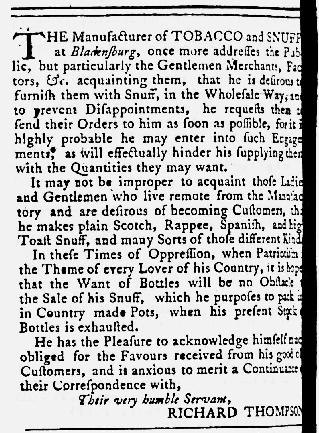
Maryland Gazette (April 12, 1770).

“He purposes to pack it in Country made Pots.”

Richard Thompson, “the Manufacturer of TOBACCO and SNUFF at Blackensburg,” placed an advertisement for his ware in the April 12, 1770, edition of the Maryland Gazette.  He invited “Gentleman Merchants,” factors, and others to submit orders for wholesale purchases quickly or else risk missing out since “it is highly probable he may enter into such Engagements, as will effectually hinder his supplying them with the Quantities that may want.”  He also listed his various products for the benefit of both wholesale and retail customers: “plain Scotch, Rapee, Spanish, and high Toast Snuff, and many Sorts of those different Kinds.”

Thompson also devoted a portion of his advertisement to the packaging for his snuff, noting that out of necessity it might deviate from what consumers expected.  He anticipated that his “present Stock” of snuff bottles would run out, forcing him to “pack [his snuff] in Country made Pots.”  Although that was not the usual or preferred form of packaging, Thompson argued that it should not dissuade customers from acquiring his snuff.  He invoked current events to make his case to principled prospective customers.  “In these Tomes of Oppression, when Patriotism is the Theme of every Lover of his County,” he declared, “it is hoped that the Want of Bottles will be no Obstacle in the Sale of his Snuff.”  Thompson suggested that consumers should accept or even welcome a minor inconvenience if it meant purchasing goods produced in the colonies rather than imported from Britain.

On the other side of the Atlantic, the king gave royal assent to repealing duties on imported glass, paper, paint, and lead on the same day that Thompson’s advertisement first appeared in the Maryland Gazette, but colonists would not learn that news for many weeks.  For the moment, nonimportation agreements adopted in protest of the duties imposed in the Townshend Acts remained in effect, a powerful symbol for both merchants and consumers.  Like others who advertised domestic manufactures as alternatives to imported goods, Thompson offered yet another avenue for practicing politics in the marketplace by purchasing his snuff packed “in Country made Pots.”

Slavery Advertisements Published April 12, 1770

The Slavery Adverts 250 Project chronicles the role of newspaper advertising in perpetuating slavery in the era of the American Revolution. The project seeks to reveal the ubiquity of slavery in eighteenth-century life from New England to Georgia by republishing advertisements for slaves – for sale, wanted to purchase, runaways, captured fugitives – in daily digests on this site as well as in real time via the @SlaveAdverts250 Twitter feed, utilizing twenty-first-century media to stand in for the print media of the eighteenth century.

The project aims to provide modern audiences with a sense of just how often colonists encountered these advertisements in their daily lives. Enslaved men, women, and children appeared in print somewhere in the colonies almost every single day. Those advertisements served as a constant backdrop for social, cultural, economic, and political life in colonial and revolutionary America. Colonists who did not own slaves were still confronted with slavery as well as invited to maintain the system by purchasing slaves or assisting in the capture of runaways. The frequency of these newspaper advertisements suggests just how embedded slavery was in colonial and revolutionary American culture in everyday interactions beyond the printed page.

These advertisements also testify to the experiences of enslaved men, women, and children, though readers must consider that those experiences have been remediated through descriptions offered by slaveholders rather than the slaves themselves. Often unnamed in the advertisements, enslaved men, women, and children were not invisible or unimportant in early America.

These advertisements appeared in colonial American newspapers 250 years ago today.

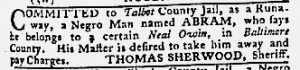
Apr 12 1770 - Maryland Gazette Slavery 1
Maryland Gazette (April 12, 1770).

**********

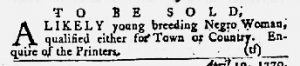
Apr 12 1770 - Maryland Gazette Slavery 2
Maryland Gazette (April 12, 1770).

**********

Apr 12 1770 - Maryland Gazette Slavery 3
Maryland Gazette (April 12, 1770).

**********

Apr 12 1770 - Maryland Gazette Slavery 4
Maryland Gazette (April 12, 1770).

**********

Apr 12 1770 - Maryland Gazette Slavery 5
Maryland Gazette (April 12, 1770).

**********

Apr 12 1770 - Maryland Gazette Slavery 6
Maryland Gazette (April 12, 1770).

**********

Apr 12 1770 - Maryland Gazette Slavery 7
Maryland Gazette (April 12, 1770).

**********

Apr 12 1770 - Maryland Gazette Slavery 8
Maryland Gazette (April 12, 1770).

**********

Apr 12 1770 - New-York Journal Slavery 1
New-York Journal (April 12, 1770).

**********

Apr 12 1770 - New-York Journal Slavery 2
New-York Journal (April 12, 1770).

**********

Apr 12 1770 - Pennsylvania Gazette Slavery 1
Pennsylvania Gazette (April 12, 1770).

**********

Apr 12 1770 - Pennsylvania Gazette Slavery 2
Pennsylvania Gazette (April 12, 1770).

**********

Apr 12 1770 - Pennsylvania Gazette Slavery 3
Pennsylvania Gazette (April 12, 1770).

**********

Apr 12 1770 - Pennsylvania Journal Slavery 1
Pennsylvania Journal (April 12, 1770).

**********

Apr 12 1770 - Pennsylvania Journal Slavery 2
Pennsylvania Journal (April 12, 1770).

**********

Apr 12 1770 - Pennsylvania Journal Slavery 3
Pennsylvania Journal (April 12, 1770).

**********

Apr 12 1770 - Pennsylvania Journal Slavery 4
Pennsylvania Journal (April 12, 1770).

**********

Apr 12 1770 - South-Carolina Gazette Slavery 1
South-Carolina Gazette (April 12, 1770).

**********

Apr 12 1770 - South-Carolina Gazette Slavery 2
South-Carolina Gazette (April 12, 1770).

April 11

What was advertised in a colonial American newspaper 250 years ago today?

Apr 11 - 4:11:1770 Georgia Gazette
Advertising Supplement for the Georgia Gazette (April 11, 1770).

“RUN AWAY … TWO NEGROE MEN.”

Given the distance, it is not surprising that it took longer for word of the Boston Massacre to reach James Johnston, printer of the Georgia Gazette, than his counterparts in other cities.  On April 11, 1770, he published coverage of the Massacre, reprinting the article that originally appeared in Edes and Gill’s Boston-Gazette on March 12.  Johnston did not indicate whether he reprinted the news directly from the Boston-Gazette or from one of the many newspapers that had earlier reprinted and further disseminated Edes and Gill’s coverage of the shocking event.

The news from Boston comprised almost an entire page, prompting Johnston to issue a relatively rare advertising supplement because he lacked space for all the content for that week.  The supplement featured sixteen advertisements, including three that described enslaved men and women who escaped from the colonists who held them in bondage.

Johnston’s supplement to the Georgia Gazette did not take the same form as most supplements to other newspapers printed throughout the colonies.  Those usually ran on half sheets with a masthead to identify the publication.  The only indication that this supplement belongs with the April 11 edition of the Georgia Gazette is a notation at the bottom of the page.  “[No. 340.]” corresponded to the issue number in the masthead of the standard issue.

It is impossible to tell the size of the sheet for Johnston’s April 11 supplement from digitized copies of the Georgia Gazette except to say that it certainly was not a half sheet.  It may very well have been a quarter sheet.  Under other circumstances, I would visit the American Antiquarian Society to examine an original edition and take measurements, but that library, like others across the nation, is temporarily closed as part of the physical distancing measures to slow and prevent the spread of the coronavirus.

No matter the size of the supplement, carrying news of the momentous events in Boston forced Johnston to decide between enlarging the size of the Georgia Gazette on April 11 or choosing among advertisements and other news to delay for a week.  Having a duty to subscribers to provide news and a financial obligation to advertisers to distribute their notices, Johnston opted for creating a supplement.  Doing so drew on a precious resource, considering that imported paper was still taxed under the Townshend Acts and supplies of paper produced in the colonies were limited.

Apr 11 - 4:11:1770 Georgia Gazette
Advertising Supplement for the Georgia Gazette (April 11, 1770).

Slavery Advertisements Published April 11, 1770

The Slavery Adverts 250 Project chronicles the role of newspaper advertising in perpetuating slavery in the era of the American Revolution. The project seeks to reveal the ubiquity of slavery in eighteenth-century life from New England to Georgia by republishing advertisements for slaves – for sale, wanted to purchase, runaways, captured fugitives – in daily digests on this site as well as in real time via the @SlaveAdverts250 Twitter feed, utilizing twenty-first-century media to stand in for the print media of the eighteenth century.

The project aims to provide modern audiences with a sense of just how often colonists encountered these advertisements in their daily lives. Enslaved men, women, and children appeared in print somewhere in the colonies almost every single day. Those advertisements served as a constant backdrop for social, cultural, economic, and political life in colonial and revolutionary America. Colonists who did not own slaves were still confronted with slavery as well as invited to maintain the system by purchasing slaves or assisting in the capture of runaways. The frequency of these newspaper advertisements suggests just how embedded slavery was in colonial and revolutionary American culture in everyday interactions beyond the printed page.

These advertisements also testify to the experiences of enslaved men, women, and children, though readers must consider that those experiences have been remediated through descriptions offered by slaveholders rather than the slaves themselves. Often unnamed in the advertisements, enslaved men, women, and children were not invisible or unimportant in early America.

These advertisements appeared in colonial American newspapers 250 years ago today.

Apr 11 1770 - Georgia Gazette Slavery 8
Georgia Gazette (April 11, 1770).

**********

Apr 11 1770 - Georgia Gazette Slavery 1
Georgia Gazette (April 11, 1770).

**********

Apr 11 1770 - Georgia Gazette Slavery 2
Georgia Gazette (April 11, 1770).

**********

Apr 11 1770 - Georgia Gazette Slavery 3
Georgia Gazette (April 11, 1770).

**********

Apr 11 1770 - Georgia Gazette Slavery 4
Georgia Gazette (April 11, 1770).

**********

Apr 11 1770 - Georgia Gazette Slavery 5
Georgia Gazette (April 11, 1770).

**********

Apr 11 1770 - Georgia Gazette Slavery 6
Georgia Gazette (April 11, 1770).

**********

Apr 11 1770 - Georgia Gazette Slavery 7
Georgia Gazette (April 11, 1770).

April 10

What was advertised in a colonial American newspaper 250 years ago today?

Apr 10 - 4:10:1770 South-Carolina Gazette and Country Journal
South-Carolina Gazette and Country Journal (April 10, 1770).

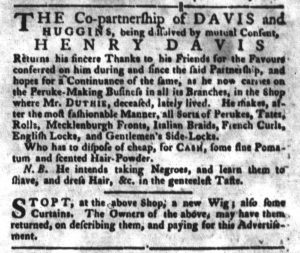
“He now carries on the Peruke-Making Business in all its Branches.”

Henry Davis, a wigmaker, hairdresser and barber, did not have only a single purpose for placing an advertisement in the April 10, 1770, edition of the South-Carolina Gazette and Country Journal.  Instead, he pursued several in the course of just a few lines, all of them ultimately promoting his business in one way or another.

He opened by extending “his sincere Thanks” to former customers now that the “Co-partnership of DAVIS and HUGGINS” had been “dissolved by mutual Consent.”  He expressed appreciation for “the Favours conferred on him” and requested “a Continuance of the same” in his new endeavor.  Now that Davis opened his own shop, he hoped to maintain the client base that he had established while in partnership with Huggins.

He also hoped to expand his clientele.  To that end, he addressed former and prospective customers alike when he listed and described the various kinds of wigs he made “after the most fashionable Manner.”  He carried “all Sorts of Perukes, Tates, Rolls, Mecklenburgh Fronts, Italian Braids, French Curls, English Locks, and Gentlemen’s Side-Locks.”  Davis knew that discerning readers could differentiate among the assorted styles.  In addition to the wigs, Davis sold accessories, including “fine Pomatum and scented Hair-Powder.”

As he launched his new business, the wigmaker also intended to expand his staff in order to provide additional services to his clients.  He previewed his plan to acquire enslaved workers and teach them “to shave, and dress Hair, &c. in the genteelest Taste.”  The skill of those assistants would testify to Davis’s own expertise.  Their presence in his shop would contribute to the pampering of clients.  He envisioned that his future success depended in part on the involuntary labor of others.

Finally, Davis advised readers that he had “STOPT” a new wig as well as some curtains.  In other words, someone presented him with items to purchase but he instead confiscated them because he believed they were stolen.  He invited the rightful owner to retrieve them upon offering an accurate description and “paying for this Advertisement.”  This demonstrated his character as he commenced a new enterprise.  It also revealed that some colonists attempted to participate in the consumer revolution and keep up with the latest fashions through unsavory means.

In quick succession, Davis announced the end of his partnership with Huggins, attempted to cement relationships with former clients, provided an overview of the products and services available at his new shop, noted that he intended to acquire additional staff, and invited the victim of a theft to retrieve goods he recovered.  Each of these aspects of his advertisement served to bolster confidence in his abilities as a wigmaker and entrepreneur among prospective customers.

Slavery Advertisements Published April 10, 1770

The Slavery Adverts 250 Project chronicles the role of newspaper advertising in perpetuating slavery in the era of the American Revolution. The project seeks to reveal the ubiquity of slavery in eighteenth-century life from New England to Georgia by republishing advertisements for slaves – for sale, wanted to purchase, runaways, captured fugitives – in daily digests on this site as well as in real time via the @SlaveAdverts250 Twitter feed, utilizing twenty-first-century media to stand in for the print media of the eighteenth century.

The project aims to provide modern audiences with a sense of just how often colonists encountered these advertisements in their daily lives. Enslaved men, women, and children appeared in print somewhere in the colonies almost every single day. Those advertisements served as a constant backdrop for social, cultural, economic, and political life in colonial and revolutionary America. Colonists who did not own slaves were still confronted with slavery as well as invited to maintain the system by purchasing slaves or assisting in the capture of runaways. The frequency of these newspaper advertisements suggests just how embedded slavery was in colonial and revolutionary American culture in everyday interactions beyond the printed page.

These advertisements also testify to the experiences of enslaved men, women, and children, though readers must consider that those experiences have been remediated through descriptions offered by slaveholders rather than the slaves themselves. Often unnamed in the advertisements, enslaved men, women, and children were not invisible or unimportant in early America.

These advertisements appeared in colonial American newspapers 250 years ago today.

Apr 10 - 4:10:1770 South-Carolina Gazette and Country Journal
South-Carolina Gazette and Country Gazette (April 10, 1770).

**********

Apr 10 1770 - South-Carolina Gazette and Country Journal Slavery 1
South-Carolina Gazette and Country Gazette (April 10, 1770).

**********

Apr 10 1770 - South-Carolina Gazette and Country Journal Slavery 2
South-Carolina Gazette and Country Gazette (April 10, 1770).

**********

Apr 10 1770 - South-Carolina Gazette and Country Journal Slavery 3
South-Carolina Gazette and Country Gazette (April 10, 1770).

**********

Apr 10 1770 - South-Carolina Gazette and Country Journal Slavery 4
South-Carolina Gazette and Country Gazette (April 10, 1770).

**********

Apr 10 1770 - South-Carolina Gazette and Country Journal Slavery 5
South-Carolina Gazette and Country Gazette (April 10, 1770).

**********

Apr 10 1770 - South-Carolina Gazette and Country Journal Slavery 6
South-Carolina Gazette and Country Gazette (April 10, 1770).

**********

Apr 10 1770 - South-Carolina Gazette and Country Journal Slavery 7
South-Carolina Gazette and Country Gazette (April 10, 1770).

**********

Apr 10 1770 - South-Carolina Gazette and Country Journal Slavery 8
South-Carolina Gazette and Country Gazette (April 10, 1770).

**********

Apr 10 1770 - South-Carolina Gazette and Country Journal Slavery 9
South-Carolina Gazette and Country Gazette (April 10, 1770).

April 9

What was advertised in a colonial American newspaper 250 years ago today?

Apr 9 - 4:9:1770 Boston Evening-Post
Boston Evening-Post (April 9, 1770).

“A small Assortment of English Goods.”

The partnership of Smith and Atkinson placed an advertisement offering cash for “POT and PEARL ASH” in the April 9, 1770, edition of the Boston Evening-Post.  In that same advertisement they offered for sale a “small Assortment of English Goods.”  They did not confine themselves to advertising in the Boston Evening-Post alone.  That same day they inserted the same advertisement in both the Boston-Gazette and the Massachusetts Gazette and Boston Post-Boy.  Later in the week, their advertisement also ran in the April 12 edition of the Massachusetts Gazette and Boston Weekly News-Letter.  Of the five newspapers published in Boston at the time, the Boston Chronicle was the only one that did not carry Smith and Atkinson’s advertisement.

Even though they attempted to increase the number of readers who would see their advertisement, they may have declined to place it in the Chronicle for a couple of reasons.  Politics may have played a part:  the Chronicle had earned a much-deserved reputation as a Loyalist newspaper.  Smith and Atkinson may not have wished to be associated with the newspaper or its printers.  The potential return on their investment may have also influenced their decision.  The Chronicle ran far fewer advertisements than any of the other newspapers published in Boston, suggesting that it likely had fewer readers.  Smith and Atkinson may not have considered inserting their advertisement in the Chronicle worth the expense.

In addition, the political argument they made in their advertisement would not have fit the Chronicle’s outlook and reputation.  Smith and Atkinson carefully specified that their English goods had been “imported before the late Agreements of the Merchants.”  They abided by the nonimportation agreement adopted in protest of duties assessed on imported paper, glass, paint, lead, and tea.  They suggested that consumers should abide by the agreement as well, grafting politics onto decisions about their participation in the marketplace.  The Chronicle, on the other hand, devoted significant effort to accusing patriot leaders and merchants of secretly cheating on the nonimportation agreement and misleading their customers and the public.

When Smith and Atkinson decided to advertise in most of Boston’s newspapers, they likely had more than one motivation for doing so.  They did not necessarily seek merely to attract customers for their goods.  Their strategy allowed them to widely publicize that they abided by the political principles adopted by most of their community, enhancing their reputation among readers even if those readers did not become customers.

Slavery Advertisements Published April 9, 1770

The Slavery Adverts 250 Project chronicles the role of newspaper advertising in perpetuating slavery in the era of the American Revolution. The project seeks to reveal the ubiquity of slavery in eighteenth-century life from New England to Georgia by republishing advertisements for slaves – for sale, wanted to purchase, runaways, captured fugitives – in daily digests on this site as well as in real time via the @SlaveAdverts250 Twitter feed, utilizing twenty-first-century media to stand in for the print media of the eighteenth century.

The project aims to provide modern audiences with a sense of just how often colonists encountered these advertisements in their daily lives. Enslaved men, women, and children appeared in print somewhere in the colonies almost every single day. Those advertisements served as a constant backdrop for social, cultural, economic, and political life in colonial and revolutionary America. Colonists who did not own slaves were still confronted with slavery as well as invited to maintain the system by purchasing slaves or assisting in the capture of runaways. The frequency of these newspaper advertisements suggests just how embedded slavery was in colonial and revolutionary American culture in everyday interactions beyond the printed page.

These advertisements also testify to the experiences of enslaved men, women, and children, though readers must consider that those experiences have been remediated through descriptions offered by slaveholders rather than the slaves themselves. Often unnamed in the advertisements, enslaved men, women, and children were not invisible or unimportant in early America.

These advertisements appeared in colonial American newspapers 250 years ago today.

Apr 9 1770 - Boston Evening-Post Slavery 1
Boston Evening-Post (April 9, 1770).

**********

Apr 9 1770 - Boston-Gazette Supplement Slavery 1
Supplement to the Boston-Gazette (April 9, 1770).

**********

Apr 9 1770 - New-York Gazette and Weekly Mercury Slavery 1
New-York Gazette and Weekly Mercury (April 9, 1770).

**********

Apr 9 1770 - New-York Gazette and Weekly Mercury Slavery 2
New-York Gazette and Weekly Mercury (April 9, 1770).

**********

Apr 9 1770 - New-York Gazette and Weekly Mercury Slavery 3
New-York Gazette and Weekly Mercury (April 9, 1770).

**********

Apr 9 1770 - New-York Gazette and Weekly Mercury Slavery 4
New-York Gazette and Weekly Mercury (April 9, 1770).

**********

Apr 9 1770 - New-York Gazette or Weekly Post-Boy Slavery 1
New-York Gazette or Weekly Post-Boy (April 9, 1770).

**********

Apr 9 1770 - New-York Gazette or Weekly Post-Boy Slavery 2
New-York Gazette or Weekly Post-Boy (April 9, 1770).

**********

Apr 9 1770 - New-York Gazette or Weekly Post-Boy Slavery 3
New-York Gazette or Weekly Post-Boy (April 9, 1770).

**********

Apr 9 1770 - Pennsylvania Chronicle Slavery 1
Pennsylvania Chronicle (April 9, 1770).