September 2

What was advertised in a colonial American newspaper 250 years ago this week?

Sep 2 - 8:30:1770 Massachusetts Gazette and Boston Weekly News-Letter
Massachusetts Gazette and Boston Weekly News-Letter (August 30, 1770).

“Some People have surmised that the above Advertisement was inserted only to amuse the Publick.”

Henry Barnes, a merchant, did not meet with success the first time he offered the “Whole of the Real-Estate” he owned in Marlborough for sale in an advertisement in the Massachusetts Gazette and Boston Weekly Mercury in the summer of 1770.  He inserted his advertisement for three consecutive weeks in the issues distributed on July 5, 12, and 19.  In it, he described “a Dwelling-House in good Repair, very pleasantly situated, with the Out-Houses” as well as a large store conveniently located and “extremely well-calculated for Business both Wholesale and Retail.”  The property also included “a very large Pearl-Ash Work,” a still that could produce five hundred barrels of cider a year, seven acres of land for mowing and pasturing, and “a Number of Asparagus Beds in their prime.”  Prospective buyers could anticipate making a living, not just residing, on this property.  Yet the “Whole of the Real-Estate of HENRY BARNES” did not sell.

Barnes had an idea why that was the case.  Four weeks after his advertisement originally ran in the Massachusetts Gazette and Boston Weekly Mercury, he placed it again, but this time with an addition.  In a nota bene that concluded the advertisement, Barnes stated, “Whereas some People have surmised that the above Advertisement was inserted only to amuse the Publick: This is to Certify, that I am determined to sell, provided anybody comes up to my Terms which are thought to be very reasonable.”  Apparently, Barnes’s advertisement had not gone unnoticed, even though it had not produced the results he intended.  Readers of the Massachusetts Gazette and Boston Weekly Mercury and others in the community became aware of Barnes’s real estate notice, discussed it, and dismissed it.  That prompted Barnes to return to the public prints to address the gossip, rumors, and idle talk that the first iteration of his advertisement produced.  He ran the advertisement with the addendum on August 16, 23, and 30.

How effective were newspaper advertisements in eighteenth-century America?  Answering questions about reception is difficult.  Barnes testified to an unintended consequence of placing his advertisement.  It did not initially result in a sale of his real estate, but other colonists did notice it and talk about it.  They read the notice, even if they did not respond in the manner that Barnes hoped.
September 1

What was advertised in a colonial American newspaper 250 years ago today?

Sep 1 - 9:1:1770 Providence Gazette
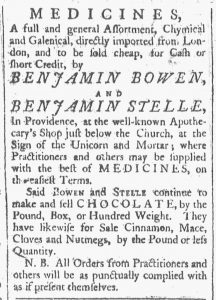
Providence Gazette (September 1, 1770).

“At the Sign of the Unicorn and Mortar.”

On the first day of September in 1770, Benjamin Bowen and Benjamin Stelle advertised “MEDICINES, A full and general Assortment, Chymical and Galenical,” in the Providence Gazette.  They informed prospective customers that they could purchase these medicines “at the well-known Apothecary’s Shop just below the Church, at the Sign of the Unicorn and Mortar.”  In case that shop was not as familiar to readers as Bowen and Stelle suggested it might be, they named the sign that adorned it.  That landmark identified the exact location to acquire “the best of MEDICINES” and “CHOCOLATE, by the Pound, Box, or Hundred Weight.”

Newspaper advertisements placed by entrepreneurs like Bowen and Stelle testify to the visual landscape that colonists encountered as they traversed the streets of towns and cities in eighteenth-century America.  In addition to the “Sign of the Unicorn and Mortar,” that same issue of the Providence Gazette included directions to John Carter’s printing office at “the Sign of Shakespeare’s Head.”  Not all advertisers always included their shop signs in their notices.  Joseph Russell and William Russell placed an advertisement for gun powder and shot that did not make reference to the “Sign of the Golden Eagle.”  On other occasions, however, they were just as likely to include the sign without their name, so familiar had it become in Providence.

Very few eighteenth-century shop signs survived into the twenty-first century.  Evidence that the “Unicorn and Mortar,” “Shakespeare’s Head,” and the “Golden Eagle” once marked places of commercial activity and aided colonists in navigating the streets of Providence and other places comes from newspaper advertisements and other documents from the period.  Any catalog of such signs draws heavily from advertisements since colonists so often referenced them in their notices.  Even those who did not have shop signs of their own listed their locations in relation to nearby signs, suggesting the extent that shop signs helped colonists make sense of their surroundings and navigate the streets of towns and cities.

Slavery Advertisements Published September 1, 1770

GUEST CURATOR:  Chloe Amour

The Slavery Adverts 250 Project chronicles the role of newspaper advertising in perpetuating slavery in the era of the American Revolution. The project seeks to reveal the ubiquity of slavery in eighteenth-century life from New England to Georgia by republishing advertisements for slaves – for sale, wanted to purchase, runaways, captured fugitives – in daily digests on this site as well as in real time via the @SlaveAdverts250 Twitter feed, utilizing twenty-first-century media to stand in for the print media of the eighteenth century.

The project aims to provide modern audiences with a sense of just how often colonists encountered these advertisements in their daily lives. Enslaved men, women, and children appeared in print somewhere in the colonies almost every single day. Those advertisements served as a constant backdrop for social, cultural, economic, and political life in colonial and revolutionary America. Colonists who did not own slaves were still confronted with slavery as well as invited to maintain the system by purchasing slaves or assisting in the capture of runaways. The frequency of these newspaper advertisements suggests just how embedded slavery was in colonial and revolutionary American culture in everyday interactions beyond the printed page.

These advertisements also testify to the experiences of enslaved men, women, and children, though readers must consider that those experiences have been remediated through descriptions offered by slaveholders rather than the slaves themselves. Often unnamed in the advertisements, enslaved men, women, and children were not invisible or unimportant in early America.

These advertisements appeared in colonial American newspapers 250 years ago today.

Sep 1 1770 - Providence Gazette Slavery 1
Providence Gazette (September 1, 1770).

**********

Sep 1 1770 - Providence Gazette Slavery 2
Providence Gazette (September 1, 1770).