September 7

What was advertised in a colonial American newspaper 250 years ago today?
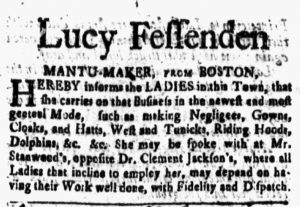
Sep 7 - 9:7:1770 New-Hampshire Gazette
New-Hampshire Gazette (September 7, 1770).

“MANTU-MAKER, FROM BOSTON.”

Over the past few days the Adverts 250 Project has examined the manner in which purveyors of goods and services in the colonies incorporated their origins into their advertisements as part of their marketing campaigns.  We began with James Yeoman, a clock- and watchmaker “FROM LONDON,” who sought to convince readers of the New-York Gazette and Weekly Mercury that his skills eclipsed those of competitors who had not trained or worked in the largest city in the empire.  Next we looked at George Lafong, a “French HAIR-DRESSER,” who informed the ladies and gentlemen of Williamsburg, Virginia, that he styled hair “in the cheapest manner, & TOUT A LA MODE” (all in fashion).  Injecting a few words of French into his advertisement in William Rind’s Virginia Gazette underscored the gentility and cachet associated with hiring a hairdresser from France.

Today we consider the advertisement that Lucy Fessenden inserted into the September 7, 1770, edition of the New-Hampshire Gazette.  She introduced herself as a mantuamaker “FROM BOSTON,” asserting that she pursued her craft “in the newest and most genteel Mode.”  While Yeoman and Lafong’s advertisements testified to migration across the Atlantic, Fessenden’s notice indicated migration within the colonies.  In both instances, advertisers sought to use their origins to their advantage.  Artisans as well as tailors, milliners, and others in the garments trade, including mantuamakers like Fessenden, frequently noted that they formerly lived and worked in some of the largest port cities when they relocated to smaller towns and advertised their services.  Perceptions of skill and associations with gentility seemed to operate on a sliding scale.  Residents of Boston, Charleston, New York, and Philadelphia looked to London and other places on the far side of the Atlantic as models.  Residents of smaller towns did as well, but they also recognized the major ports in the colonies as locations that merited notice.  Unable to make a direct connection to London, Fessenden instead leveraged her time in Boston to suggest her familiarity with “the newest and most genteel Mode” and her ability to deliver on it “with Fidelity and Dispatch.”

Slavery Advertisements Published September 7, 1770

GUEST CURATOR:  Benjamin Bartlett

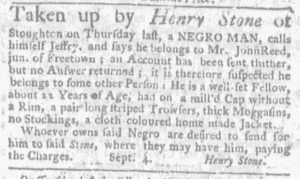
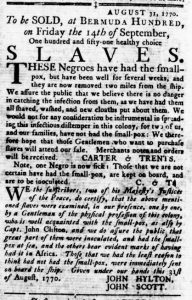
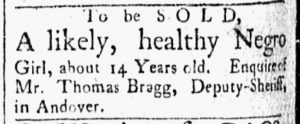
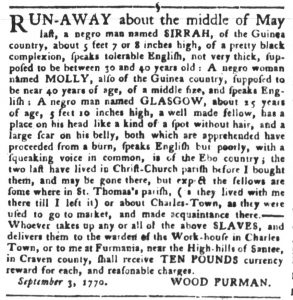
The Slavery Adverts 250 Project chronicles the role of newspaper advertising in perpetuating slavery in the era of the American Revolution. The project seeks to reveal the ubiquity of slavery in eighteenth-century life from New England to Georgia by republishing advertisements for slaves – for sale, wanted to purchase, runaways, captured fugitives – in daily digests on this site as well as in real time via the @SlaveAdverts250 Twitter feed, utilizing twenty-first-century media to stand in for the print media of the eighteenth century.

The project aims to provide modern audiences with a sense of just how often colonists encountered these advertisements in their daily lives. Enslaved men, women, and children appeared in print somewhere in the colonies almost every single day. Those advertisements served as a constant backdrop for social, cultural, economic, and political life in colonial and revolutionary America. Colonists who did not own slaves were still confronted with slavery as well as invited to maintain the system by purchasing slaves or assisting in the capture of runaways. The frequency of these newspaper advertisements suggests just how embedded slavery was in colonial and revolutionary American culture in everyday interactions beyond the printed page.

These advertisements also testify to the experiences of enslaved men, women, and children, though readers must consider that those experiences have been remediated through descriptions offered by slaveholders rather than the slaves themselves. Often unnamed in the advertisements, enslaved men, women, and children were not invisible or unimportant in early America.

These advertisements appeared in colonial American newspapers 250 years ago today.

Sep 7 1770 - New-London Gazette Slavery 1
New-London Gazette (September 7, 1770).

September 6

What was advertised in a colonial American newspaper 250 years ago today?

Sep 6 - 9:6:1770 Virginia Gazette Rind
Virginia Gazette [Rind] (September 6, 1770).
“TOUT A LA MODE.”

George Lafong introduced himself to the ladies and gentlemen of Williamsburg as a “French HAIR-DRESSER” in an advertisement in the September 6, 1770, edition of William Rind’s Virginia Gazette.  Apparently, he was new in town and had not yet established a clientele; he announced that he “intends carrying on the said business.”  He also made two familiar marketing appeals, though he put a twist on the second one when he proclaimed that he styled hair “in the cheapest manner, & TOUT A LA MODE.”  The hairdresser concluded by inviting “Gentlemen who may please to honour him with their commands” to come to him for shaving.

Extending only eight lines, it was a brief advertisement, but Lafong managed to pack a lot of meaning into it.  Throughout the colonies, newcomers often noted their origins in their advertisements, especially when they thought this signaled greater prestige for their wares or services.  Artisans often described themselves as “from London,” suggesting that they possessed greater skill and had better training.  Apothecaries and others who provided medical treatments and services also emphasized their connections to London and other places on the other side of the Atlantic, often listing their credentials.  For hairdressers, being from London hinted at the cosmopolitanism associated with the thriving metropolis at the center of the empire, but being a “French HAIR-DRESSER” may have been even better since even the genteel denizens of London looked to France for fashion cues.  Hiring a French hairdresser in colonial Virginia could have been an expensive luxury reserved for the elite, but Lafong declared that his prices were not exorbitant.  His clients could have their hair elegantly styled and adorned “in the cheapest manner.”  Hiring a French hairdresser at all alluded to exclusivity, but the newcomer did not seek to become so exclusive that he priced himself out of the market.  He also put his own spin on familiar marketing appeals that emphasized fashion.  Shopkeepers, tailors, milliners, and others who provided consumer goods and services frequently incorporated fashion into their advertisements.  Lafong did so as well, trumpeting that he styled hair “TOUT A LA MODE” or “all in fashion.”  This appeal simultaneously underscored his identity as a French hairdresser and enhanced the aura of exclusivity for prospective clients who learned French to appear more genteel to their friends and neighbors.

Upon arriving in Virginia, Lafong placed a savvy advertisement intended to cultivate a clientele among the “Ladies and Gentlemen” of Williamsburg.  Incorporating several familiar marketing appeals, he also introduced an innovative means of underscoring his origins as a “French HAIR-DRESSER” by making his appeal to fashion in French rather than English.

Slavery Advertisements Published September 6, 1770

GUEST CURATOR:  Benjamin Bartlett

The Slavery Adverts 250 Project chronicles the role of newspaper advertising in perpetuating slavery in the era of the American Revolution. The project seeks to reveal the ubiquity of slavery in eighteenth-century life from New England to Georgia by republishing advertisements for slaves – for sale, wanted to purchase, runaways, captured fugitives – in daily digests on this site as well as in real time via the @SlaveAdverts250 Twitter feed, utilizing twenty-first-century media to stand in for the print media of the eighteenth century.

The project aims to provide modern audiences with a sense of just how often colonists encountered these advertisements in their daily lives. Enslaved men, women, and children appeared in print somewhere in the colonies almost every single day. Those advertisements served as a constant backdrop for social, cultural, economic, and political life in colonial and revolutionary America. Colonists who did not own slaves were still confronted with slavery as well as invited to maintain the system by purchasing slaves or assisting in the capture of runaways. The frequency of these newspaper advertisements suggests just how embedded slavery was in colonial and revolutionary American culture in everyday interactions beyond the printed page.

These advertisements also testify to the experiences of enslaved men, women, and children, though readers must consider that those experiences have been remediated through descriptions offered by slaveholders rather than the slaves themselves. Often unnamed in the advertisements, enslaved men, women, and children were not invisible or unimportant in early America.

These advertisements appeared in colonial American newspapers 250 years ago today.

Sep 6 1770 - Maryland Gazette Slavery 1
Maryland Gazette (September 6, 1770).

**********

Sep 6 1770 - Maryland Gazette Slavery 2
Maryland Gazette (September 6, 1770).

**********

Sep 6 1770 - Maryland Gazette Slavery 3
Maryland Gazette (September 6, 1770).

**********

Sep 6 1770 - Massachusetts Gazette and Boston Weekly News-Letter Slavery 1
Massachusetts Gazette and Boston Weekly News-Letter (September 6, 1770).

**********

Sep 6 1770 - New-York Journal Slavery 1
New-York Journal (September 6, 1770).

**********

Sep 6 1770 - Pennsylvania Journal Slavery 1
Pennsylvania Journal (September 6, 1770).

**********

Sep 6 1770 - Pennsylvania Journal Slavery 2
Pennsylvania Journal (September 6, 1770).

**********

Sep 6 1770 - South-Carolina Gazette Continuation Slavery 1
Continuation to the South-Carolina Gazette (September 6, 1770).

**********

Sep 6 1770 - South-Carolina Gazette Continuation Slavery 2
Continuation to the South-Carolina Gazette (September 6, 1770).

**********

Sep 6 1770 - South-Carolina Gazette Slavery 1
South-Carolina Gazette (September 6, 1770).

**********

Sep 6 1770 - South-Carolina Gazette Slavery 2
South-Carolina Gazette (September 6, 1770).

**********

Sep 6 1770 - South-Carolina Gazette Slavery 3
South-Carolina Gazette (September 6, 1770).

**********

Sep 6 1770 - South-Carolina Gazette Supplement Slavery 1
Supplement to the South-Carolina Gazette (September 6, 1770).

**********

Sep 6 1770 - South-Carolina Gazette Supplement Slavery 2
Supplement to the South-Carolina Gazette (September 6, 1770).

**********

Sep 6 1770 - South-Carolina Gazette Supplement Slavery 3
Supplement to the South-Carolina Gazette (September 6, 1770).

**********

Sep 6 1770 - South-Carolina Gazette Supplement Slavery 4
Supplement to the South-Carolina Gazette (September 6, 1770).

**********

Sep 6 1770 - South-Carolina Gazette Supplement Slavery 5
Supplement to the South-Carolina Gazette (September 6, 1770).

**********

Sep 6 1770 - South-Carolina Gazette Supplement Slavery 6
Supplement to the South-Carolina Gazette (September 6, 1770).

**********

Sep 6 1770 - South-Carolina Gazette Supplement Slavery 7
Supplement to the South-Carolina Gazette (September 6, 1770).

**********

Sep 6 1770 - Virginia Gazette Purdie & Dixon Slavery 1
Virginia Gazette [Purdie and Dixon] (September 6, 1770).

**********

Sep 6 1770 - Virginia Gazette Purdie & Dixon Slavery 2
Virginia Gazette [Purdie and Dixon] (September 6, 1770).

**********

Sep 6 1770 - Virginia Gazette Purdie & Dixon Slavery 3
Virginia Gazette [Purdie and Dixon] (September 6, 1770).

**********

Sep 6 1770 - Virginia Gazette Purdie & Dixon Slavery 4
Virginia Gazette [Purdie and Dixon] (September 6, 1770).

**********

Sep 6 1770 - Virginia Gazette Purdie & Dixon Slavery 5
Virginia Gazette [Purdie and Dixon] (September 6, 1770).

**********

Sep 6 1770 - Virginia Gazette Purdie & Dixon Slavery 6
Virginia Gazette [Purdie and Dixon] (September 6, 1770).

**********

Sep 6 1770 - Virginia Gazette Purdie & Dixon Slavery 7
Virginia Gazette [Purdie and Dixon] (September 6, 1770).

**********

Sep 6 1770 - Virginia Gazette Purdie & Dixon Slavery 8
Virginia Gazette [Purdie and Dixon] (September 6, 1770).

**********

Sep 6 1770 - Virginia Gazette Purdie & Dixon Slavery 9
Virginia Gazette [Purdie and Dixon] (September 6, 1770).

**********

Sep 6 1770 - Virginia Gazette Purdie & Dixon Slavery 10
Virginia Gazette [Purdie and Dixon] (September 6, 1770).

**********

Sep 6 1770 - Virginia Gazette Purdie & Dixon Slavery 11
Virginia Gazette [Purdie and Dixon] (September 6, 1770).

**********

Sep 6 1770 - Virginia Gazette Purdie & Dixon Slavery 12
Virginia Gazette [Purdie and Dixon] (September 6, 1770).

**********

Sep 6 1770 - Virginia Gazette Purdie & Dixon Slavery 13
Virginia Gazette [Purdie and Dixon] (September 6, 1770).

**********

Sep 6 1770 - Virginia Gazette Rind Slavery 1
Virginia Gazette [Rind] (September 6, 1770).

**********

Sep 6 1770 - Virginia Gazette Rind Slavery 2
Virginia Gazette [Rind] (September 6, 1770).

**********

Sep 6 1770 - Virginia Gazette Rind Slavery 3
Virginia Gazette [Rind] (September 6, 1770).

**********

Sep 6 1770 - Virginia Gazette Rind Slavery 4
Virginia Gazette [Rind] (September 6, 1770).

**********

Sep 6 1770 - Virginia Gazette Rind Slavery 6
Virginia Gazette [Rind] (September 6, 1770).

**********

Sep 6 1770 - Virginia Gazette Rind Slavery 7
Virginia Gazette [Rind] (September 6, 1770).

**********

Sep 6 1770 - Virginia Gazette Rind Slavery 8
Virginia Gazette [Rind] (September 6, 1770).

**********

Sep 6 1770 - Virginia Gazette Rind Slavery 9
Virginia Gazette [Rind] (September 6, 1770).

**********

Sep 6 1770 - Virginia Gazette Rind Slavery 10
Virginia Gazette [Rind] (September 6, 1770).

**********

Sep 6 1770 - Virginia Gazette Rind Slavery 11
Virginia Gazette [Rind] (September 6, 1770).

**********

Sep 6 1770 - Virginia Gazette Slavery 5
Virginia Gazette [Rind] (September 6, 1770).

Welcome, Guest Curator Benjamin Bartlett

Benjamin Bartlett is a senior at Assumption University. He is majoring in history in order to do research and uncover truths buried in time. He is especially interested in times of conflict that have shaped the world, especially in Russia and the Middle East. He is also one of the original seven founders of the Tabletop Gaming Club at Assumption. Participating in this club gives students opportunities to network and forge friendships while playing strategy board games (many of them based on historical events) and other sorts of tabletop games. He conducted the research for his contributions as guest curator for the Slavery Adverts 250 Project when he was enrolled in HIS 400 – Research Methods: Vast Early America in Spring 2020.

Welcome, guest curator Benjamin Bartlett!

September 5

What was advertised in a colonial American newspaper 250 years ago this week?

Sep 5 - 9:3:1770 New-York Gazette and Weekly Mercury
New-York Gazette and Weekly Mercury (September 3, 1770).

“… practised by very few in ENGLAND, and those esteemed the best Mechanicks in Europe.”

Like many other artisans who migrated to the colonies in the eighteenth-century, James Yeoman emphasized his origins on the other side of the Atlantic.  In an advertisement that ran in the September 3, 1770, edition of the New-York Gazette and Weekly Mercury, Yeoman described himself as a “CLOCK and WATCH-MAKER, FROM LONDON.”  It was not clear from the advertisement how long he had resided in New York and practiced his trade there.  He extended “his best Thanks to the Ladies and Gentlemen of this City for the past Favours” and noted that he “he still continues his Shop … in Hanover Square.”  He had been in New York long enough that he already had customers.  All the same, he asserted his connections to London, aiming to take advantage of the cachet often derived from the metropolitan center of the empire.  For artisans, that cachet was often twofold, an association of their wares with cosmopolitanism and an insinuation that they possessed greater skill due to superior training compared to their competitors from the colonies.  For instance, when it came to replacing the parts of an “ever so nice mechanical Construction,” Yeoman stated that he provided that service “as reasonable and neat as if done in London.”

In that regard, the appeals he made in his advertisement paralleled those made by other artisans “FROM LONDON.”  Yeoman, however, did not stop there.  He added a nota bene that further linked him to artisans on the other side of the Atlantic, noting that he would “undertake to make Clocks for Churches, or Gentlemens Turrets, on an entire new Plan, practised by very few in ENGLAND, and those esteemed the best Mechanicks in Europe.” At the same time that Yeoman was advertising in the New-York Gazette and Weekly Mercury, John Simnet, “original maker from London,” inserted advertisements in the New-York Journal.  Simnet did not expound on his connections to London in any greater detail, while Yeoman made greater effort in his attempt to guide prospective customers to the conclusion that he did indeed possess greater skill due to his origins.  If only the “best Mechanicks in Europe” were capable of making clocks according to this “new Plan,” then Yeoman must have been skilled indeed.  At least that was the impression he sought to give in the nota bene that concluded his advertisement.  Anxious that describing himself as “FROM LONDON” did not sufficiently distinguish him from other clock- and watchmakers, Yeoman made his case for consumers in New York.

September 4

What was advertised in a colonial American newspaper 250 years ago today?

Sep 4 - 9:4:1770 Essex Gazette
Essex Gazette (September 4, 1770).

“A Person acting in direct Opposition to the general Sense of the Town.”

When Parliament repealed the duties on most imported goods that had been imposed in the Townshend Acts, New York quickly abandoned its nonimportation agreement and resumed trade with British merchants.  Boston and Philadelphia, however, maintained their nonimportation pacts for several month because duties on tea yet remained.  Merchants and traders had specified that they would not import goods from Britain until Parliament eliminated all of the duties.  All the repeal of most of the duties was a victory, it was a partial victory.  For months, colonists in Boston and Philadelphia debated whether they should relent.

Yet this discourse was not confined to the largest port cities.  Similar discussions took place in other towns as well.  In Salem, Massachusetts, for instance, the Committee of Inspection determined in late August 1770 that John Hendy was “a Person acting in direct Opposition to the general Sense of the Town” because he “persist[ed] in his Refusal to sign the Agreement against selling Tea.”  Even worse, he also continued to sell tea.  In an advertisement that ran in the September 3 edition of the Essex Gazette, the Committee of Inspection instructed the public “to withdraw their Connections from the said Hendy” for refusing to support the patriotic principles put into action in the “Agreement against selling Tea.”  The committee further described Hendy as “preferring a little private Interest to the public Good, and thus favouring the Designs of the Enemies to American Liberty.”  Other merchants and shopkeepers made sacrifices to support and maintain the nonimportation agreement, understanding that the stakes were much larger than their own businesses.  By selling tea, the committee argued, Hendy became a collaborator and thus should suffer the consequences.  The advertisement was a public shaming intended meant to have an impact on both Hendy’s business and his reputation.  It also served as an additional mechanism for possibly bringing Hendy into line with “the general Sense of the Town” if enough readers did indeed cease doing business of any sort with him or refused to socialize with him.  Hendy had not been swayed so far, but the Committee of Inspection hoped that the advertisement might help turn the tide and bring him into compliance.  At a time when some entrepreneurs used advertisements to proclaim their patriotic principles as part of their marketing strategies, newspaper notices also informed the public about violators to avoid.

Slavery Advertisements Published September 4, 1770

GUEST CURATOR:  Chloe Amour

The Slavery Adverts 250 Project chronicles the role of newspaper advertising in perpetuating slavery in the era of the American Revolution. The project seeks to reveal the ubiquity of slavery in eighteenth-century life from New England to Georgia by republishing advertisements for slaves – for sale, wanted to purchase, runaways, captured fugitives – in daily digests on this site as well as in real time via the @SlaveAdverts250 Twitter feed, utilizing twenty-first-century media to stand in for the print media of the eighteenth century.

The project aims to provide modern audiences with a sense of just how often colonists encountered these advertisements in their daily lives. Enslaved men, women, and children appeared in print somewhere in the colonies almost every single day. Those advertisements served as a constant backdrop for social, cultural, economic, and political life in colonial and revolutionary America. Colonists who did not own slaves were still confronted with slavery as well as invited to maintain the system by purchasing slaves or assisting in the capture of runaways. The frequency of these newspaper advertisements suggests just how embedded slavery was in colonial and revolutionary American culture in everyday interactions beyond the printed page.

These advertisements also testify to the experiences of enslaved men, women, and children, though readers must consider that those experiences have been remediated through descriptions offered by slaveholders rather than the slaves themselves. Often unnamed in the advertisements, enslaved men, women, and children were not invisible or unimportant in early America.

These advertisements appeared in colonial American newspapers 250 years ago today.

Sep 4 1770 - Essex Gazette Slavery 1
Essex Gazette (September 4, 1770).

**********

Sep 4 1770 - South-Carolina Gazette and Country Journal Slavery 1
South-Carolina Gazette and Country Journal (September 4, 1770).

**********

Sep 4 1770 - South-Carolina Gazette and Country Journal Slavery 2
South-Carolina Gazette and Country Journal (September 4, 1770).

**********

Sep 4 1770 - South-Carolina Gazette and Country Journal Slavery 3
South-Carolina Gazette and Country Journal (September 4, 1770).

**********

Sep 4 1770 - South-Carolina Gazette and Country Journal Slavery 4
South-Carolina Gazette and Country Journal (September 4, 1770).

**********

Sep 4 1770 - South-Carolina Gazette and Country Journal Slavery 5
South-Carolina Gazette and Country Journal (September 4, 1770).

**********

Sep 4 1770 - South-Carolina Gazette and Country Journal Slavery 6
South-Carolina Gazette and Country Journal (September 4, 1770).

**********

Sep 4 1770 - South-Carolina Gazette and Country Journal Slavery 7
South-Carolina Gazette and Country Journal (September 4, 1770).

**********

Sep 4 1770 - South-Carolina Gazette and Country Journal Slavery 8
South-Carolina Gazette and Country Journal (September 4, 1770).

**********

Sep 4 1770 - South-Carolina Gazette and Country Journal Slavery 9
South-Carolina Gazette and Country Journal (September 4, 1770).

**********

Sep 4 1770 - South-Carolina Gazette and Country Journal Slavery 10
South-Carolina Gazette and Country Journal (September 4, 1770).

September 3

What was advertised in a colonial American newspaper 250 years ago today?

Sep 3 - 9:3:1770 Boston Evening-Post
Boston Evening-Post (September 3, 1770).

“It is presumed preference will be given to NAILS manufactured here.”

As fall approached in 1770, the nonimportation agreement remained in effect in Boston.  Parliament had repealed most of the duties on imported goods, but taxes on tea remained.  Although New York already resumed trade with Britain, debates continued in Boston and Philadelphia about whether that partial victory was sufficient to return to business as usual.

It was in that context that Harbottle Dorr advertised nails and other items in the Boston Evening-Post, grounding his marketing appeals in politics.  Like many other merchants and shopkeepers, he listed the various merchandise available at his shop.  He prefaced his list, however, by noting that the items enumerated first were “manufactured in this Town” rather than imported from Britain.  Those goods included “choice hammered Pewter Dishes & Plates, Cod and Mackrel Lines, best Copper Tea Kettles, all sizes of Porringers, Quart Pots, [and] Basons,” yet he started with “10d.* and 20d. Nails, warranted tough.”  The asterisk directed readers to a short sermon that encouraged them to buy goods produced in the colonies that appeared at the end of the advertisement.  “*It is presumed,” Dorr lectured, “preference will be given to NAILS manufactured here, (not only on patriotic Principles, and to discourage the PRESENT Importers, –but) as they really are better in Quality than most English Nails, being far tougher.”  Dorr linked several appeals that supporters of the nonimportation agreement often combined.  Buying American goods, Dorr and others argued, was not merely a statement of political principles but also a smart choice when it came to quality.  Consumers did not need to worry about purchasing inferior goods, in this case nails, when they bought items made in the colonies.

Yet Dorr also stocked imported goods in addition to domestic manufactures, including “all sorts Pad & Door Locks,” “London Pewter Dishes and Plates,” and “good Combs.”  He emphasized, however, that those items “have been imported above THREE YEARS.”  In other words, Dorr acquired them before the nonimportation agreement went into effect.  He had not violated the pact and prospective customers could purchase those items with confidence that they did not act contrary to the nonimportation agreement.

Whether selling domestic manufactures or imported goods, Dorr made politics the focal point of his marketing efforts.  Even as some merchants, shopkeepers, and consumers advocated for following New York’s lead in resuming trade with Britain, he challenged them to consider “patriotic Principles” as they made their decisions about commerce.  Perhaps sensing that it was only a matter of time before the nonimportation agreement came to an end, he also made additional arguments in favor of nails produced in the colonies, noting their superior quality.

Slavery Advertisements Published September 3, 1770

GUEST CURATOR:  Chloe Amour

The Slavery Adverts 250 Project chronicles the role of newspaper advertising in perpetuating slavery in the era of the American Revolution. The project seeks to reveal the ubiquity of slavery in eighteenth-century life from New England to Georgia by republishing advertisements for slaves – for sale, wanted to purchase, runaways, captured fugitives – in daily digests on this site as well as in real time via the @SlaveAdverts250 Twitter feed, utilizing twenty-first-century media to stand in for the print media of the eighteenth century.

The project aims to provide modern audiences with a sense of just how often colonists encountered these advertisements in their daily lives. Enslaved men, women, and children appeared in print somewhere in the colonies almost every single day. Those advertisements served as a constant backdrop for social, cultural, economic, and political life in colonial and revolutionary America. Colonists who did not own slaves were still confronted with slavery as well as invited to maintain the system by purchasing slaves or assisting in the capture of runaways. The frequency of these newspaper advertisements suggests just how embedded slavery was in colonial and revolutionary American culture in everyday interactions beyond the printed page.

These advertisements also testify to the experiences of enslaved men, women, and children, though readers must consider that those experiences have been remediated through descriptions offered by slaveholders rather than the slaves themselves. Often unnamed in the advertisements, enslaved men, women, and children were not invisible or unimportant in early America.

These advertisements appeared in colonial American newspapers 250 years ago today.

Sep 3 1770 - Boston Evening-Post Slavery 1
Boston Evening-Post (September 3, 1770).

**********

Sep 3 1770 - Connecticut Courant Slavery 1
Connecticut Courant (September 3, 1770).

**********

Sep 3 1770 - Connecticut Courant Slavery 2
Connecticut Courant (September 3, 1770).

**********

Sep 3 1770 - New-York Gazette and Weekly Mercury Slavery 1
New-York Gazette and Weekly Mercury (September 3, 1770).

**********

Sep 3 1770 - New-York Gazette and Weekly Mercury Slavery 2
New-York Gazette and Weekly Mercury (September 3, 1770).

**********

Sep 3 1770 - New-York Gazette and Weekly Mercury Slavery 3
New-York Gazette and Weekly Mercury (September 3, 1770).

**********

Sep 3 1770 - New-York Gazette and Weekly Mercury Slavery 4
New-York Gazette and Weekly Mercury (September 3, 1770).

**********

Sep 3 1770 - New-York Gazette and Weekly Mercury Slavery 5
New-York Gazette and Weekly Mercury (September 3, 1770).

**********

Sep 3 1770 - South-Carolina and American General Gazette Slavery 1
South-Carolina and American General Gazette (September 3, 1770).

**********

Sep 3 1770 - South-Carolina and American General Gazette Slavery 2
South-Carolina and American General Gazette (September 3, 1770).

**********

Sep 3 1770 - South-Carolina and American General Gazette Slavery 3
South-Carolina and American General Gazette (September 3, 1770).

**********

Sep 3 1770 - South-Carolina and American General Gazette Slavery 4
South-Carolina and American General Gazette (September 3, 1770).

**********

Sep 3 1770 - South-Carolina and American General Gazette Slavery 5
South-Carolina and American General Gazette (September 3, 1770).