October 10

What was advertised in a colonial American newspaper 250 years ago this week?

Supplement to the South-Carolina Gazette and Country Journal (October 9, 1770).

“He is in want of two NEGRO MEN TAYLORS, for whom good Wages will be given.”

In the early 1770s, Thomas fell operated a tailoring shop on Elliott Street in Charleston.  He placed advertisements in South-Carolina Gazette and Country Journal to advise prospective clients of the services he offered “in the genteelest Manner, and with Dispatch.”  Yet he did not run the shop alone.  In addition to extending “hearty Thanks” to his customers, he also announced that he was “in want of two NEGRO MEN TAYLORS.”  Fell declared that “good Wages will be given” for the work undertaken by those enslaved men.

Those “good Wages,” however, did not go directly to the tailors but instead to the enslavers who hired them out by the day, week, month, or year.  As newspaper advertisements, slave narratives, and other sources demonstrate, enslavers who did not have sufficient work to occupy the time of the men and women they held in bondage instead generated a return on their investment by hiring out (or renting) them to others.  Sometimes they attempted to appear magnanimous by allowing enslaved laborers to keep a portion of those “good Wages,” but in the end it was the enslavers rather than the enslaved who derived the most significant financial benefits from such arrangements.

Colonists like Fell also gained advantages from hiring enslaved artisans, including tailors, blacksmiths, carpenters, and coopers.  While Fell promised genteel garments made quickly for clients who visited his shop, he did not do all of the work himself.  He relied on the expertise and labor of enslaved tailors.  His advertisement made clear that they worked in his shop, but many other notices in the public prints certainly obscured the contributions of enslaved artisans.  Rarely did proprietors mention assistants of any sort, whether free, indentured, or enslaved.  The advertisements that crowded the pages of newspapers and supplements depicted vibrant commerce and consumer culture in eighteenth-century America, but often obscured the extent that enslaved men and women involuntarily provided their skills, knowledge, and labor.

October 9

What was advertised in a colonial American newspaper 250 years ago today?

Essex Gazette (October 9, 1770).

“A Hymn composed by the Rev. Mr. WHITEFIELD, and intended to be sung over his Corps.”

George Whitefield, one of the most influential ministers associated with the eighteenth-century religious revivals known as the Great Awakening, was a celebrity known throughout the American colonies.  Following his death in Newburyport, Massachusetts, on September 30, 1770, newspaper coverage radiated out from Boston.  The first reports appeared in the Boston Evening-Post, the Boston-Gazette, and the Massachusetts Gazette and Boston Post-Boy the following day.  The Massachusetts Spy, published in Boston, and the Essex Gazette, published in Salem, printed the news on October 2.  Two days later, the Massachusetts Gazette and Boston Weekly News-Letter reported Whitefield’s death and the Massachusetts Spy became the first newspaper to disseminate information about the event in more than one issue.  Coverage continued in other newspapers, many of them reprinting articles that first appeared in Boston’s newspapers.  On October 5, the Connecticut Journal and New-Haven Post-Boy, the New-Hampshire Gazette, and the New-London Gazette all carried the news, as did the Providence Gazette on October 6.  All three Boston newspapers that broke the story on October 1 expanded their coverage on October 8.  The same day, the Newport Mercury reprinted news that ran in the Boston-Gazette a week earlier.  The news also appeared in newspaper published outside New England for the first time.  The New-York Gazette and Weekly Mercury and the New-York Gazette or Weekly Post-Boy reprinted items from Boston’s newspapers.

On October 9, the Connecticut Courant, published in Hartford, carried news for the first time, while the Essex Gazetteand the Massachusetts Spy continued coverage.  In addition to news items about Whitefield’s death, the Essex Gazette ran an advertisement for “A Hymn composed by the Rev. Mr. WHITEFIELD, and intended to be sung over his Corps, if he had died in England, by a Number or Orphans.”  That hymn was collected together with “some Verses on the Death of that great Man,” perhaps gathered from the various newspapers that honored Whitefield with poetry in addition to news articles.  The advertisement informed readers that the hymn and verses “will be printed on a Half Sheet, and sold at the Printing-Office To-Morrow.”  Samuel Hall, the printer of the Essex Gazette, participated in the commodification of Whitefield’s death.  He simultaneously sought to honor the revered minister and profit from his demise.

Even though Hall was the first to publish an advertisement, he was not the first to introduce the commodification of Whitefield’s death to the public.  Coverage in the October 4, 1770, edition of the Massachusetts Gazette and Boston Weekly News-Letter included a short note about a similar (or perhaps the same) broadside:  “A FUNERAL HYMN, wrote by the Rev’d Mr. Whitefield:  Said to be designed to have been sung over his Corpse by the Orphans belonging to his Tabernacle in London, had he died there.  Sold at Green & Russell’s.”  This announcement appeared as part of an original news item about Whitefield’s death dated October 4, following a reprinted news item about his death dated October 1, and immediately before verses honoring the minister.  It was not separated from the coverage of Whitefield’s death as a distinct item, nor did it appear among the advertisements that ran elsewhere in that issue.  It was fully integrated into the reporting about Whitefield.  Just four days after the minister’s death, printers were already hawking memorabilia.  Not long after that, notices about commemorative items began appearing as advertisements rather than as part of the news coverage, underscoring the possibilities for generating revenue inherent in the commodification of Whitefield’s death.  Hall may have sold a broadside he printed or the one printed by Green and Russell, but either way he aimed to profit by leveraging the Whitefield’s celebrity and death.  Hall and other printers used current events to promote sales of commemorative items.

Slavery Advertisements Published October 9, 1770

GUEST CURATOR:  Sean Duda

The Slavery Adverts 250 Project chronicles the role of newspaper advertising in perpetuating slavery in the era of the American Revolution. The project seeks to reveal the ubiquity of slavery in eighteenth-century life from New England to Georgia by republishing advertisements for slaves – for sale, wanted to purchase, runaways, captured fugitives – in daily digests on this site as well as in real time via the @SlaveAdverts250 Twitter feed, utilizing twenty-first-century media to stand in for the print media of the eighteenth century.

The project aims to provide modern audiences with a sense of just how often colonists encountered these advertisements in their daily lives. Enslaved men, women, and children appeared in print somewhere in the colonies almost every single day. Those advertisements served as a constant backdrop for social, cultural, economic, and political life in colonial and revolutionary America. Colonists who did not own slaves were still confronted with slavery as well as invited to maintain the system by purchasing slaves or assisting in the capture of runaways. The frequency of these newspaper advertisements suggests just how embedded slavery was in colonial and revolutionary American culture in everyday interactions beyond the printed page.

These advertisements also testify to the experiences of enslaved men, women, and children, though readers must consider that those experiences have been remediated through descriptions offered by slaveholders rather than the slaves themselves. Often unnamed in the advertisements, enslaved men, women, and children were not invisible or unimportant in early America.

These advertisements appeared in colonial American newspapers 250 years ago today.

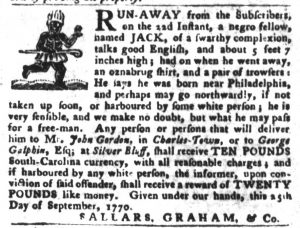
Oct 9 1770 - Essex Gazette Slavery 1
Essex Gazette (October 9, 1770).

**********

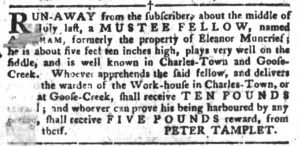
Oct 9 1770 - South-Carolina Gazette and Country Journal Slavery 1
South-Carolina Gazette and Country Journal (October 9, 1770).

**********

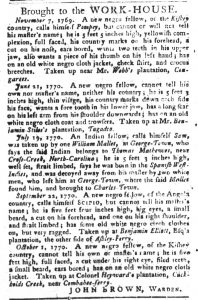
Oct 9 1770 - South-Carolina Gazette and Country Journal Slavery 2
South-Carolina Gazette and Country Journal (October 9, 1770).

**********

Oct 9 1770 - South-Carolina Gazette and Country Journal Slavery 3
South-Carolina Gazette and Country Journal (October 9, 1770).

**********

Oct 9 1770 - South-Carolina Gazette and Country Journal Slavery 4
South-Carolina Gazette and Country Journal (October 9, 1770).

**********

Oct 9 1770 - South-Carolina Gazette and Country Journal Slavery 5
South-Carolina Gazette and Country Journal (October 9, 1770).

**********

Oct 9 1770 - South-Carolina Gazette and Country Journal Slavery 6
South-Carolina Gazette and Country Journal (October 9, 1770).

**********

Oct 9 1770 - South-Carolina Gazette and Country Journal Slavery 7
South-Carolina Gazette and Country Journal (October 9, 1770).

**********

Oct 9 1770 - South-Carolina Gazette and Country Journal Slavery 8
South-Carolina Gazette and Country Journal (October 9, 1770).

**********

Oct 9 1770 - South-Carolina Gazette and Country Journal Slavery 9
South-Carolina Gazette and Country Journal (October 9, 1770).

**********

Oct 9 1770 - South-Carolina Gazette and Country Journal Slavery 10
South-Carolina Gazette and Country Journal (October 9, 1770).

**********

Oct 9 1770 - South-Carolina Gazette and Country Journal Slavery 11
South-Carolina Gazette and Country Journal (October 9, 1770).

**********

Oct 9 1770 - South-Carolina Gazette and Country Journal Slavery 12
South-Carolina Gazette and Country Journal (October 9, 1770).

**********

Supplement to the South-Carolina Gazette and Country Journal (October 9, 1770).

**********

Oct 9 1770 - South-Carolina Gazette and Country Journal Supplement Slavery 1
Supplement to the South-Carolina Gazette and Country Journal (October 9, 1770).

**********

Oct 9 1770 - South-Carolina Gazette and Country Journal Supplement Slavery 2
Supplement to the South-Carolina Gazette and Country Journal (October 9, 1770).

**********

Supplement to the South-Carolina Gazette and Country Journal (October 9, 1770).

**********

Oct 9 1770 - South-Carolina Gazette and Country Journal Supplement Slavery 3
Supplement to the South-Carolina Gazette and Country Journal (October 9, 1770).

**********

Oct 9 1770 - South-Carolina Gazette and Country Journal Supplement Slavery 4
Supplement to the South-Carolina Gazette and Country Journal (October 9, 1770).

**********

Oct 9 1770 - South-Carolina Gazette and Country Journal Supplement Slavery 5
Supplement to the South-Carolina Gazette and Country Journal (October 9, 1770).

**********

Oct 9 1770 - South-Carolina Gazette and Country Journal Supplement Slavery 6
Supplement to the South-Carolina Gazette and Country Journal (October 9, 1770).

**********

Oct 9 1770 - South-Carolina Gazette and Country Journal Supplement Slavery 7
Supplement to the South-Carolina Gazette and Country Journal (October 9, 1770).

October 8

What was advertised in a colonial American newspaper 250 years ago today?

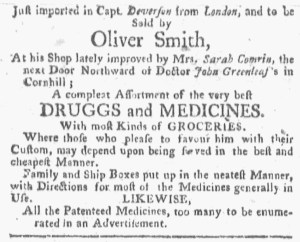
Boston-Gazette (October 8, 1770).

“All the Patenteed Medicines, too many to be enumerated in an Advertisement.”

Oliver Smith advertised a “compleat Assortment of the very best DRUGGS and MEDICINES” in the October 8, 1770, edition of the Boston-Gazette.  He sold his remedies individually, but also offered “Family and Ship Boxes” that packaged together “most of the Medicines generally in Use” along with directions for administering them.  These eighteenth-century versions of first aid kits allowed apothecaries to increase their sales by asking consumers to anticipate possible future needs for a variety of medicines rather than wait until they had a specific need for any particular medicine.  Smith and others marketed “Family and Ship Boxes” as a convenience for their customers, but they also amounted to additional revenue for the sellers.

Smith also informed readers that he carried “All the Patenteed Medicines, too many to be enumerated in an Advertisement.”  Not listing those items saved Smith both space and money.  He expected that consumers were so familiar with the array of patent medicines on the market that he did not need to name them.  This strategy also indicated confidence that he had on hand a complete inventory.  They could depend on him carrying Turlington’s Original Balsam of Life, Godfrey’s General Cordial, Walker’s Jesuit Drops, Dr. Stoughton’s Elixir, Hooper’s Pills, Greenough’s Tincture for the Teeth and Gums, Bateman’s Pectoral Drops, and a variety of other patent medicines that apothecaries, shopkeepers, and even printers frequently listed in their advertisements.  One column over from Smith’s advertisement, William Jones did indeed name all of those nostrums and others.

Much of Smith’s advertisement focused on convenience.  In addition to selling “Family and Ship Boxes” and stocking a complete inventory of patent medicines, he operated his shop at a convenient location, “the next Door Northward of Doctor John Greenleaf’s in Cornhill.”  Prospective customers who had occasion to consult with Dr. Greenleaf could then visit Smith’s apothecary shop next door to select any medicines that the doctor recommended.  Smith also noted that the shop had been “lately improved” to make it more appealing to customers.  With the various conveniences he provided, Smith sought to make it as simple as possible for prospective customers to care for their health.

Slavery Advertisements Published October 8, 1770

GUEST CURATOR:  Sean Duda

The Slavery Adverts 250 Project chronicles the role of newspaper advertising in perpetuating slavery in the era of the American Revolution. The project seeks to reveal the ubiquity of slavery in eighteenth-century life from New England to Georgia by republishing advertisements for slaves – for sale, wanted to purchase, runaways, captured fugitives – in daily digests on this site as well as in real time via the @SlaveAdverts250 Twitter feed, utilizing twenty-first-century media to stand in for the print media of the eighteenth century.

The project aims to provide modern audiences with a sense of just how often colonists encountered these advertisements in their daily lives. Enslaved men, women, and children appeared in print somewhere in the colonies almost every single day. Those advertisements served as a constant backdrop for social, cultural, economic, and political life in colonial and revolutionary America. Colonists who did not own slaves were still confronted with slavery as well as invited to maintain the system by purchasing slaves or assisting in the capture of runaways. The frequency of these newspaper advertisements suggests just how embedded slavery was in colonial and revolutionary American culture in everyday interactions beyond the printed page.

These advertisements also testify to the experiences of enslaved men, women, and children, though readers must consider that those experiences have been remediated through descriptions offered by slaveholders rather than the slaves themselves. Often unnamed in the advertisements, enslaved men, women, and children were not invisible or unimportant in early America.

These advertisements appeared in colonial American newspapers 250 years ago today.

Oct 8 1770 - Boston Evening-Post Slavery 1
Boston Evening-Post (October 8, 1770).

**********

Oct 8 1770 - Boston-Gazette Slavery 1
Boston-Gazette (October 8, 1770).

**********

Oct 8 1770 - Boston-Gazette Slavery 2
Boston-Gazette (October 8, 1770).

**********

Oct 8 1770 - Boston-Gazette Slavery 3
Boston-Gazette (October 8, 1770).

**********

Oct 8 1770 - Massachusetts Gazette and Boston Post-Boy Slavery 1
Massachusetts Gazette and Boston Post-Boy (October 8, 1770).

**********

Oct 8 1770 - Massachusetts Gazette and Boston Post-Boy Slavery 2
Massachusetts Gazette and Boston Post-Boy (October 8, 1770).

**********

Oct 8 1770 - Massachusetts Gazette and Boston Post-Boy Slavery 3
Massachusetts Gazette and Boston Post-Boy (October 8, 1770).

**********

Oct 8 1770 - New-York Gazette and Weekly Mercury Slavery 1
New-York Gazette and Weekly Mercury (October 8, 1770).

**********

Oct 8 1770 - New-York Gazette and Weekly Mercury Slavery 2
New-York Gazette and Weekly Mercury (October 8, 1770).

**********

Oct 8 1770 - New-York Gazette and Weekly Mercury Slavery 3
New-York Gazette and Weekly Mercury (October 8, 1770).

**********

Oct 8 1770 - New-York Gazette and Weekly Mercury Supplement Slavery 3
Supplement to the New-York Gazette and Weekly Mercury (October 8, 1770).

**********

Oct 8 1770 - New-York Gazette and Weekly Mercury Supplement Slavery 1
Supplement to the New-York Gazette and Weekly Mercury (October 8, 1770).

**********

Oct 8 1770 - New-York Gazette and Weekly Mercury Supplement Slavery 2
Supplement to the New-York Gazette and Weekly Mercury (October 8, 1770).

**********

Oct 8 1770 - Newport Mercury Slavery 1
Newport Mercury (October 8, 1770).

**********

Oct 8 1770 - Newport Mercury Slavery 2
Newport Mercury (October 8, 1770).

**********

Oct 8 1770 - Pennsylvania Chronicle Slavery 1
Pennsylvania Chronicle (October 8, 1770).

October 7

What was advertised in a colonial America newspaper 250 years ago this week?

New-York Journal (October 4, 1770).

“There is no other Art so various perhaps and universal in its Influence, as Music.”

D. Propert and W. C. Hulett took very different approaches to promoting music lessons in the October 4, 1770, edition of the New-York Journal. Hulett, who described himself as a “DANCING-MASTER,” advertised both his “public DANCING SCHOOL” and lessons for several instruments. Like many other dancing masters, he also provided fencing lessons for gentlemen.  Most of his advertisement focused on his work as a dancing master, but he did begin and end with information about music lessons.  The headline proclaimed, “The GUITTAR, TAUGHT By W. C. HULETT, DANCING-MASTER.”  In the final paragraph, he informed prospective pupils that also gave lessons for the violin and flute as well as the small sword.  Overall, Hulett’s notice resembled most advertisements for music lessons that appeared in American newspapers in the era of the American Revolution.

Propert, on the other hand, placed a very different advertisement, starting with the headline that introduced him to prospective students as “D. PROPERT, Professor of MUSIC.”  Nearly four times the length of Hulett’s notice, this advertisement included a short essay on how music benefited “Body and Mind” for those who heard it and those who performed it.  “Music,” Propert declared, “has ever been held in the highest Esteem, by the most exalted Characters, and finest Geniuses of almost every Age and Nation.”  Music had a sublime impact; it was “capable of raising the Soul into Dispositions for the most pleasing, useful and noble purposes.”  Propert extolled the influence of music in worship services, on the battlefield, and at funerals, banquets, and balls.  Music enhanced any activity “for it has Expression for all the various Passions and Emotions of the Heart and Soul.”  Making his pitch to those who considered themselves genteel or aspired to the ranks of gentility, Propert concluded his homily on music with an assertion that “this Art has obtained the Patronage, Regard and Praises of the greatest Personages” throughout recorded history.  He instructed prospective pupils that music “hath been the Delight and Study of every polished and ingenious National in all Climates and in all Ages.”

Propert’s advertisement and Hulett’s advertisement happened to appear one after the other, Propert’s first in the October 4 edition and Hulett’s first in the next issue on October 11.  Appearing alongside a competitor may have worked to Hulett’s benefit since Propert made a case for the virtues of learning to play an instrument that applied to Hulett’s lessons as well as his own.  According to the advertising rates in the colophon, Propert paid four times as much to run his advertisement.  Not only did the printer collect those revenues, Hulett accrued benefits as well in his quest for students for this “most pleasing of the liberal Arts.”  Propert’s innovation in marketing may have worked to the advantage of all music instructors in New York.

October 6

What was advertised in a colonial American newspaper 250 years ago today?

Providence Gazette (October 6, 1770).

“The regular and speedy Delivery of their Papers.”

In the 1770s, the Providence Gazette served as the local newspaper for many readers in the northeastern region of Connecticut as well as northern Rhode Island.  An advertisement that ran in the October 6, 1770, edition outlined the route that Joseph Rickard, a former postrider, took from Providence to several towns in Connecticut.  Joseph Jewet and Elijah Nichols intended to assume Rickard’s responsibilities, informing the public, “particularly the Customers to the PROVIDENCE GAZETTE,” that they now carried letters and newspapers to Killingly, Pomfret, Woodstock, and Ashford.

In their attempt to build their clientele, Jewet and Nichols offered improvements over the service that Rickard provided.  They pledged the “greatest Attention will be paid to the regular and speedy Delivery of the Papers” in order that “Customers may receive them earlier than usual.”  The masthead of the Providence Gazette proclaimed that it contained “the freshest ADVICES, Foreign and Domestic.”  That “speedy Delivery” enhanced the careful selection of contents and the speed that the printer took news to press, putting “the freshest Intelligence” in the hands of subscribers and other readers in northeastern Connecticut.  Jewet and Nichols also indicated that they would “extend their weekly Ride to other Towns” if they encountered sufficient demand.

John Carter, the printer of the Providence Gazette, gave Jewet and Nichols’s advertisement a privileged place.  It was the first advertisement that appeared in the October 6 edition, running immediately below the list of prices current in Providence.  Readers more interested in news than advertising were more likely to peruse Jewet and Nichols’s notice as a result of where the printer chose to place it on the page.  Carter had his own interest in the success of the postriders’ endeavor.  Reliable and speedy delivery to northeastern Connecticut meant that he could maintain and possibly even expand the number of subscribers in that region.  Success for Jewet and Nichols meant better prospects for Carter and the Providence Gazette.

Slavery Advertisements Published October 6, 1770

GUEST CURATOR:  Sean Duda

The Slavery Adverts 250 Project chronicles the role of newspaper advertising in perpetuating slavery in the era of the American Revolution. The project seeks to reveal the ubiquity of slavery in eighteenth-century life from New England to Georgia by republishing advertisements for slaves – for sale, wanted to purchase, runaways, captured fugitives – in daily digests on this site as well as in real time via the @SlaveAdverts250 Twitter feed, utilizing twenty-first-century media to stand in for the print media of the eighteenth century.

The project aims to provide modern audiences with a sense of just how often colonists encountered these advertisements in their daily lives. Enslaved men, women, and children appeared in print somewhere in the colonies almost every single day. Those advertisements served as a constant backdrop for social, cultural, economic, and political life in colonial and revolutionary America. Colonists who did not own slaves were still confronted with slavery as well as invited to maintain the system by purchasing slaves or assisting in the capture of runaways. The frequency of these newspaper advertisements suggests just how embedded slavery was in colonial and revolutionary American culture in everyday interactions beyond the printed page.

These advertisements also testify to the experiences of enslaved men, women, and children, though readers must consider that those experiences have been remediated through descriptions offered by slaveholders rather than the slaves themselves. Often unnamed in the advertisements, enslaved men, women, and children were not invisible or unimportant in early America.

These advertisements appeared in colonial American newspapers 250 years ago today.

Providence Gazette (October 6, 1770).

**********

Oct 6 1770 - Providence Gazette Slavery 1
Providence Gazette (October 6, 1770).

**********

Oct 6 1770 - Providence Gazette Slavery 2
Providence Gazette (October 6, 1770).

October 5

What was advertised in a colonial American newspaper 250 years ago today?

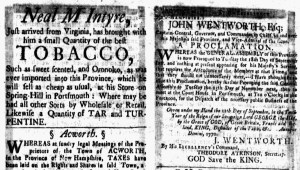
New-Hampshire Gazette (October 5, 1770)

“[illegible due to ink bleeding through from other side of sheet]”

Like many other eighteenth century newspapers, the masthead for the New-Hampshire Gazette proclaimed that it “CONTAIN[ED] the Freshest ADVICES, FOREIGN AND DOMESTIC.”  In other words, it carried current news from the colonies and abroad.  Those “ADVICES,” however, were not confined to the news articles and editorials; advertisements also delivered news to readers, sometimes about commerce and consumption, sometimes about politics, and sometimes about current events.  Advertisements relayed an array of valuable information to readers, supplementing contents that appeared elsewhere in the newspapers.

Advertisements sometimes provided additional information about articles that ran in the same issue, but in the case of some advertisements in the October 5, 1770, edition of the New-Hampshire Gazette the news bled through, literally, in a very different way.  George Whitefield, one of the most influential ministers associated with the religious revivals known as the Great Awakening, died on September 30.  The October 5 edition, the first published following Whitefield’s death, included a lengthy notice on the third page.  As was the custom in eighteenth-century newspapers, thick black borders denoting mourning enclosed the news, honoring Whitefield and attracting the attention of readers.

So thick were those borders and so firm the impression of the hand-operated printing press that ink bled through from the news item on the third page to the advertisements on the fourth page.  Among them, Neal McIntyre’s advertisement for tobacco from Virginia featured a faint unintended border.  The first lines of a notice that “the GENERAL ASSEMBLY of this Province is now Prorogued” were partially obscured by ink from the other side of the page.  Even when readers moved past the most significant news article of the October 5 issue, word of Whitefield’s death continued to reverberate in other items as the result of the printing technologies of the time.  In any newspaper, news and advertising were not delivered separately from each other.  In this particular instance, news left a very visible mark on several advertisements.

Slavery Advertisements Published October 5, 1770

GUEST CURATOR:  Sean Duda

The Slavery Adverts 250 Project chronicles the role of newspaper advertising in perpetuating slavery in the era of the American Revolution. The project seeks to reveal the ubiquity of slavery in eighteenth-century life from New England to Georgia by republishing advertisements for slaves – for sale, wanted to purchase, runaways, captured fugitives – in daily digests on this site as well as in real time via the @SlaveAdverts250 Twitter feed, utilizing twenty-first-century media to stand in for the print media of the eighteenth century.

The project aims to provide modern audiences with a sense of just how often colonists encountered these advertisements in their daily lives. Enslaved men, women, and children appeared in print somewhere in the colonies almost every single day. Those advertisements served as a constant backdrop for social, cultural, economic, and political life in colonial and revolutionary America. Colonists who did not own slaves were still confronted with slavery as well as invited to maintain the system by purchasing slaves or assisting in the capture of runaways. The frequency of these newspaper advertisements suggests just how embedded slavery was in colonial and revolutionary American culture in everyday interactions beyond the printed page.

These advertisements also testify to the experiences of enslaved men, women, and children, though readers must consider that those experiences have been remediated through descriptions offered by slaveholders rather than the slaves themselves. Often unnamed in the advertisements, enslaved men, women, and children were not invisible or unimportant in early America.

These advertisements appeared in colonial American newspapers 250 years ago today.

Oct 5 1770 - New-London Gazette Slavery 1
New-London Gazette (October 5, 1770).