October 4

What was advertised in a colonial American newspaper 250 years ago today?

New-York Journal (October 4, 1770).

“They render the skin delicately white and soft.”

Amid advertisements for textiles and housewares. James Thompson marketed cosmetics in the New-York Journal in September and October 1770.  He informed readers that he had recently acquired a “Parcel of the Queen’s pearl wash balls” that would “render the skin delicately white and soft.”  For only three shillings, consumers could use this balm for “removing sun burning, freckles, roughness of the skin, and pimples.”  Thompson also presented this product as a restorative for their skin after contracting smallpox, recommending that they dissolve the “Queen’s pearl wash balls” in milk for maximum effectiveness.  Upon applying the mixture to the face, neck, arms, and hands, they would discover that it “heals the skin, takes off the redness, and prevents it from being pitted or marked.”  Thompson also declared that the product was “well known and esteemed by the nobility and gentry in Europe, particularly in England and France.”  He encouraged consumers to associate celebrities and cosmetics in the eighteenth century, anticipating the famous spokespeople, predominantly women, who would promote cosmetic lines and brands in the twentieth and twenty-first centuries.

Thompson also stocked “La Cieur’s celebrated ointment for thickening and preserving the hair.”  He received his inventory “from the original warehouse.”  This ointment both “prevents the hair from falling off” and “when rubbed on bald places, with certainty promotes its growth.  In marketing the “Queen’s pearl wash balls” and “La Cieur’s celebrated ointment,” Thompson encouraged colonists to experience anxiety about their appearance and make purchases to alleviate them.  Richard Norris, a staymaker, adopted a similar strategy in his advertisements that ran for months in the New-York Journal.  He addressed “Ladies uneasy in their shapes,” especially “young ladies and growing misses.”  Thompson did not target female consumers exclusively, though women may have been his primary audience.  Norris, on the other hand, specifically sought to stoke anxiety among female consumers and promised them relief from their apprehensions about their appearance.  Such trends continue today, with marketers playing on the apprehensions of all consumers but targeting women much more intensively when it comes to cosmetics and other products intended to enhance their appearance and “correct” any shortcomings.
Slavery Advertisements Published October 4, 1770

GUEST CURATOR:  Sean Duda

The Slavery Adverts 250 Project chronicles the role of newspaper advertising in perpetuating slavery in the era of the American Revolution. The project seeks to reveal the ubiquity of slavery in eighteenth-century life from New England to Georgia by republishing advertisements for slaves – for sale, wanted to purchase, runaways, captured fugitives – in daily digests on this site as well as in real time via the @SlaveAdverts250 Twitter feed, utilizing twenty-first-century media to stand in for the print media of the eighteenth century.

The project aims to provide modern audiences with a sense of just how often colonists encountered these advertisements in their daily lives. Enslaved men, women, and children appeared in print somewhere in the colonies almost every single day. Those advertisements served as a constant backdrop for social, cultural, economic, and political life in colonial and revolutionary America. Colonists who did not own slaves were still confronted with slavery as well as invited to maintain the system by purchasing slaves or assisting in the capture of runaways. The frequency of these newspaper advertisements suggests just how embedded slavery was in colonial and revolutionary American culture in everyday interactions beyond the printed page.

These advertisements also testify to the experiences of enslaved men, women, and children, though readers must consider that those experiences have been remediated through descriptions offered by slaveholders rather than the slaves themselves. Often unnamed in the advertisements, enslaved men, women, and children were not invisible or unimportant in early America.

These advertisements appeared in colonial American newspapers 250 years ago today.

Oct 4 1770 - Maryland Gazette Slavery 1
Maryland Gazette (October 4, 1770).

**********

Oct 4 1770 - Maryland Gazette Slavery 2
Maryland Gazette (October 4, 1770).

**********

Oct 4 1770 - Massachusetts Gazette and Boston Weekly News-Letter Slavery 1
Massachusetts Gazette and Boston Weekly Mercury (October 4, 1770).

**********

Oct 4 1770 - Massachusetts Gazette and Boston Weekly News-Letter Slavery 2
Massachusetts Gazette and Boston Weekly Mercury (October 4, 1770).

**********

Oct 4 1770 - Massachusetts Gazette and Boston Weekly News-Letter Slavery 3
Massachusetts Gazette and Boston Weekly Mercury (October 4, 1770).

**********

Oct 4 1770 - Massachusetts Gazette and Boston Weekly News-Letter Slavery 4
Massachusetts Gazette and Boston Weekly Mercury (October 4, 1770).

**********

Oct 4 1770 - New-York Journal Slavery 1
New-York Journal (October 4, 1770).

**********

Oct 4 1770 - New-York Journal Slavery 2
New-York Journal (October 4, 1770).

**********

Oct 4 1770 - New-York Journal Slavery 3
New-York Journal (October 4, 1770).

**********

Oct 4 1770 - Pennsylvania Gazette Slavery 1
Pennsylvania Gazette (October 4, 1770).

**********

Oct 4 1770 - Pennsylvania Gazette Slavery 2
Pennsylvania Gazette (October 4, 1770).

**********

Oct 4 1770 - South-Carolina Gazette Slavery 1
South-Carolina Gazette (October 4, 1770).

**********

Oct 4 1770 - South-Carolina Gazette Slavery 2
South-Carolina Gazette (October 4, 1770).

**********

Oct 4 1770 - South-Carolina Gazette Slavery 3
South-Carolina Gazette (October 4, 1770).

**********

Oct 4 1770 - South-Carolina Gazette Slavery 4
South-Carolina Gazette (October 4, 1770).

**********

Oct 4 1770 - South-Carolina Gazette Slavery 5
South-Carolina Gazette (October 4, 1770).

**********

Oct 4 1770 - South-Carolina Gazette Slavery 6
South-Carolina Gazette (October 4, 1770).

**********

Oct 4 1770 - South-Carolina Gazette Slavery 7
South-Carolina Gazette (October 4, 1770).

**********

Oct 4 1770 - South-Carolina Gazette Slavery 8
South-Carolina Gazette (October 4, 1770).

**********

Oct 4 1770 - Virginia Gazette Purdie & Dixon Slavery 1
Virginia Gazette [Purdie and Dixon] (October 4, 1770).

**********

Oct 4 1770 - Virginia Gazette Purdie & Dixon Slavery 2
Virginia Gazette [Purdie and Dixon] (October 4, 1770).

**********

Oct 4 1770 - Virginia Gazette Purdie & Dixon Slavery 3
Virginia Gazette [Purdie and Dixon] (October 4, 1770).

**********

Oct 4 1770 - Virginia Gazette Purdie & Dixon Slavery 4
Virginia Gazette [Purdie and Dixon] (October 4, 1770).

**********

Oct 4 1770 - Virginia Gazette Purdie & Dixon Slavery 5
Virginia Gazette [Purdie and Dixon] (October 4, 1770).

**********

Oct 4 1770 - Virginia Gazette Purdie & Dixon Slavery 6
Virginia Gazette [Purdie and Dixon] (October 4, 1770).

**********

Oct 4 1770 - Virginia Gazette Rind Slavery 1
Virginia Gazette [Rind] (October 4, 1770).

**********

Oct 4 1770 - Virginia Gazette Rind Slavery 2
Virginia Gazette [Rind] (October 4, 1770).

**********

Oct 4 1770 - Virginia Gazette Rind Slavery 3
Virginia Gazette [Rind] (October 4, 1770).

**********

Oct 4 1770 - Virginia Gazette Rind Slavery 4
Virginia Gazette [Rind] (October 4, 1770).

**********

Oct 4 1770 - Virginia Gazette Rind Slavery 5
Virginia Gazette [Rind] (October 4, 1770).

Welcome Back, Guest Curator Sean Duda

Sean Duda is a senior at Assumption University in Worcester, Massachusetts.  He is majoring in History with a minor in Music. Sean is from Trumbull, Connecticut. He is a member of several organizations on campus, including Music Ministry, Jazz Band, Charismatic Praise, and Advocates for Life. He enjoys learning how to play new instruments and learning about Europe in the Middle Ages and the World Wars. He has previously served as guest curator for the Adverts 250 Project and the Slavery Adverts 250 Project when he enrolled in HIS 359 – Revolutionary America in Spring 2019. He conducted the research for his current contributions as guest curator for the Slavery Adverts 250 Project when he was enrolled in HIS 400 – Research Methods: Vast Early America in Spring 2020.

Welcome, guest curator Sean Duda.

October 3

What was advertised in a colonial American newspaper 250 years ago today?

South-Carolina and American General Gazette (October 3, 1770).

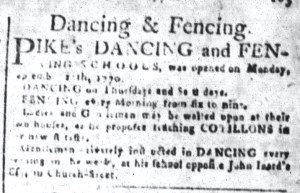
“He proposes teaching COTILLONS in the newest taste.”

The South Carolina Newspapers collection available via Accessible Archives is an invaluable resource for producing the Adverts 250 Project and the Slavery Adverts 250 Project.  The collection includes digitized images of three newspapers published in Charleston in 1770, the South-Carolina Gazette, the South-Carolina Gazette and Country Journal, and the South-Carolina and American General Gazette.

Transcriptions of the newspapers accompany the images.  In many cases, those transcriptions make it easier to decipher the contents of advertisements and other items that appear illegible for a variety or reasons.  Perhaps the original printing did not produce a clear impression in 1770 or the document suffered damage over time or poor photography resulted in a remediation that does not accurately the original.  Sometimes more than one of these factors influence the quality of digital surrogates.

Transcriptions, whether undertaken by people or technology, must be consulted with care.  Consider an advertisement for “PIKE’s DANCING and FENCING SCHOOLS” that ran in the October 3, 1770, edition of the South-Carolina and American General Gazette.  The digital image is not easily legible, though an experienced research familiar with the language and contents of eighteenth-century newspaper advertisements can piece together the contents.  The transcription, on the other hand, leaves out words, such as “Ladies” in the phrase “Ladies and Gentlemen,” and does not accurately reproduce others, such as “he proposes trashing COTILLONSisa new first” for “he proposes teaching COTILLONS in the newest taste.”

Flawed Transcription of Pike’s Advertisement

While this is obviously an error in the transcription, the interface created by Accessible Archives does correct an error that the compositor made when setting the type for the issue that contained Pike’s advertisement.  That issue consisted of six pages, four pages created by printing two on each side of a broadsheet and folding it in half and two additional pages of advertising printed on either side of a smaller sheet.  That supplement has the wrong date at the top, “Sept. 24 – Oct. 2” instead of “Sept. 24 – Oct. 3” at the top of the pages for the rest of the issue.  The page numbers for the supplement, 183 and 184, run continuously with the pages printed on the larger sheet.  The date 1770 appears in the title (an abbreviated masthead): “THE SOUTH-CAROLINA AND AMERICAN GENERAL GAZETTE, for 1770.”  Dates in some of the advertisements also make it clear that the supplement was printed in 1770.

Yet manuscript additions indicate that at some time the supplement was separated from the rest of the issue.  The first page includes a notation, either incomplete or partially illegible, that states, “Sup in 177[x],” with a missing digit at the end of the year.  Similarly, the supplement has a notation, not entirely legible, that declares it “does not belong in this [state].”  Most likely the “Oct. 2” error resulted in the supplement being cataloged or even bound with another issue of the South-Carolina and American General Gazette from another year, but an archivist noted the other discrepancies and context clues.  In the end, Accessible Archives arranged the digital images of all six pages of the issue together and in the correct order, despite an error made by the compositor in 1770.

South-Carolina and American General Gazette (October 3, 1770).

Human error and technological error sometimes creep into sources at every stage of their production, preservation, and remediation.  Such errors introduce miniature mysteries that can be entertaining to solve, but they also challenge researchers to constantly assess their sources to recognize any features that seem out of place or inconsistent with what they know about the period they are investigating or the subsequent collection and treatment of primary sources that make them accessible.

Slavery Advertisements Published October 3, 1770

GUEST CURATOR:  Luke DiCicco

The Slavery Adverts 250 Project chronicles the role of newspaper advertising in perpetuating slavery in the era of the American Revolution. The project seeks to reveal the ubiquity of slavery in eighteenth-century life from New England to Georgia by republishing advertisements for slaves – for sale, wanted to purchase, runaways, captured fugitives – in daily digests on this site as well as in real time via the @SlaveAdverts250 Twitter feed, utilizing twenty-first-century media to stand in for the print media of the eighteenth century.

The project aims to provide modern audiences with a sense of just how often colonists encountered these advertisements in their daily lives. Enslaved men, women, and children appeared in print somewhere in the colonies almost every single day. Those advertisements served as a constant backdrop for social, cultural, economic, and political life in colonial and revolutionary America. Colonists who did not own slaves were still confronted with slavery as well as invited to maintain the system by purchasing slaves or assisting in the capture of runaways. The frequency of these newspaper advertisements suggests just how embedded slavery was in colonial and revolutionary American culture in everyday interactions beyond the printed page.

These advertisements also testify to the experiences of enslaved men, women, and children, though readers must consider that those experiences have been remediated through descriptions offered by slaveholders rather than the slaves themselves. Often unnamed in the advertisements, enslaved men, women, and children were not invisible or unimportant in early America.

These advertisements appeared in colonial American newspapers 250 years ago today.

Oct 3 1770 - South-Carolina and American General Gazette Slavery 1
South-Carolina and American General Gazette (October 3, 1770).

**********

Oct 3 1770 - South-Carolina and American General Gazette Slavery 2
South-Carolina and American General Gazette (October 3, 1770).

**********

Oct 3 1770 - South-Carolina and American General Gazette Slavery 3
South-Carolina and American General Gazette (October 3, 1770).

**********

Oct 3 1770 - South-Carolina and American General Gazette Slavery 4
South-Carolina and American General Gazette (October 3, 1770).

**********

Oct 3 1770 - South-Carolina and American General Gazette Slavery 5
South-Carolina and American General Gazette (October 3, 1770).

October 2

Who were the subjects of advertisements in a colonial American newspaper 250 years ago today?

Essex Gazette (October 2, 1770).

“Ranaway … a Negro Man, named Jack.”

“Elizabeth, my Wife, hath left my Bed and Board.”

Interspersed among the advertisements for consumer goods and services that ran in the October 2, 1770, edition of the Essex Gazette, another kind of advertisement documented disruptions to the social order.  Two versions of “runaway” notices appeared in that issue, one concerning an enslaved man who liberated himself and the other concerning a woman who left her husband.  In both instances, the advertisers attempted to use the power of the press to assert their authority and return to good order (as they understood it).

Joseph Homan reported that “a Negro Man, named Jack” made his escape from bondage sometime during the night of September 17.  He offered a reward to readers and other members of the community who captured and returned Jack.  To help others recognize the fugitive, Homan noted that Jack was “near 50 Years of Age” and “speaks bad English.”  He also provided descriptions of the clothes Jack wore when he departed, but also noted that he may have changed.  Given the uncertainty of what Jack might have been wearing, any Black man over the age of forty became a suspect worthy of scrutiny and surveillance.

James Messer stated that his wife, Elizabeth, “hath left my Bed and Board.”  He feared that “she may run me in Debt,” so placed his advertisement as a warning for others “not to trust her on my Account.”  He resolutely declared that he would “not pay one Farthing of Debt that she shall contract.”  All in all, Messer’s advertisement followed a standard format for such notices.

Jack the formerly enslaved man and Elizabeth the absent wife certainly had different experiences and endured different challenges, yet their stories had similarities as well.  Neither of them inhabited a position of authority, yet they exercised power when they chose to depart.  Neither Jack nor Elizabeth published their own version of events in the Essex Gazette.  Instead, an enslaver and an aggrieved husband placed advertisements meant to vilify Jack and Elizabeth, providing incomplete narratives.  Neither advertiser could be taken at their word to tell the entire story, then or now.  Contrary to the purposes for which they were placed, their newspaper notices provided evidence that people who were supposed to be subordinate and submissive did not simply accept those roles.  Jack liberated himself, the abuses and hardships he had endured untold by Homan.  Elizabeth removed herself from her husband’s household, that act only hinting at greater domestic discord that motivated her to take action.  Cast as the offenders by Homan and Messer, Jack and Elizabeth demonstrated courage and conviction when they asserted their autonomy and sought to transform their lives for the better.

Slavery Advertisements Published October 2, 1770

GUEST CURATOR:  Luke DiCicco

The Slavery Adverts 250 Project chronicles the role of newspaper advertising in perpetuating slavery in the era of the American Revolution. The project seeks to reveal the ubiquity of slavery in eighteenth-century life from New England to Georgia by republishing advertisements for slaves – for sale, wanted to purchase, runaways, captured fugitives – in daily digests on this site as well as in real time via the @SlaveAdverts250 Twitter feed, utilizing twenty-first-century media to stand in for the print media of the eighteenth century.

The project aims to provide modern audiences with a sense of just how often colonists encountered these advertisements in their daily lives. Enslaved men, women, and children appeared in print somewhere in the colonies almost every single day. Those advertisements served as a constant backdrop for social, cultural, economic, and political life in colonial and revolutionary America. Colonists who did not own slaves were still confronted with slavery as well as invited to maintain the system by purchasing slaves or assisting in the capture of runaways. The frequency of these newspaper advertisements suggests just how embedded slavery was in colonial and revolutionary American culture in everyday interactions beyond the printed page.

These advertisements also testify to the experiences of enslaved men, women, and children, though readers must consider that those experiences have been remediated through descriptions offered by slaveholders rather than the slaves themselves. Often unnamed in the advertisements, enslaved men, women, and children were not invisible or unimportant in early America.

These advertisements appeared in colonial American newspapers 250 years ago today.

Oct 2 1770 - Essex Gazette Slavery 1
Essex Gazette (October 2, 1770).

**********

Oct 2 1770 - South-Carolina Gazette and Country Journal Slavery 1
South-Carolina Gazette and Country Journal (October 2, 1770).

**********

Oct 2 1770 - South-Carolina Gazette and Country Journal Slavery 2
South-Carolina Gazette and Country Journal (October 2, 1770).

**********

Oct 2 1770 - South-Carolina Gazette and Country Journal Slavery 3
South-Carolina Gazette and Country Journal (October 2, 1770).

**********

Oct 2 1770 - South-Carolina Gazette and Country Journal Slavery 4
South-Carolina Gazette and Country Journal (October 2, 1770).

**********

Oct 2 1770 - South-Carolina Gazette and Country Journal Slavery 5
South-Carolina Gazette and Country Journal (October 2, 1770).

**********

Oct 2 1770 - South-Carolina Gazette and Country Journal Slavery 6
South-Carolina Gazette and Country Journal (October 2, 1770).

**********

Oct 2 1770 - South-Carolina Gazette and Country Journal Slavery 7
South-Carolina Gazette and Country Journal (October 2, 1770).

**********

Oct 2 1770 - South-Carolina Gazette and Country Journal Slavery 8
South-Carolina Gazette and Country Journal (October 2, 1770).

**********

Oct 2 1770 - South-Carolina Gazette and Country Journal Slavery 9
South-Carolina Gazette and Country Journal (October 2, 1770).

**********

Oct 2 1770 - South-Carolina Gazette and Country Journal Slavery 10
South-Carolina Gazette and Country Journal (October 2, 1770).

October 1

What was advertised in a colonial American newspaper 250 years ago today?

Newport Mercury (October 1, 1770).

“It is hoped he will meet with the Encouragement of the Public in General, and particularly of all true Lovers of their Country.”

Like many other newspapers published in eighteenth-century America, the masthead of the Newport Mercury informed readers that it carried “the freshest Advices, both Foreign and Domestic.”  Starting with the December 18, 1769, edition, Solomon Southwick, the printer, included an additional line in the masthead: “Undaunted by TYRANTS, —– We’ll DIE or be FREE.”  Amid protests over duties on imported goods imposed by the Townshend Acts and other abuses perpetrated by both Parliament and British soldier quartered in the colonies, Southwick asserted that defending the liberty of American colonists was one of the main purposes of publishing his newspaper.

Staying informed about current events was not the only way for readers to support the American cause.  Advertisers argued that colonists could practice politics through the decisions they made as consumers.  Consider the notice that Jonathan Stoddard inserted in the October 1, 1770, edition of the Newport Mercury.  In it, he informed the public that “he has set up the NAIL-MAKING Business.”  He made all sorts of nails “of much better Quality than those imported.”  In addition to quality, he made an appeal to price, pledging to “sell as cheap as any imported Nails of the same Size can be had at any Retail Shop in Town.”

Stoddard hoped to “meet with the Encouragement of the Public in General,” but he also extended a challenge to “all true Lovers of their Country” to acquire nails from him rather than resorting to imported alternatives.  He used patriotism and politics to frame his advertisement, reminding consumers that price and quality were important but not the only factors they should take into account when shopping for nails or any other goods.  Stoddard’s advertisement appeared on the first page of the Newport Mercury, the second item in the first column.  In quick succession, readers encountered Southwick’s rallying cry that “Undaunted by TYRANTS, —– We’ll DIE or be FREE” and Stoddard’s appeal to “all true Lovers of their Country” to purchase goods produced in the colonies.  These messages likely reinforced each other as readers perused them and read more about current events throughout the rest of the newspaper.

Newport Mercury (October 1, 1770).

Slavery Advertisements Published October 1, 1770

GUEST CURATOR:  Luke DiCicco

The Slavery Adverts 250 Project chronicles the role of newspaper advertising in perpetuating slavery in the era of the American Revolution. The project seeks to reveal the ubiquity of slavery in eighteenth-century life from New England to Georgia by republishing advertisements for slaves – for sale, wanted to purchase, runaways, captured fugitives – in daily digests on this site as well as in real time via the @SlaveAdverts250 Twitter feed, utilizing twenty-first-century media to stand in for the print media of the eighteenth century.

The project aims to provide modern audiences with a sense of just how often colonists encountered these advertisements in their daily lives. Enslaved men, women, and children appeared in print somewhere in the colonies almost every single day. Those advertisements served as a constant backdrop for social, cultural, economic, and political life in colonial and revolutionary America. Colonists who did not own slaves were still confronted with slavery as well as invited to maintain the system by purchasing slaves or assisting in the capture of runaways. The frequency of these newspaper advertisements suggests just how embedded slavery was in colonial and revolutionary American culture in everyday interactions beyond the printed page.

These advertisements also testify to the experiences of enslaved men, women, and children, though readers must consider that those experiences have been remediated through descriptions offered by slaveholders rather than the slaves themselves. Often unnamed in the advertisements, enslaved men, women, and children were not invisible or unimportant in early America.

These advertisements appeared in colonial American newspapers 250 years ago today.

Oct 1 1770 - Boston Evening-Post Slavery 1
Boston Evening-Post (October 1, 1770).

**********

Oct 1 1770 - Boston Evening-Post Slavery 2
Boston Evening-Post (October 1, 1770).

**********

Oct 1 1770 - Boston-Gazette Slavery 1
Boston-Gazette (October 1, 1770).

**********

Oct 1 1770 - Boston-Gazette Slavery 2
Boston-Gazette (October 1, 1770).

**********

Oct 1 1770 - Boston-Gazette Slavery 3
Boston-Gazette (October 1, 1770).

**********

Oct 1 1770 - Boston-Gazette Slavery 4
Boston-Gazette (October 1, 1770).

**********

Oct 1 1770 - Massachusetts Gazette and Boston Post-Boy Slavery 1
Massachusetts Gazette and Boston Post-Boy (October 1, 1770).

**********

Oct 1 1770 - New-York Gazette and Weekly Mercury Slavery 1
New-York Gazette and Weekly Mercury (October 1, 1770).

**********

Oct 1 1770 - New-York Gazette and Weekly Mercury Slavery 2
New-York Gazette and Weekly Mercury (October 1, 1770).

**********

Oct 1 1770 - New-York Gazette and Weekly Mercury Slavery 3
New-York Gazette and Weekly Mercury (October 1, 1770).

**********

Oct 1 1770 - New-York Gazette and Weekly Mercury Slavery 4
New-York Gazette and Weekly Mercury (October 1, 1770).

**********

Oct 1 1770 - New-York Gazette and Weekly Mercury Slavery 5
New-York Gazette and Weekly Mercury (October 1, 1770).

**********

New-York Gazette and Weekly Mercury (October 1, 1770).