December 11

What was advertised in a colonial American newspaper 250 years ago today?

Connecticut Courant (December 11, 1770).

“They have been at the expence of bringing workmen from Philadelphia.”

Herman Allen and Levi Allen embarked on a new venture in December 1770.  The Allens ran a store in Salisbury, Connecticut, where they sold a “LARGE and general assortment of European, East, & West India Goods.”  Their notice, along with others for shops in Hartford and other towns in Connecticut that ran in the Connecticut Courant, demonstrated that the consumer revolution extended beyond the major port cities and into the countryside.

The Allens’ new venture also demonstrated that retailers and, likely, customers looked to larger cities for cues about consumption practices while also remaining mindful of local economies.  In addition to the “general assortment” of merchandise available at their store, the Allens also informed consumers that “they have been to the expence of bringing workmen from Philadelphia, for dressing Leather, and making Breeches and Gloves in the neatest Philadelphia fashion.”  They assumed that prospective customers in small towns were familiar with the manner of making breeches and gloves in the largest city in the colonies as well as the appearance of the finished products.  Furthermore, the Allens expected that their customers desired breeches and gloves that resembled those made in Philadelphia.  Even if prospective customers did not, the Allens suggested that they should.

The Allens also declared that their customers could gain access to the fashions of urban ports while still supporting the local economy.  Since the Allens brought the workmen to Connecticut to make breeches and gloves, “the public may be supply’d without sending the money out of this colony.”  Furthermore, customers did not have to pay a premium for that privilege.  Instead, the Allens set prices “as cheap as in New York or Albany or elsewhere.”  In terms of payment, they accepted cash and “all sorts of country produce” and extended “the usual credit.”

Colonists did not need to reside in urban ports where newspapers overflowed with advertisements for consumer goods in order to experience the pleasures of shopping and showing off the clothing and other possessions they acquired.  From stocking an assortment of goods to bringing workmen to the town of Salisbury to make breeches and gloves “in the neatest Philadelphia fashion” to low prices and credit, the Allens sought to make it easy and convenient for residents of Salisbury and other small towns in Connecticut to participate in the consumer revolution.

Slavery Advertisements Published December 11, 1770

GUEST CURATOR:  Noah Veilleux

The Slavery Adverts 250 Project chronicles the role of newspaper advertising in perpetuating slavery in the era of the American Revolution. The project seeks to reveal the ubiquity of slavery in eighteenth-century life from New England to Georgia by republishing advertisements about enslaved people – for sale as individuals or in groups, wanted to purchase or for hire for short periods, runaways who liberated themselves, and those who were subsequently captured and confined in jails and workhouses – in daily digests on this site as well as in real time via the @SlaveAdverts250 Twitter feed, utilizing twenty-first-century media to stand in for the print media of the eighteenth century.

The project aims to provide modern audiences with a sense of just how often colonists encountered these advertisements in their daily lives. Enslaved men, women, and children appeared in print somewhere in the colonies almost every single day. Those advertisements served as a constant backdrop for social, cultural, economic, and political life in colonial and revolutionary America. Colonists who did not purport to own enslaved people were still confronted with slavery as well as invited to maintain the system by purchasing enslaved men, women, and children or assisting in the capture of so-called “runaways” who sought to free themselves from bondage. The frequency of these newspaper advertisements suggests just how embedded slavery was in colonial and revolutionary American culture in everyday interactions beyond the printed page.

These advertisements also testify to the experiences of enslaved men, women, and children, though readers must consider that those experiences have been remediated through descriptions offered by enslavers rather than enslaved people themselves. Often unnamed in the advertisements, enslaved men, women, and children were not invisible or unimportant in early America.

These advertisements appeared in colonial American newspapers 250 years ago today.

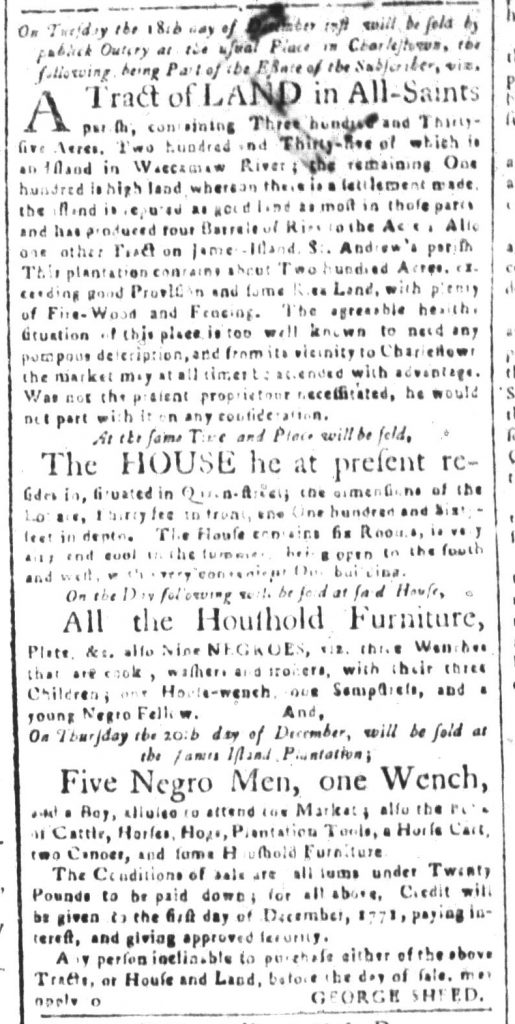
Dec 11 1770 - South-Carolina and American General Gazette Slavery 1
South-Carolina and American General Gazette (December 11, 1770).

**********

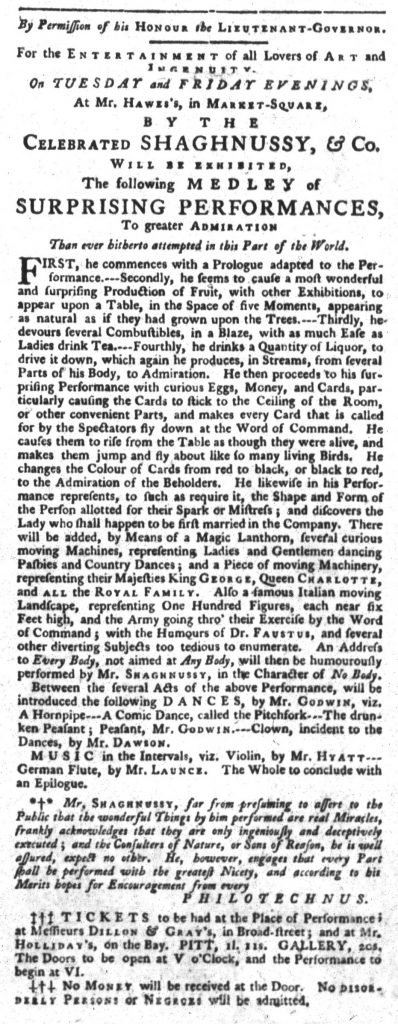
Dec 11 1770 - South-Carolina and American General Gazette Slavery 2
South-Carolina and American General Gazette (December 11, 1770).

**********

Dec 11 1770 - South-Carolina and American General Gazette Slavery 3
South-Carolina and American General Gazette (December 11, 1770).

**********

Dec 11 1770 - South-Carolina and American General Gazette Slavery 4
South-Carolina and American General Gazette (December 11, 1770).

**********

Dec 11 1770 - South-Carolina and American General Gazette Slavery 5
South-Carolina and American General Gazette (December 11, 1770).

**********

Dec 11 1770 - South-Carolina and American General Gazette Slavery 6
South-Carolina and American General Gazette (December 11, 1770).

**********

Dec 11 1770 - South-Carolina and American General Gazette Slavery 7
South-Carolina and American General Gazette (December 11, 1770).

**********

Dec 11 1770 - South-Carolina and American General Gazette Slavery 8
South-Carolina and American General Gazette (December 11, 1770).

**********

Dec 11 1770 - South-Carolina Gazette and Country Journal Slavery 1
South-Carolina Gazette and Country Journal (December 11, 1770).

**********

Dec 11 1770 - South-Carolina Gazette and Country Journal Slavery 2
South-Carolina Gazette and Country Journal (December 11, 1770).

**********

Dec 11 1770 - South-Carolina Gazette and Country Journal Slavery 3
South-Carolina Gazette and Country Journal (December 11, 1770).

**********

Dec 11 1770 - South-Carolina Gazette and Country Journal Slavery 4
South-Carolina Gazette and Country Journal (December 11, 1770).

**********

Dec 11 1770 - South-Carolina Gazette and Country Journal Slavery 5
South-Carolina Gazette and Country Journal (December 11, 1770).

**********

Dec 11 1770 - South-Carolina Gazette and Country Journal Slavery 6
South-Carolina Gazette and Country Journal (December 11, 1770).

**********

Dec 11 1770 - South-Carolina Gazette and Country Journal Slavery 7
South-Carolina Gazette and Country Journal (December 11, 1770).

**********

South-Carolina Gazette and Country Journal (December 11, 1770).

**********

Dec 11 1770 - South-Carolina Gazette and Country Journal Slavery 8
South-Carolina Gazette and Country Journal (December 11, 1770).

**********

Dec 11 1770 - South-Carolina Gazette and Country Journal Slavery 9
South-Carolina Gazette and Country Journal (December 11, 1770).

**********

Dec 11 1770 - South-Carolina Gazette and Country Journal Slavery 10
South-Carolina Gazette and Country Journal (December 11, 1770).

**********

Dec 11 1770 - South-Carolina Gazette and Country Journal Slavery 11
South-Carolina Gazette and Country Journal (December 11, 1770).

December 10

What was advertised in a colonial American newspaper 250 years ago today?

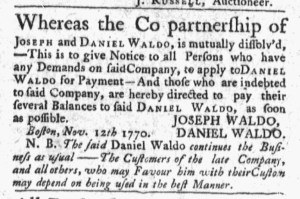
Massachusetts Gazette and Boston Post-Boy (December 10, 1770).

“The Co partnership of JOSEPH and DANIEL WALDO, is mutually dissolv’d.”

When their partnership came to an end in the fall of 1770, Joseph Waldo and Daniel Waldo placed newspaper advertisements “to give Notice to all Persons who have any Demands on said Company, to apply to DANIEL WALDO for Payment.”  They also called on “those who are indebted to said Company” to settle accounts “as soon as possible.”  That portion of the advertisement was fairly standard, replicating many others that appeared in newspapers throughout the colonies.

The nota bene at the end of the advertisement, however, incorporated a marketing strategy not nearly as common in these routine notices.  In this special note, Daniel proclaimed that he “continues the Business as usual.”  He pledged that the “Customers of the late Company, and all others, who may Favour him with their Custom may depend on being used in the best Manner.”  In the course of their partnership, the Waldos had established a clientele and a reputation among consumers in Boston and beyond.  Although the partnership had been “mutually dissolv’d,” Daniel sought to maintain both the clientele and the reputation, inviting existing customers to continue to deal with him and alerting others that the business continued to operate after Joseph’s departure.

That may explain why the advertisement did not include a certain element common to many such notices about partnerships dissolving.  The Waldos did not threaten legal action against those who owed debts, unlike others that made it clear that those who did not settle accounts would find themselves in court.  Doing so would have impaired Daniel’s attempts to continue friendly relationships with a customer base that he hoped to maintain.  After all, he promised continuing and prospective customers that they “may depend on being used in the best Manner.”  Daniel focused on customer service as a means of cultivating his business as it entered a new stage without Joseph as a partner.

Slavery Advertisements Published December 10, 1770

GUEST CURATOR:  Noah Veilleux

The Slavery Adverts 250 Project chronicles the role of newspaper advertising in perpetuating slavery in the era of the American Revolution. The project seeks to reveal the ubiquity of slavery in eighteenth-century life from New England to Georgia by republishing advertisements about enslaved people – for sale as individuals or in groups, wanted to purchase or for hire for short periods, runaways who liberated themselves, and those who were subsequently captured and confined in jails and workhouses – in daily digests on this site as well as in real time via the @SlaveAdverts250 Twitter feed, utilizing twenty-first-century media to stand in for the print media of the eighteenth century.

The project aims to provide modern audiences with a sense of just how often colonists encountered these advertisements in their daily lives. Enslaved men, women, and children appeared in print somewhere in the colonies almost every single day. Those advertisements served as a constant backdrop for social, cultural, economic, and political life in colonial and revolutionary America. Colonists who did not purport to own enslaved people were still confronted with slavery as well as invited to maintain the system by purchasing enslaved men, women, and children or assisting in the capture of so-called “runaways” who sought to free themselves from bondage. The frequency of these newspaper advertisements suggests just how embedded slavery was in colonial and revolutionary American culture in everyday interactions beyond the printed page.

These advertisements also testify to the experiences of enslaved men, women, and children, though readers must consider that those experiences have been remediated through descriptions offered by enslavers rather than enslaved people themselves. Often unnamed in the advertisements, enslaved men, women, and children were not invisible or unimportant in early America.

These advertisements appeared in colonial American newspapers 250 years ago today.

Dec 10 1770 - Boston Evening-Post Slavery 1
Boston Evening-Post (December 10, 1770).

**********

Dec 10 1770 - Boston-Gazette Slavery 1
Boston-Gazette (December 10, 1770).

**********

Dec 10 1770 - Boston-Gazette Supplement Slavery 1
Supplement to the Boston Evening-Post (December 10, 1770).

**********

Dec 10 1770 - Boston-Gazette Supplement Slavery 2
Supplement to the Boston Evening-Post (December 10, 1770).

**********

Dec 10 1770 - New-York Gazette and Weekly Mercury Slavery 1
New-York Gazette and Weekly Mercury (December 10, 1770).

**********

Dec 10 1770 - New-York Gazette and Weekly Mercury Slavery 2
New-York Gazette and Weekly Mercury (December 10, 1770).

**********

Dec 10 1770 - New-York Gazette and Weekly Mercury Slavery 3
New-York Gazette and Weekly Mercury (December 10, 1770).

**********

Dec 10 1770 - New-York Gazette or Weekly Post-Boy Slavery 1
New-York Gazette or Weekly Post-Boy (December 10, 1770).

**********

Dec 10 1770 - Pennsylvania Chronicle Slavery 1
Pennsylvania Gazette (December 10, 1770).

**********

Dec 10 1770 - Pennsylvania Chronicle Slavery 2
Pennsylvania Gazette (December 10, 1770).

December 9

What was advertised in a colonial American newspaper 250 years ago this week?

South-Carolina Gazette (December 6, 1770).

“Hopes he may meet with Encouragement from those who are Well-wishers to the MANUFACTURES of THIS Province.”

For several years in the 1760s and 1770s, silversmith Thomas You operated a workshop at the Sign of the Golden Cup in Charleston.  According to his newspaper advertisements, that does not seem to have been a fixed location.  Instead, the sign moved with You, serving as both marker and brand for his business.  For a time in the mid 1760s, the Sign of the Golden Cup had adorned his workshop on Meeting Street, but in 1770 it marked his location on Queen Street.  You also updated the iconography in his advertisements.  He was one of the few advertisers in Charleston who enhanced his notices with images related directly to his business.  He previously included a woodcut that depicted a smith at work at an anvil.  That image gave way to a cup that corresponded to the sign that identified his shop.  Consumers now saw similar images in the public prints and on the city streets when they encountered You’s business.  You’s advertisement on the front page of the December 6, 1770, edition of the South-Carolina Gazette was the only one in the entire issue that incorporated an image other than a house, a ship, or an enslaved person.  Those stock images belonged to the printer rather than the advertiser.

The silversmith deployed this unique image to attract attention to an important message.  He called on “those who are Well-wishers to the MANUFACTURES of THIS Province” to employ him and purchase his wares.  In so doing, he joined the chorus of advertisers and others throughout the colonies who advocated for the production and consumption of “domestic manufactures” as alternatives to goods imported from Britain.  Such measures boosted local economies and addressed a trade imbalance, but they also served a political purpose at a time when Parliament sought to regulate commerce and charge duties on imported goods.  Most of duties from the Townshend Acts had been repealed earlier in the year, but the one on tea still remained in place.  Even though most towns suspended their nonimportation agreements in the wake of that news, colonists continued to debate whether they should have done so since Parliament did not capitulate to all of their demands.  A notice at the top of the same page that carried You’s advertisement advised that “The GENERAL COMMITTEE desire a FULL MEETING of the SUBSCRIBERS to the RESOLUTIONS of this Province, at the LIBERTY-TREE” to discuss “IMPORTANT MATTERS.”   You did not need to go into greater detail when he expressed his “hopes he may meet with Encouragement from those who are Well-wishers to the MANUFACTURES of THIS Province.”  Such appeals were part of a discourse widely circulating and broadly understood among prospective customers.

December 8

What was advertised in a colonial American newspaper 250 years ago today?

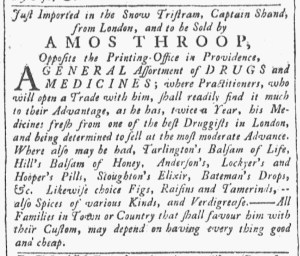
Providence Gazette (December 8, 1770).

Fresh from one of the best Druggists in London.”

Like many other apothecaries in colonial America, Amos Throop of Providence resorted to newspaper advertising to promote his wares and attract clients.  In an advertisement in the December 8, 1770, edition of the Providence Gazette, he informed the public that he carried “A GENERAL Assortment of DRUGS and MEDICINES” recently imported from London.  Those included popular patent medicines, such as “Tarlington’s Balsam of Life, Hill’s Balsam of Honey, Anderson’s Lockyer’s and Hopper’s Pills, Stoughton’s Elixir, [and] Bateman’s Drops.”  Throop expected that these remedies were so familiar to prospective clients that he did not to describe the symptoms each eliminated.

Throop sought clients of various sorts, both “Families in Town or Country” and “Practitioners” like Ephraim Otis, whose own advertisement stated that he “offers himself in the Capacity of Physician and Surgeon, in every Branch (particularly Osteology and Bone setting).”  The apothecary also found himself in competition with William Bowen.  In his advertisement, Bowen declared that he “continues to practice Physic, Surgery and Midwifry” as well as sell “a neat Assortment of Drugs and Medicines, at as cheap a Rate as can be bought in this Town.”  Throop also pledged that his customers “may depend on having everything good and cheap,” but he further enhanced his appeal to distinguish it from Bowen’s promise of low prices.  He explained that he acquired his medicines “twice a year … fresh from one of the best Druggists in London.”  His clients did not have to worry that nostrums they purchased at his shop had been sitting on the shelves or in the storeroom so long as to diminish their effectiveness.  Furthermore, Throop explained that he had received a shipment “in the Snow Tristam, Captain Shand, from London.”  Readers familiar with vessels that arrived and departed could judge for themselves how recently Throop had updated his inventory.

Bowen and Throop both advertised “DRUGS and MEDICINES” in the Providence Gazette.  While Bowen relied primarily on low prices to market his merchandise, Throop offered more extensive appeals to prospective clients.  He underscored quality by asserting connections to a respected colleague in London, outlined his schedule for replenishing his inventory, noted which vessel recently delivered new items, provided credit to practitioners “who will open a Trade with him,” sold ancillary products, and made his wares available at bargain prices.

Slavery Advertisements Published December 8, 1770

GUEST CURATOR:  Noah Veilleux

The Slavery Adverts 250 Project chronicles the role of newspaper advertising in perpetuating slavery in the era of the American Revolution. The project seeks to reveal the ubiquity of slavery in eighteenth-century life from New England to Georgia by republishing advertisements about enslaved people – for sale as individuals or in groups, wanted to purchase or for hire for short periods, runaways who liberated themselves, and those who were subsequently captured and confined in jails and workhouses – in daily digests on this site as well as in real time via the @SlaveAdverts250 Twitter feed, utilizing twenty-first-century media to stand in for the print media of the eighteenth century.

The project aims to provide modern audiences with a sense of just how often colonists encountered these advertisements in their daily lives. Enslaved men, women, and children appeared in print somewhere in the colonies almost every single day. Those advertisements served as a constant backdrop for social, cultural, economic, and political life in colonial and revolutionary America. Colonists who did not purport to own enslaved people were still confronted with slavery as well as invited to maintain the system by purchasing enslaved men, women, and children or assisting in the capture of so-called “runaways” who sought to free themselves from bondage. The frequency of these newspaper advertisements suggests just how embedded slavery was in colonial and revolutionary American culture in everyday interactions beyond the printed page.

These advertisements also testify to the experiences of enslaved men, women, and children, though readers must consider that those experiences have been remediated through descriptions offered by enslavers rather than enslaved people themselves. Often unnamed in the advertisements, enslaved men, women, and children were not invisible or unimportant in early America.

These advertisements appeared in colonial American newspapers 250 years ago today.

Dec 8 1770 - Providence Gazette Slavery 1
Providence Gazette (December 8, 1770).

December 7

What was advertised in a colonial American newspaper 250 years ago today?

Massachusetts Gazette and Boston Weekly News-Letter (December 7, 1770).

“The late Rev. and pious Mr. Whitefield favoured the World a few years ago with his opinion of this work.”

In December 1770, John Fleeming distributed subscription notices for a publication that he described as “The First BIBLE ever printed in America.”  The proposed work included “the OLD and NEW TESTAMENTS” as well as “Annotations and Parallel Scriptures By the late Rev. SAMUEL CLARK.”  Fleeming outlined the conditions, a standard part of any subscription notice, providing an overview of the type, paper, and publication schedule.  He also offered premiums to “Booksellers, Country Traders,” and others who collected at least one dozen subscriptions on his behalf and later distributed the bibles to the subscribers.  In addition, Fleeming informed prospective subscribers that their names “will be printed” among the ancillary materials that accompanied the bible, thus testifying to their commitment to the project and their role in making it possible.

Yet Fleeming devoted the greatest portion of his subscription notice to an innovative marketing strategy.  He included a lengthy testimonial from George Whitefield, one of the most prominent ministers associated with the eighteenth-century religious revivals now known as the Great Awakening.  Fleeming noted that the “pious Mr. Whitefield favoured the World a few years ago with his opinion of this work, and a character of the Author,” Samuel Clark, “in a preface which he prefixed to an edition then publishing.”  Fleeming then quoted extensively from Whitefield, filling almost an entire column.  Indeed, the entire subscription notice filled two of three columns on the first page of the December 7 edition of the Massachusetts Gazette and Boston Weekly News-Letter.

This was yet another instance of printers and booksellers seeking to capitalize on Whitefield’s death a few months earlier on September 30.  Since that time, newspaper printers published a steady stream of articles about the minister’s death and reactions throughout the colonies.  Even as those news items slowed down, they continued to print and reprint poems that eulogized Whitefield.  Almost as soon as the public received news of the minister’s death, printers and booksellers began hawking books and hymnals written by Whitefield as well as commemorative items that memorialized the minister.  Along with publishing poems in his memory, the commodification of Whitefield’s death continued after news reached even the most distant colonies.  Mobilizing the deceased minister’s preface from another edition in order to deliver a posthumous testimonial in a subscription notice that began circulating two months after his death was another means of combining outlets for expressing grief and opportunities to generate revenues.

December 6

What was advertised in a colonial American newspaper 250 years ago today?

Pennsylvania Journal (December 6, 1770).

“FOR NEWRY, The SHIP SALLY, WILLIAM KEITH, Master.”

Readers of the Pennsylvania Chronicle, and, especially, the Pennsylvania Gazette and the Pennsylvania Journal did not have to walk along the docks and wharves on the Delaware River to glimpse the ships that transported people and goods to and from Philadelphia.  Instead, they saw visual representations of the bustling coastal and transatlantic trade depicted in newspaper advertisements.  Consider the woodcuts that adorned advertisements for freight and passage that appeared in those newspapers in the first week of December 1770.

The Pennsylvania Chronicle featured the fewest such advertisements, only three, but the first item in the first column of the first page, immediately below the masthead, incorporated a woodcut of a vessel at sea into a notice about the Elizabeth and Mary departing for Barbados, Grenada, and Jamaica.  The Pennsylvania Gazette, in turn, included eleven images of ships at sea, listing destinations such as Belfast, Dublin, Newry, and Londonderry in Ireland, Glasgow in Scotland, and Barbados and Granada in the West Indies.  Ten of those advertisements ran one after the other, filling almost an entire column on the final page of the December 6 edition.

The Pennsylvania Journal had the greatest number of advertisements with depictions of trading vessels, a total of sixteen.  Fourteen of them ran consecutively, filling half of the final page.  Some also appeared in the Pennsylvania Gazette on the same day, but others did not.  The map of commerce depicted in the pages of the Pennsylvania Journal was the most extensive, including Charleston, South Carolina, on the mainland; Barbados, Granada, and Jamaica in the West Indies; Cork, Dublin, Newry, and Londonderry in Ireland; and Bristol and London in England.

The pages of Philadelphia’s newspapers testified to the port city’s participation in a bustling network of commerce that crisscrossed the Atlantic.  Readers encountered that story not only in text but also in images that depicted fleets of ships that visited the busy port.  The array of woodcuts depicting ships that accompanied advertisements for passengers and freight often made the pages of newspapers appear as busy as the Delaware River and the wharves that lined it.

Slavery Advertisements Published December 6, 1770

GUEST CURATOR:  Noah Veilleux

The Slavery Adverts 250 Project chronicles the role of newspaper advertising in perpetuating slavery in the era of the American Revolution. The project seeks to reveal the ubiquity of slavery in eighteenth-century life from New England to Georgia by republishing advertisements about enslaved people – for sale as individuals or in groups, wanted to purchase or for hire for short periods, runaways who liberated themselves, and those who were subsequently captured and confined in jails and workhouses – in daily digests on this site as well as in real time via the @SlaveAdverts250 Twitter feed, utilizing twenty-first-century media to stand in for the print media of the eighteenth century.
The project aims to provide modern audiences with a sense of just how often colonists encountered these advertisements in their daily lives. Enslaved men, women, and children appeared in print somewhere in the colonies almost every single day. Those advertisements served as a constant backdrop for social, cultural, economic, and political life in colonial and revolutionary America. Colonists who did not purport to own enslaved people were still confronted with slavery as well as invited to maintain the system by purchasing enslaved men, women, and children or assisting in the capture of so-called “runaways” who sought to free themselves from bondage. The frequency of these newspaper advertisements suggests just how embedded slavery was in colonial and revolutionary American culture in everyday interactions beyond the printed page.

These advertisements also testify to the experiences of enslaved men, women, and children, though readers must consider that those experiences have been remediated through descriptions offered by enslavers rather than enslaved people themselves. Often unnamed in the advertisements, enslaved men, women, and children were not invisible or unimportant in early America.

These advertisements appeared in colonial American newspapers 250 years ago today.

Dec 6 1770 - Maryland Gazette Slavery 1
Maryland Gazette (December 6, 1770).

**********

Dec 6 1770 - Maryland Gazette Slavery 2
Maryland Gazette (December 6, 1770).

**********

Dec 6 1770 - New-York Journal Slavery 1
New-York Journal (December 6, 1770).

**********

Dec 6 1770 - New-York Journal Slavery 2
New-York Journal (December 6, 1770).

**********

Dec 6 1770 - New-York Journal Slavery 3
New-York Journal (December 6, 1770).

**********

Dec 6 1770 - New-York Journal Slavery 4
New-York Journal (December 6, 1770).

**********

Dec 6 1770 - Pennsylvania Gazette Slavery 1
Pennsylvania Gazette (December 6, 1770).

**********

Dec 6 1770 - South-Carolina Gazette Slavery 1
South-Carolina Gazette (December 6, 1770).

**********

Dec 6 1770 - South-Carolina Gazette Slavery 2
South-Carolina Gazette (December 6, 1770).

**********

Dec 6 1770 - South-Carolina Gazette Slavery 3
South-Carolina Gazette (December 6, 1770).

**********

Dec 6 1770 - South-Carolina Gazette Slavery 4
South-Carolina Gazette (December 6, 1770).

**********

Dec 6 1770 - South-Carolina Gazette Slavery 5
South-Carolina Gazette (December 6, 1770).

**********

Dec 6 1770 - South-Carolina Gazette Slavery 6
South-Carolina Gazette (December 6, 1770).

**********

Dec 6 1770 - South-Carolina Gazette Slavery 7
South-Carolina Gazette (December 6, 1770).

**********

Dec 6 1770 - South-Carolina Gazette Slavery 8
South-Carolina Gazette (December 6, 1770).

**********

Dec 6 1770 - South-Carolina Gazette Slavery 9
South-Carolina Gazette (December 6, 1770).

**********

Dec 6 1770 - South-Carolina Gazette Slavery 10
South-Carolina Gazette (December 6, 1770).

**********

Dec 6 1770 - South-Carolina Gazette Slavery 11
South-Carolina Gazette (December 6, 1770).