Noah Veilleux is a senior majoring in History at Assumption University in Worcester, Massachusetts. He also has a minor in the Core Texts and Enduring Questions program. Noah is from Enfield, Connecticut. He is a member of the Honors Program, working on a thesis examining why Americans lost trust in their government in the decade from 1965 to 1975. Noah is also a part of the Club Ultimate Frisbee Team and Agape Latte. He has studied abroad in the university’s Rome Program. Noah conducted the research for his current contributions as guest curator for the Slavery Adverts 250 Project when he was enrolled in HIS 400 – Research Methods: Vast Early America in Spring 2020.
What was advertised in a colonial American newspaper 250 years ago today?
South-Carolina and American General Gazette (December 5, 2020).
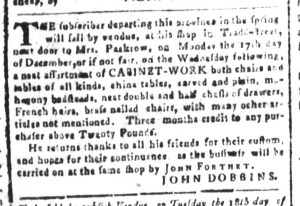
“Will sell by vendue … a neat assortment of CABINET-WORK.”
John Dobbins, a cabinetmaker, operated a shop on Tradd Street in Charleston in 1770. As the year came to a close, he inserted an advertisement in the South-Carolina and American General Gazette to alert the public that he planned to leave the colony in the spring. In preparation for his departure, he planned a vendue or auction for December 17. His inventory consisted of “a neat assortment of CABINET-WORK,” including “chairs and tables of all kinds, china tables, carved and plain, mahogany bedsteads, neat double and half chests of drawers, French [c]hairs, brass nailed chairs,” and “many other articles not mentioned.” Dobbins sought to liquidate his wares. In effect, he ran a going-out-of-business sale. Prospective customers stood to acquire better bargains by buying at auction. The cabinetmaker faced improved prospects of finding purchasers for the array of furniture that remained in stock.
In his effort to attract bidders to the auction, Dobbins offered “Three months credit to any purchaser above Twenty Pounds.” Providing such flexibility likely increased the number of prospective customers who considered attending the vendue. After all, the cabinetmaker’s first goal was to get people through the door. The number and amount of sales depended on the crowd that gathered, so announcing that he extended credit – and set the threshold at twenty pounds – was a savvy tactic for encouraging attendance and participation at the auction.
Dobbins also took the opportunity to express his appreciation to his customers for their patronage during the time he made and sold furniture at his shop on Tradd Street. Although he was leaving the colony, the business would continue at the same location. Dobbins endorsed his successor, John Forthet, asking “his friends … for their continuance as the business will be carried on at the same shop.” As one last service to his customers, he offered a recommendation and a transition to another artisan who made and sold furniture. As part of maintaining good relationships during the time that he remained in the colony, he prepared for a smooth departure that included bargains at auction, credit for preferred customers, an expression of gratitude, and recommending a successor.
The Slavery Adverts 250 Project chronicles the role of newspaper advertising in perpetuating slavery in the era of the American Revolution. The project seeks to reveal the ubiquity of slavery in eighteenth-century life from New England to Georgia by republishing advertisements about enslaved people – for sale as individuals or in groups, wanted to purchase or for hire for short periods, runaways who liberated themselves, and those who were subsequently captured and confined in jails and workhouses – in daily digests on this site as well as in real time via the @SlaveAdverts250 Twitter feed, utilizing twenty-first-century media to stand in for the print media of the eighteenth century.
The project aims to provide modern audiences with a sense of just how often colonists encountered these advertisements in their daily lives. Enslaved men, women, and children appeared in print somewhere in the colonies almost every single day. Those advertisements served as a constant backdrop for social, cultural, economic, and political life in colonial and revolutionary America. Colonists who did not purport to own enslaved people were still confronted with slavery as well as invited to maintain the system by purchasing enslaved men, women, and children or assisting in the capture of so-called “runaways” who sought to free themselves from bondage. The frequency of these newspaper advertisements suggests just how embedded slavery was in colonial and revolutionary American culture in everyday interactions beyond the printed page.
These advertisements also testify to the experiences of enslaved men, women, and children, though readers must consider that those experiences have been remediated through descriptions offered by enslavers rather than enslaved people themselves. Often unnamed in the advertisements, enslaved men, women, and children were not invisible or unimportant in early America.
These advertisements appeared in colonial American newspapers 250 years ago today.
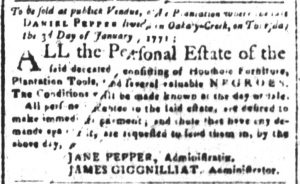
South-Carolina and American General Gazette (December 5, 1770).
**********
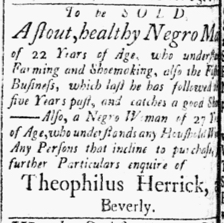
South-Carolina and American General Gazette (December 5, 1770).
**********
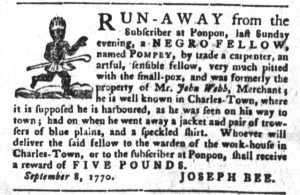
South-Carolina and American General Gazette (December 5, 1770).
**********
South-Carolina and American General Gazette (December 5, 1770).
**********
South-Carolina and American General Gazette (December 5, 1770).
**********
South-Carolina and American General Gazette (December 5, 1770).
**********
South-Carolina and American General Gazette (December 5, 1770).
**********
South-Carolina and American General Gazette (December 5, 1770).
What was advertised in a colonial American newspaper 250 years ago today?
Essex Gazette (December 4, 1770).
“JUST PUBLISHED … Dr. Whitaker’s SERMON On the DEATH of the Reverend George Whitefield.”
George Whitefield, one of the most prominent ministers associated with the eighteenth-century religious revivals now known as the Great Awakening, died in Newburyport, Massachusetts, on September 30, 1770. The next day, articles appeared in newspapers published in Boston and the news radiated to other towns throughout the colonies over several weeks. In addition to news items, many newspapers printed and reprinted poems that eulogized the minister. Almost immediately, some printers and booksellers advertised commemorative items that commodified Whitefield’s death. Through concentrated primarily in New England, such advertisements also ran in newspapers in New York, Pennsylvania, and South Carolina.
As winter approached, printers and booksellers continued to produce and market new items related to Whitefield and his death. On November 27, Samuel Hall, printer of the Essex Gazette in Salem, Massachusetts, advertised that “On Thursday or Friday next will be published … The Rev. Dr. Whitaker’s SERMON, on the Death of the late Rev. Mr. WHITEFIELD.” In the next issue, Hall inserted an updated advertisement that announced he had indeed “JUST PUBLISHED” the sermon and offered it for sale at the printing office. This advertisement, unlike most others, included thick black bands at the top and bottom, a widely recognized symbol of mourning in eighteenth-century America. Usually, black bands or borders were reserved for news articles or they adorned an entire page or issue. By incorporating them into this advertisement, Hall elevated Whitaker’s sermon on Whitefield’s death and, by extension, his marketing of that item, to news. In addition, he placed the advertisement at the top of the first column devoted to advertisements in the December 4 edition of the Essex Gazette, making it a transition between news and advertising.
In the year that saw the Boston Massacre and the repeal of most of the Townshend duties on imported goods, the death of George Whitefield was one of the most significant stories that circulated in the colonial American newspapers. Yet coverage of the minister’s death was not confined to news alone. Printers and booksellers seized opportunities to produce commemorative items and offer them for sale, simultaneously consoling the general public and seeking to profit from their grief.
The Slavery Adverts 250 Project chronicles the role of newspaper advertising in perpetuating slavery in the era of the American Revolution. The project seeks to reveal the ubiquity of slavery in eighteenth-century life from New England to Georgia by republishing advertisements about enslaved people – for sale as individuals or in groups, wanted to purchase or for hire for short periods, runaways who liberated themselves, and those who were subsequently captured and confined in jails and workhouses – in daily digests on this site as well as in real time via the @SlaveAdverts250 Twitter feed, utilizing twenty-first-century media to stand in for the print media of the eighteenth century.
The project aims to provide modern audiences with a sense of just how often colonists encountered these advertisements in their daily lives. Enslaved men, women, and children appeared in print somewhere in the colonies almost every single day. Those advertisements served as a constant backdrop for social, cultural, economic, and political life in colonial and revolutionary America. Colonists who did not purport to own enslaved people were still confronted with slavery as well as invited to maintain the system by purchasing enslaved men, women, and children or assisting in the capture of so-called “runaways” who sought to free themselves from bondage. The frequency of these newspaper advertisements suggests just how embedded slavery was in colonial and revolutionary American culture in everyday interactions beyond the printed page.
These advertisements also testify to the experiences of enslaved men, women, and children, though readers must consider that those experiences have been remediated through descriptions offered by enslavers rather than enslaved people themselves. Often unnamed in the advertisements, enslaved men, women, and children were not invisible or unimportant in early America.
These advertisements appeared in colonial American newspapers 250 years ago today.
Essex Gazette (December 4, 1770).
**********
Essex Gazette (December 4, 1770).
**********
South-Carolina Gazette and Country Journal (December 4, 1770).
**********
South-Carolina Gazette and Country Journal (December 4, 1770).
**********
South-Carolina Gazette and Country Journal (December 4, 1770).
**********
South-Carolina Gazette and Country Journal (December 4, 1770).
**********
South-Carolina Gazette and Country Journal (December 4, 1770).
**********
Supplement to the South-Carolina Gazette and Country Journal (December 4, 1770).
**********
Supplement to the South-Carolina Gazette and Country Journal (December 4, 1770).
**********
Supplement to the South-Carolina Gazette and Country Journal (December 4, 1770).
**********
Supplement to the South-Carolina Gazette and Country Journal (December 4, 1770).
**********
Supplement to the South-Carolina Gazette and Country Journal (December 4, 1770).
**********
Supplement to the South-Carolina Gazette and Country Journal (December 4, 1770).
**********
Supplement to the South-Carolina Gazette and Country Journal (December 4, 1770).
What was advertised in a colonial American newspaper 250 years ago today?
Supplement to the New-York Gazette and Weekly Mercury (December 3, 1770).
“Any quantity of seedling plants of the different species, can be got ready at a short notice, to be shipped to any Part of the World.”
Thomas Vallentine wanted his clientele in New York and beyond to feel important. In an advertisement in the supplement that accompanied the December 3, 1770, edition of the New-York Gazette and Weekly Mercury, he addressed potential clients as “The NOBILITY, GENTRY, AND others employ’d in botany and gardening.” The “nursery and seedsman” advised such illustrious prospective patrons that he “collects and keeps for sale, assortments of most kinds of seeds of trees, shrubs, and flowers, produced by this country.” To further underscore both his own importance and the importance of those who purchased seeds from him, he declared that his “care and assiduity, have been experienced by some of the first personages in Europe and America.” His clients may have included colonial elites who planted decorative gardens as well as others who participated in transatlantic scientific discourses about the natural world. At least that was the impression he wanted to give.
To generate greater demand for his services, Vallentine described some of his business practices and offered a guarantee. He assured prospective customers that he could supply “the largest orders.” He gave special attention to cones, pods, and other kinds of seeds that were “liable to germinate or lose their vegetative qualities” before customers received them. To prevent either of those misfortunes, those items were “carefully preserved in sand.” Furthermore, he pledged that “if any of the seeds he may dispose of should happen to miscarry” then he would “supply the purchaser with an equal quantity of such seeds” free of charge. That guarantee came with an additional provision; Vallentine provided replacement seeds only when clients had not “sowed and attended as directed by Mr. Philip Miller’s gardeners dictionary.” In stating that condition, he further described his clientele as gardeners and botanists familiar with a particular publication and the guidelines it provided for raising a variety of plants.
Vallentine also noted that he provided “Any quantity of seedling plants of the different species … to be shipped to any Part of the World” on short notice. That made the packaging all the more important, but it also testified to the types of clients he anticipated attracting with his advertisement. Colonists who corresponded with botanists in other parts of the Atlantic world could acquire North American seeds and seedlings from Vallentine and then arrange to have them transported to distant destinations. As Chris Parsons and Kathleen S. Murphy have described in “Ecosystems under Sail: Specimen Transport in the Eighteenth-Century French and British Atlantics,” botanists and their correspondents on both sides of the Atlantic invested significant time and effort in devising the best methods for shipping flora from one place to another for further study.[1] Vallentine did not go into great detail about his methods, but those he did briefly describe in his advertisement made clear his familiarity with best practices in the field. The “nursery and seedsman” was prepared to serve a specialized clientele.
**********
[1] Chris Parsons and Kathleen S. Murphy, “Ecosystems under Sail: Specimen Transport in the Eighteenth-Century French and British Atlantics,” Early American Studies 10, no. 3 (Fall 2012): 503-29.
The Slavery Adverts 250 Project chronicles the role of newspaper advertising in perpetuating slavery in the era of the American Revolution. The project seeks to reveal the ubiquity of slavery in eighteenth-century life from New England to Georgia by republishing advertisements about enslaved people – for sale as individuals or in groups, wanted to purchase or for hire for short periods, runaways who liberated themselves, and those who were subsequently captured and confined in jails and workhouses – in daily digests on this site as well as in real time via the @SlaveAdverts250 Twitter feed, utilizing twenty-first-century media to stand in for the print media of the eighteenth century.
The project aims to provide modern audiences with a sense of just how often colonists encountered these advertisements in their daily lives. Enslaved men, women, and children appeared in print somewhere in the colonies almost every single day. Those advertisements served as a constant backdrop for social, cultural, economic, and political life in colonial and revolutionary America. Colonists who did not purport to own enslaved people were still confronted with slavery as well as invited to maintain the system by purchasing enslaved men, women, and children or assisting in the capture of so-called “runaways” who sought to free themselves from bondage. The frequency of these newspaper advertisements suggests just how embedded slavery was in colonial and revolutionary American culture in everyday interactions beyond the printed page.
These advertisements also testify to the experiences of enslaved men, women, and children, though readers must consider that those experiences have been remediated through descriptions offered by enslavers rather than enslaved people themselves. Often unnamed in the advertisements, enslaved men, women, and children were not invisible or unimportant in early America.
These advertisements appeared in colonial American newspapers 250 years ago today.
Boston Evening-Post (December 3, 1770).
**********
Boston-Gazette (December 3, 1770).
**********
Boston-Gazette (December 3, 1770).
**********
Supplement to the Boston-Gazette (December 3, 1770).
**********
New-York Gazette and Weekly Mercury (December 3, 1770).
**********
New-York Gazette and Weekly Mercury (December 3, 1770).
**********
New-York Gazette and Weekly Mercury (December 3, 1770).
**********
Supplement to the New-York Gazette and Weekly Mercury (December 3, 1770).
**********
Supplement to the New-York Gazette and Weekly Mercury (December 3, 1770).
**********
Supplement to the New-York Gazette and Weekly Mercury (December 3, 1770).
**********
New-York Gazette or Weekly Post-Boy (December 3, 1770).
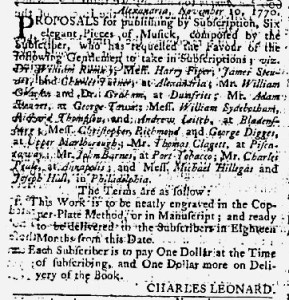
“Requested the Favour of the following Gentlemen to take in Subscriptions.”
When Charles Leonard of Alexandria, Virginia, wished to publish “Six elegant Pieces of Musick” that he composed, he distributed a subscription notice that included the terms and listed local agents who accepted subscriptions on his behalf. In an advertisement that ran in the November 29, 1770, edition of the Maryland Gazette, Leonard enumerated only two terms of publication. In the first, he stated, “This Work is to be neatly engraved in the Copper-Plate Method, or in Manuscript; and ready to be delivered to Subscribers in Eighteen Months from this Date.” The second term outlined the pricing structure. Each copy cost two dollars, one paid at the time of subscribing and the other on delivery. Publishing by subscription allowed Leonard to assess interest to determine whether moving forward with the venture was viable. The advance payments defrayed expenses while keeping subscribers committed to the project.
Leonard devoted as much space in his advertisement to listing local agents who accepted subscriptions as he did to outlining the terms. In Virginia, he identified four in Alexandria, two in Dunfries, one in Georgetown, and three in Bladensburg. Another five represented him in Maryland, including two in Upper Marlborough and one each in Piscataway, Port Tobacco, and Annapolis. Leonard also had two local agents who accepted subscriptions in Philadelphia. In total, eighteen “Gentlemen … take in Subscriptions” in three colonies. Leonard created an extensive network, hoping that this would garner success in attracting sufficient subscribers for publishing his book of music.
In addition to newspaper advertisements, Leonard may have also had subscription papers printed and distributed to his local agents. Subscription papers included both the terms of publication and space for subscribers to sign their names and indicate the number of copies they wished to order. Local agents sometimes displayed subscription papers, allowing prospective subscribers to see who else had already committed to the project. No matter the means of keeping records of subscribers, local agents eventually sent their lists to Leonard to collate and determine how many copies to publish. His newspaper advertisement was only one part of a larger coordinated campaign designed to generate interest in publishing his “Six elegant Pieces of Musick.”
What was advertised in a colonial American newspaper 250 years ago today?
Providence Gazette (December 1, 1770).
“SCHEME of a LOTTERY … for the Purpose of repairing and rebuilding the Bridge.”
Colonists sometimes used lotteries to fund public works projects in eighteenth-century America. When the “Bridge over Pawtucket River, called Whipple’s Bridge,” fell into disrepair in 1770, Rhode Island’s General Assembly authorized a lottery to raise the funds necessary to repair and build it. The colonial legislature also appointed directors to oversee the lottery. The directors then placed advertisements outlining the “SCHEME of a LOTTERY” in the Providence Gazette. They described the prizes and odds, but they also explained the value of maintaining Whipple’s Bridge. Doing so contributed to “Good of the Public in general,” but “more especially of the Town of Providence, as the Road over said Bridge leads to several large Towns in the Province of the Massachusetts-Bay.” In other words, the bridge facilitated commerce and communication between Providence and other towns.
The directors needed to raise four hundred dollars for the project. Rather than a single lottery, they planned to sponsor several, “Four Classes, or Divisions” that would yield one hundred dollars each. The “SCHEME” for the “First Class” specified that the directors would sell “Six Hundred Tickets, at One Dollar each.” Most of this revenue, however, would be paid out in prizes. The lottery consisted of 178 prizes that amounted to five hundred dollars, leaving one hundred dollars to invest in repairing Whipple’s Bridge. The grand prize was thirty dollars with two other prizes of twenty dollars and five prizes of ten dollars. The lottery also included smaller prizes, twenty worth four dollars and 150 worth two dollars. Although most of the prizes were not very large, participants enjoyed good odds for winning some sort of prize, “Near two Blanks to a Prize” or nearly one winning ticket for each two that did not win.
Still, winning was not guaranteed, prompting the directors to underscore the benefits to the general public as one of the reasons to participate in the lottery. They also suggested that the lottery met with “Encouragement already given by the Public to promote this salutary Design,” leading them to believe that all six hundred tickets would soon be sold and then the winning tickets drawn and published in the Providence Gazette. The directors had two purposes in noting the popularity of the lottery. It could incite others to join a cause that others already endorsed while also prompting some colonists to purchase tickets quickly for fear of not having a chance to participate if they waited too long.
In addition to the directors, colonists could also purchase tickets from John Carter, printer of the Providence Gazette. His printing office was not only a hub for disseminating information, but also a site for supporting the maintenance of important elements of the infrastructure that allowed for the movement of people and goods within the colony and beyond. Eighteenth-century printers brokered information, but they also served their communities in other ways.
The Slavery Adverts 250 Project chronicles the role of newspaper advertising in perpetuating slavery in the era of the American Revolution. The project seeks to reveal the ubiquity of slavery in eighteenth-century life from New England to Georgia by republishing advertisements about enslaved people – for sale as individuals or in groups, wanted to purchase or for hire for short periods, runaways who liberated themselves, and those who were subsequently captured and confined in jails and workhouses – in daily digests on this site as well as in real time via the @SlaveAdverts250 Twitter feed, utilizing twenty-first-century media to stand in for the print media of the eighteenth century.
The project aims to provide modern audiences with a sense of just how often colonists encountered these advertisements in their daily lives. Enslaved men, women, and children appeared in print somewhere in the colonies almost every single day. Those advertisements served as a constant backdrop for social, cultural, economic, and political life in colonial and revolutionary America. Colonists who did not purport to own enslaved people were still confronted with slavery as well as invited to maintain the system by purchasing enslaved men, women, and children or assisting in the capture of so-called “runaways” who sought to free themselves from bondage. The frequency of these newspaper advertisements suggests just how embedded slavery was in colonial and revolutionary American culture in everyday interactions beyond the printed page.
These advertisements also testify to the experiences of enslaved men, women, and children, though readers must consider that those experiences have been remediated through descriptions offered by enslavers rather than enslaved people themselves. Often unnamed in the advertisements, enslaved men, women, and children were not invisible or unimportant in early America.
These advertisements appeared in colonial American newspapers 250 years ago today.