December 18

What was advertised in a colonial American newspaper 250 years ago today?

South-Carolina Gazette and Country Journal (December 18, 1770).

“A SERMON SACRED TO THE MEMORY OF THE Rev. GEORGE WHITEFIELD.”

George Whitefield, one of the most prominent ministers associated with the eighteenth-century religious revivals now known as the Great Awakening, died in Newburyport, Massachusetts, on September 30, 1770.  The next day, several newspapers in Boston informed readers of Whitefield’s death.  Over the course of several weeks, news radiated from there.  Newspapers from New Hampshire to Georgia eventually reprinted articles that originated in Boston and supplemented with coverage of local reaction.  That additional coverage included poems that memorialized Whitefield and advertisements for commemorative items.  Less than a week elapsed when the October 4 edition of the Massachusetts Gazette and Boston Weekly News-Letter noted that Green and Russell sold “A FUNERAL HYMN, wrote by the Rev’d Mr. Whitefield: Said to be designed to have been sung over his Corpse by the Orphans belonging to his Tabernacle in London, had he died there.”  So began the commodification of Whitefield’s death.

That commodification was widespread, though especially prevalent in New England.  Still, printers and booksellers in other regions participated as well.  On December 18, the South-Carolina Gazette and Country Journal carried a notice that “A SERMON SACRED TO THE MEMORY OF THE Rev. GEORGE WHITEFIELD” … delivered in Charleston on October 28 by Josiah Smith “WILL BE PUBLISHED” and sold later in the week.  This was only the second commemorative item presented for purchase in South Carolina.  Previously the South-Carolina and American General Gazette carried a notice for “AN ELEGY on the Reverend GEORGE WHITEFIELD” combined in a single publication with the hymn that was first advertised in Boston.  Those advertisements ran in November.  The advertisement for the sermon first appeared four weeks after the last insertion of the advertisement for the elegy and hymn.  Consumers in South Carolina were not barraged with marketing for publications commemorating Whitefield to the same extent as their counterparts in New England, but they did not lack options either.  Perhaps of his own initiative, but perhaps in part as a result of examining newspapers from other regions, Charles Crouch, printer of both the South-Carolina Gazette and Country Journal and Smith’s sermon memorializing Whitefield, saw an opportunity to produce a commemorative item.  He contributed to public mourning of the influential minister, but simultaneously exercised some self-interest in seeking to generate revenues from sales of the sermon, not unlike many other printers and booksellers throughout the colonies.

Slavery Advertisements Published December 18, 1770

GUEST CURATOR:  Andrew Wynne

The Slavery Adverts 250 Project chronicles the role of newspaper advertising in perpetuating slavery in the era of the American Revolution. The project seeks to reveal the ubiquity of slavery in eighteenth-century life from New England to Georgia by republishing advertisements about enslaved people – for sale as individuals or in groups, wanted to purchase or for hire for short periods, runaways who liberated themselves, and those who were subsequently captured and confined in jails and workhouses – in daily digests on this site as well as in real time via the @SlaveAdverts250 Twitter feed, utilizing twenty-first-century media to stand in for the print media of the eighteenth century.

The project aims to provide modern audiences with a sense of just how often colonists encountered these advertisements in their daily lives. Enslaved men, women, and children appeared in print somewhere in the colonies almost every single day. Those advertisements served as a constant backdrop for social, cultural, economic, and political life in colonial and revolutionary America. Colonists who did not purport to own enslaved people were still confronted with slavery as well as invited to maintain the system by purchasing enslaved men, women, and children or assisting in the capture of so-called “runaways” who sought to free themselves from bondage. The frequency of these newspaper advertisements suggests just how embedded slavery was in colonial and revolutionary American culture in everyday interactions beyond the printed page.

These advertisements also testify to the experiences of enslaved men, women, and children, though readers must consider that those experiences have been remediated through descriptions offered by enslavers rather than enslaved people themselves. Often unnamed in the advertisements, enslaved men, women, and children were not invisible or unimportant in early America.

These advertisements appeared in colonial American newspapers 250 years ago today.

Dec 18 1770 - Essex Gazette Slavery 1
Essex Gazette (December 18, 1770).

**********

Dec 18 1770 - South-Carolina Gazette and Country Journal Slavery 1
South-Carolina Gazette and Country Journal (December 18, 1770).

**********

Dec 18 1770 - South-Carolina Gazette and Country Journal Slavery 2
South-Carolina Gazette and Country Journal (December 18, 1770).

**********

Dec 18 1770 - South-Carolina Gazette and Country Journal Slavery 3
South-Carolina Gazette and Country Journal (December 18, 1770).

**********

Dec 18 1770 - South-Carolina Gazette and Country Journal Slavery 4
South-Carolina Gazette and Country Journal (December 18, 1770).

**********

Dec 18 1770 - South-Carolina Gazette and Country Journal Slavery 5
South-Carolina Gazette and Country Journal (December 18, 1770).

**********

Dec 18 1770 - South-Carolina Gazette and Country Journal Slavery 6
South-Carolina Gazette and Country Journal (December 18, 1770).

**********

Dec 18 1770 - South-Carolina Gazette and Country Journal Slavery 7
South-Carolina Gazette and Country Journal (December 18, 1770).

**********

Dec 18 1770 - South-Carolina Gazette and Country Journal Slavery 8
South-Carolina Gazette and Country Journal (December 18, 1770).

**********

Dec 18 1770 - South-Carolina Gazette and Country Journal Slavery 9
South-Carolina Gazette and Country Journal (December 18, 1770).

**********

Dec 18 1770 - South-Carolina Gazette and Country Journal Slavery 10
South-Carolina Gazette and Country Journal (December 18, 1770).

**********

Dec 18 1770 - South-Carolina Gazette and Country Journal Slavery 11
South-Carolina Gazette and Country Journal (December 18, 1770).

**********

Dec 18 1770 - South-Carolina Gazette and Country Journal Supplement Slavery 1
Supplement to the South-Carolina Gazette and Country Journal (December 18, 1770).

**********

Dec 18 1770 - South-Carolina Gazette and Country Journal Supplement Slavery 2
Supplement to the South-Carolina Gazette and Country Journal (December 18, 1770).

**********

Dec 18 1770 - South-Carolina Gazette and Country Journal Supplement Slavery 3
Supplement to the South-Carolina Gazette and Country Journal (December 18, 1770).

December 17

What was advertised in a colonial American newspaper 250 years ago today?

New-York Gazette and Weekly Mercury (December 17, 1770).

“Beds and window curtains in the newest taste, as practised in London.”

An array of merchants and shopkeepers placed advertisements for imported goods in the December 17, 1770, edition of the New-York Gazette and Weekly Mercury.  For instance, John Schuyler, Jr., announced that he “just imported in the last vessels from London and Bristol, a neat assortment of goods.”  Many of them asserted that their new inventory reflected current fashions in England.  Artisans who offered their services to colonial consumers made similar appeals in their advertisements.

George Richey, who described himself as an “UPHOLSTERER and TENT-MAKER,” did so.  He informed “ladies and gentlemen that will favour him with their custom” that he “MAKES all sorts of upholstery work in the newest fashions” for beds, chairs, couches, and other furniture.  He also made curtains for both windows and beds, stressing that his wares followed “the newest taste, as practised in London.”

Richey and others who advertised consumer goods and services in the 1760s and 1770s frequently assured prospective customers that they provided products that matched current fashions in London, the cosmopolitan center of the empire.  Such appeals tapered off when nonimportation agreements went into effect, but they were quite common at other times.  Even as colonists sparred with Parliament over increased regulation of commerce, collecting duties on certain imported goods, quartering soldiers in port cities, and other matters, they continued to look to London for the latest fashions.

Newspaper advertisements published throughout the colonies made overtures concerning current trends and tastes in London, but such appeals most often appeared in advertisements placed by merchants, shopkeepers, and artisans in the largest port cities.  Residents of Boston, Charleston, New York, and Philadelphia experienced urban life, though on a much smaller scale than their counterparts in London.  Still, advertisers sought to assure potential clients and customers that they could acquire the same goods and, in the process, embody the same sophistication even though they lived on the other side of the Atlantic.  Richey the upholsterer joined a chorus of advertisers who invoked “newest fashions” and “newest taste, as practised in London.”

Slavery Advertisements Published December 17, 1770

GUEST CURATOR:  Andrew Wynne

The Slavery Adverts 250 Project chronicles the role of newspaper advertising in perpetuating slavery in the era of the American Revolution. The project seeks to reveal the ubiquity of slavery in eighteenth-century life from New England to Georgia by republishing advertisements about enslaved people – for sale as individuals or in groups, wanted to purchase or for hire for short periods, runaways who liberated themselves, and those who were subsequently captured and confined in jails and workhouses – in daily digests on this site as well as in real time via the @SlaveAdverts250 Twitter feed, utilizing twenty-first-century media to stand in for the print media of the eighteenth century.

The project aims to provide modern audiences with a sense of just how often colonists encountered these advertisements in their daily lives. Enslaved men, women, and children appeared in print somewhere in the colonies almost every single day. Those advertisements served as a constant backdrop for social, cultural, economic, and political life in colonial and revolutionary America. Colonists who did not purport to own enslaved people were still confronted with slavery as well as invited to maintain the system by purchasing enslaved men, women, and children or assisting in the capture of so-called “runaways” who sought to free themselves from bondage. The frequency of these newspaper advertisements suggests just how embedded slavery was in colonial and revolutionary American culture in everyday interactions beyond the printed page.

These advertisements also testify to the experiences of enslaved men, women, and children, though readers must consider that those experiences have been remediated through descriptions offered by enslavers rather than enslaved people themselves. Often unnamed in the advertisements, enslaved men, women, and children were not invisible or unimportant in early America.

These advertisements appeared in colonial American newspapers 250 years ago today.

Dec 17 1770 - Boston Evening-Post Slavery 1
Boston Evening-Post (December 17, 1770).

**********

Dec 17 1770 - Boston-Gazette Slavery 1
Boston-Gazette (December 17, 1770).

**********

Dec 17 1770 - New-York Gazette and Weekly Mercury Slavery 1
New-York Gazette and Weekly Mercury (December 17, 1770).

**********

New-York Gazette and Weekly Mercury (December 17, 1770).

**********

Dec 17 1770 - New-York Gazette and Weekly Mercury Slavery 2
New-York Gazette and Weekly Mercury (December 17, 1770).

**********

Dec 17 1770 - New-York Gazette or Weekly Post-Boy Slavery 1
New-York Gazette or Weekly Post-Boy (December 17, 1770).

**********

Dec 17 1770 - Pennsylvania Chronicle Slavery 1
Pennsylvania Chronicle (December 17, 1770).

**********

Dec 17 1770 - Pennsylvania Chronicle Slavery 2
Pennsylvania Chronicle (December 17, 1770).

December 16

What was advertised in a colonial American newspaper 250 years ago this week?

New-York Journal (December 13, 1770).

“54 57.”

“55 58.”

The numbers at the end of bookseller Garret Noel’s advertisement in the December 13, 1770, edition of the New-York Journal would have been a familiar sight to readers, even if they did not take the time to grasp their significance.  After all, they were not intended for readers, but instead for the compositor.  A brief notation, in this case “55 58,” alerted the compositor to the first and last issues in which an advertisement was supposed to appear.  The December 13 edition was “NUMB. 1458,” according to the masthead, thus the final issue for this particular advertisement.  It first ran three weeks earlier in “NUMB. 1455.”

This advertisement, however, had another notation with two other numbers, “54 57,” associated with it.  They appeared midway through the advertisement, a rather unusual situation.  This resulted from Noel placing two separate advertisements.  The first listed books “imported in the Britannia, Capt. Miller.”  It first ran in “NUMB. 1454” on November 15.  The following week, Noel placed another advertisement for books “IMPORTED, In the Albany, Capt. Richards.”  Rather than run it as a separate advertisement, the compositor appended it to Noel’s other notice.  In so doing, the compositor for the New-York Journal made a different decision than the compositor for the New-York Gazette and Weekly Mercury.  In the latter publication, Noel’s advertisements ran as separate items on different pages.

Noel derived advantages from both methods.  In the New-York Gazette and Weekly Mercury, readers encountered his advertisements multiple times.  This increased visibility may have made Noel and his books more memorable for prospective customers.  On the other hand, combining the advertisements into a single notice in the New-York Journalcreated a lengthy notice that testified to the range of choices available at Noel’s shop.  The amount of spaced it occupied on the page may have helped draw attention as well.  Furthermore, it seems likely that Noel may have enjoyed a free insertion of his first advertisement for an additional week.  It should have been discontinued with “NUMB. 1457” on December 6, but it appears the compositor overlooked the notation in the middle of the advertisement.  No portion of the advertisement appeared in “NUMB. 1459” on December 20.  The compositor heeded the notation at the end, the usual position, and removed the entire advertisement.

The notations at the end of many advertisements help to tell stories about business practices and the production of newspapers in the eighteenth century.  In this case, the unusual configuration of multiple notations in a single advertisement in the New-York Journal demonstrates that even though the advertiser wrote the copy the compositor exercised discretion concerning format.  The single notice in the New-York Journal had quite a different format compared to the notices in the New-York Gazette and Weekly Mercury.

December 15

What was advertised in a colonial American newspaper 250 years ago today?

Providence Gazette (December 15, 1770).

“A Collection of HYMNS … By that eminent and illustrious Servant of Christ, the late Rev. GEORGE WHITEFIELD.”

More than ten weeks after his death on September 30, 1770, news about George Whitefield and his legacy continued to appear in newspapers throughout the colonies.  Whitefield, one of the most prominent ministers associated with the eighteenth-century religious revivals now known as the Great Awakening, was a celebrity.  Very quickly, Newburyport, the site of his death, and Boston squabbled over the site of Whitefield’s burial.  When news arrived in Georgia, the colonial assembly passed resolutions to raise funds to have the minister’s remains moved to the orphanage he founded there.  Over the course of several weeks, printers reprinted those resolutions from one newspaper to another.  They finally began appearing in newspapers in New England in the middle of December.  Others honored Whitefield in other ways.  Several colonists named their children after the minister.  On December 15, the Providence Gazette reprinted news from Boston newspapers that announced “a child of Mr. George Trott was baptized by the Rev. Dr. Byles, by the name of George Whitefield.”
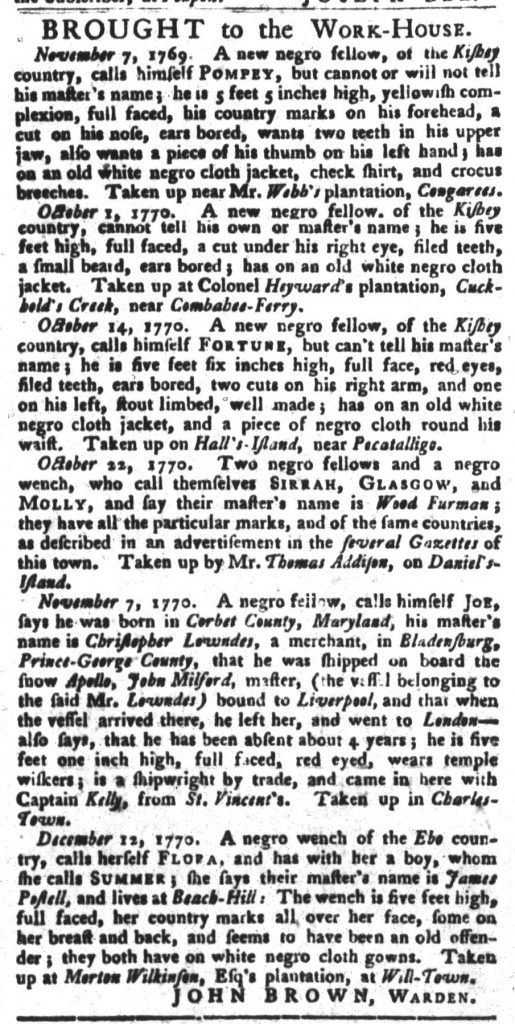
Whitefield appeared elsewhere in that issue as printers devised other means of memorializing him.  Almost as soon as the public learned of the minister’s death, printers and booksellers began producing, marketing, and selling commemorative items.  Their efforts included two subscription notices, one for “A Collection of HYMNS for social Worship” by Whitefield and another for an annotated bible that included an endorsement that the minister penned for an earlier edition.  Both of those subscription notices ran in the December 15 edition of the Providence Gazette, accounting for two columns of the final page.  Like other newspapers printed in the colonies, the Providence Gazette consisted of four pages created by printing two on each side of a broadsheet and folding it in half.  Two columns represented a significant portion of the content made available to readers that week and an even larger proportion of the advertising since paid notices filled five of the twelve columns in that issue.  The news update about a child named after Whitefield, only three lines, was exceptionally brief compared to the extensive advertisements that contributed to the commodification of the minister’s death and attempts to capitalize on it.  Mourning the loss of the minister was not the only reason that Whitefield continued to appear in the public prints, not when there was money to be made.

Providence Gazette (December 15, 1770).

December 14

What was advertised in a colonial American newspaper 250 years ago today?

New-Hampshire Gazette (December 14, 1770).

“Mrs. Winter, makes and sells, silk Purses.”

William Winter offered his services as a notary in an advertisement in the December 14, 1770, edition of the New-Hampshire Gazette.  He declared that he drew up various kinds of legal documents “with Fidelity and Dispatch” and “at a reasonable price.”  In addition, he was “also a Public AUCTIONEER.”  Although William’s name appeared as the headline for the advertisement, in a font larger than any on that page, he was not the only member of the Winter household who contributed to the family’s income.  The advertisement included a nota bene that outlined Mrs. Winter’s entrepreneurial activities.

William asked readers of the New-Hampshire Gazette to take note that “Mrs. Winter, makes and sells, silk Purses, Ladies silk, worsted, and thread Mitts.”  In addition, she also made “silk and thread Cauls for Wigs, as neat and good as any made in England.”  Furthermore, she sold them “cheaper for the Cash, than they can be bought in the Government.”  Did Mrs. Winter compose that portion of the advertisement?  Did William?  Did they collaborate on it?  Whoever was responsible for the content incorporated marketing strategies that did more than merely announce that Mrs. Winter made and sold purses, mitts, and linings for wigs.

Appeals to quality were common in eighteenth-century advertisements for goods and services.  In the era of the American Revolution, producers of goods made in the colonies and retailers who sold them increasingly compared the quality of those goods to imported alternatives.  In the wake of nonimportation agreements adopted in response to the Stamp Act and the Townshend Acts, comparing the quality of “domestic manufactures,” good made in the colonies, to imported items had a political valence.  Such appeals underscored to consumers that their choices in the marketplace had consequences in the dispute with Parliament.
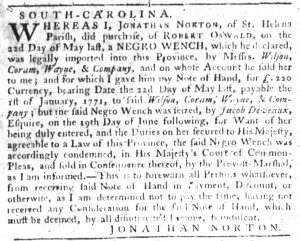
Appeals to price were also common in advertisements of the period.  The Winters did not make generic statements about Mrs. Winter’s prices.  As they had done with the appeal to quality, they also embellished this appeal by proclaiming that she charged the lowest prices that could be found “in the Government” or in the entire colony.  In the same issue of the New-Hampshire Gazette, James Haslett and Matthew Haslett, leather dressers who made and sold breeches and gloves, asserted that they set prices as low “as any in New England.”  Most advertisers usually were not so bold when comparing their prices to their competitors.  In these instances, the Winters and the Hasletts made significant claims about their prices in order to distinguish their goods from others.

Mrs. Winter’s portion of the advertisement did not benefit from the same prominence on the page as the segment in which William offered his services as notary and auctioneer.  It did not, however, lack substance.  The Winters devised a sophisticated advertisement that did more than rely on common marketing strategies.  When it came to both quality and price, they enhanced the standard appeals that appeared in other advertisements.

December 13

What was advertised in a colonial American newspaper 250 years ago today?

Massachusetts Spy (December 13, 1770).

“At the store lately improved by Mr. Robert Gould, opposite the sign of the Crown and Sceptre in Back-street.”

Francis Shaw, Jr., stocked a “LARGE and neat Assortment of cream and other coloured WARE, of the newest fashion,” at his shop in Boston.  In an advertisement in the December 13, 1770, edition of the Massachusetts Spy, he gave his locations as “the store lately improved by Mr. Robert Gould, opposite the sign of the Crown and Sceptre in Back-street.”  American cities did not use standardized street numbers to organize urban spaces until the late 1780s and early 1790s.  Before then, residents relied on a variety of landmarks and other descriptions to give directions.  They often used them in combination, as Shaw did.  He gave his street, but he also indicated the previous occupant of his store to guide prospective customers familiar with Gould’s business on Back Street.  He also used a shop sign for reference, though the Sign of the Crown and Scepter did not mark his own location.  Instead, he mentioned it as a landmark, describing his location “opposite” or across the street from the sign.

Other advertisers deployed similar strategies in describing their locations.  On the same day that Shaw placed his advertisement, John Langdon placed a notice in the Massachusetts Gazette and Boston Weekly Mercury.  In it, he invited prospective customers to “his Store lately Improv’d by Messr’s Cox & Berry nearly opposite the Post-Office.”  Peter Roberts sold medicines and medical equipment at his shop “opposite the West-Door of the Town-House.”  John Crosby, a frequent advertiser who peddled citrus fruits and other grocery items, gave his location as “the Sign of the Basket of Lemmons at the South-End.”  Samuel Abbot declared that his store was located “on Greene’s Wharff, near the East of the Market.”  Collectively, these advertisements and others suggest some of the methods colonists used to make sense of the cityscape and navigate the streets of Boston.  These descriptions supplement eighteenth-century maps, engravings, paintings, drawings, and other visual images as well as travel narratives and letters that depicted the busy port.  They also reveal important relationships, such as previous occupants and nearby landmarks, that mattered to both advertisers and readers of early American newspapers.  Commercial notices provided their own portraits of cities like Boston, Charleston, New York, and Philadelphia.

Slavery Advertisements Published December 13, 1770

GUEST CURATOR:  Andrew Wynne

The Slavery Adverts 250 Project chronicles the role of newspaper advertising in perpetuating slavery in the era of the American Revolution. The project seeks to reveal the ubiquity of slavery in eighteenth-century life from New England to Georgia by republishing advertisements about enslaved people – for sale as individuals or in groups, wanted to purchase or for hire for short periods, runaways who liberated themselves, and those who were subsequently captured and confined in jails and workhouses – in daily digests on this site as well as in real time via the @SlaveAdverts250 Twitter feed, utilizing twenty-first-century media to stand in for the print media of the eighteenth century.

The project aims to provide modern audiences with a sense of just how often colonists encountered these advertisements in their daily lives. Enslaved men, women, and children appeared in print somewhere in the colonies almost every single day. Those advertisements served as a constant backdrop for social, cultural, economic, and political life in colonial and revolutionary America. Colonists who did not purport to own enslaved people were still confronted with slavery as well as invited to maintain the system by purchasing enslaved men, women, and children or assisting in the capture of so-called “runaways” who sought to free themselves from bondage. The frequency of these newspaper advertisements suggests just how embedded slavery was in colonial and revolutionary American culture in everyday interactions beyond the printed page.

These advertisements also testify to the experiences of enslaved men, women, and children, though readers must consider that those experiences have been remediated through descriptions offered by enslavers rather than enslaved people themselves. Often unnamed in the advertisements, enslaved men, women, and children were not invisible or unimportant in early America.

These advertisements appeared in colonial American newspapers 250 years ago today.

Dec 13 1770 - Maryland Gazette Slavery 1
Maryland Gazette (December 13, 1770).

**********

Dec 13 1770 - New-York Journal Slavery 1
New-York Journal (December 13, 1770).

**********

Dec 13 1770 - New-York Journal Slavery 2
New-York Journal (December 13, 1770).

**********

Dec 13 1770 - Pennsylvania Gazette Slavery 1
Pennsylvania Gazette (December 13, 1770).

**********

Dec 13 1770 - Pennsylvania Journal Slavery 1
Pennsylvania Journal (December 13, 1770).

**********

Dec 13 1770 - Pennsylvania Journal Slavery 2
Pennsylvania Journal (December 13, 1770).

**********

Dec 13 1770 - South-Carolina Gazette Slavery 1
South-Carolina Gazette (December 13, 1770).

**********

Dec 13 1770 - South-Carolina Gazette Slavery 2
South-Carolina Gazette (December 13, 1770).

**********

Dec 13 1770 - South-Carolina Gazette Slavery 3
South-Carolina Gazette (December 13, 1770).

**********

Dec 13 1770 - South-Carolina Gazette Slavery 4
South-Carolina Gazette (December 13, 1770).

**********

Dec 13 1770 - South-Carolina Gazette Slavery 5
South-Carolina Gazette (December 13, 1770).

**********

Dec 13 1770 - South-Carolina Gazette Slavery 6
South-Carolina Gazette (December 13, 1770).

**********

Dec 13 1770 - South-Carolina Gazette Slavery 7
South-Carolina Gazette (December 13, 1770).

**********

Dec 13 1770 - South-Carolina Gazette Slavery 8
South-Carolina Gazette (December 13, 1770).

**********

Dec 13 1770 - South-Carolina Gazette Slavery 9
South-Carolina Gazette (December 13, 1770).

**********

Dec 13 1770 - South-Carolina Gazette Slavery 10
South-Carolina Gazette (December 13, 1770).

**********

Dec 13 1770 - South-Carolina Gazette Slavery 11
South-Carolina Gazette (December 13, 1770).

**********

Dec 13 1770 - South-Carolina Gazette Slavery 12
South-Carolina Gazette (December 13, 1770).

**********

Dec 13 1770 - Virginia Gazette Purdie & Dixon Slavery 1
Virginia Gazette [Purdie and Dixon] (December 13, 1770).

**********

Dec 13 1770 - Virginia Gazette Purdie & Dixon Slavery 2
Virginia Gazette [Purdie and Dixon] (December 13, 1770).

**********

Dec 13 1770 - Virginia Gazette Purdie & Dixon Slavery 3
Virginia Gazette [Purdie and Dixon] (December 13, 1770).

**********

Dec 13 1770 - Virginia Gazette Purdie & Dixon Slavery 4
Virginia Gazette [Purdie and Dixon] (December 13, 1770).

**********

Dec 13 1770 - Virginia Gazette Purdie & Dixon Slavery 5
Virginia Gazette [Purdie and Dixon] (December 13, 1770).

**********

Dec 13 1770 - Virginia Gazette Purdie & Dixon Slavery 6
Virginia Gazette [Purdie and Dixon] (December 13, 1770).

**********

Dec 13 1770 - Virginia Gazette Rind Slavery 1
Virginia Gazette [Rind] (December 13, 1770).

**********

Dec 13 1770 - Virginia Gazette Rind Slavery 2
Virginia Gazette [Rind] (December 13, 1770).

**********

Dec 13 1770 - Virginia Gazette Rind Slavery 3
Virginia Gazette [Rind] (December 13, 1770).

**********

Dec 13 1770 - Virginia Gazette Rind Slavery 4
Virginia Gazette [Rind] (December 13, 1770).

**********

Dec 13 1770 - Virginia Gazette Rind Slavery 5
Virginia Gazette [Rind] (December 13, 1770).

December 12

What was advertised in a colonial American newspaper 250 years ago this week?

Supplement to the New-York Gazette and Weekly Mercury (December 10, 1770).

“Goods of the best qualities, and newest patterns.”

George Fenner stocked a variety of textiles and clothing at his store on Broad Street in New York.  In an advertisement that he inserted several times in both the New-York Gazette and Weekly Mercury and the New-York Journal in November and December 1770, he listed “PRINTED cottons and lines of the finest colours,” “handkerchiefs of all sorts,” “linen and cotton checks,” “men and boys ready made clothes,” “womens scarlet cardinals,” and “felt and castor hats” along with an array of other merchandise.  Yet that was not an exhaustive catalog of his inventory.  Fenner advised prospective customers that he also carried “many other articles in the linen and woollen draper, too tedious to insert.”  If readers wanted to know what other items the merchant made available then they would have to visit his store.  He whetted their appetites by mentioning only some of his wares.

Fenner directed his advertisement to shopkeepers and others who wished to purchase by volume.  He noted that he sold his goods wholesale “at a very small profit.”  In other words, his markup was low enough that his buyers could still charge competitive retail prices at their retail shops.  He also attempted to incite interest in his merchandise by declaring that his customers “may depend upon having goods of the best qualities, and newest patterns.”  He realized that retailers would reiterate such appeals to their own customers when they marketed clothing and textiles.  To convince prospective buyers that he did indeed provide the “newest patterns,” Fenner opened his advertisement with a proclamation that he had “Just arrived from LONDON,” the largest and most cosmopolitan city in the empire.  Accordingly, he had been on the scene to assess for himself which patterns were currently in fashion.  Retailers who dealt with him could assure their own customers that they could choose from among the latest trends.

Fenner had several goals in constructing his advertisement.  He sought to convince retailers that he had an impressive inventory that warranted a visit to his store to select among the clothing and textiles he offered at wholesale prices.  At the same time, he needed to convince prospective buyers that these wares had good prospects for retail sales.  In so doing, he made appeals to price, quality, and fashion to reassure retailers that they would be able to sell these items to consumers.