Slavery Advertisements Published July 5, 1771

The Slavery Adverts 250 Project chronicles the role of newspaper advertising in perpetuating slavery in the era of the American Revolution. The project seeks to reveal the ubiquity of slavery in eighteenth-century life from New England to Georgia by republishing advertisements about enslaved people – for sale as individuals or in groups, wanted to purchase or for hire for short periods, runaways who liberated themselves, and those who were subsequently captured and confined in jails and workhouses – in daily digests on this site as well as in real time via the @SlaveAdverts250 Twitter feed, utilizing twenty-first-century media to stand in for the print media of the eighteenth century.

The project aims to provide modern audiences with a sense of just how often colonists encountered these advertisements in their daily lives. Enslaved men, women, and children appeared in print somewhere in the colonies almost every single day. Those advertisements served as a constant backdrop for social, cultural, economic, and political life in colonial and revolutionary America. Colonists who did not purport to own enslaved people were still confronted with slavery as well as invited to maintain the system by purchasing enslaved men, women, and children or assisting in the capture of so-called “runaways” who sought to free themselves from bondage. The frequency of these newspaper advertisements suggests just how embedded slavery was in colonial and revolutionary American culture in everyday interactions beyond the printed page.

These advertisements also testify to the experiences of enslaved men, women, and children, though readers must consider that those experiences have been remediated through descriptions offered by enslavers rather than enslaved people themselves. Often unnamed in the advertisements, enslaved men, women, and children were not invisible or unimportant in early America.

These advertisements appeared in colonial American newspapers 250 years ago today.

Connecticut Journal (July 5, 1771).

**********

New-London Gazette (July 5, 1771).

July 4

Who was the subject of an advertisement in a colonial American newspaper 250 years ago today?

Pennsylvania Journal (July 4, 1771).

“RUN-AWAY … a Mulatto Woman Slave, named VIOLET.”

On July 4, 1771, Philip Kearney told the story of Violet, an enslaved woman who liberated herself, though he certainly did not do so in celebration of her fortitude and courage.  In an advertisement that ran in both the Pennsylvania Gazetteand the Pennsylvania Journal, Kearney provided a brief account of what he knew about Violet’s whereabouts for the past decade.  Violet first liberated herself in October 1762.  In 1764, she was spotted “in company with one James Lock, somewhere on the Susquehanna.”  That led to her capture and imprisonment at the jail in Fredericks-Town (now Frederick), Maryland, “on suspicion of having runaway.”  Violet escaped and for seven years managed to elude detection by those who sought to return her to bondage.  In the spring of 1771, however, she “was discovered about fifteen miles from Ball-Fryer’s ferry” in Maryland.

According to Kearney, Violet now had three children.  He wished to enslave the entire family, including children who had only known freedom in the wake of their mother liberating herself.  According to the law, children followed the condition of the mother, and the law still considered Violet a slave.  When Kearney purchased Violet from the executors of Edward Bonnel’s estate, he also acquired any of her children born after the transaction.  Kearney offered ten pounds as a reward for the capture and return of Violet and fifteen pounds for Violet and her children.  Kearney was determined to re-enslave Violet, but she was equally determined to preserve her liberty and protect her children.  Kearney warned that anyone “who may take her up must secure her strictly, or she will certainly escape again, being remarkably artful.”  That artfulness already resulted in nearly a decade of freedom.  With three children, Violet now had even more reason to outwit anyone who attempted to capture her.  Kearney’s advertisement had the potential to bring Violet’s liberty to an end, but it may have also alerted her, her friends, or sympathetic members of her community that she and her children faced new danger.

As the American colonies experienced an imperial crisis that ultimately culminated in a war for independence, Violet seized freedom for herself, repeatedly.  In 1771, colonists did not know the significance that July 4 would gain five years later, but they did discuss liberty and lament their figurative enslavement to Parliament.  Violet, in contrast, experienced literal enslavement before liberating herself.  More than a decade prior to the first shots at Lexington and Concord, she waged her own fight for freedom, an ongoing battle that she might lose at any moment despite the many victories she won.  While certainly not Kearney’s intention, his advertisement told a story of hope and resistance … but it was an unfinished story because the enslaver most certainly aimed to enslave a family who experienced freedom as a result of a woman’s steadfast determination.

On Independence Day, the Adverts 250 Project commemorates the complicated history of the founding of the nation, the grand ideals and the unfulfilled promises, by recounting the experiences of enslaved people who liberated themselves during the era of the American Revolution.  Newspaper advertisements that offered rewards for their capture and return told incomplete stories of freedom, for each a tenuous liberation that brave men and women sought to make permanent but without any guarantee.  Violet and so many others waged their own battled for liberty, as countless advertisements from the early eighteenth century through the late nineteenth century demonstrate.

For other stories of enslaved people liberating themselves originally published on July 4 during the era of the American Revolution, see:

Slavery Advertisements Published July 4, 1771

The Slavery Adverts 250 Project chronicles the role of newspaper advertising in perpetuating slavery in the era of the American Revolution. The project seeks to reveal the ubiquity of slavery in eighteenth-century life from New England to Georgia by republishing advertisements about enslaved people – for sale as individuals or in groups, wanted to purchase or for hire for short periods, runaways who liberated themselves, and those who were subsequently captured and confined in jails and workhouses – in daily digests on this site as well as in real time via the @SlaveAdverts250 Twitter feed, utilizing twenty-first-century media to stand in for the print media of the eighteenth century.

The project aims to provide modern audiences with a sense of just how often colonists encountered these advertisements in their daily lives. Enslaved men, women, and children appeared in print somewhere in the colonies almost every single day. Those advertisements served as a constant backdrop for social, cultural, economic, and political life in colonial and revolutionary America. Colonists who did not purport to own enslaved people were still confronted with slavery as well as invited to maintain the system by purchasing enslaved men, women, and children or assisting in the capture of so-called “runaways” who sought to free themselves from bondage. The frequency of these newspaper advertisements suggests just how embedded slavery was in colonial and revolutionary American culture in everyday interactions beyond the printed page.

These advertisements also testify to the experiences of enslaved men, women, and children, though readers must consider that those experiences have been remediated through descriptions offered by enslavers rather than enslaved people themselves. Often unnamed in the advertisements, enslaved men, women, and children were not invisible or unimportant in early America.

These advertisements appeared in colonial American newspapers 250 years ago today.

Maryland Gazette (July 4, 1771).

**********

Maryland Gazette (July 4, 1771).

**********

Massachusetts Gazette and Boston Weekly News-Letter (July 4, 1771).

**********
Pennsylvania Gazette (July 4, 1771).

**********

Pennsylvania Gazette (July 4, 1771).

**********

Pennsylvania Gazette (July 4, 1771).

**********

Pennsylvania Journal (July 4, 1771).

**********

Pennsylvania Journal (July 4, 1771).

**********

Supplement to the Pennsylvania Journal (July 4, 1771).

**********

South-Carolina Gazette (July 4, 1771).

**********

South-Carolina Gazette (July 4, 1771).

**********

South-Carolina Gazette (July 4, 1771).

**********

South-Carolina Gazette (July 4, 1771).

**********

South-Carolina Gazette (July 4, 1771).

**********

South-Carolina Gazette (July 4, 1771).

**********

South-Carolina Gazette (July 4, 1771).

**********

South-Carolina Gazette (July 4, 1771).

**********

South-Carolina Gazette (July 4, 1771).

**********

Virginia Gazette [Purdie and Dixon] (July 4, 1771).

**********

Virginia Gazette [Purdie and Dixon] (July 4, 1771).

**********

Virginia Gazette [Purdie and Dixon] (July 4, 1771).

**********

Virginia Gazette [Purdie and Dixon] (July 4, 1771).

**********

Virginia Gazette [Purdie and Dixon] (July 4, 1771).

**********

Virginia Gazette [Purdie and Dixon] (July 4, 1771).

**********

Virginia Gazette [Purdie and Dixon] (July 4, 1771).

**********

Virginia Gazette [Purdie and Dixon] (July 4, 1771).

**********

Virginia Gazette [Purdie and Dixon] (July 4, 1771).

July 3

What was advertised in a colonial American newspaper 250 years ago this week?

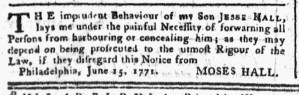
Pennsylvania Chronicle (July 1, 1771).

“THE imprudent Behaviour of my Son JESSE HALL, lays me under the painful Necessity of forwarning all Persons from harbouring or concealing him.”

Conradt Wolff lamented that his wife, Jenny, “hath behaved herself in such a manner as lays me under a necessity of forbidding any persons from trusting her on my account.”  In an advertisement in the July 1, 1771, edition of the New-York Gazette and Weekly Mercury, he warned the public that he “will pay no debts of her contracting.”  Throughout the colonies, similar notices frequently ran in eighteenth-century newspapers.  Aggrieved husbands deployed “runaway wife” advertisements to discipline disobedient women, though their notices told only one side of a story of marital discord. Relatively few wives possessed the resources to respond in print.  Those that did usually provided much different narratives, often accusing their husbands of abuse and neglect.  From their perspective, running away was an act of self-preservation and principled resistance rather than willful disobedience.

On occasion, colonists resorted to the public prints in the wake of other sorts of tumult within their households.  On the same day that Wolff placed an advertisement in the New-York Gazette, Moses Hall placed his own notice in the Pennsylvania Chronicle.  Hall, however, deplored the misbehavior of his son, Jesse.  “THE imprudent Behaviour of my Son,” Hall declared, “lays me under the painful Necessity of forwarning all Persons from harbouring or concealing him.” Furthermore, “they may depend on being prosecuted to the utmost Rigour of the Law, if they disregard this Notice.”  Hall did not elaborate on his son’s “imprudent Behaviour,” though gossip and rumors likely circulated beyond the newspaper.  That was almost certainly the case for the Camps and the Brents in Elizabethtown, New Jersey.  John D. Camp, Jr., informed readers of the New-York Gazette that he had been “compel’d by David Brent, to marry Catherine, his daughter.”  Camp vowed to “allow her a separate Maintenance, in all Respects suitable to her Degree,” but he would not pay “any Debts of her Contracting.”  Camp carefully avoided the details about events that resulted in his unwelcome wedding.  If friends and acquaintances had not been discussing whatever transpired between John and Catherine and her father before the advertisement ran in the New-York Gazette, its appearance probably prompted them to share what they knew for certain and speculate on what they did not.

Wolff, Hall, and Camp all attempted to focus attention on the subjects of their advertisements:  an absent wife, a troublesome son, or an imperious father-in-law.  In even publishing their notices, however, they called attention to themselves and their shortcomings in maintaining order within their households.  They sought to regain authority through the power of the press, but in the process they made their private altercations all the more visible to the public.  They framed the narratives and obscured the details, yet they still alerted others to scenes of difficulty and embarrassment that did not reflect well on them despite their efforts to shift responsibility to the actions of others.

July 2

What was advertised in a colonial American newspaper 250 years ago today?

Essex Gazette (July 2, 1771).

“To be sold by the Printer hereof.”

Samuel Hall, printer of the Essex Gazette, frequently supplemented the news accounts, letters, and paid notices in his newspaper with advertisements of his own.  In doing so, he simultaneously promoted various enterprises undertaken at his printing office in Salem and generated content to fill otherwise empty space.  Throughout the colonies, printers adopted similar strategies in their newspapers.

Consider the July 2, 1771, edition of the Essex Gazette.  Hall interspersed three of his own notices among the paid advertisements.  The first announced, “A good Assortment of PAPER, by the Ream or Quire, as cheap as at any Shop or Store in Boston; together with most other Sorts of Stationary, to be sold by the Printer hereof.”  Extending only four lines, this notice appeared near the bottom of the second column on the third page.  Another of Hall’s notice ran at the top of the final column on that page.  That one advised prospective customers that Hall sold copies of “the Rev. Dr. Pemberton’s Sermon in the Ordination of the Rev. Mr. Story of Marblehead.”  It also listed related items “annexed” to the sermon in the pamphlet.  Like many other printers, Hall pursued multiple revenue streams at his printing office, selling books and stationery to supplement the proceeds from newspaper subscriptions, advertisements, and job printing.

Essex Gazette (July 2, 1771).

In his third notice, Hall declared, “CASH given for RAGS, at the Printing Office in Salem.”  Printers frequently collected rags, a necessary resource for the production of the paper they needed to pursue their occupation.  Even more than his other notices in the July 2 issue, the placement of Hall’s call for rags suggests that it also served as filler to complete the page.  It appeared at the bottom of the final column.  The compositor also inserted decorative type to fill the remaining space, furthering testifying to the utility of running that particular notice.  Access to the press meant that printers could run advertisements promoting their own endeavors whenever they wished, but that was not the only reason they inserted notices into their publications.  Sometimes they sought to quickly and efficiently fill remaining space with short notices already on hand.  The type remained set for easy insertion whenever necessary, a strategy for streamlining the production of newspapers in eighteenth-century America.

Slavery Advertisements Published July 2, 1771

The Slavery Adverts 250 Project chronicles the role of newspaper advertising in perpetuating slavery in the era of the American Revolution. The project seeks to reveal the ubiquity of slavery in eighteenth-century life from New England to Georgia by republishing advertisements about enslaved people – for sale as individuals or in groups, wanted to purchase or for hire for short periods, runaways who liberated themselves, and those who were subsequently captured and confined in jails and workhouses – in daily digests on this site as well as in real time via the @SlaveAdverts250 Twitter feed, utilizing twenty-first-century media to stand in for the print media of the eighteenth century.

The project aims to provide modern audiences with a sense of just how often colonists encountered these advertisements in their daily lives. Enslaved men, women, and children appeared in print somewhere in the colonies almost every single day. Those advertisements served as a constant backdrop for social, cultural, economic, and political life in colonial and revolutionary America. Colonists who did not purport to own enslaved people were still confronted with slavery as well as invited to maintain the system by purchasing enslaved men, women, and children or assisting in the capture of so-called “runaways” who sought to free themselves from bondage. The frequency of these newspaper advertisements suggests just how embedded slavery was in colonial and revolutionary American culture in everyday interactions beyond the printed page.

These advertisements also testify to the experiences of enslaved men, women, and children, though readers must consider that those experiences have been remediated through descriptions offered by enslavers rather than enslaved people themselves. Often unnamed in the advertisements, enslaved men, women, and children were not invisible or unimportant in early America.

These advertisements appeared in colonial American newspapers 250 years ago today.

Connecticut Courant (July 2, 1771).

**********

Connecticut Courant (July 2, 1771).

**********

South-Carolina Gazette and Country Journal (July 2, 1771).

**********

South-Carolina Gazette and Country Journal (July 2, 1771).

**********

South-Carolina Gazette and Country Journal (July 2, 1771).

**********

South-Carolina Gazette and Country Journal (July 2, 1771).

**********

South-Carolina Gazette and Country Journal (July 2, 1771).

**********

South-Carolina Gazette and Country Journal (July 2, 1771).

**********

South-Carolina Gazette and Country Journal (July 2, 1771).

**********

South-Carolina Gazette and Country Journal (July 2, 1771).

**********

South-Carolina Gazette and Country Journal (July 2, 1771).

**********

South-Carolina Gazette and Country Journal (July 2, 1771).

**********

South-Carolina Gazette and Country Journal (July 2, 1771).

**********

South-Carolina Gazette and Country Journal (July 2, 1771).

**********

South-Carolina Gazette and Country Journal (July 2, 1771).

**********

South-Carolina Gazette and Country Journal (July 2, 1771).

**********

South-Carolina Gazette and Country Journal (July 2, 1771).

July 1

What was advertised in a colonial American newspaper 250 years ago today?

New-York Gazette and Weekly Mercury (July 1, 1771).

“A continuance of the same circumspect conduct and integrity.”

In the late 1760s and early 1770s, John Coghill Knapp regularly advertised the services he provided at the “Scrivener, Register, and Conveyancer’s OFFICE” in New York, including “Writings and conveyances of every kind” and “Different sums of money ready to lend.”  He also assisted in recovering debts “in the most civiliz’d easy manner, … at most times without law.”  In other words, through negotiation Knapp avoided going to court.  For “Executors and administrators,” especially those thrust into unfamiliar roles, he offered instruction “in the due execution of their office,” helping them navigate their responsibilities while “prevent[ing] the expence and difficulties from want of knowledge therein.”  In addition, Knapp aided “Seafaring men, and other strangers,” noting that they “often meet with difficulty in matter not altogether relative to the law.  Although he did not mention it in every advertisement, Knapp brokered sales of indentured servants and enslaved men, women, and children.

Knapp often composed colorful copy for his advertisements.  In a notice in the July 1, 1771, edition of the New-York Gazette and Weekly Mercury, he started with his credentials, stating that he was “ONE of the attornies of his Majesty’s high and honourable court of King’s Bench at Westminster, duly admitted, sworn, and inrolled, the 2d day of June 1755.”  After migrating to the colonies, he established his office in New York in 1764.  Having gained experience over the years, Knapp proclaimed that he “gives the most candid and satisfactory opinion and advice in all cases of law and equity, founded on such plain truths as are not to be overcome by the alluring arguments of any smooth tongue Causidie.”  Yet Knapp possessed a smooth tongue himself, declaring that he effectively met “the loud positive harangue of him who attempts to annihilate the reason of both judge and jury.”  The attorney deployed clever turns of phrase to impress potential clients with his competence and effectiveness.

Such flamboyance, however, attracted critiques.  In addition to describing his credential and services, Knapp also offered some sort of defense of his conduct in many of his advertisements.  He claimed, for instance, that he acted with integrity and requested that manner in which he “executed the business of this office for seven years past, will intitle him to a continuance of that favour and protection” that he previously received from clients and associates in the face of attacks from competitors and rivals.  In lively language that only hinted at the particulars of previous controversies, Knapp asserted that “he has so feelingly overcome the many daring assaults and unspeakable injuries done to his person and property, by cruel, invidious and designing men.”  He labeled them “hypocrites, pretending with so much ease to see the mote in their brother’s eye, but cannot behold the beam that is in their own.”

Knapp may have been an effective attorney and advocate for his clients, but that did not always win him friends.  Alternately, his verbose advertisements may have been the eighteenth-century equivalent of the bombastic marketing campaigns undertaken by many law firms with questionable reputations in the twentieth and twenty-first centuries.  Knapp claimed that he tended to his clients’ interests, but his vigorous defense of his own conduct suggested that many readers already possessed knowledge of events that yielded an unflattering reputation.  The attorney attempted to establish his own narrative, simultaneously demonstrating his skill in making arguments on behalf of clients.

Slavery Advertisements Published July 1, 1771

The Slavery Adverts 250 Project chronicles the role of newspaper advertising in perpetuating slavery in the era of the American Revolution. The project seeks to reveal the ubiquity of slavery in eighteenth-century life from New England to Georgia by republishing advertisements about enslaved people – for sale as individuals or in groups, wanted to purchase or for hire for short periods, runaways who liberated themselves, and those who were subsequently captured and confined in jails and workhouses – in daily digests on this site as well as in real time via the @SlaveAdverts250 Twitter feed, utilizing twenty-first-century media to stand in for the print media of the eighteenth century.

The project aims to provide modern audiences with a sense of just how often colonists encountered these advertisements in their daily lives. Enslaved men, women, and children appeared in print somewhere in the colonies almost every single day. Those advertisements served as a constant backdrop for social, cultural, economic, and political life in colonial and revolutionary America. Colonists who did not purport to own enslaved people were still confronted with slavery as well as invited to maintain the system by purchasing enslaved men, women, and children or assisting in the capture of so-called “runaways” who sought to free themselves from bondage. The frequency of these newspaper advertisements suggests just how embedded slavery was in colonial and revolutionary American culture in everyday interactions beyond the printed page.

These advertisements also testify to the experiences of enslaved men, women, and children, though readers must consider that those experiences have been remediated through descriptions offered by enslavers rather than enslaved people themselves. Often unnamed in the advertisements, enslaved men, women, and children were not invisible or unimportant in early America.

These advertisements appeared in colonial American newspapers 250 years ago today.

Boston Evening-Post (July 1, 1771).

**********

Boston-Gazette (July 1, 1771).

**********

Boston-Gazette (July 1, 1771).

**********

New-York Gazette and Weekly Mercury (July 1, 1771).

**********

New-York Gazette and Weekly Mercury (July 1, 1771).

**********

New-York Gazette and Weekly Mercury (July 1, 1771).

**********

New-York Gazette and Weekly Mercury (July 1, 1771).

**********

New-York Gazette and Weekly Mercury (July 1, 1771).

**********

Supplement to the New-York Gazette and Weekly Mercury (July 1, 1771).

**********

Supplement to the New-York Gazette and Weekly Mercury (July 1, 1771).

**********

Pennsylvania Chronicle (July 1, 1771).

**********

South-Carolina and American General Gazette (July 1, 1771).

**********

South-Carolina and American General Gazette (July 1, 1771).

**********

South-Carolina and American General Gazette (July 1, 1771).

**********

South-Carolina and American General Gazette (July 1, 1771).

**********

South-Carolina and American General Gazette (July 1, 1771).