August 5

What was advertised in a colonial American newspaper 250 years ago today?

Newport Mercury (August 5, 1771).

“Where may be gad all kinds of BLANKS commonly used in this Colony.”

Colonial printers often used the colophons on the final pages of their newspapers for more than merely providing the name of the printer and the place of publication.  Many printers treated colophons as spaces for promoting various aspects of their businesses, transforming them into ancillary advertisements.

In a relatively brief example, Solomon Southwick, printer of the Newport Mercury, informed readers that he supplied “all Kinds of BLANKS” (or printed forms for commercial and legal transactions) “commonly used in this Colony.”  Anne Catherine Green included a much more extensive colophon in Maryland Gazette.  Like many other printers, she hawked subscriptions and advertisements, but she also promoted other goods and services available at her printing office in Annapolis.  “At same Place may be had, ready Printed,” she declared, “most kinds of BLANKS, viz. COMMON and BAIL BONDS; TESTAMENTARY LETTERS of several Sorts, with their proper BONDS annexed; BILLS of EXCHANGE; [and] SHIPPING BILLS.”  In addition to blanks, “All Manner of PRINTING-WORK performed in the neatest and most expeditious Manner.”

Isaiah Thomas also used the colophon of his newspaper, the Massachusetts Spy, to solicit job printing in addition to subscriptions and advertisements.  “PRINTING, in its various Branches,” he proclaimed, “performed in a neat Manner, with the greatest Care and Dispatch, on the most reasonable Terms.”  In particular, Thomas produced “Small Hand-Bills at an Hour’s Notice.”  According to the colophon for the New-York Journal, John Holt did “all Sorts of Printing Work … in the neatest Manner, with Care and Expedition.”  Alexander Purdie and John Dixon deployed similar language in the colophon for the Virginia Gazette: “All sorts of PRINTING WORK done at this Office in the neatest Manner, with Care and Expedition.”

Not every newspaper printer transfigured the colophon into an advertisement.  The colophon for the Massachusetts Gazette and Boston News-Letter, for instance, simply stated, “BOSTON: Printed by R. Draper.”  A substantial number of printers, however, did seize the opportunity to do more than merely list their name and location at the bottom of the final page.  Their colophons became advertisements that perpetually appeared in their newspapers, promoting goods and services in a different format than other commercial notices.

Slavery Advertisements Published August 5, 1771

The Slavery Adverts 250 Project chronicles the role of newspaper advertising in perpetuating slavery in the era of the American Revolution. The project seeks to reveal the ubiquity of slavery in eighteenth-century life from New England to Georgia by republishing advertisements about enslaved people – for sale as individuals or in groups, wanted to purchase or for hire for short periods, runaways who liberated themselves, and those who were subsequently captured and confined in jails and workhouses – in daily digests on this site as well as in real time via the @SlaveAdverts250 Twitter feed, utilizing twenty-first-century media to stand in for the print media of the eighteenth century.

The project aims to provide modern audiences with a sense of just how often colonists encountered these advertisements in their daily lives. Enslaved men, women, and children appeared in print somewhere in the colonies almost every single day. Those advertisements served as a constant backdrop for social, cultural, economic, and political life in colonial and revolutionary America. Colonists who did not purport to own enslaved people were still confronted with slavery as well as invited to maintain the system by purchasing enslaved men, women, and children or assisting in the capture of so-called “runaways” who sought to free themselves from bondage. The frequency of these newspaper advertisements suggests just how embedded slavery was in colonial and revolutionary American culture in everyday interactions beyond the printed page.

These advertisements also testify to the experiences of enslaved men, women, and children, though readers must consider that those experiences have been remediated through descriptions offered by enslavers rather than enslaved people themselves. Often unnamed in the advertisements, enslaved men, women, and children were not invisible or unimportant in early America.

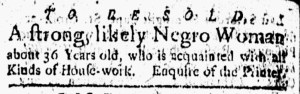
These advertisements appeared in colonial American newspapers 250 years ago today.

Boston Evening-Post (August 5, 1771).

**********

Boston Evening-Post (August 5, 1771).

**********

Boston-Gazette (August 5, 1771).

**********

Newport Mercury (August 5, 1771).

**********

Newport Mercury (August 5, 1771).

**********

Newport Mercury (August 5, 1771).

**********

New-York Gazette and Weekly Mercury (August 5, 1771).

**********

New-York Gazette and Weekly Mercury (August 5, 1771).

**********

Pennsylvania Chronicle (August 5, 1771).

**********

Pennsylvania Chronicle (August 5, 1771).

August 4

What was advertised in a colonial America newspaper 250 years ago this week?

Maryland Gazette (August 1, 1771).

“Has been regularly bred to the tailoring Trade in the most capital house for that Business.”

James Logan, a tailor, was an outsider when he arrived in Annapolis.  Like many other artisans who migrated across the Atlantic, he introduced himself to his new community (and prospective clients) in a newspaper advertisement that included an account of his credentials.  Until he had an opportunity to establish a reputation in his new home, he relied on his training and experience to recommend him to potential customers.

Logan’s advertisement ran in the August 4, 1771, edition of the Maryland Gazette.  He informed readers that “not only has [he] been regularly bred to the tailoring Trade in the most capital House for that Business, in the City of Cork, but also worked for a considerable Time with much Applause, with most eminent Masters in England and Ireland.”  Having worked with “eminent Masters” enhanced his training, but also testified to a competence that others who followed his occupation recognized in Logan.  Those experiences prepared him to pursue “his Trade in all it’s various Branches,” capable of completing any task requested by clients in his new city “to give the utmost Satisfaction.”  He also leveraged his connections to “the most capital House” in Cork and “eminent Masters in England and Ireland” to suggest a certain amount of cachet associated with hiring him.

The tailor also sought to convince prospective customers of his commitment to his craft combined with his desire to serve them.  He trumpeted his “superior Ability” and in the same breath promised “constant Adherence to the due Assiduity highly necessary in the Execution” of his new undertaking.  Even more verbose than many artisans who advertised in colonial newspapers, Logan aimed to make himself memorable to readers not yet familiar with the garments he made.  For the moment, words by necessity substituted for the reputation that he hoped to cultivate in Annapolis as he built his clientele.

August 3

What was advertised in a colonial American newspaper 250 years ago today?

Providence Gazette (August 3, 1771).

“Just imported … by Joseph and William Russell.”

Joseph Russell and William Russell, two of Providence’s most prominent merchants, made shrewd use of the public prints to keep their names … and their merchandise … before the eyes of prospective customers.  Some merchants and shopkeepers advertised only when they received new shipments of goods, running their notices for three or four weeks.  The Russells, on the other hand, continuously updated their marketing efforts, inserting new advertisements in the Providence Gazette when they discontinued others.

For four weeks in the summer of 1771, they ran an advertisement for “A VERY large and neat Assortment of English Goods, Ironmongery, Brasiery, Cutlery, Haberdashery, [and] Stationary” that they “Imported from London, in the Ship Providence, and in the Snow Tristram.”  Two weeks after that notice ran for the final time, they inserted a new advertisement, a much lengthier one that listed a variety of textiles, housewares, and other goods in two columns.  The Russells stated that these items were “Just imported from London, in the last ships.”  Savvy readers probably assumed that the Russells did not advertise merchandise that actually just arrived (or else they would have specified which vessels delivered their inventory) but instead goods received many weeks earlier via the Providence and Tristram.

That purveyors of goods sometimes hedged a bit in their advertisements was not any more of a surprise in the eighteenth century than today.  The Russells did not advance any outright misrepresentations as they attempted to garner new attention for their inventory by publishing an advertisement that differed so significantly from the shorter one that previously appeared in the Providence Gazette.  Had they continued inserting the earlier advertisement, they risked readers skipping over content that looked too familiar.  The new notice, lengthier with a different format, allowed them to highlight particular items even as they promoted all of their merchandise more generally.  The Russells invested in repetition, enhancing the visibility and reputation of their business by keeping it in the public prints.

August 2

Who was the subject of an advertisement in a colonial American newspaper 250 years ago today?

Connecticut Journal (August 2, 1771).

“Run-away … a Molatto Fellow named BEN.”

On July 20, 1771, Ben, an enslaved man, liberated himself from Isaac Woodruff of Waterbury, Connecticut.  Two days later, Woodruff penned a runaway notice to appear in the Connecticut Journal and submitted it to the printing office operated by Thomas Green and Samuel Green in New Haven.  The advertisement appeared in the next issue, published on July 26, and then again in the next two issues on August 2 and 9.  By the time the advertisement first ran, Ben had eluded Woodruff for nearly a week.  That may have been enough time for Ben to put considerable distance between himself and the man who intended to re-enslave, especially if he managed to find work aboard a ship departing for a faraway port.  Woodruff suspected that might be the case, stating that Ben “has been used to the Sea, and tis supposed he will endeavour to get on board some Vessel as soon as possible.”

Woodruff solicited the aid of readers of the Connecticut Journal, encouraging them to engage in surveillance of young Black men in order to identify “a Molatto Fellow … of a Copper Complexion, about 17 Years of Age” with “a black bushy Head of Hair.”  Woodruff also noted that Ben “speaks good English and is addicted to swearing” to aid readers in determining if any of the Black men they encountered might be the fugitive from enslavement.  To encourage their collusion in the endeavor, he offered a reward for “Any Person that shall take up said Fellow, and return him to his Master or give notice where he is.”

In publishing the advertisement, Woodruff embarked on what he hoped would become a community effort to return Ben to bondage.  Thomas Green and Samuel Green, the printers, were already complicit, providing Woodruff space in their newspaper and accepting payment for the advertisement.  They ran the notice on three occasions, but then continued to collude with other enslavers.  The first item on the first page of the August 16 edition, the first published after the last appearance of Woodruff’s advertisement offering a reward for the capture and return of Ben, was an advertisement about “a Negro man slave named BOSTON” who, like Ben, had liberated himself.  The Greens were not unique when it came to publishing such advertisements in their newspaper.  Printers from New England to Georgia generated revenues from notices about enslaved people.  In the process, they played a significant role in the perpetuation of slavery during the era of the American Revolution.

Slavery Advertisements Published August 2, 1771

The Slavery Adverts 250 Project chronicles the role of newspaper advertising in perpetuating slavery in the era of the American Revolution. The project seeks to reveal the ubiquity of slavery in eighteenth-century life from New England to Georgia by republishing advertisements about enslaved people – for sale as individuals or in groups, wanted to purchase or for hire for short periods, runaways who liberated themselves, and those who were subsequently captured and confined in jails and workhouses – in daily digests on this site as well as in real time via the @SlaveAdverts250 Twitter feed, utilizing twenty-first-century media to stand in for the print media of the eighteenth century.

The project aims to provide modern audiences with a sense of just how often colonists encountered these advertisements in their daily lives. Enslaved men, women, and children appeared in print somewhere in the colonies almost every single day. Those advertisements served as a constant backdrop for social, cultural, economic, and political life in colonial and revolutionary America. Colonists who did not purport to own enslaved people were still confronted with slavery as well as invited to maintain the system by purchasing enslaved men, women, and children or assisting in the capture of so-called “runaways” who sought to free themselves from bondage. The frequency of these newspaper advertisements suggests just how embedded slavery was in colonial and revolutionary American culture in everyday interactions beyond the printed page.

These advertisements also testify to the experiences of enslaved men, women, and children, though readers must consider that those experiences have been remediated through descriptions offered by enslavers rather than enslaved people themselves. Often unnamed in the advertisements, enslaved men, women, and children were not invisible or unimportant in early America.

These advertisements appeared in colonial American newspapers 250 years ago today.

Connecticut Journal (August 2, 1771).

**********

New-London Gazette (August 2, 1771).

August 1

What was advertised in a colonial American newspaper 250 years ago today?

Pennsylvania Gazette (August 1, 1771).

“At the GOLDEN LION.”

In the early 1770s, John Carnan, a goldsmith and jeweler, ran a shop at the corner of Second and Chestnut Streets in Philadelphia.  He promoted his “GOLD, SILVER and JEWELLERY WORK” in advertisements in the Pennsylvania Gazette, assuring prospective customers that he made his wares “in the best and newest taste.”  Like many other purveyors of goods, he provided an overview of his inventory in a dense paragraph of text.  Carnan listed everything from “TANKARDS, cans, tea, coffee and cream pots” to “gold, silver, gilt, enamelled, Scotch pebble, moco, chrystal, paste and glass sleeve buttons” to “silver and enamelled snuff-boxes [and] silver mounted decanter corks.”  In addition, he offered customers the opportunity to select among “sundry other articles, too tedious to mention.”  In terms of advertising copy, Carnan’s notice very much resembled others placed by purveyors of goods and services in Philadelphia and other American towns and cities.

The woodcut that adorned Carnan’s advertisement, however, distinguished it from others.  Carnan marked his location with a sign depicting a golden lion.  A woodcut that also depicted a lion appeared in the upper left corner of his advertisement.  (Regular visitors to the Adverts 250 Project will likely recognize this lion as the image that has appeared on its home page since its inception.)  The woodcut in the advertisement may have replicated Carnan’s shop sign, serving as a logo or brand that identified his business.  Even if the woodcut did not resemble the sign, incorporating an image of a lion likely helped consumers associate the regal animal with the goldsmith and jeweler, making his shop all the more memorable.  Unlike the woodcuts depicting ships at sea, the only other images in the August 1, 1771, edition of the Pennsylvania Gazette beyond the masthead, the woodcut of the lion belonged to the advertiser rather than the printer.  Carnan invested in an image reserved for his sole use.  Over time, he included the image in other advertisements, providing consistency via the image even as he generated new copy for his notices.  Inserting the same woodcut in multiple advertisements also allowed him a greater return on his investment.  Not every advertiser who commissioned unique woodcuts used them more than once.  Carnan, however, recognized the potential for enhancing his marketing efforts with an image that represented his business and attracted attention among prospective customers.

Slavery Advertisements Published August 1, 1771

The Slavery Adverts 250 Project chronicles the role of newspaper advertising in perpetuating slavery in the era of the American Revolution. The project seeks to reveal the ubiquity of slavery in eighteenth-century life from New England to Georgia by republishing advertisements about enslaved people – for sale as individuals or in groups, wanted to purchase or for hire for short periods, runaways who liberated themselves, and those who were subsequently captured and confined in jails and workhouses – in daily digests on this site as well as in real time via the @SlaveAdverts250 Twitter feed, utilizing twenty-first-century media to stand in for the print media of the eighteenth century.

The project aims to provide modern audiences with a sense of just how often colonists encountered these advertisements in their daily lives. Enslaved men, women, and children appeared in print somewhere in the colonies almost every single day. Those advertisements served as a constant backdrop for social, cultural, economic, and political life in colonial and revolutionary America. Colonists who did not purport to own enslaved people were still confronted with slavery as well as invited to maintain the system by purchasing enslaved men, women, and children or assisting in the capture of so-called “runaways” who sought to free themselves from bondage. The frequency of these newspaper advertisements suggests just how embedded slavery was in colonial and revolutionary American culture in everyday interactions beyond the printed page.

These advertisements also testify to the experiences of enslaved men, women, and children, though readers must consider that those experiences have been remediated through descriptions offered by enslavers rather than enslaved people themselves. Often unnamed in the advertisements, enslaved men, women, and children were not invisible or unimportant in early America.

These advertisements appeared in colonial American newspapers 250 years ago today.

Maryland Gazette (August 1, 1771).

**********

Maryland Gazette (August 1, 1771).

**********

Maryland Gazette (August 1, 1771).

**********

Maryland Gazette (August 1, 1771).

**********

Maryland Gazette (August 1, 1771).

**********

Massachusetts Gazette and Boston Weekly News-Letter (August 1, 1771).

**********

Massachusetts Gazette and Boston Weekly News-Letter (August 1, 1771).

**********

Massachusetts Spy (August 1, 1771).

**********

New-York Journal (August 1, 1771).

**********

Pennsylvania Gazette (August 1, 1771).

**********

South-Carolina Gazette (August 1, 1771).

**********

South-Carolina Gazette (August 1, 1771).

**********

South-Carolina Gazette (August 1, 1771).

**********

South-Carolina Gazette (August 1, 1771).

**********

South-Carolina Gazette (August 1, 1771).

**********

South-Carolina Gazette (August 1, 1771).

**********

South-Carolina Gazette (August 1, 1771).

**********

Supplement to the South-Carolina Gazette (August 1, 1771).

**********

Supplement to the South-Carolina Gazette (August 1, 1771).

**********

Supplement to the South-Carolina Gazette (August 1, 1771).

**********

Supplement to the South-Carolina Gazette (August 1, 1771).

**********

Virginia Gazette [Purdie and Dixon] (August 1, 1771).

**********

Virginia Gazette [Purdie and Dixon] (August 1, 1771).

**********

Virginia Gazette [Purdie and Dixon] (August 1, 1771).

**********

Virginia Gazette [Purdie and Dixon] (August 1, 1771).

**********

Virginia Gazette [Purdie and Dixon] (August 1, 1771).

**********

Virginia Gazette [Purdie and Dixon] (August 1, 1771).

**********

Virginia Gazette [Purdie and Dixon] (August 1, 1771).

**********

Virginia Gazette [Purdie and Dixon] (August 1, 1771).

**********

Virginia Gazette [Purdie and Dixon] (August 1, 1771).

**********

Virginia Gazette [Purdie and Dixon] (August 1, 1771).

**********

Virginia Gazette [Purdie and Dixon] (August 1, 1771).

**********

Virginia Gazette [Purdie and Dixon] (August 1, 1771).

**********

Virginia Gazette [Purdie and Dixon] (August 1, 1771).

**********

Virginia Gazette [Purdie and Dixon] (August 1, 1771).

**********

Virginia Gazette [Purdie and Dixon] (August 1, 1771).

**********

Virginia Gazette [Purdie and Dixon] (August 1, 1771).

**********

Virginia Gazette [Rind] (August 1, 1771).

**********

Virginia Gazette [Rind] (August 1, 1771).

**********

Virginia Gazette [Rind] (August 1, 1771).

**********

Virginia Gazette [Rind] (August 1, 1771).

**********

Virginia Gazette [Rind] (August 1, 1771).

**********

Virginia Gazette [Rind] (August 1, 1771).

**********

Virginia Gazette [Rind] (August 1, 1771).