October 24

GUEST CURATOR:  Katie Galvin

Who was the subject of an advertisement in a colonial American newspaper 250 years ago today?

Supplement to the South-Carolina Gazette (October 24, 1771).

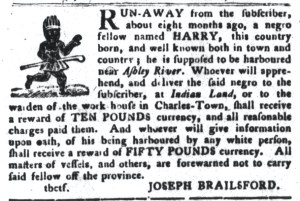
“RUN-AWAY … a NEGRO MAN, named HECTOR … Also a Negro Man, named MAIDSTONE.”

This advertisement concerns an enslaved man named Hector, along with another enslaved man named Maidstone. Both men ran away from James Sinkler’s plantation.  Sinkler claimed that Hector was “supposed to be harboured at Mr. Boone’s plantation… where his Father and Mother reside.” This means that Hector was attempting to run away and return to his family and that they helped him by hiding him. Many enslaved people at the time were separated from family and friends during auctions or other sales. Sinkler said that Maidstone has been “lately purchased at the Sale of Mr. JAMES LE BAS Estate,” so he has been recently stripped away from his community.

Maidstone and Hector had experiences similar to many other enslaved people. According to Victoria Bissell Brown and Timothy J. Shannon, enslaved people often ran away for reasons more than the mistreatment from masters. Sometimes they were “trying to preserve a family that was being driven apart by a sale.”[1] Many enslaved people wanted to liberate themselves and reunite with their families.  Historians at the National Park Service’s Ethnography Program also state that “enslaved people ran away to reestablish marital and family ties or to protest changes in ownership or even to join prospective mates from whom they’ve been separated from.”

**********

ADDITIONAL COMMENTARY:  Carl Robert Keyes

James Sinkler made a significant investment in his efforts to recover two men he enslaved.  Katie chose to examine his advertisement that ran in the South-Carolina Gazette on October 24, 1771, but that is not the only newspaper that carried Sinkler’s notice.  As guest curator for the Slavery Adverts 250 Project, Katie also worked with Sinkler’s advertisement in the October 28 edition of the South-Carolina and American General Gazette and the October 29 edition of the South-Carolina Gazette and Country Journal.  Sinkler was so eager to recapture Hector and Maidstone that he placed notices in every newspaper printed in Charleston, increasing the dissemination of his advertisement and encouraging greater numbers of colonists to engage in surveillance of Black men to determine if they matched the descriptions that appeared in print.

By the time Sinkler’s advertisement appeared in those newspapers in late October, they had already been running for months.  As work has continued on the production of the Slavery Adverts 250 Project, other guest curators and I have learned that Sinkler’s advertisements continued to appear well into 1772.  We have not yet determined when Sinkler discontinued them.  That the advertisements ran for so long suggests that Hector and Maidstone managed to elude detection and evade capture for quite some time.  They may have received assistance from family and friends in the places Sinkler suspected, but they may have gone in completely different directions than he imagined.  The same may have been true for Cudjoe, Jemmy, Rynah, Venus, and Dye, five enslaved people who fled from Peter Sinkler and James Sinkler on the last day of March in 1771.  The Sinklers thought that the fugitives seeking their freedom “intend for Ponpon, where they lately lived.”  If they did, no one there spotted them and attempted to claim the reward.  That advertisement also continued to run in October, more than six months later.

The archive includes many silences, including the fates of most enslaved people who attempted to liberate themselves by running away from those who held them in bondage.  That advertisements about Hector and Maidstone ran for many months suggests that the men managed to make good on their escape.  At the very least, they were not recaptured quickly or easily.  The text of the advertisement offers insights into their experiences, but tracking it through multiple newspapers over an extended period helps to reconstruct a more complete story of what might have happened.  Even then, the silences in the archive prevail.

**********

[1] Victoria Bissel Brown and Timothy J. Shannon, “Colonial America’s Most Wanted: Runaway Advertisements in Colonial Newspapers,” in Going to the Source: The Bedford Reader in American History, eds. Brown and Shannon (Boston: Bedford/St. Martin’s, 2004), 50.
Welcome, Guest Curator Katie Galvin

Katie Galvin is a senior at Assumption University in Worcester, Massachusetts, where she is majoring in History and minoring in English Literature. Living north of Boston, she developed a love for U.S. history, especially the American Revolution and the framing of the government. Some day she would love to work in Boston or Washington, D.C. Katie served as an intern at the American Independence Museum in Exeter, New Hampshire, during the summer of 2021.  She is currently participating in the American Studies Seminar at the American Antiquarian Society, exploring “A Second and More Glorious Revolution:  Protest and Radical Thought in the Nineteenth-Century United States.” Katie is active in Campus Ministry, Merely Players, and Club/Intramural Soccer.  She made her contributions to the Adverts 250 Project and the Slavery Adverts 250 Project while enrolled in HIS 400 Research Methods: Vast Early America in Spring 2020.

Welcome, guest curator Katie Galvin!

Slavery Advertisements Published October 24, 1771

GUEST CURATOR: Chloe Amour
with contributions from Katie Galvin

The Slavery Adverts 250 Project chronicles the role of newspaper advertising in perpetuating slavery in the era of the American Revolution. The project seeks to reveal the ubiquity of slavery in eighteenth-century life from New England to Georgia by republishing advertisements about enslaved people – for sale as individuals or in groups, wanted to purchase or for hire for short periods, runaways who liberated themselves, and those who were subsequently captured and confined in jails and workhouses – in daily digests on this site as well as in real time via the @SlaveAdverts250 Twitter feed, utilizing twenty-first-century media to stand in for the print media of the eighteenth century.

The project aims to provide modern audiences with a sense of just how often colonists encountered these advertisements in their daily lives. Enslaved men, women, and children appeared in print somewhere in the colonies almost every single day. Those advertisements served as a constant backdrop for social, cultural, economic, and political life in colonial and revolutionary America. Colonists who did not purport to own enslaved people were still confronted with slavery as well as invited to maintain the system by purchasing enslaved men, women, and children or assisting in the capture of so-called “runaways” who sought to free themselves from bondage. The frequency of these newspaper advertisements suggests just how embedded slavery was in colonial and revolutionary American culture in everyday interactions beyond the printed page.

These advertisements also testify to the experiences of enslaved men, women, and children, though readers must consider that those experiences have been remediated through descriptions offered by enslavers rather than enslaved people themselves. Often unnamed in the advertisements, enslaved men, women, and children were not invisible or unimportant in early America.

From compiling an archive of digitized eighteenth-century newspapers to identifying advertisements about enslaved men, women, and children in those newspapers to preparing images of each advertisement to posting this daily digest, Chloe Amour served as guest curator for this entry.  She completed this work while enrolled in an independent study for HIS 390 – Digital Humanities Practicum at Assumption University in Worcester, Massachusetts, in Spring 2021.

These advertisements appeared in colonial American newspapers 250 years ago today.

Maryland Gazette (October 24, 1771).

**********

New-York Journal (October 24, 1771).

**********

New-York Journal (October 24, 1771).

**********

Pennsylvania Journal (October 24, 1771).

**********

South-Carolina Gazette (October 24, 1771).

**********

South-Carolina Gazette (October 24, 1771).

**********

South-Carolina Gazette (October 24, 1771).

**********

South-Carolina Gazette (October 24, 1771).

**********

South-Carolina Gazette (October 24, 1771).

**********

South-Carolina Gazette (October 24, 1771).

**********

South-Carolina Gazette (October 24, 1771).

**********

South-Carolina Gazette (October 24, 1771).

**********

South-Carolina Gazette (October 24, 1771).

**********

South-Carolina Gazette (October 24, 1771).

**********

Virginia Gazette [Purdie and Dixon] (October 24, 1771).

**********

Virginia Gazette [Purdie and Dixon] (October 24, 1771).

**********

Virginia Gazette [Purdie and Dixon] (October 24, 1771).

**********

Virginia Gazette [Purdie and Dixon] (October 24, 1771).

**********

Virginia Gazette [Purdie and Dixon] (October 24, 1771).

**********

Virginia Gazette [Purdie and Dixon] (October 24, 1771).

**********

Virginia Gazette [Purdie and Dixon] (October 24, 1771).

**********

Virginia Gazette [Purdie and Dixon] (October 24, 1771).

**********

Virginia Gazette [Purdie and Dixon] (October 24, 1771).

**********

Virginia Gazette [Purdie and Dixon] (October 24, 1771).

**********

Virginia Gazette [Purdie and Dixon] (October 24, 1771).

**********

Virginia Gazette [Purdie and Dixon] (October 24, 1771).

October 23

What was advertised in a colonial American newspaper 250 years ago this week?

South-Carolina Gazette and Country Journal (October 22, 1771).

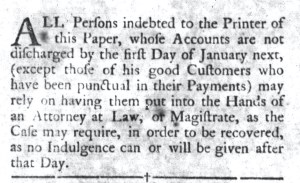
“ALL Persons indebted to the Printer of this Paper …”

The masthead for the South-Carolina Gazette and Country Journal proclaimed that its pages “Contain[ed] the freshest Advices, both Foreign and Domestic.”  The newspaper also disseminated a lot of advertisements, on some occasions more advertising than other content.  The October 22, 1771, edition, for instance, consisted primarily of advertisements.  They filled the entire front and back pages.  News appeared on the second page and overflowed into the first column on the third, but “NEW ADVERTISEMENTS” comprised the remainder of that page.  Charles Crouch received so many advertisements at his printing office that he published a two-page supplement devoted entirely to advertising.

Those advertisements represented significant revenue for Crouch, but only if advertisers actually paid for the time and labor required to set the type and for the space that their notices occupied when they ran week after week.  Many advertisers, as well as subscribers, were slow to pay, prompting Crouch to insert his own notice that “ALL Persons indebted to the Printer of this Paper, whose Accounts are not discharged by the first Day of January next … may rely on having them put into the Hands of an Attorney at Law, or Magistrate, as the Case may require.”  He made an exception for “those of his good Customers who have been punctual in their Payments,” but otherwise extended “no Indulgence” to others.

Colonists who pursued all sorts of occupations frequently placed similar advertisements in the South-Carolina Gazette and Country Journal and other newspapers throughout the colonies, but Crouch had an advantage when it came to placing his notice in front of the eyes of the customers that he wanted to see it.  As printer, he determined the order of the contents in his newspaper.  He strategically placed his notice as the first item in the first column on the first page, immediately below the masthead, making it more likely that readers would notice it even if they merely skimmed other advertisements or looked for the news.  Other advertisers usually did not choose where their notices appeared in relation to other content.  As part of the business of operating printing offices and publishing newspapers, Crouch and other printers often made the placement of their own notices a priority.  After all, the financial health of their newspapers served not only themselves but also subscribers who kept informed about current events, advertisers who wished to share their messages with the public, and entire communities that benefited from the circulation of information.

October 22

What was advertised in a colonial American newspaper 250 years ago today?

South-Carolina Gazette and Country Journal (October 22, 1771).

“Several scandalous and malicious written bills stuck up in many public places about town.”

William Tweed was angry.  As he strolled through the streets of Charleston in the fall of 1771, he discovered that an anonymous antagonist had posted small broadsides, written by hand rather than printed, that attacked him.  In response, he turned to the public prints to achieve some sort of remedy.  In an advertisement in the October 22 edition of the South-Carolina Gazette and Country Journal, he expressed his frustration that “several scandalous and malicious written bills” had been “stuck up in many public places about town, tending to injure his character and reputation with the public.”  To remedy the situation, he offered a generous “One Hundred Pounds reward” to “Whoever will discover the author thereof, so that he may be brought to justice.”

Tweed meant business.  He placed the same advertisement in the South-Carolina and American Gazette on October 21 and in the South-Carolina Gazette on October 24.  In the course of three days, it ran in each newspaper published in the city, maximizing the number of readers likely to see it.  Considering the size of the reward that Tweed offered, he probably did not think twice about how much it cost to run the advertisement simultaneously in three newspapers.

Tweed likely removed the handwritten bills wherever and whenever he encountered them, but his advertisements may have called additional attention to the accusations they made against him.  Newspaper readers who had not otherwise been aware of the bills may have sensed a good story, one that Tweed did not commit to print, and asked their friends and associates if they knew more about what had transpired than appeared in the advertisements.  Even as Tweed attempted to leverage the power of print for damage control, he may have given the handbills new life and greater reach as colonists gossiped about what occurred.  On the other hand, discovering the author of those missives gave him a better chance to defend himself and rehabilitate his character and reputation.  That, apparently, was worth the risk of drawing attention to the incident in a series of newspaper advertisements.

Slavery Advertisements Published October 22, 1771

GUEST CURATOR: Daniel Carito

The Slavery Adverts 250 Project chronicles the role of newspaper advertising in perpetuating slavery in the era of the American Revolution. The project seeks to reveal the ubiquity of slavery in eighteenth-century life from New England to Georgia by republishing advertisements about enslaved people – for sale as individuals or in groups, wanted to purchase or for hire for short periods, runaways who liberated themselves, and those who were subsequently captured and confined in jails and workhouses – in daily digests on this site as well as in real time via the @SlaveAdverts250 Twitter feed, utilizing twenty-first-century media to stand in for the print media of the eighteenth century.

The project aims to provide modern audiences with a sense of just how often colonists encountered these advertisements in their daily lives. Enslaved men, women, and children appeared in print somewhere in the colonies almost every single day. Those advertisements served as a constant backdrop for social, cultural, economic, and political life in colonial and revolutionary America. Colonists who did not purport to own enslaved people were still confronted with slavery as well as invited to maintain the system by purchasing enslaved men, women, and children or assisting in the capture of so-called “runaways” who sought to free themselves from bondage. The frequency of these newspaper advertisements suggests just how embedded slavery was in colonial and revolutionary American culture in everyday interactions beyond the printed page.

These advertisements also testify to the experiences of enslaved men, women, and children, though readers must consider that those experiences have been remediated through descriptions offered by enslavers rather than enslaved people themselves. Often unnamed in the advertisements, enslaved men, women, and children were not invisible or unimportant in early America.

These advertisements appeared in colonial American newspapers 250 years ago today.

Connecticut Courant (October 22, 1771).

**********

Essex Gazette (October 22, 1771).

**********

South-Carolina Gazette and Country Journal (October 22, 1771).

**********

South-Carolina Gazette and Country Journal (October 22, 1771).

**********

South-Carolina Gazette and Country Journal (October 22, 1771).

**********

South-Carolina Gazette and Country Journal (October 22, 1771).

**********

South-Carolina Gazette and Country Journal (October 22, 1771).

**********

Supplement to the South-Carolina Gazette and Country Journal (October 22, 1771).

**********

Supplement to the South-Carolina Gazette and Country Journal (October 22, 1771).

**********

Supplement to the South-Carolina Gazette and Country Journal (October 22, 1771).

**********

Supplement to the South-Carolina Gazette and Country Journal (October 22, 1771).

**********

Supplement to the South-Carolina Gazette and Country Journal (October 22, 1771).

**********

Supplement to the South-Carolina Gazette and Country Journal (October 22, 1771).

**********

Supplement to the South-Carolina Gazette and Country Journal (October 22, 1771).

**********

Supplement to the South-Carolina Gazette and Country Journal (October 22, 1771).

**********

Supplement to the South-Carolina Gazette and Country Journal (October 22, 1771).

**********

Supplement to the South-Carolina Gazette and Country Journal (October 22, 1771).

October 21

What was advertised in a colonial American newspaper 250 years ago today?

Pennsylvania Chronicle (October 21, 1771).

“The newest fashionable muffs [and] tippets.”

A woodcut depicting a muff and tippet adorned the advertisements that the partnership of Fromberger and Siemon placed in the Pennsylvania Chronicle and the Pennsylvania Journal in the fall of 1771.  The advertisers did not rely on the image alone to market their “large assortment of Russia and Siberia fur skins” and garments made from those furs, but it almost certainly helped draw attention to their advertisements.  That woodcut also represented an additional expense.  Unlike the type used to print the copy in their notices, the woodcut belonged to the advertisers rather than the printers.  That being the case, Fromberger and Siemon collected their woodcut from one printing office and delivered it to another when they expanded their advertising campaign.

The furriers first inserted an advertisement in the September 26 edition of the Pennsylvania Journal.  It ran again the following week.  Nearly three weeks elapsed before the same advertisement appeared in the October 21 edition of the Pennsylvania Chronicle.  It featured identical copy, though the compositor made different decisions about line breaks, as well as the familiar woodcut that occupied nearly half the space allotted to the advertisement.  Careful examination of the image reveals that it was indeed the same woodcut, not a similar image.  Fromberger and Siemon commissioned only one woodcut, but they aimed to garner a greater return on their investment by disseminating it in more than one newspaper. For many readers of the Pennsylvania Chronicle, the image would have been new and novel when they encountered it.  Those who also happened to peruse the Pennsylvania Journal, however, would have recognized the woodcut.  The repetition of the image likely helped Fromberger and Siemon achieve greater visibility for their enterprise.  Had they published it more regularly, they might have encouraged readers to consider the image a trademark of sorts, but their notices appeared too sporadically.  Although Fromberger and Siemon did not seize the opportunity to further enhance their marketing efforts through consistent repetition of the image of the muff and tippet in the fall of 1771, they did devise advertisements that stood out from others because of the woodcut that accompanied them.

Slavery Advertisements Published October 21, 1771

GUEST CURATOR: Daniel Carito

The Slavery Adverts 250 Project chronicles the role of newspaper advertising in perpetuating slavery in the era of the American Revolution. The project seeks to reveal the ubiquity of slavery in eighteenth-century life from New England to Georgia by republishing advertisements about enslaved people – for sale as individuals or in groups, wanted to purchase or for hire for short periods, runaways who liberated themselves, and those who were subsequently captured and confined in jails and workhouses – in daily digests on this site as well as in real time via the @SlaveAdverts250 Twitter feed, utilizing twenty-first-century media to stand in for the print media of the eighteenth century.

The project aims to provide modern audiences with a sense of just how often colonists encountered these advertisements in their daily lives. Enslaved men, women, and children appeared in print somewhere in the colonies almost every single day. Those advertisements served as a constant backdrop for social, cultural, economic, and political life in colonial and revolutionary America. Colonists who did not purport to own enslaved people were still confronted with slavery as well as invited to maintain the system by purchasing enslaved men, women, and children or assisting in the capture of so-called “runaways” who sought to free themselves from bondage. The frequency of these newspaper advertisements suggests just how embedded slavery was in colonial and revolutionary American culture in everyday interactions beyond the printed page.

These advertisements also testify to the experiences of enslaved men, women, and children, though readers must consider that those experiences have been remediated through descriptions offered by enslavers rather than enslaved people themselves. Often unnamed in the advertisements, enslaved men, women, and children were not invisible or unimportant in early America.

These advertisements appeared in colonial American newspapers 250 years ago today.

Supplement to the Boston-Gazette (October 21, 1771).

**********

Newport Mercury (October 21, 1771).

**********

Newport Mercury (October 21, 1771).

**********

New-York Gazette and Weekly Mercury (October 21, 1771).

**********

New-York Gazette and Weekly Mercury (October 21, 1771).

**********

Supplement to the New-York Gazette and Weekly Mercury (October 21, 1771).

**********

Supplement to the New-York Gazette and Weekly Mercury (October 21, 1771).

**********

Supplement to the New-York Gazette and Weekly Mercury (October 21, 1771).

**********

South-Carolina and American General Gazette (October 21, 1771).

**********

South-Carolina and American General Gazette (October 21, 1771).

**********

South-Carolina and American General Gazette (October 21, 1771).

**********

South-Carolina and American General Gazette (October 21, 1771).

**********

South-Carolina and American General Gazette (October 21, 1771).

**********

South-Carolina and American General Gazette (October 21, 1771).

**********

South-Carolina and American General Gazette (October 21, 1771).

**********

South-Carolina and American General Gazette (October 21, 1771).

**********

South-Carolina and American General Gazette (October 21, 1771).

**********

South-Carolina and American General Gazette (October 21, 1771).

**********

South-Carolina and American General Gazette (October 21, 1771).

October 20

What was advertised in a colonial American newspaper 250 years ago this week?

Virginia Gazette [Purdie and Dixon] (October 17, 1771).
“I have also made it known that I would never pay any of his Debts.”

Readers regularly encountered “runaway wife” advertisements in eighteenth-century newspapers.  Aggrieved husbands placed such notices to warn the community not to extend credit to women who absconded from their households without permission.  In many instances, husbands complained about various infractions committed by their wives, but such narratives privileged husbands’ perspectives.  On those rare occasions when wives responded in print, they described misbehavior and abuses perpetrated by their husbands.  For those women, running away from their husbands constituted acts of resistance and self-preservation.

Newspaper advertisements sometimes captured other kinds of familial discord.  For instance, in 1771 William Macon, Sr., placed a notice in Purdie and Dixon’s Virginia Gazette to instruct others not to extend credit under his name to his son, Hartwell Macon.  The elder Macon lamented that his son had, “by his imprudent Conduct, spent all that he had any Right to, and reduced himself to such unhappy Circumstances that he is unable to discharge his just Debts.”  The situation exasperated William.  “Notwithstanding that this has been well known to the World for some Time past, and that I have also made it known that I would never pay any of his Debts,” he declared, “many People still let him have Things on Credit, expecting I will discharge his Debts, or leave him some Part of my Estate which they may seize upon after my Decease.”  Those who made such assumptions were bound to be disappointed, William warned.  He placed his notice “to prevent any One from being deceived, or rather deceiving themselves, that I am determined never to give my said Son any Thing during my Life, nor to leave him any Thing by my Will.”  William suggested that those who extended credit to Hartwell enabled further misconduct, implying that some of them did so opportunistically for their own financial benefit without taking into account what the community already knew about William and Hartwell’s fractured relationship.

Hartwell may have had his own version of events that differed from the narrative presented by his father, but the story William told made it seem unlikely that his son engaged in the sorts of resistance and self-preservation common among runaway wives who appeared in advertisements in the public prints.  Rather than taking place within the household, beyond public observation, Hartwell’s transgressions occurred in full view of the community over an extended period.  Readers of the Virginia Gazette had means of assessing and confirming William’s claims about his son that did not rely on competing accounts of what occurred within the private spaces of the Macon household.

October 19

What was advertised in a colonial American newspaper 250 years ago today?

Providence Gazette (October 19, 1771).

“To enumerate the Articles, would exceed the Limits of an Advertisement in a News-Paper.”

Nicholas Brown and Company took a very different approach to advertising their wares than Edward Thurber did in his advertisement in the October 19, 1771, edition of the Providence Gazette.  Both advertisers emphasized the choices they made available to consumers.  Brown and Company promoted a “general and compleat Assortment of GOODS,” while Thurber used similar language in marketing a “Very compleat Assortment of Goods.”  To help prospective customers imagine the choices, he included a list of everything from “Mantua silks” to “Dutch looking glasses” to “Frying and warming pans.”  For several categories of goods, he further underscored consumer choice, including a “compleat assortment of broadcloths,” a “fine assortment of womens cloth shoes,” and “All sorts of nails and brads.”  His catalog of goods lacked only an “&c.” (the eighteenth-century abbreviation for et cetera) at the end to suggest even more choices.

Brown and Company, on the other hand, did not attempt to impress consumers with lengthy lists or to overwhelm readers with the amount of space their advertisement occupied on the page.  Instead, the partners declared, “To enumerate the Articles, would exceed the Limits of an Advertisement in a News-Paper; but among them are a Number not usually imported into this Town.”  That proclamation may have suggested to some readers that Thurber’s list of goods was too brief and too limited in comparison.  Extending half a column, it was finite and not at all “compleat.”  Brown and Company’s notice filled only half as much space, but only because the partners deemed it impossible to “enumerate” the contents of their store and, as a result, did not attempt to provide even a truncated list.  Brown and Company relied on curiosity to propel consumers to their store, curiosity about what the “general and compleat Assortment” included and curiosity about what kinds of goods might have been among those “not usually imported into this Town.”  Surprises awaited anyone who ventured to Brown and Company’s store.

Although these notices do not reveal which strategy was more effective, they demonstrate that advertisers experimented with how to represent consumer choice to prospective customers.  Neither Thurber nor Brown and Company merely proclaimed that they recently imported goods and expected that would have been sufficient to draw customers to their stores.  Instead, they devised different means of elaborating on choice to make their inventory more attractive to readers of the Providence Gazette.