Slavery Advertisements Published November 14, 1772

The Slavery Adverts 250 Project chronicles the role of newspaper advertising in perpetuating slavery in the era of the American Revolution. The project seeks to reveal the ubiquity of slavery in eighteenth-century life from New England to Georgia by republishing advertisements about enslaved people – for sale as individuals or in groups, wanted to purchase or for hire for short periods, runaways who liberated themselves, and those who were subsequently captured and confined in jails and workhouses – in daily digests on this site as well as in real time via the @SlaveAdverts250 Twitter feed, utilizing twenty-first-century media to stand in for the print media of the eighteenth century.

The project aims to provide modern audiences with a sense of just how often colonizers encountered these advertisements in their daily lives. Enslaved men, women, and children appeared in print somewhere in the colonies almost every single day. Those advertisements served as a constant backdrop for social, cultural, economic, and political life in colonial and revolutionary America. Colonizers who did not purport to own enslaved people were still confronted with slavery as well as invited to maintain the system by purchasing enslaved men, women, and children or assisting in the capture of so-called “runaways” who sought to free themselves from bondage. The frequency of these newspaper advertisements suggests just how embedded slavery was in colonial and revolutionary American culture in everyday interactions beyond the printed page.

These advertisements also testify to the experiences of enslaved men, women, and children, though readers must consider that those experiences have been remediated through descriptions offered by enslavers rather than enslaved people themselves. Often unnamed in the advertisements, enslaved men, women, and children were not invisible or unimportant in early America.

These advertisements appeared in colonial American newspapers 250 years ago today.

Pennsylvania Chronicle (November 14, 1772).

**********

Providence Gazette (November 14, 1772).

November 13

What was advertised in a colonial American newspaper 250 years ago today?

Connecticut Journal (November 13, 1772).

“Will alter any Fault (if observed within Twelve Months) gratis.”

Like many other artisans who migrated across the Atlantic, Edward Hart, a “WIG-MAKER,” described himself as “Lately from London” when he introduced himself to prospective customers in a newspaper advertisement.  Realizing that readers were unfamiliar with him and his work, he sought to use his origins to suggest a certain level of skill and, especially, knowledge of current fashions in the cosmopolitan center of the empire to convince clients in Wallingford and nearby towns to give him a chance.  In an advertisement in the November 13, 1772, edition of the Connecticut Journal, he declared that he made “Lady’s Hair Rolls … in the best Manner.”  He also boasted that his customers would “be served with all Sorts of Wigs, made in the present Taste.”

Hart did not confine his marketing efforts to those appeals.  He also offered free repair services for a year, pledging that he would “alter any Fault (if observed within Twelve Months) gratis.”  Knowing that he could not yet depend on his reputation to sell his wigs, Hart likely hoped that providing that warranty would persuade prospective customers that they had nothing to lose when they purchased his wares.  If they discovered any defects, the wigmaker pledged to correct them without charge.  Customer service extended beyond the initial purchase, aiding Hart in cultivating a clientele in a new location.

At a glance, Hart’s advertisement may look like little more than a dense block of text to modern readers, but it was not a mere announcement that he made and sold wigs.  Instead, he advanced several appeals intended to entice consumers to acquire their wigs from him rather than other sources.  He promoted his origins in London, the quality of his work, and his knowledge of the latest trends.  In case that was not enough, he also provided a warranty to reassure customers still hesitant after his other marketing appeals.  Rather than inserting an announcement in the newspaper, Hart devised a strategy for attracting customers to his new shop.

Slavery Advertisements Published November 13, 1772

The Slavery Adverts 250 Project chronicles the role of newspaper advertising in perpetuating slavery in the era of the American Revolution. The project seeks to reveal the ubiquity of slavery in eighteenth-century life from New England to Georgia by republishing advertisements about enslaved people – for sale as individuals or in groups, wanted to purchase or for hire for short periods, runaways who liberated themselves, and those who were subsequently captured and confined in jails and workhouses – in daily digests on this site as well as in real time via the @SlaveAdverts250 Twitter feed, utilizing twenty-first-century media to stand in for the print media of the eighteenth century.

The project aims to provide modern audiences with a sense of just how often colonizers encountered these advertisements in their daily lives. Enslaved men, women, and children appeared in print somewhere in the colonies almost every single day. Those advertisements served as a constant backdrop for social, cultural, economic, and political life in colonial and revolutionary America. Colonizers who did not purport to own enslaved people were still confronted with slavery as well as invited to maintain the system by purchasing enslaved men, women, and children or assisting in the capture of so-called “runaways” who sought to free themselves from bondage. The frequency of these newspaper advertisements suggests just how embedded slavery was in colonial and revolutionary American culture in everyday interactions beyond the printed page.

These advertisements also testify to the experiences of enslaved men, women, and children, though readers must consider that those experiences have been remediated through descriptions offered by enslavers rather than enslaved people themselves. Often unnamed in the advertisements, enslaved men, women, and children were not invisible or unimportant in early America.

These advertisements appeared in colonial American newspapers 250 years ago today.

Connecticut Journal (November 13, 1772).

**********

New-London Gazette (November 13, 1772).

November 12

What was advertised in a colonial American newspaper 250 years ago today?

New-York Journal (November 12, 1772).

“SABLE Muffs and Tippets.”

When John Siemon, a furrier from London, first arrived in New York in December 1771, he took to the pages of the New-York Gazette and Weekly Mercury and the New-York Journal to alert prospective customers that he “he intends to stay a month only in this city,” encouraging them to acquire “the newest fashion’d MUFFS, TIPPETS, ERMINE and lining for CLOAKS … now worn by the LADIES at the Court of Great-Britain” before he departed.  Siemon advised that any milliners and shopkeepers “who intend to purchase after his departure” could direct their orders to “FROMBERGER and SIEMON, in Second Street, Philadelphia.”  Rather than arriving in New York directly from London, the furrier had first visited the Quaker City, established a partnership, and set up shop there.

Siemon returned to New York in November 1772.  In an advertisement in the New-York Journal, he once again described himself as “from London,” but this time added “but last from Philadelphia.”  He reminded readers that he “resided in this city last winter,” but this time he “intends settling here.”  He brought with him “to this Metropolis” a “General Assortment of FURS.”  Siemon hoped to resume relationships with his clients “who were pleased to favour him with their custom last winter,” pledging that new and returning clients “may depend on” him producing muffs, tippets, and other items “agreeable to fashion and beauty, on reasonable terms.”  He did not mention an ongoing partnership with Fromberger; instead, the headline promoted “JOHN SIEMON, and Co.”

Some readers may have remembered Siemon, his furs, and his advertisements.  They may have also remembered that an image adorned some of his advertisements.  When Siemon ventured to New York, he took with him a woodcut depicting a muff and tippet that previously appeared in advertisements in the Pennsylvania Chronicle and the Pennsylvania Journal.  Siemon’s new advertisement included an image of the muff, but the woodcut appears to have been modified to remove the tippet.  Eliminating the long scarf significantly reduced the size of the woodcut.  Since advertisers paid by the amount of space their notices occupied rather than the number of words, that reduced how much Siemon spent to publish his new advertisement.  Reducing costs, however, may not have been the reason for reworking the image.  Upon dissolving his partnership with Fromberger, he may have considered the updated image an appropriate representation of his new enterprise.  On the other hand, Siemon may not have put that much thought into the image if the woodcut simply broke and he could salvage only the portion depicting the muff.

Whatever the explanation, the woodcut experienced greater mobility than others created for advertisers, transported back and forth between two cities and delivered to three different printing offices.  Including the image in his advertisements required some effort by Siemon, suggesting that he considered it effective in attracting clients.

Slavery Advertisements Published November 12, 1772

The Slavery Adverts 250 Project chronicles the role of newspaper advertising in perpetuating slavery in the era of the American Revolution. The project seeks to reveal the ubiquity of slavery in eighteenth-century life from New England to Georgia by republishing advertisements about enslaved people – for sale as individuals or in groups, wanted to purchase or for hire for short periods, runaways who liberated themselves, and those who were subsequently captured and confined in jails and workhouses – in daily digests on this site as well as in real time via the @SlaveAdverts250 Twitter feed, utilizing twenty-first-century media to stand in for the print media of the eighteenth century.

The project aims to provide modern audiences with a sense of just how often colonizers encountered these advertisements in their daily lives. Enslaved men, women, and children appeared in print somewhere in the colonies almost every single day. Those advertisements served as a constant backdrop for social, cultural, economic, and political life in colonial and revolutionary America. Colonizers who did not purport to own enslaved people were still confronted with slavery as well as invited to maintain the system by purchasing enslaved men, women, and children or assisting in the capture of so-called “runaways” who sought to free themselves from bondage. The frequency of these newspaper advertisements suggests just how embedded slavery was in colonial and revolutionary American culture in everyday interactions beyond the printed page.

These advertisements also testify to the experiences of enslaved men, women, and children, though readers must consider that those experiences have been remediated through descriptions offered by enslavers rather than enslaved people themselves. Often unnamed in the advertisements, enslaved men, women, and children were not invisible or unimportant in early America.

These advertisements appeared in colonial American newspapers 250 years ago today.

Maryland Gazette (November 12, 1772).

**********

Maryland Gazette (November 12, 1772).

**********

Maryland Gazette (November 12, 1772).

**********

Massachusetts Gazette ands Boston Weekly News-Letter (November 12, 1772).

**********

Massachusetts Gazette ands Boston Weekly News-Letter (November 12, 1772).

**********

Massachusetts Gazette ands Boston Weekly News-Letter (November 12, 1772).

**********

New-York Journal (November 12, 1772).

**********

New-York Journal (November 12, 1772).

**********

South-Carolina Gazette (November 12, 1772).

**********

South-Carolina Gazette (November 12, 1772).

**********

South-Carolina Gazette (November 12, 1772).

**********

South-Carolina Gazette (November 12, 1772).

**********

South-Carolina Gazette (November 12, 1772).

**********

Supplement to the South-Carolina Gazette (November 12, 1772).

**********

Supplement to the South-Carolina Gazette (November 12, 1772).

**********

Supplement to the South-Carolina Gazette (November 12, 1772).

**********

Supplement to the South-Carolina Gazette (November 12, 1772).

**********

Supplement to the South-Carolina Gazette (November 12, 1772).

**********

Supplement to the South-Carolina Gazette (November 12, 1772).

**********

Supplement to the South-Carolina Gazette (November 12, 1772).

**********

Supplement to the South-Carolina Gazette (November 12, 1772).

**********

Virginia Gazette [Purdie and Dixon] (November 12, 1772).

**********

Virginia Gazette [Purdie and Dixon] (November 12, 1772).

**********

Virginia Gazette [Purdie and Dixon] (November 12, 1772).

**********

Virginia Gazette [Purdie and Dixon] (November 12, 1772).

**********

Virginia Gazette [Purdie and Dixon] (November 12, 1772).

**********

Virginia Gazette [Purdie and Dixon] (November 12, 1772).

**********

Virginia Gazette [Purdie and Dixon] (November 12, 1772).

**********

Virginia Gazette [Purdie and Dixon] (November 12, 1772).

**********

Virginia Gazette [Purdie and Dixon] (November 12, 1772).

**********

Virginia Gazette [Purdie and Dixon] (November 12, 1772).

**********

Virginia Gazette [Purdie and Dixon] (November 12, 1772).

**********

Virginia Gazette [Purdie and Dixon] (November 12, 1772).

**********

Virginia Gazette [Purdie and Dixon] (November 12, 1772).

**********

Virginia Gazette [Purdie and Dixon] (November 12, 1772).

November 11

What was advertised in a colonial American newspaper 250 years ago today?

Pennsylvania Journal (November 11, 1772).

“Would be much obliged to any merchant or others for employment.”

Employment advertisements regularly appeared among advertisements for consumer goods and services, legal notices, and other advertisements in early American newspapers.  Colonizers placed notices seeking work while prospective employers alerted readers about opportunities.  On November 11, 1772, for instance, the Pennsylvania Journal carried both sorts of notices.

One had a headline that proclaimed “WANTED” in larger font.  The anonymous advertiser sought a “Single man, that understands driving a carriage and taking care of horses.”  Any candidate “must be well recommended for his honesty and sobriety, as none other need apply.”  To learn more, including the identity of the potential employer, the advertisement instructed readers to “enquire of the Printers” of the Pennsylvania Journal or “at the Bar of the London Coffee-House.”  Both places served as clearinghouses for information that did not appear in the public prints.

A notice placed by a “YOUNG MAN” who “WANTS EMPLOYMENT” advised that the advertiser considered himself qualified for various positions, including “an assistant in a store, bar-keeper, or steward of a ship.”  He boasted that he was “well acquainted with Arithmetick” and “can be well recommended for his honesty and sobriety.”  The young man requested that anyone interested in hiring him contact “Mr. Allen Moore, tavern-keeper, Mr. Fegan, store-keeper, store-keeper in Water-Street, Mr. John Cunningham, at the Center-House, on the Commons, or the Printers of this paper.”  In so doing, he did the eighteenth-century equivalent of listing his references.

The most extensive of the employment advertisements attempted to play on the sympathy of prospective employers.  An anonymous “PERSON residing in this city” reported that he “lately met with real and unavoidable misfortunes.”  Furthermore, he had “a large family to support,” compounding his difficulties.  To meet his responsibilities, he would be willing to “travel to any part of the continent, or even to the West-Indies, to settle accompts, collect money, &c. &c. for the sake of his family.”  The advertiser claimed that he had experience “serv[ing]a respectable body of merchants” in Philadelphia “as their clerk” for several years.  He also offered to provide references, declaring that he could “bring sufficient testimonials for his integrity and abilities from some of the first merchants in the city.”  He demonstrated his familiarity with how merchants conducted business by instructing prospective employers to “Enquire at the bar of the Coffee-House.”  His advertisement, longer than the others, reflected his experience and, likely, his anxiety to secure a position in order to provide for his family.

Slavery Advertisements Published November 11, 1772

The Slavery Adverts 250 Project chronicles the role of newspaper advertising in perpetuating slavery in the era of the American Revolution. The project seeks to reveal the ubiquity of slavery in eighteenth-century life from New England to Georgia by republishing advertisements about enslaved people – for sale as individuals or in groups, wanted to purchase or for hire for short periods, runaways who liberated themselves, and those who were subsequently captured and confined in jails and workhouses – in daily digests on this site as well as in real time via the @SlaveAdverts250 Twitter feed, utilizing twenty-first-century media to stand in for the print media of the eighteenth century.

The project aims to provide modern audiences with a sense of just how often colonizers encountered these advertisements in their daily lives. Enslaved men, women, and children appeared in print somewhere in the colonies almost every single day. Those advertisements served as a constant backdrop for social, cultural, economic, and political life in colonial and revolutionary America. Colonizers who did not purport to own enslaved people were still confronted with slavery as well as invited to maintain the system by purchasing enslaved men, women, and children or assisting in the capture of so-called “runaways” who sought to free themselves from bondage. The frequency of these newspaper advertisements suggests just how embedded slavery was in colonial and revolutionary American culture in everyday interactions beyond the printed page.

These advertisements also testify to the experiences of enslaved men, women, and children, though readers must consider that those experiences have been remediated through descriptions offered by enslavers rather than enslaved people themselves. Often unnamed in the advertisements, enslaved men, women, and children were not invisible or unimportant in early America.

These advertisements appeared in colonial American newspapers 250 years ago today.

Pennsylvania Journal (November 11, 1772).

**********

Pennsylvania Journal (November 11, 1772).

November 10

What was advertised in a colonial American newspaper 250 years ago today?

Essex Gazette (November 10, 1772).

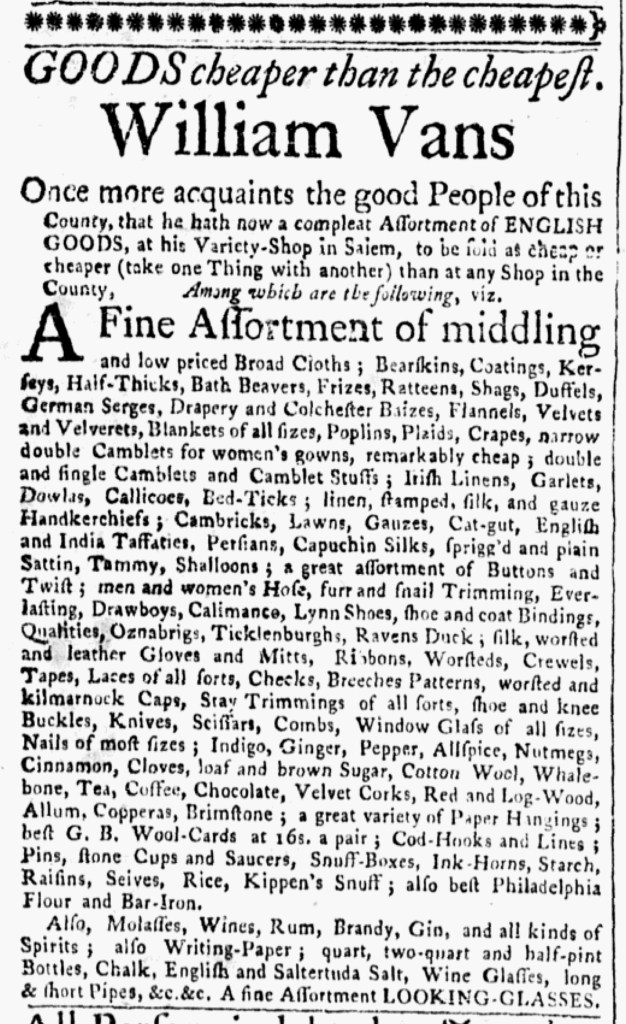
GOODS cheaper than the cheapest.”

William Vans ran a “Variety-Shop” in Salem in the early 1770s.  To incite interest in his wares, he regularly advertised in the Essex Gazette.  He often mentioned his low prices, comparing them to what consumers could expect to pay for the same merchandise in other shops.  For instance, in May 1771 he proclaimed that he sold his wares “as cheap as any Store in Town.”  Eighteen months later, he enhanced a similar appeal to price with a headline that made his marketing pitch.  “GOODS cheaper than the cheapest” appeared at the top of his advertisement in the November 10, 1772, edition of the Essex Gazette.  Vans intended the meaning of “cheap” as understood in the eighteenth century, promoting inexpensive wares without suggesting that low prices indicated inferior quality.  In the introduction to his extensive inventory, Vans declared that he set prices “as cheap or cheaper … than at any Shop in the County,” deciding to give his assertion more weight by expanding it beyond “any Store in Town.”

That Vans devised a headline with a marketing message distinguished his advertisement from others in the same issue.  William Scott advertised the “Essence of Pearl, and Pearl Dentifrice,” the toothpaste created by Jacob Hemet, “DENTIST to her Majesty, the Princess Amelia,” that he sold at his shop.  A headline that advised the product was “For the TEETH and GUMS” appeared at the beginning of the advertisement, but it did not make an explicit marketing appeal like Vans’s headline.  Most merchants and shopkeepers used their names, printed in larger font, as headlines.  Such was the case for John Appleton, “John & Andw. Cabot,” George Deblois, John Dyson, Samuel Flagg, Stephen Higginson, John Prince, and others.  Van’s name received similar treatment, but below the “GOODS cheaper than the cheapest” headline.  Some of those merchants and shopkeepers did make appeals to price in the introductions that came before their lists of merchandise.  Deblois, for instance, declared that “he will sell as cheap as is sold in any Shop or Store in Town, and as low as is sold in Boston, or elsewhere.”  John Appleton stated that “he is determined to sell at such very low Rates … as cannot fail to give full Satisfaction to every reasonable Purchaser.”  Those advertisers made appeals to price, but prospective customers encountered them only after wading into those notices.  Consumers did not have to read the smaller print in Vans’s advertisement to know that he claimed to sell “GOODS cheaper than the cheapest.”  In this instance, the format certainly enhanced the message.

Slavery Advertisements Published November 10, 1772

The Slavery Adverts 250 Project chronicles the role of newspaper advertising in perpetuating slavery in the era of the American Revolution. The project seeks to reveal the ubiquity of slavery in eighteenth-century life from New England to Georgia by republishing advertisements about enslaved people – for sale as individuals or in groups, wanted to purchase or for hire for short periods, runaways who liberated themselves, and those who were subsequently captured and confined in jails and workhouses – in daily digests on this site as well as in real time via the @SlaveAdverts250 Twitter feed, utilizing twenty-first-century media to stand in for the print media of the eighteenth century.

The project aims to provide modern audiences with a sense of just how often colonizers encountered these advertisements in their daily lives. Enslaved men, women, and children appeared in print somewhere in the colonies almost every single day. Those advertisements served as a constant backdrop for social, cultural, economic, and political life in colonial and revolutionary America. Colonizers who did not purport to own enslaved people were still confronted with slavery as well as invited to maintain the system by purchasing enslaved men, women, and children or assisting in the capture of so-called “runaways” who sought to free themselves from bondage. The frequency of these newspaper advertisements suggests just how embedded slavery was in colonial and revolutionary American culture in everyday interactions beyond the printed page.

These advertisements also testify to the experiences of enslaved men, women, and children, though readers must consider that those experiences have been remediated through descriptions offered by enslavers rather than enslaved people themselves. Often unnamed in the advertisements, enslaved men, women, and children were not invisible or unimportant in early America.

These advertisements appeared in colonial American newspapers 250 years ago today.

South-Carolina Gazette and Country Journal (November 10, 1772).

**********

South-Carolina Gazette and Country Journal (November 10, 1772).

**********

South-Carolina Gazette and Country Journal (November 10, 1772).

**********

South-Carolina Gazette and Country Journal (November 10, 1772).

**********

South-Carolina Gazette and Country Journal (November 10, 1772).

**********

South-Carolina Gazette and Country Journal (November 10, 1772).

**********

South-Carolina Gazette and Country Journal (November 10, 1772).

**********

South-Carolina Gazette and Country Journal (November 10, 1772).

**********

South-Carolina Gazette and Country Journal (November 10, 1772).

**********

Supplement to the South-Carolina Gazette and Country Journal (November 10, 1772).

**********

Supplement to the South-Carolina Gazette and Country Journal (November 10, 1772).

**********

Supplement to the South-Carolina Gazette and Country Journal (November 10, 1772).

November 9

What was advertised in a colonial American newspaper 250 years ago today?

New-York Gazette and Weekly Mercury (November 9, 1772).

“L / Leather dog collars / [Leather] Bottle stands.”

Several merchants, shopkeepers, and other entrepreneurs included lengthy lists of their merchandise in the November 9, 1772, edition of the New-York Gazette and Weekly Mercury.  Richard Sause, a cutler, listed scores of items in a dense advertisement that consisted of a single paragraph.  William Neilson did as well.  John Morton resorted to two dense paragraphs, a longer one for his general merchandise and a shorter one with a headline, “CHINA,” to direct prospective customers to those items.

In contrast, other advertisers attempted to make it easier for readers to navigate their notices and spot items of interest by dividing their advertisements into two columns with only one item per line.  Shaw and Long published a short advertisement for wine, beer, spirits, tea, and groceries that featured two columns.  Robert G. Livingston, Jr., stocked all sorts of textiles and housewares, neatly arranged in two columns in a lengthy advertisement.  Similarly, William Prince, a gardener, listed a “large collection of Fruit Trees” as well as “Timber trees and flowering shrubs” in an advertisement that extended an entire column.  He included headers for various kinds of trees, ranging from “Apricots” to “Pears” to “Apples.”  Prince also gave prices for some of his trees.

Among those advertisements, William Bayley experimented with another method of making his merchandise accessible to prospective customers.  In addition to using two columns with one item per line, the merchant also alphabetized his wares.  In 1772, that approach was rather extraordinary.  Booksellers occasionally took that approach in their newspaper notices and book catalogs, but not always.  Merchants, shopkeepers, and others beyond the book trades, however, did not alphabetize their wares, making Bayley’s approach innovative.

Bayley inserted headers for each category, starting with “B” for “BATH stove grates” and “Brass ditto.”  (Advertisers often saved space by deploying ditto.  Readers knew that Bayley meant “Brass stove grates” as an alternative to “BATH stove grates.”)  He concluded with “W” for “Wire fenders,” the only item under that letter.  Bayley did not strictly adhere to alphabetization under the various headers.  For instance, “Copper sauce pans” appeared under “C” before “Cases with silver handle knives and forks.”  The various “Brass” and “Japan’d” items also appeared in groups but not alphabetized.  “Brass headed shovels & tongs” ran above “— Dog collars” and “Japan’d tea tables” ran above “Plate Warmers.”  Each category was short enough that Bayley likely did not consider it necessary to be rigid about alphabetizing the items under each header.

Bayley devised a format that made his advertisement more readable for consumers while also directing them to similar and related items.  He may not have been the first to introduce readers to an alphabetized list of general merchandise, but few advertisers had used that method when Bayley experimented with it in 1772.  Even if prospective customers did not require the aid of alphabetization in advertisements, Bayley still delivered a format that differentiated his newspaper notice from others, perhaps making it memorable as a result.