November 7

What was advertised in a colonial American newspaper 250 years ago today?
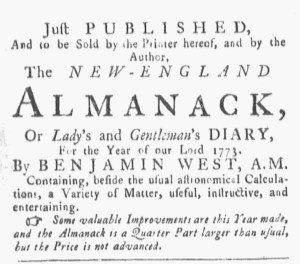
Providence Gazette (November 7, 1772).

“Just PUBLISHED … The NEW-ENGLAND ALMANACK.”

The advertising campaign for the 1773 edition of the “NEW-ENGLAND ALMANACK, Or Lady’s and Gentleman’s DIARY” continued in the November 7, 1772, edition of the Providence Gazette.  The author, Benjamin West, and the printer, John Carter, both sold copies, as did Thurber and Cahoon at the Bunch of Grapes on Constitution Street.

Marketing efforts in the public prints began two weeks earlier.  Carter, who also happened to be the printer of the Providence Gazette, included an announcement among the news to inform prospective customers that “WEST’s ALMANACK … is now in the Press, and will be speedily published by the Printer hereof.”  He nestled it between an update about the Gaspee incident, the burning of a British customs schooner near Warwick, Rhode Island, in June, and shipping news from the customs house.  Exercising his discretion as printer, Carter treated the impending publication of the almanac as news.  The following week, he placed an advertisement for the almanac first among the advertisements, increasing the chances that readers interested only in news would at least glimpse it even if they did not peruse other advertising.

Carter increased the likelihood that readers would see the advertisement when he moved it to the front page on November 7.  It appeared as the first item in the first column, immediately below the masthead.  Readers could not help but notice it.  Carter usually reserved advertising for the final pages of the Providence Gazette.  Except for his own notice about the almanac, he did so again.  All of the other advertisements in that issue ran on the last two pages.

Printing almanacs was often a very lucrative venture for colonial American printers.  Carter sought to generate as much revenue as possible for the New-England Almanack by placing advertisements in prime places in his newspaper.  The imprint on the title page indicated that Carter sold the almanac “wholesale and retail.”  He intended for his message to reach shopkeepers as well as consumers.  His newspaper notices facilitated distribution to retailers in Providence and the surrounding area as well as individual sales.  Thurber and Cahoon already included “WEST’s ALMANACK” in the list of merchandise available at their store.  Carter likely desired that others would acquire copies to sell at their own locations.

Slavery Advertisements Published November 7, 1772

The Slavery Adverts 250 Project chronicles the role of newspaper advertising in perpetuating slavery in the era of the American Revolution. The project seeks to reveal the ubiquity of slavery in eighteenth-century life from New England to Georgia by republishing advertisements about enslaved people – for sale as individuals or in groups, wanted to purchase or for hire for short periods, runaways who liberated themselves, and those who were subsequently captured and confined in jails and workhouses – in daily digests on this site as well as in real time via the @SlaveAdverts250 Twitter feed, utilizing twenty-first-century media to stand in for the print media of the eighteenth century.

The project aims to provide modern audiences with a sense of just how often colonizers encountered these advertisements in their daily lives. Enslaved men, women, and children appeared in print somewhere in the colonies almost every single day. Those advertisements served as a constant backdrop for social, cultural, economic, and political life in colonial and revolutionary America. Colonizers who did not purport to own enslaved people were still confronted with slavery as well as invited to maintain the system by purchasing enslaved men, women, and children or assisting in the capture of so-called “runaways” who sought to free themselves from bondage. The frequency of these newspaper advertisements suggests just how embedded slavery was in colonial and revolutionary American culture in everyday interactions beyond the printed page.

These advertisements also testify to the experiences of enslaved men, women, and children, though readers must consider that those experiences have been remediated through descriptions offered by enslavers rather than enslaved people themselves. Often unnamed in the advertisements, enslaved men, women, and children were not invisible or unimportant in early America.

These advertisements appeared in colonial American newspapers 250 years ago today.

Pennsylvania Chronicle (November 7, 1772).

**********

Providence Gazette (November 7, 1772).

November 6

What was advertised in a colonial American newspaper 250 years ago today?

New-Hampshire Gazette (November 6, 1772).

“Those Persons are desired to make some Agreement, otherways their Papers must cease.”

Daniel Fowle and Robert Fowle, printers of the New-Hampshire Gazette, frequently inserted notices calling on subscribers and others to settle accounts.  They threatened to sue those who did not pay their bills.  Such notices regularly appeared in newspapers throughout the colonies.  Printers extended credit to subscribers, hoping to increase their circulation numbers in order to generate more revenue by attracting advertisers, and many of those subscribers notoriously became delinquent in paying for their newspapers.

Printers were not the only ones, however, who had a hard time collecting from newspaper subscribers.  The post riders who delivered newspapers to subscribers in other towns also experienced difficulty getting subscribers to pay for their services.  Printers, including the Fowles, sometimes ran notices on behalf of the post riders who facilitated the circulation of their newspapers to subscribers and other readers in towns near and far.

On November 6, 1772, the Fowles ran notices related to both situations.  They advised that “Mr. MILK the Eastern-Post Having now Completed the Year, the Customers are desired to send pay for their Papers by him.”  The printers did not suggest legal action as a consequence of ignoring their notice this time.  Instead, they attempted to reason with subscribers, stating that having enjoyed their subscriptions throughout the year that Milk serviced the route they now had an obligation to pay.  Similarly, the Fowles stated that “Mr. LARRABEE (the Post to Dartmouth College) … also Rode a Year” so “the Customers for this Gazette, on that Road, are desired to send pay and the Entrance for another Year if they expect the Papers sent any longer.”  In this instance, the Fowles expected subscribers to settle accounts for the past year as well as pay in advance for the coming year if they wished to continue receiving the New-Hampshire Gazette.  Perhaps they had an even more difficult time collecting from subscribers at Dartmouth College than those served by the Eastern Post.

The Fowles also instructed subscribers in Hampton and other towns along the route covered by “Mr. NOBLE [and] the Boston Post” that the rider would no longer deliver their newspapers “unless he can by some Means come at the Pay” for his services.  Those subscribers needed “to make some Agreement” with Noble or else “their Papers must cease, or be sent by private Hands.”  Noble apparently no longer found it financially feasible to deliver the New-Hampshire Gazettewithout being paid for his efforts.  Enlisting the aid of the Fowles, he put subscribers on notice that they either had to pay what they owed him or he would discontinue delivery.

Both kinds of notices provide glimpses into the operations of eighteenth-century printing offices and their networks for circulating newspapers to subscribers and other readers.  The Fowles did not directly receive revenues from running these notices, but indirectly such notices may have been as lucrative as paid advertisements if they managed to get some subscribers to settle accounts and kept circulation numbers strong enough to attract advertisers.

Slavery Advertisements Published November 6, 1772

The Slavery Adverts 250 Project chronicles the role of newspaper advertising in perpetuating slavery in the era of the American Revolution. The project seeks to reveal the ubiquity of slavery in eighteenth-century life from New England to Georgia by republishing advertisements about enslaved people – for sale as individuals or in groups, wanted to purchase or for hire for short periods, runaways who liberated themselves, and those who were subsequently captured and confined in jails and workhouses – in daily digests on this site as well as in real time via the @SlaveAdverts250 Twitter feed, utilizing twenty-first-century media to stand in for the print media of the eighteenth century.

The project aims to provide modern audiences with a sense of just how often colonizers encountered these advertisements in their daily lives. Enslaved men, women, and children appeared in print somewhere in the colonies almost every single day. Those advertisements served as a constant backdrop for social, cultural, economic, and political life in colonial and revolutionary America. Colonizers who did not purport to own enslaved people were still confronted with slavery as well as invited to maintain the system by purchasing enslaved men, women, and children or assisting in the capture of so-called “runaways” who sought to free themselves from bondage. The frequency of these newspaper advertisements suggests just how embedded slavery was in colonial and revolutionary American culture in everyday interactions beyond the printed page.

These advertisements also testify to the experiences of enslaved men, women, and children, though readers must consider that those experiences have been remediated through descriptions offered by enslavers rather than enslaved people themselves. Often unnamed in the advertisements, enslaved men, women, and children were not invisible or unimportant in early America.

These advertisements appeared in colonial American newspapers 250 years ago today.

Connecticut Journal (November 6, 1772).

**********

New-London Gazette (November 6, 1772).

November 5

What was advertised in a colonial American newspaper 250 years ago today?

New-York Journal (November 5, 1772).

At the Sign of the Three Sugar Loaves.”

In the fall of 1772, George Webster joined the ranks of advertisers who attempted to draw more attention to their newspaper notices by adorning them with images related to their businesses.  Webster, a grocer, kept shop “at the Sign of the Three Sugar Loaves” on Leary Street in New York.  A woodcut at the top of his advertisement depicted three sugar loaves, a tall one flanked by two shorter ones.  The border that surrounded the sugar loaves suggested that the image replicated the sign that marked Webster’s location.

Throughout the colonies, entrepreneurs who placed notices in the public prints sometimes incorporated such images, but the use of images in advertising was not a standard practice in the eighteenth century.  When Webster first used his woodcut in the October 22, 1772, edition of the New-York Journal, it was one of only three images in the entire issue.  As usual, the lion and unicorn appeared on either side of a crown and shield in the masthead on the front page.  Elsewhere in the issue, Nesbitt Deane’s image of a tricorn hat and a banner bearing his name once again took up as much space as the copy it introduced.  The remainder of the advertisements, dozens of them filling fourteen of the eighteen columns in the six-page edition, did not have images.  That made Webster’s new woodcut depicting the Sign of the Three Sugar Loaves all the more noteworthy.  The following week, his image appeared once again, this time alongside two advertisements that featured stock images provided by the printer, a ship and a horse.  Neither of those familiar images had been crested for the exclusive use of any particular advertisers.  Webster, like Deane, made an additional investment in commissioning a woodcut so closely associated with some aspect of his own business.

By the time that the image appeared in Webster’s advertisement on November 5, regular readers would have recognized it, but that does not necessarily mean that the novelty had dissipated.  The woodcut continued to distinguish the grocer’s notice from the dozens of others in that issue.  Its mere presence demanded attention on a page that lacked other images in a newspaper with only four other images distributed across all six pages.  It likely also helped to encourage brand recognition as both image and text in Webster’s newspaper advertisement corresponded to the sign that colonizers glimpsed when they visited or passed his shop.

Slavery Advertisements Published November 5, 1772

The Slavery Adverts 250 Project chronicles the role of newspaper advertising in perpetuating slavery in the era of the American Revolution. The project seeks to reveal the ubiquity of slavery in eighteenth-century life from New England to Georgia by republishing advertisements about enslaved people – for sale as individuals or in groups, wanted to purchase or for hire for short periods, runaways who liberated themselves, and those who were subsequently captured and confined in jails and workhouses – in daily digests on this site as well as in real time via the @SlaveAdverts250 Twitter feed, utilizing twenty-first-century media to stand in for the print media of the eighteenth century.

The project aims to provide modern audiences with a sense of just how often colonizers encountered these advertisements in their daily lives. Enslaved men, women, and children appeared in print somewhere in the colonies almost every single day. Those advertisements served as a constant backdrop for social, cultural, economic, and political life in colonial and revolutionary America. Colonizers who did not purport to own enslaved people were still confronted with slavery as well as invited to maintain the system by purchasing enslaved men, women, and children or assisting in the capture of so-called “runaways” who sought to free themselves from bondage. The frequency of these newspaper advertisements suggests just how embedded slavery was in colonial and revolutionary American culture in everyday interactions beyond the printed page.

These advertisements also testify to the experiences of enslaved men, women, and children, though readers must consider that those experiences have been remediated through descriptions offered by enslavers rather than enslaved people themselves. Often unnamed in the advertisements, enslaved men, women, and children were not invisible or unimportant in early America.

These advertisements appeared in colonial American newspapers 250 years ago today.

Maryland Gazette (November 5, 1772).

**********

Maryland Gazette (November 5, 1772).

**********

Maryland Gazette (November 5, 1772).

**********

Maryland Gazette (November 5, 1772).

**********

Massachusetts Gazette and Boston Weekly News-Letter (November 5, 1772).

**********

Massachusetts Spy (November 5, 1772).

**********

New-York Journal (November 5, 1772).

**********

New-York Journal (November 5, 1772).

**********

South-Carolina Gazette (November 5, 1772).

**********

South-Carolina Gazette (November 5, 1772).

**********

South-Carolina Gazette (November 5, 1772).

**********

South-Carolina Gazette (November 5, 1772).

**********

South-Carolina Gazette (November 5, 1772).

**********

South-Carolina Gazette (November 5, 1772).

**********

South-Carolina Gazette (November 5, 1772).

**********

South-Carolina Gazette (November 5, 1772).

**********

Supplement to the South-Carolina Gazette (November 5, 1772).

**********

Supplement to the South-Carolina Gazette (November 5, 1772).

**********

Supplement to the South-Carolina Gazette (November 5, 1772).

**********

Supplement to the South-Carolina Gazette (November 5, 1772).

**********

Supplement to the South-Carolina Gazette (November 5, 1772).

**********

Supplement to the South-Carolina Gazette (November 5, 1772).

**********

Supplement to the South-Carolina Gazette (November 5, 1772).

**********

Supplement to the South-Carolina Gazette (November 5, 1772).

**********

Virginia Gazette [Purdie and Dixon] (November 5, 1772).

**********

Virginia Gazette [Purdie and Dixon] (November 5, 1772).

**********

Virginia Gazette [Purdie and Dixon] (November 5, 1772).

**********

Virginia Gazette [Purdie and Dixon] (November 5, 1772).

**********

Virginia Gazette [Purdie and Dixon] (November 5, 1772).

**********

Supplement to the Virginia Gazette [Purdie and Dixon] (November 5, 1772).

**********

Supplement to the Virginia Gazette [Purdie and Dixon] (November 5, 1772).

**********

Supplement to the Virginia Gazette [Purdie and Dixon] (November 5, 1772).

**********

Supplement to the Virginia Gazette [Purdie and Dixon] (November 5, 1772).

**********

Supplement to the Virginia Gazette [Purdie and Dixon] (November 5, 1772).

**********

Supplement to the Virginia Gazette [Purdie and Dixon] (November 5, 1772).

**********

Supplement to the Virginia Gazette [Purdie and Dixon] (November 5, 1772).

**********

Supplement to the Virginia Gazette [Purdie and Dixon] (November 5, 1772).

November 4

What was advertised in a colonial American newspaper 250 years ago today?

Pennsylvania Journal (November 4, 1772).

“MARGARET DUNCAN … has for sale, A LARGE assortment of MERCHANDIZE.”

Newspapers published in urban ports carried advertisements placed by female shopkeepers hawking their wares, though women were generally less likely to resort to the public prints to promote their businesses than their male counterparts.  Those female shopkeepers and “she merchants” who did advertise demonstrate that women participated in the marketplace in a variety of ways, not solely as shopkeepers.

Margaret Duncan was one of those women who ran newspaper advertisements.  On November 4, 1772, her notice appeared in both the Pennsylvania Gazette and the Pennsylvania Journal.  She advised current and prospective customers that she moved to a new location on Second Street, “three doors below the corner of Arch-street” and “four doors above where she formerly dwelt.”  Duncan stocked a “LARGE assortment of MERCHANDIZE, suitable to the season, imported in the last vessels from Europe.”  She declared that she sold her wares “on the lowest terms for cash or the usual credit.” In terms of substance and style, Duncan’s advertisement did not differ from those placed by other retailers.  She did not address women in particular as prospective customers, nor did she make any feminized appeals to consumers.  Duncan apparently understood that men were consumers as well as producers and retailers, just as women inhabited multiple roles in consumer society.

The shopkeeper did benefit from enhanced visibility the first time her advertisement appeared in the Pennsylvania Journal.  It ran in the middle of the second column on the front page, immediately below news items that began in the first column and overflowed into the next.  She was almost as fortunate with the placement of her notice in the Pennsylvania Gazette.  In that publication, it also appeared in the middle of the second column on the first page, though in that instance it was the second advertisement.

Duncan was the only female shopkeeper to run an advertisement in either of those newspapers that week, but she was not the only woman in Philadelphia who was selling goods to consumers.  Despite their relative absence in the public prints, women running businesses were much more visible to colonizers as they traversed the streets of the busy port and went about their daily activities.  The prominence of Duncan’s advertisement on the front page of two newspapers only hinted at the visibility of women in the marketplace.

Slavery Advertisements Published November 4, 1772

The Slavery Adverts 250 Project chronicles the role of newspaper advertising in perpetuating slavery in the era of the American Revolution. The project seeks to reveal the ubiquity of slavery in eighteenth-century life from New England to Georgia by republishing advertisements about enslaved people – for sale as individuals or in groups, wanted to purchase or for hire for short periods, runaways who liberated themselves, and those who were subsequently captured and confined in jails and workhouses – in daily digests on this site as well as in real time via the @SlaveAdverts250 Twitter feed, utilizing twenty-first-century media to stand in for the print media of the eighteenth century.

The project aims to provide modern audiences with a sense of just how often colonizers encountered these advertisements in their daily lives. Enslaved men, women, and children appeared in print somewhere in the colonies almost every single day. Those advertisements served as a constant backdrop for social, cultural, economic, and political life in colonial and revolutionary America. Colonizers who did not purport to own enslaved people were still confronted with slavery as well as invited to maintain the system by purchasing enslaved men, women, and children or assisting in the capture of so-called “runaways” who sought to free themselves from bondage. The frequency of these newspaper advertisements suggests just how embedded slavery was in colonial and revolutionary American culture in everyday interactions beyond the printed page.

These advertisements also testify to the experiences of enslaved men, women, and children, though readers must consider that those experiences have been remediated through descriptions offered by enslavers rather than enslaved people themselves. Often unnamed in the advertisements, enslaved men, women, and children were not invisible or unimportant in early America.

These advertisements appeared in colonial American newspapers 250 years ago today.

Pennsylvania Gazette (November 4, 1772).

November 3

What was advertised in a colonial American newspaper 250 years ago today?

South-Carolina Gazette and Country Journal (November 3, 1772).

“A compleat ASSORTMENT of fashionable GOODS.”

Below the masthead, the entire front page of the November 3, 1772, edition of the South-Carolina Gazette and Country Journal consisted entirely of advertisements.  The one placed by William Stukes dominated the page, due in large part to its size and unusual format.  That newspaper ran three columns per page.  Stukes’s advertisement extended across two columns.  This was not a case of a lengthy advertisement that overflowed from one column into another.  Instead, it had been designed to take up space in more than one column.  The notice ran at the top of the first two columns, making it the first item in that issue.  That enhanced its visibility, though readers could hardly have missed an advertisement that occupied about half the space on the page.

The notice opened with a standard headline and introduction, similar to those in other advertisements for consumer goods.  The advertiser’s name in capital letters, “WILLIAM STUKES,” served as the headline.  The introduction stated that he “ACQUAINTS hid Customers and Friends, that he has removed into Broad-Street … and is now opening a complete ASSORTMENT of fashionable GOODS, imported in the last Ships from LONDON.”  In addition, Stukes declared that he would sell his wares “on the most reasonable Terms, at the usual CREDIT, and extraordinary cheap for CASH.”  He used formulaic language even as the format differentiated his advertisement from others on the same page and throughout the rest of the issue.

While the headline and introduction ran across two columns, Stukes’s extensive list of merchandise ran in three narrow columns.  Other advertisers grouped goods together in dense paragraphs.  Stukes made it easier for prospective customers to skim his advertisement and spot items of interest by giving each item its own line.  That resulted in significantly more white space within his advertisement than in the news and other paid notices.  For instance, “Silk gauze handkerchiefs” appeared on their own line without other items crowding them.  That even allowed space for readers to make notations, if they wished.

Stukes deployed popular marketing strategies and incorporated formulaic language into his advertisement, depending on its size and unique format to draw attention to the low prices and range of choices he offered to consumers.  Even though this newspaper notice consisted entirely of text, Stukes effectively used graphic design to distinguish it from advertisements placed by his competitors.

Slavery Advertisements Published November 3, 1772

The Slavery Adverts 250 Project chronicles the role of newspaper advertising in perpetuating slavery in the era of the American Revolution. The project seeks to reveal the ubiquity of slavery in eighteenth-century life from New England to Georgia by republishing advertisements about enslaved people – for sale as individuals or in groups, wanted to purchase or for hire for short periods, runaways who liberated themselves, and those who were subsequently captured and confined in jails and workhouses – in daily digests on this site as well as in real time via the @SlaveAdverts250 Twitter feed, utilizing twenty-first-century media to stand in for the print media of the eighteenth century.

The project aims to provide modern audiences with a sense of just how often colonizers encountered these advertisements in their daily lives. Enslaved men, women, and children appeared in print somewhere in the colonies almost every single day. Those advertisements served as a constant backdrop for social, cultural, economic, and political life in colonial and revolutionary America. Colonizers who did not purport to own enslaved people were still confronted with slavery as well as invited to maintain the system by purchasing enslaved men, women, and children or assisting in the capture of so-called “runaways” who sought to free themselves from bondage. The frequency of these newspaper advertisements suggests just how embedded slavery was in colonial and revolutionary American culture in everyday interactions beyond the printed page.

These advertisements also testify to the experiences of enslaved men, women, and children, though readers must consider that those experiences have been remediated through descriptions offered by enslavers rather than enslaved people themselves. Often unnamed in the advertisements, enslaved men, women, and children were not invisible or unimportant in early America.

These advertisements appeared in colonial American newspapers 250 years ago today.

Essex Gazette (November 3, 1772).

**********

South-Carolina Gazette and Country Journal (November 3, 1772).

**********

South-Carolina Gazette and Country Journal (November 3, 1772).

**********

South-Carolina Gazette and Country Journal (November 3, 1772).

**********

South-Carolina Gazette and Country Journal (November 3, 1772).

**********

South-Carolina Gazette and Country Journal (November 3, 1772).

**********

South-Carolina Gazette and Country Journal (November 3, 1772).

**********

South-Carolina Gazette and Country Journal (November 3, 1772).

**********

South-Carolina Gazette and Country Journal (November 3, 1772).

**********

South-Carolina Gazette and Country Journal (November 3, 1772).

**********

South-Carolina Gazette and Country Journal (November 3, 1772).

**********

Supplement to the South-Carolina Gazette and Country Journal (November 3, 1772).

**********

Supplement to the South-Carolina Gazette and Country Journal (November 3, 1772).

**********

Supplement to the South-Carolina Gazette and Country Journal (November 3, 1772).

**********

Supplement to the South-Carolina Gazette and Country Journal (November 3, 1772).

**********

Supplement to the South-Carolina Gazette and Country Journal (November 3, 1772).

**********

Supplement to the South-Carolina Gazette and Country Journal (November 3, 1772).

**********

Supplement to the South-Carolina Gazette and Country Journal (November 3, 1772).

**********

Supplement to the South-Carolina Gazette and Country Journal (November 3, 1772).

**********

Supplement to the South-Carolina Gazette and Country Journal (November 3, 1772).