November 2

What was advertised in a colonial American newspaper 250 years ago today?

Boston-Gazette (November 2, 1772).

“The Sale of this Book has been so surprizingly rapid, as to demand Three Editions in New-York and Philadelphia.”

Two advertisements for “A DISSERTATION on the GOUT, and all CHRONIC DISEASES” by William Cadogan, “Fellow of the College of Physicians,” ran in the November 2, 1772, edition of the Boston-Gazette, one right above the other.  Benjamin Edes and John Gill, printers of that newspaper and printers of a Boston edition of Cadogan’s book, inserted the first advertisement.  Joseph Edwards, a bookseller, placed the other notice.

Both advertisements attempted to leverage the popularity of the book in other markets to generate sale in Boston.  Edes and Gill confided that the “above Pamphlet had Nine Editions in England in the short Space of Five Months.”  Edwards provided a similar figure, stating that the “Book is so much esteemed in England, that it has already past through Eight Editions.”  It had also gained following in the colonies.  “The Sale of this Book has been so surprizingly rapid, as to demand Three Editions in New-York and Philadelphia.”  Several months earlier, William Bradford and Thomas Bradford deployed a similar strategy in marketing their Philadelphia editions.  Given that so many other readers already purchased the book, the printers and the bookseller in Boston suggested that prospective customers should not miss out on acquiring copies of this bestseller.

Such demand suggested that the “rational and natural Method of CURE” for gout and other chronic illnesses that Cadogan proposed in the book was indeed effective.  Indeed, Edes and Gill even made a joke at the expense of colonizers in New York.  They observed that the book “has had such an Effect on the veteran Bacchanalians of New-York, that Madeira is no longer a fashionable Prescription for the Cure of this Disease.”  The printers included a short blurb from the book, explaining how “strong Wines” like Madeira actually made gout worse rather than better.  Cadogan was so convincing and his cure so effective that even New Yorkers who previously imbibed too much Madeira in their quest to quell the symptoms of gout had given up that remedy in favor of a more “judicious” approach.

Edwards did not resort to such levity.  Instead, he emphasized the accessibility of Cadogan’s writing.  A wide array of readers, not just physicians, could understand the discourse and recommendations in the book.  “The Doctrines advanced in it,” Edwards declared, “are rational and philosophical, and are delivered in a familiar style, which renders them intelligible to Gentlemen of all professions, as well as to Physicians.”  The bookseller sought to avoid the impression of a niche market for the medical text.

In their newspaper notices, the printers and the bookseller promoted the popularity of Cadogan’s Dissertation on the Gout, the effectiveness of the “Method of “CURE” outlined in it, and the accessible style.  Running simultaneous advertisements also testified to the popularity of the book.  Edes and Gill as well as Edwards aimed to encourage sales by creating a wide market that extended beyond physicians.

Slavery Advertisements Published November 2, 1772

The Slavery Adverts 250 Project chronicles the role of newspaper advertising in perpetuating slavery in the era of the American Revolution. The project seeks to reveal the ubiquity of slavery in eighteenth-century life from New England to Georgia by republishing advertisements about enslaved people – for sale as individuals or in groups, wanted to purchase or for hire for short periods, runaways who liberated themselves, and those who were subsequently captured and confined in jails and workhouses – in daily digests on this site as well as in real time via the @SlaveAdverts250 Twitter feed, utilizing twenty-first-century media to stand in for the print media of the eighteenth century.

The project aims to provide modern audiences with a sense of just how often colonizers encountered these advertisements in their daily lives. Enslaved men, women, and children appeared in print somewhere in the colonies almost every single day. Those advertisements served as a constant backdrop for social, cultural, economic, and political life in colonial and revolutionary America. Colonizers who did not purport to own enslaved people were still confronted with slavery as well as invited to maintain the system by purchasing enslaved men, women, and children or assisting in the capture of so-called “runaways” who sought to free themselves from bondage. The frequency of these newspaper advertisements suggests just how embedded slavery was in colonial and revolutionary American culture in everyday interactions beyond the printed page.

These advertisements also testify to the experiences of enslaved men, women, and children, though readers must consider that those experiences have been remediated through descriptions offered by enslavers rather than enslaved people themselves. Often unnamed in the advertisements, enslaved men, women, and children were not invisible or unimportant in early America.

These advertisements appeared in colonial American newspapers 250 years ago today.

Boston Evening-Post (November 2, 1772).

**********

Boston Evening-Post (November 2, 1772).

**********

Supplement to the Boston-Gazette (November 2, 1772).

**********

New-York Gazette and Weekly Mercury (November 2, 1772).

**********

New-York Gazette and Weekly Mercury (November 2, 1772).

**********

New-York Gazette and Weekly Mercury (November 2, 1772).

**********

New-York Gazette and Weekly Mercury (November 2, 1772).

**********

New-York Gazette and Weekly Mercury (November 2, 1772).

**********

New-York Gazette and Weekly Mercury (November 2, 1772).

**********

New-York Gazette and Weekly Mercury (November 2, 1772).

**********

New-York Gazette and Weekly Mercury (November 2, 1772).

**********

Supplement to the New-York Gazette and Weekly Mercury (November 2, 1772).

**********

Pennsylvania Packet (November 2, 1772).

**********

Supplement to the Pennsylvania Packet (November 2, 1772).

November 1

What was advertised in a colonial American newspaper 250 years ago this week?

New-York Journal (October 29, 1772).

“The Particular Day for Sale will be made known by Advertisements being put up at the Merchant’s Coffee-House.”

An announcement about an upcoming auction of “ONE of the best half Blood Horses in America” began running in the New-York Journal in October 1772.  The advertisement provided a variety of details about the horse, stating that it was “4 Years old, and upwards of 15 Hands high.”  In addition, the horse was “an exceeding fine bay, trots well, and is warranted sound, [and] he is sufficiently broke, both for Saddle and Carriage.”  The notice also proclaimed that the horse “was got by Capt. De Laney’s famous Horse Wildair, out of one of the best Esopus Breeding Mares, whose Size, Strength and Courage are equal to any in the Country.”

The advertisement gave a location for the auction, the Merchant’s Coffee House, and even a time, “12 o’Clock,” but not a day.  Instead, it indicated that the auction would take place either “the latter End of this or the beginning of next Month.”  A nota bene explained why a date had not yet been set.  The horse had not yet been “brought down” to the city.  It also specified that the “Particular Day for Sale will be made known by Advertisements being put up at the Merchant’s Coffee-House.”  The notice in the newspaper encouraged interested parties to visit a local business to look for other advertisements with more information posted there.  Those additional advertisements may have been broadsides produced in the printing office of the New-York Journal or may have been handwritten notices.  Either way, the newspaper notice testified to a broader scope of advertising that colonizers encountered as they conducted business and went about their daily lives.

The newspaper advertisement also included a notation intended solely for the compositor and others working in the printing office: “54—.”  That number referred to the issue in which the notice first appeared, “NUMB. 1554” on October 15.  Many other advertisements included a second number that corresponded to the final issue in which they should appear, alerting the compositor when to discontinue them.  The dash in this advertisement indicated that it should run indefinitely until the advertiser requested its removal, a decision that made sense considered that a date for the auction had not been set.  It ended up running for four consecutive weeks, from October 15 through November 5, costing five shilling according to the rates published in the colophon of the New-York Journal.  By then, the advertiser posted some sort of notice at the Merchant’s Coffee House, at least according to the pledge made in the newspaper notice.

October 31

What was advertised in a colonial American newspaper 250 years ago today?

Providence Gazette (October 31, 1772).

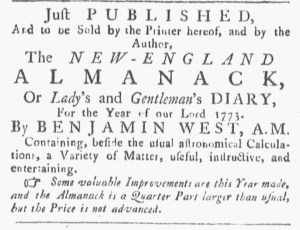
“Just PUBLISHED … The NEW-ENGLAND ALMANACK.”

In advance of having copies of the “The NEW-ENGLAND ALMANACK, Or Lady’s and Gentleman’s DIARY, For the Year of our Lord 1773” available for sale, John Carter, the printer of both the almanac and the Providence Gazette, inserted an announcement among the local news to inform prospective customers that the almanac “is now in the Press, and will be speedily published.”  The following week, he once again exercised his power as printer to give an advertisement for the almanac a privileged place in the newspaper.  It ran first among the advertisements in the October 31, 1772, edition.  Even if readers did not peruse all of the advertisements, they likely noticed the one about the almanac that immediately followed the news.  In subsequent issues, Carter placed the advertisement among the paid notices, but the first time it appeared it occupied a prime place on the page.

Prospective customers would have been familiar with the New-England Almanack, written by West.  The astronomer and mathematician had a decade of experience authoring the almanac and collaborating with the printers of the Providence Gazette in marketing and selling it.  As the newspaper changed hands over the years, the new printers continued publishing both the Providence Gazette and the New-England Almanack, augmenting their revenue by doing so.  For the 1773 edition of the almanac, Carter and West declared that it included “Some valuable Improvements” and “is a Quarter Part larger than usual, but the Price is not advanced.”  For the same price they paid the previous year, customers could acquire an almanac that contained thirty-two pages rather than twenty-four, certainly a bargain.

Providence Gazette (October 31, 1772).

In addition to the notice placed “by the Printer hereof, and by the Author,” the New-England Almanack received attention in another advertisement the first week it was available for sale.  Thurber and Cahoon ran a lengthy advertisement that listed scores of items available at their shop at the Sign of the Bunch of Grapes.  They included “WEST’s ALMANACKS” among the books in the final paragraph.  That item appeared in all capitals, distinguishing it from the rest of the merchandise mentioned in the advertisement.  Did Thurber and Cahoon arrange to have the almanac highlighted in their advertisement in hopes of benefitting from retail sales?  Or did Carter make the intervention in their advertisement, recognizing any sales of the almanac as beneficial to his bottom line?  Either way, the advertisement suggests that Carter and West quickly distributed the almanac to retailers to increase sales.  As soon as it came off the press, consumers could purchase the almanac at several locations in Providence.

October 30

What was advertised in a colonial American newspaper 250 years ago today?

New-Hampshire Gazette (October 30, 1772).

“Leather-Dressers, & Breeches-Makers, in Kingstreet, Portsmouth.”

James Haslett and Mathew Haslett placed an advertisement in the October 30, 1772, edition of the New-Hampshire Gazette to inform prospective customers that they made “Leather Breeches of all sorts” at their shop on King Street in Portsmouth.  They declared that they made breeches “as neat as cheap & as good as any in New-England,” incorporating appeals to fashion, price, and quality into their short advertisement.

The Hasletts occasionally ran newspaper advertisements in the late 1760s and early 1770s.  Sometimes they included other marketing strategies to generate interest in their business.  For instance, in previous advertisements they stated that “the Sign of the BUCK and GLOVE” marked the location of their shop.  They also listed items for sale other than breeches, such as “all sorts of Wash Leather, Deer, Sheep and Moose Skins for Breeches and Jackets, Sheep Skins for Aprons, [and] Buck and Sheepskin Gloves.”  They made bolder claims about the quality of their wares, proclaiming that “the above Articles is Warranted as good as any in Europe or America” rather than narrowing the comparison to their competitors in New England.

The woodcuts that adorned some of the Hasletts’ advertisements were the most distinctive aspect of their marketing efforts.  The leather dressers commissioned several variations, but each depicted the Sign of the Buck and Glove along with an image of leather breeches.  Some of them included their name within the sign.  All of them included “1766,” the year the Hasletts relocated from Boston and established their shop in Portsmouth.

Why did the Hasletts discontinue using woodcuts to draw attention to their advertisements?  Why did they run shorter advertisements that gave fewer details about their business?  Perhaps they considered advertising a necessity as they sought to build their reputation in a new town, but over time determined that they achieved sufficient name recognition that they did not need more elaborate advertising to earn their livelihood their local market.  As consumers became more familiar with the Hasletts and their wares, the “LEATHER DRESSERS from BOSTON” became “Leather-Dressers, & Breeches-Makers, in Kingstreet, Portsmouth,” who may have believed that relatively stark advertisements served their purpose now that they were no longer newcomers in their community.

Slavery Advertisements Published October 30, 1772

The Slavery Adverts 250 Project chronicles the role of newspaper advertising in perpetuating slavery in the era of the American Revolution. The project seeks to reveal the ubiquity of slavery in eighteenth-century life from New England to Georgia by republishing advertisements about enslaved people – for sale as individuals or in groups, wanted to purchase or for hire for short periods, runaways who liberated themselves, and those who were subsequently captured and confined in jails and workhouses – in daily digests on this site as well as in real time via the @SlaveAdverts250 Twitter feed, utilizing twenty-first-century media to stand in for the print media of the eighteenth century.

The project aims to provide modern audiences with a sense of just how often colonizers encountered these advertisements in their daily lives. Enslaved men, women, and children appeared in print somewhere in the colonies almost every single day. Those advertisements served as a constant backdrop for social, cultural, economic, and political life in colonial and revolutionary America. Colonizers who did not purport to own enslaved people were still confronted with slavery as well as invited to maintain the system by purchasing enslaved men, women, and children or assisting in the capture of so-called “runaways” who sought to free themselves from bondage. The frequency of these newspaper advertisements suggests just how embedded slavery was in colonial and revolutionary American culture in everyday interactions beyond the printed page.

These advertisements also testify to the experiences of enslaved men, women, and children, though readers must consider that those experiences have been remediated through descriptions offered by enslavers rather than enslaved people themselves. Often unnamed in the advertisements, enslaved men, women, and children were not invisible or unimportant in early America.

These advertisements appeared in colonial American newspapers 250 years ago today.

Connecticut Journal (October 30, 1772).

October 29

What was advertised in a colonial American newspaper 250 years ago today?

Maryland Gazette (October 29, 1772).

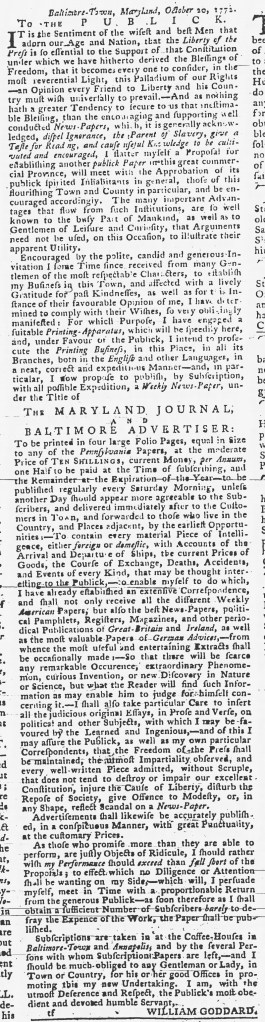
“I now propose to publish, by Subscription, … a Weekly News-Paper.”

Maryland had only one newspaper in 1772.  William Goddard aimed to change that.  To aid his efforts, he inserted a proposal in the October 29 edition of the Maryland Gazette, the publication that would be his competitor if he managed to launch “THE MARYLAND JOURNAL, AND BALTIMORE ADVERTISER.”  Printed in Annapolis, the Maryland Gazette served the entire colony, but Goddard believed that a market existed, or would exist after some savvy advertising, to support two newspapers in the colony.  In addition, he underscored the political utility of newspapers to prospective subscribers.  “IT is the Sentiment of the wisest and best Men that adorn our Age and Nation,” Goddard declared in the first sentence of his proposal, “that the Liberty of the Press is so essential to the Support of that Constitution under which we have hitherto derived the Blessings of Freedom, that it becomes every one to consider, in the most reverential Light, this Palladium of our Rights.”  The printer further explained that “well conducted News-Papersdispel Ignorance, the Parent of Slavery, give a Taste for Reading, and cause useful Knowledge to be cultivated and encouraged.”  Accordingly, he called on “every Friend to Liberty and his Country” to support his proposed project.

Goddard’s proposal filled nearly an entire column in the Maryland Gazette.  In addition to expounding on the philosophy that prompted him to consider publishing a newspaper in Baltimore, he advised potential subscribers that he was indeed prepared to launch the venture “as soon … as I shall obtain a sufficient Number of Subscribers barely to defray the Expence of the Work.”  Already in correspondence with “many Gentlemen of the most respectable Characters” in Baltimore, Goddard had “engaged a suitable Printing-Apparatus, which will be speedily here.”  In addition, as printer of the Pennsylvania Chronicle he had already “established an extensive Correspondence, and shall not only receive all the different Weekly American Papers, but also the best News-Papers, political Pamphlets, Registers, Magazines, and other periodical Publications of Great-Britain and Ireland.”  In addition to printer and publisher, Goddard assumed the responsibilities of editor, drawing the news from the letters, newspapers, and periodicals sent to him.  Every American newspaper printer-editor reprinted extensively from other publications. Goddard even acquired “the most valuable Papers of German Advices” in order to provide news of interest to the growing German population in the backcountry.

The proposal also outlined the particulars of the publication and how to subscribe.  The newspaper would be “printed in four large Folio Pages, equal in Size to any of the Pennsylvania Papers” that, along with the Maryland Gazette, operated as local newspapers for Baltimore and the region.  Goddard intended to print and distribute the newspaper “regularly every Saturday Morning, unless another Day should appear more agreeable to the Subscribers.” Subscriptions cost ten shillings per year, with half to be paid immediately and the other half at the end of the year. Goddard briefly mentioned advertisements, noting they would be “accurately published, in a conspicuous Manner, with great Punctuality, at the customary Prices.”  He did not list those prices.  Colonizers interested in subscribing could leave their names “at the Coffee-Houses in Baltimore-Town and Annapolis” or with “several Persons with whom Subscription Papers are left.”  Like other printers attempting to launch new projects, Goddard relied on a network of local agents who assisted in recruiting subscribers.

Beyond the particulars, Goddard emphasized that he pursued a higher purpose than merely generating revenues or turning a profit on the publication.  He promised to publish news about every “remarkable Occurence, extraordinary Phenomemon, curious Invention, or New Discovery in Nature or Science” as well as “judicious original Essays … on political and other Subjects.”  In selecting material to include in the Maryland Journal, Goddard pledged that “the Freedom of the Press shall be maintained, the utmost Impartiality observed, and every well written Piece admitted, without Scruple, that does not tend to destroy or impair our excellent Constitution, injure the Cause of Liberty, disturb the Repose of Society, give Offence to Modesty, or, in any Shape, reflect Scandal on a News-Paper.”  In an era of upheaval as Parliament turned unwanted attention to the colonies, Goddard framed publishing a newspaper as a civic duty that served the commercial and political interests of the community.

Did the subscription proposal help Goddard to obtain that “sufficient Number of Subscribers barely to defray the Expence” and commence publication?  Perhaps, but it took some time.  The first issue appeared on August 20, 1773, ten months after Goddard initially proposed publishing the Maryland Journal and Baltimore Advertiser.  The newspaper continued publication, under the guidance of various printers and proprietors, throughout the American Revolution and into the 1790s, transitioning from weekly to semi-weekly to tri-weekly to daily as newspaper publishing expanded throughout the new nation.

Slavery Advertisements Published October 29, 1772

The Slavery Adverts 250 Project chronicles the role of newspaper advertising in perpetuating slavery in the era of the American Revolution. The project seeks to reveal the ubiquity of slavery in eighteenth-century life from New England to Georgia by republishing advertisements about enslaved people – for sale as individuals or in groups, wanted to purchase or for hire for short periods, runaways who liberated themselves, and those who were subsequently captured and confined in jails and workhouses – in daily digests on this site as well as in real time via the @SlaveAdverts250 Twitter feed, utilizing twenty-first-century media to stand in for the print media of the eighteenth century.

The project aims to provide modern audiences with a sense of just how often colonizers encountered these advertisements in their daily lives. Enslaved men, women, and children appeared in print somewhere in the colonies almost every single day. Those advertisements served as a constant backdrop for social, cultural, economic, and political life in colonial and revolutionary America. Colonizers who did not purport to own enslaved people were still confronted with slavery as well as invited to maintain the system by purchasing enslaved men, women, and children or assisting in the capture of so-called “runaways” who sought to free themselves from bondage. The frequency of these newspaper advertisements suggests just how embedded slavery was in colonial and revolutionary American culture in everyday interactions beyond the printed page.

These advertisements also testify to the experiences of enslaved men, women, and children, though readers must consider that those experiences have been remediated through descriptions offered by enslavers rather than enslaved people themselves. Often unnamed in the advertisements, enslaved men, women, and children were not invisible or unimportant in early America.

These advertisements appeared in colonial American newspapers 250 years ago today.

Maryland Gazette (October 29, 1772).

**********

Maryland Gazette (October 29, 1772).

**********

Massachusetts Gazette and Boston Weekly News-Letter (October 29, 1772).

**********

New-York Journal (October 29, 1772).

**********

New-York Journal (October 29, 1772).

**********

New-York Journal (October 29, 1772).

**********

South-Carolina Gazette (October 29, 1772).

**********

South-Carolina Gazette (October 29, 1772).

**********

South-Carolina Gazette (October 29, 1772).

**********

South-Carolina Gazette (October 29, 1772).

**********

South-Carolina Gazette (October 29, 1772).

**********

South-Carolina Gazette (October 29, 1772).

**********

South-Carolina Gazette (October 29, 1772).

**********

South-Carolina Gazette (October 29, 1772).

**********

South-Carolina Gazette (October 29, 1772).

**********

South-Carolina Gazette (October 29, 1772).

**********

South-Carolina Gazette (October 29, 1772).

**********

Virginia Gazette [Purdie & Dixon] (October 29, 1772).

**********

Virginia Gazette [Purdie & Dixon] (October 29, 1772).

**********

Virginia Gazette [Purdie & Dixon] (October 29, 1772).

**********

Virginia Gazette [Purdie & Dixon] (October 29, 1772).

**********

Virginia Gazette [Purdie & Dixon] (October 29, 1772).

**********

Virginia Gazette [Purdie & Dixon] (October 29, 1772).

**********

Virginia Gazette [Purdie & Dixon] (October 29, 1772).

**********

Virginia Gazette [Purdie & Dixon] (October 29, 1772).

**********

Virginia Gazette [Purdie & Dixon] (October 29, 1772).

**********

Virginia Gazette [Purdie & Dixon] (October 29, 1772).

**********

Virginia Gazette [Rind] (October 29, 1772).

**********

Virginia Gazette [Rind] (October 29, 1772).

**********

Virginia Gazette [Rind] (October 29, 1772).

**********

Virginia Gazette [Rind] (October 29, 1772).

**********

Virginia Gazette [Rind] (October 29, 1772).

**********

Virginia Gazette [Rind] (October 29, 1772).

October 28

What was advertised in a colonial American newspaper 250 year ago today?

Pennsylvania Gazette (October 28, 1772).

“A catalogue of new and old books … is given away gratis.”

William Woodhouse, a bookseller, stationer, and bookbinder in Philadelphia, regularly advertised in the public prints in the early 1770s.  For instance, he ran an advertisement in the October 28, 1772, edition of the Pennsylvania Gazette, advising consumers that he had recently received a shipment of new inventory from London.  Woodhouse provided some examples to entice prospective customer, starting with stationery items.  He stocked everything from “a large assortment of the best writing paper in all sizes” to “round pewter ink stands” to “sealing-wax, wafers, quills, [and] black and red pencils.”  Woodhouse also listed some of the “variety of new books” at his shop, including “Baskerville’s grand family folio bible, with cuts,” “Pope’s Young’s Swift’s Tillotson’s, Shakespear’s, Bunyan’s. and Flavel’s works,” and “Blackstone’s commentaries, 4 vols. 4to.”  The abbreviation “4to” referred to quarto, the size of the pages, allowing readers to imagine how they might consult or display the books.  Woodhouse even had “Newberry’s small books for children, with pictures” for his youngest customers.

The bookseller concluded his newspaper advertisement with a nota bene that invited consumers to engage with other marketing materials.  “A catalogue of new and old books, with the prices printed to each book,” the nota bene declared, “is given away gratis, by said Woodhouse.”  That very well may have been the “CATALOGUE OF A COLLECTION OF NEW AND OLD BOOKS, In all the Arts and Sciences, and in various Languages” that Woodhouse first promoted six weeks earlier in another newspaper, the Pennsylvania Packet.  That catalog also included “a large quantity of entertaining Novels, with the lowest price printed to each book.”  Most book catalogs, like newspaper advertisements, did not indicate prices.  Woodhouse apparently believed that stating his prices would help in convincing customers to purchase their books from him rather than from any of his many competitors in Philadelphia.  To draw attention to both the prices and his selection, he gave away the catalog for free.

This catalog may have been part of a larger advertising campaign that Woodhouse launched in the fall of 1772.  He might have also distributed handbills or posted broadsides.  In 1771, he circulated a one-page subscription proposal for “A Pennsylvania Sailor’s Letters; alias the Farmer’s Fall.”  A quarter of a century later, Woodhouse distributed a card promoting copies of “Constitutions of the United States, According to the Latest Amendments: To Which Are Annexed, the Declaration of Independence, and the Federal Constitution, with Amendments Thereto.”  It stands to reasons that Woodhouse used advertising media other than newspapers on other occasions, though such ephemeral items have not survived in the same numbers as newspaper advertisements.  I suspect that far more advertising circulated in early America than has been preserved and identified in historical societies, research libraries, and private collections.

Slavery Advertisements Published October 28, 1772

The Slavery Adverts 250 Project chronicles the role of newspaper advertising in perpetuating slavery in the era of the American Revolution. The project seeks to reveal the ubiquity of slavery in eighteenth-century life from New England to Georgia by republishing advertisements about enslaved people – for sale as individuals or in groups, wanted to purchase or for hire for short periods, runaways who liberated themselves, and those who were subsequently captured and confined in jails and workhouses – in daily digests on this site as well as in real time via the @SlaveAdverts250 Twitter feed, utilizing twenty-first-century media to stand in for the print media of the eighteenth century.

The project aims to provide modern audiences with a sense of just how often colonizers encountered these advertisements in their daily lives. Enslaved men, women, and children appeared in print somewhere in the colonies almost every single day. Those advertisements served as a constant backdrop for social, cultural, economic, and political life in colonial and revolutionary America. Colonizers who did not purport to own enslaved people were still confronted with slavery as well as invited to maintain the system by purchasing enslaved men, women, and children or assisting in the capture of so-called “runaways” who sought to free themselves from bondage. The frequency of these newspaper advertisements suggests just how embedded slavery was in colonial and revolutionary American culture in everyday interactions beyond the printed page.

These advertisements also testify to the experiences of enslaved men, women, and children, though readers must consider that those experiences have been remediated through descriptions offered by enslavers rather than enslaved people themselves. Often unnamed in the advertisements, enslaved men, women, and children were not invisible or unimportant in early America.

These advertisements appeared in colonial American newspapers 250 years ago today.

Supplement to the Pennsylvania Gazette (October 28, 1772).

**********

Supplement to the Pennsylvania Gazette (October 28, 1772).