Slavery Advertisements Published February 16, 1773

The Slavery Adverts 250 Project chronicles the role of newspaper advertising in perpetuating slavery in the era of the American Revolution. The project seeks to reveal the ubiquity of slavery in eighteenth-century life from New England to Georgia by republishing advertisements about enslaved people – for sale as individuals or in groups, wanted to purchase or for hire for short periods, runaways who liberated themselves, and those who were subsequently captured and confined in jails and workhouses – in daily digests on this site as well as in real time via the @SlaveAdverts250 Twitter feed, utilizing twenty-first-century media to stand in for the print media of the eighteenth century.

The project aims to provide modern audiences with a sense of just how often colonizers encountered these advertisements in their daily lives. Enslaved men, women, and children appeared in print somewhere in the colonies almost every single day. Those advertisements served as a constant backdrop for social, cultural, economic, and political life in colonial and revolutionary America. Colonizers who did not purport to own enslaved people were still confronted with slavery as well as invited to maintain the system by purchasing enslaved men, women, and children or assisting in the capture of so-called “runaways” who sought to free themselves from bondage. The frequency of these newspaper advertisements suggests just how embedded slavery was in colonial and revolutionary American culture in everyday interactions beyond the printed page.

These advertisements also testify to the experiences of enslaved men, women, and children, though readers must consider that those experiences have been remediated through descriptions offered by enslavers rather than enslaved people themselves. Often unnamed in the advertisements, enslaved men, women, and children were not invisible or unimportant in early America.

These advertisements appeared in colonial American newspapers 250 years ago today.

South-Carolina Gazette and Country Journal (February 16, 1773).

**********

South-Carolina Gazette and Country Journal (February 16, 1773).

**********

South-Carolina Gazette and Country Journal (February 16, 1773).

**********

South-Carolina Gazette and Country Journal (February 16, 1773).

**********

Supplement to the South-Carolina Gazette and Country Journal (February 16, 1773).

**********

Supplement to the South-Carolina Gazette and Country Journal (February 16, 1773).

**********

Supplement to the South-Carolina Gazette and Country Journal (February 16, 1773).

**********

Supplement to the South-Carolina Gazette and Country Journal (February 16, 1773).

**********

Supplement to the South-Carolina Gazette and Country Journal (February 16, 1773).

**********

Supplement to the South-Carolina Gazette and Country Journal (February 16, 1773).

**********

Supplement to the South-Carolina Gazette and Country Journal (February 16, 1773).

**********

Supplement to the South-Carolina Gazette and Country Journal (February 16, 1773).

**********

Supplement to the South-Carolina Gazette and Country Journal (February 16, 1773).

**********

Supplement to the South-Carolina Gazette and Country Journal (February 16, 1773).

February 15

What was advertised in a colonial American newspaper 250 years ago today?

Boston-Gazette (February 15, 1773).

“THE Persons who may incline to purchase PATTY HALL’s House … need not be afraid of the Neighbours.”

The feud between Patty Hall and her neighbors continued in the advertisements in the February 15, 1773, edition of the Boston-Gazette.  The altercation first appeared in the public prints when Hall placed a notice offering her house for sale in the February 1 edition of the Boston-Gazette.  She noted that her neighbors made “a great Bustle” in court about “a Piece of Land” associated with the property, but then “dropt the Matter.”  That being the case, she assured “Any Person that inclines to Purchase, may depend that a good Title will be given.”  Hall also accused her neighbors of various acts of vandalism and intimidation, including throwing stones at her.

Hall’s neighbors apparently read or heard about the advertisement.  They did not wait a week to respond in the next issue of the Boston-Gazette.  Instead, they placed notices in the next newspapers published in town, the Massachusetts Gazette and Boston Weekly News-Letter and the Massachusetts Spy on February 4.  Hall’s neighbors sarcastically mentioned the “Politeness” accorded to them before clarifying that the matter had moved to another court and requesting that public “suspend their Judgment” until “Evidences on both Sides are properly examined.”  They also inserted their advertisement in the next issue of the Boston-Gazette on February 8, a week after Hall’s original notice.  It ran immediately above a response from Hall.  She described additional harassment she claimed that she experienced from her neighbors.

Having set the record straight once already, Hall’s neighbors did not feel the need to rush to publish a response to Hall’s latest advertisement.  Instead, they waited for the next edition of the Boston-Gazette on February 15.  In what they framed as a letter to the editors, Hall’s neighbors assured anyone “who may incline to purchase PATTY HALL’s House – with such a Title as she can give – need not be afraid of the Neighbours.”  They asserted that knocking at all hours and other alleged torments “were never heard by the Neighbours” and concluded that “it was all done within Doors.”  That being the case, they declared, Hall was in the best position to identify the real culprits.  Her neighbors recommended that if anyone who purchased the house wished to avoid such intrusions that they “need not keep the same Company” as Hall.

Edes and Gill, the printers of the Boston-Gazette, may have enjoyed the argument between Hall and her neighbors.  They almost certainly appreciated the revenue that their advertisements generated.  In publishing those advertisements, Edes and Gill and the printers of other newspapers abdicated a small amount of editorial control to those who paid to purchase space in their publications.  The advertisements carried news, of a sort, that would not have appeared among the articles and editorials that the printers selected to include elsewhere in their newspapers.  Hall and her neighbors could have relied on rumors and gossip to malign each other, but they realized that advertisements gave them a much larger audience for presenting their grievances to the court of public opinion.

Slavery Advertisements Published February 15, 1773

The Slavery Adverts 250 Project chronicles the role of newspaper advertising in perpetuating slavery in the era of the American Revolution. The project seeks to reveal the ubiquity of slavery in eighteenth-century life from New England to Georgia by republishing advertisements about enslaved people – for sale as individuals or in groups, wanted to purchase or for hire for short periods, runaways who liberated themselves, and those who were subsequently captured and confined in jails and workhouses – in daily digests on this site as well as in real time via the @SlaveAdverts250 Twitter feed, utilizing twenty-first-century media to stand in for the print media of the eighteenth century.

The project aims to provide modern audiences with a sense of just how often colonizers encountered these advertisements in their daily lives. Enslaved men, women, and children appeared in print somewhere in the colonies almost every single day. Those advertisements served as a constant backdrop for social, cultural, economic, and political life in colonial and revolutionary America. Colonizers who did not purport to own enslaved people were still confronted with slavery as well as invited to maintain the system by purchasing enslaved men, women, and children or assisting in the capture of so-called “runaways” who sought to free themselves from bondage. The frequency of these newspaper advertisements suggests just how embedded slavery was in colonial and revolutionary American culture in everyday interactions beyond the printed page.

These advertisements also testify to the experiences of enslaved men, women, and children, though readers must consider that those experiences have been remediated through descriptions offered by enslavers rather than enslaved people themselves. Often unnamed in the advertisements, enslaved men, women, and children were not invisible or unimportant in early America.

These advertisements appeared in colonial American newspapers 250 years ago today.

Boston Evening-Post (February 15, 1773).

**********

Boston Evening-Post (February 15, 1773).

**********

Boston Evening-Post (February 15, 1773).

**********

Massachusetts Gazette and Boston Post-Boy (February 15, 1773).

**********

Massachusetts Gazette and Boston Post-Boy (February 15, 1773).

**********

Newport Mercury (February 15, 1773).

**********

New-York Gazette and Weekly Mercury (February 15, 1773).

**********

Supplement to the New-York Gazette and Weekly Mercury (February 15, 1773).

**********

Supplement to the New-York Gazette and Weekly Mercury (February 15, 1773).

**********

Pennsylvania Packet (February 15, 1773).

**********

Pennsylvania Packet (February 15, 1773).

**********

Pennsylvania Packet (February 15, 1773).

**********

South-Carolina Gazette (February 15, 1773).

**********

South-Carolina Gazette (February 15, 1773).

**********

South-Carolina Gazette (February 15, 1773).

**********

South-Carolina Gazette (February 15, 1773).

**********

South-Carolina Gazette (February 15, 1773).

**********

South-Carolina Gazette (February 15, 1773).

**********

South-Carolina Gazette (February 15, 1773).

**********

South-Carolina Gazette (February 15, 1773).

**********

South-Carolina Gazette (February 15, 1773).

**********

South-Carolina Gazette (February 15, 1773).

**********

South-Carolina Gazette (February 15, 1773).

**********

Supplement to the South-Carolina Gazette (February 15, 1773).

**********

Supplement to the South-Carolina Gazette (February 15, 1773).

**********

Supplement to the South-Carolina Gazette (February 15, 1773).

**********

Supplement to the South-Carolina Gazette (February 15, 1773).

February 14

What was advertised in a colonial American newspaper 250 years ago this week?

New-York Journal (February 11, 1773).

“And many more articles, too tedious to insert.”

William Wikoff sold a variety of imported goods at his store in Hanover Square in New York in the early 1770s.  In an advertisement in the February 11, 1773, edition of the New-York Journal, for instance, he informed consumers that he stocked “a very handsome Assortment of Dry Goods, suitable for the Season,” and then offered a short catalog of some of those items to demonstrate the array of choices.  Wikoff listed a variety of textiles, including a “beautiful assortment of callicoes and cottons,” as well as “Mens and womens white and beaver gloves of the best kind” and “Childrens yellow and red leather shoes.”  Beyond fabrics and garments, Wikoff also had “Taylors thimbles,” “spelling books,” “knives and forks,” and “Bed furniture.”

To help readers navigate his advertisement, Wikoff opted for two columns with two or three items on each line.  That made it easier to read than advertisements that amalgamated everything together into a dense paragraph of text.  The merchant apparently considered that format effective, having used it on another occasion.  He also incorporated another element from his previous advertisements, asserting that that the list of merchandise did not cover everything available at his shop.  Wikoff confided that he carried “many more articles, too tedious to insert,” echoing his assertion in another advertisement that he sold “many other articles, too tedious to mention.”  Prospective customers, he suggested, would have a much more enjoyable experience browsing at his store than reading through a lengthy catalog in the newspaper.

That strategy allowed him to entice prospective customers who were curious about what else they might encounter at his store.  At the same time, Wikoff limited his advertising expenses.  He could have published an even longer list, but that would have cost more.  He likely aimed for what he considered the right balance between showcasing a good portion of the selection at his store and how much he was willing to spend on the advertisement.  In doing so, he offered enough details to capture readers’ attention and demonstrated that they were likely to find an even greater variety when they shopped at his store.

February 13

What was advertised in a colonial American newspaper 250 years ago today?

Providence Gazette (February 13, 1773).

“Gibbs makes plated Buckles in the newest Fashions, warranted tough and good.”

John Carter, printer of the Providence Gazette, limited the number of advertisements in the February 6, 1773, edition in order to make room for political news from Massachusetts.  A week later, the final page of his newspaper once again consisted entirely of advertising.  Other advertisements appeared on the first and third pages as well.  Collectively, paid notices accounted for nearly half the space in the February 13 edition.

Those advertisements included one from John Gibbs.  The notice ran for the first time, perhaps delayed by a week when Carter made the editorial decision to focus on the politics of the imperial crisis in the previous issue.  Whatever the particulars of the timing, Gibbs, wished to inform prospective customers that he opened a new shop “where he carries on the Goldsmith’s and Jeweller’s Business, in all their various Branches.”  In other words, he possessed the skill to undertake any sort of order he received.

In addition to promoting his abilities, Gibbs made other appeals commonly deployed by artisans in their newspaper advertisements.  He promised exemplary public service, stating that “Ladies and Gentlemen that please to favour him with their Custom, may depend on being served with Fidelity and Dispatch.”  He also promised low prices, declaring that he charged “as low Rates as any can work for in this Colony, or elsewhere.”  According to Gibbs, those were not just reasonable prices but the lowest prices that consumers would find in Rhode Island or anywhere else.  He also emphasized current trends and quality.  In a nota bene, he exclaimed that he “makes plated Buckles in the newest Fashions, warranted tough and good.”

Gibbs purchased a square of advertising, yet in that small amount of space in the Providence Gazette he incorporated multiple appeals intended to entice prospective customers to visit his shop and give him their business.  He demonstrated his familiarity with advertising culture by including so many appeals commonly used in notices published by goldsmiths, jewelers, and other artisans during the era of the American Revolution.  Given the prevalence of newspaper advertising in the second half of the eighteenth century, both Gibbs and readers recognized the standard elements of such advertisements.

February 12

What was advertised in a colonial American newspaper 250 years ago today?

New-Hampshire Gazette (February 12, 1773).

“This LAST Notice is given to the delinquents for this Gazette or Advertisements.”

Daniel Fowle and Robert Fowle, printers of the New-Hampshire Gazette, were among the colonial newspaper printers who most frequently ran notices calling on subscribers and others to settle accounts.  On one occasion, they threatened to publish a list of delinquent subscribers, though nothing ever came of that.  More often, they pledged to place the matter into the hands of an attorney.  In most instances, they likely did not follow through on that.

In February 1773, however, circumstances prompted Robert Fowle to take action.  He inserted a notice in the February 12 edition of the New-Hampshire Gazette to inform readers that he “lodged a large Number of Accounts in the Hands of OLIVER WHIPPLE, Attorney at Law.”  Those who owed “for this Gazette or Advertisements” had one last chance to make payment.  Robert instructed them to do so at Whipple’s office rather than visit the printing office.  Fowle had warned them seven weeks earlier in an advertisement that announced “the Co-partnership of Daniel and Robert Fowle, will be dissolved.”  That being the case, the printers needed to settle accounts, so Fowle requested that “all Persons who have Accounts open” make payment “as soon as possible.”  He cautioned that those “who neglect, & are Indebted, must expect … the Accounts will be lodged with such Gentlemen as will create Trouble and needless Charges.”  Fowle’s plans to “leave this Province” apparently prompted him to get an attorney involved when “delinquents” ignored that notice.

Robert alone signed both advertisements, perhaps because Daniel intended to remain in Portsmouth and continue publishing the New-Hampshire Gazette.  Robert resorting to legal action allowed Daniel to remain neutral in his dealings with subscribers, advertisers, and others with overdue accounts, frustrated as he may have been with them.  The printer also advised that customers who “owe for less than a Year … are desired to take no Notice of this Advertisement” because their accounts would be settled at the printing office in the usual manner.  He apparently did not see a need to create trouble with customers who kept relatively current with their accounts.  Similarly, he aimed to avoid trouble with associates who “have any Thing due to them from the Printers,” inviting them to visit the printing office for payment rather than get an attorney involved.

Colonial newspaper printers often vowed to take legal action against subscribers who did not take their bills, but those were often empty threats.  However, when Robert Fowle ended his partnership with his uncle and prepared to leave the colony, those circumstances made it necessary to enlist the aid of an attorney.  Some of the “delinquents” who had ignored similar notices for years may have been quite surprised by that turn of events.

February 11

What was advertised in a colonial American newspaper 250 years ago today?

Massachusetts Gazette and Boston Weekly News-Letter (February 11, 1773).

“His French and English Rudiments, by the help of which a scholar may learn French with very little assistance from a master.”

In February 1773, Mr. Delile, a “Professor of the French Language” Boston, published an advertisement in which he confided to the public, especially the “Encouragers of LITERATURE,” that he had “always been desirous of meriting the esteem of the learned world … by the cultivation of the BELLES LETTRES.”  To that end, he issued a subscription proposal for printing several of his “performances” in the French language.  The two volumes would include the “French and English Rudiments” that he devised, an address that he delivered at “the Academy,” the school he operated, the previous December, and two “French Odes, in the manner of Pindar.”  In addition, he planned to add a “Latin discourse, on the arts and sciences, against several paradoxes of the celebrated Jean Jacques Rousseau.”

To further entice prospective subscribers to reserve copies, Delile elaborated on most of those items.  He declared that “the public favor’d him with the kindest testimony of their benevolence” after hearing his oration at the school, so much so that “many Gentlemen” had “earnestly requested a copy.”  Delile commodified that address, giving those gentlemen and others an opportunity to purchase that address.  For those not yet fluent in French, the “most eloquent fragments … will be translated into English.”  Delile also inserted two stanzas of the French odes, providing a preview for prospective subscribers and allowing them to judge the quality of the work.  In promoting the “French and English Rudiments,” he asserted that “a scholar” could consult that “performance” and “learn French with very little assistance from a master.”  Those “Rudiments” supplemented, but did not completely replace, working with a French tutor.

Delile was prepared to provide the necessary assistance to “those Gentlemen, who study under him” and others who wished to enroll in his classes.  He concluded his subscription proposal with an announcement that he “gives constant Attendance at the Academy” throughout the day and into the evenings on Mondays, Wednesdays, and Fridays.  Such an extensive schedule made it possible for pupils to attend lessons “as their business will admit of their leisure to attend.”  Even if Delile did not garner enough subscribers to make publishing his French and Latin “performances” a viable venture, he likely hoped that the enterprising spirit and commitment to belles lettres demonstrated in his subscription proposal would resonate with current and prospective pupils to convince them to make their way to “the Academy” for lessons.

Slavery Advertisements Published February 11, 1773

The Slavery Adverts 250 Project chronicles the role of newspaper advertising in perpetuating slavery in the era of the American Revolution. The project seeks to reveal the ubiquity of slavery in eighteenth-century life from New England to Georgia by republishing advertisements about enslaved people – for sale as individuals or in groups, wanted to purchase or for hire for short periods, runaways who liberated themselves, and those who were subsequently captured and confined in jails and workhouses – in daily digests on this site as well as in real time via the @SlaveAdverts250 Twitter feed, utilizing twenty-first-century media to stand in for the print media of the eighteenth century.

The project aims to provide modern audiences with a sense of just how often colonizers encountered these advertisements in their daily lives. Enslaved men, women, and children appeared in print somewhere in the colonies almost every single day. Those advertisements served as a constant backdrop for social, cultural, economic, and political life in colonial and revolutionary America. Colonizers who did not purport to own enslaved people were still confronted with slavery as well as invited to maintain the system by purchasing enslaved men, women, and children or assisting in the capture of so-called “runaways” who sought to free themselves from bondage. The frequency of these newspaper advertisements suggests just how embedded slavery was in colonial and revolutionary American culture in everyday interactions beyond the printed page.

These advertisements also testify to the experiences of enslaved men, women, and children, though readers must consider that those experiences have been remediated through descriptions offered by enslavers rather than enslaved people themselves. Often unnamed in the advertisements, enslaved men, women, and children were not invisible or unimportant in early America.

These advertisements appeared in colonial American newspapers 250 years ago today.

Maryland Gazette (February 11, 1773).

**********

Maryland Gazette (February 11, 1773).

**********

Maryland Gazette (February 11, 1773).

**********

Massachusetts Gazette and Boston Weekly News-Letter (February 11, 1773).

**********

Massachusetts Gazette and Boston Weekly News-Letter (February 11, 1773).

**********

Massachusetts Spy (February 11, 1773).

**********

Massachusetts Spy (February 11, 1773).

**********

New-York Journal (February 11, 1773).

**********

Virginia Gazette [Purdie and Dixon] (February 11, 1773).

**********

Virginia Gazette [Purdie and Dixon] (February 11, 1773).

**********

Virginia Gazette [Purdie and Dixon] (February 11, 1773).

**********

Virginia Gazette [Purdie and Dixon] (February 11, 1773).

**********

Virginia Gazette [Purdie and Dixon] (February 11, 1773).

**********

Virginia Gazette [Purdie and Dixon] (February 11, 1773).

**********

Virginia Gazette [Purdie and Dixon] (February 11, 1773).

**********

Virginia Gazette [Purdie and Dixon] (February 11, 1773).

**********

Virginia Gazette [Purdie and Dixon] (February 11, 1773).

**********

Virginia Gazette [Purdie and Dixon] (February 11, 1773).

**********

Virginia Gazette [Purdie and Dixon] (February 11, 1773).

**********

Virginia Gazette [Purdie and Dixon] (February 11, 1773).

**********

Virginia Gazette [Purdie and Dixon] (February 11, 1773).

**********

Virginia Gazette [Purdie and Dixon] (February 11, 1773).

**********

Virginia Gazette [Rind] (February 11, 1773).

**********

Virginia Gazette [Rind] (February 11, 1773).

**********

Virginia Gazette [Rind] (February 11, 1773).

**********

Virginia Gazette [Rind] (February 11, 1773).

February 10

Who was the subject of an advertisement in a colonial American newspaper 250 years ago today?

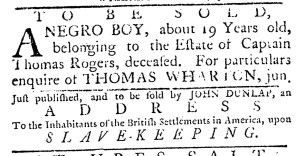
Pennsylvania Journal (February 10, 1773).

“TO BE SOLD, A NEGRO BOY.”

“Just published … an ADDRESS … upon SLAVE-KEEPING.”

When John Dunlap published An Address to the Inhabitants of the British Settlements in America, upon Slave-keeping in 1773, he advertised widely.  He promoted the pamphlet in his own newspaper, the Pennsylvania Packet, before taking it to press, hoping to incite interest and demand among prospective customers.  Before and after publication, he inserted advertisements in other newspapers as well.  For instance, he ran a brief advertisement in the February 10 edition of the Pennsylvania Journal.  Consisting of only four lines, it advised readers that the pamphlet was “Just published, and to be sold by JOHN DUNLAP.”

Printing a pamphlet that critiqued slavery did not prevent Dunlap from generating revenues from newspaper advertisements that perpetuated the slave trade.  On January 18, for instance, he ran a lengthy advertisement about the pamphlet, one that included an excerpt from the conclusion, and several notices offering enslaved people for sale or promising rewards for the capture and return of enslaved people who liberated themselves by running away from their enslavers.

Similarly, William Bradford and Thomas Bradford, printers of the Pennsylvania Journal, ran the advertisement for the pamphlet and advertisements about enslaved people.  Two advertisements in the February 10 edition, one for a “NEGRO woman eighteen years old, and six months gone with child” and another for a “NEGRO MAN, About 27 years old,” instructed prospective enslavers to “Enquire of the printers” for more information.  The Bradfords acted as slave brokers in addition to disseminating those advertisements.  Dunlap’s advertisement for the Address … upon Slave-keeping appeared immediately below an advertisement about a “NEGRO BOY, about 19 Years old,” for sale as part of the estate of Thomas Rogers.  Did the Bradfords recognize the dissonance inherent in the two advertisements?  Did a compositor exercise some editorial discretion in placing one advertisement after another, making a point to both the printers and readers?

Whatever the case, the Pennsylvania Journal gave much more space to perpetuating slavery on that day, made all the more noteworthy by the news item that filled the first two pages of that edition.  The Bradfords reprinted the response to Governor Thomas Hutchinson’s speech from a committee appointed by the Massachusetts assembly, a response that vigorously defended the liberties of English colonizers.  That response, first published by Isaiah Thomas as an extraordinary issue of the Massachusetts Spy, made its way from newspapers to newspaper, first in New England and then in other regions.  Each of those newspapers also ran advertisements that perpetuated slavery, demonstrating the limits of how many colonizers conceived of liberty.  The Address … upon Slave-Keeping presented a more expansive view.  Despite the excerpt that Dunlap published in his own newspaper, however, that pamphlet did not have such extensive coverage.

Slavery Advertisements Published February 10, 1773

The Slavery Adverts 250 Project chronicles the role of newspaper advertising in perpetuating slavery in the era of the American Revolution. The project seeks to reveal the ubiquity of slavery in eighteenth-century life from New England to Georgia by republishing advertisements about enslaved people – for sale as individuals or in groups, wanted to purchase or for hire for short periods, runaways who liberated themselves, and those who were subsequently captured and confined in jails and workhouses – in daily digests on this site as well as in real time via the @SlaveAdverts250 Twitter feed, utilizing twenty-first-century media to stand in for the print media of the eighteenth century.

The project aims to provide modern audiences with a sense of just how often colonizers encountered these advertisements in their daily lives. Enslaved men, women, and children appeared in print somewhere in the colonies almost every single day. Those advertisements served as a constant backdrop for social, cultural, economic, and political life in colonial and revolutionary America. Colonizers who did not purport to own enslaved people were still confronted with slavery as well as invited to maintain the system by purchasing enslaved men, women, and children or assisting in the capture of so-called “runaways” who sought to free themselves from bondage. The frequency of these newspaper advertisements suggests just how embedded slavery was in colonial and revolutionary American culture in everyday interactions beyond the printed page.

These advertisements also testify to the experiences of enslaved men, women, and children, though readers must consider that those experiences have been remediated through descriptions offered by enslavers rather than enslaved people themselves. Often unnamed in the advertisements, enslaved men, women, and children were not invisible or unimportant in early America.

These advertisements appeared in colonial American newspapers 250 years ago today.

Pennsylvania Gazette (February 10, 1773).

**********

Pennsylvania Journal (February 10, 1773).

**********

Pennsylvania Journal (February 10, 1773).

**********

Pennsylvania Journal (February 10, 1773).