February 22

What was advertised in a colonial American newspaper 250 years ago today?

Newport Mercury (February 22, 1773).

“Such original pieces and extracts as will afford the most pleasing and useful amusement.”

James Rivington, a prominent printer and bookseller in New York, determined that the city needed another newspaper to supplement the three already published there in 1773.  He envisioned, however, a publication that would circulate far beyond the city and even beyond the colony.  When the first issue appeared on April 22, the masthead bore a lengthy title, Rivington’s New-York Gazetteer; or the Connecticut, New-Jersey, Hudson’s River, and Quebec Weekly Advertiser.  All colonial newspapers were regional rather than local, but Rivington sought to serve several regions simultaneously.

Although he frequently placed advertisements for books, stationery, and other merchandise in newspapers printed in New York, Rivington did not place his first advertisements for his own newspaper in the city.  Instead, his first newspaper notices appeared in the Newport Mercury and the Pennsylvania Chronicle on February 22, 1773.  Over the next several weeks, his advertising campaign expanded to several other newspapers.

Pennsylvania Chronicle (February 22, 1773).

Rivington placed a fairly humble notice in the Newport Mercury, announcing his plan to publish “a WEEKLY GAZETTE, or the CITY and COUNTRY ADVERTISER” that would “contain the best and freshest advices, foreign and domestic, and such original pieces as will afford the most pleasing and useful amusement.”  He listed the prices, promised that “All favours from the inhabitants of Rhode-Island colony, will be gratefully acknowledged,” and identified local agents who collected subscriptions, including the printer of the Newport Mercury.

In comparison, his advertisement in the Pennsylvania Chronicle had a much grander tone.  Rivington proclaimed that he would publish a newspaper “differing materially in its Plan from most now extant” and asserted that he received “Encouragement from the first Personages in this Country” to pursue the endeavor.  Now he needed “public Patronage” or subscribers.  Over the course of six lines, the full title of the newspaper appeared as a headline, followed by the “Plan” that described the purpose and contents of the newspaper.  He pledged to invest “All his humble Labours” and select materials according to “the most perfect Integrity and Candour.”  He concluded by noting that he planned to distribute the first issue “when the Season will permit the several Post-Riders to perform their Stages regularly.”  After all, it did not good for residents of Philadelphia and other towns to subscribe to this newspaper if they would not receive it in a timely fashion.

Compared to the description of “such original pieces and extracts as will afford the most pleasing and useful amusement” that Rivington mentioned in his advertisement in the Newport Mercury, the “Plan” in his notice in the Pennsylvania Chronicle was much more extensive.  His newspaper would include some of the usual content, such as “the most important Events, Foreign and Domestic” and “the Mercantile Interest in Arrivals, Departures and Prices Current, at Home and Abroad.”  In addition, Rivington trumpeted that the “State of Learning shall be constantly reported.”  It seemed as though he intended to publish content that often appeared in magazines imported from London, such as the “best Modern Essays,” “New Inventions in Arts and Sciences, Mechanics and Manufactures, Agriculture and Natural History,” and a “Review of Mew Books … with Extracts from every deserving Performance.”  Rivington took his responsibilities as editor seriously, refusing to publish any “crafty Attempt with cozening Title, from the Garrets of GRUBB-STREET.”  His readers could depend on receiving only content “that may contribute to the Improvement, Information and Entertainment of the Public.”

Although Rivington went into greater detail when addressing readers of the Pennsylvania Chronicle compared to readers of the Newport Mercury, in each instance he sought to entice prospective subscribers with more than just the news, those “freshest advices, foreign and domestic.”  He promised additional content that would amuse as well as inform.  Several newspapers included a poetry corner on the final page, printing a new poem each week.  Rivington proposed giving his subscribers an even greater amount of literary content, delivering items that tended to appear in magazines.  He hoped that would help to distinguish his newspaper from other published in New York and other towns in the colonies.

Slavery Advertisements Published February 22, 1773

The Slavery Adverts 250 Project chronicles the role of newspaper advertising in perpetuating slavery in the era of the American Revolution. The project seeks to reveal the ubiquity of slavery in eighteenth-century life from New England to Georgia by republishing advertisements about enslaved people – for sale as individuals or in groups, wanted to purchase or for hire for short periods, runaways who liberated themselves, and those who were subsequently captured and confined in jails and workhouses – in daily digests on this site as well as in real time via the @SlaveAdverts250 Twitter feed, utilizing twenty-first-century media to stand in for the print media of the eighteenth century.

The project aims to provide modern audiences with a sense of just how often colonizers encountered these advertisements in their daily lives. Enslaved men, women, and children appeared in print somewhere in the colonies almost every single day. Those advertisements served as a constant backdrop for social, cultural, economic, and political life in colonial and revolutionary America. Colonizers who did not purport to own enslaved people were still confronted with slavery as well as invited to maintain the system by purchasing enslaved men, women, and children or assisting in the capture of so-called “runaways” who sought to free themselves from bondage. The frequency of these newspaper advertisements suggests just how embedded slavery was in colonial and revolutionary American culture in everyday interactions beyond the printed page.

These advertisements also testify to the experiences of enslaved men, women, and children, though readers must consider that those experiences have been remediated through descriptions offered by enslavers rather than enslaved people themselves. Often unnamed in the advertisements, enslaved men, women, and children were not invisible or unimportant in early America.

These advertisements appeared in colonial American newspapers 250 years ago today.

Boston Evening-Post (February 22, 1773).

**********

Boston-Gazette (February 22, 1773).

**********

Supplement to the Boston-Gazette (February 22, 1773).

**********

Supplement to the Newport Mercury (February 22, 1773).

**********

New-York Gazette and Weekly Mercury (February 22, 1773).

**********

New-York Gazette and Weekly Mercury (February 22, 1773).

**********

Pennsylvania Packet (February 22, 1773).

**********

Supplement to the Pennsylvania Packet (February 22, 1773).

**********

Supplement to the Pennsylvania Packet (February 22, 1773).

**********

South-Carolina Gazette (February 22, 1773).

**********

South-Carolina Gazette (February 22, 1773).

**********

South-Carolina Gazette (February 22, 1773).

**********

South-Carolina Gazette (February 22, 1773).

**********

South-Carolina Gazette (February 22, 1773).

**********

South-Carolina Gazette (February 22, 1773).

**********

South-Carolina Gazette (February 22, 1773).

**********

South-Carolina Gazette (February 22, 1773).

**********

South-Carolina Gazette (February 22, 1773).

**********

South-Carolina Gazette (February 22, 1773).

**********

South-Carolina Gazette (February 22, 1773).

**********

Supplement to the South-Carolina Gazette (February 22, 1773).

**********

Supplement to the South-Carolina Gazette (February 22, 1773).

February 21

What was advertised in a colonial American newspaper 250 years ago this week?

Boston Evening-Post (February 15, 1773).

“Early Charlton, early Hotspur, early Golden Hotspur.”

For colonizers in Boston and nearby towns, it was a sign that spring was coming!  The first advertisement for garden seeds appeared in local newspapers on February 15, 1773.  In the late 1760s and the early 1770s, seed sellers, most of them women, took to the pages of the public prints to advertise their wares when they believed that winter passed its halfway point.  Susanna Renken was the first in 1773, just as she had been in 1768 and 1770.  Soon, several other women who advertised seeds each year would join her, as would a smaller number of men.  Indeed, shopkeeper John Adams placed the second advertisement for seeds in newspapers printed in Boston in 1773, but it did not take long for women to outnumber him with their advertisements.

Renken, already familiar to many readers in part due to her annual advertising campaign, had the market to her herself for a few days.  On February 15, she ran notices with identical copy in two of the three newspapers published in Boston that day, the Boston Evening-Post and the Boston-Gazette.  She focused primarily on a long list of seeds, but concluded by mentioning some grocery items, a “Variety of China Bowls and Dishes,” and an “Assortment of India and English Goods.”  Most of her female competitors usually did not promote other items, but Renken recognized an opportunity to encourage other sales, especially if customers were not quite ready to purchase garden seeds in the middle of February.  After all, many of the headlines in other advertisements still hawked “WINTER GOODS.

Massachusetts Gazette and Boston Weekly News-Letter (February 18, 1773).

She had the public prints to herself for only three days.  Adams inserted his advertisement in the Massachusetts Gazette and Boston Weekly News-Letter on February 18.  Renken did not expand her advertising to that newspaper or the Massachusetts Spy.  Her next notices ran once again in the Boston Evening-Post and the Boston-Gazette and, for the first time that year, the Massachusetts Gazette and Boston Post-Boy on February 22.  Other women who participated in the annual ritual joined her on that day, Elizabeth Clark and Nowell, Elizabeth Dyar, and Elizabeth Greenleaf in the Supplement to the Boston-Gazette and Elizabeth Greenleaf in the Massachusetts Gazette and Boston Post-Boy.  Ebenezer Oliver, who inherited the business from his mother, Bethiah Oliver, and invoked her name in his notice, also advertised in the Supplement to the Boston-Gazette, as did John Adams.  A few days later, John Adams, Elizabeth Greenleaf, and Ebenezer Oliver advertised in the Massachusetts Gazette and Boston Weekly News-Letter and Lydia Dyar, Elizabeth Greenleaf, and Anna Johnson advertised in the Massachusetts Spy on February 25.  By then, Renken decided that she would increase the number of newspapers carrying her advertisements, perhaps after noticing that her competitors launched their campaigns.  She also placed a notice in the February 25 edition of the Massachusetts Spy.  For a few days Renken was the sole seed seller promoting her merchandise in Boston’s newspapers, but it soon became a very crowded field.

February 20

What was advertised in a colonial American newspaper 250 years ago today?

Providence Gazette (February 20, 1773).

“SCHEME Of the Third and last Class of GREENE’s IRON-WORKS LOTTERY.”

Colonizers in Rhode Island frequently resorted to lotteries to fund public works and other projects in the eighteenth century.  The press, especially the Providence Gazette, served as a vital resource for that funding mechanism.  Lottery sponsors promoted their projects in the newspaper, explaining the purpose of the project the lottery supported and encouraging readers to purchase tickets.  Notices in the Providence Gazette also facilitated accountability.  Sponsors published the terms of lotteries in advance and then notified the public of which numbers won prizes after the drawings occurred.

On occasion, the portions of the Providence Gazette devoted to advertising seemed to carry more news about lotteries than any other sort of paid notice.  Consider the February 20, 1773, edition.  Three advertisements, one after another, promoted lotteries.  In the first, the “Managers of the Wenscot Road Lottery” advised that they would hold “the First Class” or round of the lottery “at the House of Elisha Brown, Innholder, in North Providence” on February 25.  In the second, the “Managers of the Barrington Lottery” also set February 25 as the date of their first drawing, that one to be held “at the House of Colonel Nathaniel Martin, in Barrington.”  The third have the “SCHEME” or list of prizes and number of tickets for “the Third and last Class of GREENE’s IRON-WORKS LOTTERY.”  The sponsors previously held two other drawings.  The final one consisted of “3600 Tickets, at 4 Dollars each.”  The managers would draw 1385 “Benefit Tickets” for prizes that totaled $12,000.  That left $2400 “For the Iron-Works.”  Whether they participated or not, the public could review the accounting “SCHEME” for the lottery.

Such was the case for another lottery advertised elsewhere in the same issue of the Providence Gazette, that one “Granted by the Honourable General Assembly … for compleating the Repairs of King’s Church, in Providence.”  That lottery had “Four Classes” or a series of four drawings.  Purchasing tickets for one or more classes did not obligate colonizers to participate in all four.  The advertisement included the “SCHEME” and listed the managers who oversaw the lottery and sold tickets.  In addition, readers could purchase tickets “at the Printing-Office.”

In the previous issue, the “LIST of the fortunate Numbers in the Market-House Lottery, Class V,” filled two of three columns on the first pages, while a notice “To the PUBLIC” promoting “the Scheme for erecting and building a Bridge across Seaconk River, between the Towns of Providence and Rehoboth” filled an entire column and overflowed into another on the final page.  Many readers might have considered it an editorial rather than an advertisement.  Three other notices giving “schemes” of lotteries also ran on that page.  In total, advertisements concerning lotteries comprised five of the twelve columns in that edition of the Providence Gazette.  As they purchased so much advertising space, the managers appointed to oversee lotteries depended on the early American press in promoting their ventures and reporting on the outcomes.

February 19

What was advertised in a colonial American newspaper 250 years ago today?

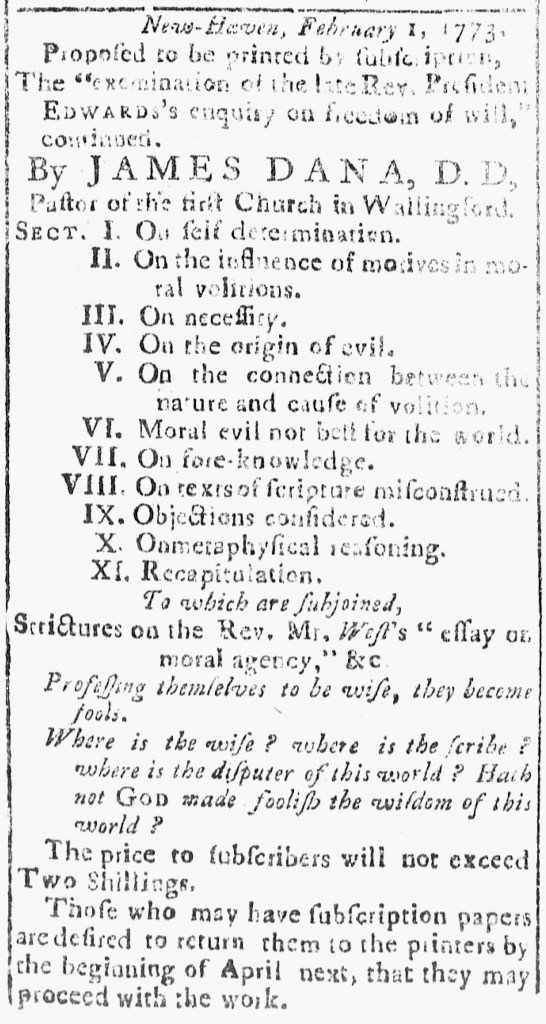
Connecticut Journal (February 19, 1773).

“Those who may have subscription papers are desired to return them to the printers.”

In February 1773, Thomas Green and Samuel Green, printers of the Connecticut Journal and New-Haven Post-Boy, inserted subscription proposals for a book by James Dana, “Pastor of the first Church in Wallingford,” into their own newspaper.  Eighteenth-century printers often placed advertisements promoting their other projects in their newspapers, whether publishing books and pamphlets or peddling books, stationery, patent medicines, and other merchandise.  In this instance, the Greens sought to publish a continuation of An Examination of the Late Reverend President Edwards’s “Enquiry on Freedom of Will” (1770), supplementing the new volume with “Strictures on the Rev. Mr. West’s ‘essay on moral agency.’”  To entice prospective customer to reserve copies by subscribing in advance, the Greens listed the contents of the book and promised that the price “will not exceed Two Shillings.”

Subscription proposals served as a rudimentary form of market research.  Printers and authors did not want to take books to press without knowing if they made a sound investment.  To assess demand for proposed works, they distributed subscription notices that described the contents, the paper and type, and the costs.  Customers interested in the proposed work reserved copies in advance, sometimes paying a deposit.  Collecting the names of subscribers provided guidance about how many copies to print.  In some instances, they discontinued projects after determining that they had not generated sufficient interest to make them viable.  Sometimes, but not always, printers gave credit to those who supported the project by inserting a list of subscribers, an additional incentive for customers to reserve copies.

The Greens began promoting this book before their advertisement appeared in the Connecticut Journal in February 1773. In that advertisement they requested that “Those who may have subscription papers are desired to return them to the printers by the beginning of April next, that they may proceed with the work.”  The Greens apparently provided separate advertisements, perhaps as handbills, broadsides, or pamphlets, to associates who took responsibility for distributing them and collecting the names of subscribers and how many copies they ordered.  Those associates may have kept lists of their own.  Alternately, they may have posted broadsides in their shops, allowing subscribers to sign their own names … and peruse the list of other subscribers to get a sense of the company they kept.  Eighteenth-century newspaper advertisements make frequent reference to subscription papers, suggesting that this form of advertising circulated more widely than surviving copies in research libraries and historical societies suggest.  Many printers and authors, including the Greens, deployed multipronged approaches to marketing, disseminating advertisements in formats other than the newspaper advertisements so familiar to historians of early America.

February 18

What was advertised in a colonial American newspaper 250 years ago today?

New-York Journal (February 18, 1773).

“With many other articles too numerous for an advertisement.”

Samuel Deall sold a variety of merchandise at his shop on Broad Street in New York in 1773.  In an advertisement in the February 18 edition of the New-York Journal, he listed only some of his wares, informing prospective customers that he carried “a large assortment of haberdashery and hosiery of all sort,” “Gentlemen and Ladies gloves of all sorts,” “gilt, bordered and plain message cards,” “Bayley’s boxes of improved soap with brushes for shaving,” “fine tooth brushes,” and “the fine new invented Cakes for shining liquid blacking for shoes and boots.”  The merchant listed a variety of other items and concluded by noting that he stocked “many other articles too numerous for an advertisement.”

In adopting that means of suggesting that he offered a wide array of choices to consumers, Deall deployed a strategy popular among merchants and shopkeepers.  Elsewhere in that issue of the New-York Journal, several other advertisers published short catalogs of their merchandise and added that space did not permit them to go into even greater detail.  For instance, Robert G. Livingston, Jr., stated that he sold “Sundry other goods in the store way, too tedious to mention.”  Similarly, Wigglesworth, Kent, and Company concluded their litany of goods with a promise that they had “many other Articles too tedious to enumerate.”  William Wikoff once again placed his advertisement that enticed consumers with “many more articles, too tedious to insert” in the newspaper.  Gerardus Duycknick ended his advertisement for his Universal Store, so named because he supposedly stocked everything, with a note about “a Variety of other Articles … too tedious to mention.”

Each of these advertisers used lists of goods to demonstrate some of the choices they made available to customers.  To enhance those lists, each also suggested that going into greater detail in a newspaper advertisement was neither practical nor entertaining.  Instead, they implied that prospective would have more satisfying and enjoyable experiences by visiting their stores, browsing their merchandise, and seeing for themselves the many choices that might suit their tastes and budgets.  As colonizers participated in a transatlantic consumer revolution in the eighteenth century, offering choices became one of the most popular marketing strategies deployed by merchants and shopkeepers.

Slavery Advertisements Published February 18, 1773

The Slavery Adverts 250 Project chronicles the role of newspaper advertising in perpetuating slavery in the era of the American Revolution. The project seeks to reveal the ubiquity of slavery in eighteenth-century life from New England to Georgia by republishing advertisements about enslaved people – for sale as individuals or in groups, wanted to purchase or for hire for short periods, runaways who liberated themselves, and those who were subsequently captured and confined in jails and workhouses – in daily digests on this site as well as in real time via the @SlaveAdverts250 Twitter feed, utilizing twenty-first-century media to stand in for the print media of the eighteenth century.

The project aims to provide modern audiences with a sense of just how often colonizers encountered these advertisements in their daily lives. Enslaved men, women, and children appeared in print somewhere in the colonies almost every single day. Those advertisements served as a constant backdrop for social, cultural, economic, and political life in colonial and revolutionary America. Colonizers who did not purport to own enslaved people were still confronted with slavery as well as invited to maintain the system by purchasing enslaved men, women, and children or assisting in the capture of so-called “runaways” who sought to free themselves from bondage. The frequency of these newspaper advertisements suggests just how embedded slavery was in colonial and revolutionary American culture in everyday interactions beyond the printed page.

These advertisements also testify to the experiences of enslaved men, women, and children, though readers must consider that those experiences have been remediated through descriptions offered by enslavers rather than enslaved people themselves. Often unnamed in the advertisements, enslaved men, women, and children were not invisible or unimportant in early America.

These advertisements appeared in colonial American newspapers 250 years ago today.

Maryland Gazette (February 18, 1773).

**********

Maryland Gazette (February 18, 1773).

**********

Maryland Gazette (February 18, 1773).

**********

Supplement to the Maryland Gazette (February 18, 1773).

**********

Massachusetts Gazette and Boston Weekly News-Letter (February 18, 1773).

**********

Massachusetts Gazette and Boston Weekly News-Letter (February 18, 1773).

**********

Massachusetts Gazette and Boston Weekly News-Letter Extraordinary (February 18, 1773).

**********

Massachusetts Spy (February 18, 1773).

**********

New-York Journal (February 18, 1773).

**********

Virginia Gazette [Purdie and Dixon] (February 18, 1773).

**********

Virginia Gazette [Purdie and Dixon] (February 18, 1773).

**********

Virginia Gazette [Purdie and Dixon] (February 18, 1773).

**********

Virginia Gazette [Purdie and Dixon] (February 18, 1773).

**********

Virginia Gazette [Purdie and Dixon] (February 18, 1773).

**********

Virginia Gazette [Purdie and Dixon] (February 18, 1773).

**********

Virginia Gazette [Purdie and Dixon] (February 18, 1773).

**********

Virginia Gazette [Purdie and Dixon] (February 18, 1773).

**********

Virginia Gazette [Purdie and Dixon] (February 18, 1773).

**********

Virginia Gazette [Purdie and Dixon] (February 18, 1773).

**********

Virginia Gazette [Purdie and Dixon] (February 18, 1773).

**********

Virginia Gazette [Purdie and Dixon] (February 18, 1773).

**********

Virginia Gazette [Purdie and Dixon] (February 18, 1773).

**********

Virginia Gazette [Rind] (February 18, 1773).

**********

Virginia Gazette [Rind] (February 18, 1773).

**********

Virginia Gazette [Rind] (February 18, 1773).

**********

Virginia Gazette [Rind] (February 18, 1773).

**********

Virginia Gazette [Rind] (February 18, 1773).

**********

Virginia Gazette [Rind] (February 18, 1773).

**********

Virginia Gazette [Rind] (February 18, 1773).

February 17

What was advertised in a colonial American newspaper 250 years ago today?

Pennsylvania Gazette (February 17, 1773).

“A SECOND PUBLICATION OF THE UNIVERSAL ALMANACK, For the Year 1773.”

Nearly six weeks into the new year, James Humphreys, Jr., commenced advertising a “SECOND PUBLICATION OF THE UNIVERSAL ALMANACK, For the Year 1773” with astronomical calculations “performed with the greatest exactness and truth” by David Rittenhouse.  Humphreys had advertised the first printing of the almanac more than three months earlier with notices in the November 9, 1772, edition of the Pennsylvania Packet and the November 11, 1772, edition of the Pennsylvania Gazette.  Those advertisements featured identical copy, though the compositors devised very different formats.

When Humphreys advertised the second publication in Pennsylvania Gazette on February 17, 1773, he used a slightly truncated version of the original advertisement.  (Perhaps the compositor took advantage of type already set from the previous run of the notice.)  Two days earlier, however, a much shorter version, one without a list of the contents, appeared in the Pennsylvania Packet.  In the next issue, published on February 22, Humphrey’s advertisement once again included the contents of the almanac, doubling the length of the notice.  That represented some expense for Humphreys, though John Dunlap, printer of the Pennsylvania Packet, may have given him a discount on advertising since he also sold the almanac.  Unlike the notice that ran in the Pennsylvania Gazette, one that listed only Humphreys, the advertisement in the Pennsylvania Packet stated that the almanac was “SOLD by JAMES HUMPHREYS junr. at his Printing-office, … and by John Dunlap.”

No matter the particulars of his arrangement with Dunlap, Humphreys took a chance on a second publication of the almanac so far into the year.  Other printers advertised surplus copies of almanacs that had not yet sold, hoping to achieve better returns on their investments for items that became more and more obsolete with each passing day.  Perhaps the initial publication did well enough that Humphreys considered printing a small number for the second publication worth the risk.  Perhaps he believed that the calculations by “that ingenious master of mathematics, Mr. DAVID RITTENHOUSE,” well known in Philadelphia, would recommend the almanac above all others.  In his first round of advertising, he asserted that “it is the only almanac published of his calculating.”  Perhaps Humphreys thought the other contents, a variety of poems, recipes, short essays, and even directions for “guarding against smutty crops of wheat,” were interesting enough to prospective customers that they would want to consult and enjoy them throughout the remainder of the year.  Perhaps he did not produce a second publication at all, but instead claimed he did in an effort to make the almanac appear popular and sell leftover copies of the first publication that he passed off as a subsequent printing.  Advertising a second publication of an almanac so far into the year was unusual, whatever Humphrey’s inspiration in doing so.

Slavery Advertisements Published February 17, 1773

The Slavery Adverts 250 Project chronicles the role of newspaper advertising in perpetuating slavery in the era of the American Revolution. The project seeks to reveal the ubiquity of slavery in eighteenth-century life from New England to Georgia by republishing advertisements about enslaved people – for sale as individuals or in groups, wanted to purchase or for hire for short periods, runaways who liberated themselves, and those who were subsequently captured and confined in jails and workhouses – in daily digests on this site as well as in real time via the @SlaveAdverts250 Twitter feed, utilizing twenty-first-century media to stand in for the print media of the eighteenth century.

The project aims to provide modern audiences with a sense of just how often colonizers encountered these advertisements in their daily lives. Enslaved men, women, and children appeared in print somewhere in the colonies almost every single day. Those advertisements served as a constant backdrop for social, cultural, economic, and political life in colonial and revolutionary America. Colonizers who did not purport to own enslaved people were still confronted with slavery as well as invited to maintain the system by purchasing enslaved men, women, and children or assisting in the capture of so-called “runaways” who sought to free themselves from bondage. The frequency of these newspaper advertisements suggests just how embedded slavery was in colonial and revolutionary American culture in everyday interactions beyond the printed page.

These advertisements also testify to the experiences of enslaved men, women, and children, though readers must consider that those experiences have been remediated through descriptions offered by enslavers rather than enslaved people themselves. Often unnamed in the advertisements, enslaved men, women, and children were not invisible or unimportant in early America.

These advertisements appeared in colonial American newspapers 250 years ago today.

Pennsylvania Gazette (February 17, 1773).

**********

Pennsylvania Journal (February 17, 1773).

**********

Pennsylvania Journal (February 17, 1773).

**********

Pennsylvania Journal (February 17, 1773).

**********

Pennsylvania Journal (February 17, 1773).

**********

Supplement to the Pennsylvania Journal (February 17, 1773).

February 16

What was advertised in a colonial American newspaper 250 years ago today?

Essex Gazette (February 16, 1773).

“Any who favour him with their Custom, may depend upon being well served.”

The decorative border that enclosed Stephen Higginson’s advertisement for a “large & general Assortment of English and India GOODS” in the February 16, 1773, edition of the Essex Gazette distinguished it from all of the other advertisements … except for one.  John Appleton’s advertisement for “as large an Assortment of English Goods as any in this Town” also featured a border made of ornamental type.

Such borders did not appear in the Essex Gazette with the same frequency that they did in several of the newspapers published in Boston.  In the summer and fall of 1772, several advertisers took an interest in enhancing their advertisements in the Boston Evening-Post, the Boston-Gazette, the Massachusetts Gazette and Boston Post-Boy, and the Massachusetts Gazette and Boston Weekly News-Letter with borders.  Among the newspapers published in the city, only the Massachusetts Spy seemed to reject that design element.

Given the proximity of Boston to Salem as well as the circulation of newspapers far beyond their places of publication during the era of the American Revolution, Higginson and, especially, Appleton may have noticed advertisements with borders in newspapers they read and then decided to incorporate that feature into their own advertisements.  Appleton did so first, commencing his advertisement in the January 19 edition of the Essex Gazette.  (His advertisement in the October 27, 1772, issue did not have a border.)  It already ran for four consecutive weeks before Higginson placed his own advertisement enclosed in a decorative border.  While Higginson may have also seen similar advertisements in newspapers published in Boston, it seems even more likely that he was familiar with Appleton’s advertisement that ran in the newspaper in his own town for the past month.

Whatever their inspirations, Appleton and Higginson continued experiments with type and format already underway among advertisers, compositors, and printers in the 1760s and 1770s.  The borders added visual aspects to their advertisement, drawing the attention of readers.  They likely also cost less than woodcuts that advertisers commissioned to adorn their notices.  After all, printers had a variety of decorative type in their cases.  Borders may have been a means of upgrading the visual appeal without significantly increasing the costs of advertising.