Slavery Advertisements Published June 8, 1773

The Slavery Adverts 250 Project chronicles the role of newspaper advertising in perpetuating slavery in the era of the American Revolution. The project seeks to reveal the ubiquity of slavery in eighteenth-century life from New England to Georgia by republishing advertisements about enslaved people – for sale as individuals or in groups, wanted to purchase or for hire for short periods, runaways who liberated themselves, and those who were subsequently captured and confined in jails and workhouses – in daily digests on this site as well as in real time via the @SlaveAdverts250 Twitter feed, utilizing twenty-first-century media to stand in for the print media of the eighteenth century.

The project aims to provide modern audiences with a sense of just how often colonizers encountered these advertisements in their daily lives. Enslaved men, women, and children appeared in print somewhere in the colonies almost every single day. Those advertisements served as a constant backdrop for social, cultural, economic, and political life in colonial and revolutionary America. Colonizers who did not purport to own enslaved people were still confronted with slavery as well as invited to maintain the system by purchasing enslaved men, women, and children or assisting in the capture of so-called “runaways” who sought to free themselves from bondage. The frequency of these newspaper advertisements suggests just how embedded slavery was in colonial and revolutionary American culture in everyday interactions beyond the printed page.

These advertisements also testify to the experiences of enslaved men, women, and children, though readers must consider that those experiences have been remediated through descriptions offered by enslavers rather than enslaved people themselves. Often unnamed in the advertisements, enslaved men, women, and children were not invisible or unimportant in early America.

These advertisements appeared in colonial American newspapers 250 years ago today.

Connecticut Courant (June 8, 1773).

**********

Essex Gazette (June 8, 1773).

**********

South-Carolina Gazette and Country Journal (June 8, 1773).

**********

South-Carolina Gazette and Country Journal (June 8, 1773).

**********

South-Carolina Gazette and Country Journal (June 8, 1773).

**********

South-Carolina Gazette and Country Journal (June 8, 1773).

**********

South-Carolina Gazette and Country Journal (June 8, 1773).

**********

South-Carolina Gazette and Country Journal (June 8, 1773).

**********

South-Carolina Gazette and Country Journal (June 8, 1773).

June 7

What was advertised in a colonial American newspaper 250 years ago today?

Supplement to the Newport Mercury (June 7, 1773).

“A general Assortment of English and India GOODS.”

For the third week in a row, Solomon Southwick, the printer of the Newport Mercury, distributed an advertising supplement because he did not have sufficient space to print all the news and notices submitted to his printing office on Queen Street.  As usual, the standard issue consisted of four pages, created by printing two pages on each side of a broadsheet and then folding it in half.  The supplement consisted of only two pages, one on each side of a smaller sheet … but not simply half a sheet of the paper used for printing the standard issue.

Instead, Southwick conserved his paper supply by resorting to an even smaller sheet.  Rather than accommodating three columns, the smaller sheet allowed for only two columns of the same width.  Southwick left it at that for the supplement that accompanied the May 31, 1773, edition.  For the May 24 and June 7 supplements, however, he managed to find room for a few more advertisements by creating a third column that ran perpendicular to the other two columns.  The printer placed shorter advertisements in this narrow column.

That worked well for the two lines that advised “Choice red CEDAR POSTS to sell, by THOMAS TRIPP” or the three lines about “CASH given for clean LINEN RAGES, coarse or fine, at the PRINTING-OFFICE in Newport.”  John Bours, on the other hand, ran a longer advertisement for a “general Assortment of English and India GOODS … at his shop, the sign of the golden eagle.”  To fit it in the narrow column without breaking down the type and setting it again, Southwick merely divided the advertisement in half and placed the two halves next to each other.  He did the same for a similar advertisement placed by George Lawton and Robert Lawton and his own notice about imported writing paper.  That facilitated reconstituting the advertisements when necessary to appear as usual in columns that had not been rotated when space permitted.

Bours’s advertisement did feature a slight variation on the usual practice.  When it ran in the standard issue on June 14, the printer replaced the smaller font for “GOODS” with a larger font to help attract attention.  The smaller font had been necessary to make the advertisement fit in the narrow column, but the notice received new consideration when space permitted.  Such was the exception rather than the rule when printers squeezed advertisements into what would have otherwise been margins.

Colonial printers often published advertising supplements that made such use of the space available to them.  Southwick and his counterparts in other towns devised a means of serving the advertisers who placed notices and the subscribers who read them while simultaneously minimizing the costs of producing and disseminating their newspapers.

Slavery Advertisements Published June 7, 1773

The Slavery Adverts 250 Project chronicles the role of newspaper advertising in perpetuating slavery in the era of the American Revolution. The project seeks to reveal the ubiquity of slavery in eighteenth-century life from New England to Georgia by republishing advertisements about enslaved people – for sale as individuals or in groups, wanted to purchase or for hire for short periods, runaways who liberated themselves, and those who were subsequently captured and confined in jails and workhouses – in daily digests on this site as well as in real time via the @SlaveAdverts250 Twitter feed, utilizing twenty-first-century media to stand in for the print media of the eighteenth century.

The project aims to provide modern audiences with a sense of just how often colonizers encountered these advertisements in their daily lives. Enslaved men, women, and children appeared in print somewhere in the colonies almost every single day. Those advertisements served as a constant backdrop for social, cultural, economic, and political life in colonial and revolutionary America. Colonizers who did not purport to own enslaved people were still confronted with slavery as well as invited to maintain the system by purchasing enslaved men, women, and children or assisting in the capture of so-called “runaways” who sought to free themselves from bondage. The frequency of these newspaper advertisements suggests just how embedded slavery was in colonial and revolutionary American culture in everyday interactions beyond the printed page.

These advertisements also testify to the experiences of enslaved men, women, and children, though readers must consider that those experiences have been remediated through descriptions offered by enslavers rather than enslaved people themselves. Often unnamed in the advertisements, enslaved men, women, and children were not invisible or unimportant in early America.

These advertisements appeared in colonial American newspapers 250 years ago today.

Supplement to the Newport Mercury (June 7, 1773).

**********

Supplement to the Newport Mercury (June 7, 1773).

**********

New-York Gazette and Weekly Mercury (June 7, 1773).

**********

New-York Gazette and Weekly Mercury (June 7, 1773).

**********

New-York Gazette and Weekly Mercury (June 7, 1773).

**********

New-York Gazette and Weekly Mercury (June 7, 1773).

**********

New-York Gazette and Weekly Mercury (June 7, 1773).

**********

Pennsylvania Chronicle (June 7, 1773).

**********

Pennsylvania Packet (June 7, 1773).

**********

Pennsylvania Packet (June 7, 1773).

**********

Supplement to the Pennsylvania Packet (June 7, 1773).

**********

Supplement to the Pennsylvania Packet (June 7, 1773).

**********

Supplement to the Pennsylvania Packet (June 7, 1773).

**********

South-Carolina Gazette (June 7, 1773).

**********

South-Carolina Gazette (June 7, 1773).

**********

South-Carolina Gazette (June 7, 1773).

**********

South-Carolina Gazette (June 7, 1773).

**********

South-Carolina Gazette (June 7, 1773).

**********

South-Carolina Gazette (June 7, 1773).

**********

South-Carolina Gazette (June 7, 1773).

**********

South-Carolina Gazette (June 7, 1773).

**********

South-Carolina Gazette (June 7, 1773).

**********

South-Carolina Gazette (June 7, 1773).

**********

South-Carolina Gazette (June 7, 1773).

**********

South-Carolina Gazette (June 7, 1773).

**********

South-Carolina Gazette (June 7, 1773).

**********

South-Carolina Gazette (June 7, 1773).

**********

South-Carolina Gazette (June 7, 1773).

**********

Supplement to the South-Carolina Gazette (June 7, 1773).

**********

Supplement to the South-Carolina Gazette (June 7, 1773).

**********

Supplement to the South-Carolina Gazette (June 7, 1773).

**********

Supplement to the South-Carolina Gazette (June 7, 1773).

**********

Supplement to the South-Carolina Gazette (June 7, 1773).

**********

Supplement to the South-Carolina Gazette (June 7, 1773).

**********

Supplement to the South-Carolina Gazette (June 7, 1773).

**********

Supplement to the South-Carolina Gazette (June 7, 1773).

**********

Supplement to the South-Carolina Gazette (June 7, 1773).

**********

Supplement to the South-Carolina Gazette (June 7, 1773).

**********

Supplement to the South-Carolina Gazette (June 7, 1773).

**********

Supplement to the South-Carolina Gazette (June 7, 1773).

**********

Supplement to the South-Carolina Gazette (June 7, 1773).

**********

Supplement to the South-Carolina Gazette (June 7, 1773).

**********

Supplement to the South-Carolina Gazette (June 7, 1773).

June 6

Who were the subjects of advertisements in a colonial American newspaper 250 years ago this week?

South-Carolina Gazette and Country Journal (June 1, 1773).

“A CARGO OF ONE HUNDRED and FIFTY-FIVE Sierra-Leon NEGROES.”

When it came to advertising, Charles Crouch, the printer of the South-Carolina Gazette and Country Journal, did good business in terms of notices about enslaved people.  Such advertisements, whether offering enslaved people for sale or offering rewards for the capture and return of those who liberated themselves by running away, generated significant revenue for Crouch and other printers.  Consider the June 1, 1773, edition of the South-Carolina Gazette and Country Journal.  It carried sixty-one advertisements.  Among those that hawked a variety of consumer goods and services appeared two notices from the printer, seven legal notices from courts held in various towns throughout the colony, and sixteen about enslaved people.  Thirteen concerned upcoming sales, while the others the described enslaved people, including Flora, a “Washer and Ironer,” who escaped from their enslavers.

Visual images made the preponderance of advertisements about enslaved people all the more striking.  Enslaved people populated the page just as they populated the busy port of Charleston as well as towns and plantations in the countryside throughout the colony.  Images adorned fourteen of the advertisements in the June 1 edition, four of them depicting vessels at sea for advertisements seeking cargo and passengers and ten of them depicting one or more enslaved people.  Nine of those woodcuts of enslaved people appeared in a single column on the third page, the repetition and proximity making them all the more difficult to overlook.

Those advertisements described captives who arrived in Charleston “after a short Passage from AFRICA,” “from the Gold Coast,” “directly from GAMBIA,” “directly from the Coast,” “from GAMBIA,” “From CAPE-MOUNT, (A RICE COUNTRY),” “from Angola,” “directly from the Coast of Africa,” and “from the Gold-Coast.”  The images not only represented the presence of enslaved people in Charleston and throughout the colony; they also testified to the scenes in the ships that transported enslaved people across the Atlantic and the scenes at auction sites that put Black bodies on display for examination and scrutiny by prospective buyers, though sanitized for consumption in the public prints.  Printers, like Crouch, helped perpetuate slavery and the slave trade via the words and images that they allowed (and encouraged) advertisers to publish in their newspapers.

June 5

What was advertised in a colonial American newspaper 250 years ago today?

Providence Gazette (June 5, 1773).

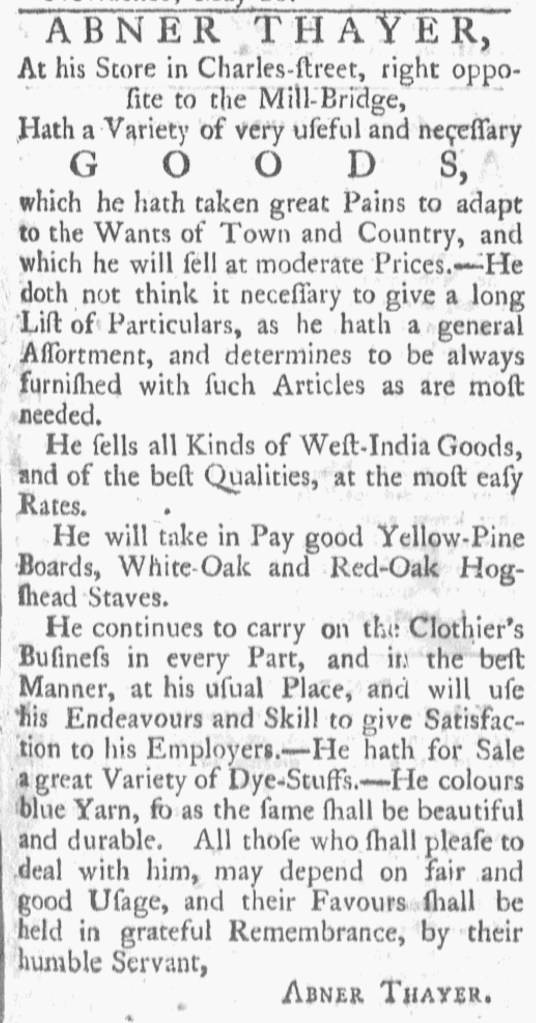
“He continues to carry on the Clothier’s Business in every part.”

Abner Thayer stocked a “Variety of very useful and necessary GOODS” at his store in Providence in the summer of 1773.  In an advertisement in the June 5 edition of the Providence. Gazette, he advised prospective customers that he “doth not think it necessary to give a long List of Particulars, as he hath a general Assortment.”  Furthermore, he “determines to be always furnished with such Articles as are most needed.”  The shopkeeper underscored that he “hath taken great Pains to adapt to the Wants of Town and Country.”

He also served colonizers in another way.  Thayer informed the public that he “continues to carry on the Clothier’s Business in every Part, and in the best Manner, at his usual Place.”  In the same paragraph, he declared that he “hath for Sale a great Variety of Dye-Stuffs” and “colours blue Yarn, so as the same shall be beautiful and durable.”  At a glance, modern readers may not realize that when Thayer invoked the “Clothier’s Business” he referred to processing textiles rather than producing garments.  The entry for “clothier” in the Oxford English Dictionary reveals the usages of the word in early America.

That entry defines a clothier as “one engaged in the cloth trade: (a) a maker of woollen cloth; (b) esp. one who performs the operations subsequent to the weaving (archaic); (c) a fuller and dresser of cloth (U.S.); (d) a seller of cloth and men’s clothes.”  This demonstrates the evolution of the meaning of the word over time, including the most common usage today.  Yet readers of the Providence Gazette did not expect Thayer to make or sell garments for men.  They understood that he processed textiles.  One of the examples provided by the OED, drawn from one of the most famous dictionaries published in America, makes this even more clear.  The entry for “clothier” from Noah Webster’s American Dictionary of the English Language (1828) states, “in English authors, a man who makes cloths.  In this sense, I believe, it is not used in the United States; certainly not in New-England.  In America, a man, whose occupation is to full and dress cloth.”  That Webster made a point about the meaning of “clothier” in New England further indicates how Thayer used the word to describe his services in an advertisement in the Providence Gazette.

When we consult eighteenth-century newspapers and other primary sources, I often have conversations with my students about how we must be cautious readers.  Just because some words look familiar to us today does not mean that colonizers used them in the same way we do.  Understanding primary sources requires knowledge of the broader context, not just the words on the page.  As part of those conversations, I introduce my students to the OED so they can explore and make assessments on their own as they do the research for their contributions to the Adverts 250 Project and other projects.

June 4

What was advertised in a colonial American newspaper 250 years ago today?

New-London Gazette (June 4, 1773).

“LONDON Coffee-House, Kept by THOMAS ALLEN.”

“THOMAS ALLEN’s Marine List.”

In the early 1770s, Thomas Allen operated the “LONDON Coffee-House” in New-London, Connecticut.  In an advertisement in that ran in the New-London Gazette in May and June 1773, he offered “genteel Entertainment … for Gentlemen Travellers.”  He also sold a variety of “Choice old Spirits by the Gallon” in addition to “Genuine” wines imported from Madeira, Faial, and Tenerife “By the Gal. or Quart.”  Presumably, he also served those wines and spirits as well as coffee, tea, and chocolate to “Gentlemen Travellers” and other patrons.

Like other coffeehouses, Allen’s establishment also served as a gathering place for merchants to conduct business and share information.  Allen likely subscribed to the New-London Gazette as well as newspapers printed in other colonies, making them available to patrons interested in all sorts of news and especially the shipping news that concerned networks of commerce that crisscrossed the Atlantic.

New-London Gazette (June 4, 1773).

In addition to that valuable service, Allen established himself as a purveyor of such information in the public prints.  Starting with the April 30 edition, the printer of the New-London Gazette supplemented the lists of ships “ENTERED IN” and “CLEARED OUT” of the customs house with “THOMAS ALLEN’s Marine List” that provided details about the location and progress of vessels.  Presumably, Allen spoke with captains when they arrived in port, then relayed the news to the printer, thus bolstering the kind of coverage offered by the newspaper.  The entry in the June 4 edition, for instance, included this news: “Capt. Newson in 21 Days from Nevis spoke with the following Vessels, viz. May 26th, Sloop Sally, Capt. Campbell, from Nevis, bound to Casco-Bay, Lat. 34 43. Long. 68 6.  May 29th, Ship Sally, Capt. Samuel Young, from Bristol, bound to Philadelphia, Lat. 38 10. Lon. 70. who had a number of Passengers on board.”  The “Marine List” also gave details about one other ship that Newsom encountered during the voyage from Nevis.  Not only merchants valued these updates; families of sailors did so as well.

Allen provided this service for more than fifteen years, bolstering his own reputation as a purveyor of shipping news.  The local newspaper benefited from his efforts, as did merchants and families who consulted “THOMAS ALLEN’s Marine List” in addition to the entries from the customs house.  The news that appeared in the public prints may have convinced some readers to visit Allen’s coffeehouse to see if they could glean more information from the proprietor, additional details that did not appear in the newspaper.

Slavery Advertisements Published June 4, 1773

The Slavery Adverts 250 Project chronicles the role of newspaper advertising in perpetuating slavery in the era of the American Revolution. The project seeks to reveal the ubiquity of slavery in eighteenth-century life from New England to Georgia by republishing advertisements about enslaved people – for sale as individuals or in groups, wanted to purchase or for hire for short periods, runaways who liberated themselves, and those who were subsequently captured and confined in jails and workhouses – in daily digests on this site as well as in real time via the @SlaveAdverts250 Twitter feed, utilizing twenty-first-century media to stand in for the print media of the eighteenth century.

The project aims to provide modern audiences with a sense of just how often colonizers encountered these advertisements in their daily lives. Enslaved men, women, and children appeared in print somewhere in the colonies almost every single day. Those advertisements served as a constant backdrop for social, cultural, economic, and political life in colonial and revolutionary America. Colonizers who did not purport to own enslaved people were still confronted with slavery as well as invited to maintain the system by purchasing enslaved men, women, and children or assisting in the capture of so-called “runaways” who sought to free themselves from bondage. The frequency of these newspaper advertisements suggests just how embedded slavery was in colonial and revolutionary American culture in everyday interactions beyond the printed page.

These advertisements also testify to the experiences of enslaved men, women, and children, though readers must consider that those experiences have been remediated through descriptions offered by enslavers rather than enslaved people themselves. Often unnamed in the advertisements, enslaved men, women, and children were not invisible or unimportant in early America.

These advertisements appeared in colonial American newspapers 250 years ago today.

New-London Gazette (June 4, 1773).

June 3

What was advertised in a colonial American newspaper 250 years ago today?

Maryland Gazette (June 3, 1773).

“He hath opened an inn and tavern, at the sign of the Fountain … in Market-street, Baltimore.”

As summer arrived in 1773, Daniel Grant opened a new inn and tavern in Baltimore.  To attract patrons, he inserted advertisements in the Maryland Gazette, published in Annapolis, and the Pennsylvania Packet, published in Philadelphia, to supplement word-of-mouth news of his establishment in Baltimore.  That city did not yet have its own newspaper, though William Goddard had recently opened a printing office there and distributed subscription proposals for the Maryland Journal.  Even if Grant could have advertised in a local newspaper, it benefited him to alert colonizers throughout the regions served by the Maryland Gazette and the Pennsylvania Packet that they could avail themselves of his services if they had occasion to travel to Baltimore.  Besides, those newspapers were the local newspapers, at least for another few months until Goddard commenced publication of the Maryland Journal near the end of August.

As part of his marketing efforts, Grant emphasized his experience running a tavern “at the sign of the Buck, near Philadelphia.”  He extended “his most grateful thanks to the gentlemen who did mum the honour to frequent his former house.”  In addition, he declared that “it shall ever be his study to please” and “he hopes for a continuance of their favours” when they visited Baltimore.  Such sentiments communicated to those who had not previously visited the tavern “at the sign of the Buck” that Grant had successfully cultivated a clientele and would offer the same quality of service to patrons at the inn and tavern “at the sign of the Fountain … in Market-street, Baltimore.”  He pledged that “those who choose to favour him with their custom, may be assured of his best endeavours to merit their approbation.”  To that end, he promoted the “late and commodious house” that he converted into an inn and tavern and asserted that he “hath provided everything for the accommodation of gentlemen, their servants, and horses, in the best manner.”  Apparently, Grant also operated a stable or made arrangements with a nearby associate to provide hosteling services.  Whatever their needs and desires, Grant promised prospective patrons a pleasant stay at his inn and tavern.

Slavery Advertisements Published June 3, 1773

The Slavery Adverts 250 Project chronicles the role of newspaper advertising in perpetuating slavery in the era of the American Revolution. The project seeks to reveal the ubiquity of slavery in eighteenth-century life from New England to Georgia by republishing advertisements about enslaved people – for sale as individuals or in groups, wanted to purchase or for hire for short periods, runaways who liberated themselves, and those who were subsequently captured and confined in jails and workhouses – in daily digests on this site as well as in real time via the @SlaveAdverts250 Twitter feed, utilizing twenty-first-century media to stand in for the print media of the eighteenth century.

The project aims to provide modern audiences with a sense of just how often colonizers encountered these advertisements in their daily lives. Enslaved men, women, and children appeared in print somewhere in the colonies almost every single day. Those advertisements served as a constant backdrop for social, cultural, economic, and political life in colonial and revolutionary America. Colonizers who did not purport to own enslaved people were still confronted with slavery as well as invited to maintain the system by purchasing enslaved men, women, and children or assisting in the capture of so-called “runaways” who sought to free themselves from bondage. The frequency of these newspaper advertisements suggests just how embedded slavery was in colonial and revolutionary American culture in everyday interactions beyond the printed page.

These advertisements also testify to the experiences of enslaved men, women, and children, though readers must consider that those experiences have been remediated through descriptions offered by enslavers rather than enslaved people themselves. Often unnamed in the advertisements, enslaved men, women, and children were not invisible or unimportant in early America.

These advertisements appeared in colonial American newspapers 250 years ago today.

Maryland Gazette (June 3, 1773).

**********

Maryland Gazette (June 3, 1773).

**********

New-York Journal (June 3, 1773).

**********

Virginia Gazette [Purdie and Dixon] (June 3, 1773).

**********

Virginia Gazette [Purdie and Dixon] (June 3, 1773).

**********

Virginia Gazette [Purdie and Dixon] (June 3, 1773).

**********

Virginia Gazette [Purdie and Dixon] (June 3, 1773).

**********

Virginia Gazette [Purdie and Dixon] (June 3, 1773).

**********

Virginia Gazette [Rind] (June 3, 1773).

**********

Virginia Gazette [Rind] (June 3, 1773).

**********

Virginia Gazette [Rind] (June 3, 1773).

**********

Virginia Gazette [Rind] (June 3, 1773).

**********

Virginia Gazette [Rind] (June 3, 1773).

June 2

What was advertised in a colonial American newspaper 250 years ago today?

Pennsylvania Gazette (June 2, 1773).

“The following Lines be pleased to read, / And they will shew the Cause indeed.”

Henry Funk and Christian Carpenter wanted to increase the chances that readers of the Pennsylvania Gazette took note of their advertisement offering a reward “For securing JOHN FARRAN, in Lancaster Goal” for stealing horses.  Except for the headline at the top and their signatures at the bottom, the entire advertisement consisted of rhyming couplets that described Farran and the offense he committed.  Other advertisements in the June 2, 1773, edition offered rewards for capturing runaway indentured servants or enslaved people who liberated themselves, but each of them featured a paragraph of dense text.  In contrast, Funk and Carpenter’s notice had plenty of white space to draw the eye and an entertaining poem to hold readers’ attention.  The aggrieved advertisers certainly put more effort into composing it than their counterparts did in writing formulaic notices that described indentured servants and enslaved people.

Funk and Carpenter offered an overview of the situation.  “In April last was stole away, / From each of us (we’re bold to say) / Two stately Horses, stout and strong, / And Farran did the cruel Wrong.”  He escaped into the woods with the horses, saddles, and other goods, but “The honest Neighbours round about, / Did hunt and find the Villain out.”  Farran managed to escape and “Where he is gone, we cannot say, / But he’s a Rogue, by Night and Day.”  According to Funk and Carpenter, that had not been the thief’s first infraction.  Instead, he had a history and “This Rogue is known both far and near, / To steal and sell, from Year to Year.”

To aid in identifying the fugitive, Funk and Carpenter offered a description, a bit disjointed in order to achieve the rhymes.  For instance, they interspersed a warning that Farran might change his name with information about his age and appearance.  “To tell his Marks we do incline, / His Age may be full Thirty-nine; / He’ll change his Name too, now and then, / His Height may be full five Feet ten.”  Similarly, they muddled together other aspects of his physical description with his speech patterns and their suspicions that the thief would attempt to disguise himself.  “His Hair is black, Complexion too, / And as it suits, says Thee, or You; / To tell his Clothes, it will us fail, / For them he’ll Change, or more will steal; / He is a stout and well made Fellow, / And in his Colour something Yellow.”

While no great work of literature, Funk and Carpenter’s advertisements likely achieved one of its intended purposes.  The rhyming couplets, though awkward, presented a more engaging and a more memorable story than if they had settled for a standard notice.  That, in turn, may have put more colonizers on the lookout for the notorious Farran, increasing the chances of capturing him and securing him in the Lancaster Jail.