September 13

What was advertised in a colonial American newspaper 250 years ago today?

Massachusetts Gazette and Boston Post-Boy (September 13, 1773).

“After reading the above I leave the World to judge of my unhappy State.”

Most newspaper advertisements concerning runaway wives went unanswered, at least in the public prints.  Friends, neighbors, and acquaintances almost certainly discussed the circumstances of the marital discord that prompted wives to depart from the households of their husbands, sharing what they knew or heard from others and checking for new developments when they engaged in the rituals of gossip.  On occasion, however, some of those wives published their own advertisements in response.  Such was the case with Judith Walker.

Her husband, Simeon, inserted an advertisement in the March 29, 1773, edition of the Massachusetts Gazette and Boston Post-Boy.  It ran for three weeks.  Simeon did not provide much detail, instead resorting to formulaic language that readers would have associated with any notice from the genre.  “WHEREAS Judith, my Wife,” Simeon announced, “has Eloped from me, and refuses to Bed and Board with me:— I now forbid all Persons trusting her on my Account, as I will not pay any Debt of her contracting after this Date.”  Curiously, Simeon dated the advertisement January 18, though it did not run until ten weeks later.

Judith’s response was anything but formulaic.  She spilled a lot more ink than her estranged husband, first citing his advertisement and then offering her reasons for “absenting myself from him.”  Judith asserted that Simeon did not provide “the common Necessaries of Life,” but instead perpetrated “abusive Treatment … for a Number of Years.”  She contended that Simeon “oblig[ed] me to take the Care of Cattle thro’ several Winters, and many unreasonable Tasks he used to compel me to, which I, nor scarce any other Woman, could perform.”  Rather than asking readers to take her word for it, Judith presented a note “from [Simeon’s] own Handwriting, and attested by two credible Persons,” Stephen Felton and Ruth Wheeler, in which he acknowledged that his wife “hath been a faithful, just Attorney in my Business … and she has just Occasion to harden her Heart against me.”  Furthermore, this passage concluded with Simeon expressing his desire for “Church and State to have Charity for my Wife, for she has been obedient to me in Sickness and in Health.”  That note bore the date “February 20th, 1773,” after the date on Simeon’s advertisement but before his advertisement appeared in the newspaper.

Their relationship apparently did not improve over the next several months.  Nearly half a year after Simeon first placed his notice in the Massachusetts Gazette and Boston Post-Boy, Judith took to the pages of the same newspaper.  Those relatively few women who did respond to “runaway wife” advertisements usually did so within weeks.  Why did Judith wait months?  Given the sentiments in Simeon’s handwritten note, had the couple perhaps reconciled temporarily and then found themselves at odds once again?  Whatever had occurred, Judith presented her perspective to the public.  “After reading the above,” she declared, “I leave the World to judge of my unhappy State.”  Husbands usually controlled the narrative in the public prints, but in this instance Judith Walker managed to gain access to the power of the press to offer a competing account.

Slavery Advertisements Published September 13, 1773

The Slavery Adverts 250 Project chronicles the role of newspaper advertising in perpetuating slavery in the era of the American Revolution. The project seeks to reveal the ubiquity of slavery in eighteenth-century life from New England to Georgia by republishing advertisements about enslaved people – for sale as individuals or in groups, wanted to purchase or for hire for short periods, runaways who liberated themselves, and those who were subsequently captured and confined in jails and workhouses – in daily digests on this site as well as in real time via the @SlaveAdverts250 Twitter feed, utilizing twenty-first-century media to stand in for the print media of the eighteenth century.

The project aims to provide modern audiences with a sense of just how often colonizers encountered these advertisements in their daily lives. Enslaved men, women, and children appeared in print somewhere in the colonies almost every single day. Those advertisements served as a constant backdrop for social, cultural, economic, and political life in colonial and revolutionary America. Colonizers who did not purport to own enslaved people were still confronted with slavery as well as invited to maintain the system by purchasing enslaved men, women, and children or assisting in the capture of so-called “runaways” who sought to free themselves from bondage. The frequency of these newspaper advertisements suggests just how embedded slavery was in colonial and revolutionary American culture in everyday interactions beyond the printed page.

These advertisements also testify to the experiences of enslaved men, women, and children, though readers must consider that those experiences have been remediated through descriptions offered by enslavers rather than enslaved people themselves. Often unnamed in the advertisements, enslaved men, women, and children were not invisible or unimportant in early America.

These advertisements appeared in colonial American newspapers 250 years ago today.

Boston Evening-Post (September 13, 1773).

**********

Boston Evening-Post (September 13, 1773).

**********

Boston-Gazette (September 13, 1773).

**********

Boston-Gazette (September 13, 1773).

**********

Boston-Gazette (September 13, 1773).

**********

Massachusetts Gazette and Boston Post-Boy (September 13, 1773).

**********

New-York Gazette and Weekly Mercury (September 13, 1773).

**********

New-York Gazette and Weekly Mercury (September 13, 1773).

**********

New-York Gazette and Weekly Mercury (September 13, 1773).

**********

New-York Gazette and Weekly Mercury (September 13, 1773).

**********

New-York Gazette and Weekly Mercury (September 13, 1773).

**********

New-York Gazette and Weekly Mercury (September 13, 1773).

**********

Pennsylvania Packet (September 13, 1773).

**********

South-Carolina Gazette (September 13, 1773).

**********

Supplement to the South-Carolina Gazette (September 13, 1773).

**********

Supplement to the South-Carolina Gazette (September 13, 1773).

**********

Supplement to the South-Carolina Gazette (September 13, 1773).

**********

Supplement to the South-Carolina Gazette (September 13, 1773).

**********

Supplement to the South-Carolina Gazette (September 13, 1773).

**********

Supplement to the South-Carolina Gazette (September 13, 1773).

**********

Supplement to the South-Carolina Gazette (September 13, 1773).

**********

Supplement to the South-Carolina Gazette (September 13, 1773).

**********

Supplement to the South-Carolina Gazette (September 13, 1773).

September 12

What was advertised in a colonial American newspaper 250 years ago this week?

Massachusetts Spy (September 9, 1773).

“The Royal American MAGAZINE is likely in a short time to make its appearance.”

Isaiah Thomas, printer of the Massachusetts Spy, continued his efforts to solicit subscribers for a new endeavor, the Royal American Magazine, in the fall of 1773.  Like many other projects proposed by printers, publishers, and booksellers, he would not take the magazine to press until his subscription proposals garnered sufficient interest to justify further investment.  Thomas began with a brief announcement in his own newspaper on May 27, declaring that he would soon publish “PROPOSALS for printing by Subscription, The ROYAL American MAGAZINE.”  On June 24, the proposals appeared in the Massachusetts Spy.  Thomas may have also distributed the proposals as a separate broadside or handbill.

After inserting the proposals in his own newspaper, Thomas set about disseminating them to an even broader market by placing them in all of the newspapers printed in Boston as well as newspapers published in other colonies.  In July, the proposals ran fourteen times, appearing in seven newspapers printed in Boston, Newport, New York, Philadelphia, and Providence.  In August, the proposals appeared thirteen more times in eight newspapers.  They ran for the first time in newspapers published in Hartford and New London.  Along the way, Thomas, who had achieved a reputation for opposing the British government with the news and editorials in the Massachusetts Spy, issued a separate clarification that the Royal American Magazine “will never be GUIDED or INFLUENCED by any PARTY whatever,” despite allegations to the contrary.  However, when Thomas began publishing the magazine in January 1774, it quickly became a vehicle for delivering propaganda that favored the patriot cause.

In September 1773, Thomas dispensed with running the lengthy proposals in the Massachusetts Spy in favor of a shorter notice that encouraged the public, presumably familiar with the project, to become “promoters of this useful undertaking” by “send[ing] in their names with all convenient speed.”  He required “NO Money” until subscribers received the first issue, which he planned to publish “as soon as he hears what number of subscribers there are in the other colonies.”  Thomas pledged that the magazine “is likely in a short time to make its appearance” thanks to “the generous encouragement of a great number of gentlemen in this province.”  Through reporting that the magazine already had so many subscribers, Thomas leveraged existing demand in hopes of generating more demand among those who had not yet subscribed.  To increase the likelihood that prospective subscribers would see and take note of this shorter advertisement, he gave it a privileged place immediately after the news in the September 9 edition of the Massachusetts Spy.

September 11

What was advertised in a colonial American newspaper 250 years ago today?

Providence Gazette (September 11, 1773).

“He now rides Post from Providence to Norwich, and will engage to deliver the Providence Gazette.”

In the early 1770s, the Providence Gazette simultaneously served as both local and regional newspaper.  With only two newspapers printed in Rhode Island, the Newport Mercury and the Providence Gazette, those publications provided news and advertising to towns throughout the colony as well as central and southeastern Massachusetts and western Connecticut.  Advertisements testify to the reach of the Providence Gazette, its dissemination beyond the port where John Carter printed the newspaper.

For instance, Reuben Bishop advertised his services as a post rider from in the fall of 1773.  He covered a route between Providence and Norwich, Connecticut, forty-five miles to the southwest.  Bishop offered to deliver the newspaper to “the present Subscribers on that Road, or to any others that may subscribe.”  Those others would have seen his advertisement when they perused copies of the Providence Gazette that passed from hand to hand, from household to household.  Colonial newspapers rarely had a single reader.  In addition to carrying letters and newspapers, Bishop proposed that he could “other Business, on reasonable Terms,” on behalf of those who engaged his services.  Customers in the Providence area could find him “at the House of Col. Knight Dexter” on Saturday mornings, the same day that Carter published a new weekly edition of the Providence Gazette.  Bishop presumably departed for Norwich once he had the newspapers to deliver to subscribers along his route.

Other advertisements in the September 11 edition also demonstrate that the Providence Gazette kept colonizers near and far informed about current events.  In one notice, Uzal Green of Coventry lamented that his wife, Martha, “hath eloped from me, and refuses to return to my Bed and Board.”  The aggrieved husband, who very likely gave his wife good reason for departing from his household, warned that he would not pay “any Debt of her contracting.”  He cut her off from his credit.  Unlike most husbands who placed such advertisements, he addressed his wife, declaring that he “will receive her kindly” if she “will return home to me.”  He trusted that she would read or hear about that overture thanks to the wide distribution of the Providence Gazette.  In another advertisement, the “Directors of the Congregational Meeting-House Lottery” in East Greenwich provided an update about their endeavor and directed colonizers to purchase tickets from agents in their town, Providence, and Newport.

After the American Revolution, printing offices established newspapers in many more towns, but throughout the colonial period newspaper publication was concentrated in major and minor ports.  Post riders like Reuben Bishop provided a valuable service in disseminating the Providence Gazette and other newspapers far beyond their places of publication.

September 10

What was advertised in a colonial American newspaper 250 years ago today?

New-Hampshire Gazette (September 10, 1773).

“Our PROFESSOR of MUSIC, Theoretical, Rudimental and Practical, absconded.”

Whether they taught reading and writing, dancing and fencing, French and Latin, or singing and playing musical instruments, sometimes itinerant tutors meant trouble for the communities they visited.  That seems to have been the case with William Crosbey, “PROFESSOR of MUSIC, Theoretical, Rudimental and Practical,” in Portsmouth in the fall of 1773.

Crosbey first introduced himself to prospective students and the public in a lengthy advertisement in the August 13 edition of the New-Hampshire Gazette.  He proclaimed that the “Charms, Beauties and Advantages of MUSIC are so universally known, that it is quite unnecessary to say any Thing for recommending it,” but also cautioned that music “looses most of it’s Beauties when not performed under the proper Restrictions of Rule and Judgment.”  To help prospective students elevate their abilities and, in turn, avoid embarrassment in social settings that involved music, Crosbey “proposes to teach Psalmody in it’s various Branches,” naming a variety of composers in his repertoire, and “teaches all Sorts of Dramatic Miusuc, such as Songs, Airs, Solo’s, Duett’s, [and] Dialogues.”  To that end, he anticipated receiving “a choice Collection of vocal Music … consisting of the newest and best Songs, as they are now sung at the Mary-Bone, Vaux-Hall and Covent Garden” in London.  Crosbey cited entertainment venues in the most cosmopolitan city in the empire, situating himself and his pupils within contemporary transatlantic popular culture.

In his initial advertisement, the tutor presented several opportunities for lessons.  He ran a singing school in the evening and private lessons in the homes of students during the day.  In addition to singing, he also “teaches the Scale of the Violin, Flute, Harpsichord and Organ.”  In a subsequent advertisement on August 27, Crosbey declared that he would open “his School for Music at the Assembly Room” the next day.  He detailed the rates for instruction by the quarter and by the month, at the school and at home, noting that “One third of the Money for each Condition to be paid at Entrance.”  To get a sense of total enrollments, he requested that “whatever Gentleman or Lady intends to Honor him with the Care of their Tuition, would attend at the Assembly Room” the following day.  He planned to open the school “with a Dissertation on Music, in general, which will be beneficial to every young Beginner.”  A week later, he placed the same advertisement with a small revision.  The first day of classes had been “deferred last Week,” though the tutor did not specify why.  The inaugural lesson would take place on Saturday, September 4.

The next issue of the New-Hampshire Gazette featured another advertisement concerning Crosbey, this one placed by “The SUFFERERS” that he apparently duped.  The day after Crosbey held his first class and presumably delivered his “Dissertation on Music” and collected the entrance fees from his students, he absconded.  The “SUFFERERS” lamented the “Damage the Public must sustain by his unexpected Retreat” and offered a reward to anyone who apprehended the Crosbey and delivered him to Portsmouth.  In a short description, the advertisers informed readers that Crosbey “had on when he went away, a green Coat, white Waistcoat and Breeches, and has a peculiar Mark, which Time will ne’er deface.”  Did that “peculiar Mark” refer to a birthmark or scar?  Or did it refer to a figurative stain resulting from an inappropriate interaction with one or more of his students?  Whatever other misconduct Crosbey committed, he apparently collected tuition from his students and then ran away before giving them lessons.  His advertisements had been part of a scam perpetrated on the people of Portsmouth.  Rather than a “PROFESSOR of MUSIC, Theoretical, Rudimental and Practical,” Crosbey was a swindler who took advantage of students who aspired to improve their musical skills.

Slavery Advertisements Published September 10, 1773

The Slavery Adverts 250 Project chronicles the role of newspaper advertising in perpetuating slavery in the era of the American Revolution. The project seeks to reveal the ubiquity of slavery in eighteenth-century life from New England to Georgia by republishing advertisements about enslaved people – for sale as individuals or in groups, wanted to purchase or for hire for short periods, runaways who liberated themselves, and those who were subsequently captured and confined in jails and workhouses – in daily digests on this site as well as in real time via the @SlaveAdverts250 Twitter feed, utilizing twenty-first-century media to stand in for the print media of the eighteenth century.

The project aims to provide modern audiences with a sense of just how often colonizers encountered these advertisements in their daily lives. Enslaved men, women, and children appeared in print somewhere in the colonies almost every single day. Those advertisements served as a constant backdrop for social, cultural, economic, and political life in colonial and revolutionary America. Colonizers who did not purport to own enslaved people were still confronted with slavery as well as invited to maintain the system by purchasing enslaved men, women, and children or assisting in the capture of so-called “runaways” who sought to free themselves from bondage. The frequency of these newspaper advertisements suggests just how embedded slavery was in colonial and revolutionary American culture in everyday interactions beyond the printed page.

These advertisements also testify to the experiences of enslaved men, women, and children, though readers must consider that those experiences have been remediated through descriptions offered by enslavers rather than enslaved people themselves. Often unnamed in the advertisements, enslaved men, women, and children were not invisible or unimportant in early America.

These advertisements appeared in colonial American newspapers 250 years ago today.

Connecticut Journal (September 10, 1773).

September 9

What was advertised in a colonial American newspaper 250 years ago today?

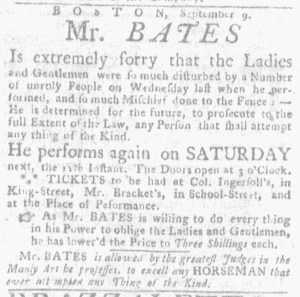
Massachusetts Gazette and Boston Weekly News-Letter (September 9, 1773).

“Mr. BATES Is extremely sorry that the Ladies and Gentlemen were so much disturbed by a Number of unruly People.”

Mr. Bates’s first performance in Boston did not go as well as he hoped.  Some sort of fracas interrupted his exhibition of feats of horsemanship, something significant enough to merit an advertisement in the Massachusetts Gazette and Boston Weekly News-Letter the day after that inaugural performance.  Bates declared that he was “extremely sorry that the Ladies and Gentlemen were so much disturbed by a Number of unruly People on Wednesday last when he performed.”  He also expressed dismay at “so much Mischief done to the Fence,” threatening “to prosecute to the full Extent of the Law, any Person that shall attempt any thing of the Kind” during subsequent performances.

Whatever disorder occurred at that performance may have worked to Bates’s advantage.  Residents of Boston likely gossiped about the disruption, spreading word about Bates’s show when they did so.  Some colonizers may have become more curious to attend the next performance, both to see Bates riding “One, Two, and Three HORSES,” as he promised in his previous advertisement, and to observe whether the crowd behaved or repeated the commotion from the first performance.  Watching the audience had the potential to provide as much entertainment as the show, a situation perhaps not lost on Bates.  After all, he collected revenue no matter what motivated Bostonians to purchase tickets.

To further encourage sales and attendance, Bates announced that he “lower’d the Price to Three Shillings each,” part of his commitment “to do every thing in his Power to oblige the Ladies and Gentlemen” of the town.  Just in case some readers had not yet heard of him and his reputation, either via newspaper advertisements or word of mouth, Bates concluded his advertisement with a summary of the introduction that he inserted in other newspapers earlier in the week.  He trumpeted, “Mr. BATES is allowed by the greatest Judges in the Manly Art he professes, to excel any HORSEMAN that ever attempted any Thing of the Kind.”  Like other itinerant performers, Bates resorted to superlatives to market his show, promising a spectacle that exceeded anything audiences could view in Boston or anywhere else.

Slavery Advertisements Published September 9, 1773

The Slavery Adverts 250 Project chronicles the role of newspaper advertising in perpetuating slavery in the era of the American Revolution. The project seeks to reveal the ubiquity of slavery in eighteenth-century life from New England to Georgia by republishing advertisements about enslaved people – for sale as individuals or in groups, wanted to purchase or for hire for short periods, runaways who liberated themselves, and those who were subsequently captured and confined in jails and workhouses – in daily digests on this site as well as in real time via the @SlaveAdverts250 Twitter feed, utilizing twenty-first-century media to stand in for the print media of the eighteenth century.

The project aims to provide modern audiences with a sense of just how often colonizers encountered these advertisements in their daily lives. Enslaved men, women, and children appeared in print somewhere in the colonies almost every single day. Those advertisements served as a constant backdrop for social, cultural, economic, and political life in colonial and revolutionary America. Colonizers who did not purport to own enslaved people were still confronted with slavery as well as invited to maintain the system by purchasing enslaved men, women, and children or assisting in the capture of so-called “runaways” who sought to free themselves from bondage. The frequency of these newspaper advertisements suggests just how embedded slavery was in colonial and revolutionary American culture in everyday interactions beyond the printed page.

These advertisements also testify to the experiences of enslaved men, women, and children, though readers must consider that those experiences have been remediated through descriptions offered by enslavers rather than enslaved people themselves. Often unnamed in the advertisements, enslaved men, women, and children were not invisible or unimportant in early America.

These advertisements appeared in colonial American newspapers 250 years ago today.

Maryland Gazette (September 9, 1773).

**********

Maryland Gazette (September 9, 1773).

**********

Maryland Gazette (September 9, 1773).

**********

Maryland Gazette (September 9, 1773).

**********

Maryland Gazette (September 9, 1773).

**********

Maryland Journal (September 9, 1773).

**********

Maryland Journal (September 9, 1773).

**********

Massachusetts Gazette and Boston Weekly News-Letter (September 9, 1773).

**********

Massachusetts Spy (September 9, 1773).

**********

Rivington’s New-York Gazetteer (September 9, 1773).

**********

Virginia Gazette [Purdie and Dixon] (September 9, 1773).

**********

Virginia Gazette [Purdie and Dixon] (September 9, 1773).

**********

Virginia Gazette [Purdie and Dixon] (September 9, 1773).

**********

Virginia Gazette [Purdie and Dixon] (September 9, 1773).

**********

Virginia Gazette [Purdie and Dixon] (September 9, 1773).

**********

Virginia Gazette [Purdie and Dixon] (September 9, 1773).

**********

Virginia Gazette [Purdie and Dixon] (September 9, 1773).

**********

Virginia Gazette [Purdie and Dixon] (September 9, 1773).

**********

Virginia Gazette [Purdie and Dixon] (September 9, 1773).

**********

Virginia Gazette [Purdie and Dixon] (September 9, 1773).

**********

Virginia Gazette [Rind] (September 9, 1773).

**********

Virginia Gazette [Rind] (September 9, 1773).

September 8

What was advertised in a colonial American newspaper 250 years ago today?

Pennsylvania Journal (September 8, 1773).

“Given away GRATIS … ROBERT BELL’S SALE CATALOGUE of a COLLECTION of NEW AND OLD BOOKS.”

Robert Bell became one of the most prominent and influential American booksellers and publishers of the late eighteenth century, in part due to his flamboyant personality and flair for marketing.  He disseminated advertising in the same formats as other booksellers and publishers – newspaper notices, book catalogs, handbills, broadsides – yet introduced innovations intended to engage and entice consumers.

Such was the case in an advertisement that Bell placed in the September 8, 1773, edition of the Pennsylvania Journal.  If they included a headline at all (other than their names), most advertisers used a stark description of their wares, such as “BOOKS” or “PORT WINE.”  Bell, on the other hand, devised a headline that both described and addressed prospective customers: “The CURIOUS IN BOOKS.”  In other advertisements, his headlines addressed “THE SONS OF SCIENCE IN AMERICA” and “THE AMERICAN WORLD” and “those who possess a PUBLIC SPIRIT.”  In other advertisements, his headlines made dramatic pronouncements, such as “HISTORY” and “LITERATURE” and “XENOPHONTICK BANQUET.”  Bell often crafted a headline intended to distinguish his advertisements from others.

He invited “The CURIOUS” to note that “This Day is Published and given away GRATIS, to all who are pleased to call or send for it, ROBERT BELL’S SALE CATALOGUE Of a COLLECTION of NEW AND OLD BOOKS.”  Those who desired a copy had the option of visiting the shop or, for their convenience, Bell had catalogs delivered to those who requested them.  He emphasized the many choices available, declaring that the catalog listed “above FIFTEEN HUNDRED VOLUMES” and then further elaborating the selection included “a number of elegant and uncommon BOOKS, very scare and rarely to be met with.”  That was because many of them were secondhand books from “the LIBRARY of a Gentleman who lately left this Country.”  That meant customers had access to rare volumes not widely available in the colonial marketplace.  It also implied scarcity, just one copy of many of the books in the catalog, so prospective customers needed to purchase books that interested them quickly.

To encourage “The CURIOUS” to take action, Bell listed more than just the authors and titles of the books in his catalog.  Every entry included “the lowest Price fixed to each Book” so consumers could make their own assessments about whether they could afford the books and how much they valued them.  Presenting prospective customers with prices also helped them imagine completing transactions and adding books to their own libraries.  Although they had to pay for any purchases, Bell distributed the catalogs to “The CURIOUS” for free as a means of getting them started on those imaginative journeys that the bookseller hoped would culminate in sales.  Bell combined a lively advertisement and free catalog into an innovative marketing campaign that set him apart from most other booksellers of the period.

Slavery Advertisements Published September 8, 1773

The Slavery Adverts 250 Project chronicles the role of newspaper advertising in perpetuating slavery in the era of the American Revolution. The project seeks to reveal the ubiquity of slavery in eighteenth-century life from New England to Georgia by republishing advertisements about enslaved people – for sale as individuals or in groups, wanted to purchase or for hire for short periods, runaways who liberated themselves, and those who were subsequently captured and confined in jails and workhouses – in daily digests on this site as well as in real time via the @SlaveAdverts250 Twitter feed, utilizing twenty-first-century media to stand in for the print media of the eighteenth century.

The project aims to provide modern audiences with a sense of just how often colonizers encountered these advertisements in their daily lives. Enslaved men, women, and children appeared in print somewhere in the colonies almost every single day. Those advertisements served as a constant backdrop for social, cultural, economic, and political life in colonial and revolutionary America. Colonizers who did not purport to own enslaved people were still confronted with slavery as well as invited to maintain the system by purchasing enslaved men, women, and children or assisting in the capture of so-called “runaways” who sought to free themselves from bondage. The frequency of these newspaper advertisements suggests just how embedded slavery was in colonial and revolutionary American culture in everyday interactions beyond the printed page.

These advertisements also testify to the experiences of enslaved men, women, and children, though readers must consider that those experiences have been remediated through descriptions offered by enslavers rather than enslaved people themselves. Often unnamed in the advertisements, enslaved men, women, and children were not invisible or unimportant in early America.

These advertisements appeared in colonial American newspapers 250 years ago today.

Pennsylvania Gazette (September 8, 1773).