September 7

What was advertised in a colonial American newspaper 250 years ago today?

South-Carolina Gazette and Country Journal (September 7, 1773).

“She expects a large and neat Assortment of Millinary from London soon.”

Jane Thomson, “SOLE-DEALER AND SEPARATE TRADER,” ran her own business in Charleston in the 1770s.  The milliner took to the pages of the South-Carolina Gazette and Country Journal to inform current and prospective clients that she “has removed from Tradd-Street to Old Church-Street, next Door to Mr. Sarazin, Silversmith,” and invited them to visit her at her new location.  She wished to maintain her clientele, expressing “grateful Thanks to her Friends and Customers for their past Favours” and stating that she “will be much obliged to her former Customers for the Continuance of their Commands.”  The milliner also hoped to expand her share of the market, promising “steady Attention” to all orders that would “give Satisfaction to all who are pleased to employ her.”

In addition to exemplary customer service, Thomson emphasized the hats as well as fabrics, ribbons, laces, other adornments, and supplies she stocked for making hats.  She declared that she “has a neat Assortment of Goods suitable for her Business.”  To further entice current and prospective clients, the milliner did not rely on her current inventory alone.  Rather than settle for leftovers that she moved from one shop to another, her customers would soon have access to a “large and neat Assortment of Millinary from London.”  Thomson expected a delivery that would replenish her supplies and keep her current with the latest fashions in the most cosmopolitan city in the empire.  On occasion, merchants, shopkeepers, tailors, milliners, and other advertisers previewed new merchandise as a means of generating excitement among prospective customers.  They leveraged anticipation to market goods not yet available, encouraging consumers to watch for subsequent advertisements or visit their shops frequently to find out what kinds of new goods recently arrived.  On another occasion, Thomson promoted “A fresh Supply of MILLINARY GOODS” that she imported from London, naming the ship and captain that delivered them to demonstrate that she did indeed carry goods recently arrived in the colony.  Like many other advertisers, she recognized that consumers placed a premium on the newest arrivals … and might even find promises of imminent arrivals even more alluring.

Slavery Advertisements Published September 7, 1773

The Slavery Adverts 250 Project chronicles the role of newspaper advertising in perpetuating slavery in the era of the American Revolution. The project seeks to reveal the ubiquity of slavery in eighteenth-century life from New England to Georgia by republishing advertisements about enslaved people – for sale as individuals or in groups, wanted to purchase or for hire for short periods, runaways who liberated themselves, and those who were subsequently captured and confined in jails and workhouses – in daily digests on this site as well as in real time via the @SlaveAdverts250 Twitter feed, utilizing twenty-first-century media to stand in for the print media of the eighteenth century.

The project aims to provide modern audiences with a sense of just how often colonizers encountered these advertisements in their daily lives. Enslaved men, women, and children appeared in print somewhere in the colonies almost every single day. Those advertisements served as a constant backdrop for social, cultural, economic, and political life in colonial and revolutionary America. Colonizers who did not purport to own enslaved people were still confronted with slavery as well as invited to maintain the system by purchasing enslaved men, women, and children or assisting in the capture of so-called “runaways” who sought to free themselves from bondage. The frequency of these newspaper advertisements suggests just how embedded slavery was in colonial and revolutionary American culture in everyday interactions beyond the printed page.

These advertisements also testify to the experiences of enslaved men, women, and children, though readers must consider that those experiences have been remediated through descriptions offered by enslavers rather than enslaved people themselves. Often unnamed in the advertisements, enslaved men, women, and children were not invisible or unimportant in early America.

These advertisements appeared in colonial American newspapers 250 years ago today.

Connecticut Courant (September 7, 1773).

**********

South-Carolina Gazette and Country Journal (September 7, 1773).

**********

South-Carolina Gazette and Country Journal (September 7, 1773).

**********

South-Carolina Gazette and Country Journal (September 7, 1773).

**********

South-Carolina Gazette and Country Journal (September 7, 1773).

**********

South-Carolina Gazette and Country Journal (September 7, 1773).

**********

South-Carolina Gazette and Country Journal (September 7, 1773).

**********

South-Carolina Gazette and Country Journal (September 7, 1773).

**********

South-Carolina Gazette and Country Journal (September 7, 1773).

**********

South-Carolina Gazette and Country Journal (September 7, 1773).

**********

South-Carolina Gazette and Country Journal (September 7, 1773).

**********

South-Carolina Gazette and Country Journal (September 7, 1773).

September 6

What was advertised in a colonial American newspaper 250 years ago today?

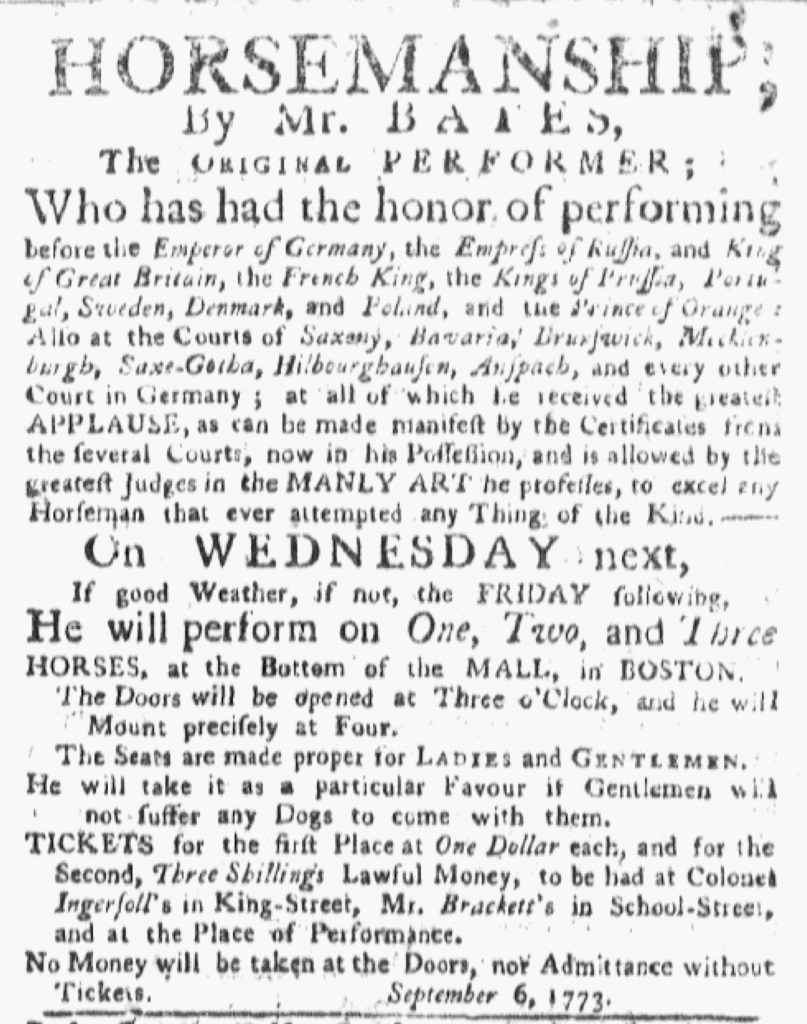
Boston Evening-Post (September 6, 1773).

“HORSEMANSHIP, By Mr. BATES.”

Not long after Mr. Bates concluded his performances in New York, he arrived in Boston and began advertising exhibitions of his feats of horsemanship in the newspapers there.  He commenced with notices in the Boston Evening-Post and the Massachusetts Gazette and Boston Post-Boy on Monday, September 6, 1773, informing ladies and gentlemen of the city about his performance on Wednesday or, if the weather did not permit, on Friday.

As he had done in his advertisements in New York, he deployed “HORSEMANSHIP” as a headline for his notice and then introduced himself as “The ORIGINAL PERFORMER; Who has had the honor or performing” for a longlist of royalty in Europe.  He declared that he earned “the greatest APPLAUSE” from those regal audiences, but did not expect colonizers in New York to take his word for it.  Instead, he had “Certificates from the several Courts” that they could examine.  In addition, he asserted that the “greatest Judges in the MANLY ART” of horsemanship considered his skills “to excel any Horseman that ever attempted any Thing of the Kind.”  Bates hoped that the promises of such a spectacle would entice audiences in Boston to attend his show.

He had reason to feel confident in the effectiveness of this marketing strategy.  After all, he gave the same pitch in New York.  He may have delivered newspapers, clippings, or perhaps even handbills from that city to the printing offices in Boston or he may have copied out the advertisement from one of those sources.  Whatever method he deployed, he remained consistent in how he introduced himself and described his skills to prospective audiences, likely sticking with what worked.  He also repeated another technique that he used in New York, encouraging anyone interested in the performance to acquire tickets quickly because “No Money will be taken at the Doors, nor Admittance without Tickets.”  Rather than wait until the time and day of the show, Bates aimed to generate ticket sales in advance.  Through experience, he devised a system that he believed worked best for inciting interest and securing his livelihood.

Slavery Advertisements Published September 6, 1773

The Slavery Adverts 250 Project chronicles the role of newspaper advertising in perpetuating slavery in the era of the American Revolution. The project seeks to reveal the ubiquity of slavery in eighteenth-century life from New England to Georgia by republishing advertisements about enslaved people – for sale as individuals or in groups, wanted to purchase or for hire for short periods, runaways who liberated themselves, and those who were subsequently captured and confined in jails and workhouses – in daily digests on this site as well as in real time via the @SlaveAdverts250 Twitter feed, utilizing twenty-first-century media to stand in for the print media of the eighteenth century.

The project aims to provide modern audiences with a sense of just how often colonizers encountered these advertisements in their daily lives. Enslaved men, women, and children appeared in print somewhere in the colonies almost every single day. Those advertisements served as a constant backdrop for social, cultural, economic, and political life in colonial and revolutionary America. Colonizers who did not purport to own enslaved people were still confronted with slavery as well as invited to maintain the system by purchasing enslaved men, women, and children or assisting in the capture of so-called “runaways” who sought to free themselves from bondage. The frequency of these newspaper advertisements suggests just how embedded slavery was in colonial and revolutionary American culture in everyday interactions beyond the printed page.

These advertisements also testify to the experiences of enslaved men, women, and children, though readers must consider that those experiences have been remediated through descriptions offered by enslavers rather than enslaved people themselves. Often unnamed in the advertisements, enslaved men, women, and children were not invisible or unimportant in early America.

These advertisements appeared in colonial American newspapers 250 years ago today.

Boston Evening-Post (September 6, 1773).

**********

Boston Evening-Post (September 6, 1773).

**********

Boston Evening-Post (September 6, 1773).

**********

Boston-Gazette (September 6, 1773).

**********

Boston-Gazette (September 6, 1773).

**********

Boston-Gazette (September 6, 1773).

**********

New-York Gazette and Weekly Mercury (September 6, 1773).

**********

Supplement to the New-York Gazette and Weekly Mercury (September 6, 1773).

**********

Supplement to the New-York Gazette and Weekly Mercury (September 6, 1773).

**********

Pennsylvania Packet (September 6, 1773).

**********

Supplement to the Pennsylvania Packet (September 6, 1773).

**********

South-Carolina Gazette (September 6, 1773).

**********

South-Carolina Gazette (September 6, 1773).

**********

South-Carolina Gazette (September 6, 1773).

**********

South-Carolina Gazette (September 6, 1773).

**********

South-Carolina Gazette (September 6, 1773).

**********

South-Carolina Gazette (September 6, 1773).

**********

South-Carolina Gazette (September 6, 1773).

**********

South-Carolina Gazette (September 6, 1773).

**********

South-Carolina Gazette (September 6, 1773).

**********

South-Carolina Gazette (September 6, 1773).

**********

South-Carolina Gazette (September 6, 1773).

**********

South-Carolina Gazette (September 6, 1773).

**********

South-Carolina Gazette (September 6, 1773).

**********

Supplement to the South-Carolina Gazette (September 6, 1773).

**********

Supplement to the South-Carolina Gazette (September 6, 1773).

**********

Supplement to the South-Carolina Gazette (September 6, 1773).

**********

Supplement to the South-Carolina Gazette (September 6, 1773).

**********

Supplement to the South-Carolina Gazette (September 6, 1773).

**********

Supplement to the South-Carolina Gazette (September 6, 1773).

September 5

What was advertised in a colonial American newspaper 250 years ago this week?

New-York Journal (September 2, 1773).

The Transpositions in Mr. SKINNER’S Advertisement, in our Paper … were owing to an Error in the Press.”

Something strange happened with S. Sp. Skinner’s advertisement for “the best of RUM” in the New-York Journal near the end of summer in 1773.  In the September 2 edition, a manicule directed attention to a note from the printing office: “The Transpositions in Mr. SKINNER’S Advertisement, in our Paper, Number 1597, and 1598, were owing to an Error in the Press.”  John Holt, the printer, apparently attempted to make amends with an advertiser after making mistakes in a notice that ran for several months.

Skinner’s advertisement first ran in the December 31, 1772, edition of the New-York Journal and then ran regularly for the next five months.  On May 27, 1773, he added a nota bene: “To prevent further Mistakes, desires his Country Customers to take Notice, that there is a Distillery adjoining Mr. Skinner’s Buildings, to the Southward, which is not occupied by him.”  Skinner did not want his advertisements to inadvertently send customers to his competitor.  The updated advertisement continued through August 5.  In the August 12 edition, however, six lines from the original advertisement were mistakenly printed below the nota bene, creating an advertisement that did not make sense.  Someone in the printing office noticed the error after that edition, “NUMBER 1597,” went to press … or perhaps Skinner contacted the printer …and attempted to make corrections for the August 19 edition, “NUMBER 1598.”  However, that only resulted in lengthening the advertisement by the nota bene a second time at the end.  It did not remedy the original error.  The compositor managed to make the necessary corrections for the August 26 edition.  The following week, Skinner launched a new advertisement, a shorter one, in the September 2 edition.  The first time it appeared, it included the note from the printing office, but not in subsequent insertions.

New-York Journal (August 5, 1773; August 12, 1773; August 19, 1773).

The various iterations of Skinner’s advertisement demonstrate a kind of error that was possible yet rarely occurred as printing offices throughout the colonies published advertisements for multiple weeks or even many months.  Typically, compositors set the type for each advertisement once, but then repositioned advertisements in each issue to make all the content fit.  That included adding new advertisements and removing others, all done without duplicating labor by setting type for any advertisement more than once.  What exactly occurred with Skinner’s advertisement, how the printing office introduced “The Transpositions” on August 12, is not readily apparent, though Holt and others clearly attempted to make corrections, introducing more “Transpositions” in the first attempt on August 19.  Most advertisements in colonial newspapers appeared week after week in the same format as their original insertion, printed from the same type. Something unusual, maybe even careless, happened with Skinner’s advertisement, prompting the printer to acknowledge the error, perhaps after receiving complaints from the advertiser about haphazard copy that made the notice border on gibberish.

September 4

What was advertised in a colonial American newspaper 250 years ago today?

Maryland Journal (September 4, 1773).

Advertisements omitted, will be inserted in our next.”

William Goddard quickly attracted advertisers when he commenced publication of the Maryland Journal, the first newspaper printed in Baltimore, in August 1773.  Paid notices filled four and a half columns, out of twelve total, in the third issue, but that was not all of them submitted to the printing office.  Goddard included a brief note alerting readers and, especially, advertisers who expected to see their notices in print that “Advertisements omitted, will be inserted in our next.”  Advertising represented an important revenue stream for printers, so Goddard must have been pleased with his initial success in attracting advertisers for the Maryland Journal.

For their part, advertisers from Baltimore and beyond welcomed the opportunity to disseminate information in the new publication.  Eleven of the advertisements in the September 4 edition described runaway indentured servants or runaway convict servants and offered rewards for their capture and return to their masters.  Previously, residents of Baltimore and surrounding towns resorted to the Maryland Gazette, published in Annapolis, the Virginia Gazette, published in Williamsburg, and the several newspapers published in Philadelphia to alert colonizers about runaways and encourage them to participate in surveillance of strangers to assess whether they matched the descriptions in the public prints.  The Maryland Journal buttressed the efforts of certain colonizers to use the early American press to uphold what they considered the appropriate order in their communities.

Other advertisers, including purveyors of consumer goods and services, now had a truly local alternative for promoting their businesses.  In the September 4 edition, Ewing and Hart marketed rum, wine, and spirits at their store on Gay Street, John Flanagan hawked tea, coffee, and sugar at his store on Market Street, and Nicholas Brooks promoted jewelry and prints “at the CROWN and CUSHION, in BALTIMORE.”  In addition, John Hamilton, “TAILOR and HABIT-MAKER, from GLASGOW,” introduced himself to prospective clients with an announcement that he “has opened shop in Gay-street, BALTIMORE-TOWN … where he makes mens and womens clothes in the very newest fashions.”  He highlighted his experience “having wrought for eight years past in the best shops in Britain,” hoping that readers would be impressed enough to give the newcomer a chance to build a reputation in Baltimore.  He promised to make it “his constant endeavour to give, to the utmost of his power, entire satisfaction” to his customers in return for “suitable encouragement from the generous public.”  The Maryland Journal provided an introduction to prospective customers beyond those Hamilton happened to meet in the course of his daily routine.

Other advertisers sought the advantages of placing notices in Baltimore’s first newspaper, some with advertisements that ran on September 4 and others with advertisements delayed until the next edition.  A newspaper, complete with shipping news, prices current, and advertisements, marked the port’s growing size and significance in the region.

Slavery Advertisements Published September 4, 1773

The Slavery Adverts 250 Project chronicles the role of newspaper advertising in perpetuating slavery in the era of the American Revolution. The project seeks to reveal the ubiquity of slavery in eighteenth-century life from New England to Georgia by republishing advertisements about enslaved people – for sale as individuals or in groups, wanted to purchase or for hire for short periods, runaways who liberated themselves, and those who were subsequently captured and confined in jails and workhouses – in daily digests on this site as well as in real time via the @SlaveAdverts250 Twitter feed, utilizing twenty-first-century media to stand in for the print media of the eighteenth century.

The project aims to provide modern audiences with a sense of just how often colonizers encountered these advertisements in their daily lives. Enslaved men, women, and children appeared in print somewhere in the colonies almost every single day. Those advertisements served as a constant backdrop for social, cultural, economic, and political life in colonial and revolutionary America. Colonizers who did not purport to own enslaved people were still confronted with slavery as well as invited to maintain the system by purchasing enslaved men, women, and children or assisting in the capture of so-called “runaways” who sought to free themselves from bondage. The frequency of these newspaper advertisements suggests just how embedded slavery was in colonial and revolutionary American culture in everyday interactions beyond the printed page.

These advertisements also testify to the experiences of enslaved men, women, and children, though readers must consider that those experiences have been remediated through descriptions offered by enslavers rather than enslaved people themselves. Often unnamed in the advertisements, enslaved men, women, and children were not invisible or unimportant in early America.

These advertisements appeared in colonial American newspapers 250 years ago today.

Maryland Journal (September 4, 1773).

**********

Maryland Journal (September 4, 1773).

**********

Providence Gazette (September 4, 1773).

**********

Providence Gazette (September 4, 1773).

September 3

What was advertised in a colonial American newspaper 250 years ago today?

Connecticut Journal (September 3, 1773).

“Amos Morrisson, Wigg-Maker & Hair-Dresser.”

“Just published … THE MACARONIE JESTER.”

Amos Morrisson may not have been very happy about where his advertisement appeared in the September 3, 1773, edition of the Connecticut Journal.  The “Wigg-Maker & Hair-Dresser” likely did not appreciate that an advertisement for “THE MACARONIE JESTER” appeared immediately below his notice directed to fashionable ladies and gentlemen.  Eighteenth-century readers would have immediately recognized the derogatory term for a man who took current fashions, both clothing and hair, to absurd and preposterous lengths.  The Oxford English Dictionary explains that this synonym for dandy or fop was especially popular in the second half of the eighteenth century to describe “a member of a set of young men who travelled in Europe and extravagantly imitated Continental tastes and fashions.”  On both sides of the Atlantic, the term broadened to refer to any man whose overindulgence in fashion suggested idleness and vice.

Given such negative associations with too much luxury, Morrisson may have been dismayed by the proximity of his advertisement and one for The Macaroni Jester, “Just published, And to be sold by the Printers.”  The wigmaker and hairdresser promoted “various modes” of wigs and hairstyles for men and women, such as “Bagg Wiggs and Spencer Bobs” and “Ladies Roles and French Curls,” as well as accoutrements to adorn hair, including ribbons.  Furthermore, he confided, “If the above Articles should not happen to suit, Gentlemen can be suited in any Taste whatever, in the best Manner and at the shortest Notice.”  Morrisson catered to his clients, but the advertisement for The Macaroni Jester raised suspicions about the “Macaroni beau,” others who luxuriated in current fashions and consumerism, and the purveyors of goods and services who outfitted them.  According to the staff at the Library of the Society of Friends, the book include “includes a ditty on ‘The Origin of Macaronies,” [but] there’s little else of the Macaroni in it: the word has been used simply as a synonym for humour, satire and above all absurdity.”  The “original stories, witty repartees, comical and original Bull’s, [and] entertaining Anecdotes” promised in the advertisement “poke fun at many stock figures.”  Still, that would not have been apparent to readers of the Connecticut Journal, especially since the advertisement emphasized that “the origin of a Macaroni” was “illustrated with a curious and neat copperplate frontispiece of a Macaroni beau.”

Morrisson almost certainly did not want such associations with the goods and services he provided as wigmaker and hairdresser.  Did he complain to the printing office about the juxtaposition of the two advertisements?  In the next issue, Morrisson’s advertisement ran on the front page, while the advertisement for The Macaroni Jester appeared on the final page.  That may have been the result of the usual sort of reorganization that took place between issues.  Compositors regularly moved around advertisements that ran for multiple weeks.  All the same, nothing prevented Morrisson from voicing his concerns about the unfortunate proximity of the two advertisements.

September 2

What was advertised in a colonial American newspaper 250 years ago today?

Rivington’s New-York Gazetteer (September 2, 1773).

“An assortment of goods suitable to the season.”

A little more than four months after James Rivington commenced publication of Rivington’s New-York Gazetteer, many of the advertisements in that newspaper had a notable feature intended to attract readers’ attention.  Borders composed of decorative type enclosed five of the advertisements in the September 2, 1773, edition.  That gave the section devoted to advertising a distinctive look compared to the New-York Gazette and Weekly Mercury and the New-York Journal.  During that week, the latter did not carry any advertisements with borders.  The former carried one with a border, a short notice about “KEYSER’s PILLS” placed by Hugh Gaine.

Rivington’s New-York Gazetteer (September 2, 1773).

Gaine happened to be the printer of the New-York Gazette and Weekly Mercury.  Although he adorned one of his own advertisements with a border, he also appeared to reserve that format for his exclusive use.  S. Sp. Skinner, a distiller, ran advertisements for “the best of RUM” with identical copy in both publications, with a border in Rivington’s newspaper and without a border in Gaine’s newspaper.  The distiller also advertised, without a border, in the New-York Journal.  Rivington or a compositor in his printing office experimented with a format that enhanced the visual appeal of advertisements.  They either offered borders to advertisers or some advertisers learned that Rivington’s New-York Gazetteer would accommodate such requests.

Rivington’s New-York Gazetteer (September 2, 1773).

Other advertisements with identical copy in multiple newspapers demonstrate that Rivington incorporated a visual element not available in other printing offices in New York.  Robert Murray and John Murray ran an announcement that they dissolved their partnership and requested that “Persons Indebted to them” settle their accounts or face legal action.  Their advertisement had a border in Rivington’s New-York Gazetteer, but not in the New-York Gazette or Weekly Mercury or the New-York Journal.  Similarly, T.B. Atwood placed an advertisement for his “Medicinal Store” in all three newspapers.  It featured side-by-side columns listing patent medicines and other merchandise in each of them, apparently a format specified by the advertiser, but only Rivington’s newspaper enclosed Atwood’s notice within a decorative border.  Not only did the advertisement have a border, that border consisted of decorative type different from any that surrounded other advertisements or separated news accounts in that issue.  Taking the service to a higher level, the compositor chose printing ornaments that made the borders for each advertisement unique.

Rivington’s New-York Gazetteer (September 2, 1773).

Vincent Pearse Ashfield’s advertisement for coffee, tea, wine, and spirits also appeared in two newspapers, the New-York Gazette and Weekly Mercury and Rivington’s New-York Gazetteer, but embellished with a border in only one.  All of the advertisers whose notices had borders in Rivington’s newspaper – Ashfield, Atwood, the Murrays, and Skinner – simultaneously placed the same advertisement in at least one other newspaper.  Despite the identical copy, only the notices in Rivington’s New-York Gazetteer incorporated borders, suggesting that Rivington’s printing office worked with advertisers to offer an option not available in other newspapers.  In addition to drawing attention to those advertisements, that made the pages of Rivington’s new newspaper easy to recognize and perhaps more interesting for readers.

Slavery Advertisements Published September 2, 1773

The Slavery Adverts 250 Project chronicles the role of newspaper advertising in perpetuating slavery in the era of the American Revolution. The project seeks to reveal the ubiquity of slavery in eighteenth-century life from New England to Georgia by republishing advertisements about enslaved people – for sale as individuals or in groups, wanted to purchase or for hire for short periods, runaways who liberated themselves, and those who were subsequently captured and confined in jails and workhouses – in daily digests on this site as well as in real time via the @SlaveAdverts250 Twitter feed, utilizing twenty-first-century media to stand in for the print media of the eighteenth century.

The project aims to provide modern audiences with a sense of just how often colonizers encountered these advertisements in their daily lives. Enslaved men, women, and children appeared in print somewhere in the colonies almost every single day. Those advertisements served as a constant backdrop for social, cultural, economic, and political life in colonial and revolutionary America. Colonizers who did not purport to own enslaved people were still confronted with slavery as well as invited to maintain the system by purchasing enslaved men, women, and children or assisting in the capture of so-called “runaways” who sought to free themselves from bondage. The frequency of these newspaper advertisements suggests just how embedded slavery was in colonial and revolutionary American culture in everyday interactions beyond the printed page.

These advertisements also testify to the experiences of enslaved men, women, and children, though readers must consider that those experiences have been remediated through descriptions offered by enslavers rather than enslaved people themselves. Often unnamed in the advertisements, enslaved men, women, and children were not invisible or unimportant in early America.

These advertisements appeared in colonial American newspapers 250 years ago today.

Maryland Gazette (September 2, 1773).

**********

Maryland Gazette (September 2, 1773).

**********

Maryland Gazette (September 2, 1773).

**********

Maryland Gazette (September 2, 1773).

**********

Maryland Gazette (September 2, 1773).

**********

Rivington’s New-York Gazetteer (September 2, 1773).

**********

Rivington’s New-York Gazetteer (September 2, 1773).

**********

Rivington’s New-York Gazetteer (September 2, 1773).

**********

Virginia Gazette [Purdie and Dixon] (September 2, 1773).

**********

Virginia Gazette [Purdie and Dixon] (September 2, 1773).

**********

Virginia Gazette [Purdie and Dixon] (September 2, 1773).

**********

Virginia Gazette [Purdie and Dixon] (September 2, 1773).

**********

Virginia Gazette [Purdie and Dixon] (September 2, 1773).

**********

Virginia Gazette [Purdie and Dixon] (September 2, 1773).

**********

Virginia Gazette [Purdie and Dixon] (September 2, 1773).

**********

Virginia Gazette [Purdie and Dixon] (September 2, 1773).

**********

Virginia Gazette [Rind] (September 2, 1773).

**********

Virginia Gazette [Rind] (September 2, 1773).

**********

Virginia Gazette [Rind] (September 2, 1773).

**********

Virginia Gazette [Rind] (September 2, 1773).

**********

Virginia Gazette [Rind] (September 2, 1773).