January 31

GUEST CURATOR:  Madeleine Arsenault

What was advertised in a colonial American newspaper 250 years ago today?
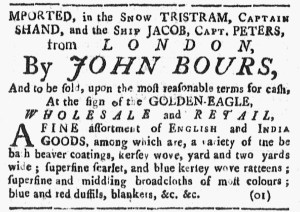
Newport Mercury (January 31, 1774).

“Blue kersey.”

This advertisement offered a shipment from London of “beaver coatings,” fabrics, and blankets. John Bours sold all of these items at a shop that had a golden eagle on the sign. One of the specific items that Bours advertised was kersey, multiple colors of it even. After some research, I found that kersey was a fabric often used in making clothing for enslaved people. Talya Housman, a Ph.D. candidate at Brown University, places kersey with other fabrics in the category of “negro cloth” or “slave cloth.” Not only were these fabrics used to clothe enslaved people, but they were also used as a way “to mark people as enslaved.”

I also learned about slavery in New England.  According to EnCompass: A Digital Sourcebook of Rhode Island History, “Rhode Island did not have the largest absolute number of enslaved people in New England,” but “it had the largest percentage of Africans, nearly all of them enslaved, among its residents.”  In addition, about one half of all the ships in the triangular slave trade came through Rhode Island, making the colony one of the anchors on the American side of transatlantic trade.  Rhode Island and other colonies in New England had more connections to slavery during the era of the American Revolution than I realized before my research.

**********

ADDITIONAL COMMENTARY:  Carl Robert Keyes

Along with her peers in my Revolutionary America class in Fall 2023, Madeleine was responsible for contributing to both the Adverts 250 Project and the Slavery Adverts 250 Project.  Through those projects, readings, and classroom discussions, we all learned more about the ubiquity of slavery throughout the colonies in the eighteenth century, including in New England, New York, Pennsylvania, and other places that most people do not readily associate with slavery.  We examined a history of slavery well known to historians but often forgotten, intentionally overlooked, or stubbornly denied by many people.

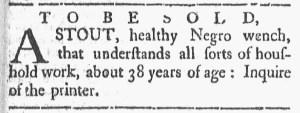
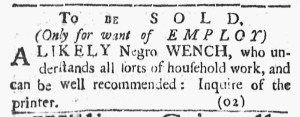
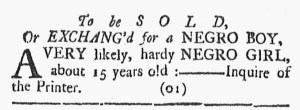
In the course of her duties as guest curator for the Slavery Adverts 250 Project this week, Madeleine identified three advertisements about enslaved people that appeared in the January 31, 1774, edition of the Newport Mercury along with Bours’s advertisement.  A notice on the front page offered a “STOUT, healthy Negro” woman for sale.  On the final page, an advertisement seeking to sell a “LIKELY Negro” woman, “who understands all sorts of household work,” ran immediately to the left of Bours’s notice.  Another notice, this one aiming to sell a “VERY likely, hardy NEGRO GIRL, about 15 years old,” or exchange her for a “NEGRO BOY,” appeared at the top of the column that contained Bours’s advertisement.

At first glance, an advertisement for a “FINE assortment of ENGLISH and INDIA GOODS,” including kersey cloth, may not seem to have much to do with slavery in New England.  As she undertook her research, Madeleine made the connections, learning about both textiles used to clothe enslaved people and how the transatlantic slave trade contributed to commerce and consumer culture in Rhode Island before, during, and after the American Revolution.  Bours was not alone in advertising imported goods; John Bell, Samuel Goldthwait, Thomas Green, George Lawton and Robert Lawton, Paul Mumford, and Jonathan Rogers placed similar advertisements.  All of them participated in commercial networks inextricably bound to the transatlantic slave trade.  Eighteenth-century readers knew that was the case.  Advertisements offering enslaved people for sale that appeared alongside notices placed by merchants and shopkeepers served as a very visible reminder.
Welcome, Guest Curator Madeleine Arsenault

Madeleine Arsenault is a senior at Assumption University in Worcester, Massachusetts. She is from Stow, Massachusetts. Madeleine is majoring in History and Secondary Education. She plans to become a high school history teacher. She is the oldest of four kids, which contributed to her decision to become a teacher. She spent a semester at Assumption’s Rome campus where she was surrounded by history and loved every second of it. She loves to travel and be outside. In the summer, she spends as much time at the beach (especially on Cape Cod) as possible and tries to go to as many Red Sox games as possible. She is also a camp counselor for second and third graders. Madeleine made her contributions to the Adverts 250 Project and the Slavery Adverts 250 Project while enrolled in HIS 401 Revolutionary America in Fall 2023.

Welcome, guest curator Madeleine Arsenault!

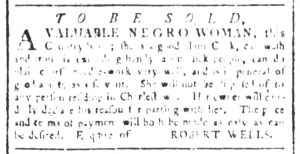
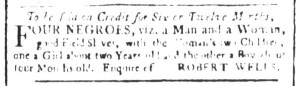
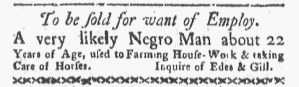
Slavery Advertisements Published January 31, 1774

GUEST CURATOR:  Madeleine Arsenault

The Slavery Adverts 250 Project chronicles the role of newspaper advertising in perpetuating slavery in the era of the American Revolution. The project seeks to reveal the ubiquity of slavery in eighteenth-century life from New England to Georgia by republishing advertisements about enslaved people – for sale as individuals or in groups, wanted to purchase or for hire for short periods, runaways who liberated themselves, and those who were subsequently captured and confined in jails and workhouses – in daily digests on this site as well as in real time via the @SlaveAdverts250 Twitter feed, utilizing twenty-first-century media to stand in for the print media of the eighteenth century.

The project aims to provide modern audiences with a sense of just how often colonizers encountered these advertisements in their daily lives. Enslaved men, women, and children appeared in print somewhere in the colonies almost every single day. Those advertisements served as a constant backdrop for social, cultural, economic, and political life in colonial and revolutionary America. Colonizers who did not purport to own enslaved people were still confronted with slavery as well as invited to maintain the system by purchasing enslaved men, women, and children or assisting in the capture of so-called “runaways” who sought to free themselves from bondage. The frequency of these newspaper advertisements suggests just how embedded slavery was in colonial and revolutionary American culture in everyday interactions beyond the printed page.

These advertisements also testify to the experiences of enslaved men, women, and children, though readers must consider that those experiences have been remediated through descriptions offered by enslavers rather than enslaved people themselves. Often unnamed in the advertisements, enslaved men, women, and children were not invisible or unimportant in early America.

These advertisements appeared in colonial American newspapers 250 years ago today.

Boston-Gazette (January 31, 1774).

**********

Dunlap’s Pennsylvania Packet (January 31, 1774).

**********

Newport Mercury (January 31, 1774).

**********

Newport Mercury (January 31, 1774).

**********

Newport Mercury (January 31, 1774).

**********

New-York Gazette and Weekly Mercury (January 31, 1774).

**********

New-York Gazette and Weekly Mercury (January 31, 1774).

**********

New-York Gazette and Weekly Mercury (January 31, 1774).

**********

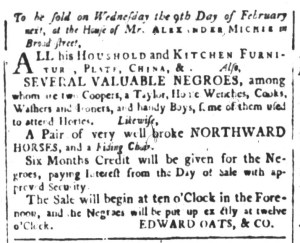
South-Carolina Gazette (January 31, 1774).

**********

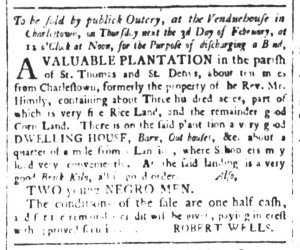
South-Carolina Gazette (January 31, 1774).

**********

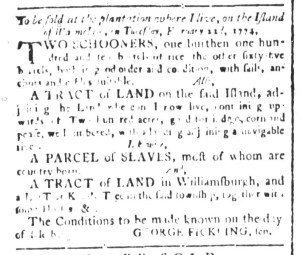
South-Carolina Gazette (January 31, 1774).

**********

South-Carolina Gazette (January 31, 1774).

**********

South-Carolina Gazette (January 31, 1774).

**********

South-Carolina Gazette (January 31, 1774).

**********

South-Carolina Gazette (January 31, 1774).

**********

Supplement to the South-Carolina Gazette (January 31, 1774).

**********

Supplement to the South-Carolina Gazette (January 31, 1774).

**********

Supplement to the South-Carolina Gazette (January 31, 1774).

**********

Supplement to the South-Carolina Gazette (January 31, 1774).

**********

Supplement to the South-Carolina Gazette (January 31, 1774).

**********

Supplement to the South-Carolina Gazette (January 31, 1774).

**********

Supplement to the South-Carolina Gazette (January 31, 1774).

**********

Supplement to the South-Carolina Gazette (January 31, 1774).

January 30

What was advertised in a colonial American newspaper 250 years ago this week?

Boston-Gazette (January 24, 1774).

Our Advertising Customers, are desired for the future to send their Advertisements by Saturday Sunset.”

Benjamin Edes and John Gill, printers of the Boston-Gazette, exercised their prerogative as proprietors of the newspaper to place some notices about its operation at the top of the first column on the first page of the January 24, 1774, edition.  Doing so, they hoped, increased the likelihood that the customers they addressed would see them and take note.  To that end, they enclosed their first notice within a decorative border.  The printers declared, “ALL Persons indebted for this Paper, whose Accounts have been above 12 Months standing, are requested to make immediate Payment.”  Printers often extended credit to subscribers.  Some of them remained delinquent for years.

In another notice, Edes and Gill instructed that “Our Advertising Customers, are desired for the future to send their Advertisements by Saturday Sunset.”  Rather than a decorative border, a manicule and italic font called attention to this notice.  Edes and Gill published the Boston-Gazette on Mondays, but ordinances in colonial Boston prohibited working on Sundays.  Sunset occurred at 4:52 in the afternoon on the day the printers published this announcement.  Though that time has been standardized for modern time zones, it was early enough in the day that those laboring in the printing office could set type and finish printing the newspaper in the evening.  John Adams suggests that Edes and Gill may not have always abided the prohibition on working on Sundays.  On Sunday, September 3, 1769, he wrote in his diary that he attended a “Charity Lecture” and then “Spent the Remainder of the Evening and supped with Mr. Otis, in Company with Mr. Adams, Mr. Wm. Davis, and Mr. Jno. Gill.  The Evening spent in preparing for the Next Days Newspaper – a curios Employment.  Cooking up Paragraphs, Articles, Occurences, &c. – Working the political Engine!”  Things were in motion at Edes and Gill’s printing office on Sundays, at least sometimes!  Yet in the early 1770s some colonizers even complained about work undertaken on Saturday evenings.  Announcing that they accepted advertisements until sunset on Saturdays may have been Edes and Gill’s way of indicating that they completed most of their work by that time while also holding firm that they could labor into the evening if they wished.  Although they would not have used the phrase, it gave them plausible deniability about any intentions of working on Sundays.

In a third notice, the printers teased an item that would appear in the next edition.  They acknowledged that they “receiv’d THE REMEMB’RANCER … intended for this Day’s Paper,” yet chose to delay publication for a week.  The piece “publickly reveals very marvellous Practices of his Excellency, at the last Session of the General Assembly.”  Edes and Gill chose to hold off on embarrassing the governor, Thomas Hutchinson, “till next Week, when the Members of both Houses will be more generally in Town.”  The printers may have hoped that the anticipation would yield more sales for the next issue of the Boston-Gazette, though their primary goal seemed to be that as many people as possible, especially those who served in the assembly, would read the piece when issues circulated the following week.  It appeared as the first item on the first page of the January 31 edition.

Rather than opening the January 24 edition with news, editorials, or advertisements submitted by customers, Edes and Gill instead tended to the business of operating their newspaper first and then published other content.  They called on delinquent subscribers to settle accounts, directed advertisers when to submit their notices, and previewed a juicy letter that would appear in the next issue, giving their own notices a prominent place on the page.

January 29

What was advertised in a colonial American newspaper 250 years ago today?

Providence Gazette (January 29, 1774).

“Had the Fire got to any Height, it would have raged to an unknown Degree, for Want of Buckets to supply the Engines.”

Newspaper advertisements often delivered local news that did not appear elsewhere in the publication.  Such was the case in the wake of a fire in Providence that took place on January 21, 1774.  The following day the Providence Gazettereported, “Yesterday Evening the Town was alarmed by the Cry of Fire, which proved to be in the Pot-Ash Works, on the West Side of the Bridge; but by timely Assistance it was suppressed before much Damage had ensued.”  John Carter, the printer, downplayed the danger, perhaps unintentionally.  He did not have much time to gather information about the fire before the newspaper went to press, so important details did not appear in the Providence Gazette until the next issue.  When they did, they ran among the paid notices rather than in the news that Carter compiled.

On January 29, the newspaper carried an advertisement that transmitted an “Order of the Engine-Company, No. 1,” to residents of the town.  The dateline indicated it had been written the day after the fire, the same day as the previous issue of the Providence Gazette, but too late to appear in the weekly publication.  “WHEREAS it was observed at the Place of the Fire last Evening,” the advertisement proclaimed, “that the greater Part of the People attending had no Buckets; and it is generally thought, that had the Fire got to any Height it would have raged to an unknown Degree, for Want of Buckets to supply the Engines: Therefore all Families, for their own Preservation, are required to provide themselves with Buckets immediately.”  Carter’s initial reporter emphasized “timely Assistance” that “suppressed” the fire “before much Damage had ensued,” but this subsequent advertisement underscored how catastrophic the fire could have been as a result of so many residents not being prepared to provide the right kind of assistance.  Not only had they been negligent, they also disregarded a local ordinance.  The Engine Company instructed “all Families” to acquire buckets so they could provide aid in the future not only “for their own Preservation” but also to “avoid the Penalty of the Law.”  The advertisement concluded with a warning about “an Examination being intended to be made throughout the Town, and the Law put into Execution.”

Those details likely spread by word of mouth in the week between the fire and the advertisement running in the Providence Gazette, so Carter may not have considered it necessary to include the additional details among the local news.  In addition, having received the Engine Company’s advertisement in the printing office, he probably thought it a sufficient update.  Readers who lived at any distance would have been less likely to hear that so many people who showed up to the fire could not assist in putting it out because they did not bring buckets, so the advertisement did indeed present new news to them.  As was so often the case, collating information in news articles and advertisements yielded more complete coverage of local events.

Slavery Advertisements Published January 29, 1774

GUEST CURATOR:  Madeleine Arsenault

The Slavery Adverts 250 Project chronicles the role of newspaper advertising in perpetuating slavery in the era of the American Revolution. The project seeks to reveal the ubiquity of slavery in eighteenth-century life from New England to Georgia by republishing advertisements about enslaved people – for sale as individuals or in groups, wanted to purchase or for hire for short periods, runaways who liberated themselves, and those who were subsequently captured and confined in jails and workhouses – in daily digests on this site as well as in real time via the @SlaveAdverts250 Twitter feed, utilizing twenty-first-century media to stand in for the print media of the eighteenth century.

The project aims to provide modern audiences with a sense of just how often colonizers encountered these advertisements in their daily lives. Enslaved men, women, and children appeared in print somewhere in the colonies almost every single day. Those advertisements served as a constant backdrop for social, cultural, economic, and political life in colonial and revolutionary America. Colonizers who did not purport to own enslaved people were still confronted with slavery as well as invited to maintain the system by purchasing enslaved men, women, and children or assisting in the capture of so-called “runaways” who sought to free themselves from bondage. The frequency of these newspaper advertisements suggests just how embedded slavery was in colonial and revolutionary American culture in everyday interactions beyond the printed page.

These advertisements also testify to the experiences of enslaved men, women, and children, though readers must consider that those experiences have been remediated through descriptions offered by enslavers rather than enslaved people themselves. Often unnamed in the advertisements, enslaved men, women, and children were not invisible or unimportant in early America.

These advertisements appeared in colonial American newspapers 250 years ago today.

Providence Gazette (January 29, 1774).

January 28

What was advertised in a colonial American newspaper 250 years ago today?

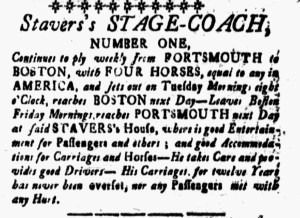
New-Hampshire Gazette (January 28, 1774).

His Carriages, for twelve Years has never been overset, nor any Passengers met with any Hurt.”

John Stavers marketed experience when he advertised his stagecoach service between Portsmouth and Boston in the January 28, 1774, edition of the New-Hampshire Gazette, just as he had done in previous advertisements.  He proclaimed that “His Carriages, for twelve Years has never been overset, nor any Passengers met with any Hurt.”  That was quite the safety record.  The proprietor even invoked his experience in the name of his business, “Stavers’s STAGE-COACH, NUMBER ONE.”  That was not merely a ranking but also a reference to the fact that he had operated service between Portsmouth and Boston longer than any of his competitors.

Stavers also promoted the quality of that service, declaring that “FOUR HORSES, equal to any in AMERICA,” pulled the coach.  In addition, he “takes Care and provides good Drivers,” selecting only the best employees to represent the business he operated for more than a decade.  At the terminus in Portsmouth, Stavers ran an inn and tavern, where he provided “good Entertainment for Passengers and others” as well as “good Accommodations for Carriages and Horses.” Whether or not they rode his stagecoach, Stavers offered hospitality to travelers who visited Portsmouth.  For those who boarded in Boston or along the way to Portsmouth, he offered convenient lodging.

As was typical in advertisements for stagecoaches and ferries, Stavers provided a schedule so prospective clients could plan accordingly.  His service made the trip to Boston and back once a week.  “NUMBER ONE” departed Portsmouth at eight o’clock on Tuesday mornings and arrived in Boston the next day.  Passengers who planned to return to Portsmouth on the next trip had Wednesday evening and the entire day on Thursday to conduct business in Boston before the stagecoach left again on Friday morning and reached Portsmouth on Saturday.

Other operators also established service between Portsmouth and Boston, but Stavers most consistently advertised in the New-Hampshire Gazette and newspapers published in New England’s largest port city.  For instance, the February 3 edition of the Massachusetts Gazette and Boston Weekly News-Letter included the same advertisement with an additional nota bene to inform “Such as want a Passage from Boston, are desired to apply to Mrs. Bean’s in King-Street.”  Perhaps savvy advertising played a role in Stavers’s enterprise achieving such longevity.

Happy Birthday, Mathew Carey!

Though Benjamin Franklin is often considered the patron saint of American advertising in the popular press, I believe that his efforts pale in comparison to the contributions made by Mathew Carey (1760-1839) in the final decades of the eighteenth century. Franklin is rightly credited with experimenting with the appearance of newspaper advertising, mixing font styles and sizes in the advertisements that helped to make him a prosperous printer, but Mathew Carey introduced and popularized an even broader assortment of advertising innovations, ranging from inventive appeals that targeted potential consumers to a variety of new media to networks for effectively distributing advertising materials. In the process, his efforts played an important role in the development of American capitalism by enlarging markets for the materials sold by printers, booksellers, and publishers as well as a host of other goods marketed by merchants, shopkeepers, and artisans who eventually adopted many of Carey’s innovative advertising methods. Mathew Carey will probably never displace Benjamin Franklin as the founder of American advertising in the popular imagination, but scholars of early American history and culture should recognize his role as the most important leader in eighteenth-century advertising among the many other activities and accomplishments of his long career in business and public life.

mathew_carey_by_john_neagle_1825
Mathew Carey (January 28, 1760 – September 16, 1839). Portrait by John Neagle, 1825. Library Company of Philadelphia.

Carey’s efforts as an advertiser were enmeshed within transatlantic networks of print and commerce. Though he did not invent the advertising wrapper printed on blue paper that accompanied magazines in the eighteenth century, he effectively utilized this medium to an extent not previously seen in America, Ireland, or the English provinces outside of London. The wrappers distributed with his American Museum (1787-1792) comprised the most extensive collection of advertising associated with any magazine published in North America in the eighteenth century, both in terms of the numbers of advertisements and the diversity of occupations represented in those advertisements. In Carey’s hands, the American Museum became a vehicle for distributing advertising media: inserts that included trade cards, subscription notices, testimonials, and book catalogues in addition to the wrappers themselves.

Located at the hub of a network of printers and booksellers, Carey advocated the use of a variety of advertising materials, some for consumption by the general public and others for use exclusively within the book trade. Subscription notices and book catalogues, for instance, could stimulate demand among potential customers, but exchange catalogues were intended for printers and booksellers to manage their inventory and enlarge their markets by trading surplus copies of books, pamphlets, and other printed goods. Working with members of this network also facilitated placing advertisements for new publications in the most popular newspapers published in distant towns and cities.

Carey also participated in the development of advertising appeals designed to stimulate demand among consumers in eighteenth-century America. He targeted specific readers by stressing the refinement associated with some of his publications, while simultaneously speaking to general audiences by emphasizing the patriotism and virtue associated with purchasing either books about American history, especially the events of the Revolution and the ratification of the Constitution, or books published in America. In his advertising, Carey invoked a patriotic politics of consumption that suggested that the success of the republican experiment depended not only on virtuous activity in the realm of politics but also on the decisions consumers made in the marketplace.

For my money, Carey is indeed the father of American advertising.  Happy 264th birthday, Mathew Carey!

Slavery Advertisements Published January 28, 1774

GUEST CURATOR:  Madeleine Arsenault

The Slavery Adverts 250 Project chronicles the role of newspaper advertising in perpetuating slavery in the era of the American Revolution. The project seeks to reveal the ubiquity of slavery in eighteenth-century life from New England to Georgia by republishing advertisements about enslaved people – for sale as individuals or in groups, wanted to purchase or for hire for short periods, runaways who liberated themselves, and those who were subsequently captured and confined in jails and workhouses – in daily digests on this site as well as in real time via the @SlaveAdverts250 Twitter feed, utilizing twenty-first-century media to stand in for the print media of the eighteenth century.

The project aims to provide modern audiences with a sense of just how often colonizers encountered these advertisements in their daily lives. Enslaved men, women, and children appeared in print somewhere in the colonies almost every single day. Those advertisements served as a constant backdrop for social, cultural, economic, and political life in colonial and revolutionary America. Colonizers who did not purport to own enslaved people were still confronted with slavery as well as invited to maintain the system by purchasing enslaved men, women, and children or assisting in the capture of so-called “runaways” who sought to free themselves from bondage. The frequency of these newspaper advertisements suggests just how embedded slavery was in colonial and revolutionary American culture in everyday interactions beyond the printed page.

These advertisements also testify to the experiences of enslaved men, women, and children, though readers must consider that those experiences have been remediated through descriptions offered by enslavers rather than enslaved people themselves. Often unnamed in the advertisements, enslaved men, women, and children were not invisible or unimportant in early America.

These advertisements appeared in colonial American newspapers 250 years ago today.

South-Carolina and American General Gazette (January 28, 1774).

**********

South-Carolina and American General Gazette (January 28, 1774).

**********

South-Carolina and American General Gazette (January 28, 1774).

**********

South-Carolina and American General Gazette (January 28, 1774).

**********

South-Carolina and American General Gazette (January 28, 1774).

**********

South-Carolina and American General Gazette (January 28, 1774).

**********

South-Carolina and American General Gazette (January 28, 1774).

**********

South-Carolina and American General Gazette (January 28, 1774).

**********

South-Carolina and American General Gazette (January 28, 1774).

**********

South-Carolina and American General Gazette (January 28, 1774).

**********

South-Carolina and American General Gazette (January 28, 1774).

**********

South-Carolina and American General Gazette (January 28, 1774).

**********

South-Carolina and American General Gazette (January 28, 1774).

**********

South-Carolina and American General Gazette (January 28, 1774).

**********

South-Carolina and American General Gazette (January 28, 1774).

**********

South-Carolina and American General Gazette (January 28, 1774).

**********

South-Carolina and American General Gazette (January 28, 1774).

**********

South-Carolina and American General Gazette (January 28, 1774).

January 27

What was advertised in a colonial American newspaper 250 years ago today?

Massachusetts Spy (January 27, 1774).

“NO TEA.”

More than a month after colonizers disguised as Indians dumped tea into Boston Harbor to protest the duties imposed by Parliament in the Tea Act, the subject of purchasing and consuming tea continued to animate conversations around town and in the public prints.  On January 27, 1774, the Massachusetts Spy published a letter from “DEBORAH DOUBTFUL,” who may have been a concerned woman or, in the spirit of Benjamin Franklin’s Silence Dogood, may have been a man masquerading as a woman.  The message mattered more than the messenger.  In this case, Deborah Doubtful issued a warning to anyone who sold or purchased tea.
The writer claimed that colonizers in Boston “hear and read so much of indulging the sale of undutied teas through comparatively a small number of the citizens countenance the use of any tea.”  That disparity prompted “a number of the female friends to liberty” to “agree to enquire into the number of those who still continue the use of that detestable drug.”  Terminology for tea had shifted.  Rather than a pleasure to imbibe, it became something worse than any of the patent medicines so widely advertised in early American newspapers.  Deborah Doubtful warned that unless those who still consumed tea “very speedily reform,” her committee would “resolve to take such measures with them, as will perhaps cause them to repent their love to their country runs so low in so trying a season.”  Those measure could include public shaming, but both men and women sometimes resorted to other forms of protest.

Deborah Doubtful made it clear that colonizers needed to be very careful about what they chose to sell or drink.  “Dealers in Dutch tea are informed form the same society,” she cautioned, “that a strict watch will be kept over them, and the smugglers exposed as they deserve.”  Her committee extended their purview beyond just those teas imported from Britain and subject to the Tea Act, refusing to accept smuggled tea as an alternative.  “The only sure way to avoid being imposed upon by dutied tea,” Deborah Doubtful proclaimed, “being to oppose the trade in all tea.”  That the author so obviously used a pseudonym put readers on notice that anyone, both men and women, could participate in surveillance of their friends and neighbors, report them to a committee composed of “friends of liberty,” and cause problems for them as result of the choices they made in the marketplace.

Joseph P. Palmer did not need to read Deborah Doubtful’s letter to reach that conclusion.  He already arrived there when he submitted his advertisement for “GRENADA RUM” and various groceries to the printing office.  It concluded with a list of “Cheese, Coffee, Chocolate, &c. as usual,” but something was missing.  In a nota bene, centered and in a larger font to make it all the more visible, Palmer declared “NO TEA.”  Merchants, shopkeepers, grocers, and other who carried coffee and chocolate usually stocked tea as well, but given the climate in Boston at the time, including Deborah Doubtful’s letter and other items about tea in that issue of the Massachusetts Spy, Palmer stayed away from the problematic commodity.  He may have done so as a matter of his own political principles, but that might not have been his only motivation.  At that moment, conducting business and remaining in the good graces of the community meant going along with prohibitions on selling and drinking tea.