
What was advertised in a colonial American newspaper 250 years ago today?
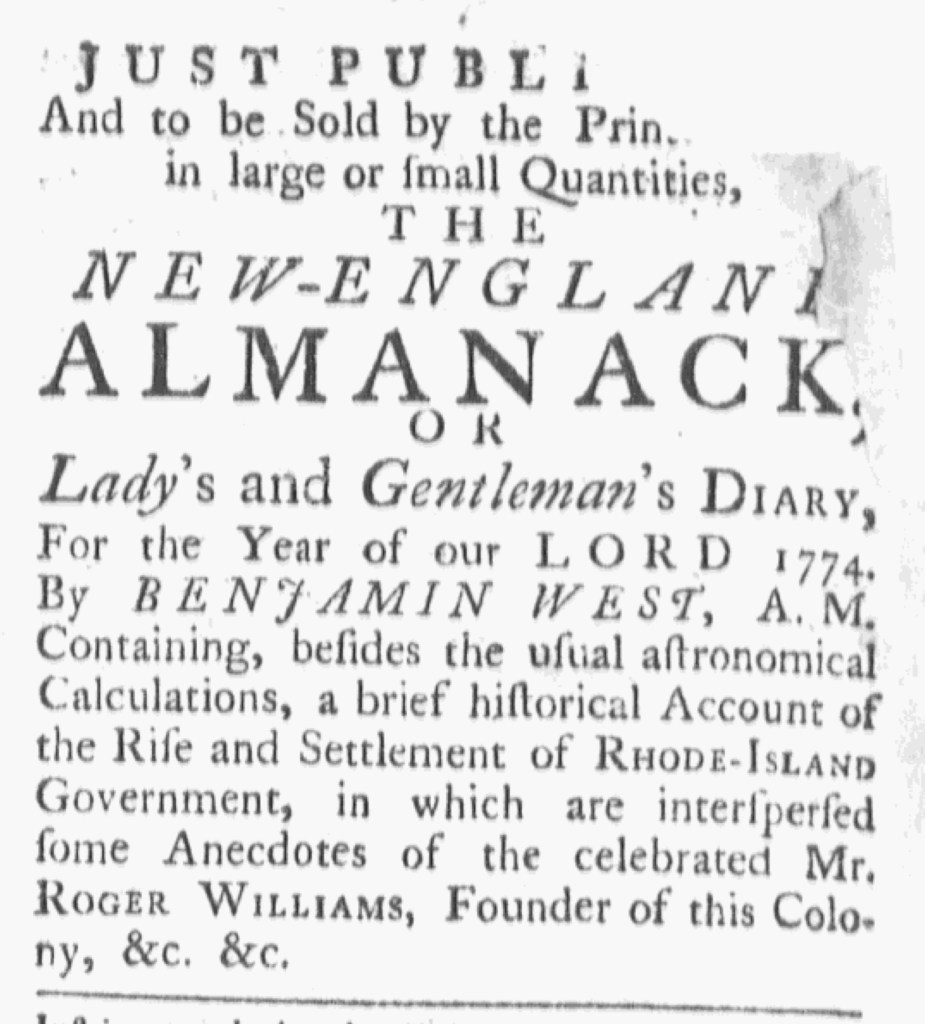
“NEW-ENGLAND ALMANACK, OR Lady’s and Gentleman’s DIARY, For the Year of our LORD 1774.”
There may not have been a better day to buy an almanac … or to advertise the “NEW-ENGLAND ALMANACK, OR Lady’s and Gentleman’s DIARY, For the Year of our LORD 1774.” On January 1, all of the astronomical Calculations in the almanac for the previous year became obsolete. Colonizers who had not yet acquired almanacs for the new year could no longer delay if they wished to have access to current information. In addition, some of the contents of that new almanac also became outdated with each passing day. To take full advantage of the useful reference manual, readers needed to have it on the first day of the year. Prospective buyers knew it. John Carter, the printer of both the New-England Almanack and the Providence Gazette, knew it as well. He placed an advertisement for it in the upper right corner of the final page of the January 1, 1774, edition of his newspaper.
It was part of an annual ritual of advertising almanacs in Providence and throughout the colonies. On occasion, advertisements appeared as early as August or September, though those usually announced that the printer intended to publish a particular title. Such advertisements alerted readers that their favorite titles would be available again, an effort to discourage them from purchasing others instead. In October and November, more and more printers inserted notices stating that they took their almanacs to press and offered them for sale. These advertisements increased in number, frequency, and length. Multiple advertisements for almanacs sometimes appeared in a single issue, especially in newspapers published in the largest port cities. Some of those advertisements featured extensive lists of the contents, seeking to entice buyers with more than the “usual astronomical Calculations.” Carter opted for a streamlined version, but he did promote “a brief historical Account of the Rise and Settlement of RHODE-ISLAND Government, in which are interspersed some Anecdotes of the celebrated Mr. ROGER WILLIAMS, Founder of this Colony,” as additional items of interest that customers could read when they acquired the New-England Almanack. The volume of advertising for almanacs continued in December, a last push before the new year, and into January, while the astronomical Calculations and schedules for courts, meetings, and other events remained relevant for the entire year. Those contents became less relevant with each passing day, but many printers still had surplus copies that cut into any profits they made from publishing almanacs. Advertisements continued to appear in January, February, and March, tapering off over time. By the time spring arrived, most advertisements for almanacs disappeared from colonial newspapers. Their presence, absence, and number became signs of the seasons among newspaper readers, corresponding to changes in the weather and the amount of sunlight in the day.