February 10

What was advertised in a colonial American newspaper 250 years ago today?
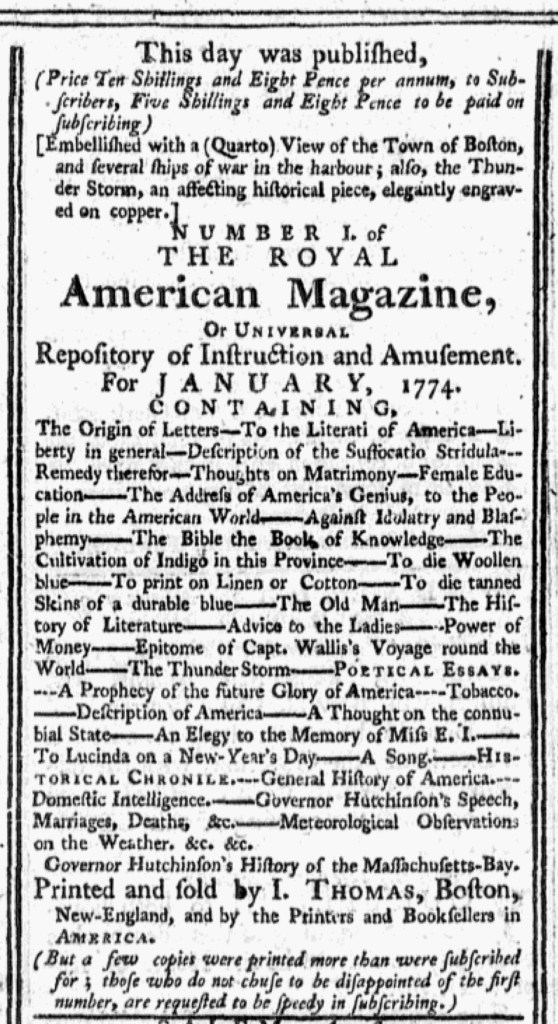
Massachusetts Spy (February 10, 1774).

Those who do not chuse to be disappointed of the first number, are requested to be speedy in subscribing.”

After months of distributing subscription proposals, advertising in newspapers from New Hampshire to Maryland, seeking submissions, and providing updates, Isaiah Thomas finally published the first issue of the Royal American Magazine on February 7, 1774.  He ran advertisements to that effect in the Boston-Gazette and the Massachusetts Gazette and Boston Post-Boy on the day the magazine became available to current and prospective subscribers.  Three days later, when he published the next edition of his own weekly newspaper, the Massachusetts Spy, Thomas inserted an even more elaborate advertisement.  He ran a similar notice, a slightly shorter variation, in the Massachusetts Gazette and Boston Weekly News-Letter on the same day.

Thomas began the version in the Massachusetts Spy with the pronouncement, “This day was published.”  Readers understood that meant that printed material, whether book, magazine, pamphlet, or almanac, was available to purchase, not necessarily that it was first printed that very day.  After all, newspaper advertisements proclaiming, “This day was published,” usually ran for weeks and sometimes even months without revision.  Thomas then reviewed the price, ten shillings and eight pence per year, with just over half, five shillings and eight pence, “to be paid on subscribing,” and promoted the copperplate engravings that “Embellished” the first issue of the magazine.  Only after providing that information did Thomas name the publication, “NUMBER I. of THE ROYAL American Magazine, Or UNIVERSAL Repository of Instruction and Amusement, For JANUARY, 1774.”  That Thomas published the January edition in early February likely did not seem odd to colonizers.  The few magazines published in eighteenth-century America tended to be printed and distributed at the end of the month rather than the beginning.
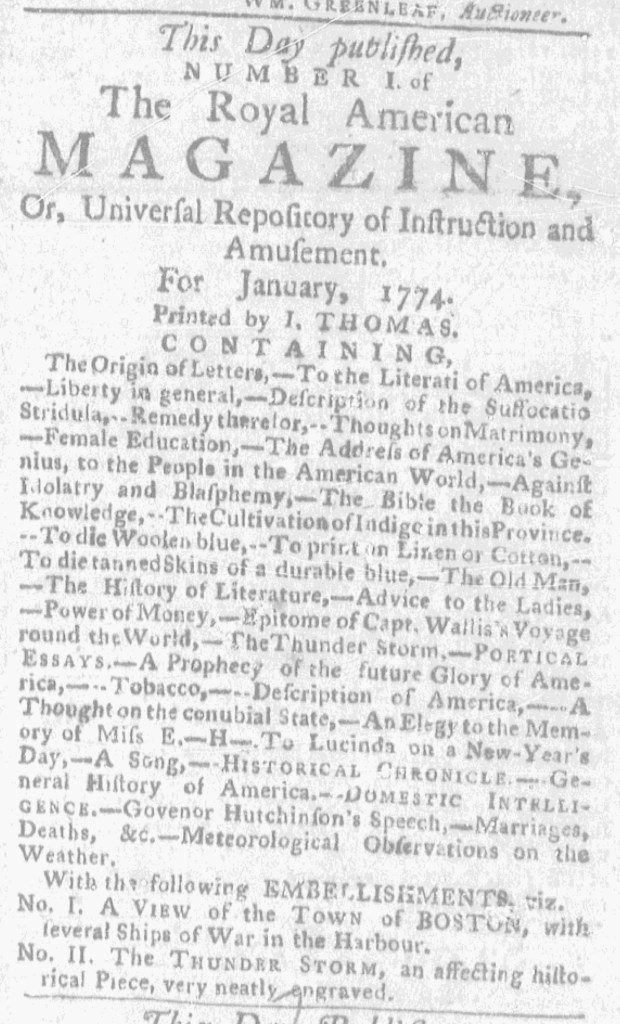
Massachusetts Gazette and Boston Weekly News-Letter (February 10, 1774).

Thomas devoted about half of the advertisement to a list of contents of the January issue of the Royal American Magazine, including essays on “Liberty in General,” “Thoughts on Matrimony,” and “Advice to the Ladies,” instructions “To die Woollen blue,” “To print on Linen or Cotton,” and “To die tanned Skins of a durable blue,” and several items under the headings “POETICAL ESSAYS” and “HISTORICAL CHRONICLE.”  Several authors apparently heeded his earlier calls for submissions, “requesting the Favour of their LUCUBRATIONS, which he promises to convey to the World with the greatest Care and Attention.”  Thomas also listed “Governor Hutchinson’s History of Massachusetts-Bay” at the end of the contents.  In the subscription proposals for the magazine, he offered Hutchinson’s History as a premium, pledging to include a portion with each issue of the magazine “in such a manner as to be bound up by itself.”  Subscribers could opt to have multiple issues of the magazine bound together into a single volume at the same time they had bookbinders collate and bind the pages of Hutchinson’s History.

Thomas concluded with a note to encourage prospective subscribers who had hesitated to submit their names soon or risk missing out.  “But a few copies were printed more than were subscribed for,” he declared, so “those who do not chuse to be disappointed of the first number, are requested to be speedy in subscribing.”  Customers could purchase the magazine from Thomas and “Printers and Booksellers in AMERICA.”  With all the fanfare around the first issue of the magazine, Thomas hoped to entice even more subscribers for his latest venture.  An advertising campaign that began months earlier continued with the publication of “NUMBER I” of the Royal American Magazine.

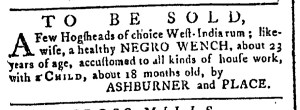
Slavery Advertisements Published February 10, 1774

GUEST CURATOR:  Kolbe Bell

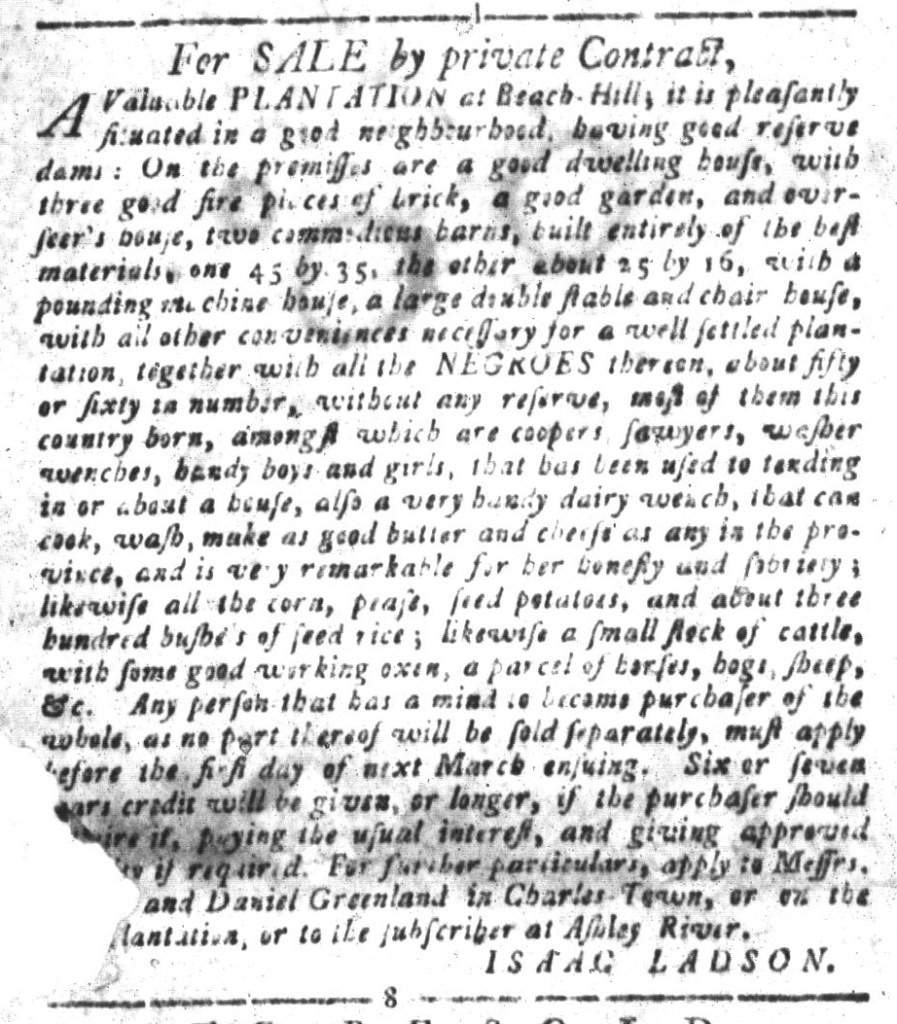
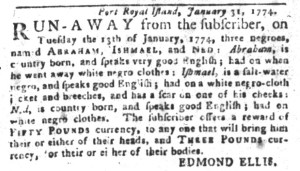
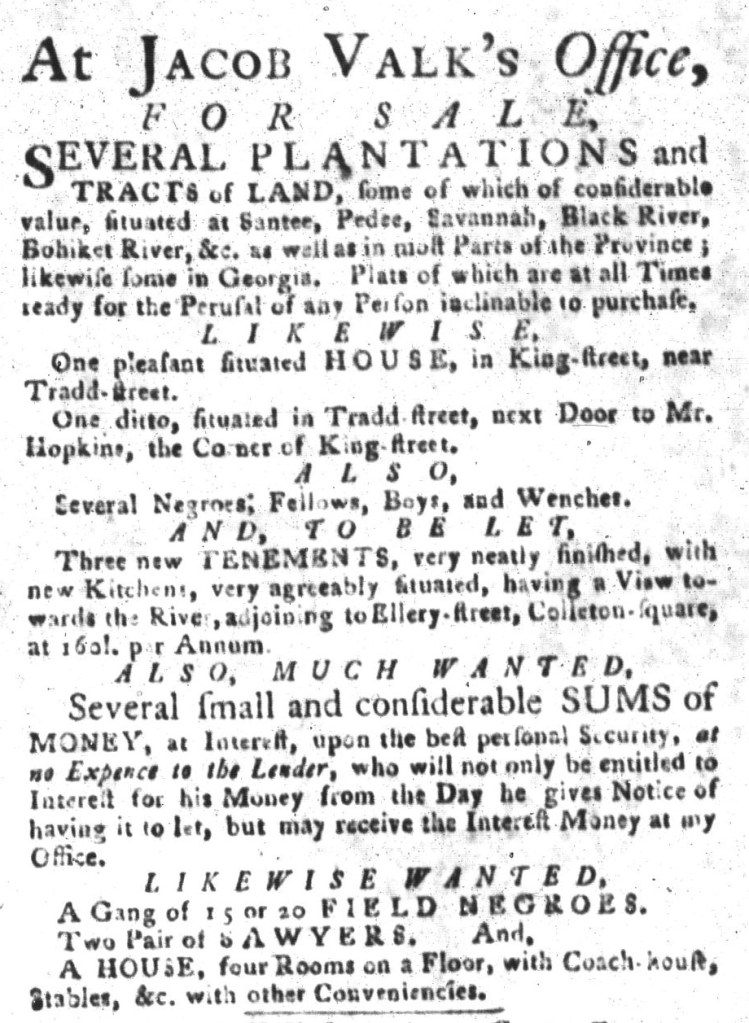
The Slavery Adverts 250 Project chronicles the role of newspaper advertising in perpetuating slavery in the era of the American Revolution. The project seeks to reveal the ubiquity of slavery in eighteenth-century life from New England to Georgia by republishing advertisements about enslaved people – for sale as individuals or in groups, wanted to purchase or for hire for short periods, runaways who liberated themselves, and those who were subsequently captured and confined in jails and workhouses – in daily digests on this site as well as in real time via the @SlaveAdverts250 Twitter feed, utilizing twenty-first-century media to stand in for the print media of the eighteenth century.

The project aims to provide modern audiences with a sense of just how often colonizers encountered these advertisements in their daily lives. Enslaved men, women, and children appeared in print somewhere in the colonies almost every single day. Those advertisements served as a constant backdrop for social, cultural, economic, and political life in colonial and revolutionary America. Colonizers who did not purport to own enslaved people were still confronted with slavery as well as invited to maintain the system by purchasing enslaved men, women, and children or assisting in the capture of so-called “runaways” who sought to free themselves from bondage. The frequency of these newspaper advertisements suggests just how embedded slavery was in colonial and revolutionary American culture in everyday interactions beyond the printed page.

These advertisements also testify to the experiences of enslaved men, women, and children, though readers must consider that those experiences have been remediated through descriptions offered by enslavers rather than enslaved people themselves. Often unnamed in the advertisements, enslaved men, women, and children were not invisible or unimportant in early America.

These advertisements appeared in colonial American newspapers 250 years ago today.

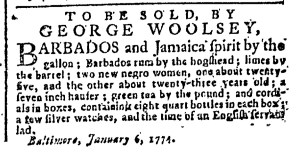
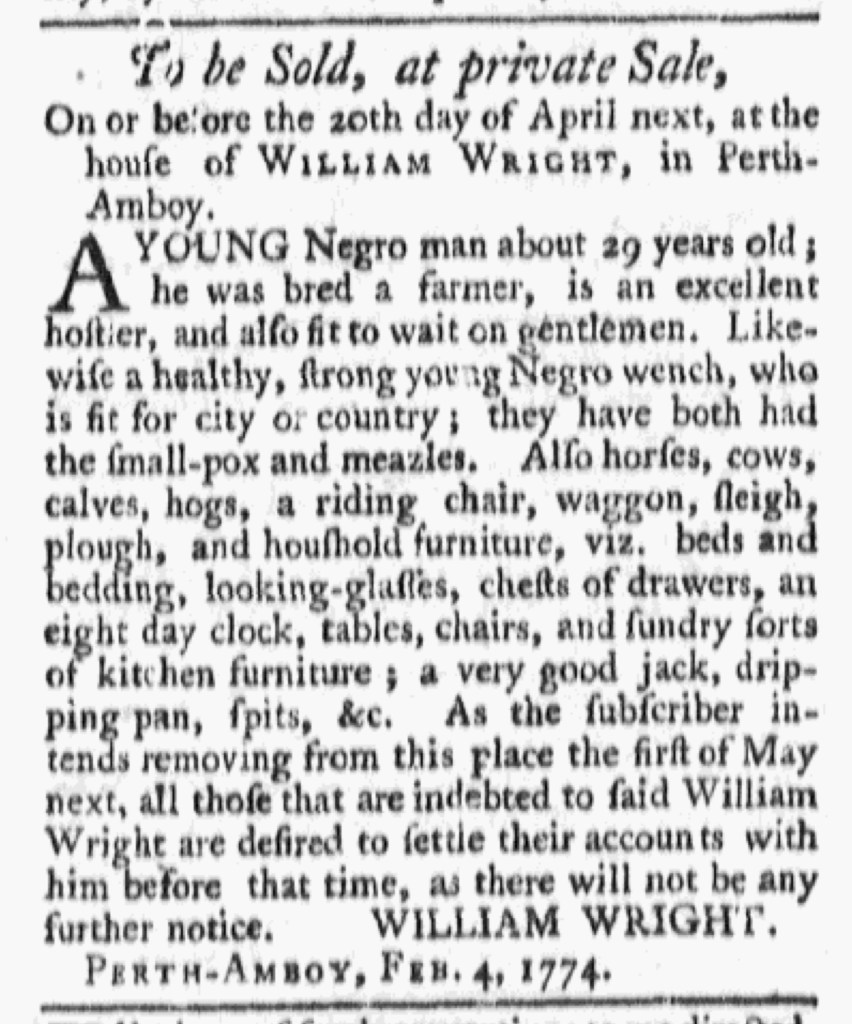
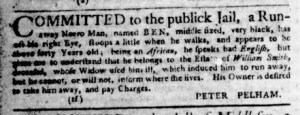
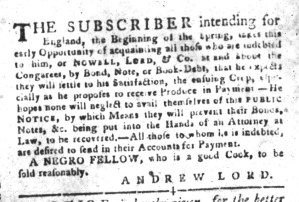
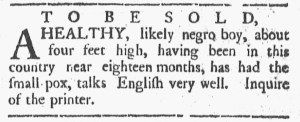
Maryland Gazette (February 10, 1774).

**********

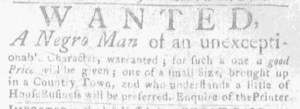
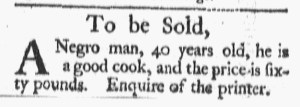
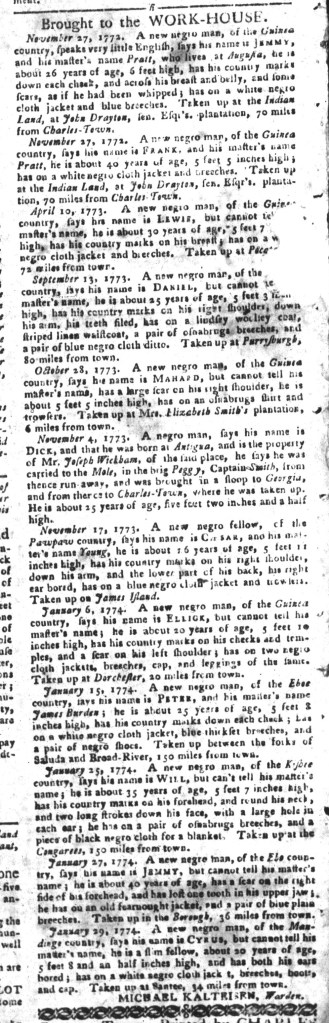
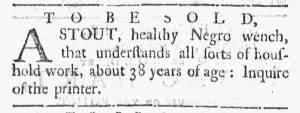
Maryland Journal (February 10, 1774).

**********

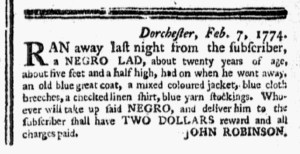
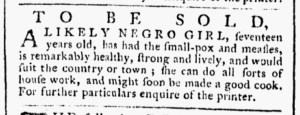
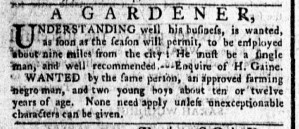
Maryland Journal (February 10, 1774).

**********

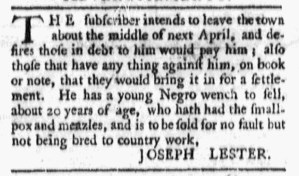
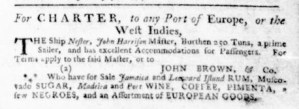
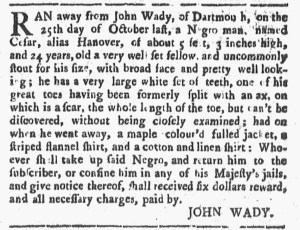
Massachusetts Gazette and Boston Weekly News-Letter (February 10, 1774).

**********

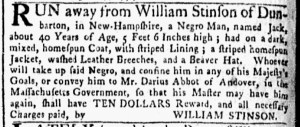
Massachusetts Spy (February 10, 1774).

**********

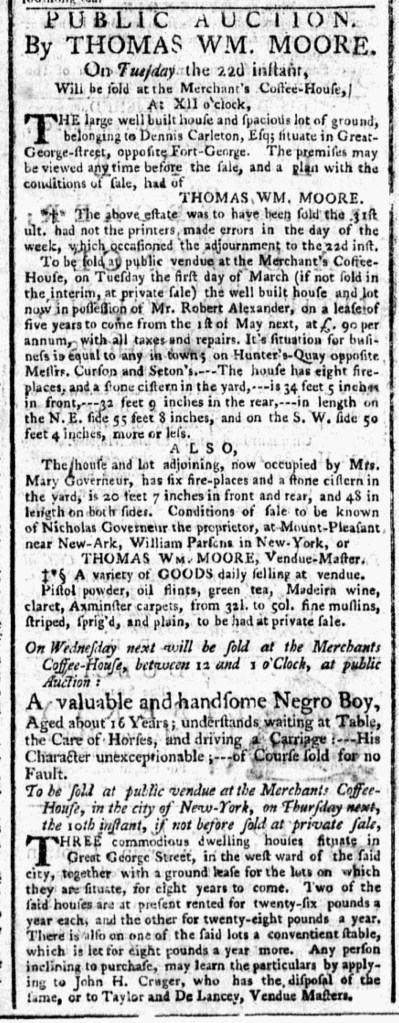
Rivington’s New-York Gazetteer (February 10, 1774).

**********

Rivington’s New-York Gazetteer (February 10, 1774).

**********

Rivington’s New-York Gazetteer (February 10, 1774).

**********

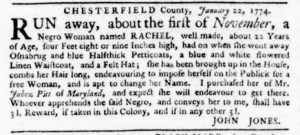
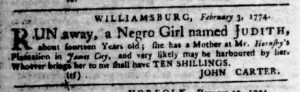
Virginia Gazette [Purdie and Dixon] (February 10, 1774).

**********

Virginia Gazette [Purdie and Dixon] (February 10, 1774).

**********

Virginia Gazette [Purdie and Dixon] (February 10, 1774).

**********

Virginia Gazette [Purdie and Dixon] (February 10, 1774).

**********

Virginia Gazette [Purdie and Dixon] (February 10, 1774).

**********

Virginia Gazette [Purdie and Dixon] (February 10, 1774).

**********

Virginia Gazette [Purdie and Dixon] (February 10, 1774).

**********

Virginia Gazette [Purdie and Dixon] (February 10, 1774).

**********

Virginia Gazette [Purdie and Dixon] (February 10, 1774).

**********

Virginia Gazette [Purdie and Dixon] (February 10, 1774).

**********

Virginia Gazette [Purdie and Dixon] (February 10, 1774).

**********

Virginia Gazette [Purdie and Dixon] (February 10, 1774).

**********

Virginia Gazette [Purdie and Dixon] (February 10, 1774).

**********

Virginia Gazette [Purdie and Dixon] (February 10, 1774).

**********

Virginia Gazette [Purdie and Dixon] (February 10, 1774).

**********

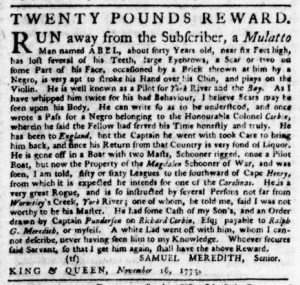
Virginia Gazette [Rind] (February 10, 1774).

**********

Virginia Gazette [Rind] (February 10, 1774).

**********

Virginia Gazette [Rind] (February 10, 1774).

**********

Virginia Gazette [Rind] (February 10, 1774).

**********

Virginia Gazette [Rind] (February 10, 1774).

**********

Virginia Gazette [Rind] (February 10, 1774).

February 9

What was advertised in a colonial American newspaper 250 years ago today?

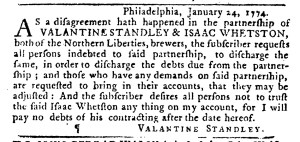
Pennsylvania Journal (February 9, 1774).

“I will pay no debts of his contracting after the date hereof.”

Valantine Standley and Isaac Whetston had a falling out at the beginning of 1774.  The brewers formed a partnership in the Northern Liberties on the outskirts of Philadelphia, but, as Standley explained in an advertisement in the February 9 edition of the Pennsylvania Journal, “a disagreement hath happened” that caused them to dissolve their partnership and go their separate ways.  Accordingly, Standley sought to separate his finances from Whetston, issuing a call for those who had done business with the brewers to settle accounts.  He requested “all persons indebted to said partnership, to discharge the same, in order to discharge the debts due from the partnership.”  At the same time, he asked that “those who have any demands on said partnership … bring in their accounts, that they may be adjusted.”

Standley could have left it there.  Merchants, shopkeepers, artisans, printers, and other entrepreneurs regularly placed advertisements asking their associates to settle accounts.  Similarly, executors often did so on behalf of the estates they administered.  Standley, however, inserted additional instructions to the partnership’s associates and to the general public, instructions that resembled those given by aggrieved husbands who ran what have become known as “runaway wife” advertisements to warn purveyors of goods and services not to extend credit to wives who had abandoned their husbands and households.  Standley advised “all persons not to trust the said Isaac Whetston any thing on my account, for I will pay no debts of his contracting.”  He replicated language that appeared in advertisements that resulted from marital discord but not usually in notices about business partnerships dissolving.  That Standley did so testified to the “disagreement” between the brewers.  He did not consider it sufficient that an announcement that they were no longer in business together would cause others to refrain from allowing Whetston to make charges on Standley’s account.  Instead, he explicitly forbade such transactions, suggesting that he did not trust his former partner to comport himself appropriately.  Rather than a dry and routine notification that the brewers were no longer in business together, Standley’s advertisement hinted at the acrimony between the two men, perhaps inciting curiosity among their neighbors and associates.  In this instance, an advertisement delivered both news and gossip.

Slavery Advertisements Published February 9, 1774

GUEST CURATOR:  Kolbe Bell

The Slavery Adverts 250 Project chronicles the role of newspaper advertising in perpetuating slavery in the era of the American Revolution. The project seeks to reveal the ubiquity of slavery in eighteenth-century life from New England to Georgia by republishing advertisements about enslaved people – for sale as individuals or in groups, wanted to purchase or for hire for short periods, runaways who liberated themselves, and those who were subsequently captured and confined in jails and workhouses – in daily digests on this site as well as in real time via the @SlaveAdverts250 Twitter feed, utilizing twenty-first-century media to stand in for the print media of the eighteenth century.

The project aims to provide modern audiences with a sense of just how often colonizers encountered these advertisements in their daily lives. Enslaved men, women, and children appeared in print somewhere in the colonies almost every single day. Those advertisements served as a constant backdrop for social, cultural, economic, and political life in colonial and revolutionary America. Colonizers who did not purport to own enslaved people were still confronted with slavery as well as invited to maintain the system by purchasing enslaved men, women, and children or assisting in the capture of so-called “runaways” who sought to free themselves from bondage. The frequency of these newspaper advertisements suggests just how embedded slavery was in colonial and revolutionary American culture in everyday interactions beyond the printed page.

These advertisements also testify to the experiences of enslaved men, women, and children, though readers must consider that those experiences have been remediated through descriptions offered by enslavers rather than enslaved people themselves. Often unnamed in the advertisements, enslaved men, women, and children were not invisible or unimportant in early America.

These advertisements appeared in colonial American newspapers 250 years ago today.

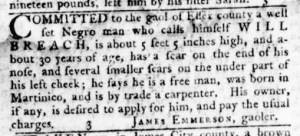
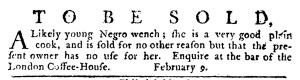
Pennsylvania Journal (February 9, 1774).

February 8

What was advertised in a colonial American newspaper 250 years ago today?

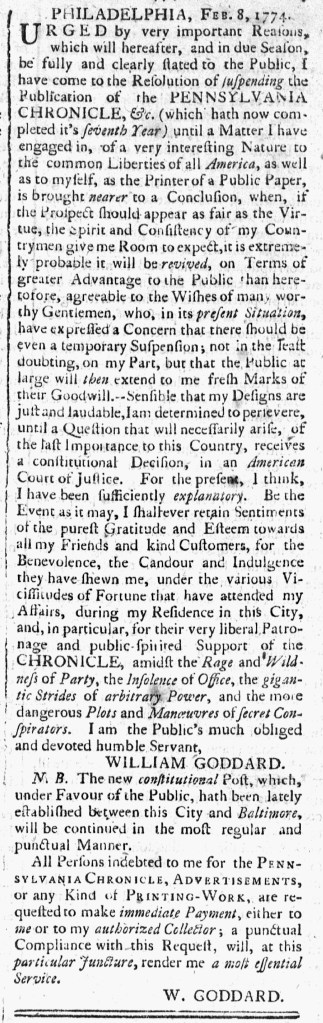
Pennsylvania Chronicle (February 8, 1774).

“I have come to the Resolution of suspending the Publication of the PENNSYLVANIA CHRONICLE.”

William Goddard published the final issue of the Pennsylvania Chronicle on February 8, 1774.  That newspaper commenced publication seven years earlier, on January 26, 1767.  The Adverts 250 Project tracked Goddard’s efforts to launch the Pennsylvania Chronicle, advertisements that ran in the first issues, and many more advertisements throughout its run.  Aside from news items, the final issue featured only three paid notices along with a letter from Goddard.

The printer explained that “very important Reasons” led him to “the Resolution of suspending the Publication of the PENNSYLVANIA CHRONICLE.”  He suggested that those reasons “will hereafter, and in due Season, be fully and clearly stated to the Public.”  He further hinted that he planned to revive the newspaper when “a Matter I have been engaged in, of a very interesting Nature to the common Liberties of all America, as well as to myself, as the Printer of a Public Paper, is brought nearer to a Conclusion.”  Goddard made other cryptic references, pronouncing that he had been “sufficiently explanatory.”  Still, he could not resist thanking his patrons for their support “amidst the Rage and Wildness of Party, the Insolence of Office, the gigantic Strides of arbitrary Power, and the more dangerous Plots and Manoeuvres of secret Conspirators.”

Many readers, especially those who had resided in Philadelphia for any amount of time, may have remembered that Goddard initially published the Pennsylvania Chronicle in partnership with Joseph Galloway and Thomas Wharton.  In his History of Printing in America (1810), Isaiah Thomas notes that the newspaper “was established under their influence and subject to their control, until 1770.”  At that time, Galloway and Wharton sold their share to Benjamin Towne, but Goddard soon “separated from his partners.”  After that, a “portion of [the newspaper] was … for a long time, devoted by Goddard to the management of a literary warfare which took place between him and his late partners.”[1]  In 1770, Goddard had also published a pamphlet, The Partnership, that put the enmity between himself and his former partners on full view for the public.  The lengthy subtitle testified to how much the relationship had deteriorated:  “The history of the rise and progress of the Pennsylvania Chronicle, &c.: Wherein the conduct of Joseph Galloway, Esq; speaker of the Honourable House of Representatives of the province of Pennsylvania; Mr. Thomas Wharton, Sen. and their man Benjamin Towne, my late partners, with my own, is properly delineated, and their calumnies against me fully refuted.”  In turn, Galloway and Wharton had Goddard imprisoned for debt for the following year.

As the Pennsylvania Chronicle declined, Goddard founded the Maryland Journal, the first newspaper published in Baltimore, in August 1773.  Goddard relocated to Baltimore after “suspending” the Pennsylvania Chronicle.  In a nota bene at the end of his letter in the final issue, he declared that the “new constitutional Post, which … hath been lately established between this City and Baltimore, will be continued in the most regular and punctual Manner.”  That was the first route in what became a much more expansive network of post offices operated independently of the British postal system, allowing colonizers to send letters and disseminate newspapers without interference from British officials.

As a last matter of housekeeping, Goddard called on “All Persons indebted to me for the PENNSYLVANIA CHRONICLE, ADVERTISEMENTS, or any Kind of PRINTING-WORK … to make immediate Payment.”  Printers and other entrepreneurs regularly placed notices with the intention of settling accounts.  Goddard’s notice merits special attention because he indicates that some customers owed for advertisements.  Many historians of the early American press assert that printers extended generous credit to subscribers while generating revenue by demanding that advertisers paid in advance.  Some printers, however, periodically ran notices calling on advertisers to make payment.  Goddard and some of his fellow printers apparently did not enforce a hard-and-fast policy when it came to paying for advertisement before publication.

Although the Pennsylvania Chronicle ceased publication in 1774, Goddard continued publishing the Maryland Journal and became involved in other projects, including the Constitutional Post, that became the subjects of news articles, editorials, and advertisements.  Undoubtedly, William Goddard will make additional appearances as the Adverts 250 Project continues examining advertising, print culture, and politics during the era of the American Revolution.

**********

[1] Isaiah Thomas, The History of Printing in America: With a Biography of Printers and an Account of Newspapers (1810; New York: Weathervane Books, 1970), 438.

Slavery Advertisements Published February 8, 1774

GUEST CURATOR:  Kolbe Bell

The Slavery Adverts 250 Project chronicles the role of newspaper advertising in perpetuating slavery in the era of the American Revolution. The project seeks to reveal the ubiquity of slavery in eighteenth-century life from New England to Georgia by republishing advertisements about enslaved people – for sale as individuals or in groups, wanted to purchase or for hire for short periods, runaways who liberated themselves, and those who were subsequently captured and confined in jails and workhouses – in daily digests on this site as well as in real time via the @SlaveAdverts250 Twitter feed, utilizing twenty-first-century media to stand in for the print media of the eighteenth century.

The project aims to provide modern audiences with a sense of just how often colonizers encountered these advertisements in their daily lives. Enslaved men, women, and children appeared in print somewhere in the colonies almost every single day. Those advertisements served as a constant backdrop for social, cultural, economic, and political life in colonial and revolutionary America. Colonizers who did not purport to own enslaved people were still confronted with slavery as well as invited to maintain the system by purchasing enslaved men, women, and children or assisting in the capture of so-called “runaways” who sought to free themselves from bondage. The frequency of these newspaper advertisements suggests just how embedded slavery was in colonial and revolutionary American culture in everyday interactions beyond the printed page.

These advertisements also testify to the experiences of enslaved men, women, and children, though readers must consider that those experiences have been remediated through descriptions offered by enslavers rather than enslaved people themselves. Often unnamed in the advertisements, enslaved men, women, and children were not invisible or unimportant in early America.

These advertisements appeared in colonial American newspapers 250 years ago today.

Essex Gazette (February 8, 1774).

**********

South-Carolina Gazette and Country Journal (February 8, 1774).

**********

South-Carolina Gazette and Country Journal (February 8, 1774).

**********

South-Carolina Gazette and Country Journal (February 8, 1774).

**********

South-Carolina Gazette and Country Journal (February 8, 1774).

**********

South-Carolina Gazette and Country Journal (February 8, 1774).

**********

South-Carolina Gazette and Country Journal (February 8, 1774).

**********

South-Carolina Gazette and Country Journal (February 8, 1774).

**********

South-Carolina Gazette and Country Journal (February 8, 1774).

**********

South-Carolina Gazette and Country Journal (February 8, 1774).

**********

South-Carolina Gazette and Country Journal (February 8, 1774).

**********

South-Carolina Gazette and Country Journal (February 8, 1774).

**********

South-Carolina Gazette and Country Journal (February 8, 1774).

**********

South-Carolina Gazette and Country Journal (February 8, 1774).

**********

South-Carolina Gazette and Country Journal (February 8, 1774).

**********

South-Carolina Gazette and Country Journal (February 8, 1774).

February 7

GUEST CURATOR:  Kolbe Bell

What was advertised in a colonial American newspaper 250 years ago today?

Massachusetts Gazette and Boston Post-Boy (February 7, 1774).

“Embellished with a (Quarto) View of the Town of Boston … neatly engraved on Copper.”

The Royal American Magazine was a popular magazine during a run cut short due to the fighting of the American Revolution.  It was first published in 1774 by Isaiah Thomas, a renowned printer who ran the Massachusetts Spy, a newspaper, since 1770.  The Royal American Magazine lasted from January 1774 to early spring of 1775.  Not many successful magazines were started in America before the American Revolution.  Frank Luther Mott states that there were only fifteen magazines published in America before the Royal American started, most of them lasting a year or less.[1]  Isaiah Thomas’s advertisement campaign for the Royal American, however, helped to make it one of the most successful American magazines prior to independence.

The Royal American Magazine was known for having many more engravings than other American magazines at the time; engravings are visual images inserted into a written work, and were made by carefully carving a reverse image onto a copper plate, coating it with ink, and then transferring the image to paper in a printing press.  The engravings representing a “View of the Town of Boston, and a Representation of a Thunder Storm,” as mentioned in this advertisement, enticed more people to subscribe to the magazine.  According to Mott, “its distinctive feature was a little series of engravings by Paul Revere.”[2]  The fact that the advertisement does not include the name of Paul Revere as the engraver for the magazine shows that Paul Revere’s fame increased after the American Revolution.  Despite the Royal American Magazine containing so many engravings and other content, it did not last much longer than a year.  Nevertheless, it was one of the most popular magazines printed in America before the American Revolution.
Visit the “Royal American Magazine Plates,” part of the “Illustrated Inventory of Paul Revere’s Works at the American Antiquarian Society,” to view the engravings and learn more about them.

**********

ADDITIONAL COMMENTARY:  Carl Robert Keyes

Later than he intended (and later than he had advertised), Isaiah Thomas published the first issue of the Royal American Magazine in early February 1774.  The Adverts 250 Project has tracked Thomas’s extensive advertising campaign over many months in 1773 and 1774, including his announcements that he would publish the first issue in January 1774 and an explanation that a ship running aground delayed delivery of the types for the magazine to Boston.  On Thursday, February 3, he inserted a brief notice in his own newspaper, the Massachusetts Spy, pledging that “MONDAY next will be published … NUMBER I. of The Royal AMERICAN MAGAZINE.”  Just as he would do four days later in the advertisement Kolbe examines today, he promoted copperplate engravings of a “View of the Town of Boston, and a Representation of a Thunder Storm.”  Subscribers could leave the engravings intact or, as many likely did, remove them to display in their homes, shops, or offices.

Boston-Gazette (February 7, 1774).

Thomas had aggressively advertised in other newspapers, including several published in Boston.  He once again did so when he finally took the magazine to press.  In addition to the version that ran in the Massachusetts Gazette and Boston Post-Boy on February 7, featured above, he placed a shorter notice in the Boston-Gazette on the same day.  Extending only three lines, it declared, “THIS DAY PUBLISHED, (by I. THOMAS,) Number I. of The Royal American MAGAZINE.”  Perhaps he submitted copy that included the blurb about the copperplate engravings to the printing office only to have the compositors edit it for length to fit on the page with the rest of the news and advertising in that issue.  Whatever the case, Thomas fulfilled the promise he made in the Massachusetts Spy on February 3.  He did indeed publish the Royal American Magazine on the following Monday.  He followed up with much more extensive advertisements in the Massachusetts Spy and the Massachusetts Gazette and Boston Weekly News-Letter on February 10, announcing his success and encouraging more readers to subscribe.

**********

[1] Frank Luther Mott, A History of American Magazines, 1741-1850 (Cambridge: Harvard University Press, 1939), 787-788.

[2] Mott, History of American Magazines, 26.

Welcome, Guest Curator Kolbe Bell

Kolbe Bell is a senior at Assumption University in Worcester, Massachusetts.  He is a history major with a political science minor.  He is also president of the Republicans’ Club on campus.  He has always been history buff and, in particular, enjoys learning about the history of Central and Eastern Europe.  He is an Eagle Scout; his Eagle Scout project was building bat houses to protect endangered brown bats in New England.  Kolbe made his contributions to the Adverts 250 Project and the Slavery Adverts 250 Project while enrolled in HIS 401 Revolutionary America, 1763-1815, in Fall 2023.

Welcome, guest curator Kolbe Bell!

Slavery Advertisements Published February 7, 1774

GUEST CURATOR:  Kolbe Bell

The Slavery Adverts 250 Project chronicles the role of newspaper advertising in perpetuating slavery in the era of the American Revolution. The project seeks to reveal the ubiquity of slavery in eighteenth-century life from New England to Georgia by republishing advertisements about enslaved people – for sale as individuals or in groups, wanted to purchase or for hire for short periods, runaways who liberated themselves, and those who were subsequently captured and confined in jails and workhouses – in daily digests on this site as well as in real time via the @SlaveAdverts250 Twitter feed, utilizing twenty-first-century media to stand in for the print media of the eighteenth century.

The project aims to provide modern audiences with a sense of just how often colonizers encountered these advertisements in their daily lives. Enslaved men, women, and children appeared in print somewhere in the colonies almost every single day. Those advertisements served as a constant backdrop for social, cultural, economic, and political life in colonial and revolutionary America. Colonizers who did not purport to own enslaved people were still confronted with slavery as well as invited to maintain the system by purchasing enslaved men, women, and children or assisting in the capture of so-called “runaways” who sought to free themselves from bondage. The frequency of these newspaper advertisements suggests just how embedded slavery was in colonial and revolutionary American culture in everyday interactions beyond the printed page.

These advertisements also testify to the experiences of enslaved men, women, and children, though readers must consider that those experiences have been remediated through descriptions offered by enslavers rather than enslaved people themselves. Often unnamed in the advertisements, enslaved men, women, and children were not invisible or unimportant in early America.

These advertisements appeared in colonial American newspapers 250 years ago today.

Boston Evening-Post (February 7, 1774).

**********

Dunlap’s Pennsylvania Packet (February 7, 1774).

**********

Newport Mercury (February 7, 1774).

**********

Newport Mercury (February 7, 1774).

**********

Newport Mercury (February 7, 1774).

**********

New-York Gazette and Weekly Mercury (February 7, 1774).

**********

New-York Gazette and Weekly Mercury (February 7, 1774).

**********

Supplement to the New-York Gazette and Weekly Mercury (February 7, 1774).

February 6

What was advertised in a colonial American newspaper 250 years ago this week?

Massachusetts Gazette and Boston Weekly News-Letter (February 3, 1774).

“The largest & compleatest Collection of Books, that ever was sold at this Office.”

A note at the end of auctioneer Robert Gould’s advertisement in the February 3, 1774, edition of the Massachusetts Gazette and Boston Weekly News-Letter seemed incongruous with the content of the rest of the notice.  Gould announced that he would auction a “Variety of genteel House-Furniture” the next morning “At TEN o’Clock.”  He listed many of the items going up for bids, including “Mahogany dining Tea & Bureau Tables,” “Looking-Glasses,” and “a few Sets genteel Pictures.”  In addition, the sale would include “a great Variety of English GOODS.”

The note that followed his signature, however, stated, “No Catalogues will be published, and as this is by far the largest & compleatest Collection of Books, that ever was sold at this Office, therefore they will be exposed to View on Saturday and Monday next.”  That reference made little sense since the auction of the furniture, housewares, and other goods was scheduled for the next day, a Friday.  In addition, a coy aside directed readers, “Pray Remember the Sale begins half past 9 Precisely,” a different time than the auction discussed earlier in the advertisement would begin.

Massachusetts Gazette and Boston Weekly News-Letter (January 27, 1774).

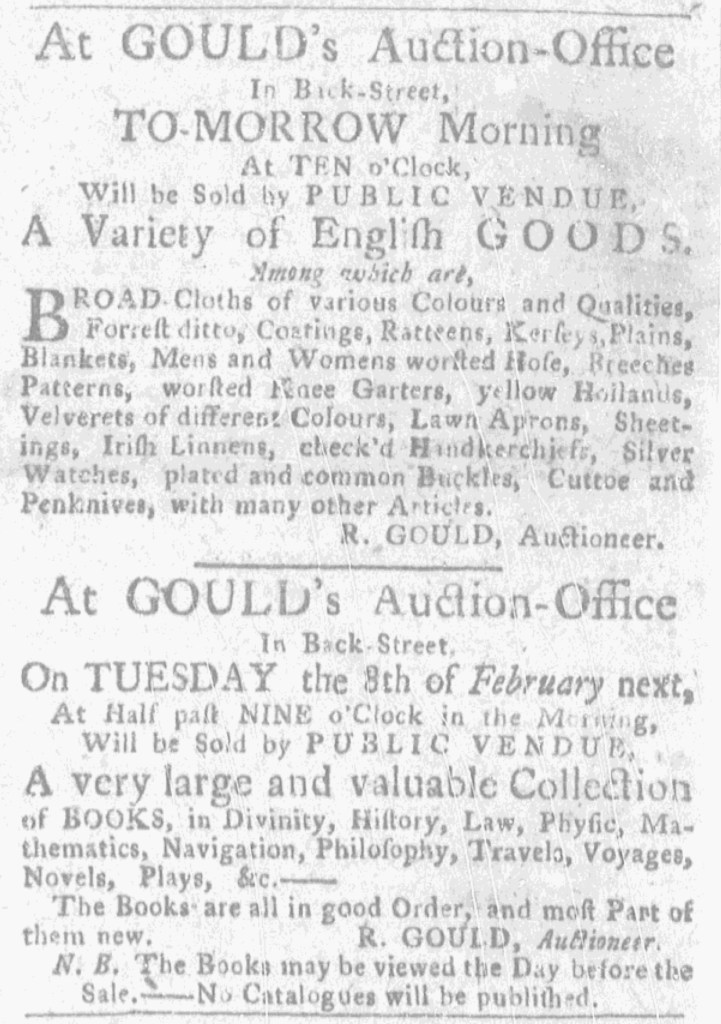
It appears that these inconsistencies resulted from a miscommunication between the auctioneer and the printing office or an error in the printing office.  In the previous issue of the Massachusetts Gazette and Boston Weekly News-Letter, Gould ran an advertisement in two parts, both of which could have appeared separately.  The first part included an introduction identical to the one in the notice published on February 3.  The compositor likely did not even reset type for the introduction, instead updating the headline from “A Variety of English GOODS” to “A Variety of genteel House-Furniture” and inserting a new list of items for sale.  The second part described an auction for a “very large and valuable Collection of BOOKS” that would take place “On TUESDAY the 8th of February next, At Half past NINE o’Clock in the Morning.”  Gould explained that the books “are all in good Order, and most Part of them new.”  In addition, he appended a nota bene advising that the books “may be viewed the Day before the Sale.—No Catalogues will be published.”

Gould probably attempted to update both parts of the advertisement, providing new information about the weekly sale at his auction office and an update about an upcoming special auction for books, but some confusion ensued.  Gould may not have been clear about how much of the previous advertisement should carry over to the new one.  Alternately, the compositor may not have paid sufficient attention to the instructions submitted to the printing office.  Either way, the strange note at the end of the advertisement could have piqued interest among readers.  After all, proclaiming the sale featured “by far the largest and compleatest Collection of Books, that was ever sold at this Office” was intended to attract attention.  To learn more, they only had to contact Gould or take note of advertisements he already published in the Boston-Gazette and the Massachusetts Gazette and Boston Weekly News-Letter.