February 5

Who were the subjects of advertisements in a colonial American newspaper 250 years ago today?
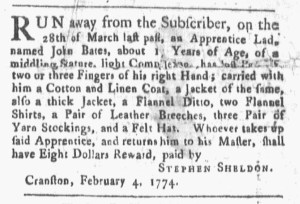
Providence Gazette (February 5, 1774).

“RUN away … an Apprentice Lad, named John Bates.”

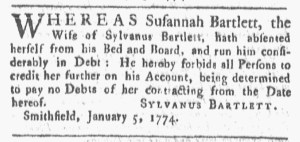
“Susannah Bartlett, the Wife of Sylvanus Bartlett, hath absented herself.”

“RUN away … a Servant Man, named Kimbal Ramsdill, a pretended Carpenter or Joiner.”

Colonizers used various kinds of “runaway” advertisements in their efforts to maintain social order.  Such was the case in the February 5, 1774, edition of the Providence Gazette.  Several colonizers published stories of subordinates who ran away, giving directions about how others should interact with them if they happened to encounter them.

In the first of those advertisements that readers saw if they perused the newspaper from the first page to the last, Stephen Sheldon of Cranston announced, “RUN away … an Apprentice Lad, named John Bates.”  The apprentice had departed on March 28, 1773, nearly a year earlier, but Sheldon hoped that his advertisement would result in recovering him.  He offered “Eight Dollars Reward” to “Whoever takes up said Apprentice, and returns him to his Master.”  He also provided a physical description to aid in identifying the runaway, including an especially distinctive feature.  The young man “has lost two or three Fingers on his right Hand.”
Providence Gazette (February 5, 1774).

The next advertisement revealed marital discord in the Bartlett household in Smithfield.  “Susannah Bartlett, the Wife of Sylvanus Bartlett,” the husband proclaimed, “hath absented herself from his Bed and Board, and run him considerably in Debt.”  Accordingly, he no longer assumed responsibility for her expenses.  Invoking language that appeared in such advertisements throughout the colonies, Sylvanus declared that he “hereby forbids all Persons to credit her further on his Account, being determined to pay no Debts of her contracting.”  As had been the case with Sheldon running an advertisement about Bates, Sylvanus had much greater access to the public prints than Susannah, so readers of the Providence Gazette knew only one side of the story.  The apprentice and the wife may have had good reasons to leave the Sheldon and Bartlett households.

Providence Gazette (February 5, 1774).

In another advertisement, Benjamin Cargill of Pomfret, Connecticut, described Kimbal Ramsdill, a “Servant Man” and a “Pretended Carpenter or Joiner” who had “RUN away” the previous December.  Cargill indicated that Ramsdill often misrepresented himself, not only in terms of his trade but also his origins.  “The above Fellow,” he stated in a nota bene, “pretends at Times he was born at Lynn, and at other Times at Newbury.”  Indeed, he was “much given to Lying, and apt to tell of his having Land in different Parts.”  In this instance, Cargill did not ask readers to accept his word alone that Ramsdill engaged in unsavory behavior.  He reported that the indentured servant “hath lately been convicted of Stealing, and publicly whipped seven Lashes, the Marks of which perhaps may yet be seen.”  Cargill promised “Ten Dollars Reward” to “Whoever will take up said Servant, and secure him in any of his Majesty’s Goals [Jails].”

The advertisements in the Providence Gazette and other colonial newspapers did not merely market goods and services to consumers.  Many of them instead delivered news about local events, including cases of runaway apprentices, wives, and indentured servants.  The colonizers who placed those advertisements did so for their own purposes, but also thought they did the community a service by warning about men and women who did not abide by behavior considered appropriate to their status or, sometimes, had even been convicted of crimes.  While there are many reasons not to lump John Bates, Susannah Bartlett, and Kimbal Ramsfill together, the men who placed advertisements about them belonged to a common category of colonizers who used the power of the press in their efforts to impose order on subordinates who they reported had misbehaved.
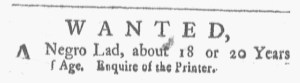
Slavery Advertisements Published February 5, 1774

GUEST CURATOR:  Kolbe Bell

The Slavery Adverts 250 Project chronicles the role of newspaper advertising in perpetuating slavery in the era of the American Revolution. The project seeks to reveal the ubiquity of slavery in eighteenth-century life from New England to Georgia by republishing advertisements about enslaved people – for sale as individuals or in groups, wanted to purchase or for hire for short periods, runaways who liberated themselves, and those who were subsequently captured and confined in jails and workhouses – in daily digests on this site as well as in real time via the @SlaveAdverts250 Twitter feed, utilizing twenty-first-century media to stand in for the print media of the eighteenth century.

The project aims to provide modern audiences with a sense of just how often colonizers encountered these advertisements in their daily lives. Enslaved men, women, and children appeared in print somewhere in the colonies almost every single day. Those advertisements served as a constant backdrop for social, cultural, economic, and political life in colonial and revolutionary America. Colonizers who did not purport to own enslaved people were still confronted with slavery as well as invited to maintain the system by purchasing enslaved men, women, and children or assisting in the capture of so-called “runaways” who sought to free themselves from bondage. The frequency of these newspaper advertisements suggests just how embedded slavery was in colonial and revolutionary American culture in everyday interactions beyond the printed page.

These advertisements also testify to the experiences of enslaved men, women, and children, though readers must consider that those experiences have been remediated through descriptions offered by enslavers rather than enslaved people themselves. Often unnamed in the advertisements, enslaved men, women, and children were not invisible or unimportant in early America.

These advertisements appeared in colonial American newspapers 250 years ago today.

Providence Gazette (February 5, 1774).

February 4

What was advertised in a colonial American newspaper 250 years ago today?

Connecticut Gazette (February 4, 1774).

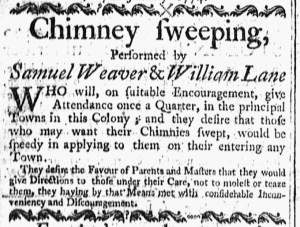
“They desire that those who may want their Chimnies swept, would be speedy in applying to them on their entering any Town.”

Samuel Weaver and William Lane worked as itinerant chimney sweeps in Connecticut in the 1770s.  In addition to word-of-mouth recommendations and calling on previous customers when they arrived in town, they also inserted an advertisement in the Connecticut Gazette in their efforts to build their clientele.  Although published in New London, the Connecticut Gazette circulated throughout the colony, reaching prospective clients in many towns.

In their advertisement, Weaver and Lane explained that their circuit brought them to “the principal Towns in this Colony” four times a year.  Accordingly, they provided regular maintenance for those who hired their services.  To keep to their schedule, they requested that “those who may want their Chimnies swept, would be speedy in applying to them on their entering any Town.”  That allowed them to efficiently tend to their business in each town and then move along to the next.

The chimney sweeps concluded their notice with other guidance to their patrons.  “They desire the Favour of Parents and Masters,” Weaver and Lane wrote, “that they would give Directions to those under their Care, not to molest of teaze them.”  In other words, the head of the household should instruct their children, apprentices, indentured servants, enslaved people, and anyone else residing or visiting there not to bother the chimney sweeps as they went about their jobs.  Weaver and Lane did not indicate what kind of abuse they had previously encountered, but apparently it merited mention in their advertisement.  They did admit that they previously “met with considerable Inconveniency and Discouragement” at the hands of children and others who interfered with their work.

Weaver and Lane hoped to prevent difficulties when they accepted jobs from clients in New London and other towns.  Their request appeared in a smaller font than the rest of their advertisement, perhaps the decision of the compositor who set the type or perhaps according to their instructions.  They made their services the central focus of their notice, while also addressing an issue that arose often enough to deserve mentioning.  The chimney sweeps primed their customers to exercise vigilance about how members of their households treated strangers providing services.

February 3

What was advertised in a colonial American newspaper 250 years ago today?

Massachusetts Gazette and Weekly News-Letter (February 3, 1774).

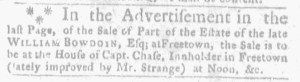
“In the Advertisement in the last Page … the Sale is to be at the House of Capt. Chase, Innholder in Freetown.”

A correction to an advertisement that appeared on the final page of the February 3, 1774, edition of the Massachusetts Gazette and Boston Weekly News-Letter appeared on the second page.  It advised, “In the Advertisement in the last Page, of Part of the Estate of the late WILLIAM BOWDOIN, Esq; at Freetown, the Sale is to be at the House of Capt. Chase, Innholder in Freetown (lately improved by Mr. Strange) at Noon, &c.”  The original advertisement stated that a tract of land “is to be Sold at the House of Mr. Strange, Innholder in Freetown.”  The revision correctly acknowledged that Chase now occupied and operated the inn formerly belonging to Strange.  Bowdoin’s executors likely also hoped that it prevented prospective bidders from missing the sale if they went to Strange’s current establishment instead of Chase’s house.

Why not avoid that confusion by updating the advertisement itself?  The answer to that question requires knowing more about the process of producing newspapers on manual presses in the eighteenth century.  Weekly newspapers usually consisted of four pages created by printing two pages on each side of a broadsheet and then folding it in half.  Printers typically printed the first and fourth pages first.  As the ink dried, they set type for the second and third pages.  That meant that the newest or more significant content did not necessarily appear on the front page!  Instead, advertisements sometimes filled the first and last page, with news items and editorials on the center pages.

For the February 3 edition, advertisements ran in the first column of the first pages and news received from New York in the other two columns.  The estate notice appeared on the final page.  On January 27, the first time the executors inserted it in the Massachusetts Gazette and Boston Weekly News-Letter, the advertisement ran on the first page.  From one issue to the next, the compositor transferred type already set from one page to another.  By the time the executors contacted the printing office about the error, it had already been replicated once again.  Presumably the first and fourth pages for the new issue had been printed, leaving Richard Draper, the printer, to resort to a separate notice on another page to offer the clarification.

The same advertisement, with the same error, ran in the Boston Evening-Post on January 24.  Bowdoin’s executors did not spot the error in time to submit a correction before the January 31 edition, so it appeared once again.  That correlates with a correction for the February 3 edition of the Massachusetts Gazette and Boston Weekly News-Letter arriving at the last minute to make it into that issue.  In the next issue of the Boston Evening-Post, published February 7, the estate notice ran with revised copy.  Similarly, the February 10 edition of the Massachusetts Gazette and Boston Weekly News-Lettercarried the advertisement once again, this time with revised copy.  Given sufficient time, printers and compositors did revise advertisements when their customers made such requests.  When they did not have time, they deployed other strategies for updating their readers.

Slavery Advertisements Published February 3, 1774

GUEST CURATOR:  Madeleine Arsenault

The Slavery Adverts 250 Project chronicles the role of newspaper advertising in perpetuating slavery in the era of the American Revolution. The project seeks to reveal the ubiquity of slavery in eighteenth-century life from New England to Georgia by republishing advertisements about enslaved people – for sale as individuals or in groups, wanted to purchase or for hire for short periods, runaways who liberated themselves, and those who were subsequently captured and confined in jails and workhouses – in daily digests on this site as well as in real time via the @SlaveAdverts250 Twitter feed, utilizing twenty-first-century media to stand in for the print media of the eighteenth century.

The project aims to provide modern audiences with a sense of just how often colonizers encountered these advertisements in their daily lives. Enslaved men, women, and children appeared in print somewhere in the colonies almost every single day. Those advertisements served as a constant backdrop for social, cultural, economic, and political life in colonial and revolutionary America. Colonizers who did not purport to own enslaved people were still confronted with slavery as well as invited to maintain the system by purchasing enslaved men, women, and children or assisting in the capture of so-called “runaways” who sought to free themselves from bondage. The frequency of these newspaper advertisements suggests just how embedded slavery was in colonial and revolutionary American culture in everyday interactions beyond the printed page.

These advertisements also testify to the experiences of enslaved men, women, and children, though readers must consider that those experiences have been remediated through descriptions offered by enslavers rather than enslaved people themselves. Often unnamed in the advertisements, enslaved men, women, and children were not invisible or unimportant in early America.

These advertisements appeared in colonial American newspapers 250 years ago today.

Maryland Gazette (February 3, 1774).

**********

Maryland Gazette (February 3, 1774).

**********

Maryland Gazette (February 3, 1774).

**********

Massachusetts Gazette and Boston Weekly News-Letter (February 3, 1774).

**********

Rivington’s New-York Gazetteer (February 3, 1774).

**********

Virginia Gazette [Purdie and Dixon] (February 3, 1774).

**********

Virginia Gazette [Purdie and Dixon] (February 3, 1774).

**********

Virginia Gazette [Purdie and Dixon] (February 3, 1774).

**********

Virginia Gazette [Purdie and Dixon] (February 3, 1774).

**********

Virginia Gazette [Purdie and Dixon] (February 3, 1774).

**********

Virginia Gazette [Purdie and Dixon] (February 3, 1774).

**********

Virginia Gazette [Purdie and Dixon] (February 3, 1774).

**********

Virginia Gazette [Purdie and Dixon] (February 3, 1774).

**********

Virginia Gazette [Purdie and Dixon] (February 3, 1774).

**********

Virginia Gazette [Purdie and Dixon] (February 3, 1774).

**********

Virginia Gazette [Purdie and Dixon] (February 3, 1774).

**********

Virginia Gazette [Purdie and Dixon] (February 3, 1774).

February 2

What was advertised in a colonial American newspaper 250 years ago today?

Essex Journal (February 2, 1774).

“He assures the Public that No. I. for January 1774, will this week be put in the Press.”

Isaiah Thomas, printer of the Massachusetts Spy, continued promoting a new venture, the Royal American Magazine, throughout January and into February 1774.  As the month began, he once again placed an update in the Essex Journal, the newspaper the industrious printer recently began publishing in partnership with Henry-Walter Tinges in Newburyport.  That update advised the public that publication of the first issue of the magazine had been delayed because the ship carrying new types “was cast ashore at Cape Cod … and although the cargo was saved” the types did not arrive in Boston in time for “the day intended for Publication.”

The Adverts 250 Project has tracked Thomas’s advertising campaign for the Royal American Magazine throughout June, July, August, September, October, November, and December 1773.  The printer and his associates advertised in Boston, throughout New England, in New York and Pennsylvania, and as far south as Maryland.  Eighteen more advertisements for the Royal American Gazette appeared in newspapers in January 1774, half of them the update about the types.

A notice that “Subscription Papers will be returned to the intended Publisher in a few Days” that previously circulated widely made its final appearance in the Maryland Gazette, published in Annapolis, in that newspaper’s first issue of the year.  An earlier update, that one addressed to “generous Patrons and Promoters of useful KNOWLEDGE throughout AMERICA,” that had also circulated widely ran twice in the Connecticut Courant, published in Hartford, and once in the Maryland Journal, published in Baltimore.  That notice had not previously appeared in the Connecticut Courant.  It was the first time that any advertisement about the Royal American Magazine ran in the Maryland Journal, extending the reach of Thomas’s marketing efforts.

He also opted to insert the complete subscription proposals in the Massachusetts Spy once again.  In the January 13 edition, he added a note of explanation:  “It being a considerable time since the PROPOSALS for the ROYAL AMERICAN MAGAZINE (which is now in the Press) were first published, and many Gentlemen and Ladies being desirous of seeing them, they are for that reason again inserted in this paper.”  Thomas had not published the complete subscription proposals in the Massachusetts Spy since August 19, 1773.  He claimed that he merely responded to the wishes of “many Gentlemen and Ladies,” though that may have been a ploy to suggest the sort of interest and demand that might prompt prospective subscribers to reserve their copies.  Running the complete subscription proposals once again also buttressed his update about the types that appeared on another page of that issue, while his assertion that the magazine “is now in the Press” underscored that those who had hesitated to subscribe until it became clear that Thomas would actually publish the magazine could no longer wait.  In the next issue, the complete subscription proposals and the update about the types ran one after the other on the first page of the January 20 edition of the Massachusetts Spy.

The update about the types ran in various newspapers at least nine times in January.  It may have first appeared in the January 3 edition of the Massachusetts Gazette and Boston Post-Boy, an issue no longer extant.  When it ran in the January 10 edition, the dateline read, “Boston, January 3, 1774,” suggesting that it could have been in the previous issue as well.  Throughout the rest of the month, the update appeared in the Essex Journal four times and in the Massachusetts Spy three times.  Newspapers published by Thomas almost exclusively carried that update, circulating it throughout Massachusetts and other colonies in New England as post riders delivered subscriptions far and wide.  In addition to the Massachusetts Gazette and Boston Post-Boy, the New-Hampshire Gazette also carried the update about the types in January.  Dated “January 2d,” it ran in the January 28 edition.

Connecticut Gazette (January 7, 1774).

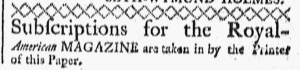
One other advertisement about the Royal American Magazine ran in January, this one exclusively in the Connecticut Gazette, published in New London.  A brief notice informed readers that “Subscriptions for the Royal-American MAGAZINE are taken in by the Printer of this Paper.”  Thomas may or may not have arranged with Timothy Green to publish this advertisement.  It appeared in three consecutive issues before being discontinued, standard practice for other advertisements submitted to the printing office.  Thomas could have sent instructions (and promised to pay) for the advertisement.  That seems most likely, especially since it was the first time that any advertisements for the Royal American Magazine ran in the Connecticut Gazette.  On the other hand, Green may have taken the initiative, aware from his participation in a network of printers that crisscrossed New England and other colonies that Thomas would soon publish the first issue of the magazine.  Green may have collected subscriptions as a service to his local customers as much as a favor to Thomas, encouraging them to visit his printing office to acquire reading materials rather than purchase them elsewhere.

Thomas’s advertising campaign for the Royal American Magazine continued in January 1774, though it also continued to taper off compared to previous months.  He exerted more effort in disseminating the subscription proposals widely and inciting interest in the prospects of the new magazine than in promoting it once publication commenced.  Once he achieved sufficient demand to make the magazine viable, he did not advertise as widely.

**********

“Subscription Papers will be returned” Update

  • January 6 – Maryland Gazette (tenth appearance)

“generous Patrons” Update

  • January 4 – Connecticut Courant (first appearance)
  • January 11 – Connecticut Courant (second appearance)
  • January 20 – Maryland Journal (first appearance)

Subscription Proposals

  • January 13 – Massachusetts Spy (ninth appearance)
  • January 20 – Massachusetts Spy (tenth appearance)

“Types are now arrived” Update

  • January 5 – Essex Journal (first appearance)
  • January 6 – Massachusetts Spy (first appearance)
  • January 10 – Massachusetts Gazette and Boston Post-Boy (first known appearance; possible second appearance)
  • January 12 – Essex Journal (second appearance)
  • January 13 – Massachusetts Spy (second appearance)
  • January 19 – Essex Journal (third appearance)
  • January 20 – Massachusetts Spy (third appearance)
  • January 26 – Essex Journal (fourth appearance)
  • January 28 – New-Hampshire Gazette (first appearance)

“Subscriptions … taken in”

  • January 7 – Connecticut Gazette (first appearance)
  • January 14 – Connecticut Gazette (second appearance)
  • January 21 – Connecticut Gazette (third appearance)

Slavery Advertisements Published February 2, 1774

GUEST CURATOR:  Madeleine Arsenault

The Slavery Adverts 250 Project chronicles the role of newspaper advertising in perpetuating slavery in the era of the American Revolution. The project seeks to reveal the ubiquity of slavery in eighteenth-century life from New England to Georgia by republishing advertisements about enslaved people – for sale as individuals or in groups, wanted to purchase or for hire for short periods, runaways who liberated themselves, and those who were subsequently captured and confined in jails and workhouses – in daily digests on this site as well as in real time via the @SlaveAdverts250 Twitter feed, utilizing twenty-first-century media to stand in for the print media of the eighteenth century.

The project aims to provide modern audiences with a sense of just how often colonizers encountered these advertisements in their daily lives. Enslaved men, women, and children appeared in print somewhere in the colonies almost every single day. Those advertisements served as a constant backdrop for social, cultural, economic, and political life in colonial and revolutionary America. Colonizers who did not purport to own enslaved people were still confronted with slavery as well as invited to maintain the system by purchasing enslaved men, women, and children or assisting in the capture of so-called “runaways” who sought to free themselves from bondage. The frequency of these newspaper advertisements suggests just how embedded slavery was in colonial and revolutionary American culture in everyday interactions beyond the printed page.

These advertisements also testify to the experiences of enslaved men, women, and children, though readers must consider that those experiences have been remediated through descriptions offered by enslavers rather than enslaved people themselves. Often unnamed in the advertisements, enslaved men, women, and children were not invisible or unimportant in early America.

These advertisements appeared in colonial American newspapers 250 years ago today.

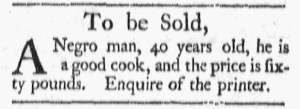
Pennsylvania Journal (February 2, 1774).

February 1

What was advertised in a colonial American newspaper 250 years ago today?

South-Carolina Gazette and Country Journal (February 1, 1774).

“He intends having ready to open as soon as possible in the spring, an elegant assortment of Linen Drapery in all its branches, with a quantity of the most fashionable summer Silks.”

Z. Kinsley inserted a lengthy advertisement promoting the “large STOCK of DRY GOODS” available at his store in Charleston in the South-Carolina Gazette and Country Journal several times in the winter of 1773 and 1774. Unlike most advertisements that ran for several consecutive weeks before being discontinued, this one appeared sporadically in December and January. Kingsley even placed it once again on February 1, perhaps in a final effort to move his current inventory before making a trip to London.  He made it known throughout his advertising campaign that “he intends going for London the beginning of February.”  With that departure in mind, he sold his wares for cash (or “ready Money”) or “short Credit.”  He set attractive prices, marking up his costs only slightly (or what he and other advertisers called “a very low Advance”).  As much as possible, he hoped to clear out his store to make room for new goods that he would acquire on his trip.

The merchant apparently did not envision staying in London for too long.  In a nota bene, he declared that he “intends having ready as soon as possible in the spring, an elegant assortment of Linen Drapery in all its branches, with a quantity of the most fashionable summer Silks” and other items.  In addition to marketing an assortment of textiles, hardware, cutlery, and ironmongery already in stock, Kingsley encouraged consumers to anticipate his summer selections well before they arrived.  Like so many other advertisers, he declared that he imported his merchandise “in the very last Ships from England,” but he devised an innovation on that popular appeal by prompting prospective customers to imagine what he would carry in his store after his trip.  Months in advance, he attempted to persuade consumers to think of his store as the place to purchase “fashionable summer Silks” and other goods appropriate for the season before his competitors began a chorus of claims about importing the newest and most fashionable items via the vessels that most recently arrived in port.  In addition, readers realized that making a trip to London meant that Kinsley could eliminate the middlemen who drove up prices.  That meant another “very low Advance” when he presented that “elegant assortment of Linen Drapery” for sale in the spring.

Most merchants and shopkeepers focused on selling the wares they already had in stock.  Kinsley devoted significant space in his advertisement to doing so, but he did not stop there.  At various points throughout the winter, he urged consumers in Charleston to anticipate the merchandise that he would select during his trip to the cosmopolitan center of the empire where he would observe the latest fashions himself.  His marketing efforts incorporated both shopping in the present and shopping in the future, priming customers to visit his store when they needed or desired to purchase from among his spring and summer selections.

Slavery Advertisements Published February 1, 1774

GUEST CURATOR:  Madeleine Arsenault

The Slavery Adverts 250 Project chronicles the role of newspaper advertising in perpetuating slavery in the era of the American Revolution. The project seeks to reveal the ubiquity of slavery in eighteenth-century life from New England to Georgia by republishing advertisements about enslaved people – for sale as individuals or in groups, wanted to purchase or for hire for short periods, runaways who liberated themselves, and those who were subsequently captured and confined in jails and workhouses – in daily digests on this site as well as in real time via the @SlaveAdverts250 Twitter feed, utilizing twenty-first-century media to stand in for the print media of the eighteenth century.

The project aims to provide modern audiences with a sense of just how often colonizers encountered these advertisements in their daily lives. Enslaved men, women, and children appeared in print somewhere in the colonies almost every single day. Those advertisements served as a constant backdrop for social, cultural, economic, and political life in colonial and revolutionary America. Colonizers who did not purport to own enslaved people were still confronted with slavery as well as invited to maintain the system by purchasing enslaved men, women, and children or assisting in the capture of so-called “runaways” who sought to free themselves from bondage. The frequency of these newspaper advertisements suggests just how embedded slavery was in colonial and revolutionary American culture in everyday interactions beyond the printed page.

These advertisements also testify to the experiences of enslaved men, women, and children, though readers must consider that those experiences have been remediated through descriptions offered by enslavers rather than enslaved people themselves. Often unnamed in the advertisements, enslaved men, women, and children were not invisible or unimportant in early America.

These advertisements appeared in colonial American newspapers 250 years ago today.

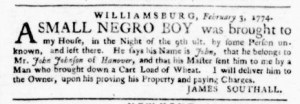
Essex Gazette (February 1, 1774).

**********

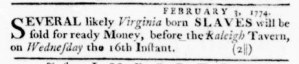
Essex Gazette (February 1, 1774).

**********

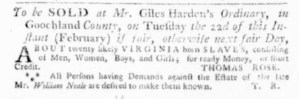
South-Carolina Gazette and Country Journal (February 1, 1774).

**********

South-Carolina Gazette and Country Journal (February 1, 1774).

**********

South-Carolina Gazette and Country Journal (February 1, 1774).

**********

South-Carolina Gazette and Country Journal (February 1, 1774).

**********

South-Carolina Gazette and Country Journal (February 1, 1774).

**********

South-Carolina Gazette and Country Journal (February 1, 1774).

**********

South-Carolina Gazette and Country Journal (February 1, 1774).

**********

South-Carolina Gazette and Country Journal (February 1, 1774).

**********

South-Carolina Gazette and Country Journal (February 1, 1774).