April 3

What was advertised in a colonial American newspaper 250 years ago this week?

Massachusetts Spy (March 24, 1774).

“Numb. III. is now in the press.”

Isaiah Thomas continued marketing the new Royal American Magazine in March 1774.  The Adverts 250 Project has traced his efforts to promote and launch the magazine in 1773 and 1774, starting with his initial announcement, published in May 1773, that he intended to circulate subscription proposals and his advertising campaign undertaken from New Hampshire to Maryland in throughout June, July, August, September, October, November, and December 1773 and January and February 1774 .  Newspaper announcements beyond Massachusetts tapered off once Thomas took the first issue to press.

March 1774 opened with the third and final insertion of an advertisement that Thomas had “Lately PUBLISHED … NUMBER I” of the magazine in the Essex Journal, the newspaper that his partner, Henry-Walter Tinges, printed in Newburyport.  On Thursday, March 3, Thomas placed a new notice in the newspaper he printed in Boston, the Massachusetts Spy, alerting the public that “Monday next will be published, NUMBER II. of THE ROYAL American Magazine … For FEBRUARY, 1774.”  He remained behind schedule following the late arrival of new types for the magazine, but he did indeed release the second issue of the magazine the following Monday.  An advertisement in the Massachusetts Gazette and Boston Post-Boy on March 7 proclaimed, “THIS DAY PUBLISHED … NUMBER II. of THE ROYAL American Magazine.”  It asserted that “the Printers and Booksellers in America” sold the magazine, though few advertised it in March 1774.  The Massachusetts Gazette and Boston Post-Boy carried that advertisement for three consecutive weeks, the only newspaper printed in Boston (with the exception of Thomas’s own Massachusetts Spy) to run more than one notice about the Royal American Magazine in March 1774.

Beyond Boston and beyond Massachusetts, the Newport Mercury featured an advertisement about the first issue of the magazine on the same day that the Massachusetts Gazette and Boston Post-Boy ran Thomas’s notice that the second issue was published.  “THE first number of the ROYAL AMERICAN MAGAZINE is come to hand,” it stated, also providing instructions that “all those persons who subscribed with the printer hereof for it, and have not had theirs, are desired to send for the same.”  That advertisement ran for two weeks.  A few days later, on March 11, the New-Hampshire Gazette circulated an advertisement about the magazine “FOR JANUARY AND FEBRUARY 1774,” informing subscribers in Portsmouth, York, Berwick, New Castle, Dover, Windham, and Kittery to apply to Isaac Williams in Portsmouth for their copies.  That notice also ran for two weeks.

The remaining advertisements for the Royal American Magazine published in March 1774 all ran in newspapers printed in Boston.  On March 10, Thomas inserted his own “This day published” notice in the Massachusetts Spy, supplementing the copy with a list of the contents and a note that the second edition was “Embellished with elegant engravings of Sir Wilbraham Wentworth; and a Night Scene.”  He inserted the same advertisement once again on March 24 and may have done so on March 17 (a missing page in the digitized edition causing the confusion).  The Boston Evening-Post carried the same advertisement on March 14, while the Massachusetts Gazette and Boston Weekly News-Letter carried it on March 17.  It appeared in both newspapers only once, compared to two insertions of a similar advertisement about the first issue of the magazine in each newspaper the previous month.  The Boston-Gazette did not carry any notices about the Royal American Magazine in March 1774.  Perhaps Thomas did not consider it imperative to advertise as aggressively once the magazine began circulating in Boston.

Thomas took to the pages of the Massachusetts Spy once again on March 17, that time with a brief notice that “Numb. III. is now in the press.”  He called on “Those Gentlemen who have original pieces, useful extracts, &c. prepared for said number” to submit them for publication.  That notice ran once again the following week.  At the end of the month, on March 31, Thomas revised Moses Cleveland’s advertisement to indicate that the post rider carried the Royal American Magazine as well as newspapers printed in Boston on his route between that city and Norwich, Connecticut.  It was a clever means of gaining more exposure for the magazine and encouraging more subscriptions, a return, however brief, to the more expansive advertising campaign and marketing strategies that Thomas had adopted in previous months.

**********

“NUMBER I” (“Lately PUBLISHED” variant)

  • March 2 – Essex Journal (third appearance)

“will be published, NUMBER II”

  • March 3 – Massachusetts Spy (first appearance)

“THIS DAY PUBLISHED … NUMBER II”

  • March 7 – Massachusetts Gazette and Boston Post-Boy (first appearance)
  • March 14 – Massachusetts Gazette and Boston Post-Boy (second appearance)
  • March 21 – Massachusetts Gazette and Boston Post-Boy (third appearance)

“first number … come to hand”

  • March 7 – Newport Mercury (first appearance)
  • March 14 – Newport Mercury (first appearance)

“This day published … NUMBER II” with contents

  • March 10 – Massachusetts Spy (first appearance)
  • March 14 – Boston Evening-Post (first appearance)
  • March 17 – Massachusetts Gazette and Boston Weekly News-Letter (first appearance)
  • March 10 – Massachusetts Spy (possible second appearance)
  • March 10 – Massachusetts Spy (second known appearance; possible third appearance)

“FOR JANUARY AND FEBRUARY 1774”

  • March 11 – New-Hampshire Gazette (first appearance)
  • March 18 – New-Hampshire Gazette (second appearance)

“Numb. III. is now in the press”

  • March 17 – Massachusetts Spy (first appearance)
  • March 24 – Massachusetts Spy (second appearance)

“MOSES CLEVELAND”

  • March 31 – Massachusetts Spy (first appearance)

April 2

What was advertised in a colonial American newspaper 250 years ago today?

Providence Gazette (April 2, 1774).

“Genteel Boarding, FOR Gentlemen, Strangers and others.”

Thomas Russell provided “Genteel Boarding … at the House lately occupied by Mr. Benjamin Bagnall, deceased, near the State-House” in Boston.  He did not, however, place his advertisement in the Boston-Gazette or the Massachusetts Spyor any of the several other newspapers printed in that city.  Instead, he ran it in the Providence Gazette for six weeks in the spring of 1774.  For “Gentlemen, Strangers and others” who planned to visit Boston, Russell presented an option for accommodations and made planning their journey that much easier.

To convince prospective guests that his establishment was a good choice, he assured readers that the house was “a very noted Place for this Business” as well as “well known to be a large and commodious House.”  For anyone not familiar with its reputation, including those who lived any distance from Boston, they “have only to apply, to be convinced how agreeably they can be accommodated.”  Russell’s hospitality and the amenities he offered, he suggested, would become immediately apparent upon meeting.

Boston and other American towns had not yet adopted standardized street numbers, so Russell provided travelers with general directions to get them to the vicinity of the house and enough information to find it once they spoke with some locals.  Anyone who made their way to the “State-House” could then ask anyone they encountered about Russell’s boarding house, though they might more efficiently find it by invoking Benjamin Bagnall’s name since Russell apparently only recently acquired the property.  Describing the landmark according to local knowledge would get guests to Russell’s door.

In promoting his boarding house, Russell joined entrepreneurs who ran taverns and inns who advertised in newspapers published in other cities.  While they certainly welcomed local custom, they believed that marketing their establishments in publications in other towns would generate additional business.  Russell seemed certain enough of it that he invested in advertising in the Providence Gazette for six weeks rather than starting with the standard three-week run for his advertisement.  With the arrival of spring, he likely anticipated more travelers from Providence and its environs making their way to Boston.  Russell stood ready to provide them with lodgings.

April 1

What was advertised in a colonial American newspaper 250 years ago today?

Connecticut Gazette (April 1, 1774).

“We the Subscribers have received such unexpected and unheard of Relief, and final Cures.”

It looked like a letter to the editor, but actually it was a testimonial advertising “Trusses or Bandages” for treating hernias.  The notice opened with a salutation, “Mr. GREEN, Please to insert the following in your next Paper,” addressing Timothy Green, the printer of the Connecticut Gazette.  Had it appeared only once on March 25, 1774, it might have been intended as an interesting news item selected by Green or it might have been an advertisement quickly discontinued.  That it ran in three consecutive issues, however, confirms that it was a paid notice that took an unusual format compared to most other advertisements for goods and services.  Testimonials about medicines and medical services appeared occasionally, though not regularly, in colonial newspapers in the 1760s and 1770s.

Eight “Subscribers [who] have received such unexpected and unheard of Relief, and final Cures, of the Difficulty of the Burst” (or hernia) extolled the efficacy of treatment provided by Stephen Johnson of Ashford.  They proclaimed that “by so many infallible Proofs, he hath the greatest Skill in that Business of any Man we ever heard of.”  Johnson had been so successful in alleviating their discomfort that those he assisted stated that they “Do think it our Duty, for the Benefit of Mankind, to publish” their endorsement of the “Trusses or Bandages, made and applied” by Johnson.  Furthermore, they encouraged “Any Person needing his Help” to contact Johnson, promising that if they sent “an exact Measure of their Body or Waist, with the Side in which the Breach is made, [they] may be as exactly fitted as present.”  Johnson possessed such great skill, the eight “Subscribers” insisted, that he could provide effective treatment even without consulting with patients in person.  He offered a precursor to mail order home health care supplies and equipment.

No doubt Daniel Holt, Samson Keyes, Amos Babcock, and five other “Subscribers” would testify to their experiences with Johnson and his trusses if asked by friends and neighbors who saw the notice in the Connecticut Gazette, but most likely they did not decide on their own to collaborate in writing and publishing that testimonial.  Instead, Johnson probably coordinated the effort, composed the copy himself, polled satisfied clients for permission to include their names, and paid top insert the advertisement in the newspaper.  Perhaps one or more of those clients enthusiastically thanked him for his assistance, planting the idea for the testimonial.  Inspired by their gratitude, Johnson may have seen an opportunity to leverage his prior experience into a marketing effort that would garner new clients.

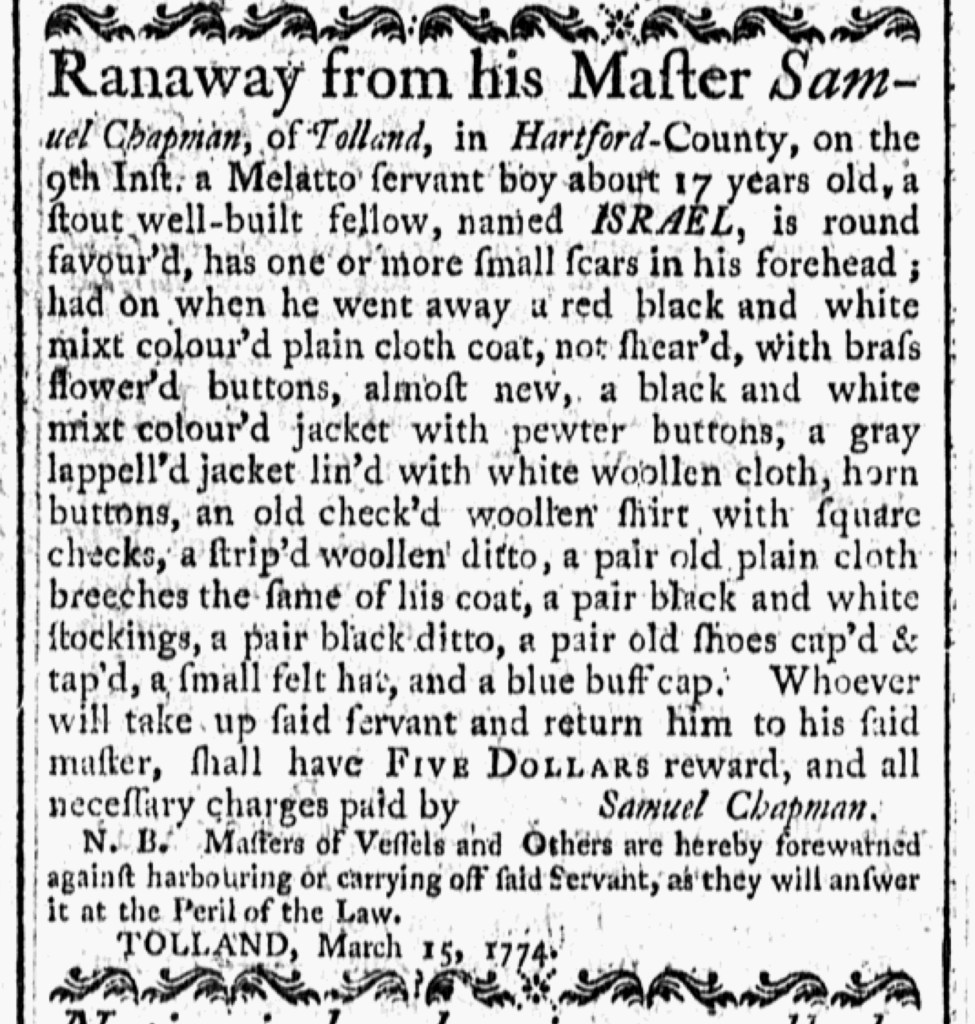
Slavery Advertisements Published April 1, 1774

GUEST CURATOR:  Delia Lee

The Slavery Adverts 250 Project chronicles the role of newspaper advertising in perpetuating slavery in the era of the American Revolution. The project seeks to reveal the ubiquity of slavery in eighteenth-century life from New England to Georgia by republishing advertisements about enslaved people – for sale as individuals or in groups, wanted to purchase or for hire for short periods, runaways who liberated themselves, and those who were subsequently captured and confined in jails and workhouses – in daily digests on this site as well as in real time via the @SlaveAdverts250 Twitter feed, utilizing twenty-first-century media to stand in for the print media of the eighteenth century.

The project aims to provide modern audiences with a sense of just how often colonizers encountered these advertisements in their daily lives. Enslaved men, women, and children appeared in print somewhere in the colonies almost every single day. Those advertisements served as a constant backdrop for social, cultural, economic, and political life in colonial and revolutionary America. Colonizers who did not purport to own enslaved people were still confronted with slavery as well as invited to maintain the system by purchasing enslaved men, women, and children or assisting in the capture of so-called “runaways” who sought to free themselves from bondage. The frequency of these newspaper advertisements suggests just how embedded slavery was in colonial and revolutionary American culture in everyday interactions beyond the printed page.

These advertisements also testify to the experiences of enslaved men, women, and children, though readers must consider that those experiences have been remediated through descriptions offered by enslavers rather than enslaved people themselves. Often unnamed in the advertisements, enslaved men, women, and children were not invisible or unimportant in early America.

These advertisements appeared in colonial American newspapers 250 years ago today.

Connecticut Gazette (April 1, 1774).