April 7

GUEST CURATOR:  Maria Lepak

What was advertised in a colonial American newspaper 250 years ago today?
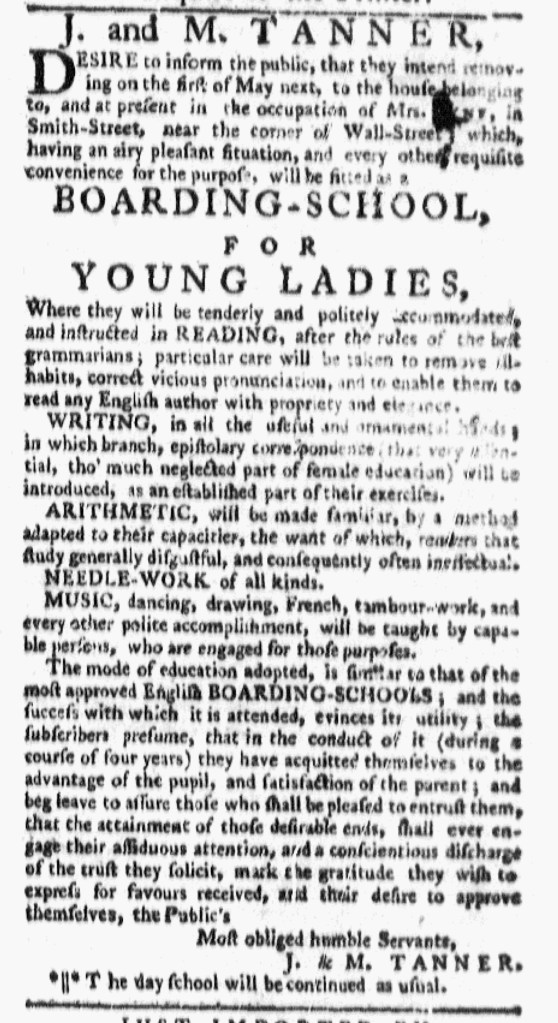
Rivington’s New-York Gazetteer (April 7, 1774).

“BOARDING-SCHOOL, FOR YOUNG LADIES.”

J. & M. Tanner’s notice in Rivington’s New-York Gazetteer advertised an opportunity for young women to attend a boarding school “in Smith-Street, near the corner of Wall Street.” At this school, the “YOUNG LADIES” would improve in reading, writing, needlework, music, dancing, and other subjects considered appropriate for them. The Tanners include a comparison of their new school to what a British boarding school had to offer, stating that their curriculum “was similar to that of the most approved English BOARDING-SCHOOLS.” According to Mary Cathcart Borer in Willingly to School: A History of Women’s Education, boarding schools for young ladies popped up in England as early as 1711, with nearly the same curriculum at each.[1] However, arithmetic was a subject that the Tanners’ school in the colonies included that many British schools for girls and young women did not. While still expected to stay in the private sphere, Tanners’ boarding school allowed for young women’s opportunities in arithmetic, which was not always an option for many young women elsewhere. We cannot conclude exactly why the Tanners chose to incorporate arithmetic into their school’s curriculum. However, it indicates that while still using the British model, there were variations of the boarding school systems in the colonies.

 The Tanners’ boarding school seems to have been an effort to demonstrate that the colonies could also partake in the same developments that England did, particularly in women’s education and manners. Considering that this advertisement was published in 1774, a year before the first battles of the American Revolution, tensions increasingly inspired colonists to establish self-sufficiency in government and commerce and other aspects of life, such as education, without reliance on Britain. Even as that happened, it is critical to recognize that while the colonies were looking to have their own self-sufficient systems and government, they still included British ideals. Britain was still influential in colonial culture, which was especially shared through ideas of education and what made well-educated and well-mannered young ladies.

**********

ADDITIONAL COMMENTARY:  Carl Robert Keyes

Rather than expand on Maria’s interpretation of today’s advertisement, I am reflecting on pedagogy and my experiences integrating the Adverts 250 Project and the Slavery Adverts 250 Project into the courses I teach at Assumption University.  Throughout this academic year, including the time that Maria and her peers were enrolled in my Revolutionary America course last fall, faculty and staff have engaged in a series of programs about “awaken[ing] in students a sense of wonder” and how we seek to fulfill the University’s mission.  I have learned some valuable lessons along the way, from my colleagues at those events and from my students in the classroom.

Maria and her classmates commence their responsibilities as guest curators by compiling a mini-archive of newspapers published during a particular week in 1774.  I provide each of them with a list of extant newspapers that have been digitized and train them in using several databases.  Once they have created their mini-archives, each student examines the newspapers for their week to identify all of the advertisements about enslaved people for inclusion in the Slavery Adverts 250 Project and to select an advertisement about consumer goods or services to feature on the Adverts 250 Project.  I provide students with hard copies of their newspapers, encouraging them to work back and forth with the digitized ones.

One morning last fall, I arrived in class intending to discuss advertisements about enslaved people and what students learned from that portion of the project.  We had a robust discussion, but, to my initial frustration, students did not stick to the topic for the day!  Instead of focusing solely on advertisements about enslaved people, they started discussing other kinds of advertisements and asking about other aspects of the newspapers as well.  I had a lesson plan, an “agenda” of material that I “needed” to cover that day, and their “off-topic” questions did not facilitate the good order that I had envisioned.

Then I realized that I was witnessing authentic wonder in my classroom, that the conversation taking place was more important than anything I scripted in my mind in advance, and that students were learning more from the experience than by following my outline for that class.  I spend so much time working with (digitized) eighteenth-century newspapers that they are as familiar to me as modern media … but having a week’s worth of newspapers published in 1774 in front of them was completely new to my students.  The advertisements were new to them, but so were the conventions of eighteenth-century print culture!  They immersed themselves in their newspapers, learning as much as they could on their own and then asking questions about life in early America based on what they encountered in those newspapers.

When I finally understood what was happening, I jettisoned my outline so we could have a lengthy conversation about anything my students found interesting or confusing or strange in their newspapers.  However unintentional, my first instinct had been to stifle their sense of wonder by attempting to rigidly follow my outline for that class.  In the end, we all – professor and students – got so much more out of that class when I learned from my students that I could better facilitate how they learned about the past by giving them opportunities to express their wonder.  As the semester progressed, we circled back, repeatedly, to discussing advertisements about enslaved people as my students worked on the Slavery Adverts 250 Project.  At the same time, I allowed for more opportunities to “get off track” as we examined a variety of other primary sources.  My students learned more and I had a more fulfilling experience as an instructor, energized by the quality of the discussions we had in class on those occasions that my students deviated from what I planned for the day.

**********

[1]  Mary Cathcart Borer, Willingly to School: A History of Women’s Education (Cambridge, UK: Lutterworth Press, 1976).
Welcome, Guest Curator Maria Lepak

Maria Lepak is a senior at Assumption University in Worcester, Massachusetts. She is pursuing a double major in History and Secondary Education and plans to be a middle school teacher. She is a member of the Phi Alpha Theta National History Honors Society and a recipient of the History Department’s Moggio Award for Outstanding Essay. She also participated in “We Protect Us: Early American Histories of Mutual Aid and Community Care,” the Fall 2022 American Studies Seminar at the American Antiquarian Society. Beyond her studies, Maria participates in an a cappella group on campus, is the president of a fashion sustainability club, and is a tutor for various history courses. Maria made her contributions to the Adverts 250 Project and the Slavery Adverts 250 Project while enrolled in HIS 401 Revolutionary America, 1763-1815, in Fall 2023.

Welcome, guest curator Maria Lepak!

Slavery Advertisements Published April 7, 1774

GUEST CURATOR:  Maria Lepak

The Slavery Adverts 250 Project chronicles the role of newspaper advertising in perpetuating slavery in the era of the American Revolution. The project seeks to reveal the ubiquity of slavery in eighteenth-century life from New England to Georgia by republishing advertisements about enslaved people – for sale as individuals or in groups, wanted to purchase or for hire for short periods, runaways who liberated themselves, and those who were subsequently captured and confined in jails and workhouses – in daily digests on this site as well as in real time via the @SlaveAdverts250 Twitter feed, utilizing twenty-first-century media to stand in for the print media of the eighteenth century.

The project aims to provide modern audiences with a sense of just how often colonizers encountered these advertisements in their daily lives. Enslaved men, women, and children appeared in print somewhere in the colonies almost every single day. Those advertisements served as a constant backdrop for social, cultural, economic, and political life in colonial and revolutionary America. Colonizers who did not purport to own enslaved people were still confronted with slavery as well as invited to maintain the system by purchasing enslaved men, women, and children or assisting in the capture of so-called “runaways” who sought to free themselves from bondage. The frequency of these newspaper advertisements suggests just how embedded slavery was in colonial and revolutionary American culture in everyday interactions beyond the printed page.

These advertisements also testify to the experiences of enslaved men, women, and children, though readers must consider that those experiences have been remediated through descriptions offered by enslavers rather than enslaved people themselves. Often unnamed in the advertisements, enslaved men, women, and children were not invisible or unimportant in early America.

These advertisements appeared in colonial American newspapers 250 years ago today.

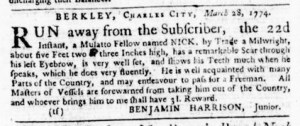
Maryland Gazette (April 7, 1774).

**********

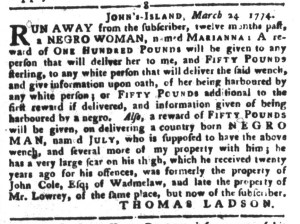
Massachusetts Gazette and Boston Weekly News-Letter (April 7, 1774).

**********

Massachusetts Gazette and Boston Weekly News-Letter (April 7, 1774).

**********

Massachusetts Gazette and Boston Weekly News-Letter (April 7, 1774).

**********

Massachusetts Gazette and Boston Weekly News-Letter (April 7, 1774).

**********

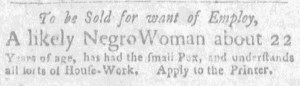
Rivington’s New-York Gazetteer (April 7, 1774).

**********

Virginia Gazette [Purdie and Dixon] (April 7, 1774).

**********

Virginia Gazette [Purdie and Dixon] (April 7, 1774).

**********

Virginia Gazette [Purdie and Dixon] (April 7, 1774).

**********

Virginia Gazette [Purdie and Dixon] (April 7, 1774).

**********

Virginia Gazette [Purdie and Dixon] (April 7, 1774).

**********

Virginia Gazette [Purdie and Dixon] (April 7, 1774).

**********

Virginia Gazette [Purdie and Dixon] (April 7, 1774).

**********

Virginia Gazette [Purdie and Dixon] (April 7, 1774).

**********

Virginia Gazette [Purdie and Dixon] (April 7, 1774).

**********

Virginia Gazette [Purdie and Dixon] (April 7, 1774).

**********

Virginia Gazette [Rind] (April 7, 1774).

**********

Virginia Gazette [Rind] (April 7, 1774).

**********

Virginia Gazette [Rind] (April 7, 1774).

**********

Virginia Gazette [Rind] (April 7, 1774).

**********

Virginia Gazette [Rind] (April 7, 1774).

**********

Virginia Gazette [Rind] (April 7, 1774).

**********

Virginia Gazette [Rind] (April 7, 1774).

April 6

What was advertised in a colonial American newspaper 250 years ago today?

Essex Journal (April 6, 1774).

“The business will be carried on as usual by his sons.”

In the spring of 1774, Patrick Tracy of Newburyport, Massachusetts, ran an advertisement in the Essex Journal to request those he owed money to call on him to settle accounts because he had “quitted the business he has been in of late years.”  Only after that did the conscientious entrepreneur also instruct “all who are indebted to him … to make speedy payment, more especially those whose debts have been long standing.”  Tracy made what he owed his priority, signaling how he did business and suggesting to current and prospective customers that they could expect similar treatment from his sons who carried on the business.  Tracy considered that business well enough known that he did not indicate his occupation.

His sons, however, revealed that they “have taken the business lately carried on by their honoured father” and “carry on the distillery as usual” in an advertisement that conveniently appeared immediately below Tracy’s notice in the April 6 edition of the Essex Journal.  Their father deployed more subtle means in attempting to pass along his clientele to his sons, while they instead emphasized their desire for “the continuance of his good customers and the custom of all others.”  The elder Tracy established a reputation during his many years in business.  His sons hoped to benefit from the customer loyalty their father had cultivated, asserting a “mutual advantage” for all involved.

To that end, they also made clear that they put the interests of their customers and associates first.  In addition to operating the distillery “as usual,” they also stocked “an assortment of English Goods, which they will sell by wholesale upon reasonable terms, and so as to afford a profit to the purchaser.”  Though they intended to make money on those transactions, the distillers associated “profit” with their customers who purchased imported goods from them, reversing the usual relationship between sellers and buyers.  Shopkeepers and others who purchased those items to sell retail would acquire them at low enough prices that Jackson, Tracy, and Tracy practically guaranteed that they could in turn offer such bargains that retail customers would purchase their wares.

In their newspaper advertisements, Tracy and his sons carefully choreographed his departure from the family business and their role in continuing its operations.  They sought to maintain and even expand the existing clientele by emphasizing certain principles, including paying what they owed to associates and selling merchandise at such “reasonable terms” that everyone involved benefited from the transactions.

Slavery Advertisements Published April 6, 1774

GUEST CURATOR:  Delia Lee

The Slavery Adverts 250 Project chronicles the role of newspaper advertising in perpetuating slavery in the era of the American Revolution. The project seeks to reveal the ubiquity of slavery in eighteenth-century life from New England to Georgia by republishing advertisements about enslaved people – for sale as individuals or in groups, wanted to purchase or for hire for short periods, runaways who liberated themselves, and those who were subsequently captured and confined in jails and workhouses – in daily digests on this site as well as in real time via the @SlaveAdverts250 Twitter feed, utilizing twenty-first-century media to stand in for the print media of the eighteenth century.

The project aims to provide modern audiences with a sense of just how often colonizers encountered these advertisements in their daily lives. Enslaved men, women, and children appeared in print somewhere in the colonies almost every single day. Those advertisements served as a constant backdrop for social, cultural, economic, and political life in colonial and revolutionary America. Colonizers who did not purport to own enslaved people were still confronted with slavery as well as invited to maintain the system by purchasing enslaved men, women, and children or assisting in the capture of so-called “runaways” who sought to free themselves from bondage. The frequency of these newspaper advertisements suggests just how embedded slavery was in colonial and revolutionary American culture in everyday interactions beyond the printed page.

These advertisements also testify to the experiences of enslaved men, women, and children, though readers must consider that those experiences have been remediated through descriptions offered by enslavers rather than enslaved people themselves. Often unnamed in the advertisements, enslaved men, women, and children were not invisible or unimportant in early America.

These advertisements appeared in colonial American newspapers 250 years ago today.

Pennsylvania Gazette (April 6, 1774).

April 5

What advertised in a colonial American newspaper 250 years ago today?

Essex Gazette (April 5, 1774).

To be sold by the Printers hereof, Mr. Hancock’s ORATION, On the Fifth of March.”

Immediately above the record of ships “Entered-In,” “Outward-Bound,” and “Cleared-Out” from the customs house in Boston in the April 5, 1774, edition of the Essex Gazette, Samuel Hall and Ebenezer Hall, the printers, inserted a brief notice, just three lines, alerting readers that they sold “Mr. Hancock’s ORATION, On the Fifth of March.”  The Halls did not need to provide further elaboration for readers to understand the announcement.  For colonizers in New England in the 1770s, the phrase “Fifth of March” conjured images like the phrase “Boston Massacre” evokes today.  They needed no explanation that the advertisement referred to John Hancock delivering the annual address to commemorate the event, to honor those killed when British soldiers from the 29th Regiment under the command of Captain Thomas Preston fired into a crowd of protesters, to condemn quartering troops in colonial cities during times of peace, and to advocate for American liberties.

As had become customary by the fourth anniversary of the Boston Massacre, the town voted to have the oration published and advertisements appeared in newspapers printed in Boston.  Yet they did not appear solely in newspapers in that town.  Other newspapers in New England sometimes carried them as well, none more often that the Essex Gazette, published in nearby Salem.  Samuel Hall had a long history of publishing news and opinion that favored sentiments expressed by Patriots.  On the first anniversary of the Boston Massacre, for instance, he included thick black mourning borders on the first page of his newspaper and published “a solemn and perpetual MEMORIAL Of the Tyranny of the British Administration of Government in the Years 1768, 1769, and 1770,” especially “THE FIFTH OF MARCH, … the Anniversary of Preston’s Massacre–in King-Street–Boston, N. England–1770.”  When Benjamin Edes and John Gill, among the most ardent of Patriots among the printers in Boston, published Hancock’s oration in 1774, the Halls acquired copies to disseminate in Salem and beyond.  In so doing, they participated in the commodification of the Boston Massacre while simultaneously commemorating it and encouraging others to side with the Patriots as relations with Parliament further deteriorated following the Boston Tea Party the previous December.

Slavery Advertisements Published April 5, 1774

GUEST CURATOR:  Delia Lee

The Slavery Adverts 250 Project chronicles the role of newspaper advertising in perpetuating slavery in the era of the American Revolution. The project seeks to reveal the ubiquity of slavery in eighteenth-century life from New England to Georgia by republishing advertisements about enslaved people – for sale as individuals or in groups, wanted to purchase or for hire for short periods, runaways who liberated themselves, and those who were subsequently captured and confined in jails and workhouses – in daily digests on this site as well as in real time via the @SlaveAdverts250 Twitter feed, utilizing twenty-first-century media to stand in for the print media of the eighteenth century.

The project aims to provide modern audiences with a sense of just how often colonizers encountered these advertisements in their daily lives. Enslaved men, women, and children appeared in print somewhere in the colonies almost every single day. Those advertisements served as a constant backdrop for social, cultural, economic, and political life in colonial and revolutionary America. Colonizers who did not purport to own enslaved people were still confronted with slavery as well as invited to maintain the system by purchasing enslaved men, women, and children or assisting in the capture of so-called “runaways” who sought to free themselves from bondage. The frequency of these newspaper advertisements suggests just how embedded slavery was in colonial and revolutionary American culture in everyday interactions beyond the printed page.

These advertisements also testify to the experiences of enslaved men, women, and children, though readers must consider that those experiences have been remediated through descriptions offered by enslavers rather than enslaved people themselves. Often unnamed in the advertisements, enslaved men, women, and children were not invisible or unimportant in early America.

These advertisements appeared in colonial American newspapers 250 years ago today.

Essex Gazette (April 5, 1773).

**********

South-Carolina Gazette and Country Journal (April 5, 1774).

**********

South-Carolina Gazette and Country Journal (April 5, 1774).

**********

South-Carolina Gazette and Country Journal (April 5, 1774).

**********

South-Carolina Gazette and Country Journal (April 5, 1774).

**********

South-Carolina Gazette and Country Journal (April 5, 1774).

**********

South-Carolina Gazette and Country Journal (April 5, 1774).

April 4

What was advertised in a colonial American newspaper 250 years ago today?

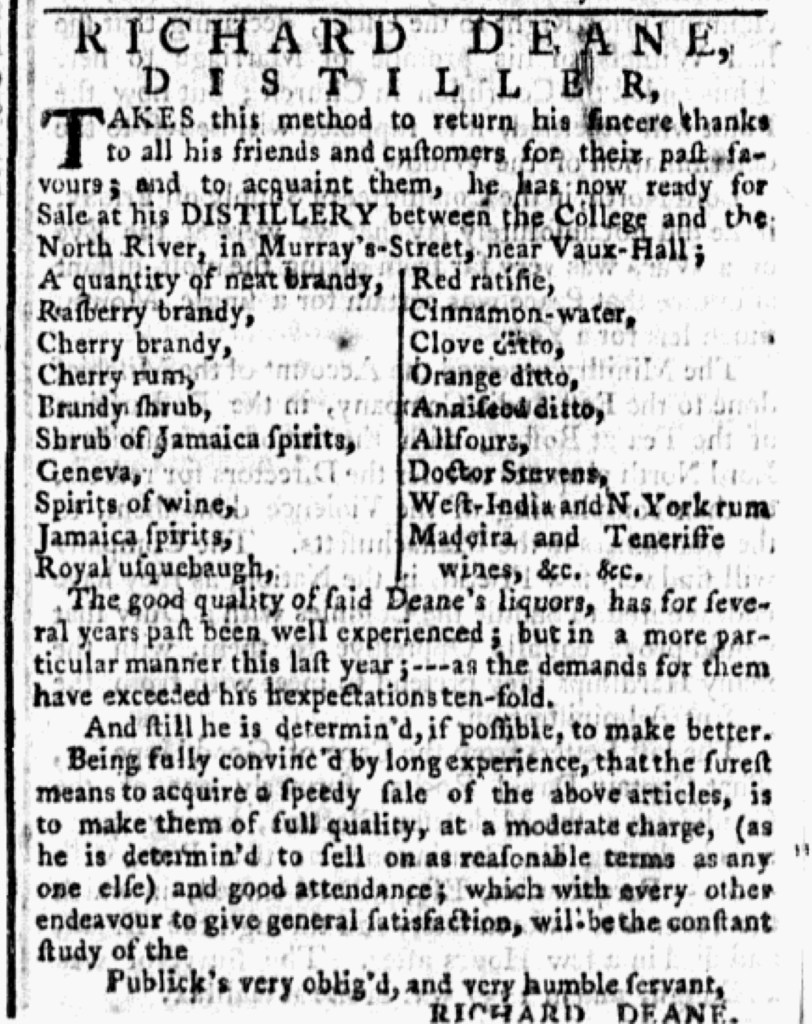
New-York Gazette and Weekly Mercury (April 4, 1774).

“West-India and New-York rum.”

Delia Lee, a student in my Revolutionary America class, selected advertisements placed by local distillers in the April 4, 1774, edition of the New-York Gazette and Weekly Mercury to feature today.  Richard Deane frequently placed advertisements in the public prints.  The Adverts 250 Project previously examined one of his advertisements that he ran in the New-York Journal in 1772.  Philip Kissick, “DISTILLER and VINTNER,” on the other hand, is making his first appearance among on the Adverts 250 Project.

New-York Gazette and Weekly Mercury (April 4, 1774).

Delia, who was enrolled in business courses at the same time she was studying Revolutionary America, was interested in the production, distribution, and consumption of alcohol in early America.  When she set about her research, she consulted W.J. Rorabaugh’s overview of “Alcohol in America” in the OAH Magazine of History.[1]  According to Rorabaugh, “By 1770 Americans consumed alcohol, mostly in the form of rum and cider, routinely with every meal.”  Deane and Kissick stood ready to meet that demand.  Both included “West-India and New-York rum” among the lists of spirits that they sold.  Rorabaugh also notes that each colonizer “consumed about three and a half gallons of alcohol per year.”  Deane asserted that demand for his “Rasberry brandy,” “Cherry rum,” “Shrub of Jamaica spirits,” and other products “exceeded his expectations ten-fold,” suggesting a brisk market, especially for his wares.

Over the next couple of decades, the American Revolution and its aftermath “drastically changed drinking habits.  When the British blockaded the seacoast and thereby cut off molasses and rum imports, Americans looked for a substitute.”  Whiskey, distilled by Scot-Irish immigrants on the western frontier, replaced rum at the end of the eighteenth century “since the British refused to supply it and the new federal government began to tax it in the 1790s.”  Neither Deane nor Kissick included whiskey among the many spirits they advertised on the eve of the American Revolution.  Their advertisements provide a snapshot of the alcohol industry in the colonies at that time, an industry that politics and war would soon alter in significant ways.

**********

[1] W.J. Rorabaugh, “Alcohol in America,” OAH Magazine of History 6, no. 2 (Fall 1991): 17-19.

Welcome, Guest Curator Delia Lee

Delia Lee is a senior at Assumption University in Worcester, Massachusetts.  She is majoring in History with minors in Education and Marketing. She is a member of the field hockey team and Phi Alpha Theta National History Honor Society.  Delia made her contributions to the Adverts 250 Project and the Slavery Adverts 250 Project while enrolled in HIS 401 Revolutionary America, 1763-1815, in Fall 2023.

Welcome, guest curator Delia Lee!

Slavery Advertisements Published April 4, 1774

GUEST CURATOR:  Delia Lee

The Slavery Adverts 250 Project chronicles the role of newspaper advertising in perpetuating slavery in the era of the American Revolution. The project seeks to reveal the ubiquity of slavery in eighteenth-century life from New England to Georgia by republishing advertisements about enslaved people – for sale as individuals or in groups, wanted to purchase or for hire for short periods, runaways who liberated themselves, and those who were subsequently captured and confined in jails and workhouses – in daily digests on this site as well as in real time via the @SlaveAdverts250 Twitter feed, utilizing twenty-first-century media to stand in for the print media of the eighteenth century.

The project aims to provide modern audiences with a sense of just how often colonizers encountered these advertisements in their daily lives. Enslaved men, women, and children appeared in print somewhere in the colonies almost every single day. Those advertisements served as a constant backdrop for social, cultural, economic, and political life in colonial and revolutionary America. Colonizers who did not purport to own enslaved people were still confronted with slavery as well as invited to maintain the system by purchasing enslaved men, women, and children or assisting in the capture of so-called “runaways” who sought to free themselves from bondage. The frequency of these newspaper advertisements suggests just how embedded slavery was in colonial and revolutionary American culture in everyday interactions beyond the printed page.

These advertisements also testify to the experiences of enslaved men, women, and children, though readers must consider that those experiences have been remediated through descriptions offered by enslavers rather than enslaved people themselves. Often unnamed in the advertisements, enslaved men, women, and children were not invisible or unimportant in early America.

These advertisements appeared in colonial American newspapers 250 years ago today.

Boston Evening-Post (April 4, 1774).

**********

Boston-Gazette (April 4, 1774).

**********

Boston-Gazette (April 4, 1774).

**********

Boston-Gazette (April 4, 1774).

**********

Newport Mercury (April 4, 1774).

**********

New-York Gazette and Weekly Mercury (April 4, 1774).

**********

New-York Gazette and Weekly Mercury (April 4, 1774).

**********

New-York Gazette and Weekly Mercury (April 4, 1774).

**********

Supplement to the New-York Gazette and Weekly Mercury (April 4, 1774).

**********

South-Carolina Gazette (April 4, 1774).

**********

South-Carolina Gazette (April 4, 1774).

**********

South-Carolina Gazette (April 4, 1774).

**********

South-Carolina Gazette (April 4, 1774).

**********

South-Carolina Gazette (April 4, 1774).

**********

South-Carolina Gazette (April 4, 1774).

**********

South-Carolina Gazette (April 4, 1774).