August 14

What was advertised in a colonial American newspaper 250 years ago this week?

Rivington’s New-York Gazetteer (August 11, 1774).

“TEA and COFFEE every afternoon.”

Amid the turmoil over tea that included the Boston Tea Party in December 1773 and closure and blockade of the harbor via the Boston Port Act in June 1774, not all advertisers and consumers abstained from the problematic beverage, despite general calls for boycotting and destroying tea and newspaper editorials that condemned both the threat to liberty and negative effects on the body associated with drinking tea.  Along with coffee, tea had become so much a part of dining, entertaining, and socializing that some entrepreneurs continued to include it among the amenities they offered to their customers in August 1774.

For instance, Edward Bardin, an experienced tavernkeeper, promoted tea when he “open’d the noted tavern at the corner house in the Fields … where ladies and gentlemen may depend upon the best entertainment and attendance.”  In an advertisement in the August 11 edition of Rivington’s New-York Gazetteer, he advised that “The PANTRY opened every evening” with an array of items on the menu, including veal, mutton, duck, chicken, lobster, pickled oysters, custards, and tarts “of different KINDS.”  Patrons could also rent a “large commodious ROOM, fit for balls or assemblies.”  For those interested in a leisurely outing, Bardin served “TEA and COFFEE every afternoon.”  Even though the political crisis intensified, he neither removed the troublesome beverage from his menu nor, apparently, believed that advertising it would lead to more trouble than it was worth.  Not everyone lined up to take a principled stand against tea.
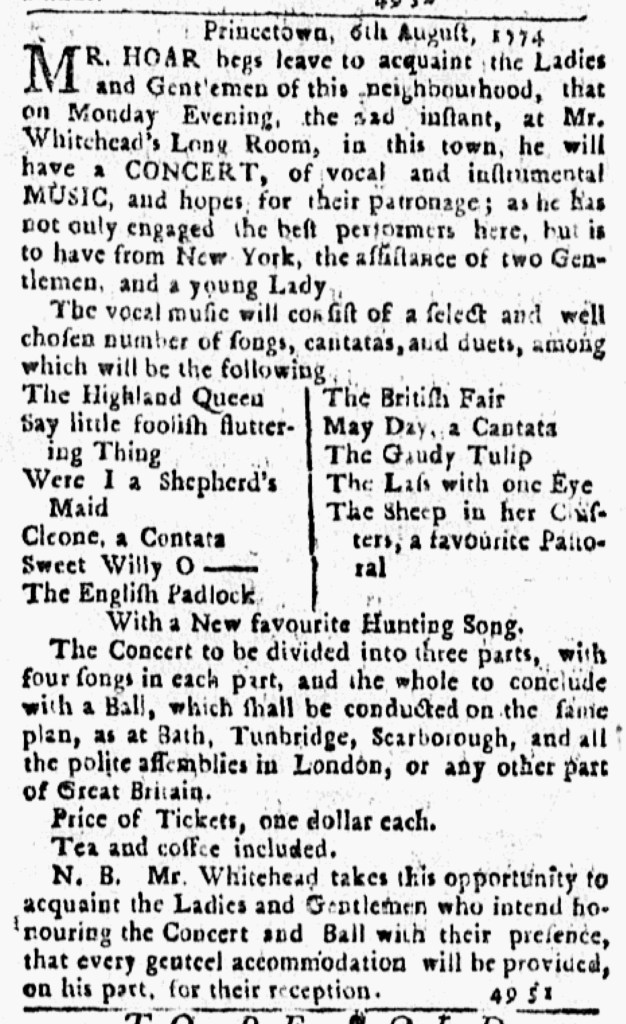
New-York Journal (August 11, 1774).

The same day that Bardin published his advertisement for the first time, Mr. Hoar of Princeton, New Jersey, inserted his own notice in the New-York Journal to invite readers in his town to attend a “CONCERT, of vocal and instrumental MUSIC” at “Mr. Whitehead’s Long Room.”  He listed several “songs, cantatas, and duets” on the program.  In addition, the concert would “conclude with a Ball, which shall be conducted on the same plan, as at Bath, Tunbridge, Scarborough, and all the polite assemblies in London.”  The proprietor of the establishment, in a nota bene, promised that “every genteel accommodation will be provided.”  Among those genteel accommodations, “Tea and coffee included” with each ticket.  Neither Hoar nor Whitehead anticipated that serving tea would alienate so many people that it would be better not to mention the beverage.  Instead, they made it a selling point in their advertisement.  Did they face any ramifications for doing so?  Perhaps growing public sentiment eventually encouraged more caution, but the tide had not turned against tea so much that some advertisers refused to include the drink as one amenity among many when they promoted entertainments to colonizers in the summer of 1774.

August 13

What was advertised in a colonial American newspaper 250 years ago today?

Providence Gazette (August 13, 1774).

“No. 6. The Imperial Lip-Salve (never made by any one before).”

When Philip Russel arrived in Rhode Island “from England,” he placed an advertisement in the Providence Gazette to advise the public that he “makes and sells” a variety of medicines to treat an array of ailments and potions for other purposes.  He enumerated and named each of them, along with giving a short description and price.  His medicines included “No. 4. His surprising excellent Tooth-Drops, which will immediately cure the Tooth-Ach the first Time of using; it will also cure the Scurvy in the Gums, and will preserve the Teeth from rotting. Price Half a Dollar a Bottle,” “No. 5. The Venetian Tooth-Powder, which in a few Times using makes them white and beautiful (although very foul and black before) and preserves those that are rotten and decayed from growing worse. Price Two Shillings a Bottle,” and “No 7. A most curious Eye Water, for cold Humours or Inflammations, which will be an effectual Cure in a few Days. Price Two Shillings a Bottle.”

Rather than addressing health and hygiene, three of Sabine’s products aided with cleaning and laundering: “No. 1 HIS famous Iron-Mould Drops, for taking Iron-Moulds and Ink-Spots out of Linen, Lawn, Muslin and Lace. Price One Shilling and Sixpence a Bottle,” “No. 2. A curious Composition for taking all Sorts of Stains, Pitch, Tar, &c. out of Cloth, Silk, Stuff or Worsted. Price One Shilling and Sixpence,” and “No. 3. A Tincture for taking any Stains out of Ma[h]agony, or any other Wood. Price One Shilling and Sixpence a Bottle.”

Including the prices helped prospective customers with comparison shopping when they considered purchasing similar products from other vendors.  Low or reasonable prices likely aided in stimulating interest in Russel’s wares among consumers unfamiliar with them, despite his assertion that some of his mixtures were “famous.”  Others were unique, such as “No. 6. The Imperial Lip-Salve (never made by any one before) which effectually takes away all Spots in the Face, makes the Skin beautiful, and cures the Lips when sore, in three or four Times rubbing.”  Knowing that this item cost “Half a Dollar a Box” might have convinced the curious to give it a try if they considered it a bargain.

In a nota bene, Sabine made three marketing appeals in quick succession: “Any Ladies or Gentlemen may, if they please, see Experiments of the above. – No Cure, no Pay. – Good Allowance to Shop Keepers who buy to sell again.”  The first two encouraged prospective customers that they had nothing to lose by visiting Sabine to learn more about his products.  He gave demonstrations so they could judge for themselves the effectiveness and value of his medicines and cleaning agents.  He also offered a moneyback guarantee, promising that customers did not have to pay if his medicines did not cure their maladies.  The final appeal presented a discount for purchasing by volume, a plan to pass along his products to retailers who then had an interest in marketing them on his behalf.  From start to finish, every word of Russel’s advertisement was calculated to persuade consumers rather than merely announce goods for sale.

August 12

What was advertised in a colonial American newspaper 250 years ago today?

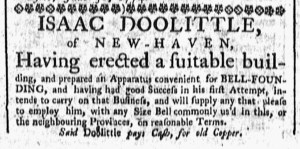
Connecticut Gazette (August 12, 1774).

“ISAAC DOOLITTLE, of NEW-HAVEN … prepared an Apparatus convenient for BELL-FOUNDING.”

On August 12, 1774, “ISAAC DOOLITTLE, of NEW-HAVEN,” placed an advertisement in the Connecticut Gazette, published in New London, to alert readers that he could cast “any Size Bell commonly us’d in this, or the neighbouring Provinces.”  The entrepreneur explained that he had “erected a suitable building, and prepared an Apparatus convenient for BELL-FOUNDING.”  Furthermore, he “had good Success in his first Attempt,” prompting him to follow that trade and seek customers.  Realizing that the market in and near New Haven would not support his business, he embarked on an advertising campaign in multiple newspapers published in Connecticut.  Along with his notice in the Connecticut Gazette, he simultaneously inserted an advertisement in the Connecticut Journal and New-Haven Post-Boy.  It featured almost identical copy, though Doolittle did not consider it necessary to advise readers of the newspaper that served his town that he was “of NEW-HAVEN.”

Not surprisingly, he did so once again in his advertisement in the August 16 edition of the Connecticut Courant, directing prospective customers in Hartford and nearby towns to send orders and other correspondence to him in New Haven.  He did not, however, run his advertisement in the Norwich Packet, the last of the four newspapers printed in Connecticut at the time.  It was also the newest, having commenced publication less than a year earlier.  Perhaps that influenced Doolittle’s decision not to invest in advertising in yet another newspaper.  He may have been unfamiliar with the Norwich Packet or doubtful that its circulation would justify the cost of advertising.  He was not the only advertiser who opted for notices in the Connecticut Courant, the Connecticut Gazette, and the Connecticut Journal, but not the Norwich Packet during that newspaper’s first year.  Even one advertiser new to Norwich passed over the Norwich Packet in favor of placing his notice in the well-established Connecticut Gazette, though he may have depended on word-of-mouth to reach prospective customers in his new location.  The colophon for the Norwich Packet advised that the printers “thankfully received” both subscriptions and advertisements “for this Paper,” but that was not sufficient to convince some prospective advertisers in other towns to extend their marketing campaigns to include the colony’s newest newspaper.

Slavery Advertisements Published August 12, 1774

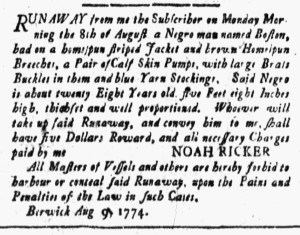
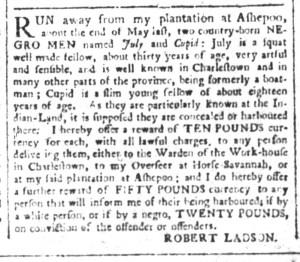
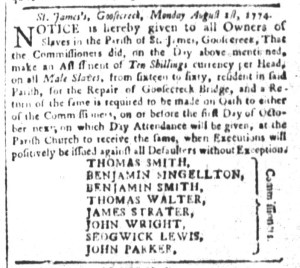
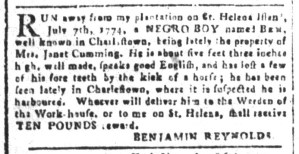
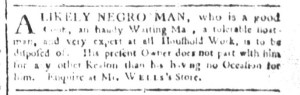
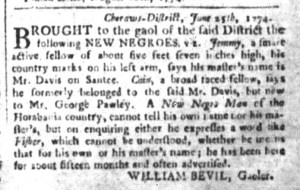
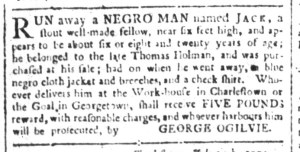
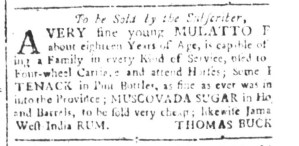
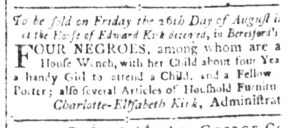
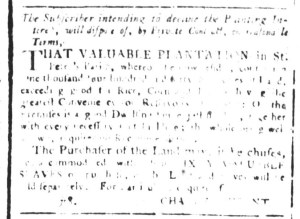
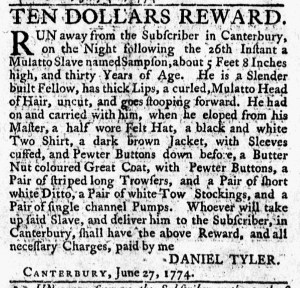
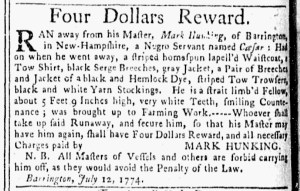
The Slavery Adverts 250 Project chronicles the role of newspaper advertising in perpetuating slavery in the era of the American Revolution. The project seeks to reveal the ubiquity of slavery in eighteenth-century life from New England to Georgia by republishing advertisements about enslaved people – for sale as individuals or in groups, wanted to purchase or for hire for short periods, runaways who liberated themselves, and those who were subsequently captured and confined in jails and workhouses – in daily digests on this site as well as in real time via the @SlaveAdverts250 Twitter feed, utilizing twenty-first-century media to stand in for the print media of the eighteenth century.

The project aims to provide modern audiences with a sense of just how often colonizers encountered these advertisements in their daily lives. Enslaved men, women, and children appeared in print somewhere in the colonies almost every single day. Those advertisements served as a constant backdrop for social, cultural, economic, and political life in colonial and revolutionary America. Colonizers who did not purport to own enslaved people were still confronted with slavery as well as invited to maintain the system by purchasing enslaved men, women, and children or assisting in the capture of so-called “runaways” who sought to free themselves from bondage. The frequency of these newspaper advertisements suggests just how embedded slavery was in colonial and revolutionary American culture in everyday interactions beyond the printed page.

These advertisements also testify to the experiences of enslaved men, women, and children, though readers must consider that those experiences have been remediated through descriptions offered by enslavers rather than enslaved people themselves. Often unnamed in the advertisements, enslaved men, women, and children were not invisible or unimportant in early America.

These advertisements appeared in colonial American newspapers 250 years ago today.

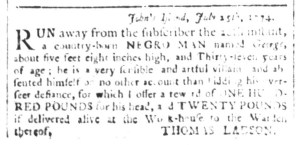
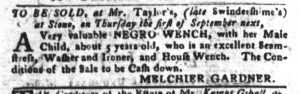
New-Hampshire Gazette (August 12, 1774).

**********

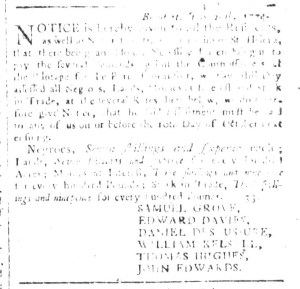
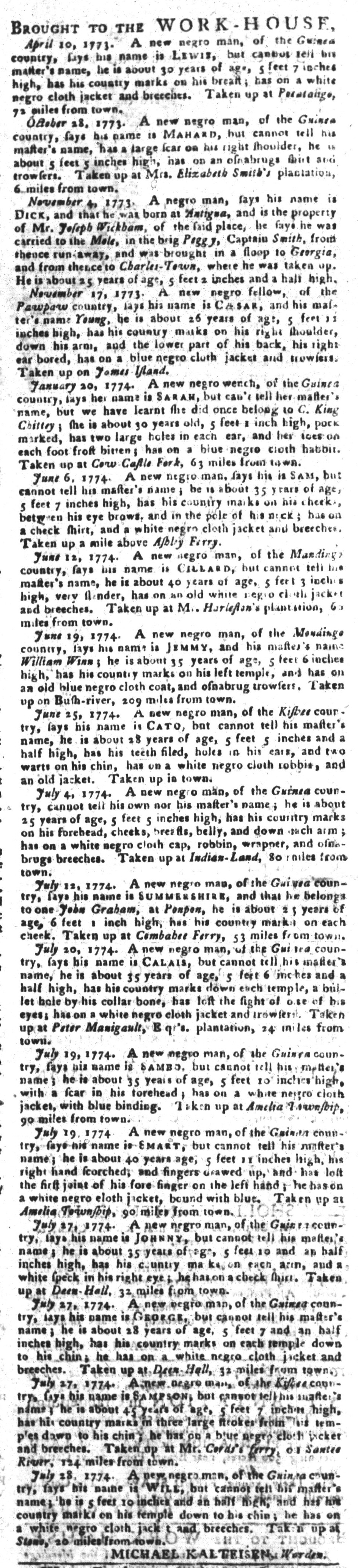
South-Carolina and American General Gazette (August 12, 1774).

**********

South-Carolina and American General Gazette (August 12, 1774).

**********

South-Carolina and American General Gazette (August 12, 1774).

**********

South-Carolina and American General Gazette (August 12, 1774).

**********

South-Carolina and American General Gazette (August 12, 1774).

**********

South-Carolina and American General Gazette (August 12, 1774).

**********

South-Carolina and American General Gazette (August 12, 1774).

**********

South-Carolina and American General Gazette (August 12, 1774).

**********

South-Carolina and American General Gazette (August 12, 1774).

**********

South-Carolina and American General Gazette (August 12, 1774).

**********

South-Carolina and American General Gazette (August 12, 1774).

**********

South-Carolina and American General Gazette (August 12, 1774).

**********

South-Carolina and American General Gazette (August 12, 1774).

**********

South-Carolina and American General Gazette (August 12, 1774).

**********

South-Carolina and American General Gazette (August 12, 1774).

**********

South-Carolina and American General Gazette (August 12, 1774).

**********

South-Carolina and American General Gazette (August 12, 1774).

**********

South-Carolina and American General Gazette (August 12, 1774).

**********

South-Carolina and American General Gazette (August 12, 1774).

**********

South-Carolina and American General Gazette (August 12, 1774).

**********

South-Carolina and American General Gazette (August 12, 1774).

**********

South-Carolina and American General Gazette (August 12, 1774).

**********

South-Carolina and American General Gazette (August 12, 1774).

**********

South-Carolina and American General Gazette (August 12, 1774).

**********

South-Carolina and American General Gazette (August 12, 1774).

**********

South-Carolina and American General Gazette (August 12, 1774).

**********

South-Carolina and American General Gazette (August 12, 1774).

**********

South-Carolina and American General Gazette (August 12, 1774).

**********

South-Carolina and American General Gazette (August 12, 1774).

August 11

What was advertised in a colonial American newspaper 250 years ago today?

Massachusetts Gazette and Boston Weekly News-Letter (August 11, 1774).

“Mrs. Draper … proposes to continue publishing the Paper herself.”

With a notice in the August 11, 1774, edition of the Massachusetts Gazette and Boston Weekly News-Letter, Margaret Draper became the sole printer responsible for publishing that newspaper.  Who served in that role had changed several times over the past several months.  On May 5, Richard Draper, Margaret’s husband who had printed the newspaper for many years, placed an advertisement seeking a “Printer that understands collecting News, and carrying on a News Paper” to assist him because his “very low State of Health, prevents his making such Collection of Intelligence and Speculation, as his Customers must have expected.”  A week later, he ran a new notice to advise his customers of “a Co-Partnership with Mr. JOHN BOYLE.”  The “Co-Partnership” of Draper and Boyle, he promised, “will Endeavor to support the Reputation the said Paper has had for many Years past.”  At the same time, he made a pitch for advertisers, noting that the “great number of Customers on the Western Roads, make it peculiarly advantageous for those who advertise therein.”  The following week, an updated masthead for the May 19 issue included the names of both printers.

That partnership lasted only a few weeks.  Richard died on June 5.  A death notice and obituary ran as the first time in the first column of the first page in the June 9 edition, followed immediately by a notice that the “Co-Partnership between RICHARD DRAPER and JOHN BOYLE is dissolved by the Death of the former.”  In turn, the newspaper “will now be carried on by MARGARET DRAPER and JOHN BOYLE,” who renewed pledges that “the utmost Endeavors will be taken to maintain the Character it has had for upwards of Seventy Years past.”  Black borders, indicative of mourning, embellished the mastheads for the standard issue and the supplement that accompanied it.  The masthead for the standard issue stated, “Published by MARGARET DRAPER and JOHN BOYLE, at their Printing-Office in Newbury Street.”  In contrast, the masthead for the supplement only named one of them: “Published by JOHN BOYLE, at his Printing-Office in Newbury Street.”  Apparently portions of the newspaper went to print before the widow and her departed husband’s partner worked out all the details of their new arrangement.  Both names appeared in the masthead for the next several issues as well as in an updated version that first appeared on June 30: “Published by DRAPER and BOYLE in Newbury-Street, where Advertisements, &c. for this PAPER are taken in, and all other Printing-Work performed.”

This new partnership endured for two months, concluding with a notice “To the Public” that “MARGARET DRAPER & JOHN BOYLE, agreeable to Contract, … dissolved by mutual Consent” their partnership.  The colophon portion of the masthead simply declared, “Draper’s,” as it had prior to the Richard’s death.  In addition to announcing that she now operated the newspaper on her own, Margaret issued a call for friends, customers, and the public to provide “some reputable Means of Subsistence” for her.  To that end, she “solicit[ed] the Favor of further Subscriptions” that would allow her to “keep up the Credit which the Paper had for a long Time sustained in the Days of her deceased Husband.”  She ran the printing office on her own for several months before entering into an agreement with John Howe to manage the business.  That made her one of several female printers, along with Sarah Goddard, Anne Catharine Green, and Clementina Rind, in the colonies on the eve of the American Revolution.

Slavery Advertisements Published August 11, 1774

The Slavery Adverts 250 Project chronicles the role of newspaper advertising in perpetuating slavery in the era of the American Revolution. The project seeks to reveal the ubiquity of slavery in eighteenth-century life from New England to Georgia by republishing advertisements about enslaved people – for sale as individuals or in groups, wanted to purchase or for hire for short periods, runaways who liberated themselves, and those who were subsequently captured and confined in jails and workhouses – in daily digests on this site as well as in real time via the @SlaveAdverts250 Twitter feed, utilizing twenty-first-century media to stand in for the print media of the eighteenth century.

The project aims to provide modern audiences with a sense of just how often colonizers encountered these advertisements in their daily lives. Enslaved men, women, and children appeared in print somewhere in the colonies almost every single day. Those advertisements served as a constant backdrop for social, cultural, economic, and political life in colonial and revolutionary America. Colonizers who did not purport to own enslaved people were still confronted with slavery as well as invited to maintain the system by purchasing enslaved men, women, and children or assisting in the capture of so-called “runaways” who sought to free themselves from bondage. The frequency of these newspaper advertisements suggests just how embedded slavery was in colonial and revolutionary American culture in everyday interactions beyond the printed page.

These advertisements also testify to the experiences of enslaved men, women, and children, though readers must consider that those experiences have been remediated through descriptions offered by enslavers rather than enslaved people themselves. Often unnamed in the advertisements, enslaved men, women, and children were not invisible or unimportant in early America.

These advertisements appeared in colonial American newspapers 250 years ago today.

Maryland Gazette (August 11, 1774).

**********

Maryland Gazette (August 11, 1774).

**********

Maryland Gazette (August 11, 1774).

**********

Maryland Gazette (August 11, 1774).

**********

Maryland Gazette (August 11, 1774).

**********

Maryland Gazette (August 11, 1774).

**********

Massachusetts Gazette and Boston Weekly Mercury (August 11, 1774).

**********

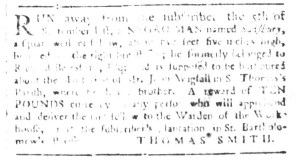
Rivington’s New-York Gazetteer (August 11, 1774).

**********

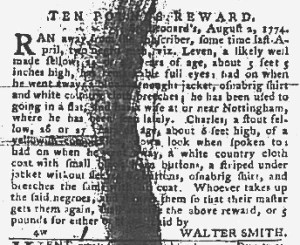
Virginia Gazette [Purdie and Dixon] (August 11, 1774).

**********

Virginia Gazette [Purdie and Dixon] (August 11, 1774).

**********

Virginia Gazette [Purdie and Dixon] (August 11, 1774).

**********

Virginia Gazette [Purdie and Dixon] (August 11, 1774).

**********

Virginia Gazette [Purdie and Dixon] (August 11, 1774).

**********

Virginia Gazette [Purdie and Dixon] (August 11, 1774).

**********

Virginia Gazette [Purdie and Dixon] (August 11, 1774).

**********

Virginia Gazette [Rind] (August 11, 1774).

**********

Virginia Gazette [Rind] (August 11, 1774).

**********

Virginia Gazette [Rind] (August 11, 1774).

**********

Virginia Gazette [Rind] (August 11, 1774).

**********

Virginia Gazette [Rind] (August 11, 1774).

August 10

Who was the subject of an advertisement in a colonial American newspaper 250 years ago today?

Pennsylvania Gazette (August 10, 1774).

“SAMUEL PENNOCK … has thought fit … to publish me in the Pennsylvania Gazette.”

Martha Pennock was not having it.  Her husband, Samuel, a hatter, ran a newspaper advertisement that claimed she was not legally his wife because she had previously been married to John Morton of the Royal American Regiment.  Her first husband was still alive for several years after Samuel married Martha, making her a bigamist and invalidating her marriage to the hatter.  That being the case, Samuel advised the public “not to trust her on my account, for I will not pay any debts of her contracting.”  It was quite a twist on the usual “runaway wife” advertisements that appeared so frequently in colonial newspapers.

In another twist, Martha responded in the public prints.  Most women did not have the resources to counter the claims made by their husbands, especially after being cut off from their credit.  That meant that the public had access to only one account, the one from the husband’s perspective, in newspapers, though conversations and gossip likely circulated alternate versions of what occurred.  Martha not only published her rejoinder but did so very quickly.  Samuel inserted his advertisement in the August 3, 1774, edition of the Pennsylvania Gazette.  Martha’s notice ran in the next issue on August 10.  If she became aware of what Samuel had done quickly enough, she could have responded in Dunlap’s Pennsylvania Packet on August 8, but waiting two more days meant that she presented her side of the story to readers in the same publication that carried her husband’s diatribe against her.

Martha’s narrative was quite different.  She blamed the discord on “the instigation of his malicious friends,” asserting that Samuel and his friends “have used me extremely ill, at sundry times.”  She denied “with a safe conscience” that she had another living husband, stating that she had been married to Samuel for eight years and “always behaved as a prudent wife to him.  If necessary, she could provide “a sufficient testimonial of my lawful marriage to the said Pennock” as well as “an authentic power of attorney, under hand and seal, to collect his debts, and enjoy all that is or may be belonging to him hereafter.”  Martha aimed to invalidate any claims that Samuel made, whether about having a first husband or about her rights as Samuel’s “lawful” wife.  In doing so, she joined the ranks of relatively few women who responded in print to husbands who used advertisements to disavow their wives and blame them for discord within their households.

Slavery Advertisements Published August 10, 1774

The Slavery Adverts 250 Project chronicles the role of newspaper advertising in perpetuating slavery in the era of the American Revolution. The project seeks to reveal the ubiquity of slavery in eighteenth-century life from New England to Georgia by republishing advertisements about enslaved people – for sale as individuals or in groups, wanted to purchase or for hire for short periods, runaways who liberated themselves, and those who were subsequently captured and confined in jails and workhouses – in daily digests on this site as well as in real time via the @SlaveAdverts250 Twitter feed, utilizing twenty-first-century media to stand in for the print media of the eighteenth century.

The project aims to provide modern audiences with a sense of just how often colonizers encountered these advertisements in their daily lives. Enslaved men, women, and children appeared in print somewhere in the colonies almost every single day. Those advertisements served as a constant backdrop for social, cultural, economic, and political life in colonial and revolutionary America. Colonizers who did not purport to own enslaved people were still confronted with slavery as well as invited to maintain the system by purchasing enslaved men, women, and children or assisting in the capture of so-called “runaways” who sought to free themselves from bondage. The frequency of these newspaper advertisements suggests just how embedded slavery was in colonial and revolutionary American culture in everyday interactions beyond the printed page.

These advertisements also testify to the experiences of enslaved men, women, and children, though readers must consider that those experiences have been remediated through descriptions offered by enslavers rather than enslaved people themselves. Often unnamed in the advertisements, enslaved men, women, and children were not invisible or unimportant in early America.

These advertisements appeared in colonial American newspapers 250 years ago today.

Pennsylvania Gazette (August 10, 1774).

August 9

What was advertised in a colonial American newspaper 250 years ago today?

South-Carolina Gazette and Country Journal (August 9, 1774).

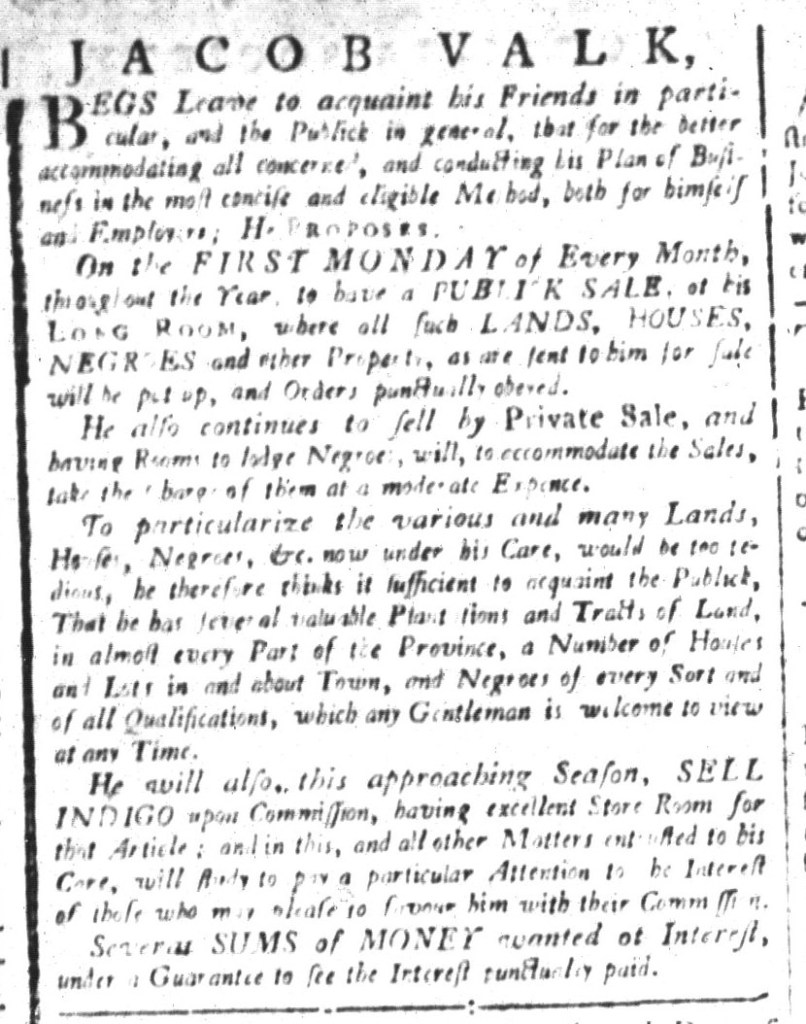
“That large commodious Room, (for the better accommodating Business for the Public Utility).”

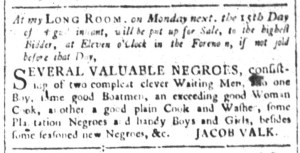
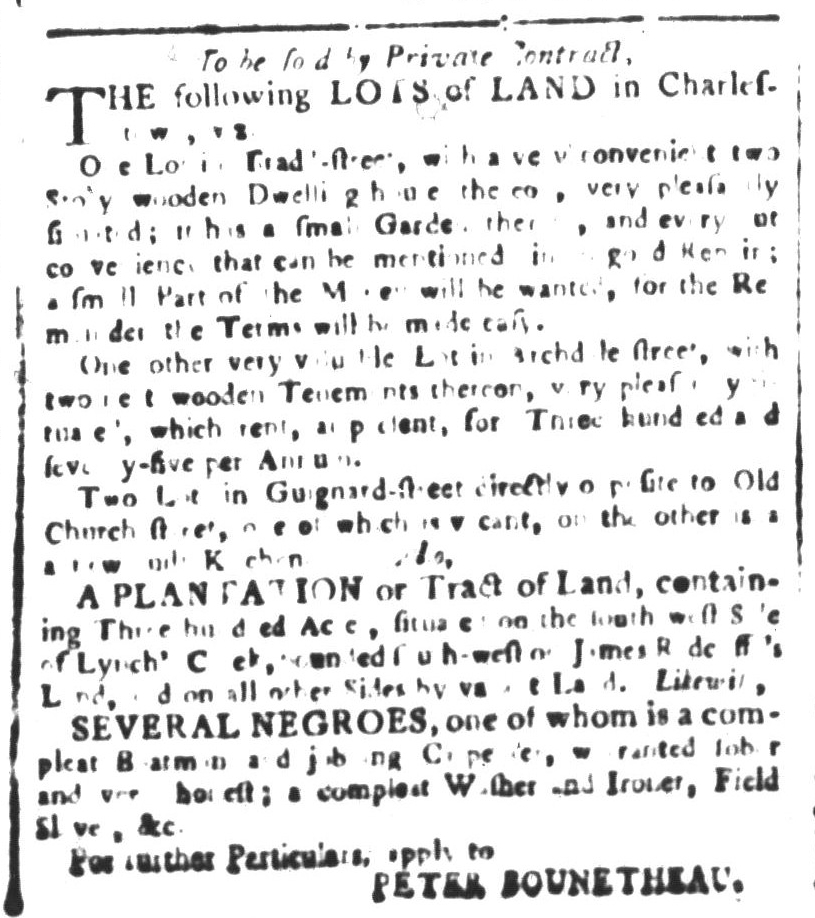
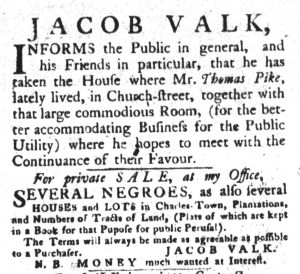
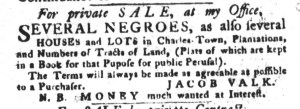
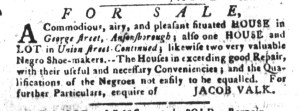
Jacob Valk continued to do well as a broker for “Lands, Houses, and Negroes” in Charleston in the summer of 1774.  He attracted so many clients that the advertisements he placed on their behalf filled two of the three columns on the first page of the August 9, 1774, edition of the South-Carolina Gazette and Country Journal.  In addition to that publication, he regularly bought a significant amount of space in the South-Carolina Gazette and the South-Carolina and American General Gazette.  His investment in advertising testified to his belief in its effectiveness, while the number of advertisements demonstrated the extensive demand for his services.
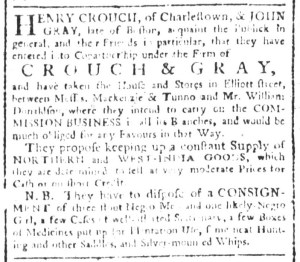
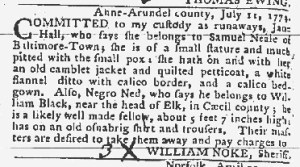
Such success prompted him to move his brokerage office to a new location.  He announced that he “has taken the House where Mr. Thomas Pike, lately lived … together with that large commodious Room, (for the better accommodating Business for the Public Utility).”  Pike had recently departed the city after offering dancing and fencing lessons to its residents for a decade.  He hosted an annual ball for his students to display their talents, most recently in the “New-Assembly Room” where Valk now conducted business.  Even while he was still in town, Pike had rented the room for “Public Sales, of Estates, Negroes, [and] Dry Goods.”  With Valk on the scene, the space only occasionally used for the buying and selling of enslaved men, women, and children now became a site dedicated to perpetuating the slave trade.

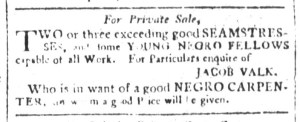
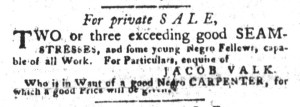
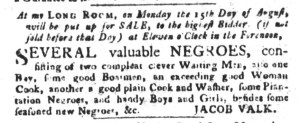
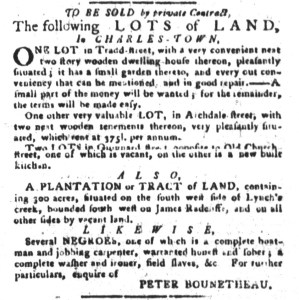
Immediately below his note about his new location, Valk advertised “SEVERAL NEGROES” available “For private SALE, at my Office.”  In the subsequent advertisements that filled those two columns, he also sought buyers for “two very valuable Negro Shoemakers” and “TWO or three exceeding good SEAMSTRESSES, and some young Negro Fellows, capable of all Work.”  He also put out a call for a “good Negro CARPENTER,” seeking an enslaver interested in selling a skilled artisan.  Although most of these enslaved people did not need to appear in the “New-Assembly Room” for Valk to broker the sales, that “large commodious Room” did lend itself to putting enslaved people on display.  Colonizers who sought Valk’s services buying and selling enslaved people did conduct business in the space formerly used for dancing lessons.  Some of them had likely socialized there during Pike’s annual balls before buying and selling enslaved people in the same space after the dancing master’s departure from the city.  Valk seamlessly moved his brokerage office there, a testament to how slavery was so deeply enmeshed in daily life in colonial Charleston and other urban centers.

Slavery Advertisements Published August 9, 1774

The Slavery Adverts 250 Project chronicles the role of newspaper advertising in perpetuating slavery in the era of the American Revolution. The project seeks to reveal the ubiquity of slavery in eighteenth-century life from New England to Georgia by republishing advertisements about enslaved people – for sale as individuals or in groups, wanted to purchase or for hire for short periods, runaways who liberated themselves, and those who were subsequently captured and confined in jails and workhouses – in daily digests on this site as well as in real time via the @SlaveAdverts250 Twitter feed, utilizing twenty-first-century media to stand in for the print media of the eighteenth century.

The project aims to provide modern audiences with a sense of just how often colonizers encountered these advertisements in their daily lives. Enslaved men, women, and children appeared in print somewhere in the colonies almost every single day. Those advertisements served as a constant backdrop for social, cultural, economic, and political life in colonial and revolutionary America. Colonizers who did not purport to own enslaved people were still confronted with slavery as well as invited to maintain the system by purchasing enslaved men, women, and children or assisting in the capture of so-called “runaways” who sought to free themselves from bondage. The frequency of these newspaper advertisements suggests just how embedded slavery was in colonial and revolutionary American culture in everyday interactions beyond the printed page.

These advertisements also testify to the experiences of enslaved men, women, and children, though readers must consider that those experiences have been remediated through descriptions offered by enslavers rather than enslaved people themselves. Often unnamed in the advertisements, enslaved men, women, and children were not invisible or unimportant in early America.

These advertisements appeared in colonial American newspapers 250 years ago today.

Connecticut Courant (August 9, 1774).

**********

Connecticut Courant (August 9, 1774).

**********

Connecticut Courant (August 9, 1774).

**********

Essex Gazette (August 9, 1774).

**********

South-Carolina Gazette and Country Journal (August 9, 1774).

**********

South-Carolina Gazette and Country Journal (August 9, 1774).

**********

South-Carolina Gazette and Country Journal (August 9, 1774).

**********

South-Carolina Gazette and Country Journal (August 9, 1774).

**********

South-Carolina Gazette and Country Journal (August 9, 1774).

**********

South-Carolina Gazette and Country Journal (August 9, 1774).

**********

South-Carolina Gazette and Country Journal (August 9, 1774).

**********

South-Carolina Gazette and Country Journal (August 9, 1774).

**********

South-Carolina Gazette and Country Journal (August 9, 1774).

**********

South-Carolina Gazette and Country Journal (August 9, 1774).

**********

South-Carolina Gazette and Country Journal (August 9, 1774).

**********

South-Carolina Gazette and Country Journal (August 9, 1774).

**********

South-Carolina Gazette and Country Journal (August 9, 1774).

**********

South-Carolina Gazette and Country Journal (August 9, 1774).

**********

South-Carolina Gazette and Country Journal (August 9, 1774).

**********

South-Carolina Gazette and Country Journal (August 9, 1774).

**********

South-Carolina Gazette and Country Journal (August 9, 1774).

**********

South-Carolina Gazette and Country Journal (August 9, 1774).

**********

South-Carolina Gazette and Country Journal (August 9, 1774).