October 19

What was advertised in a colonial American newspaper 250 years ago today?

Pennsylvania Gazette (October 19, 1774).

“I … am really sorry that my Fellow-Citizens should be so unfriendly to me.”

Tensions rose in the fall of 1774 as the harbor in Boston remained closed and blockaded due to the Boston Port Act and the rest of the Coercive Acts went into effect as punishment for the Boston Tea Party.  Yet that port was not the only place that experienced discord.  John Head’s advertisement, published in both the Pennsylvania Gazette and the Pennsylvania Journal on October 19, revealed his frustration with rumors and accusations that he sought to take advantage of the situation through unscrupulous business practices.

He reported that “a Number of unkind People have industriously propagated through this City, Philadelphia, “I made it my Business to purchase a large Quantity of several Sorts of dry Goods, in order to sell them again at an advanced Price.” Head, like many other colonizers, anticipated that the First Continental Congress, meeting in Philadelphia at the time, would enact some sort of nonimportation agreement in response to the Coercive Acts.  His critics accused him of attempting to sidestep such measures by stocking up on merchandise in advance, thus not having to make the same sacrifices as truly patriotic merchants.  To make matters worse, they insinuated that once goods became scare because of a nonimportation agreement that Head would jack up his prices and gouge consumers who did not have the usual range of choices available to them.

Head vigorously denied those rumors.  That “Report,” he asserted, “I do declare to be false.”  Furthermore, he challenged “any Person to appear to my Face, and prove that I have bought to the Amount of One Shilling’s Worth of Goods from them, since the Arrival of said Ships.”  Continuing to make his case, Head declared that “on a cool Reflection, I cannot recollect that I have bought to the Amount of Fifty Pounds Worth of dry Goods on Speculation since I have been in Trade.”  He did not have a history of acquiring goods in large quantities, nor had he done so recently, despite whatever his adversaries claimed.  Head expressed his disappointment over the gossip that made it necessary to take to the public prints to defend his reputation.  He lamented that “my Fellow-Citizens should be so unfriendly to me, and unjust to themselves, as to propagate a Report of this Sort.”  In so doing, he positioned himself among the ranks of citizens and patriots, confirming his fidelity to their cause.
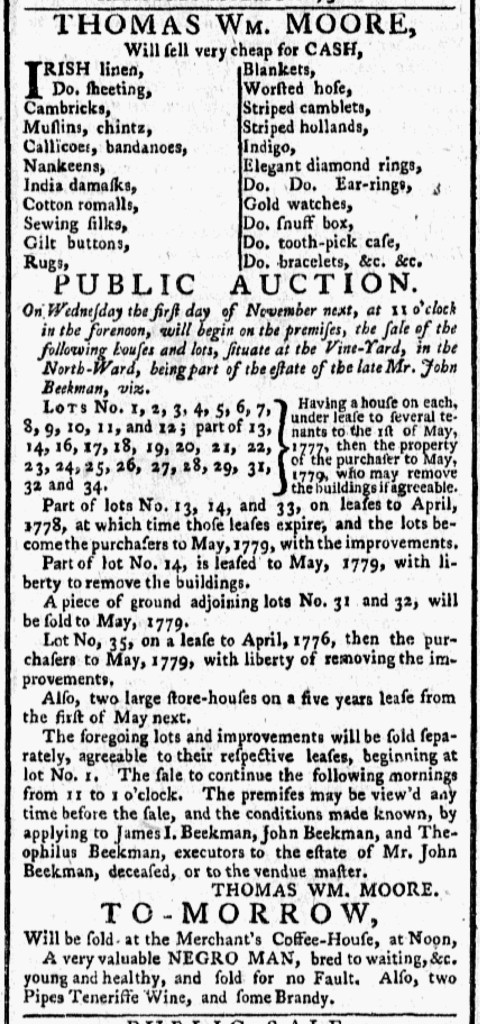
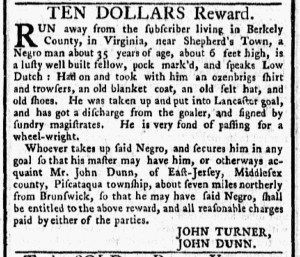
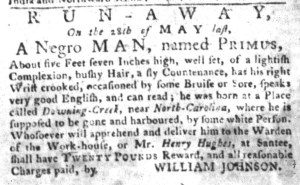
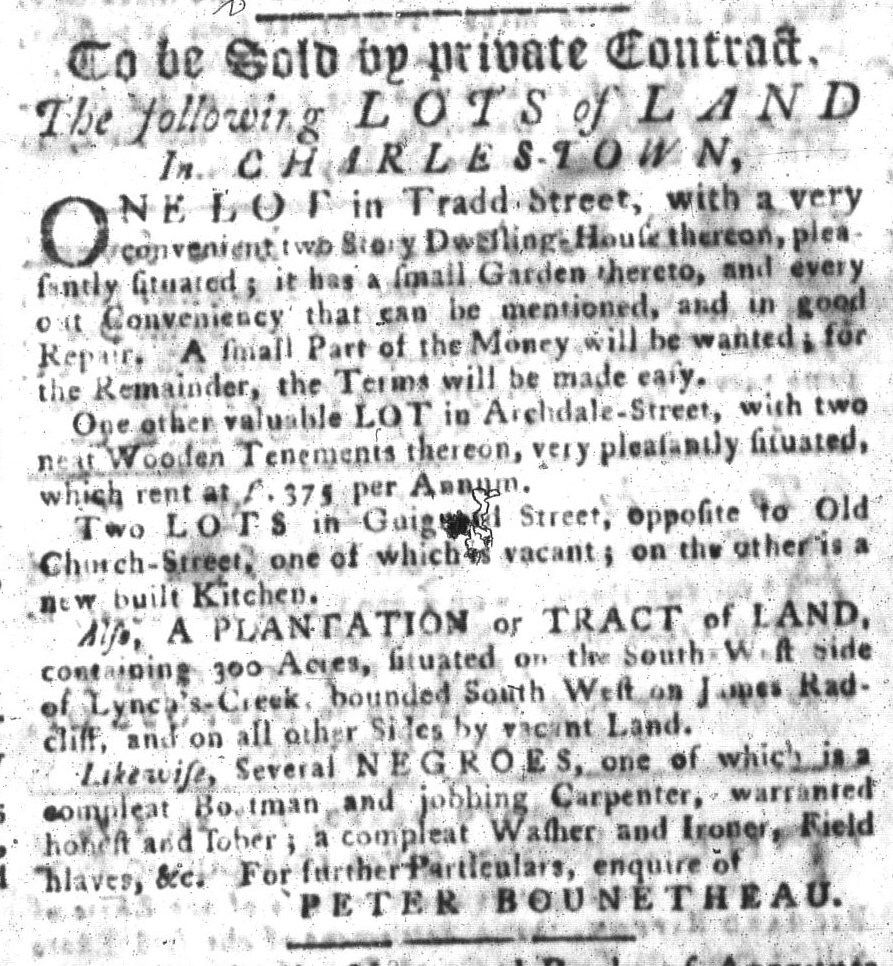
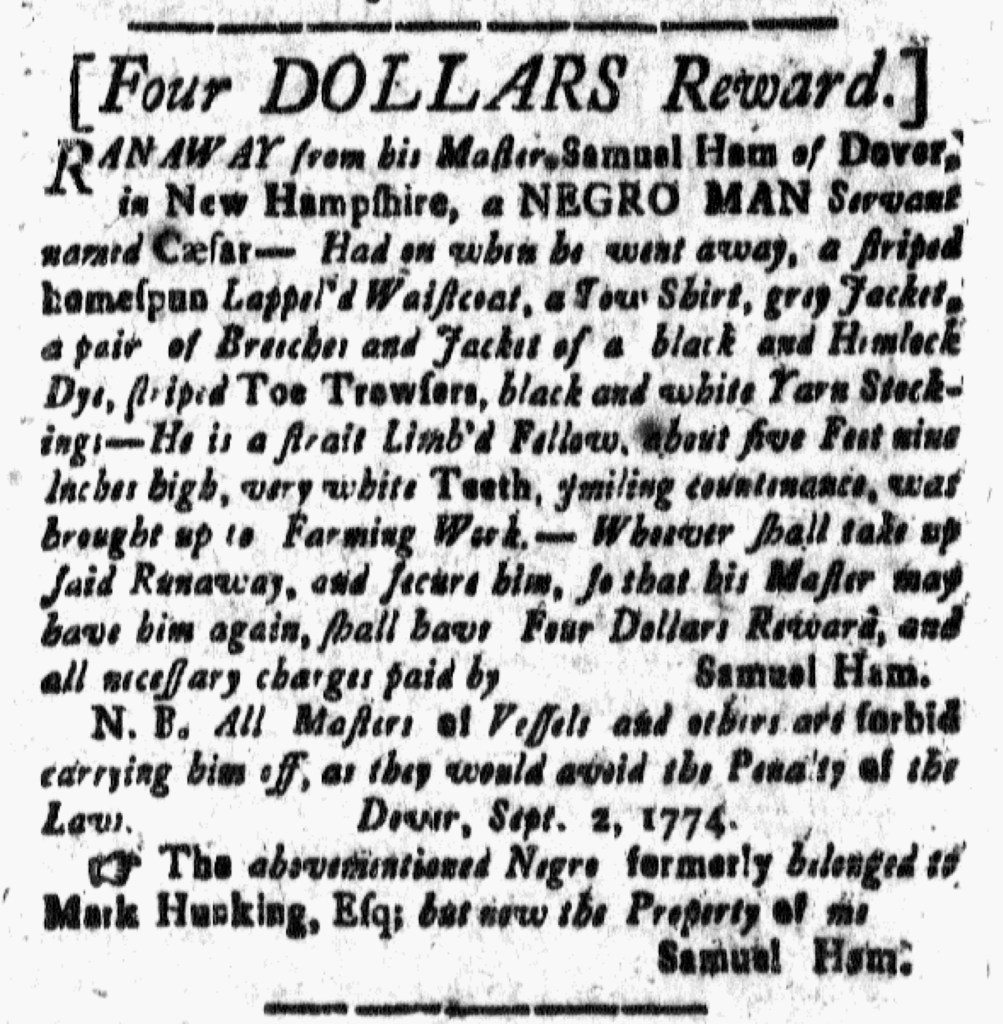
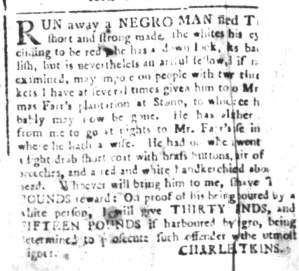
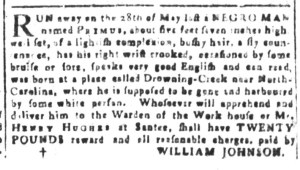
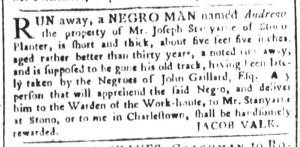
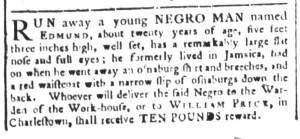
Slavery Advertisements Published October 19, 1774

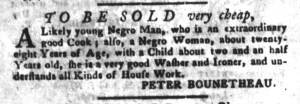
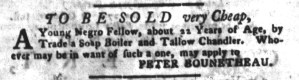
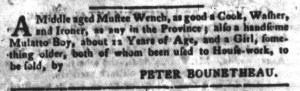
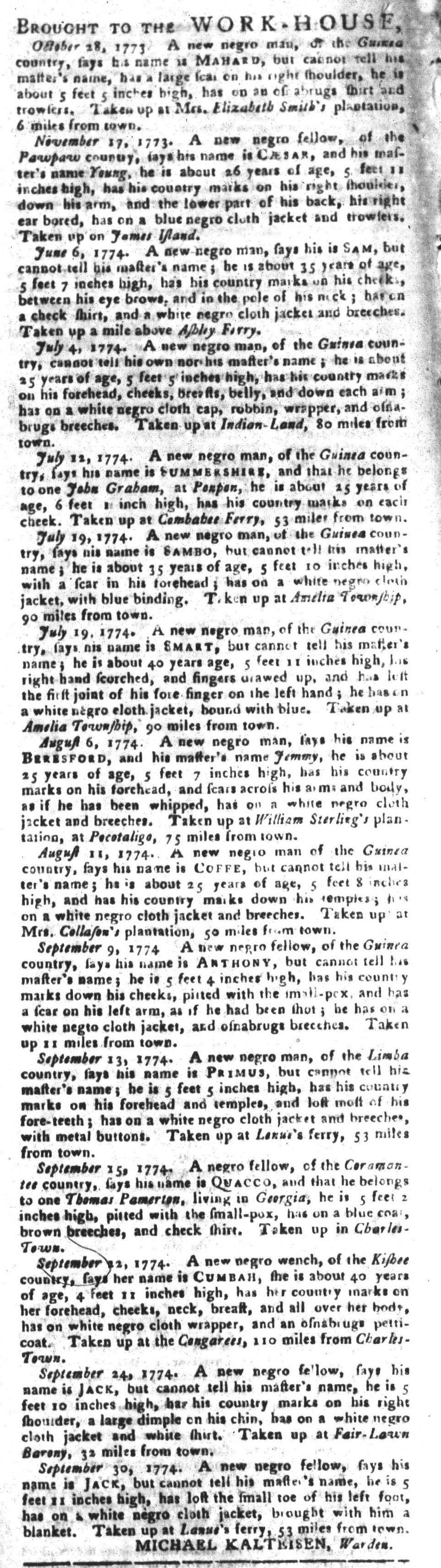
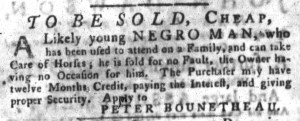
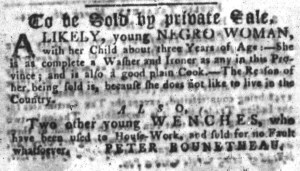
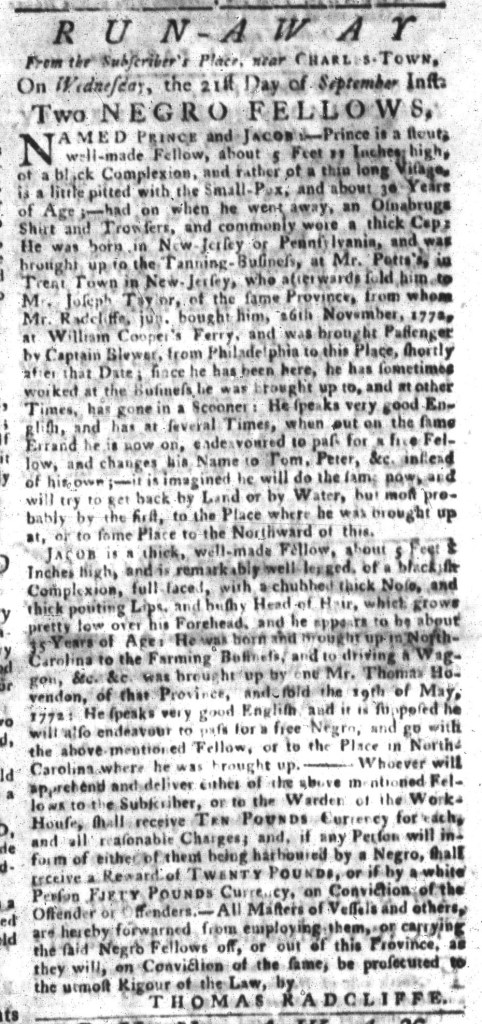
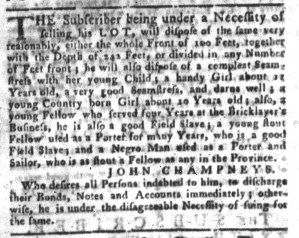
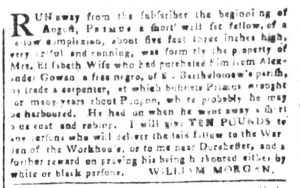
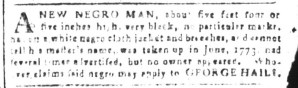
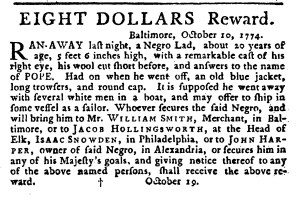
The Slavery Adverts 250 Project chronicles the role of newspaper advertising in perpetuating slavery in the era of the American Revolution. The project seeks to reveal the ubiquity of slavery in eighteenth-century life from New England to Georgia by republishing advertisements about enslaved people – for sale as individuals or in groups, wanted to purchase or for hire for short periods, runaways who liberated themselves, and those who were subsequently captured and confined in jails and workhouses – in daily digests on this site as well as in real time via the @SlaveAdverts250 Twitter feed, utilizing twenty-first-century media to stand in for the print media of the eighteenth century.

The project aims to provide modern audiences with a sense of just how often colonizers encountered these advertisements in their daily lives. Enslaved men, women, and children appeared in print somewhere in the colonies almost every single day. Those advertisements served as a constant backdrop for social, cultural, economic, and political life in colonial and revolutionary America. Colonizers who did not purport to own enslaved people were still confronted with slavery as well as invited to maintain the system by purchasing enslaved men, women, and children or assisting in the capture of so-called “runaways” who sought to free themselves from bondage. The frequency of these newspaper advertisements suggests just how embedded slavery was in colonial and revolutionary American culture in everyday interactions beyond the printed page.

These advertisements also testify to the experiences of enslaved men, women, and children, though readers must consider that those experiences have been remediated through descriptions offered by enslavers rather than enslaved people themselves. Often unnamed in the advertisements, enslaved men, women, and children were not invisible or unimportant in early America.

These advertisements appeared in colonial American newspapers 250 years ago today.

Pennsylvania Journal (October 19, 1774).

October 18

What was advertised in a colonial American newspaper 250 years ago today?

Essex Gazette (October 18, 1774).

“In Consequence of the Boston Port-Bill … he has opened a Store in Salem.”

In October 1774, Nathan Frazier did what he could to continue selling “an Assortment of Goods, suitable for the Season,” when the Boston Port Act closed the harbor in retaliation for colonizers destroying shipments of tea the previous December.  He opted to open a second location, renting a shop in Salem.  In the October 18 edition of the Essex Gazette, published in that town, he informed readers that “in Consequence of the Boston Port-Bill, and with a View of accommodating those of his Customers to whom it may be most convenient to have their Supplies conveyed by Water,” he now did business in Salem as well as in Boston.  The circumstances had not caused him to close his original store; he “still continues his Business at his Store in Boston as usual.”  Accordingly, his customers “may be supplied at either of said Stores,” though Frazier, “for the present, give[s] his personal Attendance at his Salem Store.”

In addition to inserting this notice in the Essex Gazette, the merchant also placed it in the Boston Evening-Post and the Boston-Gazette on October 17, increasing the chances that readers in Boston, Salem, and other towns would see it.  In the Boston Evening-Post, Frazier’s advertisement happened to appear immediately below William Blair Townsend’s notice that he sold goods “imported before the oppressive Acts on this Town and Province were laid” and, accordingly, could be bought and sold “without any Breach on the solemn League and Covenant” that called for ceasing trade with Britain until Parliament repealed the Coercive Acts.  In the Essex Gazette, Samuel Flagg asserted that “he is determined not to import any more Goods at present,” alluding to current events without naming them as plainly as Frazier and Townsend.  All three advertisements testified to the challenges that merchants and shopkeepers faced as well as their efforts to meet them.  As much as Frazier wished to encourage consumers to visit either of his shops, it was not business “as usual” in Boston and other towns in Massachusetts.  Advertisements, as well as news articles and editorials, made that clear.

Slavery Advertisements Published October 18, 1774

The Slavery Adverts 250 Project chronicles the role of newspaper advertising in perpetuating slavery in the era of the American Revolution. The project seeks to reveal the ubiquity of slavery in eighteenth-century life from New England to Georgia by republishing advertisements about enslaved people – for sale as individuals or in groups, wanted to purchase or for hire for short periods, runaways who liberated themselves, and those who were subsequently captured and confined in jails and workhouses – in daily digests on this site as well as in real time via the @SlaveAdverts250 Twitter feed, utilizing twenty-first-century media to stand in for the print media of the eighteenth century.

The project aims to provide modern audiences with a sense of just how often colonizers encountered these advertisements in their daily lives. Enslaved men, women, and children appeared in print somewhere in the colonies almost every single day. Those advertisements served as a constant backdrop for social, cultural, economic, and political life in colonial and revolutionary America. Colonizers who did not purport to own enslaved people were still confronted with slavery as well as invited to maintain the system by purchasing enslaved men, women, and children or assisting in the capture of so-called “runaways” who sought to free themselves from bondage. The frequency of these newspaper advertisements suggests just how embedded slavery was in colonial and revolutionary American culture in everyday interactions beyond the printed page.

These advertisements also testify to the experiences of enslaved men, women, and children, though readers must consider that those experiences have been remediated through descriptions offered by enslavers rather than enslaved people themselves. Often unnamed in the advertisements, enslaved men, women, and children were not invisible or unimportant in early America.

These advertisements appeared in colonial American newspapers 250 years ago today.

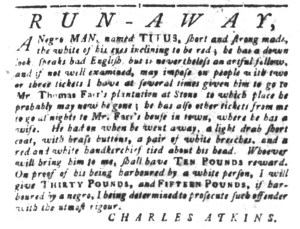
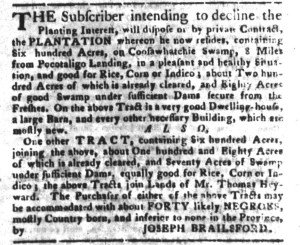
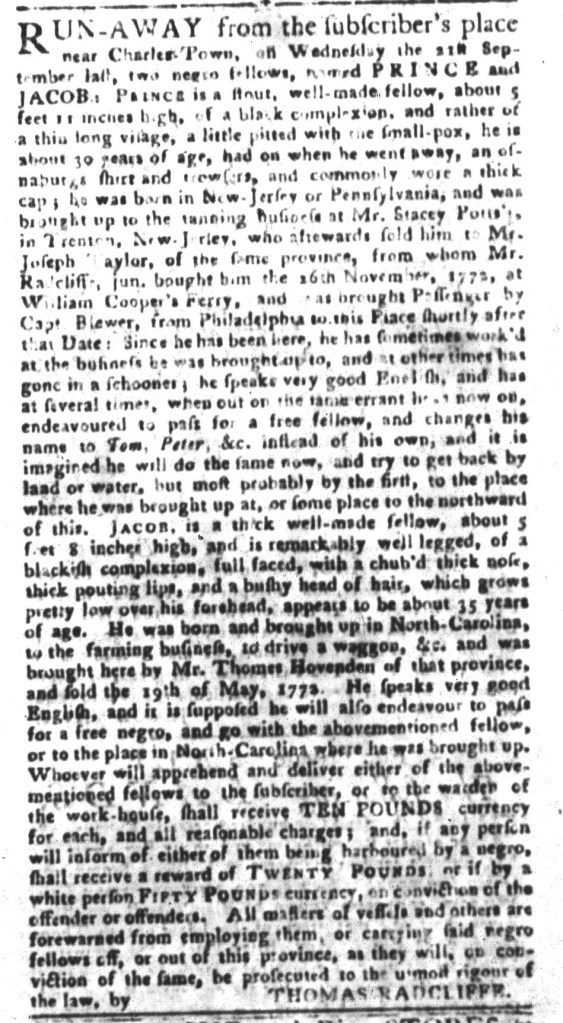
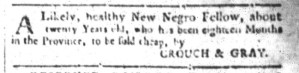
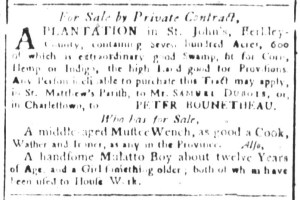
South-Carolina Gazette and Country Journal (October 18, 1774).

**********

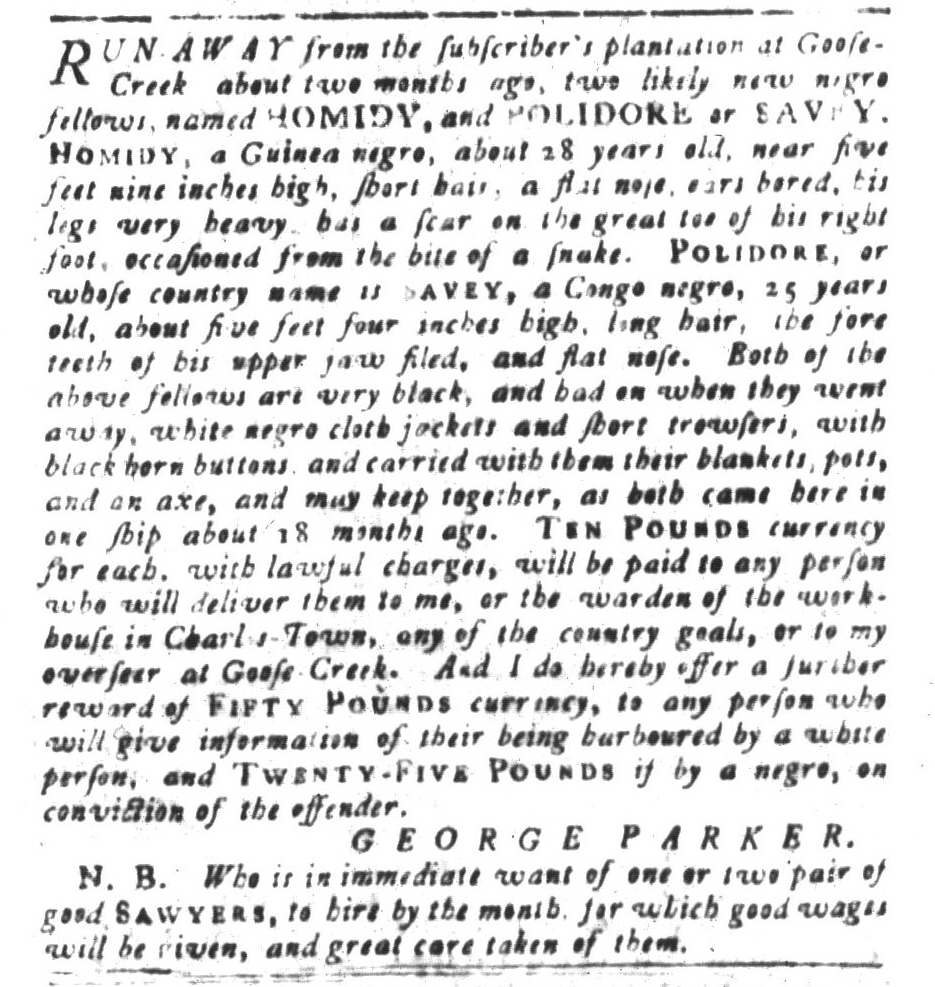
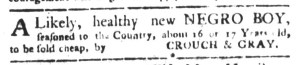
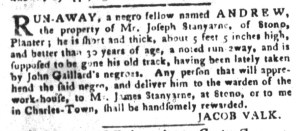
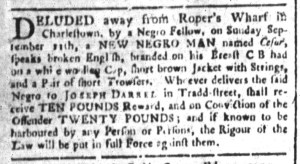
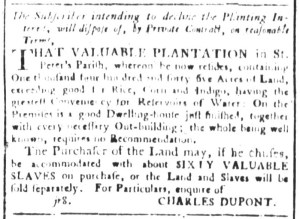
South-Carolina Gazette and Country Journal (October 18, 1774).

**********

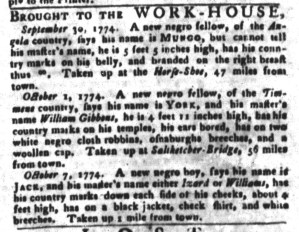
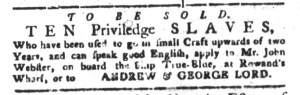
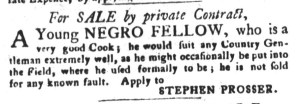
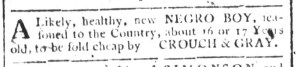
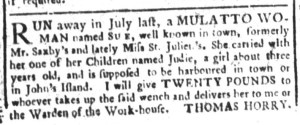
South-Carolina Gazette and Country Journal (October 18, 1774).

**********

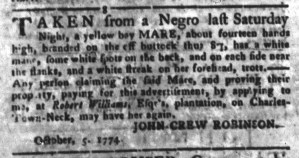
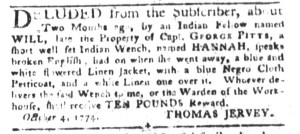
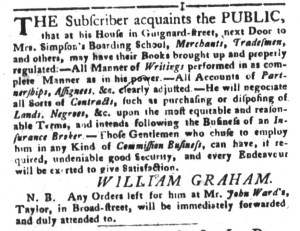
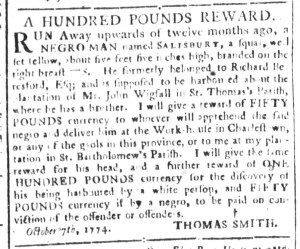
South-Carolina Gazette and Country Journal (October 18, 1774).

**********

South-Carolina Gazette and Country Journal (October 18, 1774).

**********

South-Carolina Gazette and Country Journal (October 18, 1774).

**********

South-Carolina Gazette and Country Journal (October 18, 1774).

**********

South-Carolina Gazette and Country Journal (October 18, 1774).

**********

South-Carolina Gazette and Country Journal (October 18, 1774).

**********

South-Carolina Gazette and Country Journal (October 18, 1774).

**********

South-Carolina Gazette and Country Journal (October 18, 1774).

**********

South-Carolina Gazette and Country Journal (October 18, 1774).

**********

South-Carolina Gazette and Country Journal (October 18, 1774).

**********

Supplement to the South-Carolina Gazette and Country Journal (October 18, 1774).

**********

Supplement to the South-Carolina Gazette and Country Journal (October 18, 1774).

**********

Supplement to the South-Carolina Gazette and Country Journal (October 18, 1774).

**********

Supplement to the South-Carolina Gazette and Country Journal (October 18, 1774).

**********

Supplement to the South-Carolina Gazette and Country Journal (October 18, 1774).

**********

Supplement to the South-Carolina Gazette and Country Journal (October 18, 1774).

**********

Supplement to the South-Carolina Gazette and Country Journal (October 18, 1774).

**********

Supplement to the South-Carolina Gazette and Country Journal (October 18, 1774).

October 17

What was advertised in a colonial American newspaper 250 years ago today?

Boston Evening-Post (October 17, 1774).

“May therefore be … sold … without any Breach on the solemn League and Covenant.”

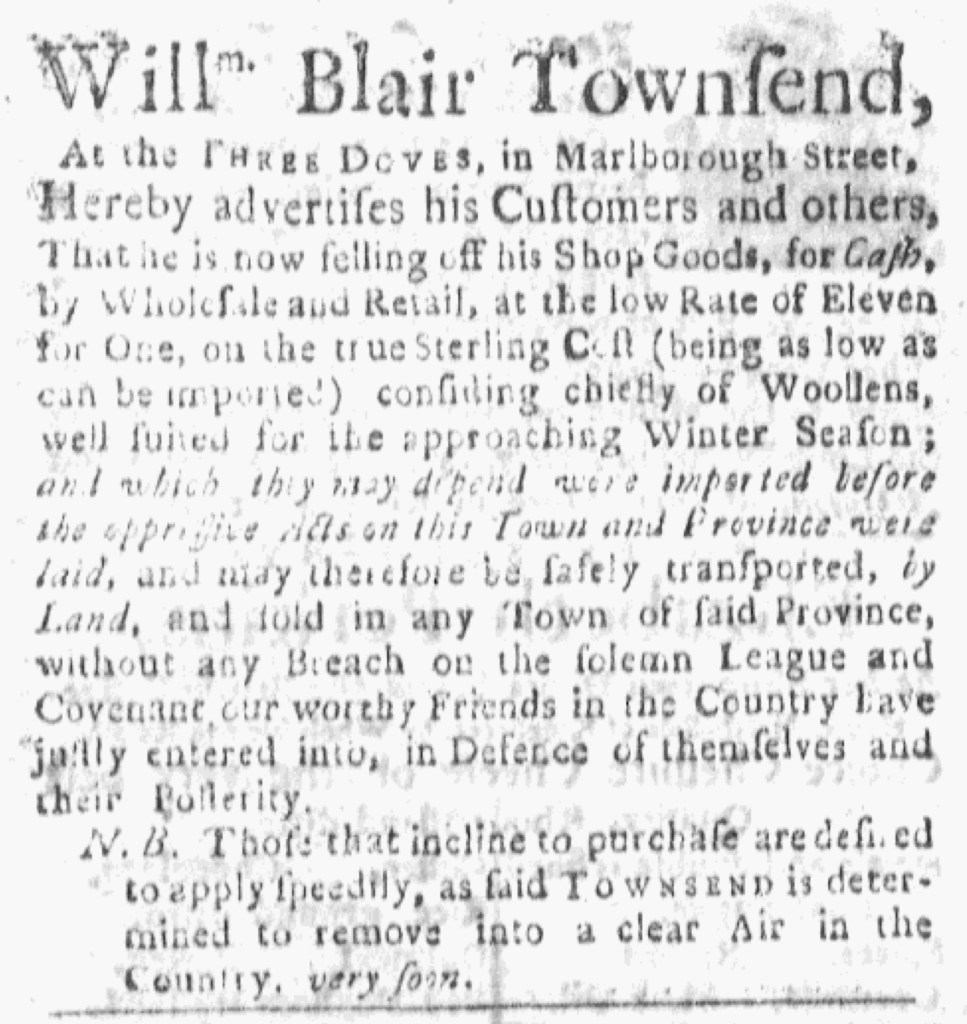
Politics took center stage in William Blair Townsend’s advertisements for “Shop Goods … consisting chiefly of Woollens, well suited for the approaching Season” in the October 17, 1774, edition of the Boston Evening-Post.  He looked to sell his entire inventory “by Wholesale and Retail” and close his shop, a casualty of the blockade of Boston that went into effect with the Boston Port Act that Parliament passed to punish the town for tossing tea into the harbor the previous December.  To that end, he assured prospective customers that “they may depend [the goods] were imported before the oppressive Acts on this Town and Province were laid.”  In addition to the Boston Port Act, Townsend invoked the Massachusetts Government Act and the other Coercive Acts.

Furthermore, he asserted that his wares “may therefore be safely transported, by Land, and sold in any Town of said Province, without any Breach on the solemn League and Covenant our worthy Friends in the Country have justly entered into, in Defence of themselves and their Posterity.”  Townsend referred to a plan outlined in a letter that the Boston Committee of Correspondence circulated on June 8.  After outlining the abuses perpetrated by Parliament, the letter encouraged resistance in the form of “affecting the trade and interest of Great Britain, so deeply as shall induce her to withdraw her oppressive hand.”  The Committee of Correspondence sought to revive nonimportation agreements enacted twice in the past decade, first in response to the Stamp Act and, later, the Townshend duties.  The letter proposed that colonizers “come into a solemn league, not to import goods from Great Britain, and not to buy any goods that shall hereafter be imported from thence, until our grievances shall be redressed.”  Some merchants advocated waiting for more comprehensive measures that enlisted cooperation of other colonies, like the Continental Association that the First Continental Congress was in the process of drawing up in Philadelphia at the time Townsend published his advertisement, yet colonizers in towns throughout Massachusetts supported the Solemn League and Covenant.

Knowing that was the case, Townsend acknowledged the politics of the moment in his advertisement.  He endorsed the pact while also making clear that neither he nor his prospective customers violated it.  They could buy and sell with clear consciences … and without attracting the ire of the public.  Beyond that, Townsend wished to clear out of Boston.  In a nota bene, he encouraged “Those that incline to purchase … to apply speedily” since he “is determined to remove into a clear Air in the Country, very soon.”  The situation had grown so bleak that that he did not intend to remain in Boston much longer.

Slavery Advertisements Published October 17, 1774

The Slavery Adverts 250 Project chronicles the role of newspaper advertising in perpetuating slavery in the era of the American Revolution. The project seeks to reveal the ubiquity of slavery in eighteenth-century life from New England to Georgia by republishing advertisements about enslaved people – for sale as individuals or in groups, wanted to purchase or for hire for short periods, runaways who liberated themselves, and those who were subsequently captured and confined in jails and workhouses – in daily digests on this site as well as in real time via the @SlaveAdverts250 Twitter feed, utilizing twenty-first-century media to stand in for the print media of the eighteenth century.

The project aims to provide modern audiences with a sense of just how often colonizers encountered these advertisements in their daily lives. Enslaved men, women, and children appeared in print somewhere in the colonies almost every single day. Those advertisements served as a constant backdrop for social, cultural, economic, and political life in colonial and revolutionary America. Colonizers who did not purport to own enslaved people were still confronted with slavery as well as invited to maintain the system by purchasing enslaved men, women, and children or assisting in the capture of so-called “runaways” who sought to free themselves from bondage. The frequency of these newspaper advertisements suggests just how embedded slavery was in colonial and revolutionary American culture in everyday interactions beyond the printed page.

These advertisements also testify to the experiences of enslaved men, women, and children, though readers must consider that those experiences have been remediated through descriptions offered by enslavers rather than enslaved people themselves. Often unnamed in the advertisements, enslaved men, women, and children were not invisible or unimportant in early America.

These advertisements appeared in colonial American newspapers 250 years ago today.

Boston Evening-Post (October 17, 1774).

**********

Boston-Gazette (October 17, 1774).

**********

Boston-Gazette (October 17, 1774).

**********

Connecticut Courant (October 17, 1774).

**********

Dunlap’s Pennsylvania Packet (October 17, 1774).

**********

Postscript to Dunlap’s Pennsylvania Packet (October 17, 1774).

**********

Postscript to Dunlap’s Pennsylvania Packet (October 17, 1774).

**********

Massachusetts Gazette and Boston Post-Boy (October 17, 1774).

**********

Newport Mercury (October 17, 1774).

**********

New-York Gazette and Weekly Mercury (October 17, 1774).

**********

New-York Gazette and Weekly Mercury (October 17, 1774).

**********

New-York Gazette and Weekly Mercury (October 17, 1774).

**********

South-Carolina Gazette (October 17, 1774).

**********

South-Carolina Gazette (October 17, 1774).

**********

Supplement to the South-Carolina Gazette (October 17, 1774).

**********

Supplement to the South-Carolina Gazette (October 17, 1774).

**********

Supplement to the South-Carolina Gazette (October 17, 1774).

**********

Supplement to the South-Carolina Gazette (October 17, 1774).

**********

Supplement to the South-Carolina Gazette (October 17, 1774).

**********

Supplement to the South-Carolina Gazette (October 17, 1774).

**********

Supplement to the South-Carolina Gazette (October 17, 1774).

**********

Supplement to the South-Carolina Gazette (October 17, 1774).

**********

Supplement to the South-Carolina Gazette (October 17, 1774).

**********

Supplement to the South-Carolina Gazette (October 17, 1774).

**********

Supplement to the South-Carolina Gazette (October 17, 1774).

**********

Supplement to the South-Carolina Gazette (October 17, 1774).

October 16

What was advertised in a colonial American magazine 250 years ago this month?

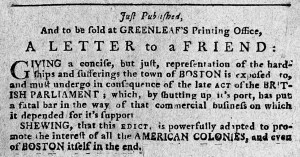
Detail from advertising wrapper: Royal American Magazine (August 1774).

“A concise, but just, representation of the hardships and sufferings of the town of BOSTON.”

For eighteen months, the Adverts 250 Project has been tracing the efforts of, first, Isaiah Thomas and, eventually, Joseph Greenleaf in advertising and publishing the Royal American Magazine.  Newspaper advertisements have definitively demonstrated that the dates associated with most issues did not match when they were published and distributed to subscribers and other readers.  On October 13, 1774, for instance Greenleaf placed advertisements in both the Massachusetts Gazette and Boston Weekly News-Letter and the Massachusetts Spy to announce “This day was published, THE Royal American Magazine, No. 8. For AUGUST, 1774.  In the eighteenth century, magazines usually came out at the end of the month, so readers would have expected to see the September issue advertised in October. Greenleaf continued to work on catching up on delinquent issues after acquiring the magazine from Thomas.

Greenleaf packaged the August issue in wrappers intended to be removed when the subscriber had the monthly issues bound into a single volume.  The pages numbers continued from one issue to the next.  The wrapper supplemented a title page that included a list of contents within the issue; printers intended for the title page to remain after discarding the wrapper.  Unlike modern magazines, advertisements did not appear within the issue.  Instead, they ran only on the wrappers.  The front of the wrapper for the August 1774 issue of the Royal American Magazine featured the same items as the one for July: the coat of arms of Great Britain above the title of the magazine (along with an updated date and issue number), an address to subscribers from Thomas, and an advertisement for “A LETTER to a FRIEND: GIVING a concise, but just, representation of the hardships and sufferings the town of BOSTON is exposed to” available at Greenleaf’s printing office.

What about the back of the wrapper?  That presented a bit of a mystery that cannot be solved solely by examining the digital surrogates.  A list of books and blanks that Greenleaf sold filled the back of the wrapper that accompanied the July issue.  That was also the case for the September issue.  The digitized version of the August issue, however, does not include any trace of the back of the wrapper, not even images of blank pages.  It does include an image of the blank page that was the interior of the front of the wrapper with the impression of the title and date from the other side clearly visible.  The same database includes images of blank pages for the interiors of front and back wrappers for the July and September issues, demonstrating that production of the digital surrogates incorporated careful attention to capturing more than just the contents printed on the numbered pages of those issues.  It stands to reason, then, that if the back of the wrapper had been present with the August issue that it would have been digitized.  Perhaps it had been damaged and removed at some point.  Yet sometimes mistakes happen.  The only way to know for certain is to examine the original document.

Unfortunately, my teaching schedule will not allow me to visit the reading room at the American Antiquarian Society before publishing this entry.  On the other hand, I am fortunate to live and work in the same city as the research library that houses the original magazine that was digitized to make the Royal American Magazine more widely accessible.  That means that I have more ready access to the original and tracking down answers to these sorts of questions than most others who consult the images in the database.  I will update this entry when time allow, but leave this discussion intact since it demonstrates that even though digital surrogates expand access, they cannot replace original sources.

October 15

What was advertised in a colonial American newspaper 250 years ago today?

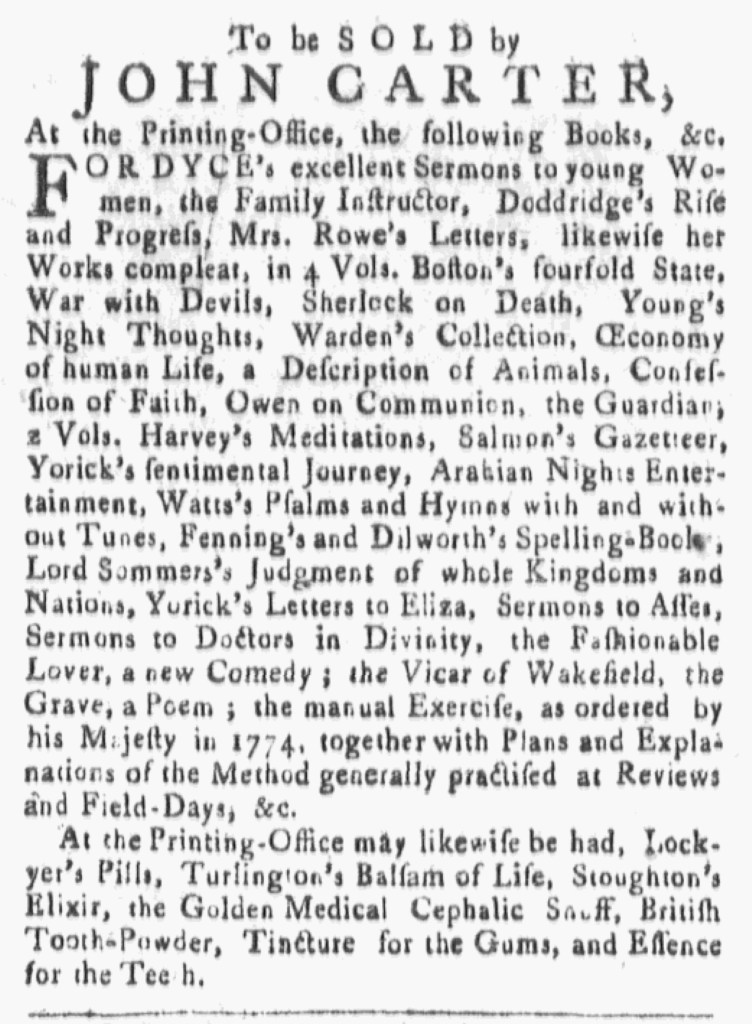
Providence Gazette (October 15, 1774).

“At the Printing-Office may likewise be had, Lockyer’s Pills, Turlington’s Balsam of Life.”

Colonial printers devised multiple revenue streams to earn their livelihoods.  John Carter, the printer of the Providence Gazette, was no exception.  In addition to seeking subscribers and advertisers for his newspaper, the colophon in each issue announced that “all Manner of Printing-Work is performed with Care and Expedition” at his printing office.  Carter took orders for job printing, everything from handbills and broadsides to printed blanks and circular letters.  Like other printers, he was also a bookseller, dealing primarily in imported volumes rather than books and pamphlets produced in his own shop.  In the October 15, 1774, edition of the Providence Gazette, Carter inserted an advertisement that listed a couple of dozen titles that he had on hand, including “FORDYCE’s excellent Sermons to young Women, the Family Instructor, Doddridge’s Rise and Progress, Mrs. Rowe’s Letters, likewise he Works compleat, in 4 Vols.”  Each fall, Carter collaborated with Benjamin West, an astronomer and mathematician, in publishing an almanac.  Separate advertisements for that useful work would commence soon, though the printer did not yet promote it in the middle of October.

His advertisement did, however, conclude with a separate list of patent medicines that he stocked at the printing office: “Lockyer’s Pills, Turlington’s Balsam of Life, Stoughton’s Elixir, the Golden Medical Cephalic Snuff, British Tooth-Powder, Tincture for the Gums, and Essence for the Teeth.”  Apothecaries imported and sold these popular remedies, as did merchants and shopkeepers … and printers.  Throughout the colonies, printers frequently advertised patent medicines in addition to goods and services associated with the book trade.  They did not need to possess any specialized medical knowledge to peddle these eighteenth-century versions of over-the-counter medications.  Customers already knew which patent medicines treated which maladies.  In addition, the various pills, powders, and elixirs frequently came with printed instructions that absolved printers and other retailers from having to provide any guidance about their use.  When it came to acquiring patent medicines, consumers may have found it just as convenient to visit the local printing office as any other shop.  For his part, Carter accommodated them, supplementing the revenues he earned from printing and selling books.
October 14

What was advertised in a colonial American newspaper 250 years ago today?

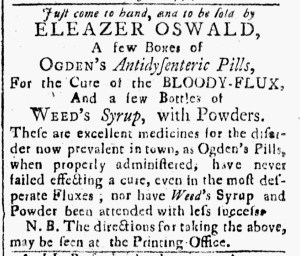
Connecticut Journal (October 14, 1774).

“The directions for taking the above [medicines], may be seen at the Printing Office.”

Colonial printers not only disseminated advertisements for patent medicines but also sold them to supplement the revenues from the other goods and services they offered at their printing offices.  In some instances, printers cooperated with others in advertising and selling patent medicines.  That seems to have been the case with Thomas Green and Samuel Green, printers of the Connecticut Journal and New-Haven Post-Boy, and Eleazer Oswald in the fall of 1774.  Oswald advertised a “few Boxes of OGDEN’s Antidysenteric Pills, For the Cure of the BLOODY-FLUX, And a few Bottles of WEED’S Syrup, with Powders” in the October 14 edition of the Connecticut Journal.  For those unfamiliar with these nostrums, he explained, “These are excellent medicines for the disorder now prevalent in town, as Ogden’s Pills, when properly administered, have never failed effecting a cure, even in the most desperate Fluxes; nor have Weed’s Syrup and Powder been attended with less success.”  As further evidence, Oswald suggested that prospective customers could examine the directions for the patent medicines at the printing office.
Oswald did not mention his affiliation with the Greens, nor did he give a separate address where customers could purchase the medicines.  In a town the size of New Haven, local readers did not always need advertisers to list their addresses.  In this instance, doing so might have been unnecessary if Oswald worked in the printing office and the community knew that without him stating it in the advertisement.  He apparently spent some time in New Haven in addition to seeking opportunities in other towns.  Born in England, Oswald migrated to the colonies in the early 1770s.  He served as an apprentice to John Holt, the printer of the New-York Journal.  In 1779, he entered a partnership with William Goddard in printing the Maryland Journal in Baltimore.  In 1782, he established his own newspaper, the Independent Gazetteer, in Philadelphia.  In the time between his apprenticeship with Holt and his partnership with Goddard, Oswald formed some sort of relationship with the Greens.  He may have worked in their printing office, selling patent medicines as a side hustle, or he may have been a tenant.  Either way, his advertisement for Ogden’s pills and Weed’s syrup and powders had the potential to increase traffic in the printing office, making it an even more bustling hub of activity as colonizers exchanged goods and information.

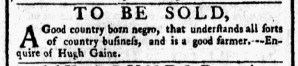
Slavery Advertisements Published October 14, 1774

The Slavery Adverts 250 Project chronicles the role of newspaper advertising in perpetuating slavery in the era of the American Revolution. The project seeks to reveal the ubiquity of slavery in eighteenth-century life from New England to Georgia by republishing advertisements about enslaved people – for sale as individuals or in groups, wanted to purchase or for hire for short periods, runaways who liberated themselves, and those who were subsequently captured and confined in jails and workhouses – in daily digests on this site as well as in real time via the @SlaveAdverts250 Twitter feed, utilizing twenty-first-century media to stand in for the print media of the eighteenth century.

The project aims to provide modern audiences with a sense of just how often colonizers encountered these advertisements in their daily lives. Enslaved men, women, and children appeared in print somewhere in the colonies almost every single day. Those advertisements served as a constant backdrop for social, cultural, economic, and political life in colonial and revolutionary America. Colonizers who did not purport to own enslaved people were still confronted with slavery as well as invited to maintain the system by purchasing enslaved men, women, and children or assisting in the capture of so-called “runaways” who sought to free themselves from bondage. The frequency of these newspaper advertisements suggests just how embedded slavery was in colonial and revolutionary American culture in everyday interactions beyond the printed page.

These advertisements also testify to the experiences of enslaved men, women, and children, though readers must consider that those experiences have been remediated through descriptions offered by enslavers rather than enslaved people themselves. Often unnamed in the advertisements, enslaved men, women, and children were not invisible or unimportant in early America.

These advertisements appeared in colonial American newspapers 250 years ago today.

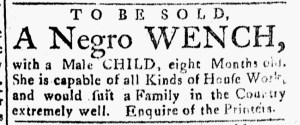
Connecticut Journal (October 14, 1774).

**********

New-Hampshire Gazette (October 14, 1774).

**********

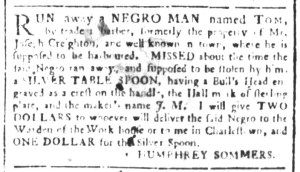
South-Carolina and American General Gazette (October 14, 1774).

**********

South-Carolina and American General Gazette (October 14, 1774).

**********

South-Carolina and American General Gazette (October 14, 1774).

**********

South-Carolina and American General Gazette (October 14, 1774).

**********

South-Carolina and American General Gazette (October 14, 1774).

**********

South-Carolina and American General Gazette (October 14, 1774).

**********

South-Carolina and American General Gazette (October 14, 1774).

**********

South-Carolina and American General Gazette (October 14, 1774).

**********

South-Carolina and American General Gazette (October 14, 1774).

**********

South-Carolina and American General Gazette (October 14, 1774).

**********

South-Carolina and American General Gazette (October 14, 1774).

**********

South-Carolina and American General Gazette (October 14, 1774).

**********

South-Carolina and American General Gazette (October 14, 1774).

**********

South-Carolina and American General Gazette (October 14, 1774).

**********

South-Carolina and American General Gazette (October 14, 1774).

**********

South-Carolina and American General Gazette (October 14, 1774).

**********

South-Carolina and American General Gazette (October 14, 1774).

**********

South-Carolina and American General Gazette (October 14, 1774).

**********

South-Carolina and American General Gazette (October 14, 1774).

**********

South-Carolina and American General Gazette (October 14, 1774).

**********

South-Carolina and American General Gazette (October 14, 1774).

**********

South-Carolina and American General Gazette (October 14, 1774).

**********

South-Carolina and American General Gazette (October 14, 1774).