October 13

What was advertised in a colonial American newspaper 250 years ago today?
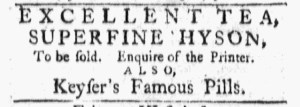
Rivington’s New-York Gazetteer (October 13, 1774).

“EXCELLENT TEA, SUPERFINE HYSON.”

Advertisements for tea did not disappear from American newspapers immediately following the Boston Tea Party, nor did they disappear in anticipation of nonimportation agreements enacted in protest of the Coercive Acts that Parliament passed in response.  In Tea: Consumption, Politics, and Revolution, 1773-1776, James R. Fichter notes, “Printers Isaiah Thomas (Patriot) and James Rivington (Loyalist) used their newspapers to advertise their own tea.”[1]  Rivington did so in the October 13, 1774, edition of Rivington’s New-York Gazetteer, offering both “EXCELLENT TEA, SUPERFINE HYSON,” and “Keyser’s Famous Pills,” one of the most famous patent medicines of the era.

Yet that was not only advertisement for tea in that issue.  In the next column, Abraham Duryee provided an extensive list of imported merchandise that concluded with a familiar list: “sugar, tea, coffee, corks, &c. &c. &c.”  On the next page, tavernkeeper Edward Bardin once again inserted his advertisement that promoted “TEA and COFFEE every afternoon” among the amenities available at his establishment.  In the two-page supplement, filled entirely with advertisements, William Parsons included “Green Tea” among the wares in stock at his store.  Peter Elting sold “best Hyson and Bohea tea” along with other groceries.  Fichter reports that Rivington’s New-York Gazetteer “carried tea ads until early 1775, reaching colonies where local tea advertising had already ended.”[2]  Colonial newspapers tended to circulate across regions, including Rivington’s New-York Gazetteer; or, the Connecticut, Hudson’s Rivers, New-Jersey, and Quebec Weekly Advertiser.

Rivington’s editorial stance as well as the advertisements for tea in his newspaper caught the attention of Patriots in New York and beyond.  They often burned Rivington’s New-York Gazetteer, both along with tea and separately.  Furthermore, Fichter identifies “[c]ommittees in at least twenty communities from Rhode Island to South Carolina called for boycotts of his Gazetteer” and “also pressed Rivington’s advertisers” by “urg[ing] ‘Friends of America’ to avoid Rivington and his advertisers.”[3]  Even as tea became the subject of news coverage and editorials and advertisements for tea no longer appeared in some colonial newspapers, other continued to publish advertisements for tea for more than a year after the Boston Tea Party.  The commodity was hotly contested, even as Patriots attempted to impose a boycott of the problematic beverage.

**********

[1] James R. Fichter, Tea: Consumption, Politics, and Revolution, 1773-1776 (Ithaca: Cornell University Press, 2023), 144.

[2] Fichter, Tea, 154.

[3] Fichter, Tea, 208.
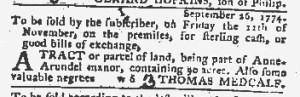
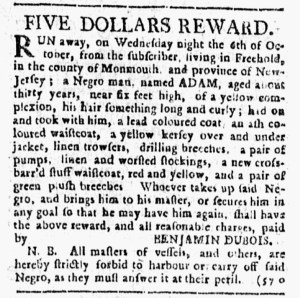
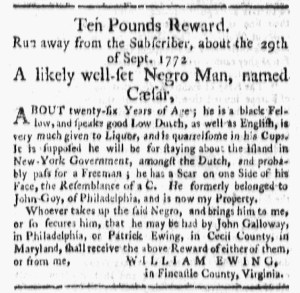
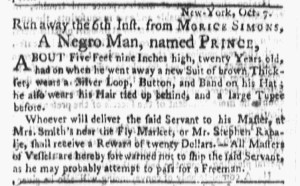
Slavery Advertisements Published October 13, 1774

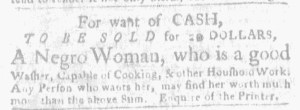
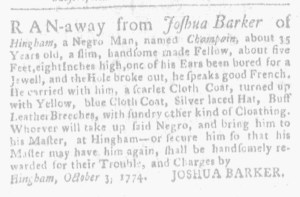
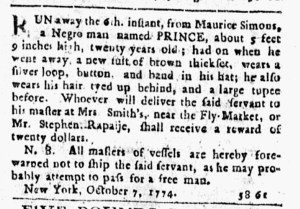
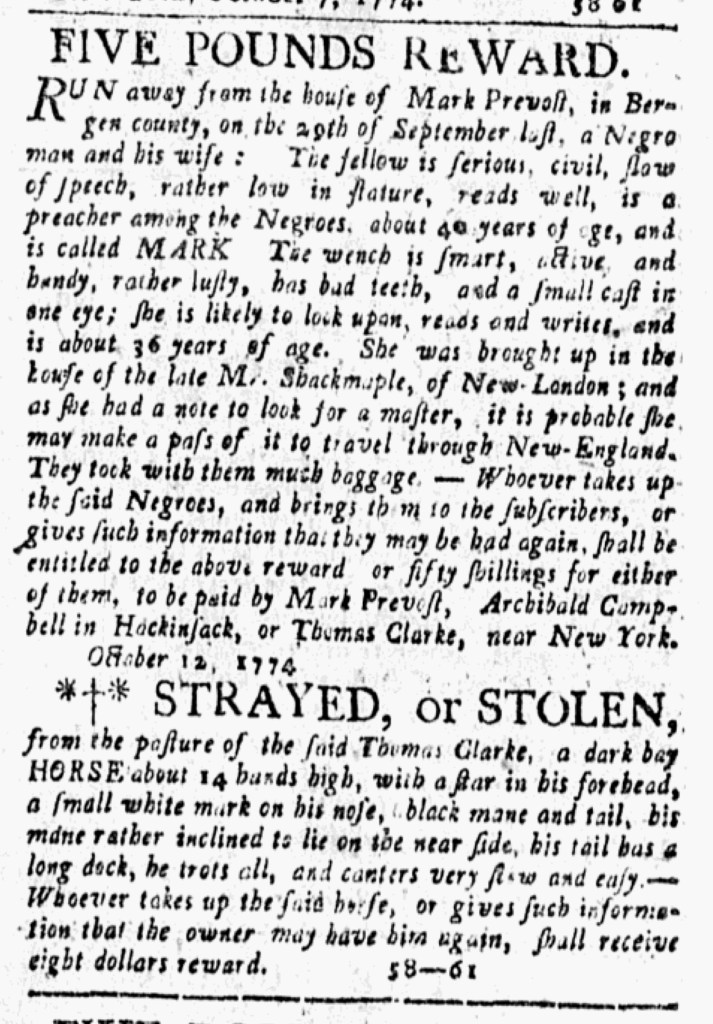
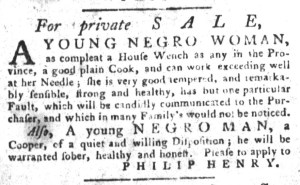
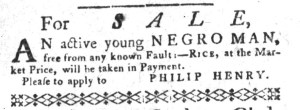
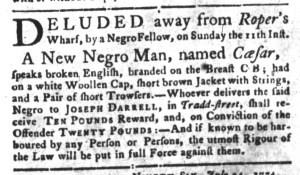
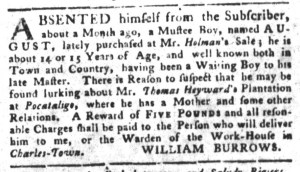
The Slavery Adverts 250 Project chronicles the role of newspaper advertising in perpetuating slavery in the era of the American Revolution. The project seeks to reveal the ubiquity of slavery in eighteenth-century life from New England to Georgia by republishing advertisements about enslaved people – for sale as individuals or in groups, wanted to purchase or for hire for short periods, runaways who liberated themselves, and those who were subsequently captured and confined in jails and workhouses – in daily digests on this site as well as in real time via the @SlaveAdverts250 Twitter feed, utilizing twenty-first-century media to stand in for the print media of the eighteenth century.

The project aims to provide modern audiences with a sense of just how often colonizers encountered these advertisements in their daily lives. Enslaved men, women, and children appeared in print somewhere in the colonies almost every single day. Those advertisements served as a constant backdrop for social, cultural, economic, and political life in colonial and revolutionary America. Colonizers who did not purport to own enslaved people were still confronted with slavery as well as invited to maintain the system by purchasing enslaved men, women, and children or assisting in the capture of so-called “runaways” who sought to free themselves from bondage. The frequency of these newspaper advertisements suggests just how embedded slavery was in colonial and revolutionary American culture in everyday interactions beyond the printed page.

These advertisements also testify to the experiences of enslaved men, women, and children, though readers must consider that those experiences have been remediated through descriptions offered by enslavers rather than enslaved people themselves. Often unnamed in the advertisements, enslaved men, women, and children were not invisible or unimportant in early America.

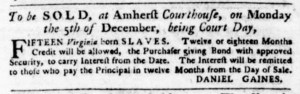
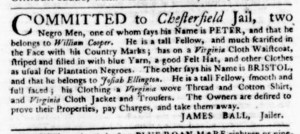
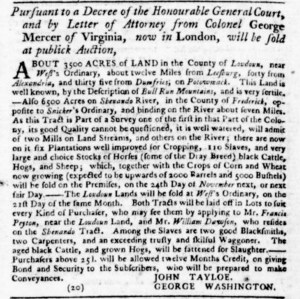
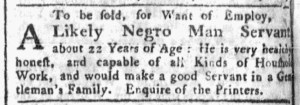
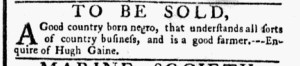
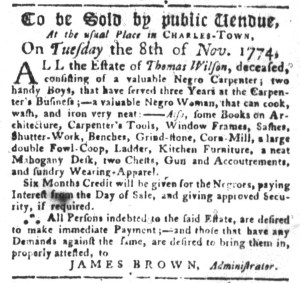
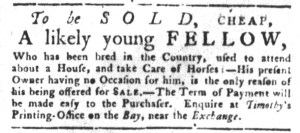
These advertisements appeared in colonial American newspapers 250 years ago today.

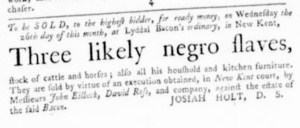
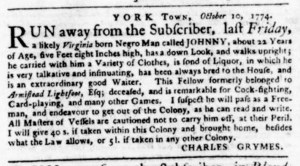
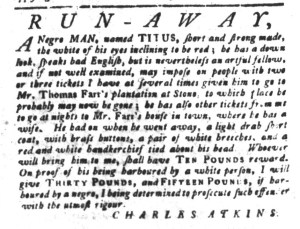
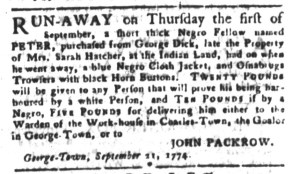
Maryland Gazette (October 13, 1774).

**********

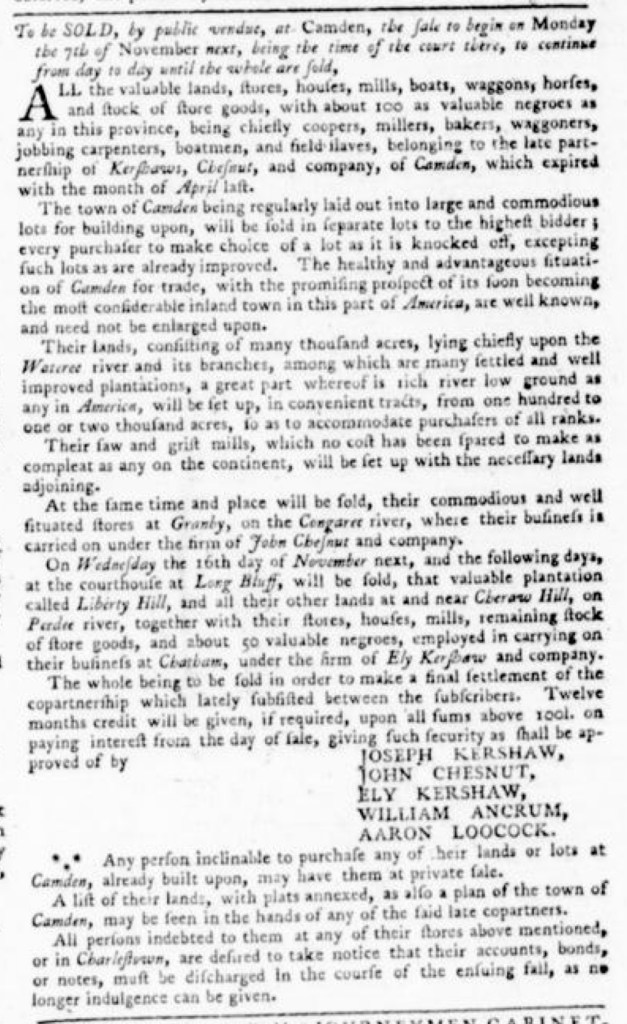
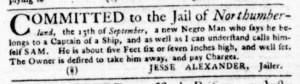
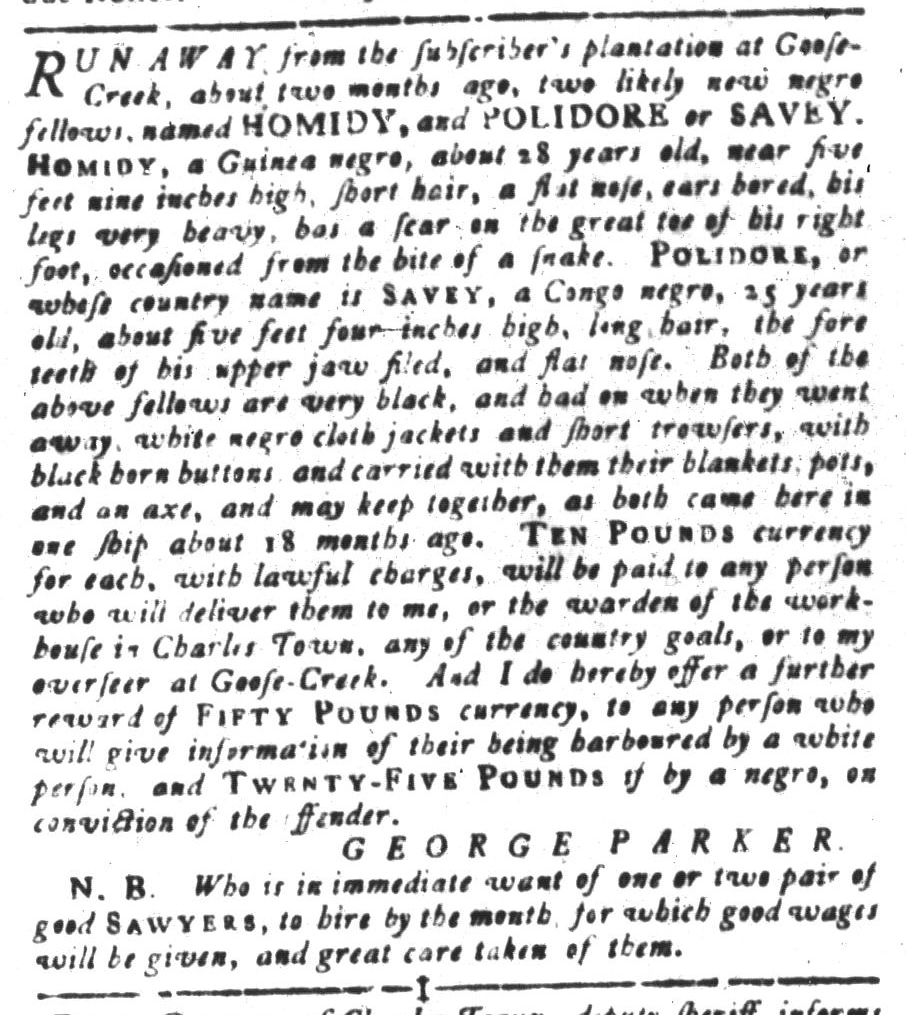
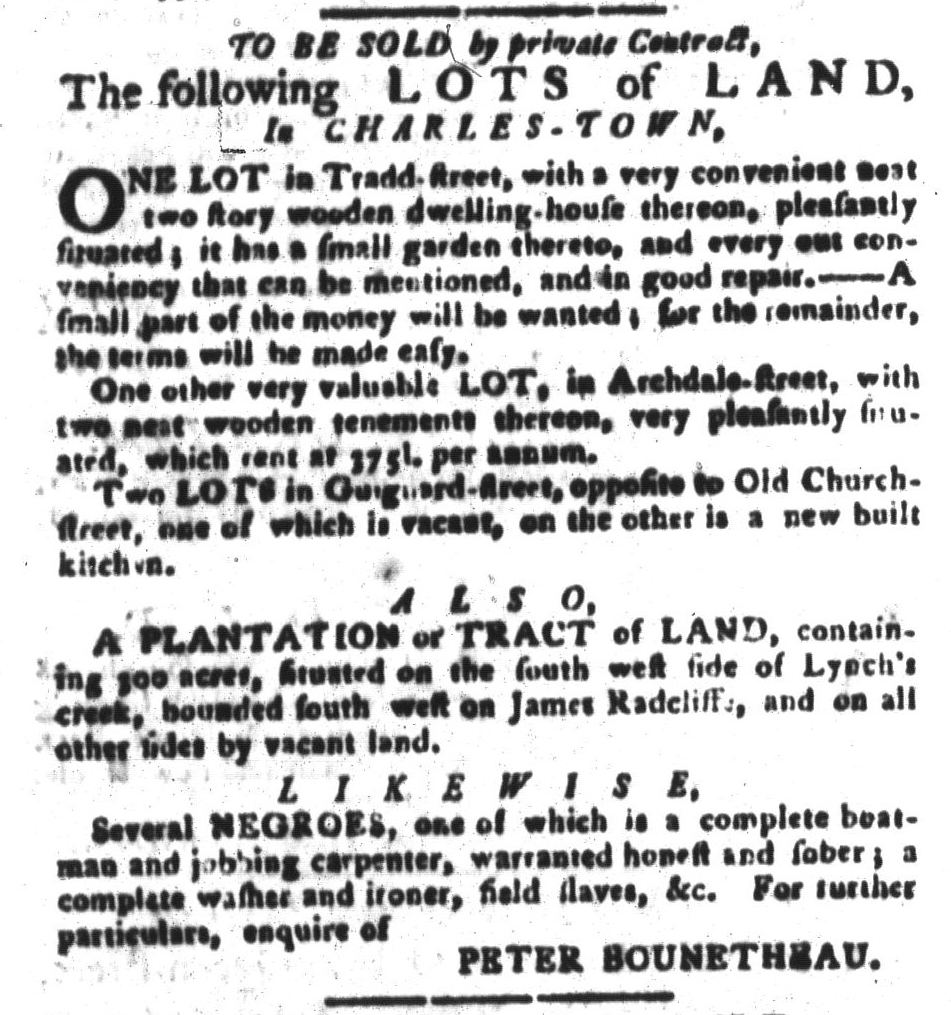
Maryland Gazette (October 13, 1774).

**********

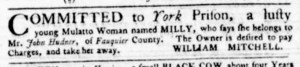
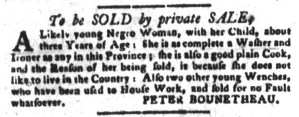
Massachusetts Gazette and Boston Weekly News-Letter (October 13, 1774).

**********

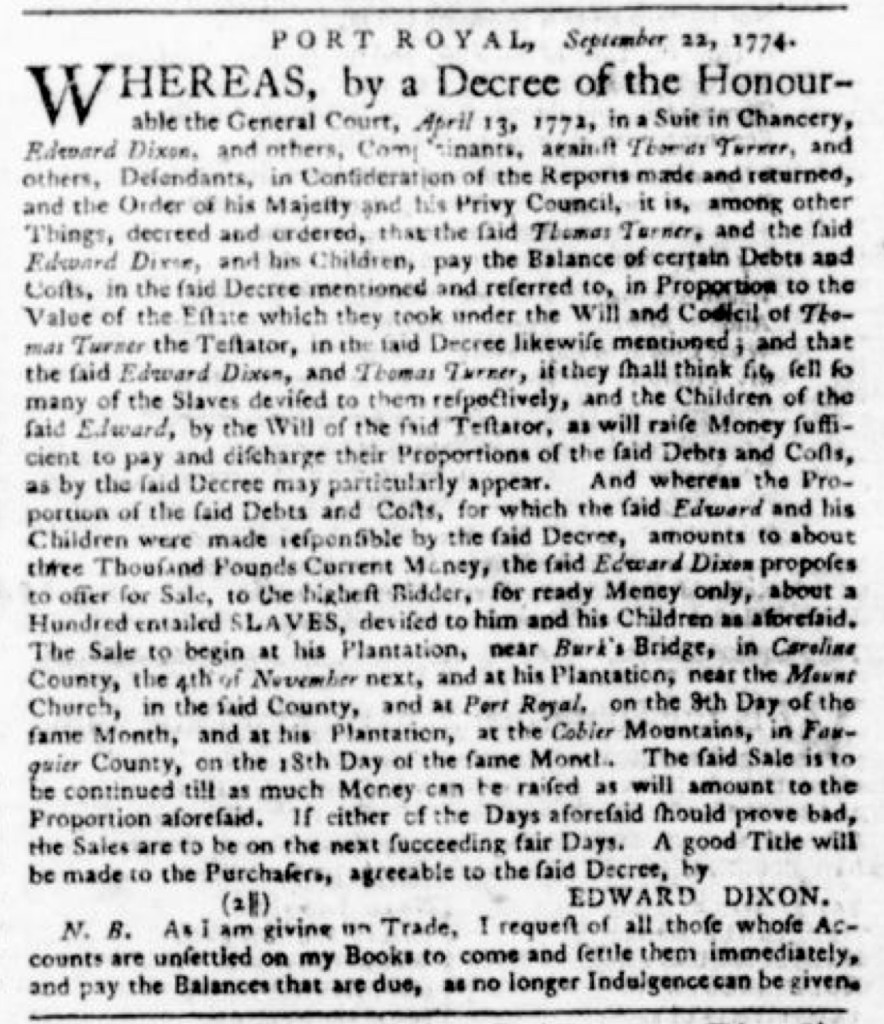
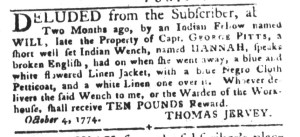
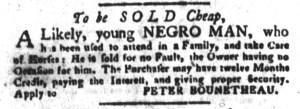
Massachusetts Gazette and Boston Weekly News-Letter (October 13, 1774).

**********

New-York Journal (October 13, 1774).

**********

New-York Journal (October 13, 1774).

**********

New-York Journal (October 13, 1774).

**********

Rivington’s New-York Gazetteer (October 13, 1774).

**********

Rivington’s New-York Gazetteer (October 13, 1774).

**********

Rivington’s New-York Gazetteer (October 13, 1774).

**********

Supplement to Rivington’s New-York Gazetteer (October 13, 1774).

**********

Supplement to Rivington’s New-York Gazetteer (October 13, 1774).

**********

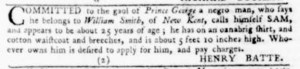
Virginia Gazette [Pinkney] (October 13, 1774).

**********

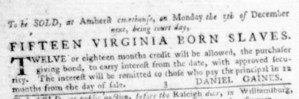
Virginia Gazette [Pinkney] (October 13, 1774).

**********

Virginia Gazette [Pinkney] (October 13, 1774).

**********

Virginia Gazette [Pinkney] (October 13, 1774).

**********

Virginia Gazette [Pinkney] (October 13, 1774).

**********

Virginia Gazette [Pinkney] (October 13, 1774).

**********

Virginia Gazette [Pinkney] (October 13, 1774).

**********

Virginia Gazette [Pinkney] (October 13, 1774).

**********

Virginia Gazette [Purdie and Dixon] (October 13, 1774).

**********

Virginia Gazette [Purdie and Dixon] (October 13, 1774).

**********

Virginia Gazette [Purdie and Dixon] (October 13, 1774).

**********

Virginia Gazette [Purdie and Dixon] (October 13, 1774).

**********

Virginia Gazette [Purdie and Dixon] (October 13, 1774).

**********

Virginia Gazette [Purdie and Dixon] (October 13, 1774).

**********

Virginia Gazette [Purdie and Dixon] (October 13, 1774).

**********

Virginia Gazette [Purdie and Dixon] (October 13, 1774).

**********

Virginia Gazette [Purdie and Dixon] (October 13, 1774).

**********

Virginia Gazette [Purdie and Dixon] (October 13, 1774).

October 12

What was advertised in a colonial American newspaper 250 years ago today?

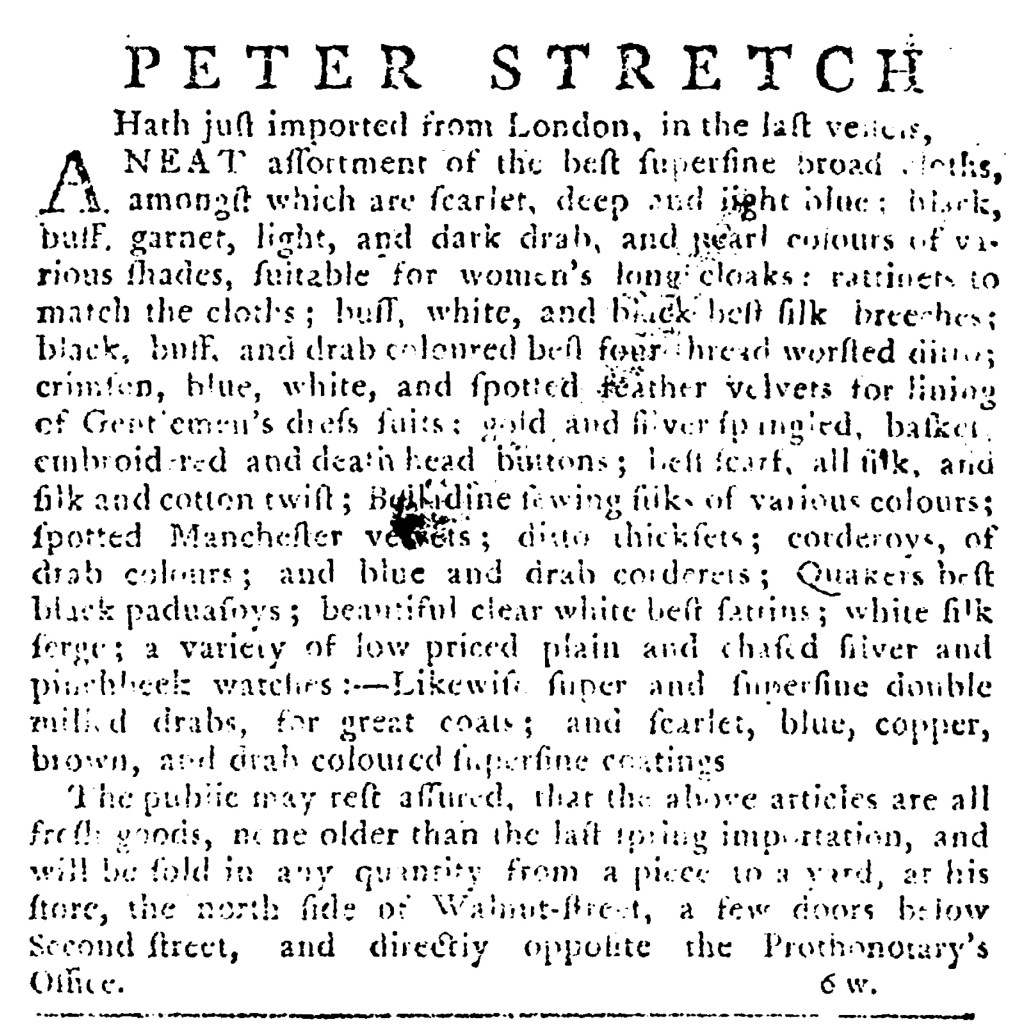
Pennsylvania Journal (October 12, 1774).

“The above articles are all fresh goods, none older than the last spring importation.”

In the fall of 1774, Peter Stretch advertised a “NEAT assortment” of textiles and accessories that he “Hath just imported from London, in the last vessels.”  In an advertisement in the October 12 edition of the Pennsylvania Journal, he listed many of those items, including “the best superfine broad cloths, amongst which are scarlet, deep and light blue, black, buff, garnet, light, and dark drab and pearl colours of various shades, suitable for women’s long cloaks,” “crimson, blue, white, and spotted feather velvets for lining of Gentlemen’s dress suits,” and “gold and silver spangled, basket, embroidered and death head buttons.”

In stating that he had recently imported his wares “in the last vessels,” Stretch deployed language commonly used by merchants and shopkeepers in their marketing efforts.  Elsewhere on the same page, for instance, Barclay and Mitchell declared that they stocked merchandise “Imported in the last vessels from England.”  Yet Stretch decided to provide further details about when he received his inventory at the end of his advertisement.  “The public may rest assured,” he confided, “that the above articles are all fresh goods, none older than the last spring importation.”  Stretch was in a bit of an awkward position.  He wanted the public to think of his goods as new rather than as leftovers that had been lingering on the shelves or in the storeroom, yet not too new.  As the First Continental Congress continued to meet in Philadelphia, just a short distance from Stretch’s store, the colonies prepared to adopt a nonimportation agreement in protest of the Coercive Acts imposed by Parliament following the Boston Tea Party.  Stretch seemingly did not want the public to get the impression that he had imported surplus goods with the intention of sidestepping any nonimportation agreement when it went into effect.  That would have meant allegations that he technically lived up to the letter of the pact but not the spirit.  Rather than hoarding goods in recent months to sell once a nonimportation made imported wares scarce, Stretch “assured” the public that he acquired much of his inventory during “the last spring importation” before the colonies knew about the Boston Port Act, the Massachusetts Government Act, and other legislation passed by Parliament.  He hoped that made it acceptable for patriots to make purchases at his store even as they became wary of the goods carried by his competitors.

Slavery Advertisements Published October 12, 1774

The Slavery Adverts 250 Project chronicles the role of newspaper advertising in perpetuating slavery in the era of the American Revolution. The project seeks to reveal the ubiquity of slavery in eighteenth-century life from New England to Georgia by republishing advertisements about enslaved people – for sale as individuals or in groups, wanted to purchase or for hire for short periods, runaways who liberated themselves, and those who were subsequently captured and confined in jails and workhouses – in daily digests on this site as well as in real time via the @SlaveAdverts250 Twitter feed, utilizing twenty-first-century media to stand in for the print media of the eighteenth century.

The project aims to provide modern audiences with a sense of just how often colonizers encountered these advertisements in their daily lives. Enslaved men, women, and children appeared in print somewhere in the colonies almost every single day. Those advertisements served as a constant backdrop for social, cultural, economic, and political life in colonial and revolutionary America. Colonizers who did not purport to own enslaved people were still confronted with slavery as well as invited to maintain the system by purchasing enslaved men, women, and children or assisting in the capture of so-called “runaways” who sought to free themselves from bondage. The frequency of these newspaper advertisements suggests just how embedded slavery was in colonial and revolutionary American culture in everyday interactions beyond the printed page.

These advertisements also testify to the experiences of enslaved men, women, and children, though readers must consider that those experiences have been remediated through descriptions offered by enslavers rather than enslaved people themselves. Often unnamed in the advertisements, enslaved men, women, and children were not invisible or unimportant in early America.

These advertisements appeared in colonial American newspapers 250 years ago today.

Essex Journal (October 12, 1774).

**********

Pennsylvania Gazette (October 12, 1774).

**********

Pennsylvania Gazette (October 12, 1774).

**********

Pennsylvania Gazette (October 12, 1774).

**********

Pennsylvania Journal (October 12, 1774).

October 11

What was advertised in a colonial American newspaper 250 years ago today?

Essex Gazette (October 11, 1774).

“LOST at the Fire on Wednesday Night last … the following Pieces of Merchandise.”

The October 11, 1774, edition of the Essex Gazette included coverage of a fire in Salem on October 6.  The conflagration destroyed the homes of several families as well as the shops and stores of more than a dozen merchants and shopkeepers.  In addition, the fire consumed a meeting house and the customs house.  Samuel Hall and Ebenezer Hall, the printers of the Essex Gazette, lost their printing office.  Just below the article about the fire, they inserted a notice alerting the public that they had relocated.  The Halls also reported that “Great Quantities of Goods, House Furniture and Papers of Value were lost, stole and destroyed in the Confusion and Destruction occasioned by the Fire; but it is impossible to obtain Accounts from the several Sufferers, sufficiently accurate to publish at this Time.”

That did not prevent others from publishing more information about the fire, either as letters to editors or by taking out advertisements that supplemented the coverage provided by the Halls.  One letter, for instance, noted that “the Sufferers in the late Fire in this Town, and others whose Goods were removed, still miss great Quantities of their Furniture and Goods.”  Such items clearly had not been misplaced and would soon be recovered as the confusion subsided and the town recovered; instead, the anonymous author asserted that goods and personal property “were stolen by the hardened Villains who ever stand ready to make their Harvest at such Times of Danger and Distress.”  Furthermore, those “Miscreants, in the Form of Pedlars, will doubtless be hawking these Goods about the Country,” capitalizing on the misfortune of others.  The letter concluded with a call for “well disposed People” to identify and imprison the thieves and encouraging justices of the peace to invoke existing laws to regulate peddlers to make sure they did not sell stolen goods when they “stroll[ed] about the Country.”

Nathaniel Sparhawk was among those with missing goods following the fire.  In an advertisement, he listed and described “Pieces of Merchandise” he “LOST at the Fire.”  He offered a reward to “Whoever will bring the above Articles or any of them” to him.  In a nota bene, he added, “No Questions will be asked.”  In other words, he only sought to recover goods apparently looted during the fire, choosing to give the benefit of the doubt that they had been removed to save them.  In exchange for that polite fiction, he would not prosecute anyone whose conscience (or the reward) prompted them to return the items.  He hoped that a reward given without questions or the possibility of prosecution would seem more attractive than whatever thieves might earn if they risked selling or fencing the stolen items.

Other advertisements also provided additional information about the fire.  One offered “300 Dollars Reward” to anyone who “will give Information” that the fire “was kindled with Design.”  Many residents believed the fire had been set intentionally.  Anyone who could prove that was the case would receive the reward “on Conviction of the Perpetrator or Perpetrators.”  Henry Putnam, who lost his shop in the fire, feared that he was a suspect.  In his own advertisement, he reported that “some ill-minded Person or Persons” spread “false Reports … intimating that there was reason to suspect that I had been guilty of the horrid Crime of being the Occasion of the late terrible Fire.”  Doing what he could to combat such gossip, he harnessed the power of the press to inform the public, especially “People at a Distance” who might hear such rumors, that “the People of this Place are fully convinced that the Reports are false and groundless.” Putnam defended his reputation in print, hoping to reach people who heard tales that spread by word of mouth.

Readers of the Essex Gazette pieced together a more complete account of the fire and its aftermath when they consulted the coverage written by the printers, the letter to the editors, and the advertisements.  As was often the case in colonial newspapers, advertisements delivered news that supplemented information that appeared elsewhere.  In this instance, the advertisements appeared in the next column, immediately to the right of the news, helping readers to make connections among the different kinds of reporting.

Slavery Advertisements Published October 11, 1774

The Slavery Adverts 250 Project chronicles the role of newspaper advertising in perpetuating slavery in the era of the American Revolution. The project seeks to reveal the ubiquity of slavery in eighteenth-century life from New England to Georgia by republishing advertisements about enslaved people – for sale as individuals or in groups, wanted to purchase or for hire for short periods, runaways who liberated themselves, and those who were subsequently captured and confined in jails and workhouses – in daily digests on this site as well as in real time via the @SlaveAdverts250 Twitter feed, utilizing twenty-first-century media to stand in for the print media of the eighteenth century.

The project aims to provide modern audiences with a sense of just how often colonizers encountered these advertisements in their daily lives. Enslaved men, women, and children appeared in print somewhere in the colonies almost every single day. Those advertisements served as a constant backdrop for social, cultural, economic, and political life in colonial and revolutionary America. Colonizers who did not purport to own enslaved people were still confronted with slavery as well as invited to maintain the system by purchasing enslaved men, women, and children or assisting in the capture of so-called “runaways” who sought to free themselves from bondage. The frequency of these newspaper advertisements suggests just how embedded slavery was in colonial and revolutionary American culture in everyday interactions beyond the printed page.

These advertisements also testify to the experiences of enslaved men, women, and children, though readers must consider that those experiences have been remediated through descriptions offered by enslavers rather than enslaved people themselves. Often unnamed in the advertisements, enslaved men, women, and children were not invisible or unimportant in early America.

These advertisements appeared in colonial American newspapers 250 years ago today.

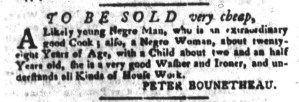
South-Carolina Gazette and Country Journal (October 11, 1774).

**********

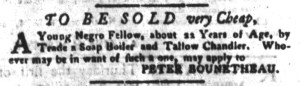
South-Carolina Gazette and Country Journal (October 11, 1774).

**********

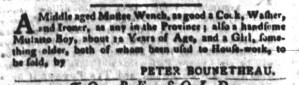
South-Carolina Gazette and Country Journal (October 11, 1774).

**********

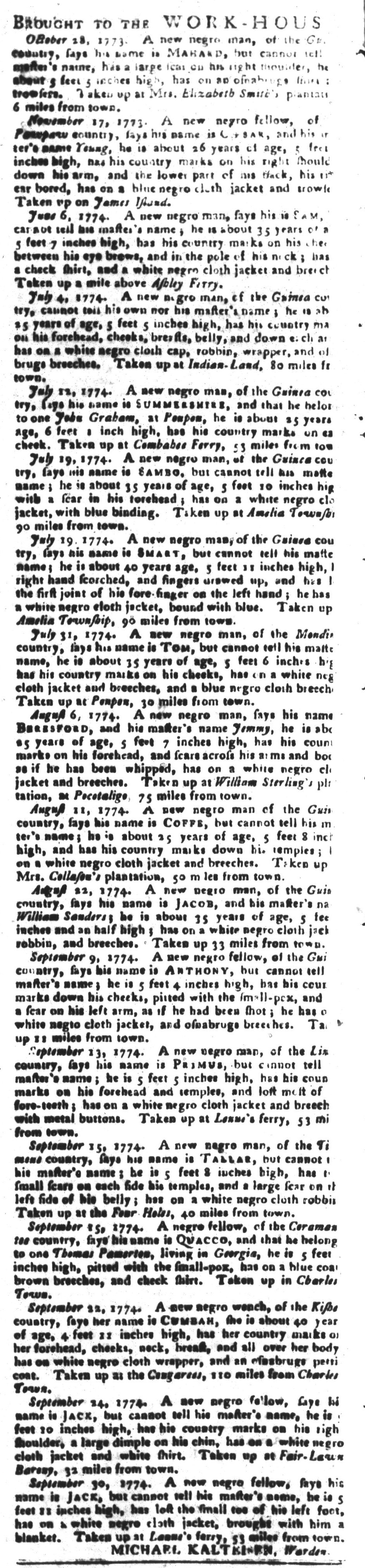
South-Carolina Gazette and Country Journal (October 11, 1774).

**********

South-Carolina Gazette and Country Journal (October 11, 1774).

**********

South-Carolina Gazette and Country Journal (October 11, 1774).

**********

South-Carolina Gazette and Country Journal (October 11, 1774).

**********

Supplement to the South-Carolina Gazette and Country Journal (October 11, 1774).

**********

Supplement to the South-Carolina Gazette and Country Journal (October 11, 1774).

**********

Supplement to the South-Carolina Gazette and Country Journal (October 11, 1774).

**********

Supplement to the South-Carolina Gazette and Country Journal (October 11, 1774).

**********

Supplement to the South-Carolina Gazette and Country Journal (October 11, 1774).

**********

Supplement to the South-Carolina Gazette and Country Journal (October 11, 1774).

**********

Supplement to the South-Carolina Gazette and Country Journal (October 11, 1774).

**********

Supplement to the South-Carolina Gazette and Country Journal (October 11, 1774).

**********

Supplement to the South-Carolina Gazette and Country Journal (October 11, 1774).

**********

Supplement to the South-Carolina Gazette and Country Journal (October 11, 1774).

**********

Supplement to the South-Carolina Gazette and Country Journal (October 11, 1774).

**********

Supplement to the South-Carolina Gazette and Country Journal (October 11, 1774).

October 10

Who was the subject of an advertisement in a colonial American newspaper 250 years ago today?

Connecticut Courant (October 10, 1774).

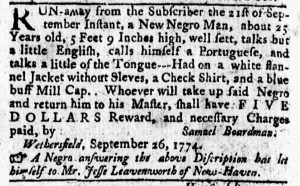
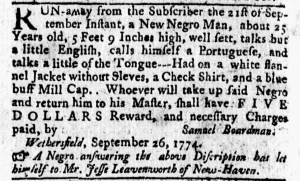
A Negro answering the above Discription has let himself to Mr. Jesse Leavensworth of New-Haven.”

In the fall of 1774, Samuel Boardman of Wethersfield took to the pages of the Connecticut Courant and Hartford Weekly Intelligencer to offer a reward for the capture and return of a “New Negro Man” who liberated himself by running away.  Boardman did not give a name for this man, but instead stated that he “talks but a little English, calls himself a Portuguese, and talks a little of the Tongue.”  He offered a reward to “Whoever will take up said Negro and return him to his Master.”  Dated September 26, the advertisement first appeared in the October 3 edition of the Connecticut Courant.  It included a notation indicating that a “Negro answering the above Discription has let himself to Mr. Jesse Leavensworth of New-Haven.”  Boardman most likely did not include that information in the copy he submitted to the printing office.

Instead, Ebenezer Watson, the printer, likely supplied it upon reading an advertisement that Leavenworth placed in the September 30 edition of the Connecticut Journal and New-Haven Post-Boy.  After all, printers regularly exchanged newspapers in hopes of acquiring content for their own publications.  Leavenworth devoted most of that notice to giving instructions for hiring his ferry, but added a note that recently a “lusty negro man, about 23 or 24 years old, speaks the Portuguese language, but little English” had “let himself to me.”  Leavenworth hired the young man, but was suspicious that he was a fugitive seeking freedom and his enslaver was looking for him.  Just in case, he supplemented his advertisement for the ferry with the description of the Black man who spoke Portuguese.  Given the timing of the advertisements in the two newspapers, Boardman would not have seen Leavenworth’s notice when he drafted his own advertisement.  If he had that information, he could have dispensed with advertising at all.

What role did Watson play in keeping Boardman informed about this development?  He might have dispatched a message to the advertiser in Wethersfield, though he could have considered the note at the end of the advertisement sufficient to update Boardman, figuring that his customer would check the pages of the Connecticut Courant to confirm that his notice appeared.  Watson could have also sent a message to Thomas Green and Samuel Green, the printers of the Connecticut Journal, along with his exchange copy of the Connecticut Courant, expecting they might pass along the information to Leavenworth.  In addition, Leavenworth might have eventually encountered Boardman’s advertisement, depending on his reading habits, or otherwise heard about it.  That alternative seems most likely.  No matter what other action Watson took, inserting the note that connected the unnamed Black man in Boardman’s advertisement in the Connecticut Courant to the unnamed Black man in Leavenworth’s advertisement in the Connecticut Journal alerted readers that they could collect the reward if they decided to pursue the matter.  The power of the press, including a printer whose assistance extended beyond merely setting type and disseminating the advertisement, worked to the advantage of Boardman, the enslaver, against the interests of the unnamed Black man who spoke Portuguese.

Slavery Advertisements Published October 10, 1774

The Slavery Adverts 250 Project chronicles the role of newspaper advertising in perpetuating slavery in the era of the American Revolution. The project seeks to reveal the ubiquity of slavery in eighteenth-century life from New England to Georgia by republishing advertisements about enslaved people – for sale as individuals or in groups, wanted to purchase or for hire for short periods, runaways who liberated themselves, and those who were subsequently captured and confined in jails and workhouses – in daily digests on this site as well as in real time via the @SlaveAdverts250 Twitter feed, utilizing twenty-first-century media to stand in for the print media of the eighteenth century.

The project aims to provide modern audiences with a sense of just how often colonizers encountered these advertisements in their daily lives. Enslaved men, women, and children appeared in print somewhere in the colonies almost every single day. Those advertisements served as a constant backdrop for social, cultural, economic, and political life in colonial and revolutionary America. Colonizers who did not purport to own enslaved people were still confronted with slavery as well as invited to maintain the system by purchasing enslaved men, women, and children or assisting in the capture of so-called “runaways” who sought to free themselves from bondage. The frequency of these newspaper advertisements suggests just how embedded slavery was in colonial and revolutionary American culture in everyday interactions beyond the printed page.

These advertisements also testify to the experiences of enslaved men, women, and children, though readers must consider that those experiences have been remediated through descriptions offered by enslavers rather than enslaved people themselves. Often unnamed in the advertisements, enslaved men, women, and children were not invisible or unimportant in early America.

These advertisements appeared in colonial American newspapers 250 years ago today.

Boston Evening-Post (October 10, 1774).

**********

Boston Evening-Post (October 10, 1774).

**********

Boston-Gazette (October 10, 1774).

**********

Boston-Gazette (October 10, 1774).

**********

Connecticut Courant (October 10, 1774).

**********

Dunlap’s Pennsylvania Packet (October 10, 1774).

**********

Dunlap’s Pennsylvania Packet (October 10, 1774).

**********

Dunlap’s Pennsylvania Packet (October 10, 1774).

**********

Dunlap’s Pennsylvania Packet (October 10, 1774).

**********

Massachusetts Gazette and Boston Post-Boy (October 10, 1774).

**********

New-York Gazette and Weekly Mercury (October 10, 1774).

**********

South-Carolina Gazette (October 10, 1774).

**********

South-Carolina Gazette (October 10, 1774).

**********

South-Carolina Gazette (October 10, 1774).

**********

South-Carolina Gazette (October 10, 1774).

**********

South-Carolina Gazette (October 10, 1774).

**********

South-Carolina Gazette (October 10, 1774).

**********

South-Carolina Gazette (October 10, 1774).

**********

Supplement to the South-Carolina Gazette (October 10, 1774).

**********

Supplement to the South-Carolina Gazette (October 10, 1774).

**********

Supplement to the South-Carolina Gazette (October 10, 1774).

**********

Supplement to the South-Carolina Gazette (October 10, 1774).

**********

Supplement to the South-Carolina Gazette (October 10, 1774).

**********

Supplement to the South-Carolina Gazette (October 10, 1774).

**********

Supplement to the South-Carolina Gazette (October 10, 1774).

**********

Supplement to the South-Carolina Gazette (October 10, 1774).

**********

Supplement to the South-Carolina Gazette (October 10, 1774).

**********

Supplement to the South-Carolina Gazette (October 10, 1774).

**********

Supplement to the South-Carolina Gazette (October 10, 1774).

**********

Supplement to the South-Carolina Gazette (October 10, 1774).

**********

Supplement to the South-Carolina Gazette (October 10, 1774).

**********

Supplement to the South-Carolina Gazette (October 10, 1774).

October 9

What was advertised in a colonial American newspaper 250 years ago this week?

Massachusetts Gazette and Boston Weekly News-Letter (October 6, 1774).

“ALMAN[A]CK … Ornamented with a large and elegant Engraving, representing the VIRTUOUS PATRIOT.”

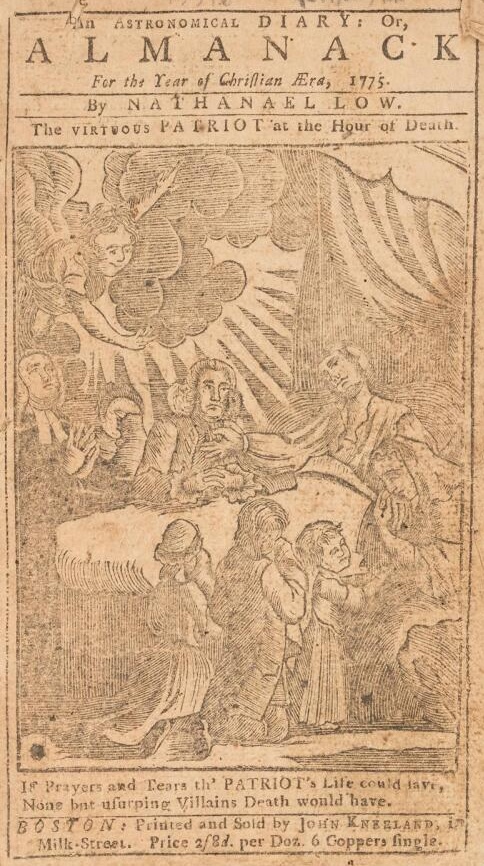
When it came to buying almanacs, residents of Boston had many choices during the era of the American Revolution.  That meant that printers often advertised what made the almanacs they published distinctive from others on the market.  Such was the case for John Kneeland when he advertised Nathanael Low’s Astronomical Diary: Or, Almanack for the Year of Christian Aera, 1775 in the Massachusetts Gazette and Boston Weekly News-Letter in the fall of 1774.  The production of the almanac and its promotion resonated with current events as the imperial crisis intensified.  The Boston Port Act closed the harbor, the Massachusetts Government Act revoked the colony’s charter, and the other Coercive Acts punished the port city for the Boston Tea Party.

Kneeland informed prospective customers that this almanac was “Ornamented with a large and elegant Engraving, representing the VIRTUOUS PATRIOT at the Hour of Death.”  In addition to the usual contents, “every Thing necessary in an Almanack,” it also included a “long and sympathetic Address to the Inhabitants of Boston, with several other Pieces of Speculation, which tends to rend it not only useful, but entertaining.”  The engraving dominated the cover of the almanac.  It depicted a man, the “VIRTUOUS PATRIOT,” on his deathbed. A woman, presumably his wife, and three children kneeled in the foreground.  On the other side of the bed, a minister prayed while another man, perhaps a relative and likely another patriot, joined the family in their vigil.  Above the bed, an angel welcomed the “VIRTUOUS PATRIOT” into heaven.  A caption below the image stated, “IF Prayers and Tear th’ PATRIOT’s Life could save, None but usurping Villains Death would have.”

According to an auction catalog prepared by PBA Galleries, the “long and sympathetic Address” filled the first four pages of the almanac.  Echoing rhetoric that circulated in newspapers and pamphlets, the address “rails against the British,” assuring residents of Boston that “[Your countrymen] are sensible the heavy hand of power under which you are now groaning is designed only as a prelude to the utter abolishment of American freedom.”  The Coercive Acts, the address warned, would enslave the colonies to Britain.  (Two advertisements on the same page as the advertisement for the almanac in the October 6, 1774, edition of the Massachusetts Gazette and Boston News-Letter concerned enslaved people, one presenting an enslaved woman for sale and the other offering a reward for the capture and return of an enslaved man who liberated himself by running away from his enslaver.)  The address proclaimed, “My dear brethren, the destiny of America seems to be suspended on the present controversy; and it is on your fidelity, firmness, and good conduct, for which you have so remarkably signalized yourself on all occasions, that a happy issue of it in a great measure depends.”  The advertisement for the almanac containing this address ran in the newspaper as the First Continental Congress continued its meetings in Philadelphia.  A month earlier, the colonial militia in Worcester County to the west of Boston had closed the courts and removed British authority in what has become known as the Worcester Revolution of 1774.  Six months after Kneeland advertised the almanac with the engraving and the address, a war for independence began with the skirmishes at Lexington and Concord.

Nathanael Low, An Astronomical Diary: Or, Almanack for the Year of Christian Aera, 1775 (Boston: John Kneeland, 1774). Courtesy PBA Galleries.

October 8

What was advertised in a colonial American newspaper 250 years ago today?

Providence Gazette (October 8, 1774).

“The whole Library may be got together, examined and numbered, as soon as possible.”

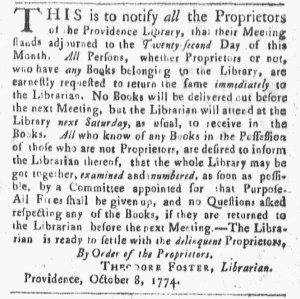
Advertisements published in the Providence Gazette reveal some of the work undertaken in administering the Providence Library Company.  In 1753, prominent residents founded this subscription library, believing that “a Collection or Library of Usefull and Edifying Books will most certainly tend to the Benefit and Instruction of the Inhabitants of this Town and County of Providence and the Rising Generation thereto belonging.”  Two decades later, Theodore Foster held the post of librarian.  He took to the pages of the Providence Gazette to address “all the Proprietors” as well as “All Persons, whether Proprietors or not, who have any Books belonging to the Library.”  Foster instructed all of them to return their books “immediately.”

The librarian apparently intended to conduct an inventory of the collection.  He informed the public that “No Books will be delivered out before the next Meeting, but the Librarian will attend at the Library next Saturday, as usual, to receive in the Books.”  Furthermore, he sought to enlist the aid of others in successfully pursuing this project: “All who know of any Books in the Possession of those who are not Proprietors, are desired to inform the Librarian thereof.”  Foster intended to be complete and comprehensive, working with a committee tasked with “examin[ing] and number[ing]” the “whole Library … as soon as possible.”  Gathering the entire collection together was more important than assessing fines for overdue books or investigating where any of the books had been.  “All Fines shall be given up,” Foster declared, “and no Questions asked respecting any of the Books, if they are returned to the Librarian before the next Meeting.”  As an aside, Foster noted that he “is ready to settle with delinquent Proprietors” who had not paid their subscription fees.

The Providence Library Company had compiled and published a Catalogue of All the Books Belonging to the Providence Library as well as Rules for Governing the Proprietors of, and Institutions for Rendering Useful the Books Belonging to the Providence Library in 1768.  The Rules, adopted in 1762, outlined the procedures for borrowing books and the duties of the librarian.  They also specified that that a “Catalogue of all the books belonging to the Library be fairly written in the Register, in alphabetical order, … care being taken to leave Room under each Letter for inserting such Books, as may hereafter be purchased.”  Despite those best intentions, the librarian and the proprietors apparently considered a careful and complete inventory necessary to assess the status of the library’s holdings.  Beyond the annual meeting for the proprietors, Foster resorted to a newspaper advertisement to reach anyone who had information about any books belonging to the library.