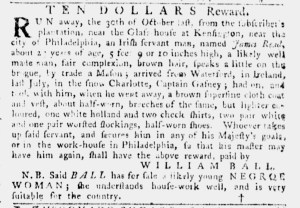
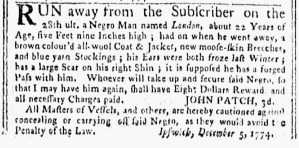
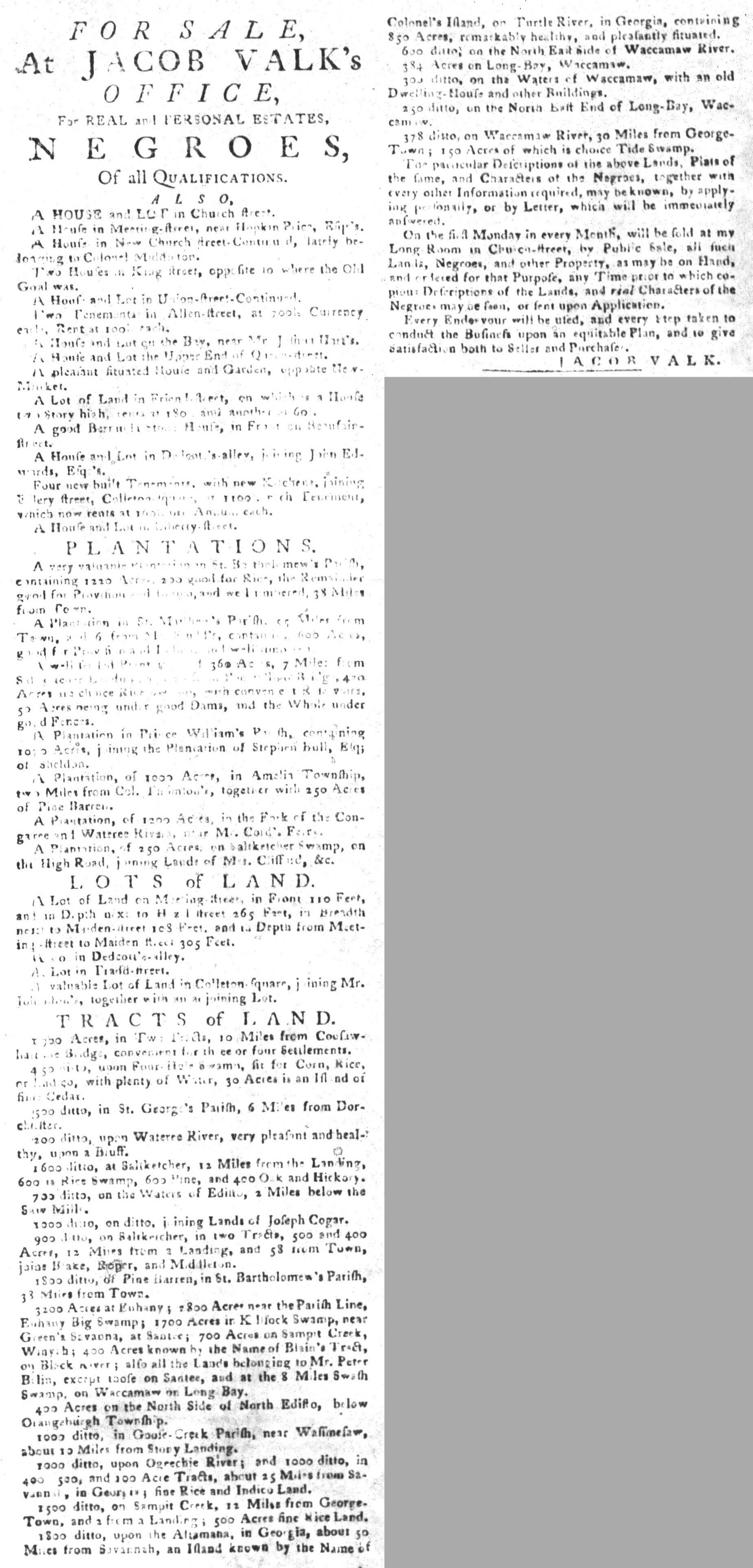
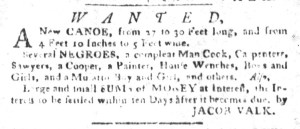
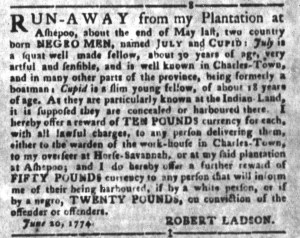
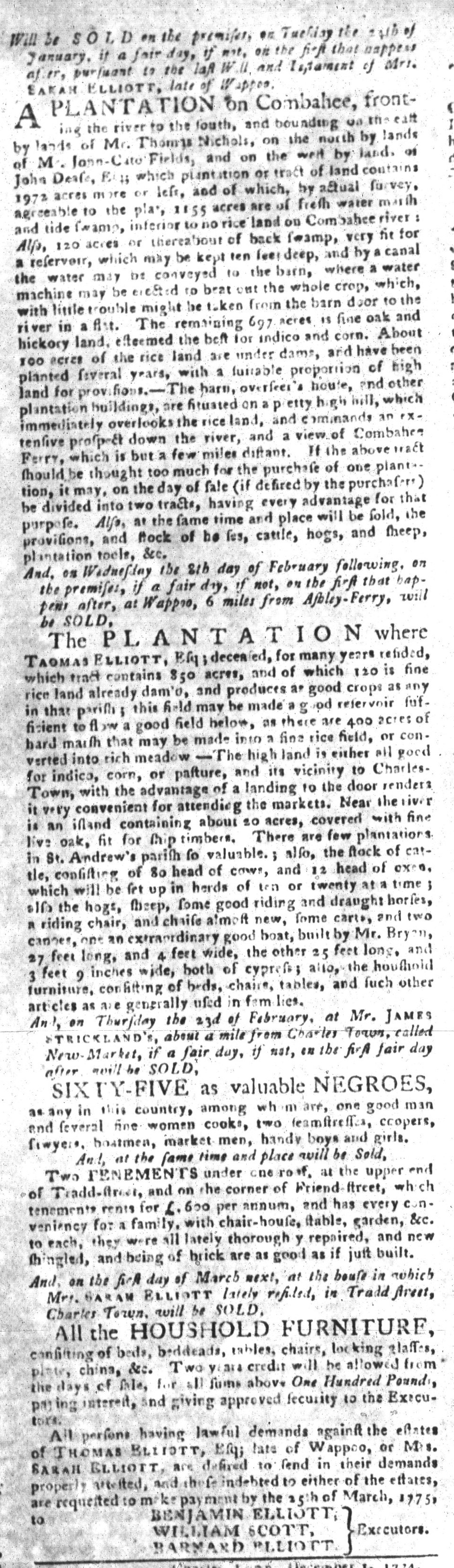
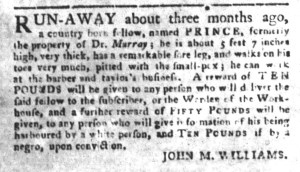
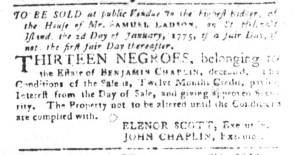
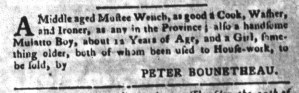
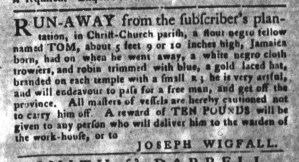
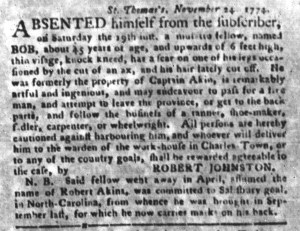
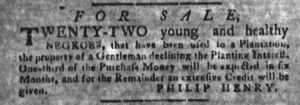
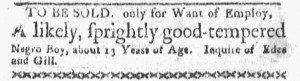
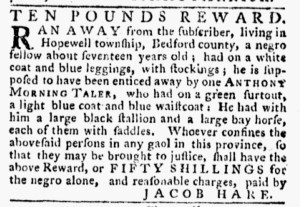
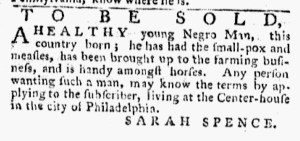
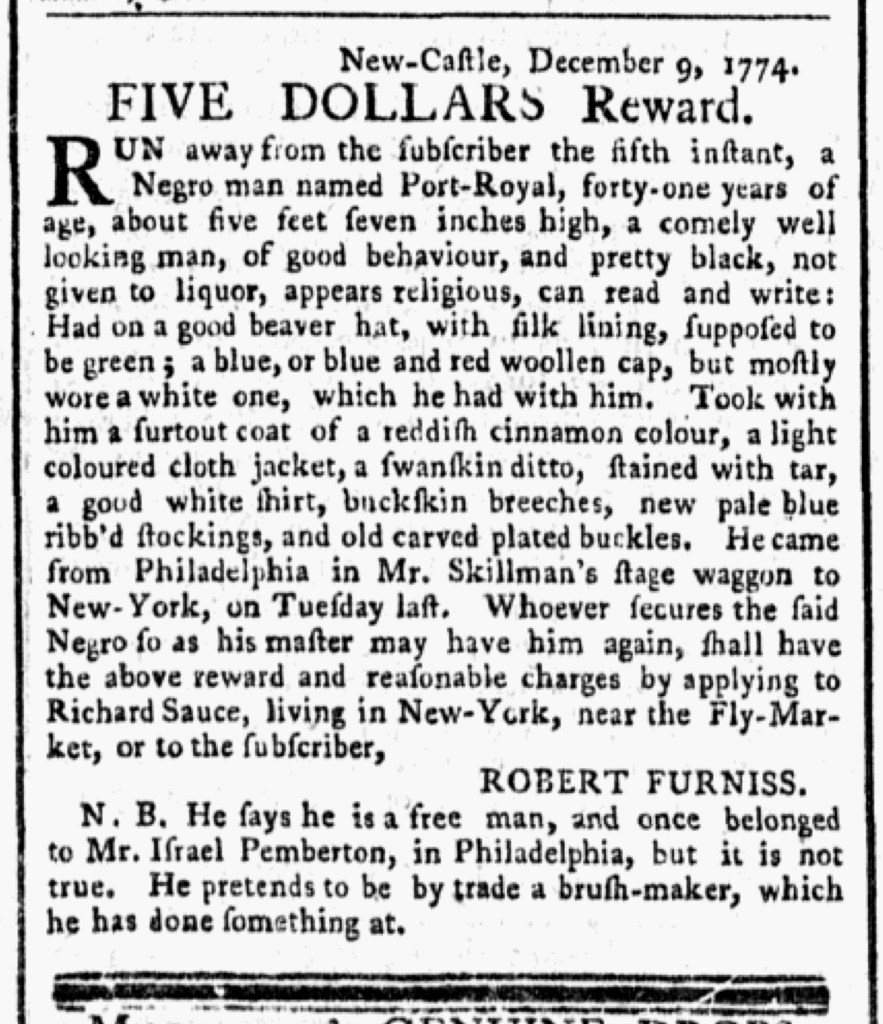
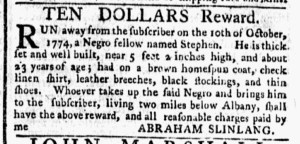
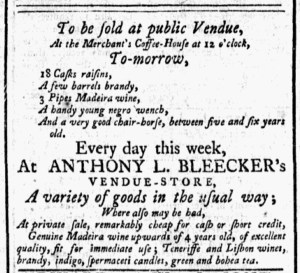
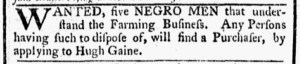
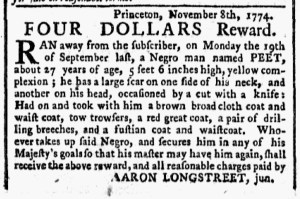
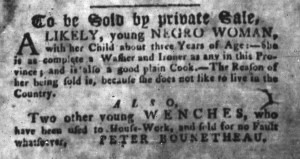
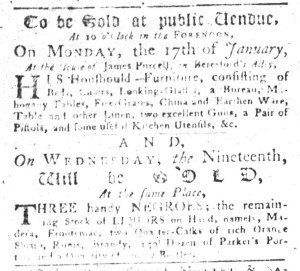
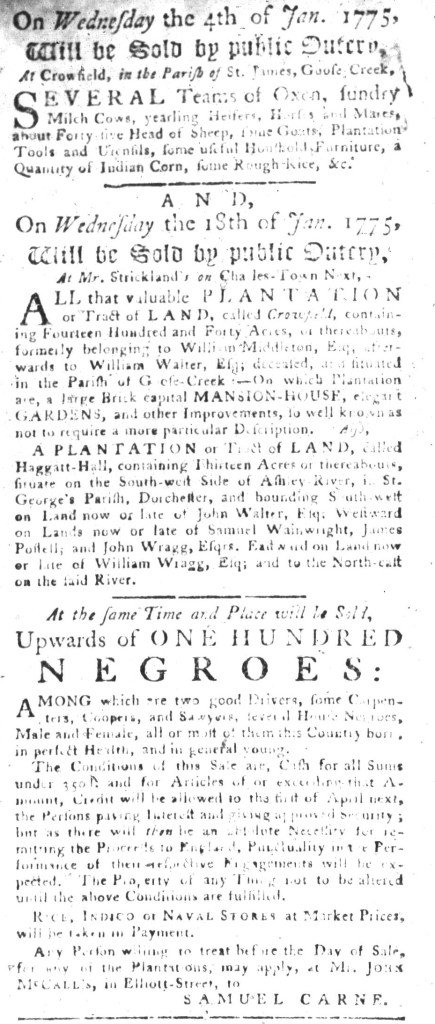
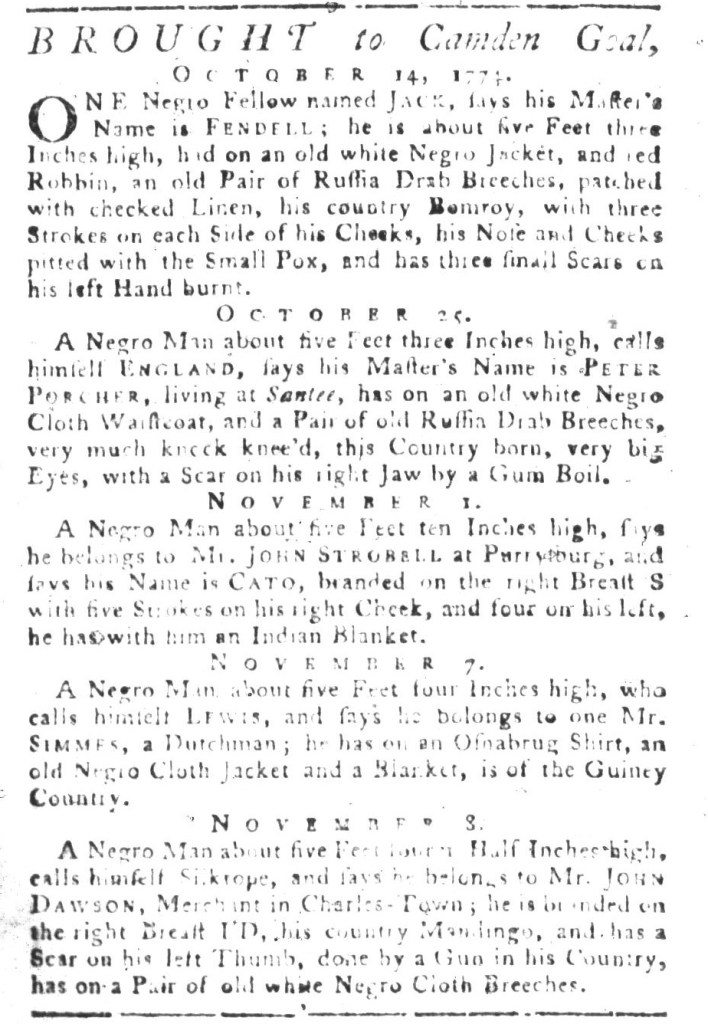
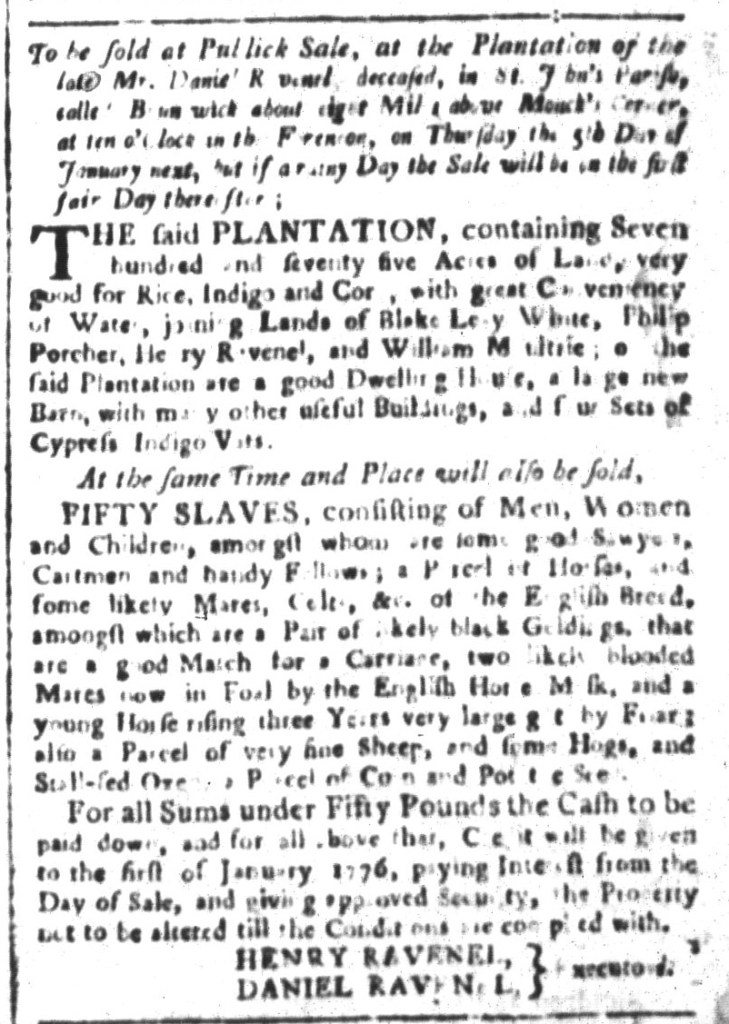
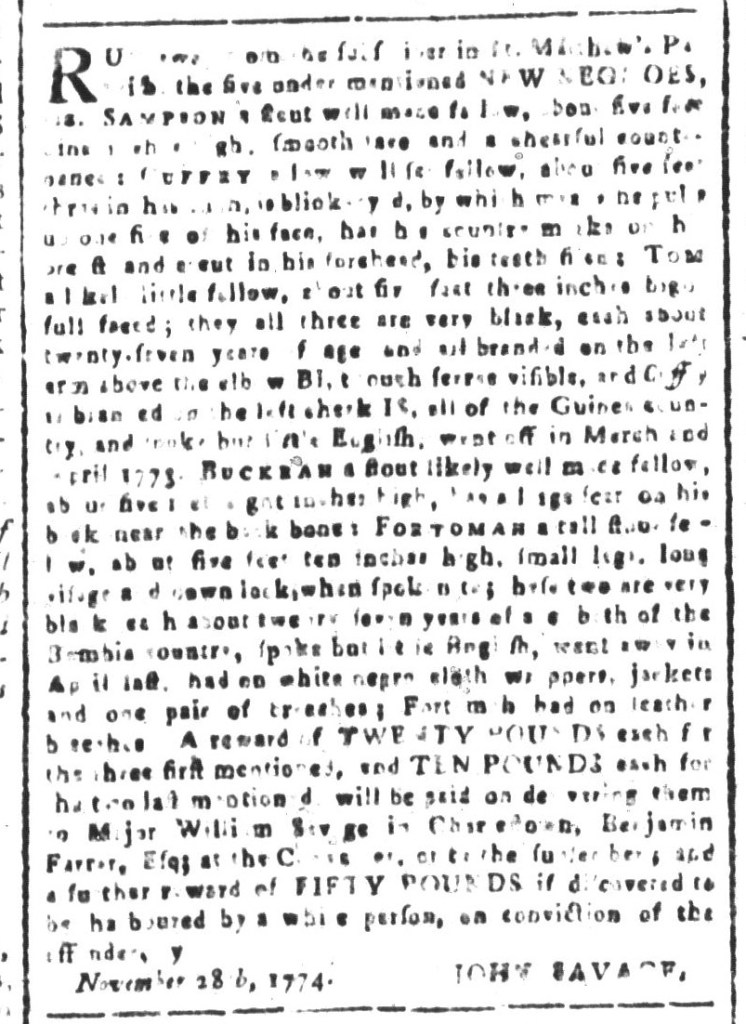
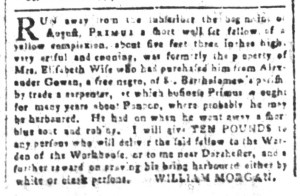
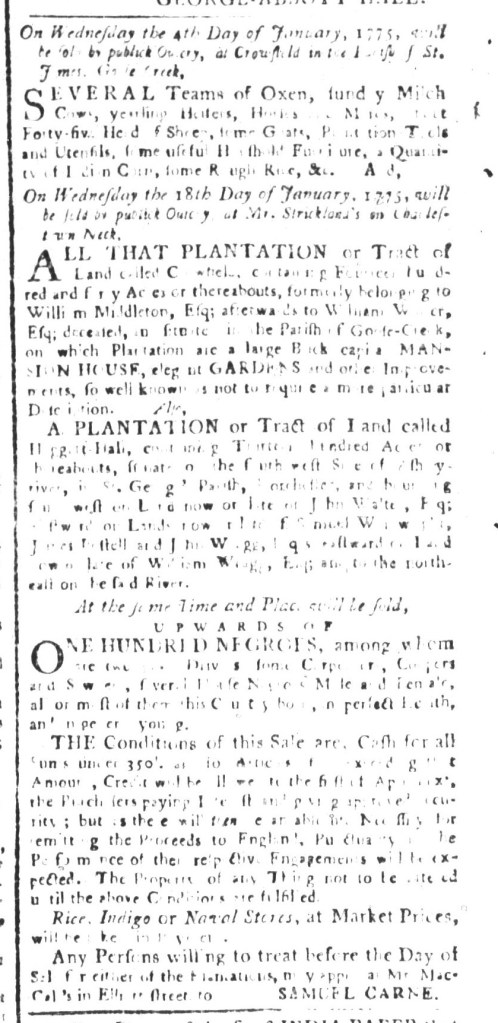
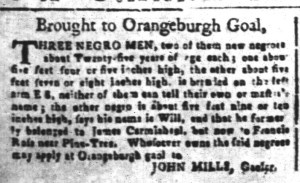
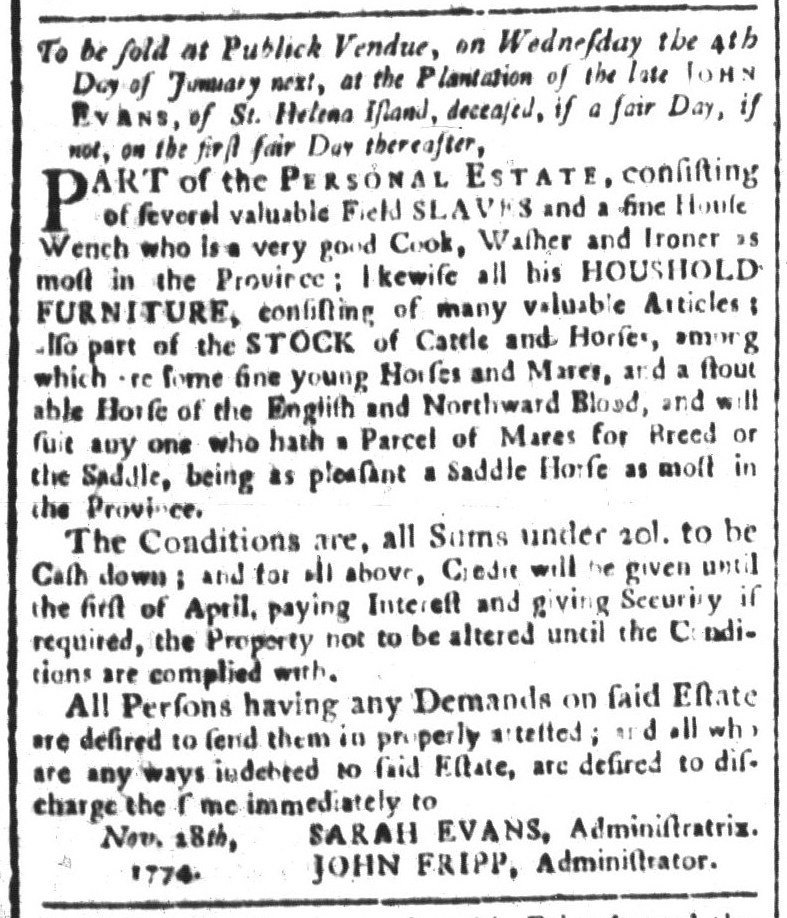
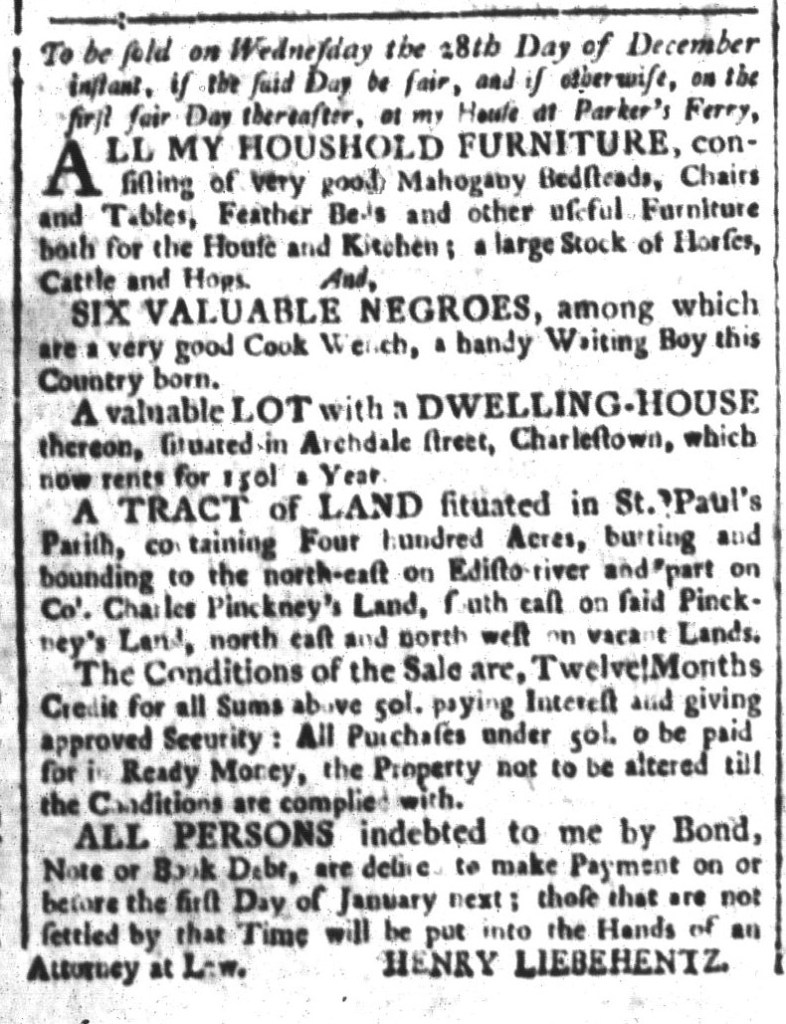
The Slavery Adverts 250 Project chronicles the role of newspaper advertising in perpetuating slavery in the era of the American Revolution. The project seeks to reveal the ubiquity of slavery in eighteenth-century life from New England to Georgia by republishing advertisements about enslaved people – for sale as individuals or in groups, wanted to purchase or for hire for short periods, runaways who liberated themselves, and those who were subsequently captured and confined in jails and workhouses – in daily digests on this site as well as in real time via the @SlaveAdverts250 Twitter feed, utilizing twenty-first-century media to stand in for the print media of the eighteenth century.
The project aims to provide modern audiences with a sense of just how often colonizers encountered these advertisements in their daily lives. Enslaved men, women, and children appeared in print somewhere in the colonies almost every single day. Those advertisements served as a constant backdrop for social, cultural, economic, and political life in colonial and revolutionary America. Colonizers who did not purport to own enslaved people were still confronted with slavery as well as invited to maintain the system by purchasing enslaved men, women, and children or assisting in the capture of so-called “runaways” who sought to free themselves from bondage. The frequency of these newspaper advertisements suggests just how embedded slavery was in colonial and revolutionary American culture in everyday interactions beyond the printed page.
These advertisements also testify to the experiences of enslaved men, women, and children, though readers must consider that those experiences have been remediated through descriptions offered by enslavers rather than enslaved people themselves. Often unnamed in the advertisements, enslaved men, women, and children were not invisible or unimportant in early America.
These advertisements appeared in colonial American newspapers 250 years ago today.
Supplement to the Pennsylvania Gazette (December 14, 1774).
What was advertised in a colonial American newspaper 250 years ago today?
Essex Gazette (December 13, 1774).
“The WONDERFUL APPEARANCE of an Angel, Devil and Ghost.”
It resembled a Dickens story decades before Charles Dickens wrote “A Christmas Carol” or anything else! In December 1775, John Boyle published and advertised “The WONDER of WONDERS! Or, the WONDERFUL APPEARANCE of an Angel, Devil and Ghost, To a Gentleman in the Town of BOSTON, in the Nights of the 14th, 15th, and 16th of October last.” His advertisements first appeared in the Massachusetts Spy in early December and very soon after in other newspapers in Boston as well the Essex Gazette in Salem and the Essex Journal in Newburyport.
That gentleman, Boyle suggested in his advertisements, was apparently a Loyalist “To whom in some Measure may be attributed the Distresses that have of late fallen upon that unhappy Metropolis.” The Boston Port Act had closed the harbor to commercial shipping, the Massachusetts Government Act had given the royally appointed governor more authority at the expense of the locally elected legislature and town meetings, and the Quartering Act provided for a greater presence of British soldiers. The unnamed gentleman who supposedly experienced these visitations shared his experience with a neighbor and then agreed to their publication “as a solemn Warning to all those, who, for the sake of aggrandizing themselves and their Families, would entail the most abject Wretchedness upon Millions of their Fellow-Creatures.” J.L. Bell, who has been chronicling Boston in the era of the American Revolution in a daily research blog for nearly two decades, notes, “All but the most credulous readers knew that this presentation was a sham designed to lend a wild cautionary tale some veneer of veracity.”
Bell examines “Wonder of Wonders” in three entries, the first introducing the pamphlet and its publication history, the second relaying the visitation by the angel, and the third recounting the visits by the devil and a ghost as well as interpreting the story in the context of how the imperial crisis unfolded in Boston. Bell summarizes the pamphlet as purportedly an “account of a wealthy friend of the royal government whose sleep was disturbed by three supernatural visitors warning him to change his ways and start caring more about his neighbors.” On the first night, the angel provides a warning to get back on the right path, a footnote explaining that the gentleman received compensation for his support of the officials dispatched to Boston from Britain but not specifying which services he provided. The gentleman initially dismissed this visitor as “a delusion” until the devil visited the next night. Their conversation covered “the previous nine years of conflict through Loyalist eyes.” The editor conveniently provided an alternate interpretation of events in footnotes. On the third night, the ghost of one of the gentleman’s ancestors appeared and chastised him for betraying principles that had been in place since the founding of the colony. Colonizers settled New England, the ghost declared, “for the sake of enjoying that liberty which was denied them at home.” The gentleman realizes the error of his way and vows to repent.
Bell wonders about the intended audience for the pamphlet, “Loyalists who needed converting” or Patriots “who enjoyed the sight of an opposing gentleman scared into submission.” It very well could have been both, though describing it as “a solemn Warning” seemed to invite Loyalists to take heed. The advertisement invited the curious of all political persuasions to purchase and read the pamphlet, supplementing the spectacular title with promises of four images that adorned the work. Depictions of “THE DEVIL,” “AN ANGEL, with a Sword in one Hand, a Pair of Scales in the other,” “BELZEBUB, holding in his right Hand a folio Book, and in his left a Halter,” and “A GHOST, having on a white Gown, his Hair much dishevelled,” enhanced the story. Whoever the intended audience may have been, Boyle aimed to generate revenue with the pamphlet by advertising widely and disseminating copies to local agents in other towns.
**********
Quotations not drawn from the advertisement come from J.L. Bell’s Boston 1775: History, Analysis, and Unabashed Gossip about the Start of the American Revolution in Massachusetts.
The Slavery Adverts 250 Project chronicles the role of newspaper advertising in perpetuating slavery in the era of the American Revolution. The project seeks to reveal the ubiquity of slavery in eighteenth-century life from New England to Georgia by republishing advertisements about enslaved people – for sale as individuals or in groups, wanted to purchase or for hire for short periods, runaways who liberated themselves, and those who were subsequently captured and confined in jails and workhouses – in daily digests on this site as well as in real time via the @SlaveAdverts250 Twitter feed, utilizing twenty-first-century media to stand in for the print media of the eighteenth century.
The project aims to provide modern audiences with a sense of just how often colonizers encountered these advertisements in their daily lives. Enslaved men, women, and children appeared in print somewhere in the colonies almost every single day. Those advertisements served as a constant backdrop for social, cultural, economic, and political life in colonial and revolutionary America. Colonizers who did not purport to own enslaved people were still confronted with slavery as well as invited to maintain the system by purchasing enslaved men, women, and children or assisting in the capture of so-called “runaways” who sought to free themselves from bondage. The frequency of these newspaper advertisements suggests just how embedded slavery was in colonial and revolutionary American culture in everyday interactions beyond the printed page.
These advertisements also testify to the experiences of enslaved men, women, and children, though readers must consider that those experiences have been remediated through descriptions offered by enslavers rather than enslaved people themselves. Often unnamed in the advertisements, enslaved men, women, and children were not invisible or unimportant in early America.
These advertisements appeared in colonial American newspapers 250 years ago today.
Essex Gazette (December 13, 1774).
**********
Essex Gazette (December 13, 1774).
**********
South-Carolina Gazette and Country Journal (December 13, 1774).
**********
South-Carolina Gazette and Country Journal (December 13, 1774).
**********
South-Carolina Gazette and Country Journal (December 13, 1774).
**********
South-Carolina Gazette and Country Journal (December 13, 1774).
**********
South-Carolina Gazette and Country Journal (December 13, 1774).
**********
South-Carolina Gazette and Country Journal (December 13, 1774).
**********
South-Carolina Gazette and Country Journal (December 13, 1774).
**********
South-Carolina Gazette and Country Journal (December 13, 1774).
**********
South-Carolina Gazette and Country Journal (December 13, 1774).
**********
South-Carolina Gazette and Country Journal (December 13, 1774).
**********
South-Carolina Gazette and Country Journal (December 13, 1774).
**********
South-Carolina Gazette and Country Journal (December 13, 1774).
**********
South-Carolina Gazette and Country Journal (December 13, 1774).
**********
Supplement to the South-Carolina Gazette and Country Journal (December 13, 1774).
**********
Supplement to the South-Carolina Gazette and Country Journal (December 13, 1774).
**********
Supplement to the South-Carolina Gazette and Country Journal (December 13, 1774).
**********
Supplement to the South-Carolina Gazette and Country Journal (December 13, 1774).
**********
Supplement to the South-Carolina Gazette and Country Journal (December 13, 1774).
**********
Supplement to the South-Carolina Gazette and Country Journal (December 13, 1774).
**********
Supplement to the South-Carolina Gazette and Country Journal (December 13, 1774).
**********
Supplement to the South-Carolina Gazette and Country Journal (December 13, 1774).
**********
Supplement to the South-Carolina Gazette and Country Journal (December 13, 1774).
**********
Supplement to the South-Carolina Gazette and Country Journal (December 13, 1774).
**********
Supplement to the South-Carolina Gazette and Country Journal (December 13, 1774).
**********
Supplement to the South-Carolina Gazette and Country Journal (December 13, 1774).
**********
Supplement to the South-Carolina Gazette and Country Journal (December 13, 1774).
**********
Supplement to the South-Carolina Gazette and Country Journal (December 13, 1774).
**********
Supplement to the South-Carolina Gazette and Country Journal (December 13, 1774).
What was advertised in a colonial American newspaper 250 years ago today?
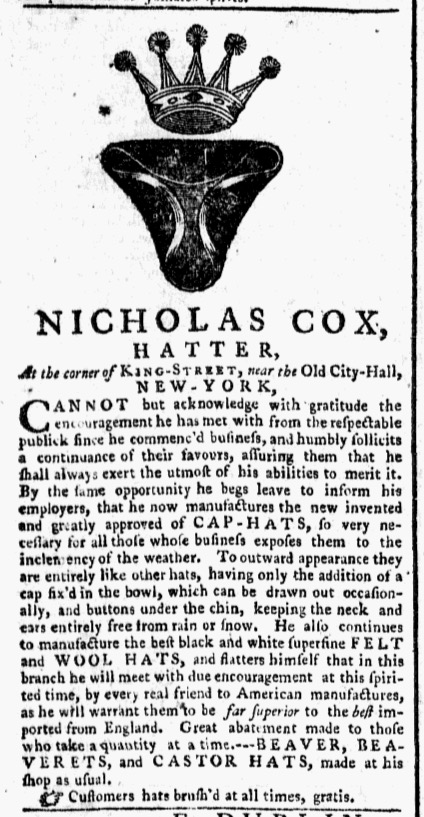
New-York Gazette and Weekly Mercury (December 12, 1774).
“He will meet with due encouragement … by every real friend to American manufactures.”
Nicholas Cox, a hatter, made several appeals to consumers in his advertisement in the December 12, 1774, edition of the New-York Gazette and Weekly Mercury. He commenced with a standard expression of gratitude for “the encouragement he had met with from the respectable publick since he commenc’d business.” Many purveyors of goods and services did so in their advertisements, signaling to readers that other consumers already considered them worthy of their business. It was a familiar means of bolstering an advertiser’s reputation.
The hatter also incorporated commentary specific to his trade, proclaiming that he “manufactures the new invented and greatly approved of CAP-HATS.” For those unaware of this innovation, eh explained that by “outward appearance they are entirely like other hats, having only the addition of a cap fix’d in the bowl, which can be drawn out occasionally.” In such instances, it “buttons under the chin, keeping the neck and ears entirely free from rain or snow.” Cox marketed this new style, a very practical element, as “so very necessary for all those whose business exposes them to the inclemency of the weather.” According to Kate Haulman, colonizers debated whether they should carry umbrellas, “stylistic spoils of empire hailing from India,” in the 1760s and 1770s. “Some regarded umbrellas as ridiculous and frivolous,” she notes, “serving no purpose that a good hat could not supply.”[1] Cox produced and sold such hats for men of business who sought to eschew the effeminacy and luxury associated with umbrellas.
His next appeal made an even more explicitly political argument to prospective customers. He made “the best black and white superfine FELT and WOOL HATS,” like the tricorne hat depicted in the woodcut that adorned his advertisement. Cox asserted that patriotic consumers had a duty to support his business when they made choices about where to acquire their hats. He expressed confidence that he “will meet with due encouragement at this spirited time, by every real friend to American manufactures.” The Continental Association, a boycott of British goods adopted in response to the Coercive Acts, had recently gone into effect. Cox offered an alternative to colonizers who desired to acquire hats yet wished to remain patriotically correct, either according to their own principles or at least to avoid the ire of others who observed the purchases they made. Furthermore, his customers did not have sacrifice quality for principles. The hatter pledged that “he will warrant [his hats] to be far superior to the best imported from England.” That being the case, the crown that appeared above the tricorne hat at the top of his advertisement may have testified to the superior quality of his hats, a general sense of pride in being part of the British Empire, or reverence for the monarch whom many colonizers still hoped would intervene on their behalf in their altercation with Parliament.
In addition to those appeals, Cox included two more common marketing strategies. He promised a “[g]reat abatement … to those who take a quantity at a time.” In other words, he gave discounts for buying multiple hats, both for consumers and for retailers who intended to sell them in their own shops. He also provided a free ancillary service: “Customers hats brush’d at all times, gratis.” Cox saw to the care and maintenance of the hats he made and sold long after the time of purchase. He cultivated relationships with customers by encouraging them to return to his shop for assistance in keeping their hats in good order. Overall, Cox resorted to a variety of familiar and specific appeals when advertising his hats, distinguishing him from competitors who did not put as much effort into marketing their wares.
**********
[1] Kate Haulman, “Fashion and the Culture Wars of Revolutionary Philadelphia,” William and Mary Quarterly, 3rd ser., 62, no 4 (October 2005): 632.
The Slavery Adverts 250 Project chronicles the role of newspaper advertising in perpetuating slavery in the era of the American Revolution. The project seeks to reveal the ubiquity of slavery in eighteenth-century life from New England to Georgia by republishing advertisements about enslaved people – for sale as individuals or in groups, wanted to purchase or for hire for short periods, runaways who liberated themselves, and those who were subsequently captured and confined in jails and workhouses – in daily digests on this site as well as in real time via the @SlaveAdverts250 Twitter feed, utilizing twenty-first-century media to stand in for the print media of the eighteenth century.
The project aims to provide modern audiences with a sense of just how often colonizers encountered these advertisements in their daily lives. Enslaved men, women, and children appeared in print somewhere in the colonies almost every single day. Those advertisements served as a constant backdrop for social, cultural, economic, and political life in colonial and revolutionary America. Colonizers who did not purport to own enslaved people were still confronted with slavery as well as invited to maintain the system by purchasing enslaved men, women, and children or assisting in the capture of so-called “runaways” who sought to free themselves from bondage. The frequency of these newspaper advertisements suggests just how embedded slavery was in colonial and revolutionary American culture in everyday interactions beyond the printed page.
These advertisements also testify to the experiences of enslaved men, women, and children, though readers must consider that those experiences have been remediated through descriptions offered by enslavers rather than enslaved people themselves. Often unnamed in the advertisements, enslaved men, women, and children were not invisible or unimportant in early America.
These advertisements appeared in colonial American newspapers 250 years ago today.
Boston-Gazette (December 12, 1774).
**********
Postscript to Dunlap’s Pennsylvania Packet (December 12, 1774).
**********
Postscript to Dunlap’s Pennsylvania Packet (December 12, 1774).
**********
Dunlap’s Pennsylvania Packet (December 12, 1774).
**********
Newport Mercury (December 12, 1774).
**********
New-York Gazette and Weekly Mercury (December 12, 1774).
**********
New-York Gazette and Weekly Mercury (December 12, 1774).
**********
New-York Gazette and Weekly Mercury (December 12, 1774).
**********
New-York Gazette and Weekly Mercury (December 12, 1774).
**********
New-York Gazette and Weekly Mercury (December 12, 1774).
**********
South-Carolina Gazette (December 12, 1774).
**********
South-Carolina Gazette (December 12, 1774).
**********
South-Carolina Gazette (December 12, 1774).
**********
South-Carolina Gazette (December 12, 1774).
**********
South-Carolina Gazette (December 12, 1774).
**********
South-Carolina Gazette (December 12, 1774).
**********
Supplement to the South-Carolina Gazette (December 12, 1774).
**********
Supplement to the South-Carolina Gazette (December 12, 1774).
**********
Supplement to the South-Carolina Gazette (December 12, 1774).
**********
Supplement to the South-Carolina Gazette (December 12, 1774).
**********
Supplement to the South-Carolina Gazette (December 12, 1774).
**********
Supplement to the South-Carolina Gazette (December 12, 1774).
**********
Supplement to the South-Carolina Gazette (December 12, 1774).
**********
Supplement to the South-Carolina Gazette (December 12, 1774).
**********
Supplement to the South-Carolina Gazette (December 12, 1774).
**********
Supplement to the South-Carolina Gazette (December 12, 1774).
**********
Supplement to the South-Carolina Gazette (December 12, 1774).
**********
Supplement to the South-Carolina Gazette (December 12, 1774).
**********
Supplement to the South-Carolina Gazette (December 12, 1774).
**********
Supplement to the South-Carolina Gazette (December 12, 1774).
What was advertised in a colonial American newspaper 250 years ago this week?
Supplement to the New-York Journal (December 8, 1774).
“The hatter’s business will be carried on as usual, by her.”
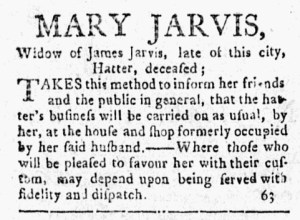
Mary Jarvis assumed responsibility for the family business following the death of her husband, James, a hatter. In an advertisement that ran in the New-York Journal for several weeks in November and December 1774, she “inform[ed] her friends and the public and general, that the hatter’s business will be carried on as usual, by her, at the house and shop formerly occupied by her said husband.” Like many others who advertised goods and services in colonial newspapers, she promised that “those who will be pleased to favour her with their custom, may depend upon being served with fidelity and dispatch.” Jarvis may have consulted with John Holt, the printer, on the wording for her notice when she made arrangements for its publication, though that may not have been necessary. Considering that she knew enough about the enterprise to continue its operations following the death of her husband, she may very well have been familiar enough with the usual contents of newspaper advertisements to compose it herself. In addition, she could have perused similar notices many times as a consumer and learned for herself what they should contain.
The widow’s role in the business changed following the death of her husband, yet she likely had experience with many of the tasks from assisting him over the years. When she declared that “the hatter’s business will be carried on as usual, by her,” she suggested that she did the work herself rather than managing employees previously affiliated with the business or hired after her situation changed. Although James had been the public face of the venture, Mary no doubt made valuable contributions and learned much about the trade. She sought to leverage that knowledge to support herself through her own industry, joining many other women – milliners and seamstresses – in the garment trades. Historian Laurel Thatcher Ulrich distinguishes between what was probable for women and what was possible for women in early America. In this case, Jarvis embodied both. It was probable that she assisted James in his business as a “deputy husband” (a concept developed by Ulrich) and that made it possible for her to work as a hatter in her own right when circumstances demanded.
What was advertised in a colonial American newspaper 250 years ago today?
Providence Gazette (December 10, 1774).
“For further Particulars enquire … at the Sign of the Greyhound.”
When Nathaniel Wheaton advertised “TWO convenient Dwelling-Houses, pleasantly situated, adjoining the main Street, near King’s Church, in Providence” in December 1774, he instructed interested parties to seek “further Particulars … at the Sign of the Greyhound.” That sign had marked Wheaton’s location for some time, becoming a familiar sight as residents of the town traversed its streets. Regular readers of the Providence Gazette may have also remembered that Wheaton adorned some of his previous advertisements with a woodcut depicting a greyhound, perhaps replicating the image on the sign.
Without standardized street numbers, colonizers resorted to a variety of other means of giving directions to their homes and shops. In the December 10, 1774, edition of the Providence Gazette, Stephen Whiting, Jr., stated that he sold “Looking-Glasses and Pictures … at his shop, at Col. Knight Dexter’s, in King-street, and over Mr. William Tyler’s paint-shop.” Similarly, Eliezer Callender declared that he sold a “large Assortment of Hard-Ware … Next to Mr. Hill’s Variety Store.” Silas Downer announced that he moved to a new location and now gave “Advice and Assistance in the Law” at “the House which belonged to the late Henry Paget, Esq; and near the Bridge Market.”
Signs also served as landmarks that clearly marked the locations of shops and offices. Like Downer, Charles Bowler recently moved to a different location, opening “his new Bake-House, in Union-Street.” Patrons would recognize it by “the Sign of the Bakers Arms.” In the colophon of each issue of the Providence Gazette, John Carter, the printer, noted that he operated his printing office “at Shakespear’s Head,” a reference to his own sign. In addition, customers recognized Hill’s Variety Store, mentioned in Callender’s advertisement, by “the Sign of the ELEPHANT.” Like Wheaton, Hill commissioned a woodcut related to his sign to draw attention to some of his newspaper advertisements. Though few colonial-era signs survive today, newspaper advertisements demonstrate that they played a prominent role in the visual culture of eighteenth-century urban ports.
What was advertised in a colonial American newspaper 250 years ago today?
Connecticut Gazette (December 9, 1774).
“Glass buttons having the word liberty printed in them.”
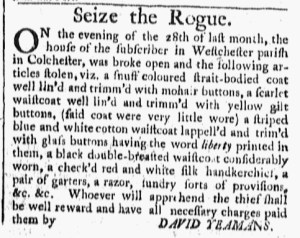
The headline for David Yeaman’s advertisement in the December 9, 1774, edition of the Connecticut Gazette alerted readers that it would document some sort of misbehavior. “Seize the Rogue,” it proclaimed. The rogue “broke open” Yeamans’s house and stole several items on November 28. They included clothing, a “check’d red and white silk handkerchief,” a razor, and “sundry sorts of provisions.” The unfortunate advertiser offered a reward to whoever apprehended the thief.
Yeamans’s descriptions of the missing garments revealed his taste and sartorial sensibilities. The thief took a “snuff coloured strait-bodied coat well lin’d and trimm’d with mohair buttons,” a “scarlet waitcoast well lin’d and trimm’d with yellow gilt buttons” that showed very little wear, a “black double-breasted waistcoat considerably worn,” and a “striped blue and white cotton waistcoat lappell’d and trim’d with glass buttons.” That last piece of clothing testified to more than Yeamans’s sense of fashion. It also said something about his politics and how he felt about the imperial crisis that had been intensifying for the year since the Boston Tea Party. Those glass buttons had “the word liberty printed in them.” Yeamans made a statement every time he wore the striped waistcoat adorned with those buttons.
This advertisement, printed immediately below entries from the “CUSTOM-HOUSE, New-LONDON,” and other shipping news in “THOMAS ALLEN’s MARINE LIST,” provided additional coverage of local news, though selected by an advertiser who paid to have it appear in print rather than by the editor who compiled “Fresh Advices from London!” and reports from Boston, New York, Philadelphia, and Hartford. At first glance, it featured a theft, yet the details about one of the stolen garments prompted readers to think about the contents of the articles and editorials in that issue, including discussion of the Continental Association adopted by the First Continental Congress and the impact of the Boston Port Bill on residents of that city. Those buttons with “the word liberty printed in them” contributed to discussions about politics when Yeamans wore his waistcoat and when he advertised its theft.
The Slavery Adverts 250 Project chronicles the role of newspaper advertising in perpetuating slavery in the era of the American Revolution. The project seeks to reveal the ubiquity of slavery in eighteenth-century life from New England to Georgia by republishing advertisements about enslaved people – for sale as individuals or in groups, wanted to purchase or for hire for short periods, runaways who liberated themselves, and those who were subsequently captured and confined in jails and workhouses – in daily digests on this site as well as in real time via the @SlaveAdverts250 Twitter feed, utilizing twenty-first-century media to stand in for the print media of the eighteenth century.
The project aims to provide modern audiences with a sense of just how often colonizers encountered these advertisements in their daily lives. Enslaved men, women, and children appeared in print somewhere in the colonies almost every single day. Those advertisements served as a constant backdrop for social, cultural, economic, and political life in colonial and revolutionary America. Colonizers who did not purport to own enslaved people were still confronted with slavery as well as invited to maintain the system by purchasing enslaved men, women, and children or assisting in the capture of so-called “runaways” who sought to free themselves from bondage. The frequency of these newspaper advertisements suggests just how embedded slavery was in colonial and revolutionary American culture in everyday interactions beyond the printed page.
These advertisements also testify to the experiences of enslaved men, women, and children, though readers must consider that those experiences have been remediated through descriptions offered by enslavers rather than enslaved people themselves. Often unnamed in the advertisements, enslaved men, women, and children were not invisible or unimportant in early America.
These advertisements appeared in colonial American newspapers 250 years ago today.
Connecticut Gazette (December 9, 1774).
**********
South-Carolina and American General Gazette (December 9, 1774).
**********
South-Carolina and American General Gazette (December 9, 1774).
**********
South-Carolina and American General Gazette (December 9, 1774).
**********
South-Carolina and American General Gazette (December 9, 1774).
**********
South-Carolina and American General Gazette (December 9, 1774).
**********
South-Carolina and American General Gazette (December 9, 1774).
**********
South-Carolina and American General Gazette (December 9, 1774).
**********
South-Carolina and American General Gazette (December 9, 1774).
**********
South-Carolina and American General Gazette (December 9, 1774).
**********
South-Carolina and American General Gazette (December 9, 1774).
**********
South-Carolina and American General Gazette (December 9, 1774).
**********
South-Carolina and American General Gazette (December 9, 1774).
**********
South-Carolina and American General Gazette (December 9, 1774).
**********
South-Carolina and American General Gazette (December 9, 1774).
**********
South-Carolina and American General Gazette (December 9, 1774).
**********
South-Carolina and American General Gazette (December 9, 1774).
**********
South-Carolina and American General Gazette (December 9, 1774).
**********
South-Carolina and American General Gazette (December 9, 1774).
**********
South-Carolina and American General Gazette (December 9, 1774).
**********
South-Carolina and American General Gazette (December 9, 1774).
**********
South-Carolina and American General Gazette (December 9, 1774).
**********
South-Carolina and American General Gazette (December 9, 1774).
**********
South-Carolina and American General Gazette (December 9, 1774).
**********
South-Carolina and American General Gazette (December 9, 1774).
**********
South-Carolina and American General Gazette (December 9, 1774).
**********
South-Carolina and American General Gazette (December 9, 1774).
**********
South-Carolina and American General Gazette (December 9, 1774).
**********
South-Carolina and American General Gazette (December 9, 1774).
**********
South-Carolina and American General Gazette (December 9, 1774).
**********
South-Carolina and American General Gazette (December 9, 1774).
**********
South-Carolina and American General Gazette (December 9, 1774).
**********
South-Carolina and American General Gazette (December 9, 1774).
**********
South-Carolina and American General Gazette (December 9, 1774).
**********
South-Carolina and American General Gazette (December 9, 1774).
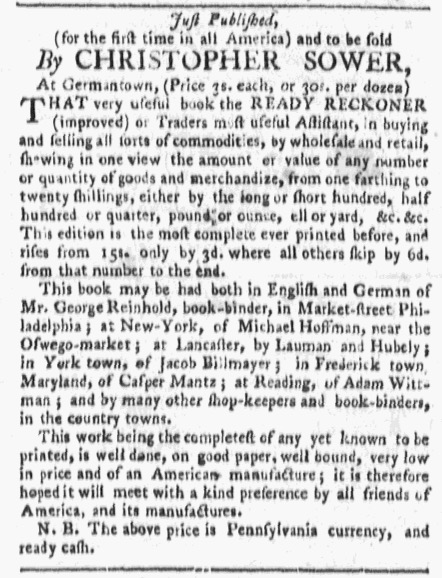
“It is therefore hoped that it will meet with a kind preference by all friends of America, and its manufactures.”
As the final days of 1774 approached, Christopher Sower, the printer of the Germantowner Zeitung, advertised an American edition of Daniel Fenning’s The Ready Reckoner; or Trader’s Most Useful Assistant, in Buying and Selling All Sorts of Commodities Either Wholesale or Retail. The handy reference volume had been through several London editions, published it “for the first time in all America” and established a network of local agents to sell copies “both in English and German” in several cities and towns. His advertisement in the December 8, 1774, edition of Rivington’s New-York Gazetteer listed his own printing office in Germantown, Pennsylvania, and named associates in Lancaster, Reading Philadelphia; New York City; Fredericktown, Maryland; and Yorktown, Virginia. In addition, Sower claimed that “many other shop-keepers and book-binders, in the country towns” stocked the volume. For those interested in selling copies at their shops, he offered a discount, thirty shilling for a dozen copies compared to three shillings for a single copy. In other words, those who bought ten copies received two additional copies for free.
Sower declared that he issued an “improved” edition, “the most complete ever printed.” The table it contained were supposed to save time and avoid errors in calculations, as the lengthy subtitle explained: “shewing at one view the amount or value of any number of quantity of goods from one farthing to twenty shillings … in so plain and easy a manner, that persons quite unacquainted with arithmetic may hereby ascertain the value of any number … at any price whatever.” Sower considered it the “most complete” edition because it featured increments of three pence instead of six pence. Yet that element alone did not recommend the book to prospective customers. The publisher described it as “well done, on good paper, well bound and of an American manufacture.” He did not specify whether “American manufacture” referred to the “good paper” as well as the labor undertaken in setting type, working the press, and binding the book. Still, he expected that an American edition “will meet with a kind preference by all friends of America, and its manufactures” who might otherwise opt for a London edition published in 1773. Sower’s call to purchase the American edition likely had even greater resonance given that the Continental Association, a nonimportation agreement adopted in response to the Coercive Acts, had recently gone into effect.