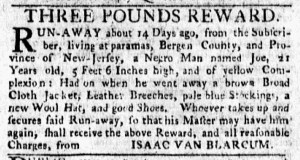
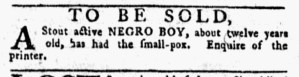
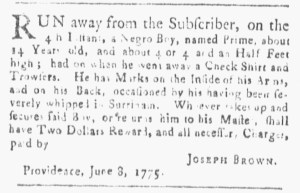
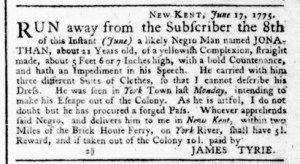
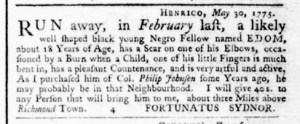
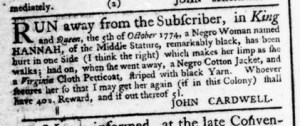
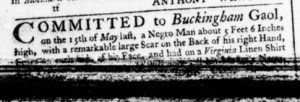
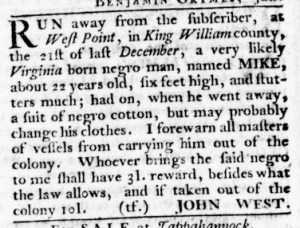
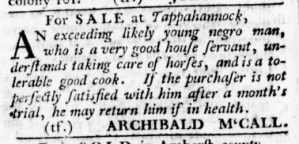
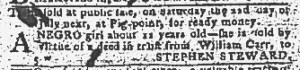
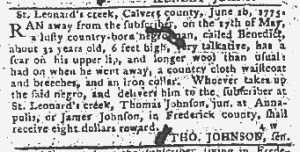
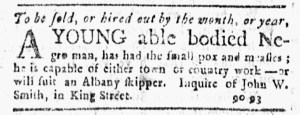
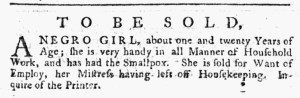
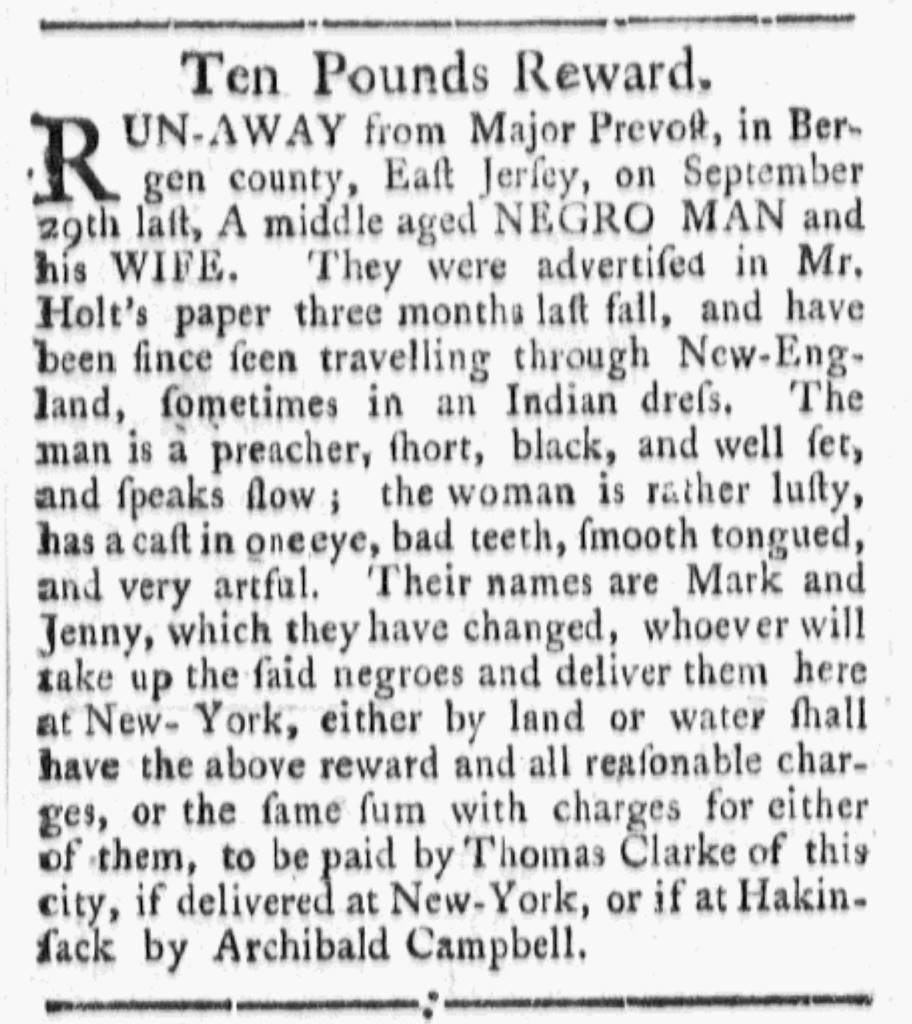
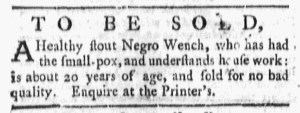
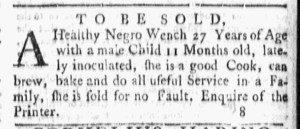
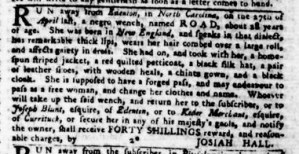
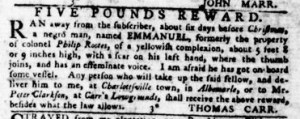
Slavery Advertisements Published June 20, 1775

The Slavery Adverts 250 Project chronicles the role of newspaper advertising in perpetuating slavery in the era of the American Revolution. The project seeks to reveal the ubiquity of slavery in eighteenth-century life from New England to Georgia by republishing advertisements about enslaved people – for sale as individuals or in groups, wanted to purchase or for hire for short periods, runaways who liberated themselves, and those who were subsequently captured and confined in jails and workhouses – in daily digests on this site as well as in real time via the @SlaveAdverts250 Twitter feed, utilizing twenty-first-century media to stand in for the print media of the eighteenth century.

The project aims to provide modern audiences with a sense of just how often colonizers encountered these advertisements in their daily lives. Enslaved men, women, and children appeared in print somewhere in the colonies almost every single day. Those advertisements served as a constant backdrop for social, cultural, economic, and political life in colonial and revolutionary America. Colonizers who did not purport to own enslaved people were still confronted with slavery as well as invited to maintain the system by purchasing enslaved men, women, and children or assisting in the capture of so-called “runaways” who sought to free themselves from bondage. The frequency of these newspaper advertisements suggests just how embedded slavery was in colonial and revolutionary American culture in everyday interactions beyond the printed page.

These advertisements also testify to the experiences of enslaved men, women, and children, though readers must consider that those experiences have been remediated through descriptions offered by enslavers rather than enslaved people themselves. Often unnamed in the advertisements, enslaved men, women, and children were not invisible or unimportant in early America.

These advertisements appeared in colonial American newspapers 250 years ago today.
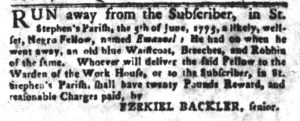
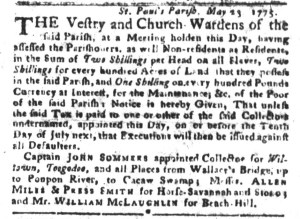
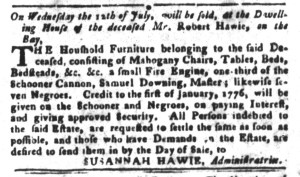
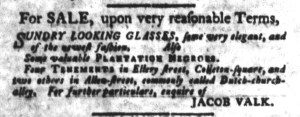
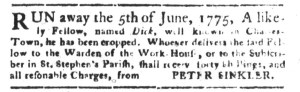
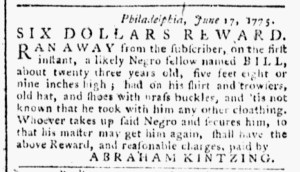
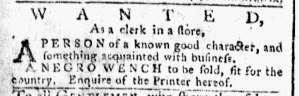
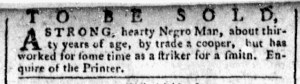
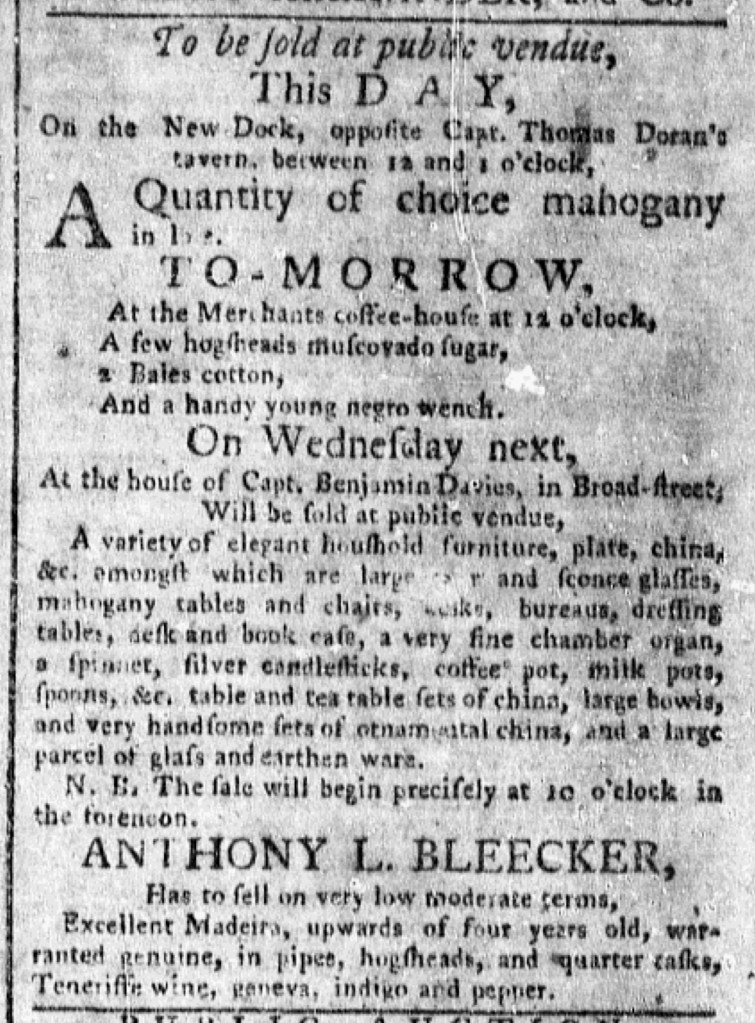
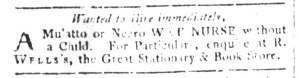
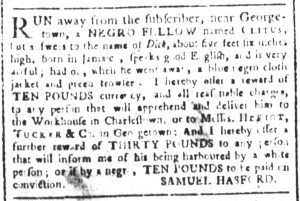
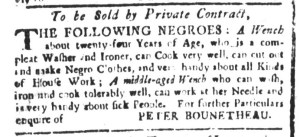
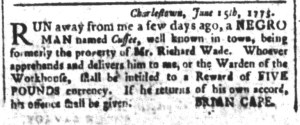
South-Carolina Gazette and Country Journal (June 20, 1775).

**********
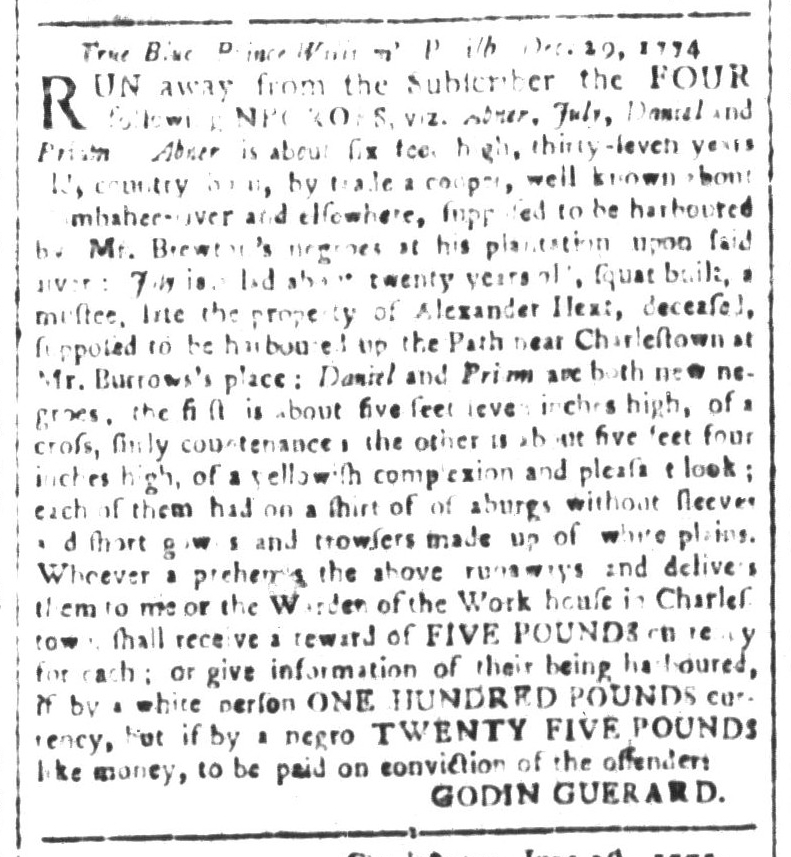
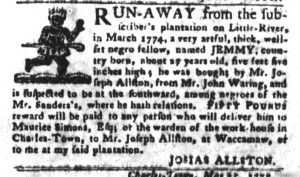
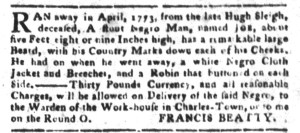
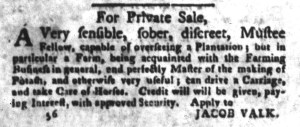
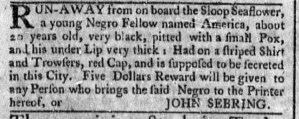
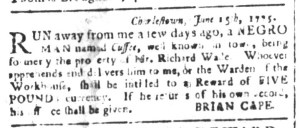
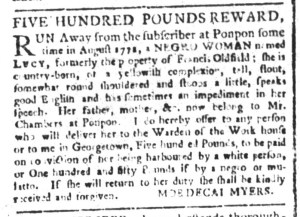
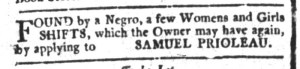
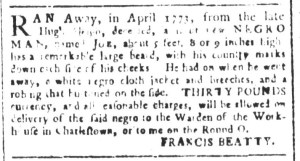
South-Carolina Gazette and Country Journal (June 20, 1775).

**********
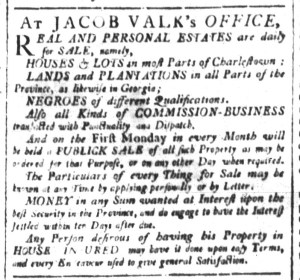
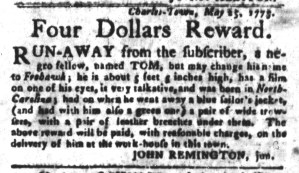
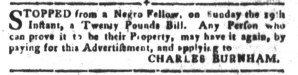
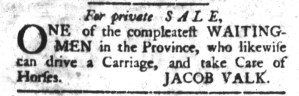
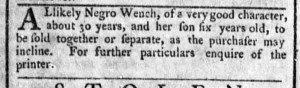
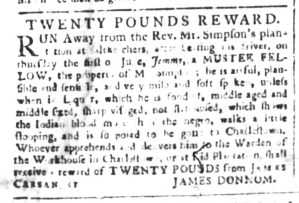
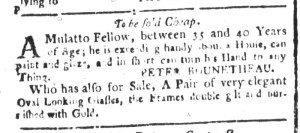
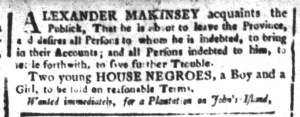
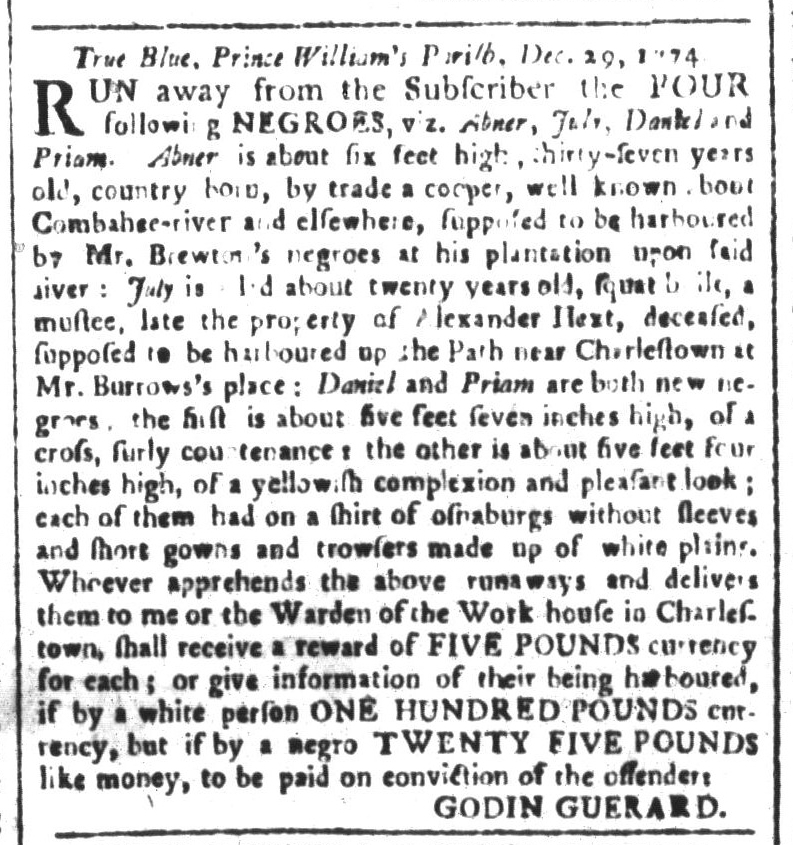
South-Carolina Gazette and Country Journal (June 20, 1775).

**********
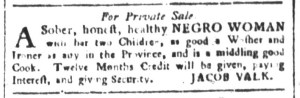
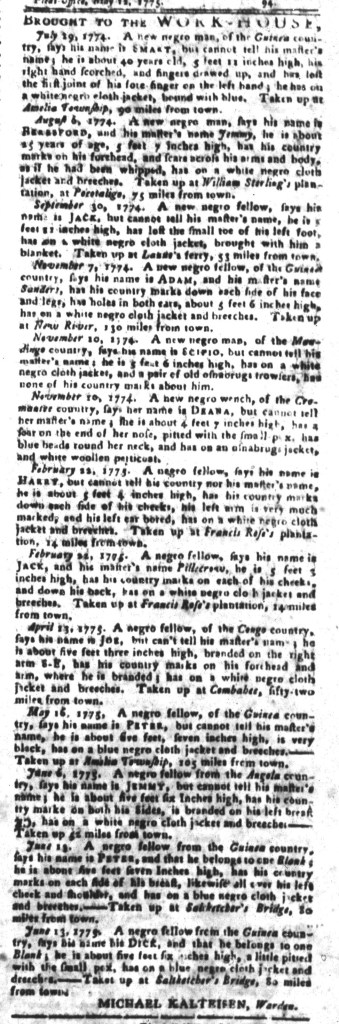
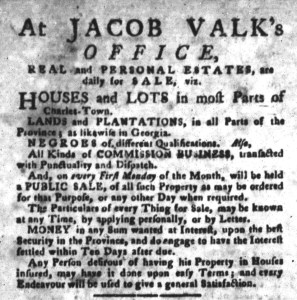
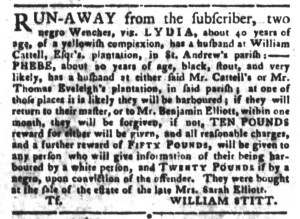
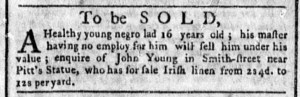
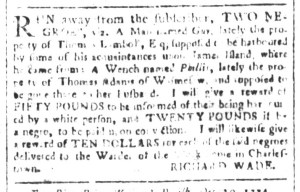
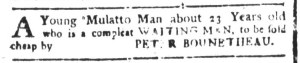
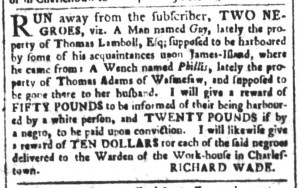
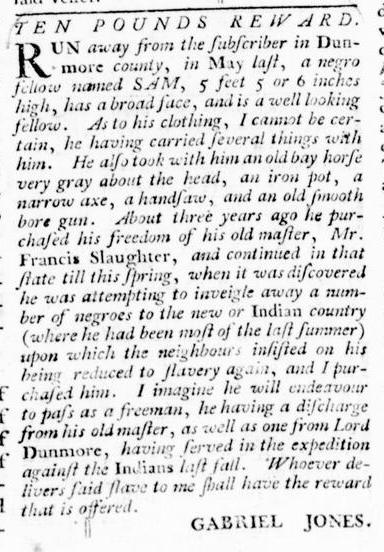
South-Carolina Gazette and Country Journal (June 20, 1775).

**********
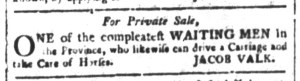
South-Carolina Gazette and Country Journal (June 20, 1775).

**********
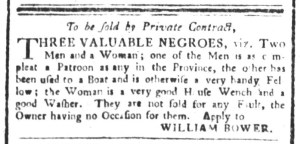
South-Carolina Gazette and Country Journal (June 20, 1775).

**********
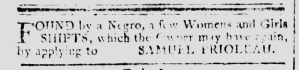
South-Carolina Gazette and Country Journal (June 20, 1775).

**********
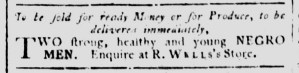
South-Carolina Gazette and Country Journal (June 20, 1775).

**********
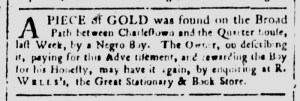
South-Carolina Gazette and Country Journal (June 20, 1775).

**********
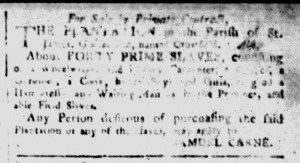
South-Carolina Gazette and Country Journal (June 20, 1775).

**********
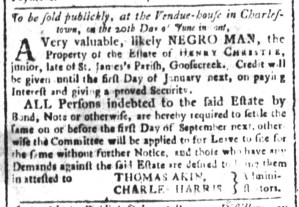
South-Carolina Gazette and Country Journal (June 20, 1775).

**********
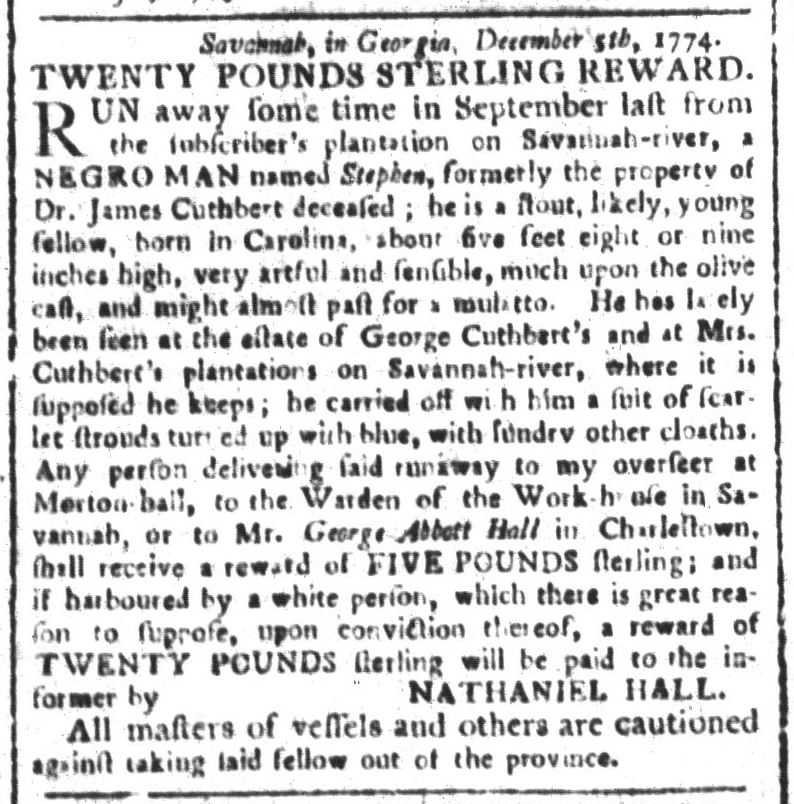
South-Carolina Gazette and Country Journal (June 20, 1775).

**********
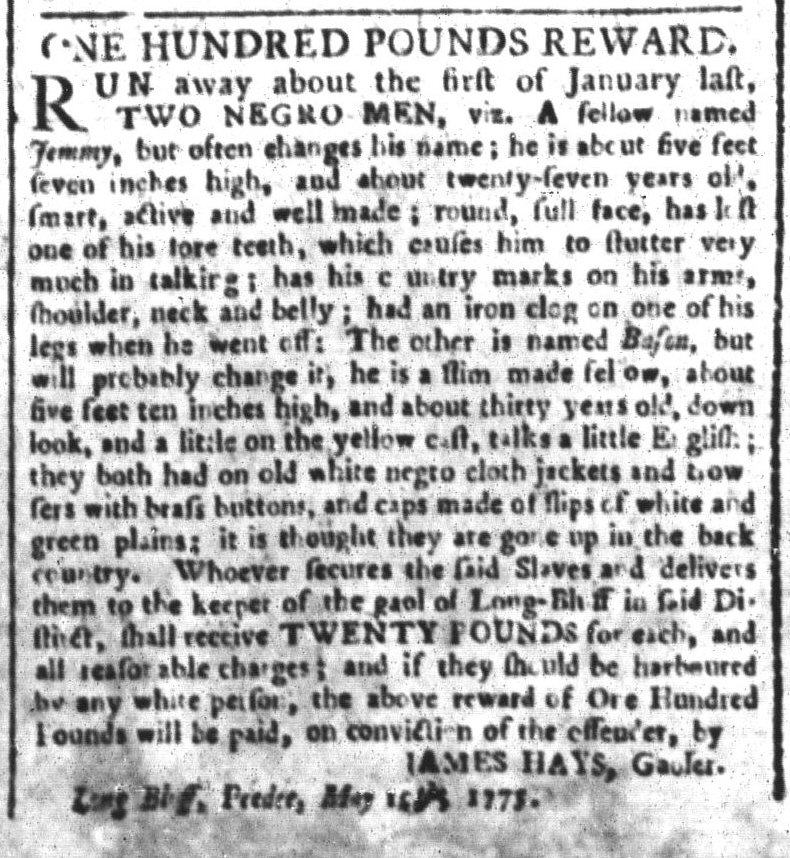
South-Carolina Gazette and Country Journal (June 20, 1775).

**********

South-Carolina Gazette and Country Journal (June 20, 1775).

**********

South-Carolina Gazette and Country Journal (June 20, 1775).

June 19

What was advertised in a revolutionary American newspaper 250 years ago today?

Postscript to Dunlap’s Pennsylvania Packet (June 19, 1775).

“A NEW AMERICAN MANUFACTORY.”

As summer arrived in 1775, Ryves and Fletcher took to the pages of Dunlap’s Pennsylvania Packet to inform the public that they established a “NEW AMERICAN MANUFACTORY” where they made and sold “all kinds of PAPER HANGINGS” (better known as wallpaper today).  The eighth article of the Continental Association, the nonimportation pact devised by the First Continental Congress in the fall of 1774, called for “promot[ing] Agriculture, Arts, and the Manufactures of this Country” as alternatives to imported goods.  That charge had even greater urgency following once colonizers heard about the battles at Lexington and Concord and the ensuing siege of Boston.  When Ryves and Fletcher ran their advertisement two days after the Battle of Bunker Hill, word of that engagement had not yet arrived in Philadelphia.  When it appeared again in July, readers had even more information about momentous events in Massachusetts that likely shaped how they reacted to Ryes and Fletcher marketing paper hangings made in America.

The “PAPER STAINERS,” as Ryves and Fletcher described themselves, asserted that they “are the first who have attempted that manufacture on this continent.”  Perhaps they were not aware that Plunket Fleeson made, advertised, and sold “AMERICAN PAPER HANGINGS” in Philadelphia in 1769, though they may have conveniently overlooked that enterprise in their efforts to promote their own.  Ryves and Fletcher made significant investment in procuring both workers and materials, noting in particular that their undertaking “consumes a large quantity of the paper of this country.”  In return for their dedication to the patriot cause, they “are therefore induced to hope for the countenance and protection of all well wishers to the infant manufacturers of America.”  They did their duty as producers, but that was not enough; consumers now had an obligation to purchase the paper hangings that Ryves and Fletcher made.  The paper stainers launched a “Buy American” campaign at the beginning of the Revolutionary War.  As part of their marketing efforts, they emphasized quality, extolling the “neatness of patterns and elegance of colour,” and price, pledging that “they will sell on much more reasonable terms than any paper can be disposed of which is imported into America.”  Ryves and Fletcher were among the first to produce and market paper hangings made in America, helping establish a new industry during the era of the American Revolution.

**********

I provide a brief case study of patriotic advertisements for paper hangings in Carl Robert Keyes, “A Revolution in Advertising: ‘Buy American’ Campaigns in the Late Eighteenth Century,” in Creating Advertising Culture:  Beginnings to the 1930s, vol. 1, We Are What We Sell:  How Advertising Shapes American Life … And Always Has, eds. Danielle Coombs and Bob Batchelor (New York:  Praeger, 2013), 1-25.

Slavery Advertisements Published June 19, 1775

The Slavery Adverts 250 Project chronicles the role of newspaper advertising in perpetuating slavery in the era of the American Revolution. The project seeks to reveal the ubiquity of slavery in eighteenth-century life from New England to Georgia by republishing advertisements about enslaved people – for sale as individuals or in groups, wanted to purchase or for hire for short periods, runaways who liberated themselves, and those who were subsequently captured and confined in jails and workhouses – in daily digests on this site as well as in real time via the @SlaveAdverts250 Twitter feed, utilizing twenty-first-century media to stand in for the print media of the eighteenth century.

The project aims to provide modern audiences with a sense of just how often colonizers encountered these advertisements in their daily lives. Enslaved men, women, and children appeared in print somewhere in the colonies almost every single day. Those advertisements served as a constant backdrop for social, cultural, economic, and political life in colonial and revolutionary America. Colonizers who did not purport to own enslaved people were still confronted with slavery as well as invited to maintain the system by purchasing enslaved men, women, and children or assisting in the capture of so-called “runaways” who sought to free themselves from bondage. The frequency of these newspaper advertisements suggests just how embedded slavery was in colonial and revolutionary American culture in everyday interactions beyond the printed page.

These advertisements also testify to the experiences of enslaved men, women, and children, though readers must consider that those experiences have been remediated through descriptions offered by enslavers rather than enslaved people themselves. Often unnamed in the advertisements, enslaved men, women, and children were not invisible or unimportant in early America.

These advertisements appeared in colonial American newspapers 250 years ago today.

Dunlap’s Pennsylvania Packet (June 19, 1775).

**********

Postscript to Dunlap’s Pennsylvania Packet (June 19, 1775).

**********

Postscript to Dunlap’s Pennsylvania Packet (June 19, 1775).

**********

New-York Gazette and Weekly Mercury (June 19, 1775).

**********

New-York Gazette and Weekly Mercury (June 19, 1775).

**********

New-York Gazette and Weekly Mercury (June 19, 1775).

**********

New-York Gazette and Weekly Mercury (June 19, 1775).

**********

Supplement to the New-York Gazette and Weekly Mercury (June 19, 1775).

**********

Supplement to the New-York Gazette and Weekly Mercury (June 19, 1775).

June 18

What was advertised in a revolutionary American newspaper 250 years ago this week?

Massachusetts Spy (June 14, 1775).

This Paper now has the greatest advantage for News, from ALL quarters, of any in this Province.”

Isaiah Thomas, the printer of the Massachusetts Spy, took his press and left Boston just before the battles at Lexington and Concord in April 1775.  He announced his intention to continue publishing the newspapers at a new printing office he established in Worcester, safely away from the British officials he angered with his advocacy for the patriot cause.  Printing his newspaper in another town at the beginning of the Revolutionary War meant building up a new customer base, something that Thomas diligently endeavored to do.  During the first months that he published the Massachusetts Spy in Worcester, he regularly placed advertisements promoting the newspapers and encouraging colonizers in central Massachusetts and beyond to become subscribers.

Interspersed with news on the third page of the June 14, 1775, edition of the Massachusetts Spy, Thomas placed a notice that proclaimed, “This Paper has now the greatest advantage for News, from ALL quarters, of any in this Province.  Those who incline to become customers may know the Conditions, by turning to the last Page, column 3d.”  Readers who followed those instructions encountered the “PROPOSALS For continuing the Publication of The MASSACHUSETTS SPY, OR American ORACLE of LIBERTY,” including the extensive list of local agents who received subscriptions in nearly three dozen towns in Worcester County.  Those proposals had appeared in every issue of the Massachusetts Spy since Thomas began printing it in Worcester on May 3, initially on the front page and then migrating to the last one.

In addition to the proposals, readers found another notice from Thomas, one that furthered his argument that his newspapers “has now the greatest advantage from News, from ALL quarters, of any in this Province.”  He announced that he “has engaged Two RIDERS, one to go from hence to CAMBRIDGE and SALEM, the other to PROVIDENCEand NEWPORT.”  The printer then explained that the “great advantage that will arise to the Public, from their going to, and coming from, the places abovementioned, is well known, especially with regard to fresh and authentic intelligence.”  The rider that went east gathered the latest news from the siege of Boston, while the rider who headed south acquired newspapers from other colonies that made their way by land and sea to the printing offices in Rhode Island.  Thomas did not exaggerate in describing his network for receiving news to reprint in the Massachusetts Spy as superior to any other newspaper then published in the colony.

That was not the only notice in which Thomas discussed the communications infrastructure he developed in the spring of 1775.  Two weeks earlier, he announced a plan to establish riders to both Cambridge and Providence.  A week later, he ran an advertisement about a new “Post-Rider to Cambridge and Salem” who covered one of the proposed routes and another advertisement abut a “Post-Rider to Providence and Newport” who followed the other one.  Both appeared again in the June 14 issue, supplementing the proposals and Thomas’s other notices promoting the Massachusetts Spy.  He devoted more space to his own advertisements than paid notices from customers!  The success of the enterprise, however, depended on the public.  Thomas “begs the assistance of the public to support this undertaking, by promoting the circulation of News-Papers, and helping the Riders to such business as they may be thought capable of transacting.”  The printer did not focus solely on distributing the Massachusetts Spy but instead the “circulation of News-Papers” in general.  That contributed to his livelihood, but that was not the printer’s only purpose.  Having already witnessed the power of the press, he aimed to keep the public informed about current events, charging them with taking some responsibility in that endeavor.

June 17

What was advertised in a revolutionary American newspaper 250 years ago today?

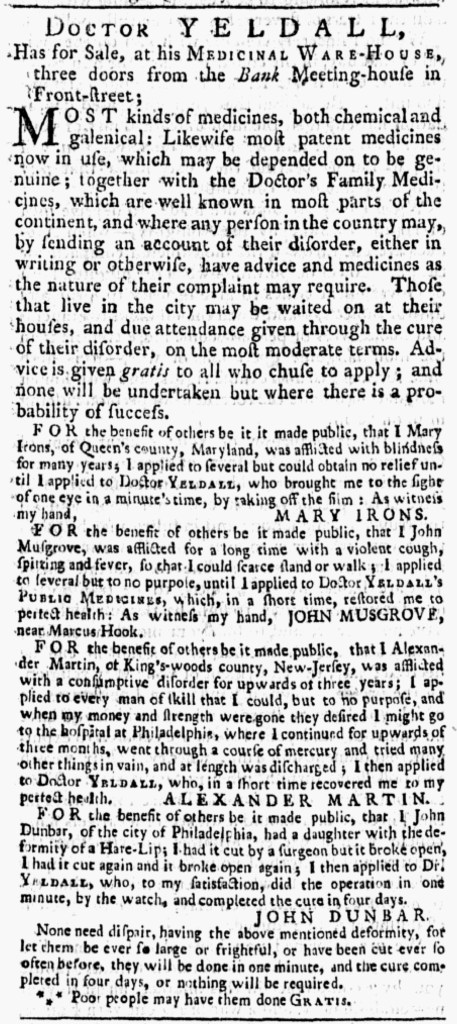
Pennsylvania Ledger (June 17, 1775).

“I applied to Doctor YELDALL’S PUBLIC MEDICINES, which, in a short time, restored me to perfect health.”

An advertisement placed by “DOCTOR YELDALL” in the June 17, 1775, edition of the Pennsylvania Ledger advised the public that he sold “MOST kinds of medicines” at his “MEDICINAL WARE-HOUSE” on Front Street in Philadelphia.  He carried “most patent medicines now in use” as well as his own line of “the Doctor’s Family Medicines,” which, he claimed, “are well known in most parts of the continent.”  Customers residing in the country could send orders for Yeldall to fill, while those in the city could arrange to “be waited on at their houses, and due attendance given through the cure of their disorder.”  The doctor did not charge for consultations, nor did he commence treatment except “where there is a probability of success.”  He attempted to build trust with prospective patients in his advertisement.

To that end, he also published a series of testimonials, hoping that former patients would prove even more convincing than his own description of his services.  Each started with the same phrase, “FOR the benefit of other be it made public,” suggesting that Yeldall solicited the testimonials and assisted in drafting them (or perhaps even wrote them himself).  In one, John Musgrove, who lived near Marcus Hook, Pennsylvania, reported that he “was afflicted for a long time with a violent cough, spitting and fever” to the point that he “could scarce stand or walk.”  He sought assistance “but to no purpose, until [he] applied to Doctor YELDALL’S PUBLIC MEDICINES.”  They quickly restored him to “perfect health.”  Alexander Martin “of Kings-woods county, New-Jersey” similarly declared that he “was afflicted with a consumptive disorder for upwards of three years,” during which time he “applied to every man of skill that [he] could, but to no purpose.”  He even entered the “hospital at Philadelphia” and stayed for three months, enduring “a course of mercury” and “tried many other things in vain.”  Only after his discharge from the hospital did Martin seek aid from Yeldall, who “in a short time recovered me to my perfect health.”  According to Martin and Musgrove, the doctor’s methods were both fast and effective.

In addition to prescribing the right medicines to treat his patients’ maladies, Yeldall also performed medical procedures.  In one testimonial, Mary Irons of Queen’s County, Maryland, declared that she “was afflicted with blindness for many years.”  She “applied to several, but could obtain no relief until I applied to Doctor YELDALL, who brought me to the sight of one eye in a minute’s time, by taking off the film.”  John Dunbar “of the city of Philadelphia” told of a surgeon who unsuccessfully treated his daughter.  She had “the deformity of a Hare-Lip” that “broke open” after the surgeon “cut” it.  Dunbar then took his daughter to Yeldall, “who, to my satisfaction, did the operation in one minute, by the watch, and completed the cure in four days.”  Yeldall added a note that others with “the above mentioned deformity” did not need to “dispair,” no matter how “large or frightful, or hav[ing] been cut so often before,” because his procedure “will be done in one minute, and the cure completed in four days” or else he did not charge for his services.  Perhaps the focus on how quickly the doctor performed these operations was meant to reassure prospective patients that they would not experience prolonged discomfort during a procedure.

Yeldall’s promises seemed too good to be true … and they almost certainly were.  Yet the “DOCTOR” realized that some prospective patients were likely desperate for any sort of treatment that they could hope for a different outcome.  As they searched for hope, he expected that his own promises and, especially, testimonials supposedly composed by his former patients would convince the afflicted to give him a chance to restore them to health.

Slavery Advertisements Published June 17, 1775

The Slavery Adverts 250 Project chronicles the role of newspaper advertising in perpetuating slavery in the era of the American Revolution. The project seeks to reveal the ubiquity of slavery in eighteenth-century life from New England to Georgia by republishing advertisements about enslaved people – for sale as individuals or in groups, wanted to purchase or for hire for short periods, runaways who liberated themselves, and those who were subsequently captured and confined in jails and workhouses – in daily digests on this site as well as in real time via the @SlaveAdverts250 Twitter feed, utilizing twenty-first-century media to stand in for the print media of the eighteenth century.

The project aims to provide modern audiences with a sense of just how often colonizers encountered these advertisements in their daily lives. Enslaved men, women, and children appeared in print somewhere in the colonies almost every single day. Those advertisements served as a constant backdrop for social, cultural, economic, and political life in colonial and revolutionary America. Colonizers who did not purport to own enslaved people were still confronted with slavery as well as invited to maintain the system by purchasing enslaved men, women, and children or assisting in the capture of so-called “runaways” who sought to free themselves from bondage. The frequency of these newspaper advertisements suggests just how embedded slavery was in colonial and revolutionary American culture in everyday interactions beyond the printed page.

These advertisements also testify to the experiences of enslaved men, women, and children, though readers must consider that those experiences have been remediated through descriptions offered by enslavers rather than enslaved people themselves. Often unnamed in the advertisements, enslaved men, women, and children were not invisible or unimportant in early America.

These advertisements appeared in colonial American newspapers 250 years ago today.

Providence Gazette (June 17, 1775).

**********

Virginia Gazette [Dixon and Hunter] (June 17, 1775).

**********

Virginia Gazette [Dixon and Hunter] (June 17, 1775).

**********

Virginia Gazette [Dixon and Hunter] (June 17, 1775).

**********

Virginia Gazette [Dixon and Hunter] (June 17, 1775).

**********

Virginia Gazette [Dixon and Hunter] (June 17, 1775).

**********

Virginia Gazette [Dixon and Hunter] (June 17, 1775).

**********

Virginia Gazette [Dixon and Hunter] (June 17, 1775).

June 16

What was advertised in a revolutionary American newspaper 250 years ago today?

Story and Humphreys’s Pennsylvania Mercury (June 16, 1775).

“Enquire of the PRINTERS.”

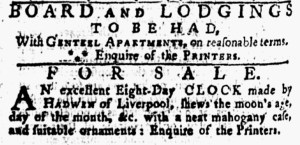
Printing offices were busy places.  In addition to the master printers, journeymen, apprentices, and others who worked in them, a variety of associates and customers frequently visited to share news and information or to conduct business.  That was almost certainly the case in the printing office operated by Enoch Story and Daniel Humphreys in Norris’s Alley in Philadelphia when the American Revolution began.  The colophon on the final page of their newspaper, Story and Humphreys’s Pennsylvania Mercury, advised that “Subscriptions, … Advertisements, [and] Articles and Letters of Intelligence” were “gratefully received” there.  A constant stream of people likely visited their printing office.

Some of them arrived seeking more information about advertisements that ran in the Pennsylvania Mercury.  In addition to printing and disseminating notices on behalf of advertisers, the printers also served as brokers who provided additional information beyond what appeared in the public prints.  The June 16, 1775, edition, for instance, carried two advertisements that instructed interested parties to “Enquire of the Printers” to learn more.  One gave sparse details about “BOARD AND LODGING TO BE HAD, With GENTEEL APARTMENTS, on reasonable terms.”  Which additional details did Story and Humphreys give to those who did enquire?  Did they merely facilitate an introduction to the advertiser?  Did they have details about price, furnishings, or the schedule for meals?  The advertisement does not reveal how much information they relayed, only that both the printers and the advertiser anticipated that Story and Humphreys would have some involvement beyond publishing the advertisement.

Another advertisement offered for sale an “excellent Eight-Day CLOCK made by HADWEN of Liverpool” that “shews the moon’s age” and the “day of the month” in “a neat mahogany case” with “suitable ornaments.”  Again, the advertisement did not indicate which additional details Story and Humphreys relayed to those who did “Enquire of the Printers,” but it testified to their additional involvement in the transaction after publishing the advertiser’s notice in their newspaper.  Eighteenth-century printers brokered information both in print and in person, the latter an element of the customer service available to advertisers.

Slavery Advertisements Published June 16, 1775

The Slavery Adverts 250 Project chronicles the role of newspaper advertising in perpetuating slavery in the era of the American Revolution. The project seeks to reveal the ubiquity of slavery in eighteenth-century life from New England to Georgia by republishing advertisements about enslaved people – for sale as individuals or in groups, wanted to purchase or for hire for short periods, runaways who liberated themselves, and those who were subsequently captured and confined in jails and workhouses – in daily digests on this site as well as in real time via the @SlaveAdverts250 Twitter feed, utilizing twenty-first-century media to stand in for the print media of the eighteenth century.

The project aims to provide modern audiences with a sense of just how often colonizers encountered these advertisements in their daily lives. Enslaved men, women, and children appeared in print somewhere in the colonies almost every single day. Those advertisements served as a constant backdrop for social, cultural, economic, and political life in colonial and revolutionary America. Colonizers who did not purport to own enslaved people were still confronted with slavery as well as invited to maintain the system by purchasing enslaved men, women, and children or assisting in the capture of so-called “runaways” who sought to free themselves from bondage. The frequency of these newspaper advertisements suggests just how embedded slavery was in colonial and revolutionary American culture in everyday interactions beyond the printed page.

These advertisements also testify to the experiences of enslaved men, women, and children, though readers must consider that those experiences have been remediated through descriptions offered by enslavers rather than enslaved people themselves. Often unnamed in the advertisements, enslaved men, women, and children were not invisible or unimportant in early America.

These advertisements appeared in colonial American newspapers 250 years ago today.

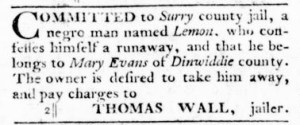
South-Carolina and American General Gazette (June 16, 1775).

**********

South-Carolina and American General Gazette (June 16, 1775).

**********

South-Carolina and American General Gazette (June 16, 1775).

**********

South-Carolina and American General Gazette (June 16, 1775).

**********

South-Carolina and American General Gazette (June 16, 1775).

**********

South-Carolina and American General Gazette (June 16, 1775).

**********

South-Carolina and American General Gazette (June 16, 1775).

**********

South-Carolina and American General Gazette (June 16, 1775).

**********

South-Carolina and American General Gazette (June 16, 1775).

**********

South-Carolina and American General Gazette (June 16, 1775).

**********

South-Carolina and American General Gazette (June 16, 1775).

**********

South-Carolina and American General Gazette (June 16, 1775).

**********

South-Carolina and American General Gazette (June 16, 1775).

**********

South-Carolina and American General Gazette (June 16, 1775).

**********

South-Carolina and American General Gazette (June 16, 1775).

**********

South-Carolina and American General Gazette (June 16, 1775).

**********

South-Carolina and American General Gazette (June 16, 1775).

**********

South-Carolina and American General Gazette (June 16, 1775).

**********

South-Carolina and American General Gazette (June 16, 1775).

**********

South-Carolina and American General Gazette (June 16, 1775).

**********

South-Carolina and American General Gazette (June 16, 1775).

**********

South-Carolina and American General Gazette (June 16, 1775).

**********

South-Carolina and American General Gazette (June 16, 1775).

**********

South-Carolina and American General Gazette (June 16, 1775).

**********

South-Carolina and American General Gazette (June 16, 1775).

**********

South-Carolina and American General Gazette (June 16, 1775).

**********

South-Carolina and American General Gazette (June 16, 1775).

**********

South-Carolina and American General Gazette (June 16, 1775).

**********

South-Carolina and American General Gazette (June 16, 1775).

**********

South-Carolina and American General Gazette (June 16, 1775).

**********

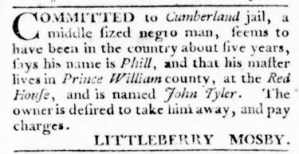
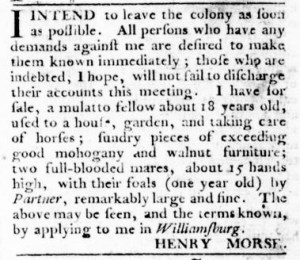
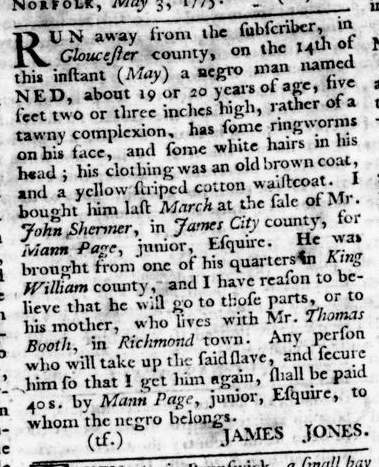
Virginia Gazette [Purdie] (June 16, 1775).

**********

Virginia Gazette [Purdie] (June 16, 1775).

**********

Virginia Gazette [Purdie] (June 16, 1775).

**********

Virginia Gazette [Purdie] (June 16, 1775).

**********

Virginia Gazette [Purdie] (June 16, 1775).

**********

Virginia Gazette [Purdie] (June 16, 1775).

**********

Virginia Gazette [Purdie] (June 16, 1775).

**********

Virginia Gazette [Purdie] (June 16, 1775).

June 15

What was advertised in a revolutionary American newspaper 250 years ago today?

New-England Chronicle (June 15, 1775).

“We are satisfied that Mr. Bradish had no Desire … to do any Injury to his Country.”

On the eve of the American Revolution and during the first months of the war, colonizers in New England resorted to newspaper to clarify their positions and frame their own narratives about how their experiences fit into current events.  They used advertisements to set the record straight for a public that might have misunderstood their actions or principles.  For nearly a year before the battles at Lexington and Concord, some of those who signed an address to the former governor, Thomas Hutchinson, upon his departure from Massachusetts to return to England ran advertisements with recantations and assurances that they supported the American cause.

Once hostilities commenced, others depended on advertisements endorsed by reputable patriots to clear their names.  Such was the case with Ebenezer Bradish, Jr., of Cambridge who had been “represented as a Person unfriendly to the just Rights and Liberties of his Country.”  To make matters worse, he moved to Boston on the same day as “the late unhappy Commencement of Hostilities betweed the Troops under the Command of General Gage,” the governor, and “the Inhabitants of this Province.”  That “increased public Suspicions against him” and “rendered [him] more odious and disagreeable to his Countrymen.”

Yet that unfortunate coincidence did not tell the entire story, according to ten men who signed a notice in which they recommended that “all Persons” treat Bradish “as a Gentlemen who is not unfriendly to the Rights and Privileges of his Countrymen,” at least “so far as we are able to discover upon strict Enquiry into his late Conduct.”  They declared that they had investigated “the Cause of his going to Boston at the Time aforesaid” as well as “his Conduct since” and determined that Bradish “had no Desire by that Means, to any Injury to his Country.”  On the contrary, they asserted,” his Design was friendly, and his Conduct was justifiable,” though they did not give more details about the circumstances.  The men who signed the notice came from various towns in Massachusetts (and one from Connecticut).  Most listed their ranks, with “Seth Pomeroy, of Northampton, (General.)” first and then five colonels, two majors, and one captain.  Even though Bradish was suspect, these men were not.  Readers could trust them when they said that they wished “to do Justice to Mr. Bradish” by “remov[ing] from the Minds of our beloved Friends and Countrymen, all groundless Apprehensions” about his conduct.

When Bradish published the conclusions reached by their “Enquiry” as an advertisement in the June 15, 1775, edition of the New-England Chronicle, he appended a nota bene that made clear he had no sympathy for British authorities or the conduct of the troops under their command.  “Whereas a Report had been unjustly spread abroad, that it not the Regulars but our own People who took the Goods lost out of my House,” Bradish proclaimed, “this is to certify to all good People, that said Report is false.”  Furthermore, it “never came from me” but instead from someone else with malicious intent.  To leave no doubt about where he stood, Bradish concluded with an indictment of British troops: “I am certain my House was not only shot at but plundered by the Regulars.”  In publishing the letter from the men who investigated his actions and his own account of what happened to his house as a newspaper advertisement, Bradish hoped to harness the power of the public prints to clear his name and restore himself to good standing among those who supported the patriot cause.

Slavery Advertisements Published June 15, 1775

The Slavery Adverts 250 Project chronicles the role of newspaper advertising in perpetuating slavery in the era of the American Revolution. The project seeks to reveal the ubiquity of slavery in eighteenth-century life from New England to Georgia by republishing advertisements about enslaved people – for sale as individuals or in groups, wanted to purchase or for hire for short periods, runaways who liberated themselves, and those who were subsequently captured and confined in jails and workhouses – in daily digests on this site as well as in real time via the @SlaveAdverts250 Twitter feed, utilizing twenty-first-century media to stand in for the print media of the eighteenth century.

The project aims to provide modern audiences with a sense of just how often colonizers encountered these advertisements in their daily lives. Enslaved men, women, and children appeared in print somewhere in the colonies almost every single day. Those advertisements served as a constant backdrop for social, cultural, economic, and political life in colonial and revolutionary America. Colonizers who did not purport to own enslaved people were still confronted with slavery as well as invited to maintain the system by purchasing enslaved men, women, and children or assisting in the capture of so-called “runaways” who sought to free themselves from bondage. The frequency of these newspaper advertisements suggests just how embedded slavery was in colonial and revolutionary American culture in everyday interactions beyond the printed page.

These advertisements also testify to the experiences of enslaved men, women, and children, though readers must consider that those experiences have been remediated through descriptions offered by enslavers rather than enslaved people themselves. Often unnamed in the advertisements, enslaved men, women, and children were not invisible or unimportant in early America.

These advertisements appeared in colonial American newspapers 250 years ago today.

Maryland Gazette (June 15, 1775).

**********

Maryland Gazette (June 15, 1775).

**********

Maryland Gazette (June 15, 1775).

**********

Maryland Gazette (June 15, 1775).

**********

Maryland Gazette (June 15, 1775).

**********

Maryland Gazette (June 15, 1775).

**********

New-York Journal (June 15, 1775).

**********

New-York Journal (June 15, 1775).

**********

Pennsylvania Evening Post (June 15, 1775).

**********

Rivington’s New-York Gazetteer (June 15, 1775).

**********

Rivington’s New-York Gazetteer (June 15, 1775).

**********

Rivington’s New-York Gazetteer (June 15, 1775).

**********

Virginia Gazette [Pinkney] (June 15, 1775).

**********

Virginia Gazette [Pinkney] (June 15, 1775).