Slavery Advertisements Published July 26, 1775

GUEST CURATORS:  Jules Rizzitelli, Anna Shew, and Maddy Watt

The Slavery Adverts 250 Project chronicles the role of newspaper advertising in perpetuating slavery in the era of the American Revolution. The project seeks to reveal the ubiquity of slavery in eighteenth-century life from New England to Georgia by republishing advertisements about enslaved people – for sale as individuals or in groups, wanted to purchase or for hire for short periods, runaways who liberated themselves, and those who were subsequently captured and confined in jails and workhouses – in daily digests on this site as well as in real time via the @SlaveAdverts250 Twitter feed, utilizing twenty-first-century media to stand in for the print media of the eighteenth century.

The project aims to provide modern audiences with a sense of just how often colonizers encountered these advertisements in their daily lives. Enslaved men, women, and children appeared in print somewhere in the colonies almost every single day. Those advertisements served as a constant backdrop for social, cultural, economic, and political life in colonial and revolutionary America. Colonizers who did not purport to own enslaved people were still confronted with slavery as well as invited to maintain the system by purchasing enslaved men, women, and children or assisting in the capture of so-called “runaways” who sought to free themselves from bondage. The frequency of these newspaper advertisements suggests just how embedded slavery was in colonial and revolutionary American culture in everyday interactions beyond the printed page.

These advertisements also testify to the experiences of enslaved men, women, and children, though readers must consider that those experiences have been remediated through descriptions offered by enslavers rather than enslaved people themselves. Often unnamed in the advertisements, enslaved men, women, and children were not invisible or unimportant in early America.

These advertisements appeared in colonial American newspapers 250 years ago today.

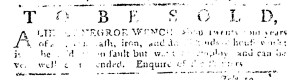
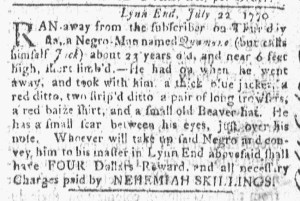
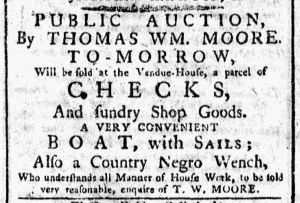
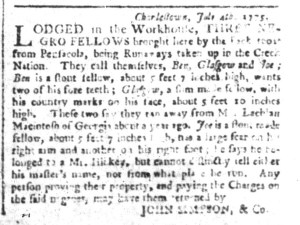
Connecticut Journal (July 26, 1775).

**********

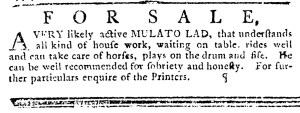
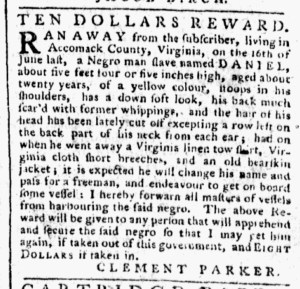
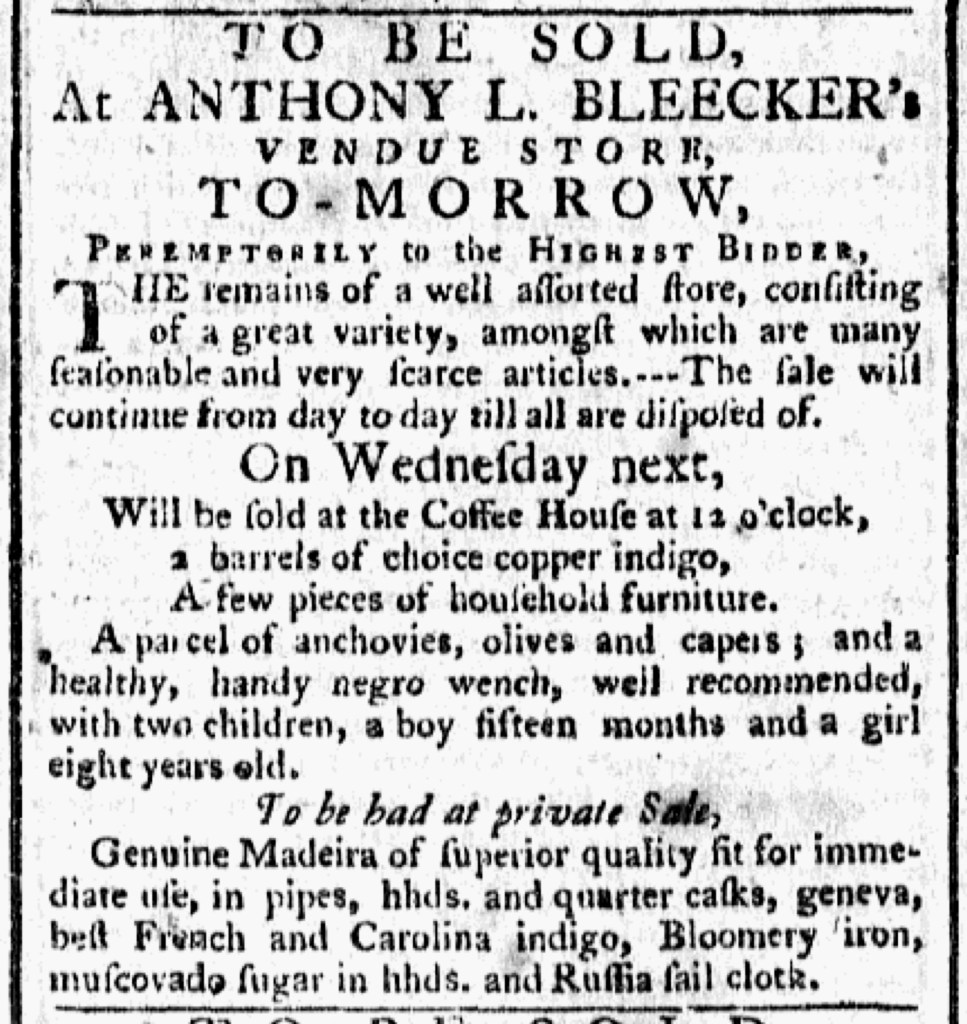
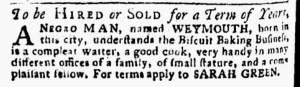
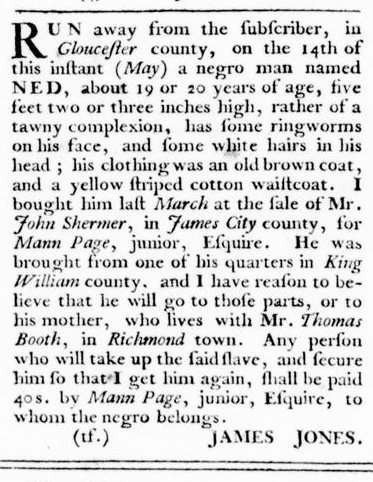
Pennsylvania Journal (July 26, 1775).

**********

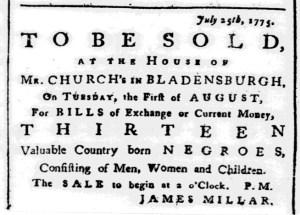
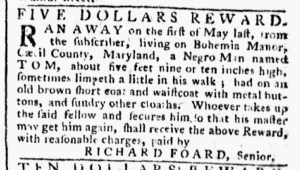
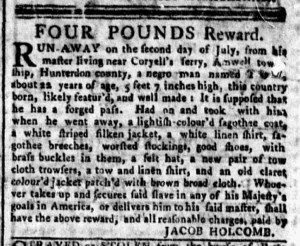
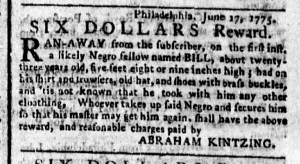
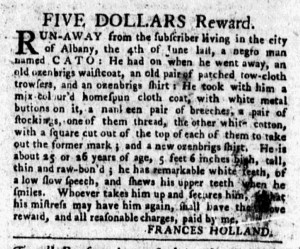
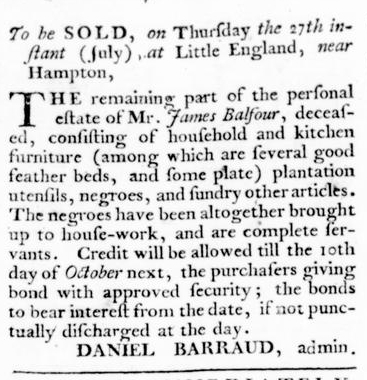
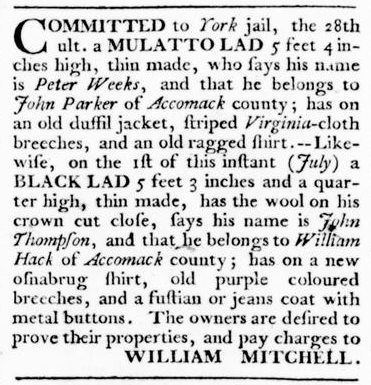
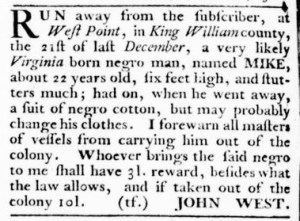
Pennsylvania Journal (July 26, 1775).

July 25

What was advertised in a revolutionary American newspaper 250 years ago today?

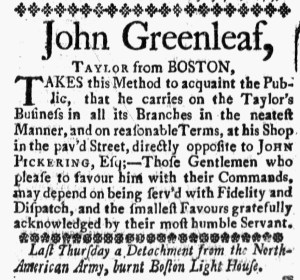
New-Hampshire Gazette (July 25, 1775).

“John Greenleaf, TAYLOR from BOSTON.”

Even though Daniel Fowle sometimes had to reduce the size of the New-Hampshire Gazette to two pages instead of four in the months following the battles at Lexington and Concord, he found space to include advertisements alongside the news of the momentous events taking place in Massachusetts where the siege of Boston continued and General George Washington took command of the Continental Army, in Philadelphia where the Second Continental Congress met to address the crisis, and throughout the colonies as everyone took stock of what occurred and made preparations for what they believed might come next.  The July 25, 1775, edition of the New-Hampshire Gazette, for instance, consisted of six columns spread over two pages.  Several advertisements filled just over half of the final column.

Those advertisements included one from John Greenleaf, “TAYLOR from BOSTON,” who wished “to acquaint the Public, that he carries on the Taylor’s Business in all its Branches in the neatest Manner, and on reasonable Terms, at his Shop” in Portsmouth.  After rehearsing common appeals about his skill and the quality of his work (“neatest Manner”) and the price (“reasonable Terms”), Greenleaf emphasized the sort of service that customers expected from tailors: “Those Gentlemen who please to favour him with their Commands, may depend on being serv’d with Fidelity and Dispatch, and the smallest Favours gratefully acknowledged.”  The tailor’s advertisement followed a familiar formula, one used by members of his trade from New England to Georgia.

Even listing his occupation and the place he formerly lived and worked (“TAYLOR from BOSTON”) as a secondary headline was part of that formula, yet in this instance doing so had new significance.  Greenleaf did not merely communicate that he brought his experience from one of the largest urban ports in the colonies to the smaller town of Portsmouth.  He also made a statement about how his life had been disrupted when hostilities commenced in April 1775.  He took advantage of negotiations between General Thomas Gage, the governor and king’s representative, and the Massachusetts Provincial Congress that allowed Loyalists to enter Boston and Patriots and others to depart.  In describing himself as a “TAYLOR from BOSTON,” Greenleaf declared that he was a refugee, one of many who placed advertisements when they settled in new towns.  He likely hoped that would influence prospective customers to avail themselves of his services.  The scrap of news that Fowle, the printer, inserted immediately below the tailor’s advertisement underscored Greenleaf’s status as a refugee.  “Last Thursday,” Fowle reported, “a Detachment from the North-American Army, burnt Boston Light House.”  Greenleaf did not need to elaborate on the dangers he escaped and the challenges he faced in establishing his business in a new town.  Readers already knew all about it.

Slavery Advertisements Published July 25, 1775

GUEST CURATORS:  Jules Rizzitelli, Anna Shew, and Maddy Watt

The Slavery Adverts 250 Project chronicles the role of newspaper advertising in perpetuating slavery in the era of the American Revolution. The project seeks to reveal the ubiquity of slavery in eighteenth-century life from New England to Georgia by republishing advertisements about enslaved people – for sale as individuals or in groups, wanted to purchase or for hire for short periods, runaways who liberated themselves, and those who were subsequently captured and confined in jails and workhouses – in daily digests on this site as well as in real time via the @SlaveAdverts250 Twitter feed, utilizing twenty-first-century media to stand in for the print media of the eighteenth century.

The project aims to provide modern audiences with a sense of just how often colonizers encountered these advertisements in their daily lives. Enslaved men, women, and children appeared in print somewhere in the colonies almost every single day. Those advertisements served as a constant backdrop for social, cultural, economic, and political life in colonial and revolutionary America. Colonizers who did not purport to own enslaved people were still confronted with slavery as well as invited to maintain the system by purchasing enslaved men, women, and children or assisting in the capture of so-called “runaways” who sought to free themselves from bondage. The frequency of these newspaper advertisements suggests just how embedded slavery was in colonial and revolutionary American culture in everyday interactions beyond the printed page.

These advertisements also testify to the experiences of enslaved men, women, and children, though readers must consider that those experiences have been remediated through descriptions offered by enslavers rather than enslaved people themselves. Often unnamed in the advertisements, enslaved men, women, and children were not invisible or unimportant in early America.

These advertisements appeared in colonial American newspapers 250 years ago today.

Dunlap’s Maryland Gazette (July 25, 1775).

**********

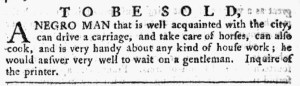
South-Carolina Gazette and Country Journal (July 25, 1775).

**********
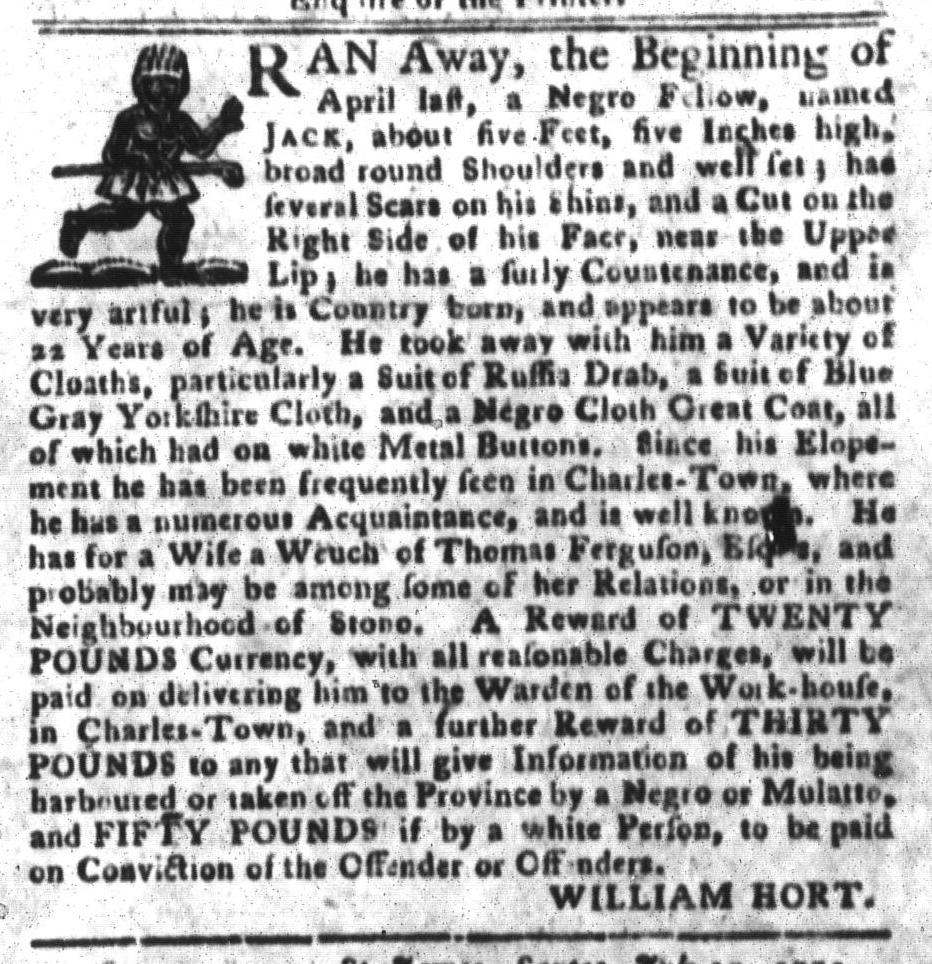
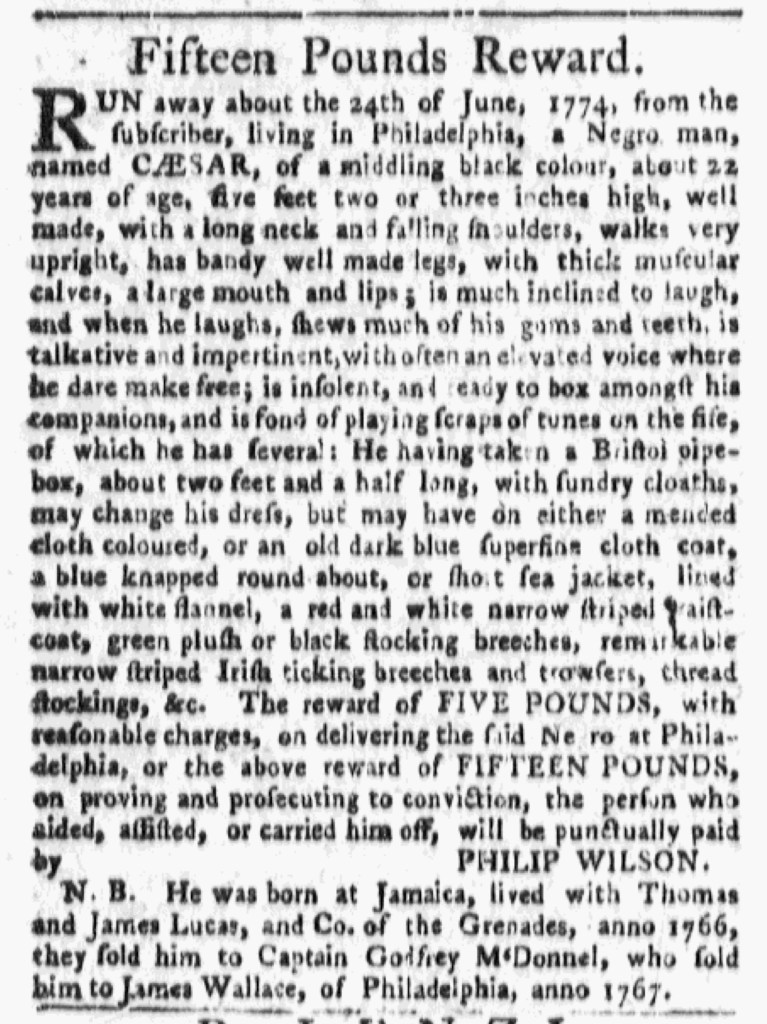
South-Carolina Gazette and Country Journal (July 25, 1775).

**********
South-Carolina Gazette and Country Journal (July 25, 1775).

**********
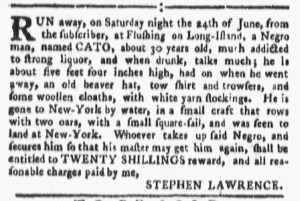
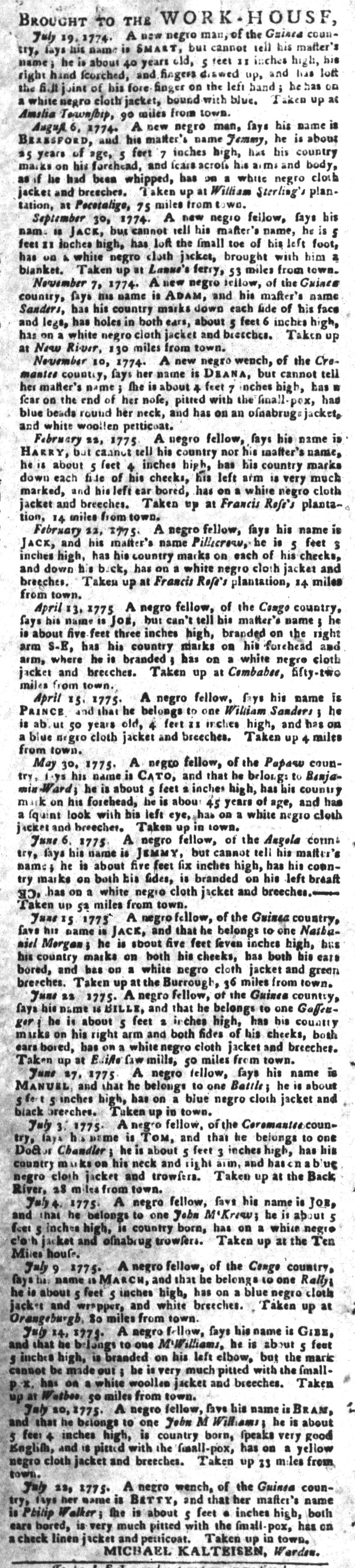
South-Carolina Gazette and Country Journal (July 25, 1775).

**********
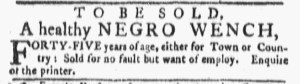
South-Carolina Gazette and Country Journal (July 25, 1775).

**********

South-Carolina Gazette and Country Journal (July 25, 1775).

July 24

What was advertised in a revolutionary American newspaper 250 years ago today?

New-York Gazette and Weekly Mercury (July 24, 1775).

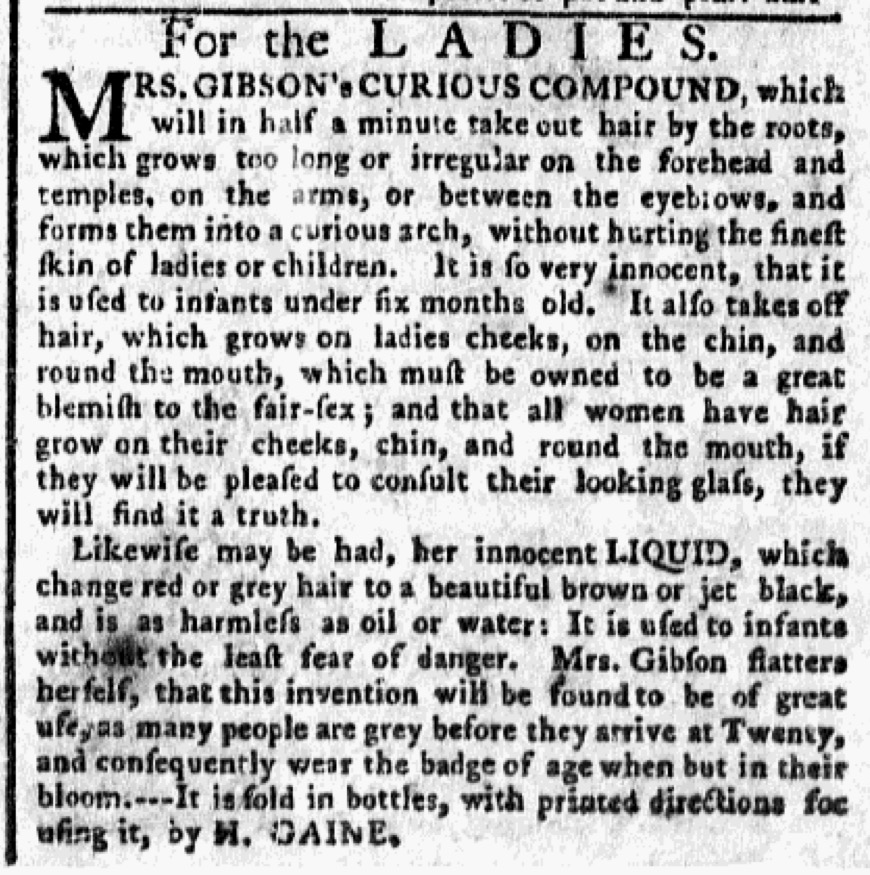
“For the LADIES. MRS. GIBSON’s CURIOUS COMPOUND.”

Cosmetics advertisements occasionally appeared in newspapers during the era of the American Revolution, such as one about “MRS. GIBSON’s CURIOUS COMPOUND” in the July 24, 1775, edition of the New-York Gazette and Weekly Mercury.  The headline, “For the LADIES,” made clear the target audience.  The copy explained that the product “will in half a minute take out hair by the roots, which grows too long or irregular on the forehead and temples, on the arms, or between the eyebrows, and forms them into a curious arch.”  Even more appealing, it did so “without hurting the finest skin of ladies or children.”  Indeed, Mrs. Gibson’s Curious Compound was so gentle and “so very innocent, that it is used [on] infants under six months old.”

Yet the pitch did not end there.  According to the advertisement, the product “also takes off hair, which grows on ladies cheeks, on the chin, and round the mouth, which must be owned to be a great blemish to the fair-sex.”  Lest any female readers to feel too confident about their appearance, the advertisement asserted that “all women have hair grow on their cheeks, chin, and round the mouth.”  That was not a matter of conjecture but something they could prove with their own eyes: “if they will be pleased to consult their looking glass, they will find it a truth.”  The marketing for Mrs. Gibson’s Curious Compound relied on making women feel anxiety about their bodies, not unlike the marketing undertaken by staymakers who addressed “Ladies who are uneasy in their shapes.”

In addition to her hair removal compound, Mrs. Gibson produced an “innocent LIQUID, which change[s] red or grey hair to a beautiful brown or jet black.”  Safety once again played a role in promoting the product.  The advertisement claimed it was “as harmless as oil or water” and could even be “used [on] infants without the least fear of danger.”  The marketing for Mrs. Gibson’s products seemed to have a formula.  After a description of the purpose of Mrs. Gibson’s Liquid and a note about safety, the copy attempted to incite feelings of discomfort and self-consciousness among readers.  “[T]his invention will be found to be of great use,” the advertisement declared, “as many people are grey before they arrive at Twenty, and consequently wear the badge of age when but in their bloom.”  Yet young ladies did not need to appear prematurely old, nor did older ladies need to look their age if they applied Mrs. Gibson’s Liquid to their hair.

Where could women acquire Mrs. Gibson’s Curious Compound and Mrs. Gibson’s Liquid?  Hugh Gaine sold both products, along with “printed directions,” at the printing office where he published the New-York Gazette and Weekly Mercury.  The printer also supplemented his income by marketing Keyser’s Famous Pills once again.  Both advertisements appeared in the final column of the first page of his newspaper.  Printers often stocked, marketed, and sold patent medicines as an additional revenue stream, but they did not promote cosmetics nearly as often.  The printed directions, however, made Mrs. Gibson’s products easy to sell since nobody in the printing office needed to have any direct knowledge of them, just as printed directions made it unnecessary to know much about patent medicines sold in printing offices.

Slavery Advertisements Published July 24, 1775

GUEST CURATORS:  Jules Rizzitelli, Anna Shew, and Maddy Watt

The Slavery Adverts 250 Project chronicles the role of newspaper advertising in perpetuating slavery in the era of the American Revolution. The project seeks to reveal the ubiquity of slavery in eighteenth-century life from New England to Georgia by republishing advertisements about enslaved people – for sale as individuals or in groups, wanted to purchase or for hire for short periods, runaways who liberated themselves, and those who were subsequently captured and confined in jails and workhouses – in daily digests on this site as well as in real time via the @SlaveAdverts250 Twitter feed, utilizing twenty-first-century media to stand in for the print media of the eighteenth century.

The project aims to provide modern audiences with a sense of just how often colonizers encountered these advertisements in their daily lives. Enslaved men, women, and children appeared in print somewhere in the colonies almost every single day. Those advertisements served as a constant backdrop for social, cultural, economic, and political life in colonial and revolutionary America. Colonizers who did not purport to own enslaved people were still confronted with slavery as well as invited to maintain the system by purchasing enslaved men, women, and children or assisting in the capture of so-called “runaways” who sought to free themselves from bondage. The frequency of these newspaper advertisements suggests just how embedded slavery was in colonial and revolutionary American culture in everyday interactions beyond the printed page.

These advertisements also testify to the experiences of enslaved men, women, and children, though readers must consider that those experiences have been remediated through descriptions offered by enslavers rather than enslaved people themselves. Often unnamed in the advertisements, enslaved men, women, and children were not invisible or unimportant in early America.

These advertisements appeared in colonial American newspapers 250 years ago today.

Boston-Gazette (July 24, 1775).

**********
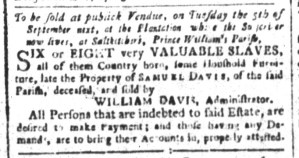
Dunlap’s Pennsylvania Packet (July 24, 1775).

**********
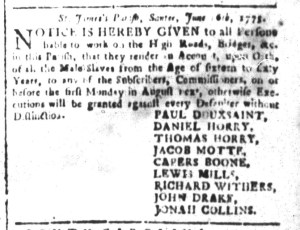
Dunlap’s Pennsylvania Packet (July 24, 1775).

**********

New-York Gazette and Weekly Mercury (July 24, 1775).

**********
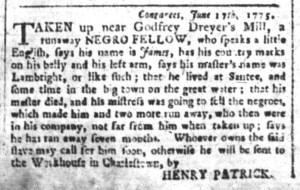
New-York Gazette and Weekly Mercury (July 24, 1775).

**********

New-York Gazette and Weekly Mercury (July 24, 1775).

**********

New-York Gazette and Weekly Mercury (July 24, 1775).

**********

New-York Gazette and Weekly Mercury (July 24, 1775).

**********

New-York Gazette and Weekly Mercury (July 24, 1775).

**********

Supplement to the New-York Gazette and Weekly Mercury (July 24, 1775).

**********

Norwich Packet (July 24, 1775).

July 23

What was advertised in a revolutionary American newspaper 250 years ago this week?

South-Carolina and American General Gazette (July 21, 1775).

“A SERMON on the present Situation of American Affairs.”

Robert Wells, the printer of the South-Carolina and American General Gazette, often inserted advertisements that promoted the merchandise available at his “GREAT STATIONARY & BOOK STORE” in Charleston.  On July 21, 1775, he devoted a notice to “A SERMON on the present Situation of American Affairs.  Preached in Christ Church, Philadelphia, June 23, 1775, at the Request of the Officers of the Third Battalion of the City of Philadelphia and District of Southwark.  By WILLIAM SMITH, D.D. Provost of the College in that City.”  Like many other advertisements for books, the copy replicated the title page.  Wells added the verse from the Book of Joshua that Smith cited as inspiration for the sermon.

The headline for the advertisement declared, “Just published, and to be sold BY ROBERT WELLS.”  Did “Just published” and “to be sold” both describe Wells’s role in disseminating Smith’s sermon?  When printers and booksellers linked those phrases together, they often meant that a work had been “Just published” by someone else and made available “to be sold” by other printers and booksellers.  Wells may have acquired copies of the sermon printed by James Humphreys, Jr., in Philadelphia and retailed them at his own shop.  Another advertisement in the same issue used the headline, “This Day are Published, BY ROBERT WELLS,” to introduce two books, “OBSERVATIONS on the RAISING and TRAINING of RECRUITS. By CAMPBELL DALRYMPLE, Esq; Lieutenant Colonel to the King’s Own Regiment of Dragoons,” and “THE MANUAL EXERCISE, with EXPLANATIONS, as now practised by The CHARLESTOWN ARTILLERY COMPANY.”  In contrast to “This Day are Published,” other items certainly not printed by Wells appeared beneath a header that stated, “At the same STORE may be had.”  On the other hand, Wells could have published a local edition of Smith’s sermon.  James Adams printed and sold a local edition in Wilmington, Delaware.

Christopher Gould includes Smith’s Sermon on the Present Situation of American Affairs (entry 103) in his roster of imprints from Wells’s printing office, along with The Manual Exercise (entry 92) and Observations on the Raising and Training of Recruits (entry 93).  For each of them, he indicates that he did not examine an extant copy but instead drew the information from newspaper advertisements.  Gould explains that “many of the entries for 1774 and 1775 must be regarded as suspect.  Wells advertises them as his publications, but in the absence of extant copies bearing his imprint, the likelihood is strong that they are in fact London editions of popular works bound in Charleston by Wells.”[1]  As I have noted, Wells used a headline to introduce Smith’s Sermon that both contemporary printers and readers understood did not necessarily attribute publication to the advertiser.  Even if he sold copies of the sermon printed elsewhere, they did not come from London.  Smith delivered the sermon on June 23 and Wells advertised it just four weeks later, not nearly enough time for London printers to be involved.  Wells advertised an American edition, even if he did not publish it.

Whatever the case, the sermon supplemented the news.  Readers of the South-Carolina and American General Gazettefollowed all sorts of “AMERICAN INTELLIGENCE” from New England to Georgia, but the pages of any newspaper could present only so much content.  Wells presented readers an opportunity to learn more about the discussions about current events taking place in Philadelphia by experiencing Smith’s sermon themselves.  As consumers, they could become better informed and join with others who heard or read the sermon.

**********

[1] Chrisopher Gould, “Robert Wells, Colonial Charleston Printer,” South Carolina Historical Magazine 79, no. 1 (January 1978): 42.

July 22

What was advertised in a revolutionary American newspaper 250 years ago today?

Essex Journal (July 22, 1775).

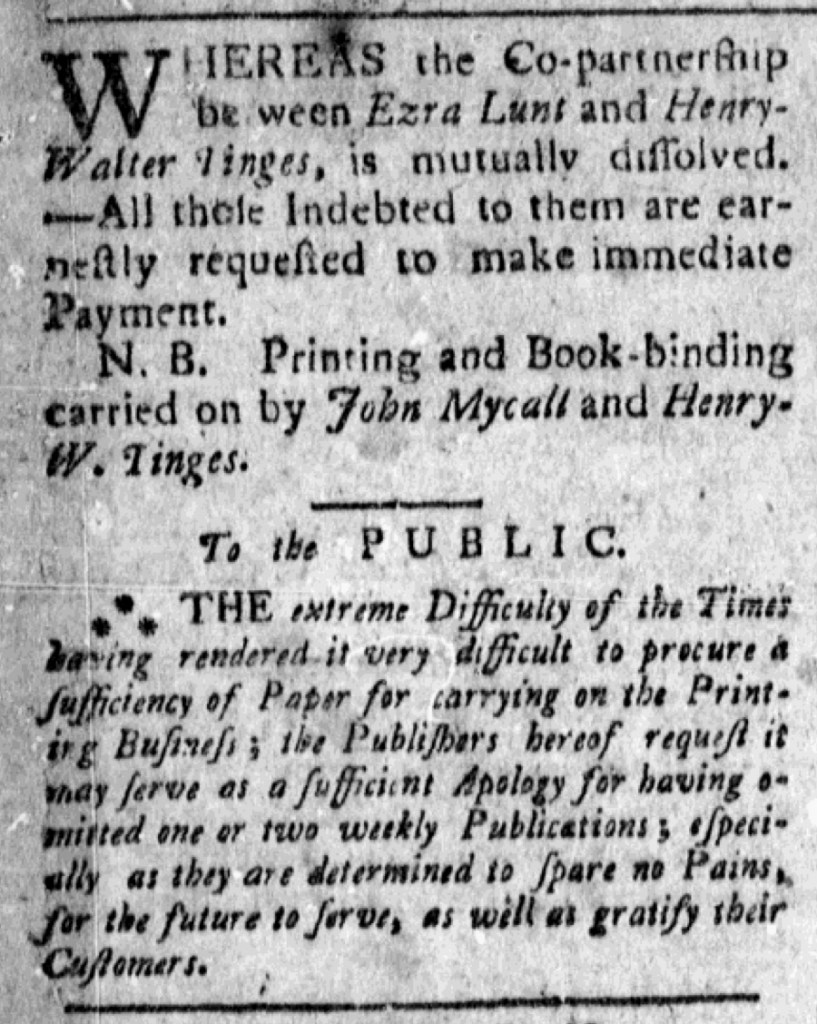
THE extreme Difficulty of the Times having rendered it very difficult to procure a sufficiency of Paper.”

A notice on the first page of the July 22, 1775, edition of the Essex Journal, Or, the Massachusetts and New-Hampshire General Advertiser informed readers that the “Co-partnership between Ezra Lunt and Henry-Walter Tinges,” the publishers of the newspaper, “is mutually dissolved” and called on “those Indebted to them” to settle accounts.  Yet the printing office in Newburyport was not being shuttered.  Instead, a nota bene declared, “Printing and Book-binding carried on by John Mycall and Henry-W. Tinges.”  Mycall became Tinges’s third partner in less than three years.  The young printer first went into business with Isaiah Thomas, the printer of the Massachusetts Spy in the late fall of 1773.  The more experienced printer remained in Boston while his junior partner oversaw the printing office and their new newspaper.  The partnership lasted less than a year.  On August 17, 1774, they notified the public that they “mutually dissolved” their partnership, but the “Printing Business is carried on as usual, by Ezra Lunt and Henry W. Tinges.”

Nearly a year later, Lunt departed and Mycall took his place.  As their first order of business, the new partners addressed some of the challenges the newspaper faced since the battles at Lexington and Concord three months earlier.  “THE extreme Difficulty of the Times having rendered it very difficult to procure a sufficiency of Paper for carrying on the Printing Business,” they lamented, “the Publishers hereof request it may serve as a sufficient Apology for having immitted one or two weekly Publications.”  Indeed, publication had been sporadic during May, immediately after the outbreak of hostilities, returned to a regular schedule in June, and then missed a week in July before announcing the departure of Lunt and arrival of Mycall.  The Essex Journal had missed only two issues, but the publishers did not consistently distribute the newspapers on the same day each week.  That likely added to the impression that they had not supplied all the newspapers that their customers expected.  In addition, the two most recent issues, June 30 and July, and the one that carried the notice about the new partnership consisted of only two pages rather than the usual four.  Mycall and Tinges vowed that “they are determined to spare no Pains, for the future to serve, as well as gratify their Customers.”  Mycall and Tinges kept that promise.  Publication returned to a regular schedule with only minor disruptions.

Slavery Advertisements Published July 22, 1775

GUEST CURATORS:  Jules Rizzitelli, Anna Shew, and Maddy Watt

The Slavery Adverts 250 Project chronicles the role of newspaper advertising in perpetuating slavery in the era of the American Revolution. The project seeks to reveal the ubiquity of slavery in eighteenth-century life from New England to Georgia by republishing advertisements about enslaved people – for sale as individuals or in groups, wanted to purchase or for hire for short periods, runaways who liberated themselves, and those who were subsequently captured and confined in jails and workhouses – in daily digests on this site as well as in real time via the @SlaveAdverts250 Twitter feed, utilizing twenty-first-century media to stand in for the print media of the eighteenth century.

The project aims to provide modern audiences with a sense of just how often colonizers encountered these advertisements in their daily lives. Enslaved men, women, and children appeared in print somewhere in the colonies almost every single day. Those advertisements served as a constant backdrop for social, cultural, economic, and political life in colonial and revolutionary America. Colonizers who did not purport to own enslaved people were still confronted with slavery as well as invited to maintain the system by purchasing enslaved men, women, and children or assisting in the capture of so-called “runaways” who sought to free themselves from bondage. The frequency of these newspaper advertisements suggests just how embedded slavery was in colonial and revolutionary American culture in everyday interactions beyond the printed page.

These advertisements also testify to the experiences of enslaved men, women, and children, though readers must consider that those experiences have been remediated through descriptions offered by enslavers rather than enslaved people themselves. Often unnamed in the advertisements, enslaved men, women, and children were not invisible or unimportant in early America.

These advertisements appeared in colonial American newspapers 250 years ago today.

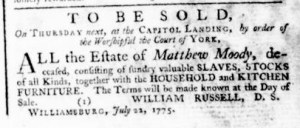
Virginia Gazette [Dixon and Hunter] (July 22, 1775).

**********

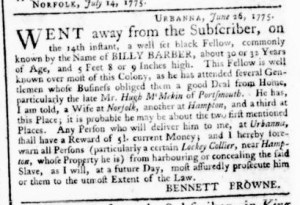
Virginia Gazette [Dixon and Hunter] (July 22, 1775).

**********

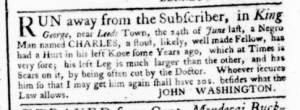
Virginia Gazette [Dixon and Hunter] (July 22, 1775).

July 21

What was advertised in a revolutionary American newspaper 250 years ago today?

Pennsylvania Evening Post (July 21, 1775).

“He hopes to meet with due encouragement, especially as it is the first of its kind attempted in America.”

John Melchior Naff, a “MANUFACTORER of WIRE,” used an advertisement in the July 21, 1775, edition of the Pennsylvania Evening Post to inform “the public in general, and his friends in particular,” about the business he planned to establish in Philadelphia.  He declared that he “proposes to manufacture and sell all kinds of WIRE, BRASS and IRON, and draw it to any size, fit for any use whatsoever.”  He also stated that he “can make all kinds of COMMON PINS, HAIR PINS, COTTON CARDS, and HOOKS and EYES, as good and as cheap as can be imported from Europe.”

Although Naff did not invoke the Continental Association, a nonimportation agreement in protest of the Coercive Acts that had been in effect since the previous December, he almost certainly expected that readers would take it into consideration when they perused his advertisement.  In addition to boycotting goods imported from Britain, the Continental Association called for consumers and producers alike to encourage “domestic manufactures.”  Naff answered that call with pins and other items of the same quality and low prices as imported ones.  He made an investment in the enterprise, reporting that he “hath, at his own expence, already furnished himself with the proper tools and implements to carry on the said business.”  The entrepreneur felt he deserved “due encouragement” from consumers, “especially as it is the first of its kind attempted in America.”  That claim echoed the one that Richard Lightfoot recently made about his “PIN MANUFACTORY” in New York, asserting that “he is the first that ever attempted” to produce several kinds of wirework “on this continent.”  Similarly, Ryves and Fletcher, paper stainers in Philadelphia, advertised that “they are the first who have ever attempted” to make paper hangings (or wallpaper) “on this continent.”

A few months before Naff, Lightfoot, and Ryes and Fletcher ran their advertisements, the imperial crisis boiled over.  Word about the battles at Lexington and Concord and the siege of Boston spread quickly.  More recently, colonizers learned about the Battle of Bunker Hill.  As they prepared for the possibility of more military encounters, perhaps even in or near their own towns, they also continued to use the marketplace as a venue to engage in resistance.  When Naff requested “due encouragement” for establishing a new industry in America, he reminded prospective customers of their duty to fight against Parliament in the decisions they made about the goods they purchased.

Slavery Advertisements Published July 21, 1775

GUEST CURATORS:  Jules Rizzitelli, Anna Shew, and Maddy Watt

The Slavery Adverts 250 Project chronicles the role of newspaper advertising in perpetuating slavery in the era of the American Revolution. The project seeks to reveal the ubiquity of slavery in eighteenth-century life from New England to Georgia by republishing advertisements about enslaved people – for sale as individuals or in groups, wanted to purchase or for hire for short periods, runaways who liberated themselves, and those who were subsequently captured and confined in jails and workhouses – in daily digests on this site as well as in real time via the @SlaveAdverts250 Twitter feed, utilizing twenty-first-century media to stand in for the print media of the eighteenth century.

The project aims to provide modern audiences with a sense of just how often colonizers encountered these advertisements in their daily lives. Enslaved men, women, and children appeared in print somewhere in the colonies almost every single day. Those advertisements served as a constant backdrop for social, cultural, economic, and political life in colonial and revolutionary America. Colonizers who did not purport to own enslaved people were still confronted with slavery as well as invited to maintain the system by purchasing enslaved men, women, and children or assisting in the capture of so-called “runaways” who sought to free themselves from bondage. The frequency of these newspaper advertisements suggests just how embedded slavery was in colonial and revolutionary American culture in everyday interactions beyond the printed page.

These advertisements also testify to the experiences of enslaved men, women, and children, though readers must consider that those experiences have been remediated through descriptions offered by enslavers rather than enslaved people themselves. Often unnamed in the advertisements, enslaved men, women, and children were not invisible or unimportant in early America.

These advertisements appeared in colonial American newspapers 250 years ago today.

New-England Chronicle (July 21, 1775).

**********

New-England Chronicle (July 21, 1775).

**********

New-England Chronicle (July 21, 1775).

**********

Pennsylvania Evening Post (July 21, 1775).

**********

Rivington’s New-York Gazetteer (July 21, 1775).

**********

Rivington’s New-York Gazetteer (July 21, 1775).

**********

Rivington’s New-York Gazetteer (July 21, 1775).

**********

Rivington’s New-York Gazetteer (July 21, 1775).

**********

South-Carolina and American General Gazette (July 21, 1775).

**********

South-Carolina and American General Gazette (July 21, 1775).

**********

South-Carolina and American General Gazette (July 21, 1775).

**********

South-Carolina and American General Gazette (July 21, 1775).

**********

South-Carolina and American General Gazette (July 21, 1775).

**********

South-Carolina and American General Gazette (July 21, 1775).

**********

Story and Humphreys’s Pennsylvania Mercury (July 21, 1775).

**********

Virginia Gazette [Purdie] (July 21, 1775).

**********

Virginia Gazette [Purdie] (July 21, 1775).

**********

Virginia Gazette [Purdie] (July 21, 1775).

**********

Virginia Gazette [Purdie] (July 21, 1775).

**********

Virginia Gazette [Purdie] (July 21, 1775).

**********

Virginia Gazette [Purdie] (July 21, 1775).

**********

Virginia Gazette [Purdie] (July 21, 1775).

**********

Virginia Gazette [Purdie] (July 21, 1775).