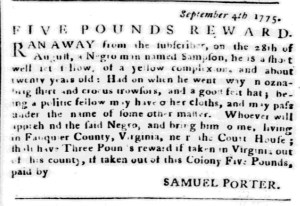
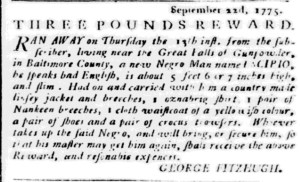
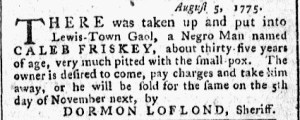
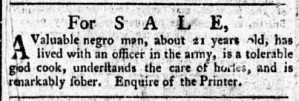
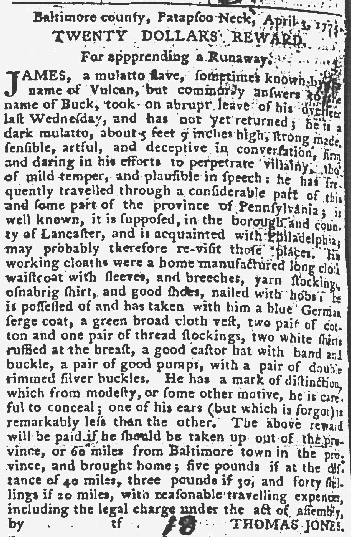
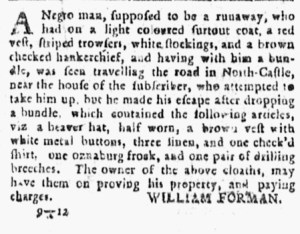
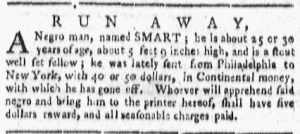
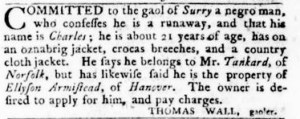
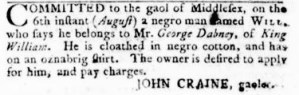
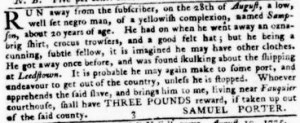
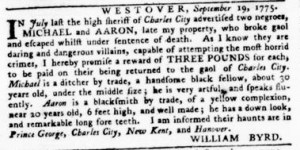
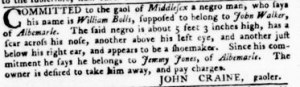
Slavery Advertisements Published October 10, 1775

GUEST CURATOR: Massimo Sgambati

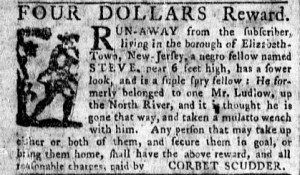
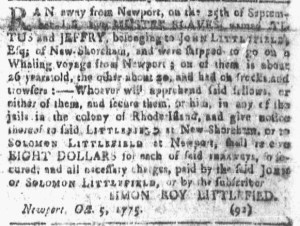
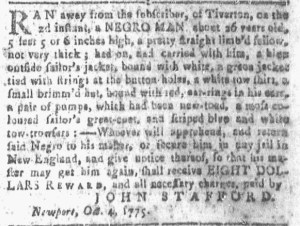
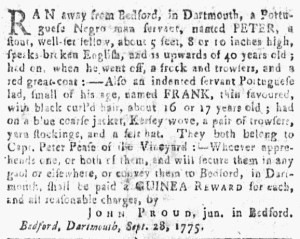
The Slavery Adverts 250 Project chronicles the role of newspaper advertising in perpetuating slavery in the era of the American Revolution. The project seeks to reveal the ubiquity of slavery in eighteenth-century life from New England to Georgia by republishing advertisements about enslaved people – for sale as individuals or in groups, wanted to purchase or for hire for short periods, runaways who liberated themselves, and those who were subsequently captured and confined in jails and workhouses – in daily digests on this site as well as in real time via the @SlaveAdverts250 Twitter feed, utilizing twenty-first-century media to stand in for the print media of the eighteenth century.

The project aims to provide modern audiences with a sense of just how often colonizers encountered these advertisements in their daily lives. Enslaved men, women, and children appeared in print somewhere in the colonies almost every single day. Those advertisements served as a constant backdrop for social, cultural, economic, and political life in colonial and revolutionary America. Colonizers who did not purport to own enslaved people were still confronted with slavery as well as invited to maintain the system by purchasing enslaved men, women, and children or assisting in the capture of so-called “runaways” who sought to free themselves from bondage. The frequency of these newspaper advertisements suggests just how embedded slavery was in colonial and revolutionary American culture in everyday interactions beyond the printed page.

These advertisements also testify to the experiences of enslaved men, women, and children, though readers must consider that those experiences have been remediated through descriptions offered by enslavers rather than enslaved people themselves. Often unnamed in the advertisements, enslaved men, women, and children were not invisible or unimportant in early America.

From compiling an archive of digitized eighteenth-century newspapers to identifying advertisements about enslaved men, women, and children in those newspapers to preparing images of each advertisement to posting this daily digest, Massimo Sgambati served as guest curator for this entry. He completed this work as part of the Summer Scholars Program, funded by a fellowship from the D’Amour College of Liberal Arts and Sciences at Assumption University in Worcester, Massachusetts, in Summer 2025.

These advertisements appeared in colonial American newspapers 250 years ago today.
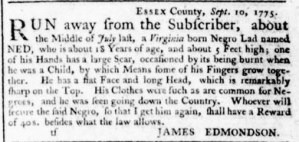
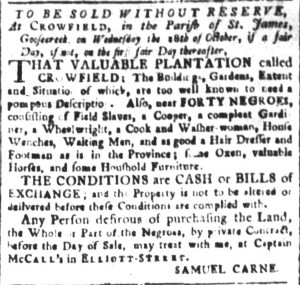
Dunlap’s Maryland Gazette (October 10, 1775)

**********
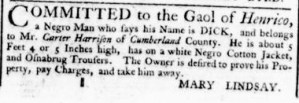
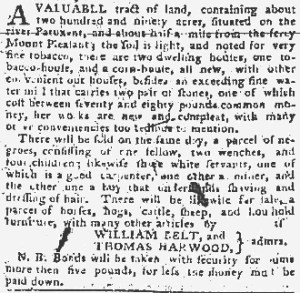
Dunlap’s Maryland Gazette (October 10, 1775)

**********
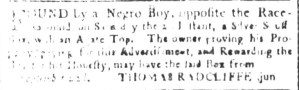
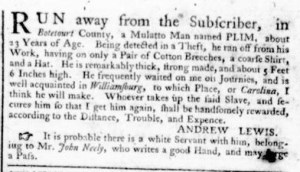
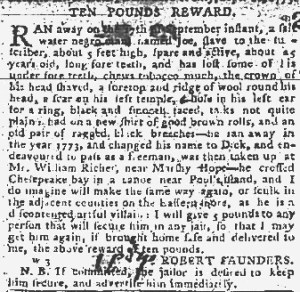
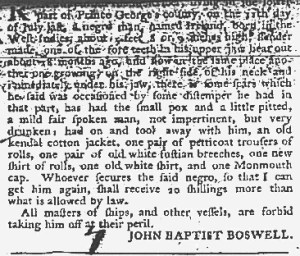
Dunlap’s Maryland Gazette (October 10, 1775)

October 9

What was advertised in a revolutionary American newspaper 250 year ago today?

Dunlap’s Pennsylvania Packet (October 9, 1775).

“ON July last, twenty-first day, / My servant, JOHN SMITH, ran away.”

Advertisements about indentured servants who ran away before completing their contracts appeared regularly in Dunlap’s Pennsylvania Packet in the 1770s.  In “Reading the Runaways,” David Waldstreicher demonstrates that similar advertisements ran in newspapers throughout the Middle Atlantic colonies during the era of the American Revolution.[1]  As I have examined newspapers from New England to Georgia for the Adverts 250 Project, I have encountered advertisements describing runaway servants and offering rewards for detaining and returning them in newspapers in every region.  They were so common that many issues featured multiple advertisements, some of them concerning two or more indentured servants that made a getaway together.

Given the ubiquity of those advertisements, John Whitehill wanted to increase the chances that readers noticed, read, and remembered his advertisement.  Rather than write formulaic copy, he composed a poem of more than a dozen rhyming couplets.  “ON July last, twenty-first day,” the first two lines read, “My servant, JOHN SMITH, ran away.”  The poem was easy to spot on the page of the October 9, 1775, edition of Dunlap’s Pennsylvania Packet.  The compositor indented each line, creating white space that distinguished the advertisement from other content.  The irregular lengths of each line of the poem meant even more white space on the right.  On a page of news and advertisements printed in orderly columns, justified on the left and on the right, the significant amount of white space in Whitehill’s advertisement made it easy to spot.

Once readers looked more closely, the opening couplet may have inspired even more curiosity.  “Age twenty-five years, and no more,” Whitehill’s poem continued, “I think his heighth is five feet four; / Black curled hair, and slender made, / And is a weaver by his trade.”  Additional couplets described Smith’s clothing, the items he took with him to set up trade somewhere else, and his arrival from Newry on the Renown the previous fall.  One couplet warned others not to aid Smith: “Should any persons him conceal, / No doubt with them I think to deal.”  The final couplets offered a reward and named the aggrieved master: “SIX LAWFUL DOLLARS I will pay; / I live in Salsbury, Pequea, / And further to oblige you still, / My name is junior JOHN WHITEHILL.”  The reward and the names of the servant and the advertiser were the only part of the poem in all capitals, likely intended to draw attention to the incentive for reading the advertisement and assisting Whitehill.

The poem certainly was not Milton nor Shakespeare, but the format of Whitehill’s runaway advertisement made it different (and more entertaining) than any of the other five notices placed for the same purposes in that issue of Dunlap’s Pennsylvania Packet.  The attention it garnered may very well have been worth the time and effort that Whitehill invested in writing the poem.  For other examples of masters adopting this strategy, see James Gibbons’s advertisement about Catherine Waterson in the December 21, 1769, issue of the Pennsylvania Gazette and John McGoun’s advertisement about John Hunter in the October 26, 1774, issue of the Pennsylvania Gazette.

**********
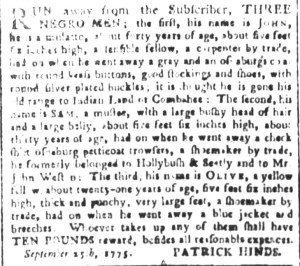
[1] David Waldstreicher, “Reading the Runaways: Self-Fashioning, Print Culture, and Confidence in Slavery in the Eighteenth-Century Mid-Atlantic,” William and Mary Quarterly, 3rd ser., 56, no. 2 (April 1999): 243-272.

Slavery Advertisements Published October 9, 1775

GUEST CURATOR: Massimo Sgambati

The Slavery Adverts 250 Project chronicles the role of newspaper advertising in perpetuating slavery in the era of the American Revolution. The project seeks to reveal the ubiquity of slavery in eighteenth-century life from New England to Georgia by republishing advertisements about enslaved people – for sale as individuals or in groups, wanted to purchase or for hire for short periods, runaways who liberated themselves, and those who were subsequently captured and confined in jails and workhouses – in daily digests on this site as well as in real time via the @SlaveAdverts250 Twitter feed, utilizing twenty-first-century media to stand in for the print media of the eighteenth century.

The project aims to provide modern audiences with a sense of just how often colonizers encountered these advertisements in their daily lives. Enslaved men, women, and children appeared in print somewhere in the colonies almost every single day. Those advertisements served as a constant backdrop for social, cultural, economic, and political life in colonial and revolutionary America. Colonizers who did not purport to own enslaved people were still confronted with slavery as well as invited to maintain the system by purchasing enslaved men, women, and children or assisting in the capture of so-called “runaways” who sought to free themselves from bondage. The frequency of these newspaper advertisements suggests just how embedded slavery was in colonial and revolutionary American culture in everyday interactions beyond the printed page.

These advertisements also testify to the experiences of enslaved men, women, and children, though readers must consider that those experiences have been remediated through descriptions offered by enslavers rather than enslaved people themselves. Often unnamed in the advertisements, enslaved men, women, and children were not invisible or unimportant in early America.

From compiling an archive of digitized eighteenth-century newspapers to identifying advertisements about enslaved men, women, and children in those newspapers to preparing images of each advertisement to posting this daily digest, Massimo Sgambati served as guest curator for this entry. He completed this work as part of the Summer Scholars Program, funded by a fellowship from the D’Amour College of Liberal Arts and Sciences at Assumption University in Worcester, Massachusetts, in Summer 2025.

These advertisements appeared in colonial American newspapers 250 years ago today.

Dunlap’s Pennsylvania Gazette (October 9, 1775)

**********

New-York Gazette and Weekly Mercury (October 9, 1775)

**********

New-York Gazette and Weekly Mercury (October 9, 1775)

**********

New-York Gazette and Weekly Mercury (October 9, 1775)

**********

Newport Mercury (October 9, 1775)

**********
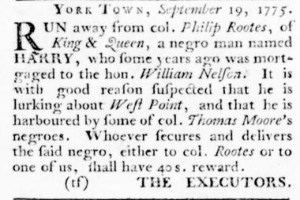
Newport Mercury (October 9, 1775)

**********

Newport Mercury (October 9, 1775)

**********
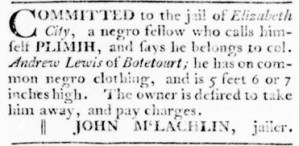
Newport Mercury (October 9, 1775)

**********

Newport Mercury (October 9, 1775)

October 8

What was advertised in a revolutionary American newspaper 250 years ago this week?

Providence Gazette (October 7, 1775).

“He presumes every Friend to America, both in Town and Country, will encourage him occasionally.”

When Cornelius Cooper, a “BRUSH-MAKER, from Philadelphia,” relocated to Providence, he ran an advertisement in the October 7, 1775, edition of the Providence Gazette to introduce himself to his new neighbors and prospective customers.  The newcomer announced that he “makes and sells, Wholesale and Retail, Sweeping, Hearth, Cloaths, Shoe and Buckle Brushes, and every other Article in the Brush Way.”

Realizing that he was unknown to the residents of Providence, Cooper realized that he might increase sales by giving them sound reasons to purchase his brushes, either to use themselves or to stock in their shops to sell to others.  “As our own Fabrications, of every Kind, hold forth their Utility, in a most conspicuous Manner,” the brushmaker declared, “he presumes every Friend to America, both in Town and Country, will encourage him occasionally.”  Cooper did not need to rehearse current events for readers to understand his meaning.  They knew that the siege of Boston continued, following the battles at Lexington and Concord in April and the Battle of Bunker Hill in June.  They also knew that the Continental Association, a nonimportation agreement devised by the First Continental Congress, went into effect on December 1, 1774, in response to the Coercive Acts.  Colonizers sought to use commerce, especially their choices about consumption, as political leverage to convince Parliament to repeal the Boston Port Bill, the Massachusetts Government Act, and other legislation.  The Continental Association also called on colonizers to encourage domestic manufactures or the production of goods in the colonies as replacements or substitutes for imported ones.  Cooper did his part in making brushes.  Now “every Friend to America” needed to do their part by supporting his enterprise.

Making purchases was not the only way they could do so.  In a nota bene, Cooper requested “that People will be careful to save their Hogs Bristles, for which he will give a good Price in Cash.”  Consuming goods made in the colonies was important, but colonizers could also participate in the production of those goods by collecting materials, delivering them to Cooper, and earning some cash for their efforts.  The brushmaker also noted that he sought an apprentice, “a discreet, active Lad, about 14 Years of Age.”  He would pass along knowledge of his trade and make help the next generation contribute to the local economy.  Readers understood the inspiration and political ramifications without Cooper going into detail in his advertisement.  He presented them with a patriotic obligation and encouraged them to do their civic duty in the marketplace.

October 7

What was advertised in a revolutionary American newspaper 250 years ago today?

Virginia Gazette [Dixon and Hunter] (October 7, 1775).

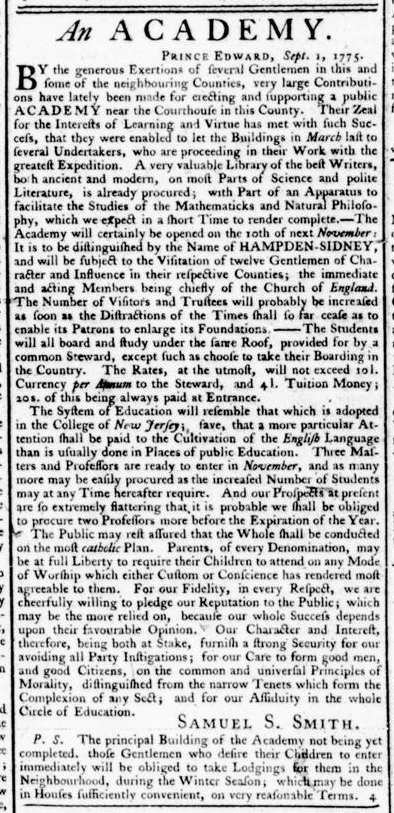
“An ACADEMY … distinguished by the Name of HAMPDEN-SIDNEY.”

An advertisement for a new academy “distinguished by the Name of HAMPDEN-SIDNEY” ran for the first time in the October 7, 1775, edition of John Dixon and William Hunter’s Virginia Gazette.  It delivered an overview of the last American college founded before the Declaration of Independence, announcing that classes would begin on November 10.  As the “History of Hampden-Sydney College” posted on the institution’s website explains, “The first president, at the suggestion of Dr. John Witherspoon, the Scottish president of the College of New Jersey (now Princeton University), chose the name Hampden-Sydney to symbolize devotion to the principles of representative government and full civil and religious freedom which John Hampden (1594-1643) and Algernon Sydney (1622-1683) had outspokenly supported, and for which they had given their lives, in England’s two great constitutional crises of the previous century.”

That first president of Hampden-Sydney College was Samuel Stanhope Smith, the valedictorian of the College of New Jersey (now Princeton University) in 1769.  Six years later, his connections to that institution influenced more than just the name of the academy he founded in Virginia.  “The System of Education will resemble that which is adopted in the College of New Jersey,” he noted in the advertisement, “save, that a more particular Attention shall be paid to the Cultivation of the EnglishLanguage than is usually done in Places of public Education.”  Three “Masters and Professors” had already been hired, yet Smith anticipated that enrollments would justify engaging two more instructors “before the Expiration of the Year.”  The academy had also procured a “very valuable Library of the best Writers, both ancient and modern, on most Parts of Science and polite Literature.”  Construction of the “principal Building of the Academy” had begun but would not be complete before classes commenced on November 10.  Students would need to find lodging “in the Neighbourhood, during the Winter Season,” though Smith assured prospective pupils and their parents that there were “Houses sufficiently convenient” available “on very reasonable terms.”

For governance and oversight, the academy “will be subject to the Visitation of twelve Gentlemen of Character and Influence in their respective Counties.”  They included, according to the College’s “History,” James Madison, Patrick Henry, and “other less well-known but equally vigorous patriots.”  Smith mused that the “Number of Visitors and Trustees will probably be increased as soon as the Distractions of the Times shall so far cease as to enable its Patrons to enlarge its Foundation.”  He referred, as readers knew, to events in Massachusetts over the past six months, including the battles at Lexington and Concord, the siege of Boston, and the Battle of Bunker Hill.

The imperial crisis that led to those events certainly played a role in naming the academy and formulating its mission.  Even though the first trustees were “chiefly of the Church of England,” Smith pledged that “the Whole shall be conducted on the most catholic” or universal “Plan.”  Inspired by Hampden and Sydney’s commitment to civil and religious freedom, the academy adopted a policy of toleration: “Parents, of every Denomination, may be at full Liberty to require their Children to attend on any Mode of Worship which either Custom or Conscience has rendered most agreeable to them.”  Smith also made a series of promises grounded in the academy’s “Character and Interest,” stating that the faculty and trustees “furnish a strong Security for our avoiding all Party Instigations; for our Care to form good men, and good Citizens, on the common and universal Principles of Morality, distinguished from the narrow Tenets which form the Complexion of any Sect; and for our Assiduity in the whole Circle of Education.”  From its inception during the era of the American Revolution, Smith’s academy, Hampden-Sydney College, emphasized civic virtue and religious freedom as hallmarks of the education it provided for young men.

**********

Hampden-Sydney College features an image and transcription of the advertisement on its website as well as a brief “History of Hampden-Sydney College.”

Slavery Advertisements Published October 7, 1775

GUEST CURATOR: Massimo Sgambati

The Slavery Adverts 250 Project chronicles the role of newspaper advertising in perpetuating slavery in the era of the American Revolution. The project seeks to reveal the ubiquity of slavery in eighteenth-century life from New England to Georgia by republishing advertisements about enslaved people – for sale as individuals or in groups, wanted to purchase or for hire for short periods, runaways who liberated themselves, and those who were subsequently captured and confined in jails and workhouses – in daily digests on this site as well as in real time via the @SlaveAdverts250 Twitter feed, utilizing twenty-first-century media to stand in for the print media of the eighteenth century.

The project aims to provide modern audiences with a sense of just how often colonizers encountered these advertisements in their daily lives. Enslaved men, women, and children appeared in print somewhere in the colonies almost every single day. Those advertisements served as a constant backdrop for social, cultural, economic, and political life in colonial and revolutionary America. Colonizers who did not purport to own enslaved people were still confronted with slavery as well as invited to maintain the system by purchasing enslaved men, women, and children or assisting in the capture of so-called “runaways” who sought to free themselves from bondage. The frequency of these newspaper advertisements suggests just how embedded slavery was in colonial and revolutionary American culture in everyday interactions beyond the printed page.

These advertisements also testify to the experiences of enslaved men, women, and children, though readers must consider that those experiences have been remediated through descriptions offered by enslavers rather than enslaved people themselves. Often unnamed in the advertisements, enslaved men, women, and children were not invisible or unimportant in early America.

From compiling an archive of digitized eighteenth-century newspapers to identifying advertisements about enslaved men, women, and children in those newspapers to preparing images of each advertisement to posting this daily digest, Massimo Sgambati served as guest curator for this entry. He completed this work as part of the Summer Scholars Program, funded by a fellowship from the D’Amour College of Liberal Arts and Sciences at Assumption University in Worcester, Massachusetts, in Summer 2025.

These advertisements appeared in colonial American newspapers 250 years ago today.

Pennsylvania Ledger (October 7, 1775)

**********

Providence Gazette (October 7, 1775)

**********

Virginia Gazette [Dixon and Hunter] (October 7, 1775)

**********

Virginia Gazette [Dixon and Hunter] (October 7, 1775)

**********

Virginia Gazette [Dixon and Hunter] (October 7, 1775)

**********

Virginia Gazette [Dixon and Hunter] (October 7, 1775)

**********

Virginia Gazette [Dixon and Hunter] (October 7, 1775)

October 6

Who was the subject of an advertisement in a revolutionary American newspaper 250 years ago today?

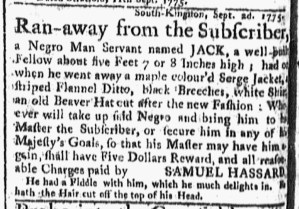
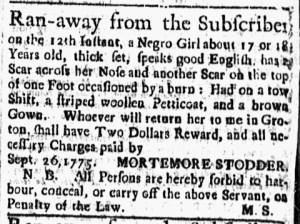
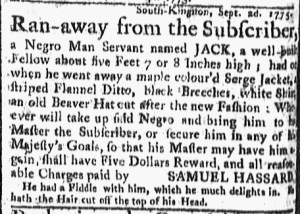
“Ran-away … a Negro Man Servant named JACK.”

Connecticut Gazette (October 6, 1775).

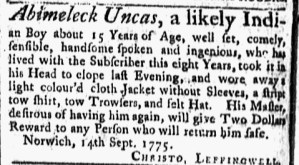
Even as it carried essays about the imperial crisis and news about one of the first battles of the Revolutionary War, the October 6, 1775, edition of the Connecticut Gazette also ran advertisements described enslaved men and women who liberated themselves by running away from their enslavers.  Each notice encouraged readers to engage in surveillance of Black people they encountered to determine if they matched the description in the newspaper.  Each also offered a reward to those who assisted in capturing fugitives from slavery and returning them to their enslavers.

One of those advertisements, for instance, described a “Negro Man Servant named JACK” who fled from Samuel Hassard of South Kingstown, Rhode Island, at the beginning of September.  He had managed to elude capture for a month.  Hassard described Jack as a “well-built Fellow about five Feet 7 or 8 Inches high,” but did not indicate his approximate age.  At the time he departed, he wore a “maple colour’d Serge Jacket, a striped Flannel [Jacket], black Breeches, white Shirt, [and] an old Beaver Hat cut after the new Fashion.”  Hassard also mentioned that Jack “had a Fiddle with him, which he much delights in” and that he “Hath the Hair cut off the top of his Head.”  Both details made Jack more easily recognizable to readers of the Connecticut Gazette.

In another advertisement, Mortemore Stodder of Groton described a “Negro Girl about 17 or 18 Years old” whose name was once known but did not appear in the notice.  Instead, Stodder informed readers that the “thick set” young woman “speaks good English” and “has a Scar across her Nose and another Scar on the top of one Foot occasioned by a burn.”  In addition to those distinguishing features, she “[h]ad on a tow Shift, a striped woollen Petticoat, and a brown Gown.”  Stodder was so concerned that others might help the young woman remain free that he added a nota bene advising, “All Persons are hereby forbid to harbour, conceal, or carry off the above Servant, on Penalty of the Law.”  There would be consequences beyond Stodder’s frustration and displeasure if he learned that anyone aided this young woman in liberating herself.

As the siege of Boston continued, Timothy Green, the printer of the Connecticut Gazette, published the latest entry in “The Crisis,” a series of essays supporting the American cause, new details about the Battle of Bunker Hill, and an address from George Washington, “Commander in Chief of the Army of the United Colonies of North-America,” to the inhabitants of Canada.  Even as those pieces each promoted liberty in various ways, Green continued a practice adopted by all newspaper printers.  He generated revenue by disseminating advertisements about enslaved people who fled from their enslavers to seize their own freedom.

**********

For all advertisements about enslaved people that ran in American newspapers published 250 years ago today, visit the Slavery Adverts 250 Project‘s daily digest.

Slavery Advertisements Published October 6, 1775

GUEST CURATOR: Massimo Sgambati

The Slavery Adverts 250 Project chronicles the role of newspaper advertising in perpetuating slavery in the era of the American Revolution. The project seeks to reveal the ubiquity of slavery in eighteenth-century life from New England to Georgia by republishing advertisements about enslaved people – for sale as individuals or in groups, wanted to purchase or for hire for short periods, runaways who liberated themselves, and those who were subsequently captured and confined in jails and workhouses – in daily digests on this site as well as in real time via the @SlaveAdverts250 Twitter feed, utilizing twenty-first-century media to stand in for the print media of the eighteenth century.

The project aims to provide modern audiences with a sense of just how often colonizers encountered these advertisements in their daily lives. Enslaved men, women, and children appeared in print somewhere in the colonies almost every single day. Those advertisements served as a constant backdrop for social, cultural, economic, and political life in colonial and revolutionary America. Colonizers who did not purport to own enslaved people were still confronted with slavery as well as invited to maintain the system by purchasing enslaved men, women, and children or assisting in the capture of so-called “runaways” who sought to free themselves from bondage. The frequency of these newspaper advertisements suggests just how embedded slavery was in colonial and revolutionary American culture in everyday interactions beyond the printed page.

These advertisements also testify to the experiences of enslaved men, women, and children, though readers must consider that those experiences have been remediated through descriptions offered by enslavers rather than enslaved people themselves. Often unnamed in the advertisements, enslaved men, women, and children were not invisible or unimportant in early America.

From compiling an archive of digitized eighteenth-century newspapers to identifying advertisements about enslaved men, women, and children in those newspapers to preparing images of each advertisement to posting this daily digest, Massimo Sgambati served as guest curator for this entry. He completed this work as part of the Summer Scholars Program, funded by a fellowship from the D’Amour College of Liberal Arts and Sciences at Assumption University in Worcester, Massachusetts, in Summer 2025.

These advertisements appeared in colonial American newspapers 250 years ago today.

Connecticut Gazette (October 6, 1775)

**********

Connecticut Gazette (October 6, 1775)

**********

Connecticut Gazette (October 6, 1775)

**********

South-Carolina and American General Gazette (October 6, 1775)

**********

South-Carolina and American General Gazette (October 6, 1775)

**********

South-Carolina and American General Gazette (October 6, 1775)

**********

South-Carolina and American General Gazette (October 6, 1775)

**********

South-Carolina and American General Gazette (October 6, 1775)

**********

South-Carolina and American General Gazette (October 6, 1775)

**********

South-Carolina and American General Gazette (October 6, 1775)

**********

Virginia Gazette [Purdie] (October 6, 1775)

**********

Virginia Gazette [Purdie] (October 6, 1775)

**********

Virginia Gazette [Purdie] (October 6, 1775)

**********

Virginia Gazette [Purdie] (October 6, 1775)

**********

Virginia Gazette [Purdie] (October 6, 1775)

**********

Virginia Gazette [Purdie] (October 6, 1775)

**********

Virginia Gazette [Purdie] (October 6, 1775)

**********

Virginia Gazette [Purdie] (October 6, 1775)

October 5

What was advertised in a revolutionary American newspaper 250 years ago today?

Rivington’s New-York Gazetteer (October 5, 1775).

“THE Speeches of EDMUND BURKE, Esq; on American Taxation.”

James Rivington did not know it when he published the October 5, 1775, edition, nor did readers and the rest of the community, but he would soon discontinue printing Rivington’s New-York Gazetteer.  With hindsight, we know that less than two months later, on November 27, the Sons of Liberty would attack his printing office and destroy his press and type “because of his pronounced Tory sentiments.”[1]  It was not the first time.  His home and printing office had been attacked the previous May.  For a few weeks, he had sought refuge on a British ship in the harbor.  He had been hung in effigy.  After all that, the November 23, 1775, edition would be the last issue of Rivington’s New-York Gazetteer that he would print before departing for London.  The printer returned to New York in 1777, during the British occupation, and established Rivington’s New-York Loyal Gazette.  Today, historians consider it possible that Rivington spied on behalf of the American cause, but that would not have been public knowledge in the 1770s.

What was public knowledge was that the masthead of Rivington’s New-York Gazetteer featured the seal of Great Britain at a time when the mastheads for other newspapers did not have an image or chose some other device.  The “UNITE OR DIE” political cartoon depicting a severed snake, each segment representing a colony, even appeared in the masthead of the Pennsylvania Journal.  A few other newspapers did continue to include the seal of Great Britain in their masthead, but the printers did not have the same history of expressing positions that supported the officials considered enemies of American liberties.  Even with the seal of Great Britain in the masthead, the October 5, 1775, edition of Rivington’s New-York Gazetteer included an advertisement for “THE Speeches of EDMUND BURKE, Esq; on American Taxation, delivered April 19, 1774” and “His Speech on Moving his Resolutions of Conciliation with the Colonies, March 22d, 1775.”  Rivington printed and sold both speeches by a member of Parliament considered a friend to America.  The printer had a history of marketing “pamphlets on the Whig and Tory side” of “The American Controversy” and arguing for freedom of the press when it came to the contents of his newspaper and other items he printed and sold.  After the battles at Lexington and Concord, however, he discontinued advertising pamphlets that expressed the Tory perspective.  The advertisement for Burke’s speeches, pamphlets that he printed as well as promoted, starkly presented only one side of “THE AMERICAN CONTEST.”  Rivington seemingly changed his advertising strategy as the political situation in the colonies intensified once hostilities commenced in Massachusetts.

**********

[1] Clarence S. Brigham, History and Bibliography of American Newspapers, 1690-1820 (Worcester: American Antiquarian Society, 1947), 686.

Slavery Advertisements Published October 5, 1775

GUEST CURATOR: Massimo Sgambati

The Slavery Adverts 250 Project chronicles the role of newspaper advertising in perpetuating slavery in the era of the American Revolution. The project seeks to reveal the ubiquity of slavery in eighteenth-century life from New England to Georgia by republishing advertisements about enslaved people – for sale as individuals or in groups, wanted to purchase or for hire for short periods, runaways who liberated themselves, and those who were subsequently captured and confined in jails and workhouses – in daily digests on this site as well as in real time via the @SlaveAdverts250 Twitter feed, utilizing twenty-first-century media to stand in for the print media of the eighteenth century.

The project aims to provide modern audiences with a sense of just how often colonizers encountered these advertisements in their daily lives. Enslaved men, women, and children appeared in print somewhere in the colonies almost every single day. Those advertisements served as a constant backdrop for social, cultural, economic, and political life in colonial and revolutionary America. Colonizers who did not purport to own enslaved people were still confronted with slavery as well as invited to maintain the system by purchasing enslaved men, women, and children or assisting in the capture of so-called “runaways” who sought to free themselves from bondage. The frequency of these newspaper advertisements suggests just how embedded slavery was in colonial and revolutionary American culture in everyday interactions beyond the printed page.

These advertisements also testify to the experiences of enslaved men, women, and children, though readers must consider that those experiences have been remediated through descriptions offered by enslavers rather than enslaved people themselves. Often unnamed in the advertisements, enslaved men, women, and children were not invisible or unimportant in early America.

From compiling an archive of digitized eighteenth-century newspapers to identifying advertisements about enslaved men, women, and children in those newspapers to preparing images of each advertisement to posting this daily digest, Massimo Sgambati served as guest curator for this entry. He completed this work as part of the Summer Scholars Program, funded by a fellowship from the D’Amour College of Liberal Arts and Sciences at Assumption University in Worcester, Massachusetts, in Summer 2025.

These advertisements appeared in colonial American newspapers 250 years ago today.

Maryland Gazette (October 5, 1775)

**********

Maryland Gazette (October 5, 1775)

**********

Maryland Gazette (October 5, 1775)

**********

Maryland Gazette (October 5, 1775)

**********

Maryland Gazette (October 5, 1775)

**********

Maryland Gazette (October 5, 1775)

**********

New-York Journal (October 5, 1775)

**********

New-York Journal (October 5, 1775)

**********

Rivington’s New-York Gazetteer (October 5, 1775)

**********

Rivington’s New-York Gazetteer (October 5, 1775)

**********

Virginia Gazette [Pinkney] (October 5, 1775)

**********

Virginia Gazette [Pinkney] (October 5, 1775)

**********

Virginia Gazette [Pinkney] (October 5, 1775)

**********

Virginia Gazette [Pinkney] (October 5, 1775)

**********

Virginia Gazette [Pinkney] (October 5, 1775)

**********

Virginia Gazette [Pinkney] (October 5, 1775)

**********

Virginia Gazette [Pinkney] (October 5, 1775)

**********

Virginia Gazette [Pinkney] (October 5, 1775)

**********

Virginia Gazette [Pinkney] (October 5, 1775)

**********

Virginia Gazette [Pinkney] (October 5, 1775)