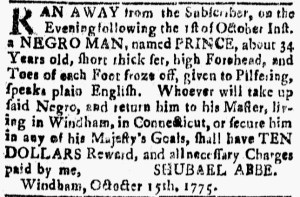
November 3

What was advertised in a revolutionary American newspaper 250 years ago today?

Virginia Gazette [Purdie] (November 3, 1775).

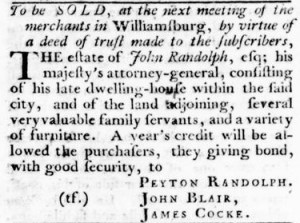
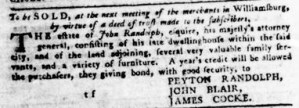
“To be SOLD … THE estate of John Randolph, esq; his majesty’s attorney-general.”

The advertisement for the “Estate of John Randolph” that ran in John Dixon and William Hunter’s Virginia Gazette in the fall of 1775 also appeared in the other newspapers published in Williamsburg, John Pinkney’s Virginia Gazette and Alexander Purdie’s Virginia Gazette.  When the Loyalist departed for England, either he left instructions to advertise widely or the trustees – Peyton Randolph (his brother), John Blair, and James Cocke – decided that they wanted news of the upcoming sale of Randolph’s house, furniture, and enslaved “family servants” to circulate as widely as possible.
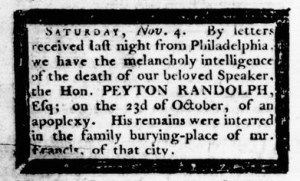
Virginia Gazette [Purdie] (November 3, 1775).

When the advertisement ran on the final page in the November 3 edition of Purdie’s Virginia Gazette, it contradicted news that appeared on the second page.  Thick black borders that indicated mourning surrounded a short article that informed readers, “By letter received last night from Philadelphia, we have the melancholy intelligence of the death of our beloved Speaker, the Hon. PEYTON RANDOLPH, Esq; on the 23d of October, of an apoplexy.  His remains were interred in the family burying-place of mr. Francis, of that city.”  Randolph had served as speaker of the colony’s House of Burgesses.  He also held very different political views than his brother, having served as president of the First Continental Congress when it met in Philadelphia in the fall of 1774 and, briefly, as president of the Second Continental Congress when it convened after the battles at Lexington and Concord the following year.  He had been in Philadelphia as one of Virginia’s delegates when he died.

Blair and Cocke, the “surviving trustees,” ran an updated advertisement the following week, but there had not been time to revise the notice that had been running for several weeks.  The side of the broadsheet that carried the advertisement may even have been printed already when Purdie’s printing office received word of Randolph’s death.  In addition, the report, dated “SATURDAY, Nov. 4,” introduces some confusion about when the news arrived and when Purdie printed and distributed the November 3 edition of his newspaper.  Purdie scooped the other two newspapers.  Pinkney delivered the news in his next edition on November 9 (along with the updated advertisement).  Dixon and Hunter inserted a news report and an extensive memorial on November 11.  Either they did not have the news in time for their November 4 edition, or the type had been set and the printing already commenced when it arrived.  That still does not describe the discrepancy in the dates for Purdie’s newspaper, though he may have been a day late in publishing it but listed November 3, the anticipated date of publication for the weekly newspaper, in the masthead as a polite fiction.

Not only did Purdie publish the news first with a brief article, but the following week he ran both a news article about Randolph’s death and funeral and a memorial to Randolph in his November 10 edition.  The text matched the memorial in Dixon and Hunter’s November 11 edition, but the compositor made different choices for the format.  Purdie also honored Randolph with thick black borders around the content on all four pages, not just enclosing the memorial.  That issue included the updated notice about John Randolph’s estate sale as the first of the advertisements on the final page, though the two-page supplement that accompanied it carried the original advertisement.  The news and an advertisement continued delivering contradictory information, suggesting that Purdie and others in his printing office were not attentive to every detail in every advertisement they published.  The original advertisement may have appeared again as filler to complete the page rather than as an intentional insertion by the trustees who oversaw the sale it announced.
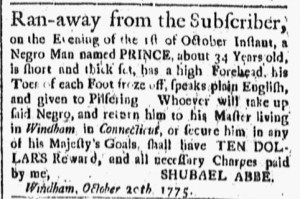
Slavery Advertisements Published November 3, 1775

GUEST CURATOR: Massimo Sgambati

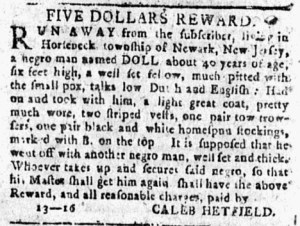
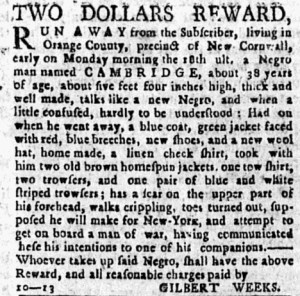
The Slavery Adverts 250 Project chronicles the role of newspaper advertising in perpetuating slavery in the era of the American Revolution. The project seeks to reveal the ubiquity of slavery in eighteenth-century life from New England to Georgia by republishing advertisements about enslaved people – for sale as individuals or in groups, wanted to purchase or for hire for short periods, runaways who liberated themselves, and those who were subsequently captured and confined in jails and workhouses – in daily digests on this site as well as in real time via the @SlaveAdverts250 Twitter feed, utilizing twenty-first-century media to stand in for the print media of the eighteenth century.

The project aims to provide modern audiences with a sense of just how often colonizers encountered these advertisements in their daily lives. Enslaved men, women, and children appeared in print somewhere in the colonies almost every single day. Those advertisements served as a constant backdrop for social, cultural, economic, and political life in colonial and revolutionary America. Colonizers who did not purport to own enslaved people were still confronted with slavery as well as invited to maintain the system by purchasing enslaved men, women, and children or assisting in the capture of so-called “runaways” who sought to free themselves from bondage. The frequency of these newspaper advertisements suggests just how embedded slavery was in colonial and revolutionary American culture in everyday interactions beyond the printed page.

These advertisements also testify to the experiences of enslaved men, women, and children, though readers must consider that those experiences have been remediated through descriptions offered by enslavers rather than enslaved people themselves. Often unnamed in the advertisements, enslaved men, women, and children were not invisible or unimportant in early America.

From compiling an archive of digitized eighteenth-century newspapers to identifying advertisements about enslaved men, women, and children in those newspapers to preparing images of each advertisement to posting this daily digest, Massimo Sgambati served as guest curator for this entry. He completed this work as part of the Summer Scholars Program, funded by a fellowship from the D’Amour College of Liberal Arts and Sciences at Assumption University in Worcester, Massachusetts, in Summer 2025.

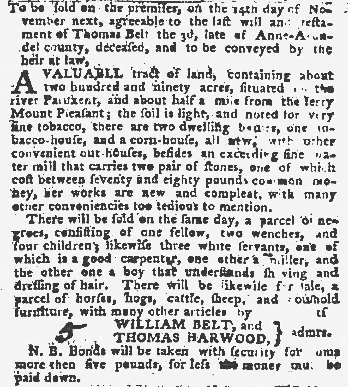
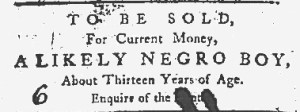
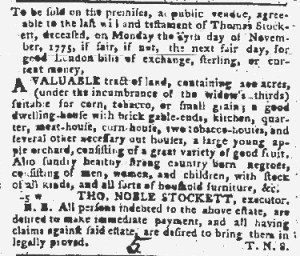
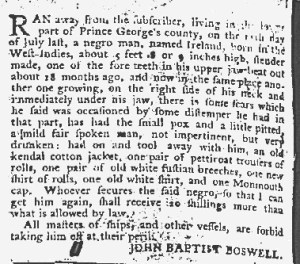
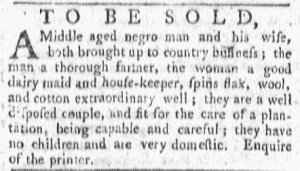
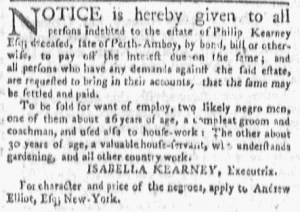
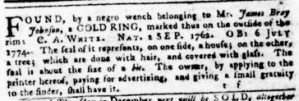
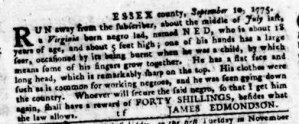
These advertisements appeared in colonial American newspapers 250 years ago today.

Connecticut Gazette (November 3, 1775)

**********

Essex Journal (November 3, 1775)

**********

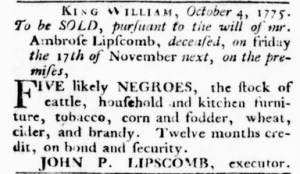
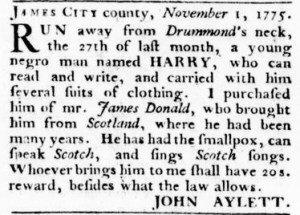
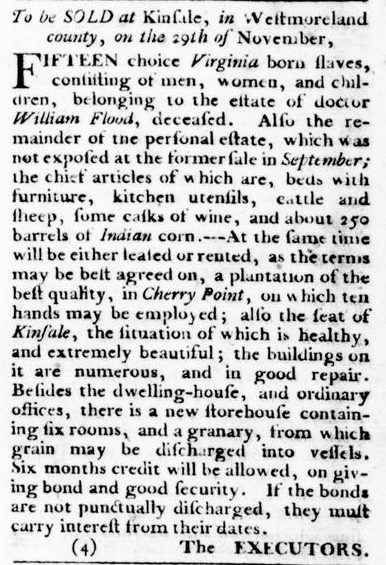
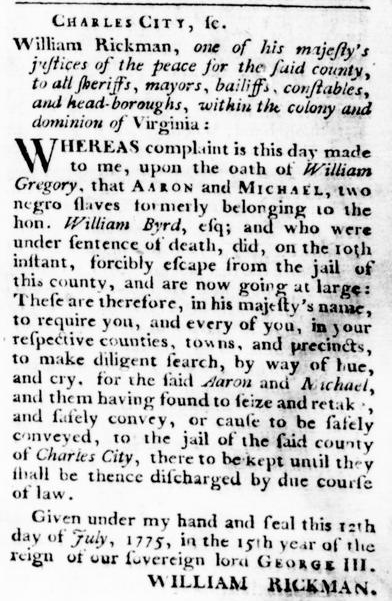
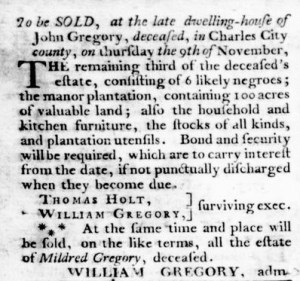
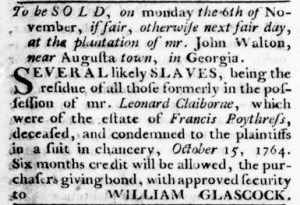
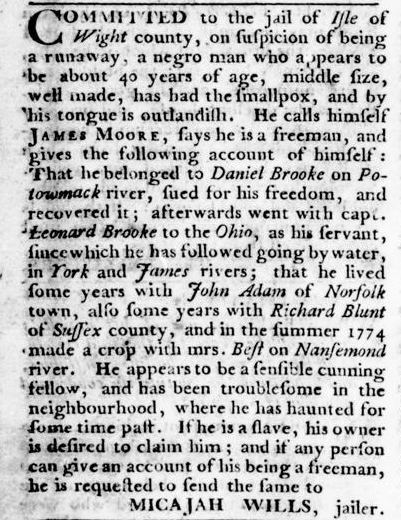
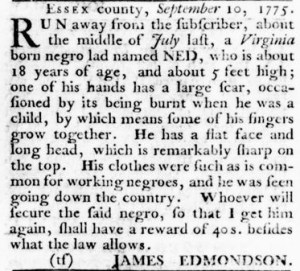
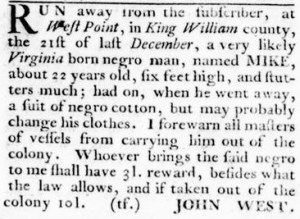
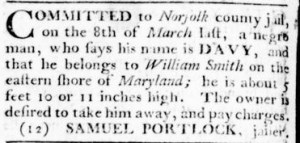
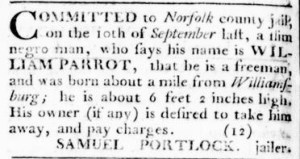
Virginia Gazette [Purdie] (November 3, 1775)

**********

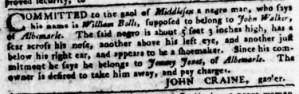
Virginia Gazette [Purdie] (November 3, 1775)

**********

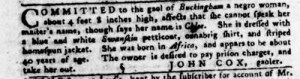
Virginia Gazette [Purdie] (November 3, 1775)

**********

Virginia Gazette [Purdie] (November 3, 1775)

**********

Virginia Gazette [Purdie] (November 3, 1775)

**********

Virginia Gazette [Purdie] (November 3, 1775)

**********

Virginia Gazette [Purdie] (November 3, 1775)

**********

Virginia Gazette [Purdie] (November 3, 1775)

**********

Virginia Gazette [Purdie] (November 3, 1775)

**********

Virginia Gazette [Purdie] (November 3, 1775)

**********

Virginia Gazette [Purdie] (November 3, 1775)

**********

Virginia Gazette [Purdie] (November 3, 1775)

**********

Virginia Gazette [Purdie] (November 3, 1775)

**********

Virginia Gazette [Purdie] (November 3, 1775)

November 2

Who was the subject of an advertisement in a revolutionary American newspaper 250 years ago today?

New-Hampshire Gazette (November 2, 1775).

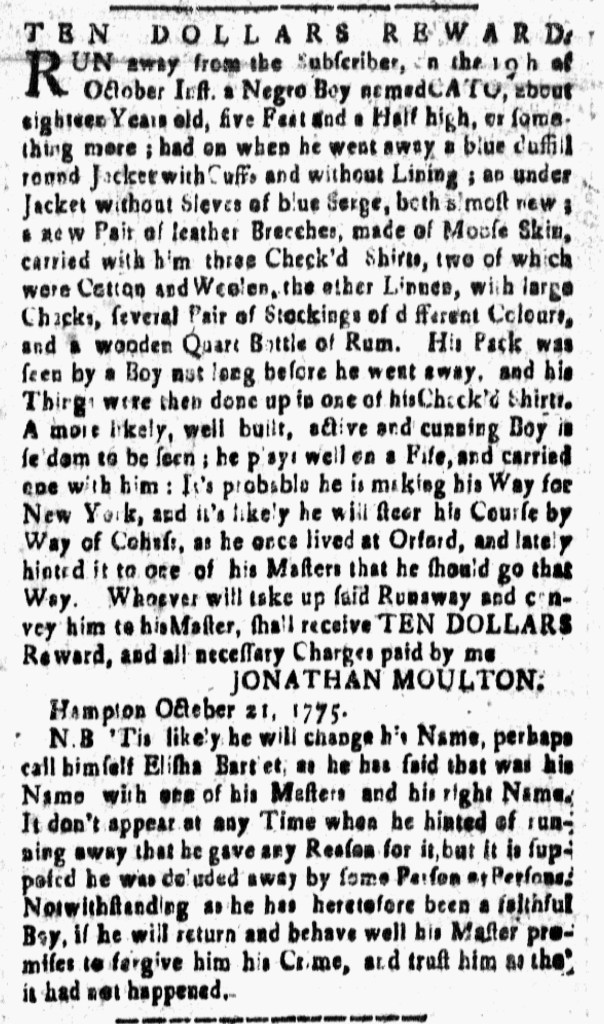
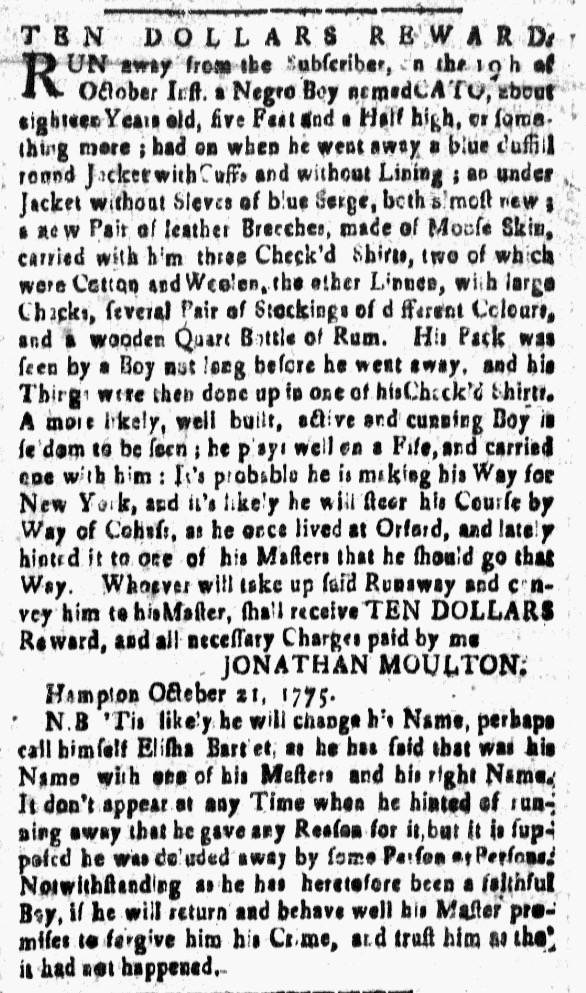
“’Tis likely he will change his Name, perhaps call himself Elisha Bartlet, as he has said that was … his right Name.”

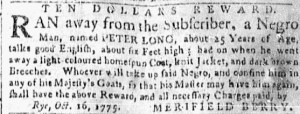
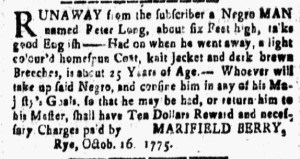
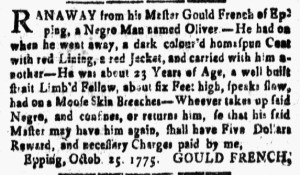
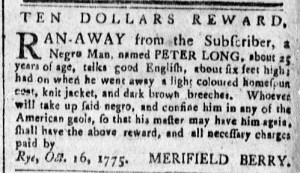
Even though the disruption in the paper supply once again meant that the New-Hampshire Gazette consisted of only two pages instead of the usual four, Daniel Fowle, the printer, found space to publish three advertisements about enslaved men who liberated themselves by running away from their enslavers in the November 2, 1775, edition.  They appeared one after the other in the final column on the first page.  All three men – Cato (also known as Elisha Bartlet), Peter Long, and Oliver – made their escape in October, perhaps taking advantage of the turmoil caused by the outbreak of hostilities at Lexington and Concord the previous spring and the ongoing siege of Boston.

Jonathan Moulton’s advertisement describing Bartlet was about three times the length of Marifield Berry’s advertisement about Peter Long and Gould French’s advertisement about Oliver.  Moulton reported on the clothes that Bartlet wore when he departed, noting that he “carried with him three Check’d Shirts [and] several Pair of Stockings of different Colours.”  Apparently, Bartlet had been spotted by a boy who observed that “his Things were then done up in one of Check’d Shirts” as a pack that he carried.  Moulton suspected that the man he called Cato would “change his Name, perhaps call himself Elisha Bartlet, as he has said that was his Name with one of his Masters and his right Name.” Although not his intention in placing the advertisement, Moulton revealed Bartlet’s commitment to self-determination in naming himself.  It did not matter to Bartlet what Moulton or any other enslaver called him at their own whim.  He considered Elisha Bartlet his true name, though Moulton did not share enough of the enslaved man’s story to explain why that was the case.
The enslaver did indicate that Bartlet had suggested on more than one occasion that he planned to escape.  He thought it “probable [Bartlet] is making his Way for New York,” having “lately hinted it to one of his Masters.”  In addition, Moulton stated, “It don’t appear at any Time when he hinted of running away that he gave any Reason for it.”  Given the circumstances, Moulton conjectured that Bartlet had been “deluded away by some Person or Persons.”  The enslaver seemingly did not entertain the notion that the man he insisted on calling Cato had the same aspirations for freedom that animated so much of the news and editorials about current events that ran alongside his advertisement in the New-Hampshire Gazette.  Instead, Moulton asserted that since Bartlet “has heretofore been a faithful Boy, if he will return and behave well his Master promises to forgive him his Crime, and trust him as tho’ it had not happened.”  Considering that Bartlet planned his escape from slavery for some time and chose an opportune moment to flee, he likely had little interest in any promises that his enslaver published in the public prints.

Slavery Advertisements Published November 2, 1775

GUEST CURATOR: Massimo Sgambati

The Slavery Adverts 250 Project chronicles the role of newspaper advertising in perpetuating slavery in the era of the American Revolution. The project seeks to reveal the ubiquity of slavery in eighteenth-century life from New England to Georgia by republishing advertisements about enslaved people – for sale as individuals or in groups, wanted to purchase or for hire for short periods, runaways who liberated themselves, and those who were subsequently captured and confined in jails and workhouses – in daily digests on this site as well as in real time via the @SlaveAdverts250 Twitter feed, utilizing twenty-first-century media to stand in for the print media of the eighteenth century.

The project aims to provide modern audiences with a sense of just how often colonizers encountered these advertisements in their daily lives. Enslaved men, women, and children appeared in print somewhere in the colonies almost every single day. Those advertisements served as a constant backdrop for social, cultural, economic, and political life in colonial and revolutionary America. Colonizers who did not purport to own enslaved people were still confronted with slavery as well as invited to maintain the system by purchasing enslaved men, women, and children or assisting in the capture of so-called “runaways” who sought to free themselves from bondage. The frequency of these newspaper advertisements suggests just how embedded slavery was in colonial and revolutionary American culture in everyday interactions beyond the printed page.

These advertisements also testify to the experiences of enslaved men, women, and children, though readers must consider that those experiences have been remediated through descriptions offered by enslavers rather than enslaved people themselves. Often unnamed in the advertisements, enslaved men, women, and children were not invisible or unimportant in early America.

From compiling an archive of digitized eighteenth-century newspapers to identifying advertisements about enslaved men, women, and children in those newspapers to preparing images of each advertisement to posting this daily digest, Massimo Sgambati served as guest curator for this entry. He completed this work as part of the Summer Scholars Program, funded by a fellowship from the D’Amour College of Liberal Arts and Sciences at Assumption University in Worcester, Massachusetts, in Summer 2025.

These advertisements appeared in colonial American newspapers 250 years ago today.

Maryland Gazette (November 2, 1775)

**********

Maryland Gazette (November 2, 1775)

**********

Maryland Gazette (November 2, 1775)

**********

Maryland Gazette (November 2, 1775)

**********

Maryland Gazette (November 2, 1775)

**********

Maryland Gazette (November 2, 1775)

**********

Maryland Gazette (November 2, 1775)

**********

New-England Chronicle (November 2, 1775)

**********

New-England Chronicle (November 2, 1775)

**********

New-Hampshire Gazette (November 2, 1775)

**********

New-Hampshire Gazette (November 2, 1775)

**********

New-Hampshire Gazette (November 2, 1775)

**********

New-York Journal (November 2, 1775)

**********

New-York Journal (November 2, 1775)

**********

Rivington’s New-York Gazetteer (November 2, 1775)

**********

Rivington’s New-York Gazetteer (November 2, 1775)

**********

Rivington’s New-York Gazetteer (November 2, 1775)

**********

Rivington’s New-York Gazetteer (November 2, 1775)

**********

Virginia Gazette [Pinkney] (November 2, 1775)

**********

Virginia Gazette [Pinkney] (November 2, 1775)

**********

Virginia Gazette [Pinkney] (November 2, 1775)

**********

Virginia Gazette [Pinkney] (November 2, 1775)

**********

Virginia Gazette [Pinkney] (November 2, 1775)

**********

Virginia Gazette [Pinkney] (November 2, 1775)

**********

Virginia Gazette [Pinkney] (November 2, 1775)

**********

Virginia Gazette [Pinkney] (November 2, 1775)

November 1

What was advertised in a revolutionary American newspaper 250 years ago today?

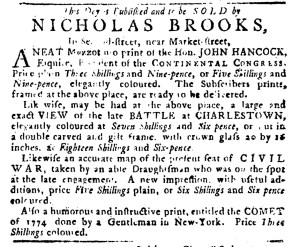
Pennsylvania Journal (November 1, 1775).

“A NEAT Mezzotinto print of the Hon. JOHN HANCOCK.”

“A large and exact VIEW of the late BATTLE at CHARLESTOWN.”

“An accurate map of the present seat of CIVIL WAR.”

Nicholas Brooks produced and marketed items that commemorated the American Revolution before the colonies declared independence.  In an advertisement in the November 1, 1775, edition of the Pennsylvania Journal, for instance, he packaged together three prints previously advertised separately, each of them related to imperial crisis that had boiled over into a war.  For this notice, Brooks presented them as a collection of prints for consumers who wished to demonstrate their support for the American cause by purchasing and displaying one or more of them.

Brooks announced that a “NEAT Mezzotinto print of the Hon JOHN HANCOCK, Esquire, President of the CONTINENTAL CONGRESS,” that had previously been proposed in other advertisements had been published and was now for sale at his shop on Second Street in Philadelphia.  The subscribers who had reserved copies in advance could pick up their framed copies or arrange for delivery.  Others who had not placed advanced orders could acquire the print for three shillings and nine pence or pay two extra shillings for one “elegantly coloured.”

“Likewise, may be had at the above place,” Brooks reported, “a large and exact VIEW of the late BATTLE at CHARLESTOWN,” depicting what has become known as the Battle of Bunker Hill.  This print competed with an imitation bearing a similar title, “a neat and correct VIEW of the late BATTLE at CHARLESTOWN,” that Robert Aitken inserted in the Pennsylvania Magazine and sold separately.  Brooks, who had long experience selling framed prints, offered choices for his “exact VIEW.”  Customers could opt for an “elegantly coloured” version for seven shillings and six pence” or have it “put in a double carved and gilt frame, with glass 20 by 16 inches,” for eighteen shillings and six pence.  The eleven shillings for the frame, half again the cost of the print, indicated that Brooks anticipated that customers would display the “exact VIEW” proudly in their homes or offices.

He also promoted “an accurate map of the present seat of CIVIL WAR, taken by an able Draughtsman,” Bernard Romans, “who was on the spot of the late engagement.”  Brooks revised copy from earlier advertisements: “The draught was taken by the most skillful draughtsman in all America, and who was on the spot at the engagements of Lexington and Bunker’s Hill.”  The map showed a portion of New England that included Boston, Salem, Providence, and Worcester.   This print, he declared, was a “new impression, with useful additions,” though he did not specify how it differed from the one he previously marketed and sold.  As with the others, customers had a choice of a plain version for five shillings or a “coloured” one for six shillings and six pence.
Brooks added one more item, “a humorous and instructive print, entitled the COMET of 1774, done by a Gentleman in New-York.”  Did this print offer some sort of satirical commentary on current events?  Or was it unrelated to the prints of Hancock, the Battle of Bunker Hill, and the “CIVIL WAR” in New England?  Whatever the additional print depicted, Brooks made the prints that commemorated the American Revolution the focus of his advertisement, gathering together three items previously promoted individually.  In so doing, he not only offered each print to customers as separate purchases but also suggested that they could consider them part of a collection.  Consumers who really wanted to demonstrate their patriotism could easily acquire all three at his shop.

Slavery Advertisements Published November 1, 1775

GUEST CURATOR: Massimo Sgambati

The Slavery Adverts 250 Project chronicles the role of newspaper advertising in perpetuating slavery in the era of the American Revolution. The project seeks to reveal the ubiquity of slavery in eighteenth-century life from New England to Georgia by republishing advertisements about enslaved people – for sale as individuals or in groups, wanted to purchase or for hire for short periods, runaways who liberated themselves, and those who were subsequently captured and confined in jails and workhouses – in daily digests on this site as well as in real time via the @SlaveAdverts250 Twitter feed, utilizing twenty-first-century media to stand in for the print media of the eighteenth century.

The project aims to provide modern audiences with a sense of just how often colonizers encountered these advertisements in their daily lives. Enslaved men, women, and children appeared in print somewhere in the colonies almost every single day. Those advertisements served as a constant backdrop for social, cultural, economic, and political life in colonial and revolutionary America. Colonizers who did not purport to own enslaved people were still confronted with slavery as well as invited to maintain the system by purchasing enslaved men, women, and children or assisting in the capture of so-called “runaways” who sought to free themselves from bondage. The frequency of these newspaper advertisements suggests just how embedded slavery was in colonial and revolutionary American culture in everyday interactions beyond the printed page.

These advertisements also testify to the experiences of enslaved men, women, and children, though readers must consider that those experiences have been remediated through descriptions offered by enslavers rather than enslaved people themselves. Often unnamed in the advertisements, enslaved men, women, and children were not invisible or unimportant in early America.

From compiling an archive of digitized eighteenth-century newspapers to identifying advertisements about enslaved men, women, and children in those newspapers to preparing images of each advertisement to posting this daily digest, Massimo Sgambati served as guest curator for this entry. He completed this work as part of the Summer Scholars Program, funded by a fellowship from the D’Amour College of Liberal Arts and Sciences at Assumption University in Worcester, Massachusetts, in Summer 2025.

These advertisements appeared in colonial American newspapers 250 years ago today.

Connecticut Journal (November 1, 1775)

**********

Connecticut Gazette (November 1, 1775)

**********

Maryland Journal (November 1, 1775)

**********

Pennsylvania Gazette (November 1, 1775)

**********

Pennsylvania Journal (November 1, 1775)