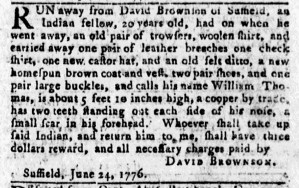
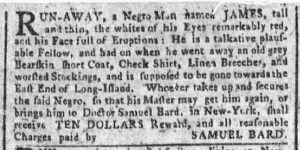
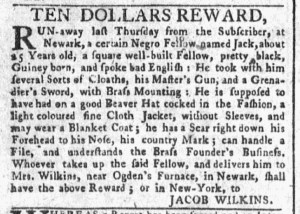
Slavery Advertisements Published July 3, 1776

The Slavery Adverts 250 Project chronicles the role of newspaper advertising in perpetuating slavery in the era of the American Revolution. The project seeks to reveal the ubiquity of slavery in eighteenth-century life from New England to Georgia by republishing advertisements about enslaved people – for sale as individuals or in groups, wanted to purchase or for hire for short periods, runaways who liberated themselves, and those who were subsequently captured and confined in jails and workhouses – in daily digests on this site as well as in real time via the @SlaveAdverts250 Twitter feed, utilizing twenty-first-century media to stand in for the print media of the eighteenth century.

The project aims to provide modern audiences with a sense of just how often colonizers encountered these advertisements in their daily lives. Enslaved men, women, and children appeared in print somewhere in the colonies almost every single day. Those advertisements served as a constant backdrop for social, cultural, economic, and political life in colonial and revolutionary America. Colonizers who did not purport to own enslaved people were still confronted with slavery as well as invited to maintain the system by purchasing enslaved men, women, and children or assisting in the capture of so-called “runaways” who sought to free themselves from bondage. The frequency of these newspaper advertisements suggests just how embedded slavery was in colonial and revolutionary American culture in everyday interactions beyond the printed page.

These advertisements also testify to the experiences of enslaved men, women, and children, though readers must consider that those experiences have been remediated through descriptions offered by enslavers rather than enslaved people themselves. Often unnamed in the advertisements, enslaved men, women, and children were not invisible or unimportant in early America.

These advertisements appeared in revolutionary American newspapers 250 years ago today.
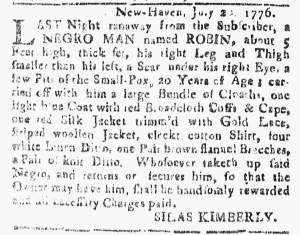
Connecticut Journal (July 3, 1776).

**********

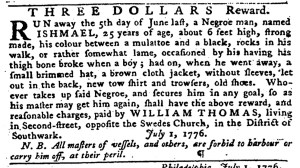
Pennsylvania Gazette (July 3, 1776).

**********

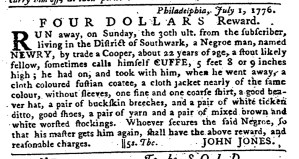
Pennsylvania Gazette (July 3, 1776).

July 2

What was advertised in a revolutionary American newspaper 250 years ago today?

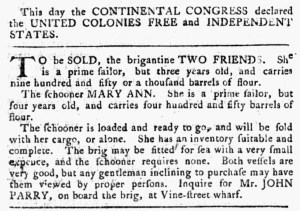
Pennsylvania Evening Post (July 2, 1776).

“TO be SOLD, the brigantine TWO FRIENDS.”

The most significant news from the Continental Congress first appeared in just three lines between an update from Pennsylvania’s Committee of Safety and an advertisement offering a brigantine and a schooner for sale in the June 2, 1776, edition of the Pennsylvania Evening Post.  At the end of the news and before the paid notices, Benjamin Towne, the printer, informed readers that “[t]his day the CONTINENTAL CONGRESS declared the UNITED COLONIES FREE and INDEPENDENT STATES.”  The following day, the Pennsylvania Gazette and the Pennsylvania Journaleach carried the news in their weekly issues, though neither provided many more details.  The Pennsylvania Gazette replicated what appeared in the Pennsylvania Evening Post almost exactly, changing “This day” to “Yesterday” and placing the news first among the updates from Philadelphia but after news from London, Halifax, Charleston, Williamsburg, Watertown (outside of Boston), Providence, and New York.  The Pennsylvania Journal have the news similar treatment, but did note that “the Congress Unanimously Resolved to Declare the UNITED COLONIES FREE AND INDEPENDANT STATES.”

Three newspapers reported that the Continental Congress declared independence before July 4, 1776.  How does that square with the most common narrative about the American Revolution and the long practice of celebrating Independence Day on July 4?  On July 2, the Continental Congress approved the Lee Resolution.  On June 7, Richard Henry Lee, a delegate from Virginia, acting on instructions received from the Virginia Convention, proposed that the colonies declare independence, seek foreign alliances, and form a confederation for their mutual benefit.  The Second Continental Congress did not immediately vote on Lee’s resolution since many delegates were waiting for instructions from their own colonies.  Even though they delayed the vote, they established three committees to work on the elements of the resolution, including a committee to draft a declaration of independence.  On July 2, the Continental Congress approved this resolution: “That these united colonies are and of right ought to be free and independent states; that they are absolved from all allegiance to the british crown and that all political connection between them and the state of great Britain is and out to be totally dissolved.”

The following day, John Adams included the news in a letter to his wife, Abigail.  “The Second Day of July 1776,” he proclaimed, “will be the most memorable Epocha, in the History of America.  I am apt to believe that it will be celebrated, by succeeding Generations, as the great anniversary Festival.  It ought to be commemorated, as the Day of Deliverance by solemn Acts of Devotion to God Almighty.  It ought to be solemnized with Pomp and Parade, with Shews, Games, Sports, Guns, Bells, Bonfires and Illuminations from one End of this Continent to the other from this Time forward forever more.”  Yet history did not work out that way.  On July 4, 1776, the Continental Congress approved a revised draft of a declaration of independence submitted by Thomas Jefferson and the other members of that committee.  The Declaration of Independence then circulated in newspapers and on broadsides, each bearing the date July 4, 1776, the date that became associated with declaring independence.

News that the Continental Congress declared independence was much more substantial than the details of the sale of the brigantine Two Friends and the schooner Mary Ann that appeared immediately below it in the Pennsylvania Evening Post on July 2, 1776, yet such a momentous event has been largely overlooked in the narrative most familiar to the public.  Historians of early America chronicle what occurred, but the importance of July 2 is not widely recognized in the popular memory of the events of the imperial crisis and the American Revolution.

Slavery Advertisements Published July 2, 1776

The Slavery Adverts 250 Project chronicles the role of newspaper advertising in perpetuating slavery in the era of the American Revolution. The project seeks to reveal the ubiquity of slavery in eighteenth-century life from New England to Georgia by republishing advertisements about enslaved people – for sale as individuals or in groups, wanted to purchase or for hire for short periods, runaways who liberated themselves, and those who were subsequently captured and confined in jails and workhouses – in daily digests on this site as well as in real time via the @SlaveAdverts250 Twitter feed, utilizing twenty-first-century media to stand in for the print media of the eighteenth century.

The project aims to provide modern audiences with a sense of just how often colonizers encountered these advertisements in their daily lives. Enslaved men, women, and children appeared in print somewhere in the colonies almost every single day. Those advertisements served as a constant backdrop for social, cultural, economic, and political life in colonial and revolutionary America. Colonizers who did not purport to own enslaved people were still confronted with slavery as well as invited to maintain the system by purchasing enslaved men, women, and children or assisting in the capture of so-called “runaways” who sought to free themselves from bondage. The frequency of these newspaper advertisements suggests just how embedded slavery was in colonial and revolutionary American culture in everyday interactions beyond the printed page.

These advertisements also testify to the experiences of enslaved men, women, and children, though readers must consider that those experiences have been remediated through descriptions offered by enslavers rather than enslaved people themselves. Often unnamed in the advertisements, enslaved men, women, and children were not invisible or unimportant in early America.

These advertisements appeared in revolutionary American newspapers 250 years ago today.

American Gazette (July 2, 1776).

**********

Dunlap’s Maryland Gazette (July 2, 1776).

**********

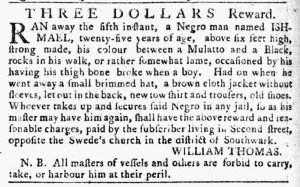
Pennsylvania Evening Post (July 2, 1776).

July 1

What was advertised in a revolutionary American newspaper 250 years ago today?

Dunlap’s Pennsylvania Packet (July 1, 1776).

“PROCEEDINGS OF THE PROVINCIAL CONFERENCE of COMMITTEES, Of the PROVINCE of PENNSYLVANIA.”

The Pennsylvania Provincial Congress met at Carpenters’ Hall in Philadelphia in June 1776.  Delegates from the city of Philadelphia and each of the ten counties in the colony convened on June 18 and adjourned on June 25.  Over the course of a week, the Pennsylvania Provincial Congress reached some momentous decisions.  Newspapers carried updates about the work undertaken and news almost certainly reached even more colonizers via word of mouth, yet those were not the only means of learning about the debates and decisions of the ninety-seven delegates who participated in the congress.

On July 1, William Bradford and Thomas Bradford advertised that they published and sold “PROCEEDINGS OF THE PROVINCIAL CONFERENCE of COMMITTEES, Of the PROVINCE of PENNSYLVANIA,” less than a week after the meeting concluded.  They were so eager to make the record of the Pennsylvania Provincial Congress and its outcomes available to the public that they did not wait to advertise the pamphlet in the next issue of their own newspaper, the Pennsylvania Journal, scheduled for July 3 (though they did also publish the same advertisement in that issue, giving it a prominent place right after news from Pennsylvania’s Committee of Safety).

What decisions did the delegates to Pennsylvania Provincial Congress make?  According to the overview of the sestercentennial commemorations sponsored by Carpenters’ Hall and other cultural, academic, and political institutions in Pennsylvania, they voted to “[d]eclare Pennsylvania’s independence from the British Empire, thus establishing the Commonwealth of Pennsylvania, [m]obilize the Pennsylvania militia for the American Revolutionary War, [and o]rganize elections to select delegates to a constitutional convention, which framed the influential Pennsylvania Constitution of 1776,” a constitution often considered the most democratic of all the state constitutions adopted during the War for Independence.  (For more on the Pennsylvania Provincial Congress, see Carl G. Karsh’s short essay, “Pennsylvania: From Colony to State.”

The Bradfords and many other printers throughout the colonies published, advertised, and sold proceedings of provincial congresses and the Continental Congress.  In so doing, they offered colonizers greater access and more complete coverage of those meetings, reporting not only the outcomes but also the processes and the debates that led to them.  The publication and sale of the Proceedings of the Provincial Conference of Committees, of the Province of Pennsylvania and similar conventions in other colonies helped the public stay informed about current events and perhaps even shaped opinions during the transition from resistance to revolution.

Slavery Advertisements Published July 1, 1776

The Slavery Adverts 250 Project chronicles the role of newspaper advertising in perpetuating slavery in the era of the American Revolution. The project seeks to reveal the ubiquity of slavery in eighteenth-century life from New England to Georgia by republishing advertisements about enslaved people – for sale as individuals or in groups, wanted to purchase or for hire for short periods, runaways who liberated themselves, and those who were subsequently captured and confined in jails and workhouses – in daily digests on this site as well as in real time via the @SlaveAdverts250 Twitter feed, utilizing twenty-first-century media to stand in for the print media of the eighteenth century.

The project aims to provide modern audiences with a sense of just how often colonizers encountered these advertisements in their daily lives. Enslaved men, women, and children appeared in print somewhere in the colonies almost every single day. Those advertisements served as a constant backdrop for social, cultural, economic, and political life in colonial and revolutionary America. Colonizers who did not purport to own enslaved people were still confronted with slavery as well as invited to maintain the system by purchasing enslaved men, women, and children or assisting in the capture of so-called “runaways” who sought to free themselves from bondage. The frequency of these newspaper advertisements suggests just how embedded slavery was in colonial and revolutionary American culture in everyday interactions beyond the printed page.

These advertisements also testify to the experiences of enslaved men, women, and children, though readers must consider that those experiences have been remediated through descriptions offered by enslavers rather than enslaved people themselves. Often unnamed in the advertisements, enslaved men, women, and children were not invisible or unimportant in early America.

These advertisements appeared in revolutionary American newspapers 250 years ago today.

Boston-Gazette (July 1, 1776).

**********

Connecticut Courant (July 1, 1776).

**********

Connecticut Courant (July 1, 1776).

**********

New-York Gazette and Weekly Mercury (July 1, 1776).

**********

New-York Gazette and Weekly Mercury (July 1, 1776).

**********

New-York Gazette and Weekly Mercury (July 1, 1776).