
What was advertised in a revolutionary American newspaper 250 years ago today?
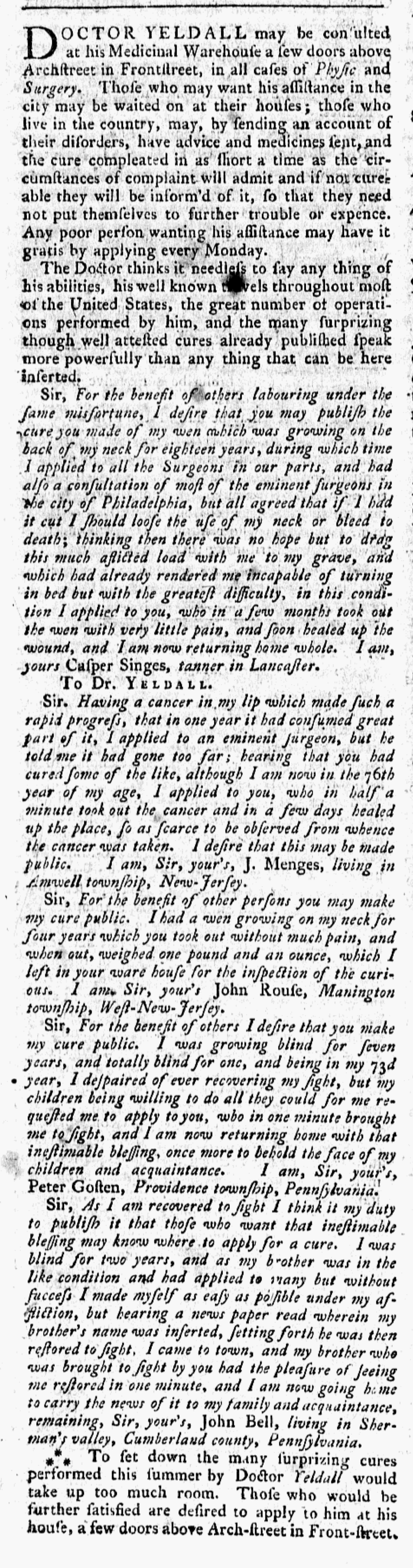
“The many surprizing though well attested cures already published.”
It was a lengthy advertisement, but Anthony Yeldall must have considered it worth the investment. After all, he had been placing similar notices in newspapers in Philadelphia and New York for more than a year. His latest advertisement filled most of a column on the final page of the November 23, 1776, edition of the Pennsylvania Ledger. When it appeared in the previous issue, it occupied an entire column on the first page (except for a two-line advertisement for “Genuine Keyser’s Pills, To be had of the Printer”) below the masthead.
The advertisement opened with an invitation: “DOCTOR YELDALL may be consulted at his Medicinal Warehouse … in all cases of Physic and Surgery.” If visiting Yeldall as not practical or possible, “[t]hose who may want his assistance in the city may be waited on at their houses” and “those who live in the country, may, by sending an account of their disorders, have advice and medicines sent.” Yeldall pledged that his patients could expect “the cure completed in as short a time as the circumstances of complaint will admit.” If he determined that their “disorders” were “not cure-able” then “they will be inform’d of it, so that they need not put themselves to further trouble or expence.” Like some other physicians seeking to bolster their reputations, he also engaged in philanthropy: “Any poor person wanting his assistance may have it gratis by applying every Monday.”
While that was a nice gesture, prospective patients were already aware of his reputation, at least according to Yeldall. “The Doctor thinks it needless to say any thing of his abilities, his well known travels throughout most of the United States, [and] the great number of operations performed by him.” It was “needless” because “the many surprizing though well attested cures already published speak more powerfully than any thing that can be here inserted.” His previous advertisements featured testimonials from patients and their families, contributing significantly to the length of those notices. Once again, Yeldall opted to incorporate testimonials into his advertisement, this time including five that praised his skill as a physician and the effectiveness of the care he provided. His correspondents included Casper Singes, “tanner in Lancaster,” J. Menges, “living in Amwell township, New-Jersey,” John Rouse, “Manington township, West-New-Jersey,” Peter Goston, “Providence township, Pennsylvania,” and John Bell, “living in Sherman’s valley, Cumberland county, Pennsylvania.” Several of them requested that Yeldall publish their letters of appreciation “For the benefit of others” so they would know where to seek relief for similar ailments. Yeldall considered it “needless” to say more about his abilities because he published so much of what his patients said.
Yet he could have circulated even more stories. “To set down the many surprizing cures performed this summer by Doctor Yeldall,” he declared following the testimonials, “would take up too much room. Nearly a column was enough! “Those who would be further satisfied,” he concluded, “are desired to apply to him at his house” at the same location as his “Medicinal Warehouse.” In his advertisements, Yeldall promoted his skill as a physician by consistently resorting to testimonials from former patients who requested that he publish their stories so “those who want that inestimable blessing may know where to apply for a cure.”