April 9

GUEST CURATOR: Drew Nunnemacher

Who was the subject of an advertisement in a colonial American newspaper 250 years ago today?

New-York Journal (April 9, 1772).

“A Likely young Negro Girl.”

We do not know much about this “Likely young Negro Girl” advertised in the New-York Journal except that she was around 13 years old and had been “brought up in the Country” and not in New York City.  She may have been separated from her mother and other members of her family at a young age.  Even if that was not the case, being sold would separate her from family and friends.  According to Heather Andrea Williams in an article about “How Slavery Affected African American Families,” enslaved people “lived with the perpetual possibility of separation through the sale of one or more family members.”  She also states, “Young children, innocently unaware of the possibilities, learned quickly of the pain that such separations could cost.”  This advertisement was about one girl, but it helps to tell the stories of many more children and their families who were separated because of slavery and the slave trade during the era of the American Revolution.

**********

ADDITIONAL COMMENTARY: Carl Robert Keyes

Like his peers in my Revolutionary America class, Drew had an opportunity to select any newspaper advertisement to examine in greater detail from his week as guest curator of the Adverts 250 Project and the Slavery Adverts 250 Project.  That meant that he selected from hundreds of advertisements for consumer goods and services and dozens of advertisements about enslaved men, women, and children.  In total, he identified sixty advertisements about enslaved people published in newspapers from New Hampshire to South Carolina from April 3 through April 9, 1772.  The vast majority of those ran in newspapers in the Chesapeake and the Lower South, but a significant number of them, like this advertisement for a “Likely young Negro Girl,” appeared in newspapers published in Pennsylvania, New York, and New England.  Drew could have chosen any of those advertisements to research for his entry on the Adverts 250 Project.

I suspect that he decided on an advertisement about an enslaved girl published in New York in part because he and his classmates were dismayed to learn about the extent of slavery in New England and the Middle Atlantic before, during, and after the American Revolution.  They were accustomed to thinking of slavery as a southern institution in the nineteenth century, not an integral part of daily life throughout the colonies during the eighteenth century.  Working on the Slavery Adverts 250 Project, examining entire issues of approximately two dozen newspapers published in the early 1770s, allowed them to witness the reality of slavery in New England, New York, and Pennsylvania.  This advertisement about a “Likely young Negro Girl” was not some sort of exceptional example.  It appeared immediately below another advertisement for a “Likely Negro Man, about 20 years of age.”  The same day, the Pennsylvania Gazette and the Pennsylvania Journal both carried advertisements about enslaved people.  Throughout the week, similar advertisements appeared in the Boston Evening-Post, the New-Hampshire Gazette, the New-London Gazette, and the New-York Gazette and Weekly Mercury as well as in several newspapers in the Chesapeake and the Lower South.  As an instructor, I could have gathered together examples to share with my students, but I believe that examining the primary sources themselves, seeing these advertisements in the context of the newspapers that carried them, more fully testifies to the presence of slavery and enslaved people in early America.

March 20

GUEST CURATOR: Catherine Hurlburt

What was advertised in a colonial American newspaper 250 years ago today?

Connecticut Journal (March 20, 1772).

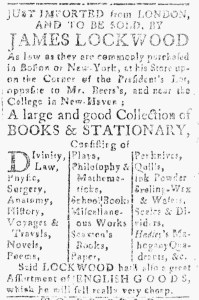
“Penknives, Quills, Ink Powder, Sealing-Wax & Wafers.”

In this advertisement, James Lockwood put up for sale an array of books on various subjects, as well as different writing tools. Lockwood emphasized that these commodities were English, “JUST IMPORTED from LONDON,” which may have been enticing to some colonists. Even though in 1772 the relationship between Britain and the colonies was deteriorating, many colonists still considered themselves to be British, and having English goods was considered a sign of status throughout the colonies, making these goods more desirable.[1]

Today, some readers might find that the writing utensils pique their interest and become curious about writing in the eighteenth century. Colonists mixed their own ink from ink powder and wrote with pens made by sharpening quills with penknives. Lockwood sold all of those items that are so different from the writing tools we use today. Another interesting difference between then and now is the age at which people who learned to write began their lessons. According to Rachel Bartgis, reading education began around age four and lasted until age seven, but writing did not occur until around age nine. This is because writing with a quill took higher fine motor ability than using today’s pen or pencil. In contrast, children learn reading and writing at the same time today. In addition, colonists learned “cursive” because “print,” named after the script on the printing press, was only used for special purposes, such as labelling parcels.

**********

ADDITIONAL COMMENTARY:  Carl Robert Keyes

In the advertisement that Catherine selected to feature today, James Lockwood updated a notice that he first published in the Connecticut Journal more than two months earlier.  He began 1772 by placing an advertisement to advise consumers in New Haven and the nearby towns that he “is now opening, at a new Store, … a great Assortment of English & India GOODS, BOOKS, and all kinds of STATIONARY.”  He pledged that he sold his merchandise “Wholesale or Retail, at least as cheap as any of his Neighbours.”

As Lockwood settled in at his new store, he decided to emphasize his “large and good Collection of BOOKS & STATIONARY” in his next advertisement, mentioning his “great Assortment of ENGLISH GOODS” only after listing the various kinds of books he had in stock.  He did not mention any titles, but instead announced that he carried “Divinity, Law, Physic, Surgery, Anatomy, History, Voyages& Travels, Novels, Poems, Plays, Philosophy & Mathematicks, School Books, Miscellaneous Works, [and] Seaman’s Books.”  Each genre received its own line in a portion of the advertisements divided into three columns.  That made the list easier for readers to peruse and areas of interest more visible to prospective customers.  The unique format also distinguished Lockwood’s advertisement from others on the page.  The third column included the various writing implements that Catherine examined.

Lockwood continued to promote his low prices, though he further enhanced that appeal.  Rather than claiming that he set process “at least as cheap as any of his Neighbours,” he instead looked to competitors in Boston and New York.  Lockwood declared that his customers acquired books, stationery, and “ENGLISH GOODS” from him “As low as they are commonly purchased” in those larger ports.  Prospective customers did not need to travel or send away to merchants and shopkeepers in those cities.  Instead, they could find the best bargains right in New Haven.

Lockwood’s proximity to “the College in New-Haven” (now Yale University) may have inspired him to publish an updated advertisement that focused on books and stationery.  He did not rely on a single newspaper notice to attract customers to his new Store.  Instead, he tried different methods of marketing his wares and generating name recognition among readers of the Connecticut Journal.

**********

[1] T.H. Breen, “An Empire of Goods: The Anglicization of Colonial America, 1690-1776,” Journal of British Studies 25, no. 4 (October 1986): 476.

March 17

GUEST CURATOR:  Matthew Holbrook

What was advertised in a colonial American newspaper 250 years ago today?

Essex Gazette (March 17, 1772).

“A large ASSORTMENT of Hard-Ware GOODS.”

I found that this advertisement interesting because Jacob Ashton owned a shop in Salem, Massachusetts, about 50 miles from my hometown. I connected with this advertisement because my grandfather was a carpenter who owned a small shop and sold similar materials. Jacob Ashton sold a wide variety of hardware and other goods, including nails, case knives, hammers, teaspoons and tablespoons, frying pans, knitting needles, gun powder, cinnamon, brass clocks, and just about anything in between.

In the “Meet the Carpenter” podcast from Colonial Williamsburg, master carpenter Garlin Wood explains what it was like to be a carpenter during the era of the American Revolution. In particular, he describes the differences between different woodworkers. A carpenter focused on the construction of the timber frame. A joiner used similar tools as a carpenter but focused on the finishing of the house, such as panel doors and paneling. A cabinetmaker focused on constructing furniture that belonged inside the house. Garlin describes the importance that carpenters and other woodworkers had in early America. In Colonial Williamsburg, then and now, carpenters built everything by hand and used tools such as chisels and mallets. According to Garlin, many carpenters in early America were savvy businessmen who used their trade to move into the gentry. When it comes to his work as a carpenter, he likes the idea of putting a roof over other people’s heads.

**********

ADDITIONAL COMMENTARY:  Carl Robert Keyes

When I invite students enrolled in my classes to serve as guest curators for the Adverts 250 Project, I am always interested in which advertisements they choose to feature and which aspects of those advertisements they choose to examine in greater detail.  I appreciate that they select advertisements that I might have otherwise overlooked, that they investigate aspects that did not initially resonate for me and, in the process, demonstrate the significance of something that I might have otherwise dismissed, and that they identify a range of sources about early American history.  As guest curators, my students are junior colleagues who help me to continue learning and asking new questions about familiar sources even as I engage in mentoring and teaching them.

That was the case when working with Matt on this entry.  In his absence, I would have chosen a different advertisement in the Essex Gazette, one in which Abraham Cornish offered a guarantee on the fishhooks he made in Boston and pledged to provide two new hooks for each one found defective.  In his role as guest curator, however, Matt determined which advertisement he wanted to examine … and then demonstrated why his choice was just as sound as the one I would have made.  If I had chosen to analyze Ashton’s advertisement for “Hard-Ware GOODS,” I would have focused primarily on the range of choices he offered to consumers and the low prices that he promised.  Matt, inspired by his grandfather, instead opted to examine the kinds of work undertaken by the customers who purchased many of the items listed in Ashton’s advertisement.  He identified the various roles of woodworkers in early America, outlining the contributions of carpenters, joiners, and cabinetmakers.  To do so, he sought information from a public historian who interprets the past through re-creating the experiences of eighteenth-century carpenters at Colonial Williamsburg.  In working on a digital humanities project for his college course about the era of the American Revolution, Matt consulted the expertise of a public historian, demonstrating that no one kind of historian has a monopoly on knowledge about the past.  Matt’s experience as a guest curator, the many ways in which his contribution enhances the Adverts 250 Project, underscores why I believe it is so important to incorporate my own research and digital humanities projects into the classes I teach.

February 27

GUEST CURATOR: Charlotte Hatcher

What was advertised in a colonial American newspaper 250 years ago today?

Postscript to the Massachusetts Spy (February 27, 1772).

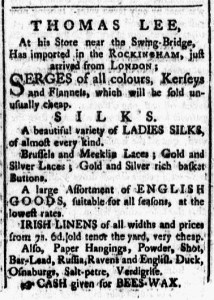
“A large Assortment of ENGLISH GOODS.”

Thomas Lee sold many fabrics and other household goods from his shop “near the Swing-Bridge” in Boston in 1772. This advertisement originally caught my eye due to the “ENGLISH GOODS” he advertised. After the Townshend Acts placed duties on glass, lead, paper, paints and tea in 1767, many colonists used social pressure to boycott goods imported from England. In a broadside issued by the town clerk of Boston in late October 1767, the notes about a town meeting listed items that colonists agreed to boycotted out of protest.  Residents of the town of Boston, according to the broadside, were encouraged to “take all prudent and legal Measures to encourage the Produce and Manufactures of this Province, and to lessen the Use of Superfluities” imported from England. The list of boycotted goods included many items that Thomas Lee advertised less than five years later. Colonists quickly resumed buying those goods as soon as Parliament repealed the duties on most of the items in the Townshend Acts and even though Parliament did not repeal the duty on tea.

**********

ADDITIONAL COMMENTARY: Carl Robert Keyes

Not surprisingly, we spend a lot of time examining the consumer revolution of the eighteenth century in my Revolutionary America class.  Understanding changing consumption habits provides important context for understanding political participation during the imperial crisis that eventually resulted in thirteen colonies declaring independence.  I challenge my students to think about political participation broadly, not just as voting or serving in a colonial legislature.  We discuss various ways that everyday activities, including shopping, became political statements.  Colonizers could not remain neutral when they made decisions about consumption.  They either supported colonial liberties by choosing not to purchase imported goods or they supported Parliament by ignoring the nonimportation agreements adopted by their fellow colonizers.  Merely thinking about consumption forced colonizers to think about the political implications as well the repercussions they faced from friends and neighbors for the decisions they made.

That meant that colonizers of various backgrounds participated in politics.  Affluent colonizers chose whether to curtail extravagant consumption habits, yet colonizers of more humble means also made decisions about whether to make purchases.  Men considered the politics of consumption, as did women who desired the “beautiful variety of LADIES SILKS” that Thomas Lee and other shopkeepers advertised in the 1760s and 1770s.

That political participation, as Charlotte notes, was not a steady crescendo.  By the time that Lee placed his advertisement for “ENGLISH GOODS, suitable for all seasons,” colonizers already enacted nonimportation agreements twice and then eagerly resumed consuming imported goods as soon as Parliament met their demands, first in response to the Stamp Act and later in response to the Townshend Acts.  Indeed, colonizers were so eager to once again gain access to imported goods and merchants and shopkeepers were so eager to resume business as usual that the nonimportation agreements enacted in response to the Townshend Acts lapsed even though duties on tea remained in place.  Some colonizers objected, encouraging their communities to continue the boycotts until they achieved all of their goals, but the pull of commerce and consumption was so strong among the majority of colonizers that the most strident advocates of defending colonial liberties managed to delay the resumption of trade and consumption only briefly.  Colonizers adjusted how they interpreted the politics of consumption in the wake of new developments on several occasions.


February 20

GUEST CURATOR:  Blue Gabriel

What was advertised in a colonial American newspaper 250 years ago today?

Massachusetts Spy (February 20, 1772).

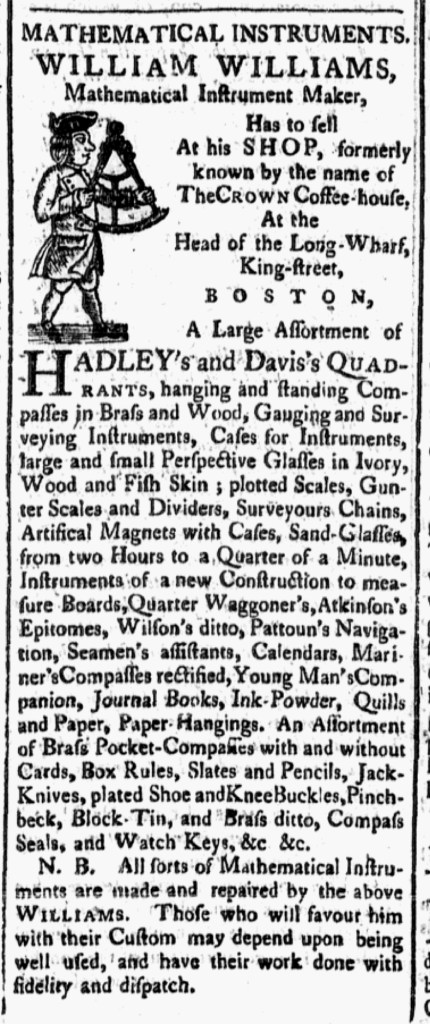
“All sorts of Mathematical Instruments are made and repaired by the above WILLIAMS.”

As I read through all of the newspapers for my week as guest curator, I aw advertisements for perishable goods or clothing items such as linens and other fabrics. This advertisement for “MATHEMATICAL INSTRUMENTS” caught my eye because it was so different. I became more and more interested in in this “Mathematical Instrument Maker” and his life during the eighteenth century.

William Williams started making and repairing mathematical instruments and clocks in 1770, according to Silvio A. Bedini. His shop was called “The Little Admiral” because of a carved figure that marked its location. Bedini notes that Williams served in the American Revolution “as a private in Captain Mills’ company, of Col. Jeduthan Baldwin’s regiment of artificers, during the years 1777-1779.  In 1780 he served in Captain Pattin’s company of General Knox’s artillery, which was stationed at West Point.”[1]

In addition to the mathematical instruments that he made and sold, Williams also sold general goods such as “Journal Books, Ink-powder, Quills and Paper, … and plated Shoe and Knee Buckles.” The nonimportation agreement adopted by the town of Boston on August 1, 1768, restricted importing British goods in response to the duties that Parliament placed on some goods. When the nonimportation agreement ended, Williams sold imported goods.  Shopkeepers, artisans, and other colonists wanted to participate in the consumer revolution.

**********

ADDITIONAL COMMENTARY:  Carl Robert Keyes

One of my favorite parts of inviting students in my classes to serve as guest curators for the Adverts 250 Project is seeing which advertisements they select, what part of each advertisement they choose to research in greater detail, and the sources they consult in their research.  Blue decided to focus on the biography of the advertiser, William Williams, just as Dillon Escandon did in an advertisement placed by Henry Knox, a bookseller, featured on the Adverts 250 Project a week ago.  Williams and Knox may have crossed paths in Boston prior to the American Revolution.  Blue determined that they did indeed have a connection at West Point in 1780.

Between them, Blue and Dillon researched three people mentioned in their advertisements:  Henry Knox, William Williams, and Captain Cazneau.  Their research yielded some interesting insights about how much we can learn about the advertisers whose names appeared in the pages of eighteenth-century newspapers.  Dillon had little difficulty finding information about Henry Knox, a bookseller who became a prominent general in the Continental Army and the first Secretary of War after the American Revolution.  It took a bit more work for Blue to locate biographical information about William Williams, the mathematical instrument maker.  Their research led them to a bulletin about Early American Scientific Instruments and Their Makers written by Silvio A. Bedini, curator of mechanical and civil engineering at the Smithsonian Institution, and published in 1964.  Williams was one of just over a dozen instrument makers with brief biographies in Bedini’s bulletin.  That bulletin is now available via Project Gutenberg.  Captain Cazneau was the most elusive of the people mentioned in the advertisements Blue and Dillon examined.  Dillon managed to find references to the captain in correspondence between Thomas Digges and John Adams, but very little information compared to what Bedini’s bulletin provided about Williams.  The National Archives provided access to a transcription of the letter from Digges to Adams.

Between them, Blue and Dillon demonstrated the possible outcomes of researching eighteenth-century advertisers and the people mentioned in their newspaper notices.  For some of them who achieved fame or influence, including Henry Knox, historians and scholars have already compiled extensive biographies.  Others, like Captain Cazneau, remain obscure.  Even with painstaking research, it may not be possible to recover significantly more information about Cazneau.  William Williams falls somewhere in the middle.  An historian and curator consulted a variety of primary sources, including multiple newspaper advertisements, to piece together a brief biography.  From my perspective as the instructor for Blue and Dillon’s Revolutionary America class, that may have been the most interesting case because Bedini succinctly demonstrated both how much we can learn about this mathematical instrument maker and how many different kinds of primary sources contributed to the biography he constructed.

**********

[1] Silvio A. Bedini, Early American Scientific Instruments and Their Makers (Washington, DC: Smithsonian Institution, 1964), 95.

February 13

GUEST CURATOR: Dillon Escandon

What was advertised in a colonial American newspaper 250 years ago today?

Massachusetts Gazette and Boston Weekly News-Letter (February 13, 1772).

“BOOKS … which have just been received in the Paoli, Capt, Cazneau.”

This advertisement struck me particularly because I have always been curious about what kinds of books people read during the era of the American Revolution. Henry Knox listed books of divinity, surgery, sea books, and bibles. The source of the books also caught my attention. Many of the books were recently shipped in the Paoli by Captain Cazneau.

I wanted to learn more about the people mentioned in this advertisement, Henry Knox and Captain Cazneau. I learned that Henry Knox lived in Boston and worked as a bookseller before joining the Continental Army and participating in the siege of Boston. He ultimately became a member of George Washington’s cabinet as the first Secretary of War for the United States.  I did not locate as much information about Captain Cazneau.  In my research, I found a letter from June 8, 1780, written by Thomas Digges to John Adams that mentioned a “Capt. Cazneau” and a voyage to Ireland during the American Revolution.  Cazneau delivered “four Louis D’ors” to Digges to pay one of Adams’s debts.  I did not find out as much about his role in the American Revolution as I did about Henry Knox.

**********

ADDITIONAL COMMENTARY: Carl Robert Keyes

I often tell my students that being an historian is similar to being a detective.  Reconstructing the past requires searching for clues in a variety of places, both primary sources and secondary sources.  Especially when consulting primary sources, historians sift through many, many items to determine which provide helpful clues and which do not.  It is a laborious and time-consuming process.  In the end, we do not always uncover all the clues that we want or need to offer a complete explanation of what happened.

Dillon had that experience in his effort to learn more about the people mentioned in the advertisement he selected.  When he embarked on his research, he consulted both primary sources and secondary sources, distinguishing his approach from the work undertaken by most students in my Revolutionary America class working on their own contributions to the Adverts 250 Project.  Working with eighteenth-century newspapers gave them an opportunity to consult primary sources from the era of the American Revolution.  After selecting their advertisements, each student needed to identify at least one additional source that helped them provide historical context as they explained what we might learn about the past from newspaper advertisements.  In most instances, students chose secondary sources to aid in analyzing their advertisements.  That presented many opportunities for discussing what constituted authoritative and reliable sources.

When Dillon went in search of primary sources, his research prompted a different conversation about the challenges of “doing” history.  He found a reference in a letter to John Adams to a “Capt. Cazneau” that might have been the same “Captain Cazneau” in Henry Knox’s advertisement published nearly a decade earlier.  Dillon identified a tantalizing clue, but one that requires much more research and consulting many more documents than the scope of the project assigned to him for my Revolutionary America class.  In this instance, I did not expect him to tell a complete story about Cazneau’s life and career.  Instead, I considered it valuable for him to have the experience of doing some of that detective work required of historians in order to gain greater appreciation for the research, writing, and revising that goes into crafting the narratives in secondary sources we read and discussed throughout the semester.

February 6

GUEST CURATOR: Declan Dunbar

What was advertised in a colonial American newspaper 250 years ago today?

Massachusetts Gazette and Boston Weekly News-Letter (February 6, 1772).

“IRISH LINNENS.”

This advertisement is about an item that many colonists purchased in the years before the American Revolution. Colonists imported Irish linens as part of what we now call the consumer revolution. In “Baubles of Britain,” T.H. Breen describes how many American colonists sought goods imported from the British Isles as part of the consumer revolution.[1] Those goods, including linens imported from England, Scotland, and Ireland, gave them a sense of camaraderie with Britain at a time when most colonists were proud to be subjects of the British Crown. In “The British Linen Trade with the United States in the Eighteenth and Nineteenth Centuries,” N.B. Harte states, “[T]he American colonies up to the revolution provided the bulk of the export market for English linens. It is difficult to dis-entangle re-exports of Scottish and Irish linen through London and exports of English Linen.”[2] In this advertisement, William Beatty declared that he imported Irish linens “from the Manufacturers at BELFAST, in the North of Ireland” as part of the larger market that connected the British Isles and the American colonies.

Not only did American colonists depend on England, Scotland, and Ireland as a source of linens at the time, British merchants depended on the colonies as customers and a main source of their income as well. When the colonists first started to rebel against the British, one of the first items they boycotted was linen and other fabrics from overseas in favor of homespun cloth made in the colonies. The colonists wanted to show Britain how resilient they were, but they also believed that hurting the profits of British merchants would cause them to demand that Parliament repeal duties on imported goods. Colonists used decisions about buying imported linens as economic leverage to achieve political goals. Linens, although they might seem insignificant, contributed a great deal to the economy and were part of the American Revolution.

**********

ADDITIONAL COMMENTARY: Carl Robert Keyes

Declan explores some of the major themes from my Revolutionary America class.  We examine several kinds of protests from the period, including petitions by colonial assemblies, nonimportation agreements by colonial merchants, and demonstrations by colonizers.  We situate nonimportation and nonconsumption agreements within the context of the consumer revolution.  Despite the sense of British identity and close ties to Britain that colonizers experienced when they participated in a transatlantic consumer revolution, that did not prevent them from using trade as a political tool when they believed that Parliament infringed on their rights by imposing duties on certain imported goods.  Although colonizers in America did not benefit from direct representation in Parliament, British merchants did. American colonizers hoped that if they disrupted the marketplace then British merchants would join them in demanding that Parliament repeal the objectionable import duties.

Textiles became an important political symbol in the colonies.  Colonizers produced homespun cloth, usually not of the same quality as imported alternatives.  The quality hardly mattered compared to the symbolism of producing, purchasing, and wearing homespun.  This occurred within what Harte describes as a “dual economy” for linen in the colonies.  “[B]asic linen needs were provided outside the market by the widespread domestic production of homespun coarse linen, while the market was dominated by a range of better-quality (though still low-priced) linens imported from England, Scotland, and Ireland, and imported too from the continent of Europe (especially Germany) via London.”[3]  Embracing homespun, women participated in spinning bees.  College graduates wore suits made of homespun to ceremonies.  Consumers made choices about what to buy … and what not to buy.  All of those activities had political valences, communicating support for nonimportation agreements and opposition to Parliament.  Harte argues that linen “became the most important single commodity shipped across the Atlantic in the eighteenth century.”  That helped to make homespun a powerful symbol, especially in those years that colonizers participated in nonimportation agreements.

**********

[1] T.H. Breen, “‘Baubles of Britain’:  The American and Consumer Revolutions of the Eighteenth Century,” Past and Present 119 (May 1988):  73-104.

[2] N.B. Harte, “The British Linen Trade with the United States in the Eighteenth and Nineteenth Centuries,” Textile Society of America Symposium Proceedings (1990): 19.

[3] Harte, “British Linen Trade,” 15.

February 4

GUEST CURATOR: Alex Devolve

What was advertised in a colonial American newspaper 250 years ago today?

Connecticut Courant (February 4, 1772).

“Wanted Immediately, a number of settlers, to remove and settle … in New Hampshire.”

I have chosen an advertisement about settling a town called Relham in New Hampshire. The reason I chose this advertisement is because the idea of settling and expanding within and outside of the colonial borders was not only part of colonial dreams in the eighteenth century, but was similar to Manifest Destiny in the nineteenth century.

According to the Office of the Historian of the Foreign Service Institute of the United States Department of State, “The settlement of the lands west of the Appalachians brought inevitable tension and conflict between settlers and indigenous peoples” during the years prior to the American Revolution. Colonists’ hopes for expansion seemed to end after the French and Indian War due to the Proclamation Line of 1763, put in place in response to Pontiac’s Rebellion. This move was one of many that sent colonists into a rebellious state.  They believed they were deprived of lands promised to them and that many had died for in the French and Indian War. The colonists’ felt their own interests were not being recognized by Britain. Even in places already settled by colonists, such as New Hampshire, they wanted their own land and opportunities.

This advertisement made me think about how important land was to colonists … and how their desire to create settlements had an impact on the events of the American Revolution and long after, impacting millions of lives.

**********

ADDITIONAL COMMENTARY: Carl Robert Keyes

When they enter my Revolutionary America class, most students attribute the cause of the Revolution to “taxation without representation” and events like the Boston Massacre.  That gives us a chance to discuss how that narrative tells an incomplete story, one that largely leaves out Indigenous peoples and the territories that Britain gained in the Seven Years War.  As Alex notes, many colonizers, including land speculators, had their sights on territory previously claimed by the French.  Neither the British government nor the colonizers, however, took into account the wishes of Indigenous peoples who already inhabited the region.  That prompted an uprising, Pontiac’s War.  Pontiac and his Indigenous allies captured most British forts in the Great Lakes, but not key outposts like Detroit.  The uprising ultimately collapsed, but it convinced the British to establish the Proclamation Line in hopes that forbidding westward expansion would prevent further turmoil in the region.  Colonizers promptly ignored the Proclamation Line, except to add it to a list of grievances that spurred them to declare independence.

Starting our examination of the era of the American Revolution with the outcome of the Seven Years War and the repercussions of Pontiac’s War makes sense chronologically, but, more significantly, it also introduces settler colonialism as an important theme for understanding the founding of the nation.  As we consider events from 1763 to 1815 – before, during, and after the Revolution – we assess the extent that European colonizers and, later, American citizens sought to displace Indigenous Americans.  This requires broadening the geographic scope of traditional narratives of the American Revolution.  We do not focus solely on events in the thirteen colonies on the Atlantic coast. To aid in that endeavor, we work our way through Tiya Miles’s The Dawn of Detroit: A Chronicle of Slavery and Freedom in the City of the Straits.  Miles tells the story of Detroit and the Great Lakes between 1760 and 1815, allowing us to move back and forth between the coast and the interior.  She carefully recovers and incorporates the experiences of Indigenous people, enslaved and free, and Black people, enslaved and free, as well as French and English colonizers and American citizens.  As my students and I discuss the political philosophy and the grievances against the king in the Declaration of Independence or the events that caused the War of 1812, often considered a second war for independence, we take into account settler colonialism within the thirteen colonies that became a new nation and in territories coveted and claimed by those colonizers and that nation.

Alex selected an advertisement that contributed to those discussions.  Settler colonialism continued within the colonies in the early 1770s as colonizers responded to advertisements about “remarkable rich” land, moving from Connecticut to what would have been considered a frontier in New Hampshire.  This advertisement in the Connecticut Courantproclaimed that “inhabitants are removing fast from this and the other colonies” to settle towns and possess land in territory already claimed by colonies.  Examining settler colonialism during the era of the American Revolution helps us achieve a better understanding of the past than we achieve if we just retell the familiar story of “taxation without representation” and the Boston Massacre.

January 25

GUEST CURATOR:  Mike Butkus

Who was the subject of an advertisement in a colonial American newspaper 250 years ago today?

South-Carolina Gazette (January 25, 1772).

“RUN AWAY … A Negro Man, named SAUL … and a [Woman] named CHARLOTTE, with a Male Child.”

This advertisement is interesting because it shows us how slave owners viewed their slaves during the era of the American Revolution. The advertiser gave physical descriptions of Saul and Charlotte.  He also mentioned that Saul spoke “very proper English,” making a distinction between him and the many slaves criticized for not speaking “proper English.” The advertiser uses the term “wench” to describe Charlotte. That the dehumanization of female slaves specifically.

This advertisement also included details about Saul and Charlotte’s experiences.  They did not escape on their own.  They took their baby, “a Male Child … about eight Months old,” with them.  This may have been the determining factor for them to “RUN AWAY” from the advertiser. They probably did not want their baby to grow up to the same fate that they did.

The rewards for Saul, Charlotte, and their baby are also interesting.  The amount offered for Saul was ten pounds, while Charlotte and the child were together listed at ten pounds. It makes sense that Saul had a higher reward than Charlotte because he had a valuable skill.  He was a cooper, a barrel maker, and Charlotte was a seamstress.  Saul’s skill was probably more lucrative for the advertiser, even though she was “an extraordinary seamstress.”

According to Arlene Balkansky, “The vast majority of those who escaped or attempted to escape enslavement in America were never well-known.”  Instead, the “only record we have for many are fugitive slave ads,” like this one for Saul, Charlotte, and their baby.

**********

ADDITIONAL COMMENTARY:  Carl Robert Keyes

Mike and his fellow guest curators in my Revolutionary America class had several responsibilities.  Each of them compiled a digital archive of newspapers from a particular week in 1772, examined those newspapers to identify advertisements that belong in the Slavery Adverts 250 Project, composed the tweets distributed via the project’s Twitter feed, and wrote an essay about what they learned about slavery in the era of the American Revolution from the work they did as guest curators.  In addition, each guest curator selected an advertisement to feature on the Adverts 250 Project.  Most chose advertisements for consumer goods and services, but I also approved advertisements about enslaved men, women, and children.

Doing so gave guest curators like Mike an opportunity to examine one advertisement in greater detail than was possible in the tweet about that advertisement.  Mike composed tweets for more than sixty advertisements, but each tweet was limited to 280 characters.  Each had to include the tagline that explained one of the purposes of the project (“Colonial newspapers contributed to the perpetuation of slavery”), an illustrative quotation, and a citation that listed the newspaper and date.  The length of the tagline and citations (especially for advertisements from newspapers with longer titles) required Mike and other guest curators to select the most salient details to include in the quotations, but that also meant that they could not include everything of significance.

In choosing this advertisement about Saul, Charlotte, and their child to feature on the Adverts 250 Project, Mike had an opportunity to examine their experiences in greater depth.  He noted some of the aspects of Saul and Charlotte’s experience that consistently appeared in advertisements about enslaved people who liberated themselves published in the eighteenth century.  Enslavers often commented on linguistic ability, as the advertiser did in noting that Saul spoke “very proper English.”  Advertisements about enslaved people also document that they possessed a variety of skills and pursued all sorts of occupations.  Saul and Charlotte, a cooper and a seamstress, were not unique; newspaper advertisements reveal that countless enslaved men and women pursued occupations far beyond agricultural labor.  Perhaps most importantly, these advertisements provide glimpses of how enslaved men and women thought about their experiences, though that certainly was not the intention of the enslavers who placed these notices.  As Mike notes, offering their child a life outside the confines of bondage may have convinced Saul and Charlotte to liberate themselves when they did.

January 20

GUEST CURATOR:  Kelly Blecker

What was advertised in a colonial American newspaper 250 years ago today?

Supplement to the Boston-Gazette (January 20, 1772).

“Snake Root Waters.”

This advertisement features a wide variety of items for sale by Joseph Hall, including “Snake Root Waters,” an item I found particularly interesting. I had never heard of this before, so I was curious to see what it was and how colonists used it. The snakeroot plant is native to North America. According to George E. Gifford, Jr., in “Botanic Remedies in Colonial Massachusetts, 1620-1820,” snakeroot “had long been used by the Seneca … as a specific in cases of poisoning by the bite of a rattlesnake.” They boiled the plant in water and made a paste, or poultice, which they used to heal rattlesnake bite. “They had inferred this from a supposed resemblance between the root of the plant and the rattle of the snake.” Other uses for snakeroot included treating headache, stomachache, and respiratory problems such as pneumonia and bronchitis. English physicians found using the plant to treat their patients to be highly effective.

The increase in the use of snakeroot waters and other natural remedies showcases how the colonists did not trust European medicine exclusively. Gifford states, “The settlers benefited from the skill of native healers who understood the medicinal value of many indigenous animal and vegetable products.”  As a result, they “establish[ed] an independent tradition of prescribing a specific remedy for a specific ailment. It also caused them to gradually shift from relying on the European schoolmen to depending on the simples and specifics of the old wives, Indians, and ministers.” Colonists adopted knowledge and guidance from Native Americans to create remedies right in North America instead of relying only on patent medicines imported from England.

**********

ADDITIONAL COMMENTARY:  Carl Robert Keyes

Readers of the Boston-Gazette and other newspapers published throughout the colonies regularly encountered advertisements for a vast array of patent medicines produced in England and exported to America.  Apothecaries stocked patent medicines (as we will see in some of the advertisements selected by Kelly’s classmates), but so did merchants and shopkeepers … and even printers!  Patent medicines were the over-the-counter drugs of the eighteenth century, the brands and their uses so familiar that they did not require specialized expertise on the part of purveyors who provided them to colonial consumers.  The producers of many of those patent medicines claimed that their elixirs cured all sorts of maladies rather than targeting specific symptoms and illnesses.

Yet medical knowledge and remedies did not flow in just one direction across the Atlantic, as Kelly demonstrates in her examination of snakeroot.  On both sides of the Atlantic, Europeans embraced knowledge and products derived from the experiences of indigenous peoples.  As Gifford explains, “simple remedies,” like snakeroot, “were quite unlike the complicated nostrums and electuaries of Europe,” those patent medicines, “which sometimes contained up to eighty ingredients.”  Identifying a specific purpose for snakeroot and other flora contributed to a “tradition of prescribing a specific remedy for a specific ailment” instead of relying as extensively on patent medicines that supposedly cured just about any disorder or disease.

Gifford indicates that the “collection, cultivation, and exportation of plant drugs such as ipecac, Virginia snakeroot, and ginseng were of considerable economic significance in the colonies.”  In 1770, for instance, England imported seventy-seven tons of sassafras, used for treating syphilis.  Gifford describes this as part of a “favorable exchange” of ideas as European practitioners incorporated indigenous knowledge into their treatment of patients.  That does not mean that doctors and apothecaries recognized indigenous healers as equal partners in the enterprise, but Europeans on both sides of the Atlantic did benefit from knowledge, experience, and guidance from indigenous Americans.