January 25

GUEST CURATOR:  Mike Butkus

Who was the subject of an advertisement in a colonial American newspaper 250 years ago today?

South-Carolina Gazette (January 25, 1772).

“RUN AWAY … A Negro Man, named SAUL … and a [Woman] named CHARLOTTE, with a Male Child.”

This advertisement is interesting because it shows us how slave owners viewed their slaves during the era of the American Revolution. The advertiser gave physical descriptions of Saul and Charlotte.  He also mentioned that Saul spoke “very proper English,” making a distinction between him and the many slaves criticized for not speaking “proper English.” The advertiser uses the term “wench” to describe Charlotte. That the dehumanization of female slaves specifically.

This advertisement also included details about Saul and Charlotte’s experiences.  They did not escape on their own.  They took their baby, “a Male Child … about eight Months old,” with them.  This may have been the determining factor for them to “RUN AWAY” from the advertiser. They probably did not want their baby to grow up to the same fate that they did.

The rewards for Saul, Charlotte, and their baby are also interesting.  The amount offered for Saul was ten pounds, while Charlotte and the child were together listed at ten pounds. It makes sense that Saul had a higher reward than Charlotte because he had a valuable skill.  He was a cooper, a barrel maker, and Charlotte was a seamstress.  Saul’s skill was probably more lucrative for the advertiser, even though she was “an extraordinary seamstress.”

According to Arlene Balkansky, “The vast majority of those who escaped or attempted to escape enslavement in America were never well-known.”  Instead, the “only record we have for many are fugitive slave ads,” like this one for Saul, Charlotte, and their baby.

**********

ADDITIONAL COMMENTARY:  Carl Robert Keyes

Mike and his fellow guest curators in my Revolutionary America class had several responsibilities.  Each of them compiled a digital archive of newspapers from a particular week in 1772, examined those newspapers to identify advertisements that belong in the Slavery Adverts 250 Project, composed the tweets distributed via the project’s Twitter feed, and wrote an essay about what they learned about slavery in the era of the American Revolution from the work they did as guest curators.  In addition, each guest curator selected an advertisement to feature on the Adverts 250 Project.  Most chose advertisements for consumer goods and services, but I also approved advertisements about enslaved men, women, and children.

Doing so gave guest curators like Mike an opportunity to examine one advertisement in greater detail than was possible in the tweet about that advertisement.  Mike composed tweets for more than sixty advertisements, but each tweet was limited to 280 characters.  Each had to include the tagline that explained one of the purposes of the project (“Colonial newspapers contributed to the perpetuation of slavery”), an illustrative quotation, and a citation that listed the newspaper and date.  The length of the tagline and citations (especially for advertisements from newspapers with longer titles) required Mike and other guest curators to select the most salient details to include in the quotations, but that also meant that they could not include everything of significance.

In choosing this advertisement about Saul, Charlotte, and their child to feature on the Adverts 250 Project, Mike had an opportunity to examine their experiences in greater depth.  He noted some of the aspects of Saul and Charlotte’s experience that consistently appeared in advertisements about enslaved people who liberated themselves published in the eighteenth century.  Enslavers often commented on linguistic ability, as the advertiser did in noting that Saul spoke “very proper English.”  Advertisements about enslaved people also document that they possessed a variety of skills and pursued all sorts of occupations.  Saul and Charlotte, a cooper and a seamstress, were not unique; newspaper advertisements reveal that countless enslaved men and women pursued occupations far beyond agricultural labor.  Perhaps most importantly, these advertisements provide glimpses of how enslaved men and women thought about their experiences, though that certainly was not the intention of the enslavers who placed these notices.  As Mike notes, offering their child a life outside the confines of bondage may have convinced Saul and Charlotte to liberate themselves when they did.

January 20

GUEST CURATOR:  Kelly Blecker

What was advertised in a colonial American newspaper 250 years ago today?

Supplement to the Boston-Gazette (January 20, 1772).

“Snake Root Waters.”

This advertisement features a wide variety of items for sale by Joseph Hall, including “Snake Root Waters,” an item I found particularly interesting. I had never heard of this before, so I was curious to see what it was and how colonists used it. The snakeroot plant is native to North America. According to George E. Gifford, Jr., in “Botanic Remedies in Colonial Massachusetts, 1620-1820,” snakeroot “had long been used by the Seneca … as a specific in cases of poisoning by the bite of a rattlesnake.” They boiled the plant in water and made a paste, or poultice, which they used to heal rattlesnake bite. “They had inferred this from a supposed resemblance between the root of the plant and the rattle of the snake.” Other uses for snakeroot included treating headache, stomachache, and respiratory problems such as pneumonia and bronchitis. English physicians found using the plant to treat their patients to be highly effective.

The increase in the use of snakeroot waters and other natural remedies showcases how the colonists did not trust European medicine exclusively. Gifford states, “The settlers benefited from the skill of native healers who understood the medicinal value of many indigenous animal and vegetable products.”  As a result, they “establish[ed] an independent tradition of prescribing a specific remedy for a specific ailment. It also caused them to gradually shift from relying on the European schoolmen to depending on the simples and specifics of the old wives, Indians, and ministers.” Colonists adopted knowledge and guidance from Native Americans to create remedies right in North America instead of relying only on patent medicines imported from England.

**********

ADDITIONAL COMMENTARY:  Carl Robert Keyes

Readers of the Boston-Gazette and other newspapers published throughout the colonies regularly encountered advertisements for a vast array of patent medicines produced in England and exported to America.  Apothecaries stocked patent medicines (as we will see in some of the advertisements selected by Kelly’s classmates), but so did merchants and shopkeepers … and even printers!  Patent medicines were the over-the-counter drugs of the eighteenth century, the brands and their uses so familiar that they did not require specialized expertise on the part of purveyors who provided them to colonial consumers.  The producers of many of those patent medicines claimed that their elixirs cured all sorts of maladies rather than targeting specific symptoms and illnesses.

Yet medical knowledge and remedies did not flow in just one direction across the Atlantic, as Kelly demonstrates in her examination of snakeroot.  On both sides of the Atlantic, Europeans embraced knowledge and products derived from the experiences of indigenous peoples.  As Gifford explains, “simple remedies,” like snakeroot, “were quite unlike the complicated nostrums and electuaries of Europe,” those patent medicines, “which sometimes contained up to eighty ingredients.”  Identifying a specific purpose for snakeroot and other flora contributed to a “tradition of prescribing a specific remedy for a specific ailment” instead of relying as extensively on patent medicines that supposedly cured just about any disorder or disease.

Gifford indicates that the “collection, cultivation, and exportation of plant drugs such as ipecac, Virginia snakeroot, and ginseng were of considerable economic significance in the colonies.”  In 1770, for instance, England imported seventy-seven tons of sassafras, used for treating syphilis.  Gifford describes this as part of a “favorable exchange” of ideas as European practitioners incorporated indigenous knowledge into their treatment of patients.  That does not mean that doctors and apothecaries recognized indigenous healers as equal partners in the enterprise, but Europeans on both sides of the Atlantic did benefit from knowledge, experience, and guidance from indigenous Americans.

January 9

What was advertised in a colonial American newspaper 250 years ago today?

Massachusetts Gazette and Boston Weekly News-Letter (January 9, 1772).

“Cutlery Ware.”

Chris Barone, a student in my Revolutionary America class in Fall 2021, selected this advertisement that Nathan Frazier placed in the January 9, 1772, edition of the Massachusetts Gazette and Boston Weekly News-Letter.  It prompted a conversation about how the meanings of some words have shifted since the eighteenth century.  Frazier advertised “Cutlery Ware” among his “fresh Assortment of English and Scotch GOODS,” but that phrase did not mean knives, forks, and spoons to the shopkeeper or his prospective customers.

Instead, cutlery referred to “the art or trade of the cutler,” according to the Oxford English Dictionary.  That gave us a chance to discuss the cutler, “one who makes, deals in, or repairs knives and similar cutting utensils,” as a common occupation in the eighteenth century.  It also prompted us to explore the entry for “cutlery” in the Oxford English Dictionary in greater detail.  We learned that the word also refers to “articles made or sold by cutlers, as knives, scissors, etc.”  That definition included an example from 1787, the same period as the advertisement Chris selected.  For other examples, we looked to previous entries in the Adverts 250 Project.  We discovered several advertisements placed by cutlers that listed a variety of items they made, sold, and repaired.  Samuel Wheeler advertised “good scythes and sickles” in the Pennsylvania Gazette in June 1770.  Amos Atwell listed “Case Knives and Forks, Carving Knives and Forks, Pocket and Pen Knives of various Kinds, Razors, [and] Surgeons Instruments” in an advertisement for his “CUTLERY BUSINESS” in the Providence Gazette in 1771.  Bailey and Youle, “Cutlers from Sheffield,” informed the public that they “MAKE all sorts of surgeons instruments” and “grinds all sorts of knives, razors, shears, and scissors” in an advertisement in the New-York Gazette and Weekly Mercury in March 1771.  A month later, Richard Sause ran a similar advertisement that included the same services and added “sword cutling.”  Bailey and Youle included an image depicting about a dozen cutlery items.  Sause again imitated his competitors with a similar image.

The Oxford English Dictionary also includes a definition for cutlery more familiar to modern readers: “knives, forks, spoons, etc., used for eating or serving food; a set of table utensils of this kind.”  That entry includes several examples, though the earliest dates from 1821, half a century after Frazier placed his advertisement.  A note also states that in earlier examples it is difficult to distinguish this meaning from “articles made or sold by cutlers.”  Frazier’s advertisement for “Cutlery Ware” demonstrated that colonizers easily spoke a language of consumption among themselves that requires some effort by historians to understand 250 years later.

January 2

GUEST CURATOR:  Benjamin Andonian

What was advertised in a colonial American newspaper 250 years ago today?

Massachusetts Spy (January 2, 1772).

“WANTED immediately, a Journeyman COMPOSITER.”

This advertisement struck me because it was related to the production of the newspapers we were reading in class.  This advertisement “WANTED immediately” a compositor at a newspaper. I thought it would be interesting to learn about what a compositor is and how this might increase my knowledge of early American newspapers.

The invention of movable type opened the door for a new age of printing in Europe in the 1500s.  That meant new crafts and careers, including compositors. Compositors arranged the letters in advance of them being covered in ink.  Historian Liz Covart describes the job expectations step by step.  The compositor starts with the composition stick, placing letters in proper order.  The placement of letters is done in opposite order, right to left, so they appear right side up and left to right on final edition.  After a quick check to clean up errors, compositors place their work in a chase to be inked up and printed.

I found it very interesting how the printing press offered positions for compositors and others to make the newspapers we read in class and consulted for this project.  Each sentence, letter, and word or punctuation mark was positioned by a compositor like the one sought in this advertisement.  Seeing such a specific job and the steps involved made me think of the process today and the new jobs and careers that the internet has created, like the printing press did in early America.  Lily Talavera expands on this in an article about the booming market for social media jobs.  According to Talavera, “Social media has created a new category of jobs. You may have heard them as social media jobs or with other names relevant to the requested tasks. These jobs are in high demand, and many people already work full-time on social media.”  Innovations in delivering news today have a similar effect on creating new kinds of jobs as an innovation like the printing press had in creating jobs for compositors in the early modern period.

**********

ADDITIONAL COMMENTARY:  Carl Robert Keyes

When I taught a course about Revolutionary America, 1763-1815, in Fall 2021, I once again incorporated the Adverts 250 Project and the Slavery Adverts 250 Project.  I asked each of the twenty-three students in the class to serve as guest curators for those projects.  Each of them was responsible for compiling a digital archive of newspapers originally published during a particular week in 1772.  Then they scoured the newspapers to identify advertisements about enslaved men, women, and children for inclusion in the Slavery Adverts 250 Project.  For each of those advertisements, the guest curators composed tweets that included the project’s tagline, a quotation, and a citation.  For the Adverts 250 Project, each student selected one advertisement to research in greater detail, consulting at least one secondary source by an historian of early America, and then wrote an entry about what they learned and what the advertisement reveals about some aspect of commerce, politics, or daily life during the era of the American Revolution.

Ben is the first of the students from that class to have his work as a guest curator appear on the Adverts 250 Project and the Slavery Adverts 250 Project.  In many ways, it is very fitting that he starts the entries researched and written for that class with one that examines an advertisement about the printing trade.  We devoted a lot of time to discussing print culture, consumer culture, slavery, and their intersections during the era of the American Revolution.  Compositors set the type for the newspapers, broadsides (including the Declaration of Independence), and pamphlets (such as Thomas Paine’s Common Sense) that kept colonizers informed during the imperial crisis and, ultimately, encouraged them to sever their political allegiance to Great Britain.  Compositors also set the type for the countless newspaper advertisements that offered enslaved people for sale or promised rewards for the capture and return of those who liberated themselves from their enslavers.  Liberty and slavery appeared side by side on the pages of newspaper published during the era of the American Revolution.  Compositors also set the type for advertisements for consumer goods as well as essays that critiqued consumption and editorials that advocated nonimportation agreements and promoted “domestic manufactures” as means of exerting economic pressure to achieve political ends.

I invited students to contemplate all of these developments, not only in the abstract but also taking into consideration actual people and their experiences during the era of the American Revolution.  This advertisement for a “Journeyman COMPOSITER” provides a springboard for considering the many themes woven throughout the Revolutionary America class that I designed and that Ben completed.  Throughout the colonies, compositors played a role in presenting news and opinions about current events to the public.  They also played a role in shaping consumer culture and perpetuating slavery.  Beyond their contributions to producing the printed page, compositors made decisions about their own political activities and what kind of society they wanted to emerge from the American Revolution.  That being the case, Ben’s choice of an advertisement to start a new round of entries from guest curators is very fitting indeed.

December 19

GUEST CURATOR:  Colin Wren

What was advertised in a colonial American newspaper 250 years ago today?

Massachusetts Spy (December 19, 1771).

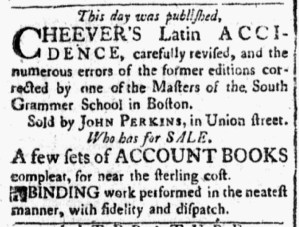
“CHEEVER’S Latin ACCIDENCE, carefully revised.”

Ezekiel Cheever, the author of A Short Introduction to the Latin Tongue, was a Puritan who migrated to New England in 1637. He originally settled in Connecticut before moving to Massachusetts to teach Latin and grammar in the public schools. In 1670 he took the position of Master of the Boston Latin Grammar School which he held until his death in 1708. During his life he was widely loved by his students despite his strict reputation. Under his leadership the school became regarded as one of the best in the colonies and his students included men such as the poet Michael Wigglesworth, Governor Johnathan Belcher, and Judge Samuel Sewall. One year after his death, one of Cheever’s students compiled his teaching notes into a book and published Cheever’s Accidence in 1709. The book was exceedingly popular and became the unofficial standard textbook for teaching Latin grammar in America. In all, twenty-three editions of the book were published, the last of which was published in 1838. While “Latin ACCIDENCE,” as the book was called in this advertisement, was written to teach students Latin, it also taught them the basics of English grammar and helped to formalize definitions that are still taught in schools today.

**********

ADDITIONAL COMMENTARY:  Carl Robert Keyes

Colin selected an advertisement for the fifteenth edition of Ezekiel Cheever’s Short Introduction to the Latin Tongue. Two variants of that edition hit the market in 1771.  In one, the imprint stated, “Printed and sold by Isaiah Thomas, in Union-Street.”  In the other, the imprint declared, “Printed by Isaiah Thomas, for John Perkins, on Union-Street.”  According to the catalogers at the American Antiquarian Society, only the imprints differed between the two volumes.  Perkins most likely placed the advertisement in the Massachusetts Spy since it advised prospective customers that he sold the textbook, as well as a “few sets of ACCOUNT BOOKS,” but did not mention Thomas.

What prompted Thomas to produce variant imprints for the fifteenth edition?  Did Perkins pay to publish only a certain number to carry at his shop, assuming the risk for those copies but not for any others?  If so, did he and Thomas agree in advance that the printer would produce additional copies that omitted Perkins’s name from the imprint?  Or did production take place in the opposite order?  Perhaps Thomas initiated the project, but Perkins recognized an opportunity to profit from a new edition, one with significant improvements.  The advertisement did underscore that the volume had been “carefully revised, and the numerous errors of the former editions corrected by one of the Masters of the South Grammer School in Boston.”

Whatever the order of publication of the variants, Perkins turned to Thomas when he set about marketing the book, inserting an advertisement in the newspaper that Thomas published.  Did Perkins have to pay for that advertisement?  Or was advertising part of a more extensive agreement?  Given that Perkins also promoted “BINDING work performed in the neatest manner, with fidelity and dispatch,” the two entrepreneurs, fellow members of the book trades who possessed different skills, may have negotiated several in-kind exchanges that went beyond publishing Cheever’s “Latin ACCIDENCE.”

December 16

GUEST CURATOR:  J. Rioux

Who was the subject of an advertisement in a colonial American newspaper 250 years ago today?

South-Carolina and American General Gazette (December 16, 1771).

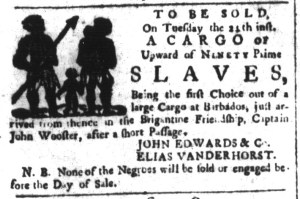
“A CARGO OF Upward of NINETY Prime SLAVES.”

Advertisements in early American newspapers contain some of the most degrading language used towards fellow human beings. On December 16, 1771, the South-Carolina and American General Gazette published a listing for a large group of enslaved people to be sold, likely by auction. John Edwards and Company and Elias Vanderhorst stated, “To be sold … A CARGO of Upward NINETY Prime SLAVES, Being the first Choice out of a large Cargo at Barbados.” This choice of words signals to modern readers that racism was embedded in the United States from the very beginning.

The words “Choice” and “Prime” was often used in regards to goods. In essence, these men, women, and children were being described as objects, as commodities. The language in this advertisement stripped them of their identities, demonstrating that some people were valued less than others. This is contradictory to precious words written during the same era: “We hold these truths to be self-evident, that all men are created equal, that they are endowed by their Creator with certain unalienable Rights, that among these are Life, Liberty and the pursuit of Happiness.” Thomas Jefferson wrote those words less than five years after the men, women, and children in this “CARGO” were deprived of their liberty.

John Cheng, a historian who teaches at George Mason University, declares, “‘Race” explained why Africans were slaves, while slavery’s degradation supplied the evidence for their inferiority.” The repercussions of such ideology continue today as Black Lives Matter and other organizations have emerged to address the ongoing dehumanization that too often takes place in American society.

**********

ADDITIONAL COMMENTARY:  Carl Robert Keyes

Rioux, as he prefers to be called, completed this entry in the spring of 2021 when he enrolled in my research methods class, a course required of all History majors before they take the capstone research seminar in their senior year.  In addition to selecting an advertisement to feature for the Adverts 250 Project, he also served as the guest curator for the Slavery Adverts 250 Project this week.  This advertisement about a “CARGO OF … Prime SLAVES” is one of the sixty-one advertisements about enslaved men, women, and children that appeared in colonial American newspapers from New England to South Carolina during the week of December 12-18, 1771.  His classmates all undertook the same assignments: select one advertisement to feature on the Adverts 250 Project (not necessarily about slavery) and serve as guest curator of the Slavery Adverts 250 Project for a week.  I incorporated the same assignments into my Revolutionary America, 1763-1815, class this semester.

I’m preparing Rioux’s entry for publication and writing my own commentary on the same day that I have devoted many hours to grading final projects for my Revolutionary America course.  Many students confess to some initial trepidation about taking on these responsibilities when I first introduce the projects in class.  After all, these are not the essays that they expected to write in a history class.  Like Rioux, however, they become proficient at using databases of digitized eighteenth-century newspapers, identifying advertisements that belong in the project, and placing them in historical context.  That they examine so many advertisements about enslaved men, women, and children certainly has an impact, much more than when I supplied representative examples for consideration during lectures and discussion.  Encountering the advertisements in the original sources, seeing their frequency and their proximity to other contents of early American newspapers, helps my students understand the ubiquity of notices presenting enslaved people for sale or offering rewards for the capture and return of those who liberated themselves.  When they do the research themselves, it becomes impossible for my students not to recognize how entrenched slavery was in everyday life throughout the colonies during the era of the American Revolution.  Books, articles, and lectures make the same point, but many of my students report that it becomes more real when they see it for themselves as they examine newspapers from the period.  This also allows them to reach their own conclusions as they test the arguments made by historians against what they find in original sources from early America.

December 7

GUEST CURATOR:  Samantha Rhodes

Who was the subject of an advertisement in a colonial American newspaper 250 years ago today?

Providence Gazette (December 7, 1771).

“A LIKELY NEGRO GIRL … that understands … Spinning.”

During the era of the American Revolution, Matthew Allen of Barrington, Rhode Island, placed an advertisement offering “A LIKELY NEGRO GIRL” for sale. Allen stated that the enslaved young woman “understands all Kinds of Houshold Work.” In particular, she was familiar with spinning. That young woman spun wool on a spinning wheel, perhaps contributing to the revolutionary cause even as she remained enslaved.  In The Age of Homespun, Laurel Thatcher Ulrich argues that women “played a critical role” during the “decades of resistance leading up to the War of Independence.”  When “Americans throughout the colonies began boycotting the importation of British goods in protest of increased taxation on everyday items,” women participated in spinning bees.  Ulrich declares, “One writer described the Daughters of Liberty at Newport, Rhode Island, ‘laudably employed in playing on a musical Instrument called a Spinning Wheel, the Melody of whose Music, and the beauty of the Prospect, transcending for Delight, all the Entertainment of my Life.’”  What did the sound of the spinning wheel mean to the enslaved woman in this advertisement?  She may not have experienced the same enthusiasm.

**********

ADDITIONAL COMMENTARY:  Carl Robert Keyes

Ulrich examines accounts of spinning bees in New England.  Reports about those public demonstrations staged by women received positive coverage in the early American press, celebrating women who devised an appropriately feminine means of making political statements in the wake of the abuses perpetrated by Parliament.  According to Ulrich, “Only six newspaper stories explicitly described the spinners as ‘Daughters of Liberty.’”  Others made reference to “young women,” “the fair sex,” “Daughters of Industry,” and “noble-hearted Nymphs.”  Some writers were even more verbose.  One presented the spinners in Taunton, Massachusetts, as “young Blooming Virgins … with all their Native Beauties of Sixteen.”  Another lauded the spinners who gathered at Daniel Weeden’s house in Jamestown, Rhode Island, asserting that they were “of good Fashion and unexceptionable Reputation.”

The enslaved woman advertised in the Providence Gazette possessed the same skills as the women who participated in the spinning bees, yet, as Samantha notes, spinning likely had a very different meaning for her.  To a young enslaved woman marketed as someone who “understands … spinning,” the noises made by spinning wheels did not resonate with the ideals of freedom and resistance enunciated by white women who attended spinning bees, white observers who witnessed or read about their efforts, and white writers who memorialized their activities.  This form of domestic labor became a form of political protest for some women in the colonies, but not for every woman.  In private spaces, the enslaved woman in this advertisement may have labored alongside other women who became visible symbols of the American cause when they participated in spinning bees observed by the public.  Her efforts at the wheel may have been part of a chain of production that ultimately resulted in homespun cloth that replaced imported textiles when nonimportation agreements were in effect.  Yet spinning did not hold the same promises of freedom for that “LIKELY NEGRO GIRL” offered for sale in the Providence Gazette that it did for the young women acclaimed in so many accounts that appeared elsewhere in the newspaper.

December 2

GUEST CURATOR:  Elizabeth Peterson

What was advertised in a colonial American newspaper 250 years ago today?

Boston-Gazette (December 2, 1771).

“POTASH Kettles.”

Smith and Atkinson advertised “POTASH KETTLES” and “EUROPEAN and INDIA GOODS” in the Boston Gazetteon December 2, 1771. The combination of potash kettles and imported goods in their advertisement give insight about life during this time. Potash, a chemical compound made from burning trees, was an important commodity produced in colonial America. As William I. Roberts III explains, “Potash, or pot-ashes, as contemporaries called it, was the principal industrial chemical of the eighteenth century, being essential in the production of crown or flint glass, soft soap, various drugs and dyes, and saltpetre.”[1] As Roberts suggests, potash was a very important chemical during this era, one used in many different everyday items.  Colonists produced and exported this commodity. Potash helped colonists make money.  In turn, producing potash helped them participate in the consumer revolution. Colonists used the money they earned from selling a material used to make other goods, like glass and soap, to purchase the imported goods that Smith and Atkinson advertised.

**********

ADDITIONAL COMMENTARY:  Carl Robert Keyes

When selecting an advertisement about potash kettles, Lizzie had several options.  She ultimately chose the advertisement that best illuminated themes from readings and discussions about commerce and consumption in early America in our Research Methods class at Assumption University in Spring 2021.  Smith and Atkinson’s advertisement does indeed demonstrate both production and consumption in eighteenth-century America, distinguishing it from other advertisements about potash kettles that ran in the same issue of the Boston-Gazette.

Note that Smith and Atkinson’s advertisement was nestled between and advertisement for “Pot-Ash Kettles” placed by Benjamin Andrews, Jr., and another for “POT-ASH KETTLES” by Joseph Webb.  Those three notices accounted for most of the middle column on the front page of the December 2, 1771, edition of the Boston-Gazette, prominently placed where readers would likely notice them.  Each advertisement encouraged American industry, noting that the kettles had been cast at forges in several towns in New England.  In turn, buyers would use the kettles to produce potash to export.  As Lizzie notes, they could use the proceeds to participate in the consumer revolution, purchasing the “EUROPEAN and INDIA GOODS” that Smith and Atkinson so prominently promoted in their advertisement.  Andrews also mentioned “a small assortment of English Goods” on hand at his shop, but Smith and Atkinson’s advertisement most visibly establishes the relationship between production and consumption in early America.

Colonists encountered the same advertisement in the Boston Evening-Post and the Massachusetts Gazette and Boston Post-Boy on the same day it ran in the Boston-Gazette.  All three newspapers ran other advertisements by merchants and shopkeepers who listed an array of merchandise – textiles, housewares, hardware – that they imported and sold.  Colonists who acquired their potash kettles from Smith and Atkinson had many other options beyond the “large and general assortment of EUROPEAN and INDIA GOODS” stocked by Smith and Atkinson.  The widespread encouragement to consume imported goods that appeared in advertisements in all three newspapers buttressed Smith and Atkinson’s notice that balanced production and consumption.

**********

[1] William I. Roberts III, “American Potash Manufacture before the American Revolution,” Proceedings of the American Philosophical Society 116, no. 5 (October 1972): 383.


November 21

GUEST CURATOR:  Victoria Ostrowski

New-York Journal (November 21, 1771).

Who was the subject of an advertisement in a colonial American newspaper 250 years ago today?

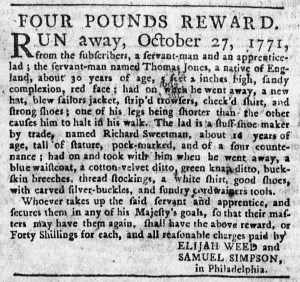
“An apprentice-lad … named Richard Sweetman.”

In the fall of 1771, Elijah Weed and Samuel Simpson placed an advertisement describing two runaways, Thomas Jones, an indentured servant, and Richard Sweetman, an apprentice.  The advertisement mentioned that Sweetman was sixteen years old and learning to be a shoemaker.  This stood out to me because it was so different from the experiences of teenagers today.  At sixteen, most teenagers go to high school before embarking on their jobs.  Some receive vocational training and others go to college.  They do not become apprentices at age sixteen or younger, bound to masters who teach them a trade until they turn twenty-one years old.  According to an article about “Colonial Teenagers,” children “grew into adulthood more quickly than they do today, and by the time a child entered their teen years, they were already on a path toward their life’s occupation.”  In addition, “young men usually learned their trade through some form of apprenticeship.”

**********

ADDITIONAL COMMENTARY:  Carl Robert Keyes

Although he had not yet completed his apprenticeship, Richard Sweetman acquired sufficient skill that Elijah Weed and Samuel Simpson described the runaway as “a stuff-shoe-maker by trade.”  Their advertisement did not elaborate on the reasons that Sweetman fled, but the “sour countenance” that they attributed to him may have been the result of dissatisfaction with the treatment that he received from the master who was supposed to provide training, lodging, food, and other necessities during the time of his apprenticeship.  If Weed or Simpson had been cruel or negligent, Sweetman might have decided to depart.

Weed and Simpson cataloged a variety of items that Sweetman took with him, many of them garments that almost certainly did not belong to him.  He may have taken them with the intention of disguising himself or selling or trading them.  He also carried “sundry cordwainers tools” that he likely stole.  Rather than sell or trade those items, he may have thought that he could support himself by making and repairing shoes once he arrived in a place that he believed that Weed and Simpson would not locate him.

For their part, however, Weed and Simpson cast their net widely.  They resided in Philadelphia, but placed an advertisement in the New-York Journal to alert readers there and throughout the region to keep to keep their eyes open for a runaway apprentice who may have been traveling with an indentured servant with a distinctive walk due to one leg being shorter than the other.  The power of the press worked to their advantage.  Their advertisement did not reveal any of Sweetman’s grievances that might have prompted him to run away, but it did enlist the assistance of readers who could engage in surveillance of strangers they encountered in hopes of detecting the apprentice and earning a reward for his capture.


November 18

GUEST CURATOR:  Kaden McSheffrey

Who was the subject of an advertisement in a colonial American newspaper 250 years ago today?

Boston-Gazette (November 18, 1771).

“Ran-away … a Negro Man Servant named CROMARTE.”

This advertisement from the Boston-Gazette in November 1771 offers a reward for “Negro Man Servant named CROMARTE, commonly called CRUM” who “Ran-away” from Samuel Fitch.  At first, Fitch calls Cromarte a “Negro Man Servant” and does not mention the word “slave.” At the end of the advertisement, however, he calls Cromarte a “Slave for Life” when he warns “Masters of Vessels and others” not to help him. This is interesting because many people are not aware that slavery was present in the northern colonies in the eighteenth century; most people assume that slavery happened only in the southern colonies. It is clear that this is an advertisement about an enslaved man in Boston in 1771. Cromarte’s experience was part of a longer story. According to the Massachusetts Historical Society, “John Winthrop (the founder of Boston) … recorded on 26 February 1638 that the Massachusetts ship Desire had returned from the West Indies carrying ‘some cotton, and tobacco, and negroes, etc.’”  Slavery was part of Massachusetts history from the earliest days of English settlement.

**********

ADDITIONAL COMMENTARY:  Carl Robert Keyes

In Slavery and American History: The Tough Stuff of Memory (2006), James Oliver Horton tells a story of a tourist in Boston shocked to learn about slavery and the slave trade in New England.  “I thought we were better than that,” the tourist lamented.  Reflecting on this encounter, Horton notes that “confronting the contradiction between the American ideal and the reality of American history can be disturbing.”  He continues with an assertion: “The first task for the public historian is to attempt to address popular ignorance of slavery’s diversity, longevity, complexity, and centrality.”[1]  Fifteen years later, historians and others continue to work toward that goal.  They have made some progress, especially in the wake of the 1619 Project, though that work has also met with backlash.

I teach at a regional university.  Most of my students grew up in New England.  They arrive in my classes assuming, as many Americans do, that slavery was limited to southern colonies and states.  When they serve as guest curators for the Adverts 250 Project and the Slavery Adverts 250 Project, they see for themselves the extent that slavery thrived throughout the colonies, including in New England, during the era of the American Revolution.  They do not merely read an article or listen to a lecture about slavery in the region; instead, they encounter accounts of enslaved people repeatedly as they examine newspapers from the period.  My students must grapple with the diversity, complexity, and centrality of slavery in the era of the Revolution, intensively examining a relatively short period does not necessarily address the longevity of slavery in New England.  In doing independent research to identify primary and secondary sources to help him analyze his selected advertisement, however, Kaden incorporated the longevity of slavery in Massachusetts into his work as guest curator, identifying the first documented reference to the sale of enslaved people in the colony more than 130 years before Cromarte, a “Slave for Life,” liberated himself from Samuel Fitch in Boston in the fall of 1771.

**********

[1] James Oliver Horton, “Slavery in American History: An Uncomfortable National Dialogue,” in Slavery and Public History: The Tough Stuff of American Memory, eds. James Oliver Horton and Lois E. Horton (New York: New Press, 2006): 37-38.