Welcome, Guest Curator Grace Crowley

Grace Crowley is a senior double majoring in History and Secondary Education at Assumption University in Worcester, Massachusetts. Her interest in history includes history from the “bottom up,” switching the focus of history to everyday people living through historical events.

On campus, Grace is an active member of the Assumption community. She is an Admissions Ambassador, Orientation Leader, First Year COMPASS Facilitator, and a Student Ambassador for Alumni. She also serves as the Student Leader of the new ASPIRE Program. For the past two summers, Grace has worked as the Student Leader of the Argentinian Summer Exchange Program that Assumption hosts every summer. Grace worked with more than fifty high school students from Argentina and their teachers who came to take classes and immerse themselves in American culture for the month of July.

Grace is also an active member of Hound Sound A Capella, the National Honor Society of Leadership and Success, and Phi Alpha Theta, the National History Honor Society.

In the future, Grace hopes to pursue a career in higher education, focusing on the success of students in their academic lives and beyond. She would also like to visit all of her students in Argentina.

Welcome, guest curator Grace Crowley!

February 14

GUEST CURATOR:  Caroline Branch

What was advertised in a colonial American newspaper 250 years ago today?

Boston-Gazette (February 14, 1774).

“KEYSER’s FAMOUS PILLS … eradicating every Degree of a certain Disease.”

The date of this advertisement for “KEYSER’s FAMOUS PILLS” to treat venereal disease is an ironic one, appearing on Valentine’s Day, but advertisements for these pills ran often. This advertisement displays the fear of venereal diseases throughout Europe and the colonies in the eighteenth century. Doctors agreed that mercury was the way to treat the disease, including Jean Keyser, a French military surgeon. According to Micheline Louis-Courvoisier, many doctors prescribed a mercurial ointment that patients rubbed all over their bodies for about forty days. In contrast, Keyser’s Pills “contain[ed] a combination of mercuric acid and acetic acid.”  The pills were an invention to treat venereal diseases better. In 1761 doctors in Geneva tested the two methods. Louis-Courvoisier states that “following that trial, Keyser pills were considered a good treatment.” They were deemed a success due to the improvement of side effects from previous medications. The pills became a common medication to treat syphilis and other diseases in Europe and the American colonies.

**********

ADDITIONAL COMMENTARY:  Carl Robert Keyes

Keyser’s Pills may very well have been the most popular, or at least the most widely advertised and generally recognized, patent medicine marketed in British mainland North America in the 1760s and 1770s.  Apothecaries stocked the pills, as did shopkeepers and even printers.  The Adverts 250 Project traced the competition among apothecaries and printers in New York and Philadelphia in the fall of 1773.  That competition (or was it a coordinated effort?) continued into the winter of 1774, extending to Boston as well.

Hugh Gaine, the printer of the New-York Gazette and Weekly Mercury, continued advertising Keyser’s Pills in his newspaper in the new year.  To corner as much of the market as he could, he had previously advertised in the Newport Mercury, encouraging prospective customers in Rhode Island to submit orders to “his book store and printing-office, at the bible & crown in Hanover-square” in New York.  When Benjamin Edes and John Gill, printers of the Boston-Gazette, advertised “KEYSER’s FAMOUS PILLS” on February 14, 1774, they lifted the copy for their notice directly from Gaine’s advertisement.  Edes and Gill used the same headline, followed by two paragraphs of identical text (with some variations in capitalization and italics).”  Like Gaine, they declared that declared that the remedy was “So well known all over Europe, and in this and the neighbouring Colonies, for their superior Efficacy and peculiar Mildness,” making note of the less severe side effects that Caroline discusses above.  The format continued to replicate Gaine’s advertisement, with a secondary headline distributed over three lines.  It announced, “THESE PILLS ARE NOW SOLD BY / EDES and GILL, / (In Boxes of 7s6 L.M. each, fresh imported).”  They simply traded out Gaine’s name for their own and converted the price into local currency.  In another paragraph, Edes and Gill claimed that they “have in their Hands a Letter from the Widow KEYSER, and a Certificate from under her own Hand of the Genuineness of the above Pills.”  Apothecaries, shopkeepers, printers, and other purveyors of Keyser’s Pills frequently squabbled over who sold the real remedy and who peddled counterfeits.  Edes and Gill invited “any Person” to have a “Perusal” of the letter and certificate at their printing office, once again replicating and only slightly editing as necessary Gaine’s advertisement.

Printers and others competed to sell Keyser’s Pills, sometimes even appropriating advertising copy devised by their rivals.  Edes and Gill may not have needed to resort to consulting an advertisement from the Newport Mercury published a couple of months earlier when they first ran their own notice on January 31 and again on February 7 and 14.  More recently, Gaine ran the same advertisement in his New-York Gazette and Weekly Mercury, commencing on January 17.  (He resurrected copy that previously appeared in both his own newspaper and the Newport Mercury.)  That allowed enough time for Edes and Gill to receive that issue in Boston.  Perhaps Gaine even franchised out Keyser’s Pills to Edes and Gill to sell in New England, providing them with both pills and copy for their marketing efforts.  Whatever the explanation, readers in New York and New England experienced consistent messaging about a product imported from Europe and sold in several American ports.  That likely contributed to the acclaim the pills earned in the colonies.

February 7

GUEST CURATOR:  Kolbe Bell

What was advertised in a colonial American newspaper 250 years ago today?

Massachusetts Gazette and Boston Post-Boy (February 7, 1774).

“Embellished with a (Quarto) View of the Town of Boston … neatly engraved on Copper.”

The Royal American Magazine was a popular magazine during a run cut short due to the fighting of the American Revolution.  It was first published in 1774 by Isaiah Thomas, a renowned printer who ran the Massachusetts Spy, a newspaper, since 1770.  The Royal American Magazine lasted from January 1774 to early spring of 1775.  Not many successful magazines were started in America before the American Revolution.  Frank Luther Mott states that there were only fifteen magazines published in America before the Royal American started, most of them lasting a year or less.[1]  Isaiah Thomas’s advertisement campaign for the Royal American, however, helped to make it one of the most successful American magazines prior to independence.

The Royal American Magazine was known for having many more engravings than other American magazines at the time; engravings are visual images inserted into a written work, and were made by carefully carving a reverse image onto a copper plate, coating it with ink, and then transferring the image to paper in a printing press.  The engravings representing a “View of the Town of Boston, and a Representation of a Thunder Storm,” as mentioned in this advertisement, enticed more people to subscribe to the magazine.  According to Mott, “its distinctive feature was a little series of engravings by Paul Revere.”[2]  The fact that the advertisement does not include the name of Paul Revere as the engraver for the magazine shows that Paul Revere’s fame increased after the American Revolution.  Despite the Royal American Magazine containing so many engravings and other content, it did not last much longer than a year.  Nevertheless, it was one of the most popular magazines printed in America before the American Revolution.

Visit the “Royal American Magazine Plates,” part of the “Illustrated Inventory of Paul Revere’s Works at the American Antiquarian Society,” to view the engravings and learn more about them.

**********

ADDITIONAL COMMENTARY:  Carl Robert Keyes

Later than he intended (and later than he had advertised), Isaiah Thomas published the first issue of the Royal American Magazine in early February 1774.  The Adverts 250 Project has tracked Thomas’s extensive advertising campaign over many months in 1773 and 1774, including his announcements that he would publish the first issue in January 1774 and an explanation that a ship running aground delayed delivery of the types for the magazine to Boston.  On Thursday, February 3, he inserted a brief notice in his own newspaper, the Massachusetts Spy, pledging that “MONDAY next will be published … NUMBER I. of The Royal AMERICAN MAGAZINE.”  Just as he would do four days later in the advertisement Kolbe examines today, he promoted copperplate engravings of a “View of the Town of Boston, and a Representation of a Thunder Storm.”  Subscribers could leave the engravings intact or, as many likely did, remove them to display in their homes, shops, or offices.

Boston-Gazette (February 7, 1774).

Thomas had aggressively advertised in other newspapers, including several published in Boston.  He once again did so when he finally took the magazine to press.  In addition to the version that ran in the Massachusetts Gazette and Boston Post-Boy on February 7, featured above, he placed a shorter notice in the Boston-Gazette on the same day.  Extending only three lines, it declared, “THIS DAY PUBLISHED, (by I. THOMAS,) Number I. of The Royal American MAGAZINE.”  Perhaps he submitted copy that included the blurb about the copperplate engravings to the printing office only to have the compositors edit it for length to fit on the page with the rest of the news and advertising in that issue.  Whatever the case, Thomas fulfilled the promise he made in the Massachusetts Spy on February 3.  He did indeed publish the Royal American Magazine on the following Monday.  He followed up with much more extensive advertisements in the Massachusetts Spy and the Massachusetts Gazette and Boston Weekly News-Letter on February 10, announcing his success and encouraging more readers to subscribe.

**********

[1] Frank Luther Mott, A History of American Magazines, 1741-1850 (Cambridge: Harvard University Press, 1939), 787-788.

[2] Mott, History of American Magazines, 26.

January 31

GUEST CURATOR:  Madeleine Arsenault

What was advertised in a colonial American newspaper 250 years ago today?

Newport Mercury (January 31, 1774).

“Blue kersey.”

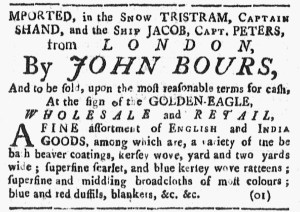
This advertisement offered a shipment from London of “beaver coatings,” fabrics, and blankets. John Bours sold all of these items at a shop that had a golden eagle on the sign. One of the specific items that Bours advertised was kersey, multiple colors of it even. After some research, I found that kersey was a fabric often used in making clothing for enslaved people. Talya Housman, a Ph.D. candidate at Brown University, places kersey with other fabrics in the category of “negro cloth” or “slave cloth.” Not only were these fabrics used to clothe enslaved people, but they were also used as a way “to mark people as enslaved.”

I also learned about slavery in New England.  According to EnCompass: A Digital Sourcebook of Rhode Island History, “Rhode Island did not have the largest absolute number of enslaved people in New England,” but “it had the largest percentage of Africans, nearly all of them enslaved, among its residents.”  In addition, about one half of all the ships in the triangular slave trade came through Rhode Island, making the colony one of the anchors on the American side of transatlantic trade.  Rhode Island and other colonies in New England had more connections to slavery during the era of the American Revolution than I realized before my research.

**********

ADDITIONAL COMMENTARY:  Carl Robert Keyes

Along with her peers in my Revolutionary America class in Fall 2023, Madeleine was responsible for contributing to both the Adverts 250 Project and the Slavery Adverts 250 Project.  Through those projects, readings, and classroom discussions, we all learned more about the ubiquity of slavery throughout the colonies in the eighteenth century, including in New England, New York, Pennsylvania, and other places that most people do not readily associate with slavery.  We examined a history of slavery well known to historians but often forgotten, intentionally overlooked, or stubbornly denied by many people.

In the course of her duties as guest curator for the Slavery Adverts 250 Project this week, Madeleine identified three advertisements about enslaved people that appeared in the January 31, 1774, edition of the Newport Mercury along with Bours’s advertisement.  A notice on the front page offered a “STOUT, healthy Negro” woman for sale.  On the final page, an advertisement seeking to sell a “LIKELY Negro” woman, “who understands all sorts of household work,” ran immediately to the left of Bours’s notice.  Another notice, this one aiming to sell a “VERY likely, hardy NEGRO GIRL, about 15 years old,” or exchange her for a “NEGRO BOY,” appeared at the top of the column that contained Bours’s advertisement.

At first glance, an advertisement for a “FINE assortment of ENGLISH and INDIA GOODS,” including kersey cloth, may not seem to have much to do with slavery in New England.  As she undertook her research, Madeleine made the connections, learning about both textiles used to clothe enslaved people and how the transatlantic slave trade contributed to commerce and consumer culture in Rhode Island before, during, and after the American Revolution.  Bours was not alone in advertising imported goods; John Bell, Samuel Goldthwait, Thomas Green, George Lawton and Robert Lawton, Paul Mumford, and Jonathan Rogers placed similar advertisements.  All of them participated in commercial networks inextricably bound to the transatlantic slave trade.  Eighteenth-century readers knew that was the case.  Advertisements offering enslaved people for sale that appeared alongside notices placed by merchants and shopkeepers served as a very visible reminder.

January 17

GUEST CURATOR:  David Alexander

What was advertised in a colonial American newspaper 250 years ago today?

Boston Evening-Post (January 17, 1774).

TO BE SOLD CHEAP, by Mrs. Sheaffe.”

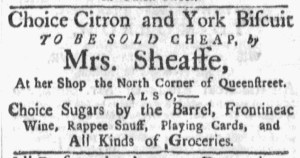
Mrs. Sheaffe placed this advertisement in the Boston Evening-Post.  She ran a shop where she sold a variety of items, including choice citron (referring to citrus fruits), sugar, wine, and “All Kinds of Groceries.” Mrs. Sheaffe ambitiously invested to integrate herself into life as a businessowner as her advertisements appear twice in Massachusetts newspapers during the week of January 14-20, 1774, appearing in both the Boston Evening-Post and the Boston-Gazette. According to Gloria Main in “Gender, Work, and Wages in Colonial New England,” most women in retailing were widows who had taken over a deceased husband’s shop.”[1]  As this woman went by “Mrs. Sheaffe” it is likely that she was a widow and opened her shop to support herself and her family. Mrs. Sheaffe’s investments in advertising her shop in multiple newspapers demonstrates her industriousness and desire to establish herself as a businessowner of Boston. During the Revolutionary Era, the role of women in business extended far beyond just buying goods, many of them acting as retailers themselves.

**********

ADDITIONAL COMMENTARY:  Carl Robert Keyes

David convincingly suggests that Mrs. Sheaffe may have been a widow responsible for supporting herself and perhaps others in her household.  When other female entrepreneurs placed advertisements in newspapers published in Boston, they tended to use their full names, just as their male counterparts did.  Mrs. Sheaffe’s decision to go by “Mrs. Sheaffe” may have been intended to remind those who knew her of her circumstances as a widow.  She may have also meant for that to justify her role in the marketplace as a shopkeeper rather than as a consumer.  Although some women ran businesses, as their advertisements attest, doing so was often depicted as a masculine endeavor, one better suited to men than women.

Mrs. Sheaffe attained a certain level of visibility in Boston, thanks in part to her frequent advertisements.  Other women certainly assisted in running family businesses, even when they were not considered proprietors or mentioned in advertisements.  When Herman Brimmer and Andrew Brimmer advertised “An Assortment of Mens, Womens & Childrens Hose” and other garments in the same edition of the Boston Evening-Post that Mrs. Sheaffe promoted her wares, they sought female customers, recognizing the role that women played as consumers.  Their advertisement, like so many others, may have hidden the role that wives, daughters, and other female relations played in helping to run their shop “next Door to the Sign of the Lamb.”

Other female entrepreneurs did not achieve the same visibility in the marketplace as Mrs. Sheaffe because women were less likely to place newspaper advertisements compared to men who ran businesses.  That same issue of the Boston Evening-Post included a notice calling on “All Persons indebted to the Estate of the late Mrs. Ruth Sinclair, Shopkeeper,” to settle accounts.  According to a list of recent deaths in the December 27, 1773, edition of the Boston Evening-Post, she was the “Widow of the late Capt. Sinclair.”  He died thirteen years earlier, a notice about settling his estate in the August 25, 1760, edition of the Boston-Gazette listing his widow as “sole Executrix.”  Although she was apparently known to residents of Boston as a shopkeeper, Ruth Sinclair did not publish any advertisements.  Instead, she may have relied on foot traffic and recommendations from loyal customers.

Mrs. Sheaffe was not alone as a proprietor of her own business during the era of the American Revolution.  Other women ran businesses and an even greater number participated in the marketplace as more than consumers, assisting in shops run by husbands, fathers, brothers, and others.  Yet Mrs. Sheaffe did make her role as a female entrepreneur much more visible in the public prints than most other women.  Her advertisements testify to what was possible for women, though not usual.

**********

[1] Gloria L. Main, “Gender, Work, and Wages in Colonial New England,” William and Mary Quarterly, 3rd ser., 51, no. 1 (January 1994): 58.

May 29

GUEST CURATOR: Julia Tardugno

What was advertised in a colonial American newspaper 250 years ago today?

New-Hampshire Gazette (May 29, 1772).

“The very best of BOHEA TEA.”

This advertisement immediately struck me because tea was such an important symbol during the time of the American Revolution. Parliament’s taxed tea was through the Indemnity Act of 1767, one of the notorious Townshend Acts. When the Townshend Acts went into place, the colonists were so furious that they resorted to nonimportation agreements in which they no longer purchased goods from Britain. On October 28, 1767, a town meeting took place at Faneuil Hall in Boston to discuss the Townshend Acts and their negative impact on the colonies. A broadside distributed after the meeting said that colonists decided to meet “That some effectual Measures might be agreed upon to promote Industry, Economy, and Manufacturers; thereby to prevent the unnecessary Importation of European Commodities, which threaten the Country with Poverty and Ruin.” This petition to start the nonimportation agreements was voted on unanimously and the residents of Boston listed the items that they vowed not to purchase imported goods. Instead, they would encourage “Manufacturers” in the colonies. That included “Labrador tea.” The colonists felt strongly about implementing the nonimportation agreements at first, but they put an end to the boycotts in 1770 after Parliament repealed most of the taxes on imports. The tax on tea remained. The colonists canceled the nonimportation agreements two years prior to William Elliot’s advertisement about Bohea tea, a popular consumer good. That did not mean that colonists stopped worrying about the taxes on tea. In 1773, they participated in the Boston Tea Party. Tea became an even more important symbol of the American Revolution as a result of the Boston Tea Party, but that is not the whole story.

**********

ADDITIONAL COMMENTARY: Carl Robert Keyes

William Elliot was not alone in marketing tea to readers of the New-Hampshire Gazette in the spring of 1772.  Jeremiah Libbey listed tea alongside two other beverages, coffee and chocolate, in an advertisement that also promoted an “Assortment of ENGLISH GOODS.”  In another advertisement, David Cutler and J. Cutler provided an extensive list of their “General Assortment of GOODS that came in the last Ships from London.”  The groceries they stocked included “Bohea Tea, Coffee, [and] Chocolate.”  John Penhallow published an even more extensive catalog of “GOODS … Just Imported from LONDON.”  Like his competitors, he sold “choice Bohea Tea.”  Colonizers in Portsmouth and other towns had plenty of options when it came to purchasing tea.  Throughout the colonies, merchants and shopkeepers supplemented their other inventory with tea.

The ubiquity of tea makes it an ideal commodity for examining a variety of interlocking topics in my Revolutionary America class.  We discuss trade and commerce; consumer culture and rituals that helped build a sense of community; and boycotts, politics, and protests.  I introduce students to the traditional narrative about tea and taxes, but we also take into consideration details that complicate that narrative.  As Julia notes, colonizers rescinded the nonimportation agreements when Parliament repealed the duties on most imported goods even though the tax on tea remained in place.  Some colonizers advocated for holding firm until they achieved all of their goals, but most merchants wanted to resume trade and bring an end to the disruption in transatlantic commerce.  We examine how women participated in politics as consumers, especially as consumers of tea, when they made decisions about whether they would purchase imported goods.  In October 1774, women in Edenton, North Carolina, formalized their position by signing a petition in which they resolved to boycott tea and other imported goods.  In response, engraver Philip Dawe created a print that critiqued those women who did not seem to know their place … and, by extension, their male relations incapable of exercising proper authority within their households.  We also read Peter Oliver’s account of the “Origins & Progress” of the American Revolution, including his accusation that women devised various strategies for gathering together to drink tea and cheating on the boycott.  In addition, we discuss T.H. Breen’s descriptions of colonizers destroying tea at public gatherings and enforcing compliance with boycotts.  Many students initially view tea as a quaint vestige of the eighteenth century, associating it primarily with the Boston Tea Party.  Throughout the semester, we repeatedly return to tea so they gain a better understanding of the intersection of colonial culture and politics during the era of the American Revolution.

May 26

GUEST CURATOR:  Kelsey Savoy

What was advertised in a colonial American newspaper 250 years ago today?

Essex Gazette (May 26, 1772).

“Every Article in the Apothecary Way.”

Nathaniel Dabney owned a shop called “Head of HIPPOCRATES” in Salem, Massachusetts. In an advertisement from the Essex Gazette on May 25, 1772, Dabney announced he had a “fresh and full Assortment of Drugs, Medicines, Groceries, Instruments,” and more, indicating that he ran an apothecary shop. An apothecary shop in 1772 and modern pharmacies are very similar.  That inspired me to find out more about medicine in the colonies during the eighteenth century.

Individuals who ran apothecary shops, who sold or administered medicines, did not require any education or licensure, nor did physicians. In “Medical Practice in Colonial America,” Whitefield J. Bell, Jr., notes that “only one in nine Virginia physicians of the eighteenth century had attended a medical school.”[1] Physicians and apothecaries often learned from experience instead of formal training.  This began to change in the colonies in 1772, the year Dabney posted this advertisement. Bell details the Medical Society of New Jersey dedicated to getting legislation passed that required physicians to obtain licensure by the courts to practice “after examination by a board of medical men.” The society’s goal was “to discourage and discountenance all quacks, mountebanks, imposters, or other ignorant pretenders to medicine, and not to associate professionally with any except those who had been regularly initiated into medicine.”[2] Requiring training for physicians was an improvement that colonists enacted during the era of the American Revolution.

**********

ADDITIONAL COMMENTARY:  Carl Robert Keyes

Kelsey astutely observes that many eighteenth-century apothecary shops and twenty-first century retail pharmacies have much in common.  Neither of them exclusively carried drugs and medicines, though selling remedies of all sorts gave those establishments their primary identity.  Nathaniel Dabney (or Nathanael Dabney in other advertisements) made that clear when he selected Hippocrates, a physician from ancient Greece widely considered the “Father of Medicine,” to identify his shop.

In his newspaper notice, Dabney commenced the list of merchandise available at “the Head of HIPPOCRATES” with a “fresh and full Assortment of Drugs, [and] Medicines” and cataloged several familiar patent medicines from his “Assortment” of goods.  He sold “Turlington’s original Balsam of Life,” “Bateman’s Pectoral Drops,” “Dr. Walker’s Jesuits Drops,” “Anderson’s and Locker’s Pills,” and “Hooper’s Female [Pills],” as well as other patent medicines less commonly mentioned in newspaper advertisements.  Those nostrums were the over-the-counter medications of the day.  Customers could consult with the apothecary of they wished, just like customers ask pharmacists in retail stores for advice today, but many also selected patent medicines based on their reputation and common knowledge about the maladies they supposedly relieved.

Yet Dabney, like other apothecaries, hawked other goods.  His apothecary shop, like modern retail pharmacies, doubled as a convenience store where customers could acquire groceries, home health care equipment and supplies, and a variety of other items.  In his advertisement, Dabney promoted “Groceries,” including cinnamon, cloves, raisins, and “Flour of Mustard, by the Dozen or single Bottle.”  He also had supplies for the “Clothiers Business” and the “Painters Business,” mostly items for producing colors.  In addition, Dabney sold medical instruments to physicians, a practice not followed by most modern retail pharmacies that focus on providing care to consumers.  All the same, a visit to the Head of Hippocrates in 1772 likely would not have been that much different from a visit to CVS, Rite Aid, or other retail pharmacy today.

**********

[1] Whitfield J. Bell, Jr., “Medical Practice in Colonial America,” Bulletin of the History of Medicine 31, no. 5 (September-October 1957): 444.

[2] Bell, “Medical Practice in Colonial America,” 453.

May 18

GUEST CURATOR:  Alex Ruston

What was advertised in a colonial American newspaper 250 years ago today?

Supplement to the Boston-Gazette (May 18, 1772).

“UMBRILLOES.”

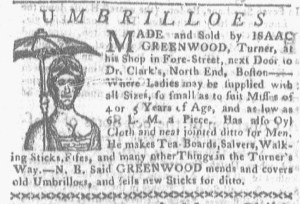
This advertisement features an item that many of us probably take for granted in the twenty-first century.  Umbrellas first appeared in England in the 1760s.  In the eighteenth-century, the umbrella stirred up a lot of social attention.  According to Kate Haulman, “Though large and clumsy by modern standards, the umbrellas of the late eighteenth century were brightly colored items of fashion made of oiled silk, stylistic spoils of empire hailing from India.”  Umbrellas were popular for the upper class, especially women, leading to a lot of controversy surrounding their use.  “Some regarded umbrellas as ridiculous and frivolous, serving no purpose that a good hat could not supply. Others called them effeminate, appropriate only for use by women.”  In this advertisement, Isaac Greenwood of Boston emphasized women and girls as customers for his “UMBRILLOES.”  When umbrellas debuted in colonial America they were a controversial and uncommon accessory that “received positive and negative attention.”[1]

**********

ADDITIONAL COMMENTARY:  Carl Robert Keyes

By the time this advertisement appeared in the Boston-Gazette in the spring of 1772, Isaac Greenwood was already familiar to many of the residents of Boston.  They may have spotted women and girls carrying his umbrellas as they traversed the streets of the city.  Readers of the Boston-Gazette saw his advertisements, many of them featuring a distinctive woodcut that depicted a woman carrying an umbrella.  Greenwood first included that image in an advertisement that ran in the May 20, 1771, edition of the Boston-Gazette.  Over the course of the next year, he periodically ran additional advertisements that featured the woman with the umbrella.

In that time, he sought to expand his clientele by offering even smaller umbrellas for young girls.  In May 1771, he declared that “Ladies may be supplied with all Sizes, so small as to suit Misses of 6 or 7 Years of Age.”  A year later, he revised the copy to state that “Ladies may be supplied with all Sizes, so small as to suit Misses of 4 or 5 Years of Age.”  Eager to sell his product, Greenwood took a position in the debates about umbrellas.  They were appropriate for women and even young girls.

Greenwood was not the only artisan in Boston who advertised that he made and sold “UMBRILLOES.”  In the June 12, 1769, edition of the Boston-Gazette, his advertisement appeared next to one placed by Oliver Greenleaf.  Greenwood gave his customers the option of buying finished products or the supplies to construct their own umbrellas, informing “Those Ladies whose Ingenuity, Leisure and Oeconomy leads them to make their own, [that they] may have them cut out by buying the Sticks or Frames of him.”  In extending that offer, he suggested that umbrellas were not as frivolous as some of the critics claimed.  Rather than luxury items that merely testified to conspicuous consumption, umbrellas made by female consumers had the potential to demonstrate some of the virtues that women possessed.  Since any umbrella could have been made through the “Ingenuity” and “Oeconomy” of the woman who carried it, Greenwood might have intended to reduce critiques of all ladies with umbrellas in an effort to increase sales by making his product less controversial.

**********

[1] Kate Haulman, “Fashion and the Culture Wars of Revolutionary Philadelphia,” William and Mary Quarterly, 3rd ser., 62, no. 4 (October 2005): 632.

May 12

GUEST CURATOR:  Thomas Ross

What was advertised in a colonial American newspaper 250 years ago today?

Essex Gazette (May 12, 1772).

“The handsomest Horse in America.”

This advertisement describes “The famous Bellsize Arabian,” a horse considered “the handsomest Horse in America.” During the eighteenth century, horse racing was a popular sport throughout the colonies. According to Mehmet Samuk, “horse racing was separated by strong lines of class and race.”  In 1674, a court in Virginia fined a tailor who planned a race because horse racing was supposed to be “exclusive to only rich gentlemen.”  Even though that was the official position of the court, horse racing became popular among the general public in almost every colony by the time of the American Revolution.

Rich gentlemen were not the only people who participated in the races. It was not uncommon for the owners of the horses to employ enslaved people, free black people, and poor white people as jockeys. Samuk states that “African Americans eventually emerged as some of the most talented and experienced trainers of racing horses,” another contribution to American commerce and culture beyond working on plantations.

**********

ADDITIONAL COMMENTARY:  Carl Robert Keyes

In addition to the prestige associated with racing horses, some colonizers also sought to earn money by breeding horses with notable pedigrees.  They placed newspaper advertisements offering stallions to “cover” mares.  Such was the case with Amos Mansfield of Danvers, Massachusetts, and an Arabian horse named Bellsize Arabian (or Belsize Arabian, according to the list of “Historic Sires” compiled by Thoroughbred Heritage).  Mansfield placed an advertisement in the May 12, 1772, edition of the Essex Gazette to inform readers that the horse “will cover this Season.”

To incite interest, Mansfield detailed Belsize Arabian’s pedigree.  “He is a Son of the famous Horse called Moresah,” Mansfield declared, “and his Mother is of the best Race that the great Sultan or Emperor Muley Abalah ever had.”  He further explained that Belsize Arabian was “both by Sire and Mother of the best Blood and true Araback Race in all Barbary.”  By 1772, the horse already had a reputation for “covering” mares, first in England and then in New England.  Even if prospective clients were not familiar with all the details in the horse’s pedigree, Mansfield likely expected that the connection to the Sultan of Morocco would resonate with them.  For just “a Guinea a Colt,” colonizers could have Belsize Arabian “cover” their mares.

Mansfield attempted to increase the chances that readers would take note of his advertisement by including an image of a horse.  The woodcut did not depict Belsize Arabian in particular.  Instead, the printer provided a generic image that could have adorned any advertisement about horses.  Nonetheless, it was the only image that accompanied an advertisement in that issue of the Essex Gazette, almost certainly drawing eyes to the pedigree that Mansfield considered so important.  Some customers who engaged the services of Belsize Arabian might have been interested in racing horses, but other may have been content with displaying the offspring of “the handsomest Horse in America.”

May 4

GUEST CURATOR: Tyler Reid

What was advertised in a colonial American newspaper 250 years ago today?

Supplement to the New-York Gazette and Weekly Mercury (May 4, 1772).

“Be cautious, there are many … counterfeit watches … so bad they cannot be rendered useful.”

John Simnet, a clock- and watchmaker, created this advertisement.  It displays a competitive market in 1772. Simnet emphasizes his “Term of Apprenticeship to Mr. Webster, Exchange Alley, London.”  He thought that his qualifications mattered.  He also mentioned his expertise in cleaning watches and fitting glasses. These skills mattered.  In an article about clocks and clockmakers in eighteenth-century Philadelphia, Michelle Smiley states that clockmaking “was considered an intellectual profession requiring great artisanal skill and scientific knowledge.”  In addition, “the mathematical precision and mechanical intricacy of the profession put it at a superior rank to the crafts of blacksmithing and carpentry.”  In his advertisement, Simnet had a big ego about his skill and knowledge, especially being trained in England and voyaging to the colonies.  He also complained about “counterfeit Watches … so bad they cannot be rendered useful.”  He believed that colonists should be careful when buying watches from others because they might end up receiving broken merchandise.  He wanted customers to think of him as reliable, as someone who sold only good watches that worked well.  According to his advertisements, they could trust him because of his training in England.

**********

ADDITIONAL COMMENTARY:  Carl Robert Keyes

When students in my classes submit their proposed advertisements for approval before moving to the research and writing phases of contributing the Adverts 250 Project, I often recognize the advertisers because I have already perused the newspapers to identify which notices belong in the Slavery Adverts 250 Project.  I did not simply recognize the advertiser that Tyler selected for his entry.  Instead, John Simnet has become very familiar to me over the past three years as I have traced his advertisements in the New-Hampshire Gazette in 1769 and 1770 and then in newspapers published in New York in the early 1770s.  I consider Simnet the most notorious of the advertisers featured on the Adverts 250 Project because he regularly disseminated negative advertisements that demeaned his competitors as much as they promoted his own skill, expertise, training, and experience.  In both Portsmouth and New York, he participated in bitter feuds with competitors in the public prints, sometimes demeaning character as well as their abilities.

Tyler was not yet familiar with Simnet when he selected this advertisement, one of several variations that Simnet published in the New-York Gazette and Weekly Mercury and the New-York Journal in the spring of 1772.  He chose it because the headline for “WATCHES” caught his interest.  He wanted to learn more about clock- and watchmakers in early America.  This presented an opportunity for me to once again dovetail my teaching and my research, a pedagogical moment that could not be planned in advance when inviting students to select any advertisements they wished to feature.  They usually focus on a single advertisement, an appropriate approach for students working this intensively with primary sources for the first time.  They make all sorts of connections between their advertisements and commerce, politics, and daily life in eighteenth-century America.  Yet we have fewer opportunities to examine the advertisers and their marketing campaigns.  When Tyler chose Simnet’s advertisement from among the hundreds that he might have selected from the first week of May 1772, that gave all the students in my Revolutionary America class a chance to hear more about the clock- and watchmaker’s long history of placing cantankerous advertisements that deviated from the norms of the period.  This context better humanized Simnet, even if it did not make him particularly likeable.  Each advertisement represents a snapshot of a particular moment in the past, but I also underscored the value of examining multiple advertisements, placed over weeks or even years, as a means of constructing an even more robust understanding of the experiences of the advertisers and their world.